How Do You Choose an NTC Temperature Sensor for HVAC?
Choose an NTC temperature sensor for HVAC by matching its resistance–temperature curve to the controller, then matching its construction to the measurement location. An air-temperature probe, an evaporator sensor and a pipe-mounted sensor have different installation requirements, even when their nominal resistance is identical. Before requesting samples, define the sensing point, electrical curve, operating conditions, mounting arrangement and acceptance tests. Tianrui’s NTC temperature sensor range provides several probe configurations for this review, but a catalog resemblance is not sufficient for approval. The finished sensor must work with the control board and measure the intended location consistently.
Where Does the Sensor Fit in an HVAC System?
An NTC thermistor is a temperature-sensitive resistor whose resistance decreases as its temperature rises. The controller interprets that resistance using the specified resistance–temperature relationship. In heating, ventilation and air-conditioning equipment, this feedback can support air-temperature regulation, coil monitoring, heat-pump operation and related control functions. Tianrui’s NTC sensor selection guide identifies these application directions. This article focuses on passive NTC probes for equipment manufacturers and component sourcing teams. A passive probe is not a complete thermostat or transmitter; equipment expecting another sensor technology or an active signal requires a separate compatibility review.
Define the Measurement Location Before Choosing the Housing
Supply Air, Return Air and Ambient Air
For air sensing, begin with the location the controller needs to represent. A return-air reading, a supply-air reading and an outdoor ambient reading serve different purposes. Specify the intended airflow, mounting position and nearby heat sources rather than requesting a general “air-conditioning sensor.” During prototype testing, check whether the probe follows the air temperature or is being influenced by its bracket, enclosure or neighboring components. Compact or lightly encapsulated structures may be candidates, but response and protection must be checked together. Do not assume that a smaller sensor is automatically suitable for condensation, handling or the equipment’s assembly process.
Evaporator Coils and Defrost-Related Sensing
A coil sensor needs a defined relationship with the coil location being monitored. Record the attachment position and mounting method so production does not place nominally identical sensors at different points. Where the controller uses temperature feedback during defrost, validate the sensor in the operating modes supported by the unit—not only in a stable room-temperature test. Tianrui’s refrigeration sensor guide discusses evaporator sensing, condensation and defrost-related requirements. Treat the probe as one input to the control strategy; it does not independently determine every condition needed for safe or effective defrost operation.
Pipe Surfaces, Water Circuits and Sensor Pockets
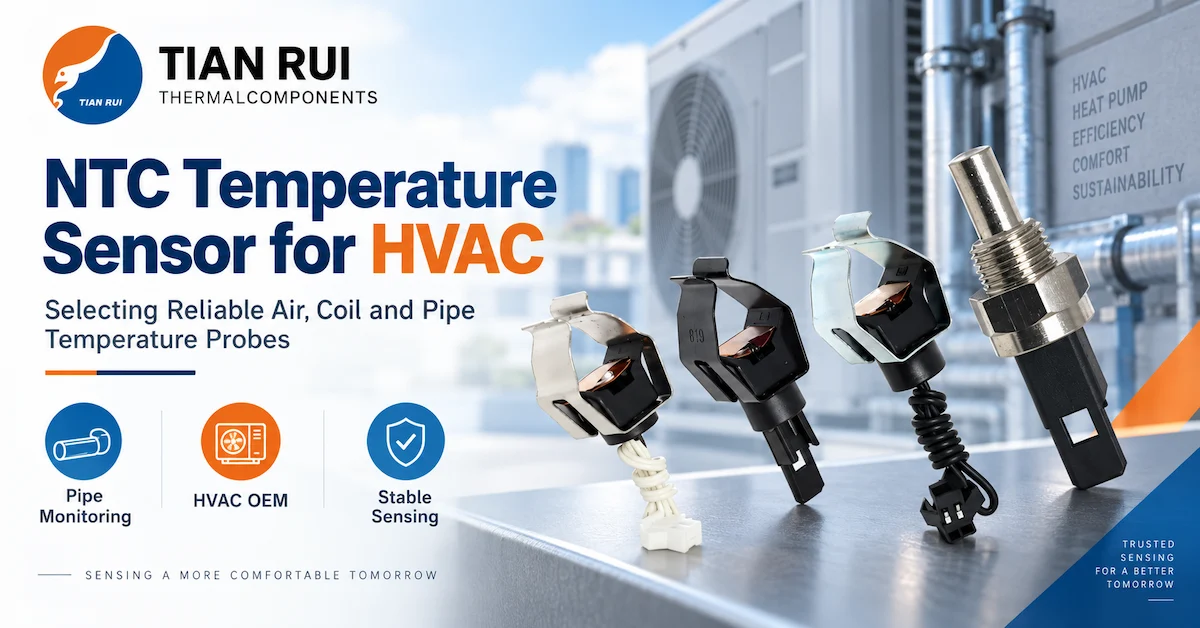
A pipe-clamp sensor measures the pipe surface without entering the circuit. That differs from a probe immersed in liquid or inserted into a sensor pocket, also called a thermowell. Tianrui’s pipe-clamp NTC sensor is described specifically for external pipe-temperature monitoring. For this arrangement, confirm pipe diameter, clamp fit, contact conditions and the installed insulation arrangement. For a water-circuit or tank application, state whether the probe contacts the medium directly. Do not infer pressure capability or chemical compatibility from the presence of a metal housing; those requirements belong to the approved assembly specification.
Match the Controller Curve Before Choosing 10K, 20K or 50K
There is no single resistance value that makes an NTC temperature sensor for HVAC universally compatible. R25 specifies resistance at 25°C, while the B value describes the resistance–temperature characteristic over a defined interval. Record that interval: B25/50 and B25/85 describe different reference ranges and should not be treated as equivalent labels. For an existing controller, request its approved resistance–temperature table or sensor specification before selecting a replacement. Two probes can agree at room temperature and diverge at the temperatures where the equipment makes control decisions. Compare resistance limits at those relevant points rather than accepting a one-point match. Tianrui’s NTC datasheet guide explains the underlying parameter definitions.
Separate Sensor Tolerance from Installed Accuracy
A resistance tolerance is not the same as a complete temperature-accuracy specification. A 10kΩ sensor with ±1% resistance tolerance at 25°C permits 9,900–10,100Ω at that reference point; it does not establish ±1°C accuracy throughout an HVAC operating range. The measurement also depends on the resistance curve, reading circuit and installation. Set acceptance limits around the actual control task: which temperature points matter, what deviation is acceptable, and under what conditions? For an air probe, include excitation-related self-heating in the review. The current used to measure the thermistor can warm it, so the electronics and sensor should be evaluated together.
What Specifications Should an HVAC Sensor RFQ Include?
Prepare one specification package for every shortlisted supplier. The table below is a recommended RFQ checklist, not a set of universal product ratings. Mark unknown values as open questions rather than allowing each supplier to fill them in differently.
| Specification | Information to define | HVAC acceptance question |
|---|---|---|
| Measurement task | Supply air, return air, ambient air, coil, pipe or water circuit | What temperature should this location represent? |
| Electrical characteristic | R25, tolerance, B value and its temperature interval | Does the probe match the controller input? |
| R–T acceptance limits | Resistance limits at relevant temperature points | Is compatibility maintained beyond 25°C? |
| Temperature exposure | Normal operation, storage and temporary excursions | Can the complete assembly tolerate every required condition? |
| Response requirement | Agreed response measure and test arrangement | Does the installed probe respond quickly enough for its function? |
| Probe and mounting | Dimensions, insertion depth, clip, thread or pocket interface | Can production reproduce the approved installation? |
| Cable and connector | Length, insulation, conductor, terminal and connector identity | Does the assembly fit the harness and routing conditions? |
| Environmental exposure | Condensation, water contact, cleaning agents and vibration, where applicable | Which qualification evidence is required? |
| Purchasing scope | Samples, initial order, forecast volume and documentation | Are quotations based on the same deliverable? |
Compare Tianrui Probe Configurations for HVAC Projects
Tianrui’s published products offer practical starting points for a technical discussion. The configurations below are not interchangeable parts, and the selection considerations are recommendations rather than blanket application approvals. Confirm the current drawing, complete electrical data and installation requirements before ordering.
| Published product | Information shown on the product page | Selection consideration |
|---|---|---|
| G12/G18 pipe-clamp NTC sensor | The specification table identifies a G12 clamp configuration, R25 = 50kΩ ±1% and B25/50 = 3950K ±1% | A starting point for external pipe sensing; confirm the actual pipe diameter, clamp configuration and contact arrangement |
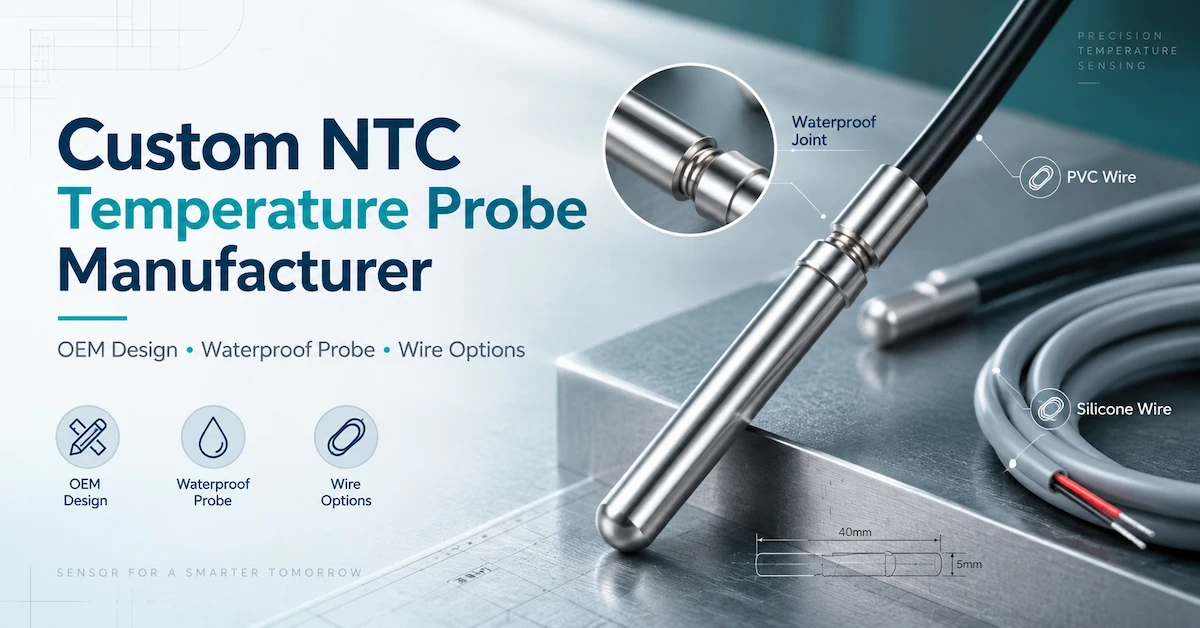
| 3×12mm stainless-steel NTC probe | 3×12mm probe, 10kΩ, B3435, listed 1% tolerance and UL1332 28AWG wire | A compact probe option; request the B-value interval, full R–T limits, finished cable length and mounting details |
| NTC probe for air-energy tanks | Stainless-steel construction, selectable resistance configurations and B25/50 = 3950K ±1% | Relevant to tank-sensing discussions; confirm the selected resistance and whether installation is in a pocket or directly in the medium |
A useful comparison begins with these differences, not with a shared “NTC sensor” label. For example, the listed 50kΩ pipe-clamp configuration and the 10kΩ cylindrical probe should not be offered as direct electrical substitutes without reviewing the controller.
Response Time Must Be Measured in the Intended Installation
When comparing an NTC temperature sensor for HVAC, ask what “response time” means on each quotation. A commonly used measure is the thermal time constant: the time needed to complete 63.2% of a temperature step under defined test conditions. It is not the time required to reach the final temperature completely. Tianrui’s temperature-sensor datasheet guidance explains this distinction. A result obtained in liquid does not establish performance in duct air, and a bare-element result does not describe a finished probe inside a pocket. Agree on the medium, airflow or circulation, mounting, temperature step and recorded endpoint before comparing samples.
Condensation Resistance Requires More Than a Metal Shell
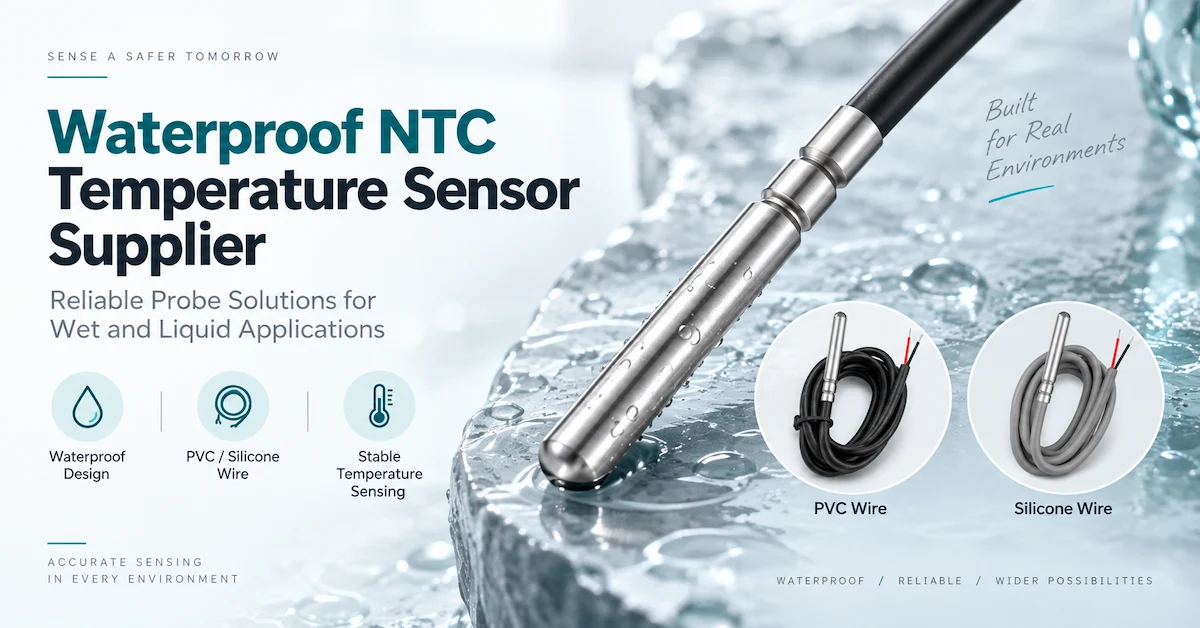
For cooling coils and cold pipework, review the complete assembly: sensing element, internal joints, encapsulation, housing, cable exit and connector. A stainless-steel tube alone does not prove that the cable entry or termination will tolerate the intended exposure. Likewise, a stated ingress rating should be checked against the exact configuration and supporting test conditions. Use the metal-shell sensor range to compare available structures, then identify the conditions your project must verify. For a coil location, that might include repeated wetting and temperature cycling; for a protected indoor location, a different test plan may be appropriate. Qualification should follow the exposure, not the appearance of the probe.
Cable Routing and Assembly Details Belong on the Drawing
For an NTC temperature sensor for HVAC, the lead assembly is part of the product rather than an accessory added after electrical approval. Define the cable route, finished length, connector keying and termination before sampling. Identify hot surfaces, moving parts, sharp edges and locations where condensation could reach a connection. For longer sensor runs, have the electronics team evaluate wiring resistance and interference in the intended circuit instead of assuming any extension will be acceptable. Where different sensing positions use similar connectors, consider clear identification to reduce assembly mistakes. Tianrui offers both metal-shell and plastic-shell NTC assemblies; whichever structure is selected, the released drawing should describe the entire installed component.
Use a Sample Test That Separates Electrical Error from Installation Error
First, Check the Electrical Match
For prototype approval, compare sample resistance at the agreed temperature points using controlled conditions and sufficiently low measurement power. Record sample identity, stabilization conditions, measured values and acceptance limits. Then confirm the reading with the intended controller. This separates a thermistor-curve mismatch from a conversion or circuit problem. Do not correct an unexplained discrepancy by changing a software offset before establishing its cause. Keep this electrical check distinct from environmental qualification and routine production inspection, since they answer different questions.
Then, Check the Installed Response
Mount the samples in representative equipment using the proposed production method. For a pipe-clamp design, repeat the installation to see whether different assemblies produce consistent contact. For an air sensor, evaluate the relevant fan conditions. For a coil sensor, include the operating transitions that matter to the controller. Consider a diagnostic example: two samples agree in a controlled-temperature check but differ after installation on a pipe. That result points the investigation toward mounting, contact or local conditions before a tighter thermistor tolerance is requested. This is a suggested evaluation method, not a reported Tianrui customer test. Document the final mounting arrangement alongside the electrical approval.
Which Manufacturing Controls Matter for HVAC Sensor Consistency?
Once samples are accepted, retain the connection between that approval and later production. Ask how the supplier controls element placement, electrical joints, filling or sealing, cable retention and connector assembly for the selected design. Agree which characteristics are inspected routinely and which are verified through qualification or periodic testing. Tianrui describes incoming inspection, performance testing, process checks and final verification within its sensor manufacturing and quality-control workflow. Confirm the actual control plan for your part rather than assuming every catalog product receives identical tests. Where certificates or declarations are required, check the covered model, materials and document scope; a component document does not automatically establish compliance for the complete HVAC unit.
What Affects Cost, MOQ and Production Lead Time?
Compare quotations for an NTC temperature sensor for HVAC against the same electrical curve, housing, cable, connector, mounting hardware and inspection scope. Ask suppliers to separate sample work, tooling and special testing where applicable. A lower component price is not directly comparable when another quotation includes a connector or assembly operation that it excludes. Confirm sample, pilot and repeat-order quantities separately, and establish which approval event starts each delivery schedule. For capacity planning, ask about the selected assembly and its materials rather than using a company-wide thermistor output figure. Keep forecast volume and replenishment requirements in the discussion so a successful sample can be followed by a workable production arrangement.
Develop an HVAC Sensor Specification with Tianrui
Dongguan Tianrui Electronics Co., Ltd. provides thermistor and temperature-sensing products, while its published OEM/ODM offering includes configurable electrical characteristics, housings, cables and connectors. For an HVAC project, submit the equipment type, measurement location, controller curve, installation drawing and environmental conditions first. Add the sample quantity, intended validation method and expected production demand. Where an existing part is being replaced, provide its specification or a reference sample and identify any known installation problems. Use the Tianrui contact page to request a configuration review and quotation. Feasibility, sample timing and acceptance requirements should be confirmed for the proposed assembly.
Frequently Asked Questions
What Is an NTC Temperature Sensor for HVAC Used For?
It provides resistance-based temperature feedback to the controller. Depending on the equipment design, the sensing point may be in air, on a coil, on pipework or in a water-related assembly. The installation must match the temperature the control system needs to evaluate.
Can Any 10K NTC Sensor Replace an Existing HVAC Probe?
No. Match the approved resistance–temperature curve, tolerances and construction—not only the resistance at 25°C. Confirm the connector, mounting and operating conditions as well. An identical-looking probe may still require a different controller interpretation.
Can the Same Sensor Be Used for Air and Coil Measurement?
Only after both installations have been validated. The electrical characteristic may be shared, but mounting, thermal contact, response and moisture exposure can differ. Treat each sensing location as a separate application requirement even when the selected part number is the same.
Does a Pipe-Clamp Sensor Measure the Liquid Directly?
No. It measures at the pipe surface. The relationship between that reading and the fluid temperature depends on the installation and operating conditions. Specify and validate the clamp arrangement rather than treating it as equivalent to an immersed probe.
Is a Stainless-Steel HVAC Probe Automatically Waterproof?
No. The complete sealing design matters, particularly at cable entries and connections. Request evidence for the exact assembly and required exposure. A housing material or a broad product-family description is not a substitute for a defined environmental specification.
What Response Time Should an HVAC NTC Sensor Have?
There is no universal target. Set the requirement according to the control function and test it in the relevant installation. Compare results only when the response definition and conditions match; a liquid-bath time constant should not be used as a duct-air guarantee.
Can a Passive NTC Probe Replace a 0–10V or 4–20mA Sensor?
Not directly. A passive NTC presents a temperature-dependent resistance, while those signals require an active interface. Check the receiving controller and system design before selecting a substitute. A matching temperature range does not establish electrical compatibility.
Can an NTC Probe Be Used on a Hot Compressor Discharge Line?
Only when the exact assembly is rated and validated for that location. Review normal and temporary temperature exposure, cable insulation, joints, encapsulation and mounting. Do not transfer the rating of an air or water-temperature probe to a hotter position without confirmation.
Can Cable Length and Connectors Be Customized?
Tianrui lists cable, connector and housing engineering within its customization offering. Provide the required connector identity, termination, finished length and routing conditions. Confirm availability and the effect on sampling or production before releasing the specification.
What Should Be Approved Before Placing a Production Order?
Approve the electrical curve, assembly drawing, materials, mounting method, sample results and inspection requirements together. Record the revision and agree how future changes will be handled. A physical sample alone leaves too much uncertainty about the product required for repeat orders.
Conclusion
Selecting an NTC temperature sensor for HVAC is a measurement-location and controller-matching decision. Start with the required resistance–temperature curve, then define how the probe will measure air, a coil, a pipe surface or a water-related sensing point. Verify response and environmental performance in the installed arrangement rather than relying on a nominal resistance, housing material or isolated laboratory result. Finally, connect the approved samples to a controlled production specification. Review Tianrui’s NTC temperature sensor portfolio and submit your HVAC sensor requirements for configuration review, sample planning and quotation.