Quick Answer: What Should Buyers Know About Battery Thermal Management?
A reliable Battery Thermal Management solution requires accurate temperature monitoring, suitable sensor placement and stable communication between the temperature sensor and battery management system. OEM buyers should evaluate the NTC sensor characteristics, installation location, thermal response, insulation requirements, mechanical design and supplier capability before selecting a battery temperature sensing solution.
For EV battery packs and energy storage systems, temperature is one of the most important parameters affecting battery performance and system operation. A temperature sensor does not control the battery by itself; instead, it provides critical information that allows the BMS and thermal-control system to make decisions.
When selecting a battery thermal management temperature sensor, engineers should consider:
- Temperature measurement location
- NTC resistance characteristics
- Thermal contact method
- Sensor size and packaging
- Cable and connector requirements
- Environmental conditions
- Validation requirements
- Production consistency
Tianrui provides NTC temperature sensor solutions for different applications, including automotive electronics, battery-related temperature monitoring and customized sensing requirements.
Why Battery Thermal Management Matters in Modern Battery Systems
Battery systems are becoming more powerful and compact. Electric vehicles, energy storage systems and industrial battery applications require efficient thermal control to maintain stable operation.
Battery temperature influences many important factors:
- Charging performance
- Discharging capability
- System efficiency
- Battery lifetime
- Safety management
- Thermal balance
A battery pack does not have a single temperature point. Different areas may experience different thermal conditions because of:
- Cell arrangement
- Current distribution
- Cooling structure
- Environmental temperature
- Operating conditions
For example, cells located near cooling channels may experience different temperatures from cells positioned in the center of a module. During charging or high-power operation, temperature differences can become more significant.
This is why battery manufacturers need accurate temperature sensing rather than simply measuring ambient temperature.
A well-designed battery thermal management system typically includes:
- Temperature sensors
- Battery management system (BMS)
- Cooling or heating components
- Control algorithms
- Mechanical thermal design
The temperature sensor is an important information source within the complete thermal-management system.
What Is Battery Thermal Management?
Battery Thermal Management refers to the methods and systems used to monitor and regulate battery temperature during operation.
The main objectives are:
- Maintain suitable operating temperature
- Reduce temperature differences between cells
- Improve battery performance consistency
- Support charging and discharging control
- Protect battery system operation
A thermal management system may include:
- Temperature measurement
- Cooling systems
- Heating systems
- Thermal interface materials
- Control strategies
Temperature sensors provide the data required for these systems.
For battery manufacturers, selecting the right sensor requires understanding not only the sensor itself but also how it interacts with the entire battery structure.
The Role of Temperature Sensors in Battery Thermal Management
Temperature sensors in battery systems mainly provide real-time temperature information.
The sensor signal can help the system understand:
- Current battery temperature
- Temperature differences between locations
- Thermal changes during operation
- Abnormal temperature conditions
However, sensor selection involves several engineering considerations.
A battery temperature sensor should provide:
Stable Electrical Characteristics
The sensor must match the BMS measurement circuit.
Important parameters include:
- Resistance value
- B value
- Resistance-temperature curve
- Tolerance
Reliable Mechanical Integration
The sensor must fit the battery structure.
Important factors include:
- Sensor thickness
- Mounting method
- Cable routing
- Connector position
Suitable Thermal Response
The sensor should respond appropriately to temperature changes.
A sensor that reacts too slowly may delay system response, while a sensor affected too strongly by local conditions may not represent the actual battery temperature.
What Types of Sensors Are Used in Battery Thermal Management?
Different battery designs may use different temperature sensing structures.
The most common options include:
| Sensor Type | Main Feature | Battery Application Consideration |
|---|---|---|
| Thin film NTC sensor | Small size and low thermal mass | Suitable for compact cell/module monitoring |
| Wired NTC sensor | Flexible installation | Suitable for custom battery assemblies |
| Encapsulated NTC sensor | Additional protection | Used where mechanical protection is needed |
| Metal probe sensor | Strong structure | Suitable for protected measurement locations |
| Custom sensor assembly | Application-specific design | Used for OEM battery projects |
The correct selection depends on:
- Battery structure
- Available installation space
- Measurement target
- Environmental conditions
Why NTC Sensors Are Commonly Used in Battery Systems
NTC thermistors are widely used in temperature measurement because they provide predictable resistance changes according to temperature.
The basic principle:
- Higher temperature
- Lower resistance
- Controller calculates temperature from resistance change
Advantages of NTC technology include:
- Compact size
- High sensitivity
- Flexible resistance options
- Easy integration with electronics
- Cost efficiency
Tianrui provides NTC thermistor products for temperature sensing applications.
However, selecting an NTC sensor for a battery system requires more than choosing a resistance value.
Engineers should evaluate:
- R25 value
- B value
- Operating temperature range
- Response requirements
- Mechanical structure
Understanding R25 and B Value in Battery Temperature Sensors
R25 Value
R25 represents the nominal resistance of an NTC sensor at 25°C.
Common values include:
- 5KΩ
- 10KΩ
- 20KΩ
- 50KΩ
- 100KΩ
However, R25 alone does not define the complete sensor behavior.
Two sensors may both be:
10K NTC sensors
but provide different readings because of different resistance-temperature characteristics.
B Value
The B value describes the relationship between resistance and temperature over a specific range.
For battery applications, engineers should confirm:
- B value
- Reference temperature range
- R-T curve
A mismatch can cause:
- Incorrect temperature calculation
- BMS measurement error
- Calibration problems
Tianrui explains NTC parameter selection through its NTC temperature sensor guide.
Why Sensor Placement Is Critical in Battery Thermal Management
A temperature sensor only measures the temperature at its installation location.
This means placement directly affects measurement quality.
Common battery temperature monitoring locations include:
- Individual cells
- Battery modules
- Battery pack enclosure
- Cooling plates
- Thermal management components
Each location provides different information.
Cell Surface Temperature Monitoring
Cell-level monitoring focuses on the temperature of individual battery cells.
Important considerations:
- Sensor attachment
- Thermal contact
- Space limitations
- Electrical insulation
Module Temperature Monitoring
Module-level sensing focuses on overall thermal conditions.
Important considerations:
- Sensor location
- Temperature distribution
- Mechanical stability
Cooling System Temperature Monitoring
Some systems monitor:
- Coolant temperature
- Cooling plate temperature
- Heat-transfer components
The sensor structure should match the measurement objective.
Thin Film NTC Sensors for Compact Battery Applications
Battery packs often have limited internal space. Large sensors may affect mechanical design or thermal behavior.
Thin film NTC sensors provide advantages:
- Small footprint
- Lightweight structure
- Low thermal influence
- Flexible integration
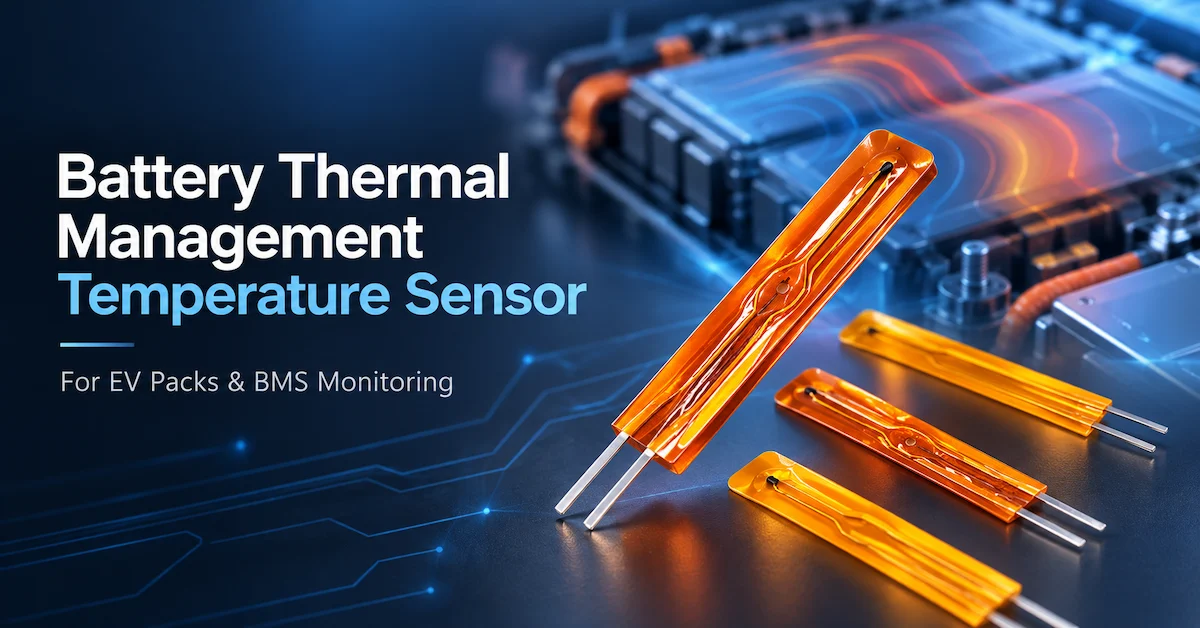
Tianrui provides thin film NTC temperature sensor solutions.
For battery applications, engineers should still evaluate:
- Attachment method
- Insulation requirements
- Cable connection
- Long-term stability
A small sensor is useful only when it remains reliable after integration into the battery structure.
What Should Battery OEMs Include in a Sensor Specification?
Before contacting a supplier, battery manufacturers should prepare a complete requirement document.
| Requirement | Details |
|---|---|
| Battery type | EV, ESS or industrial battery |
| Measurement location | Cell, module, pack or cooling system |
| Temperature range | Operating and storage conditions |
| NTC specification | Resistance and B value |
| Accuracy requirement | Allowed measurement tolerance |
| Sensor size | Thickness, length and width |
| Mounting method | Adhesive, clamp or embedded installation |
| Cable | Length and insulation requirement |
| Connector | Type and pin configuration |
| Environment | Vibration, moisture and thermal cycling |
| Quantity | Prototype and production demand |
A detailed specification helps suppliers provide accurate recommendations.
How to Select the Right Battery Thermal Management Sensor Structure
Selecting the correct sensor structure is one of the most important decisions in battery thermal management projects. A sensor may have excellent electrical characteristics, but if the mechanical structure does not match the battery design, the final measurement result may not meet system requirements.
OEM engineers should consider:
- Available installation space
- Thermal contact method
- Mechanical protection requirements
- Electrical insulation requirements
- Cable routing limitations
- Production assembly method
The best sensor is not always the smallest or most accurate component. It is the sensor that provides reliable temperature information after integration into the battery system.
Thin Film NTC Sensors for Battery Module Integration
Thin film NTC sensors are widely considered for applications where installation space is limited.
Typical advantages include:
- Compact size
- Low thermal mass
- Fast thermal response
- Flexible installation
These characteristics make thin film sensors suitable for:
- Battery cells
- Battery modules
- Compact electronic systems
- Space-limited assemblies
Tianrui’s thin film NTC temperature sensor solutions provide a product direction for applications requiring compact temperature measurement.
However, battery manufacturers should evaluate more than sensor size.
Important factors include:
Attachment Method
The connection between the sensor and the battery surface affects thermal transfer.
Engineers should consider:
- Adhesive thickness
- Contact pressure
- Surface condition
- Long-term stability
Poor thermal contact may create a difference between actual cell temperature and measured temperature.
Mechanical Protection
Although thin film sensors are compact, they still require protection according to the battery environment.
Consider:
- Compression
- Vibration
- Thermal cycling
- Assembly stress
Wired NTC Temperature Sensors for Battery Systems
Wired NTC sensors are commonly used when the sensing point is separated from the control electronics.
Advantages include:
- Flexible installation
- Easy connection
- Customized cable length
- Simple integration
For battery applications, buyers should define:
- Cable length
- Wire insulation
- Connector type
- Routing method
- Mechanical protection
A sensor may perform correctly electrically but fail during production if the cable cannot be installed efficiently.
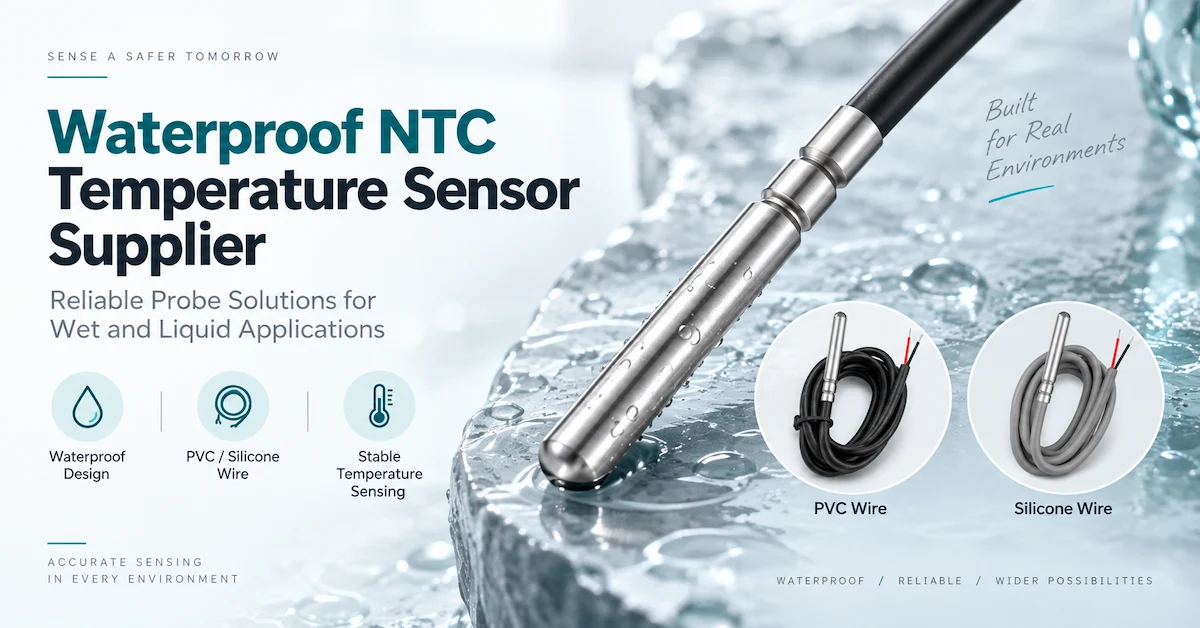
Tianrui provides NTC temperature sensor assemblies with different structural configurations for OEM applications.
Metal Shell Temperature Sensors in Battery Thermal Systems
Metal shell sensors are commonly selected when stronger mechanical protection is required.
Advantages include:
- Durable structure
- Corrosion resistance
- Mechanical strength
- Protection against external conditions
They may be suitable for:
- Cooling systems
- Battery thermal management components
- Industrial battery equipment
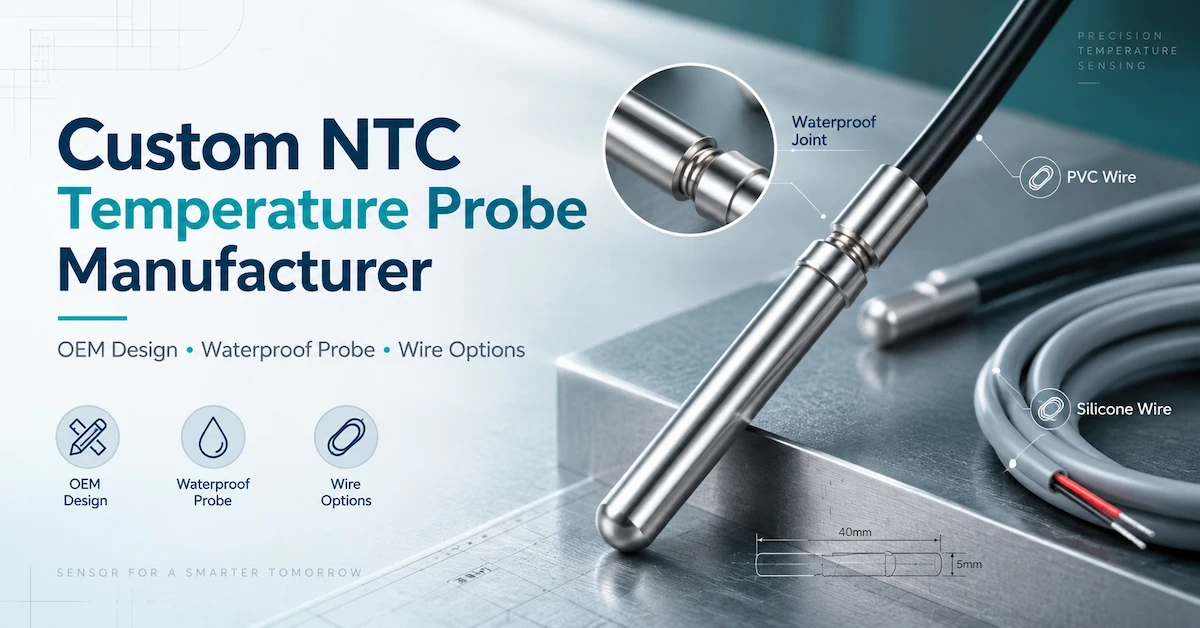
Tianrui provides metal shell NTC temperature sensors.
However, metal housing selection should consider thermal response.
A thicker metal structure may provide stronger protection but may also influence response speed because heat needs to transfer through the housing before reaching the sensing element.
How Does Thermal Contact Affect Battery Temperature Measurement?
Temperature measurement accuracy depends not only on the sensor itself but also on how heat reaches the sensing element.
Important thermal contact factors include:
- Contact surface
- Installation pressure
- Adhesive material
- Sensor position
- Surrounding materials
For example:
A sensor attached tightly to a cell surface may respond differently from a sensor separated by an air gap.
The electrical characteristics may be identical, but the measured temperature can be different.
For battery OEM projects, engineers should validate:
- Sensor position
- Mounting process
- Thermal response
- Measurement consistency
A repeatable installation method is as important as the sensor specification.
Battery Pack Temperature Sensor Installation Considerations
Battery pack design creates several unique challenges.
Limited Space Inside Battery Modules
Battery systems often contain:
- Cells
- Busbars
- Cooling structures
- Insulation layers
- Mechanical supports
The sensor must fit within the available space without affecting other components.
Important considerations:
- Sensor thickness
- Cable direction
- Connector location
- Assembly sequence
Electrical Insulation Requirements
Battery systems may contain high-voltage components.
The sensor design should consider:
- Insulation requirements
- Contact risks
- Cable protection
- Assembly conditions
The temperature sensor itself is only one part of the complete battery safety design.
OEM engineers should define:
- Required insulation level
- Installation position
- Contact limitations
- Validation method
Vibration and Mechanical Stress
Electric vehicles and industrial battery systems may experience:
- Vibration
- Shock
- Repeated thermal expansion
The sensor assembly should consider:
- Cable strain
- Connection reliability
- Mounting stability
A sensor that works during initial testing may require additional validation for long-term operation.
How Does a Battery Management System Use Temperature Sensor Data?
The Battery Management System (BMS) receives temperature information from sensors and uses this data together with other battery parameters.
Temperature information can support:
- Charging management
- Discharging control
- Thermal system operation
- Battery condition monitoring
However, the temperature sensor does not independently control battery safety.
The complete system includes:
- Battery cells
- BMS hardware
- Software algorithms
- Cooling/heating system
- Protection strategy
Therefore, sensor selection should focus on providing reliable temperature information to the system.
Why Sensor Matching with BMS Is Important
The BMS must correctly interpret the sensor signal.
Important matching factors include:
- Resistance value
- B value
- Measurement range
- Circuit design
- Calibration requirements
A sensor with incorrect characteristics may cause:
- Incorrect temperature calculation
- False readings
- Additional calibration work
Before selecting a sensor, battery manufacturers should confirm the approved sensor specification from the BMS design team.
How Should Battery OEMs Validate Temperature Sensors Before Production?
A complete validation process should include several stages.
Electrical Validation
Confirm:
- Resistance value
- B value
- R-T characteristics
- Temperature response
The purpose is to confirm that the sensor matches the BMS requirements.
Mechanical Validation
Check:
- Sensor dimensions
- Installation method
- Cable routing
- Connector compatibility
The sensor should fit the actual battery structure.
Thermal Validation
Evaluate:
- Temperature response
- Thermal contact
- Measurement stability
- Temperature differences
Testing should represent the real battery operating environment.
Environmental Validation
Depending on the application, testing may include:
- Temperature cycling
- Vibration
- Moisture exposure
- Mechanical stress
The validation plan should focus on actual battery risks rather than unnecessary testing.
How Should Buyers Evaluate a Battery Thermal Management Supplier?
Choosing a sensor supplier requires evaluating both product capability and engineering support.
Technical Capability Evaluation
Ask suppliers:
- Can they provide NTC parameter data?
- Can they support custom structures?
- Can they review battery application requirements?
- Can they provide samples for validation?
A supplier should understand both the sensor and the application.
Manufacturing Capability Evaluation
Important areas include:
| Area | Buyer Evaluation |
|---|---|
| Material control | Component consistency |
| Production process | Assembly reliability |
| Testing | Electrical verification |
| Inspection | Finished product quality |
| Documentation | Specification control |
For battery applications, production consistency is especially important because sensor variations may affect system calibration.
OEM Customization Capability Evaluation
Battery manufacturers may require:
- Different sensor sizes
- Special cable lengths
- Custom connectors
- Specific resistance values
- Special mounting structures
A supplier with OEM experience can help optimize the design before mass production.
Tianrui provides custom temperature sensor solutions for projects requiring customized configurations.
How Should Battery Companies Manage Sensor Supply Risks?
Long-term battery production requires supply stability.
Common risks include:
Specification Changes
A supplier may change:
- Material
- Cable
- Component source
- Manufacturing process
Any change should be reviewed before implementation.
Production Consistency Problems
A sensor should maintain:
- Electrical characteristics
- Mechanical dimensions
- Assembly quality
between prototype and mass production.
Insufficient Technical Communication
Battery projects often involve:
- Engineering teams
- Purchasing teams
- Quality teams
- Production teams
Clear technical documentation reduces misunderstanding.
How Does Cost Influence Battery Temperature Sensor Selection?
Cost is important, but it should be evaluated together with system value.
Main cost factors include:
| Cost Factor | Influence |
|---|---|
| Sensor structure | Different designs require different processes |
| Thermistor specification | Resistance and tolerance requirements |
| Cable and connector | Integration requirements |
| Testing | Validation scope |
| Quantity | Production volume |
A lower sensor price may increase total project cost if it creates:
- Additional testing
- Redesign work
- Calibration issues
- Production interruptions
OEM buyers should compare suppliers based on complete project requirements.
What Should Battery OEMs Include in a Supplier Inquiry?
A professional inquiry should include:
Technical Information
- Battery application
- Sensor location
- Temperature range
- Resistance requirement
- B value
- Accuracy requirement
Mechanical Information
- Sensor size
- Installation method
- Cable requirement
- Connector
Production Information
- Prototype quantity
- Expected annual volume
- Target production schedule
Providing complete information helps suppliers recommend suitable solutions.
How Can Tianrui Support Battery Thermal Management Projects?
Battery thermal management projects require a combination of:
- Suitable NTC technology
- Correct sensor structure
- Reliable production
- Application understanding
Tianrui provides NTC-based temperature sensing products and supports OEM discussions involving:
- Sensor selection
- Custom structures
- Cable and connector requirements
- Application evaluation
Buyers can review Tianrui’s NTC temperature sensor product range and contact Tianrui for battery temperature sensing requirements.
How Should EV and Energy Storage Companies Source Battery Thermal Management Sensors?
For EV battery packs and energy storage systems, sourcing a temperature sensor is not only a component purchasing decision. It is part of a larger product-development process involving electrical design, mechanical integration, thermal engineering and supply-chain management.
A professional sourcing process should consider:
- Sensor technology suitability
- Application requirements
- Supplier engineering capability
- Sample validation
- Production consistency
- Long-term supply stability
A battery temperature sensor may represent only a small portion of the total battery system cost, but an incorrect selection can create significant engineering and production problems.
Battery Thermal Management Sensor Buying Checklist
Before approving a supplier, battery manufacturers can review the following checklist:
| Evaluation Item | Buyer Consideration |
|---|---|
| Application purpose | Cell monitoring, module monitoring or cooling system monitoring |
| Sensor technology | NTC thermistor or other sensing method |
| Electrical parameters | R25, B value, R-T curve and tolerance |
| Physical design | Thickness, length, width and mounting method |
| Thermal interface | Adhesive, clamp or direct contact |
| Cable design | Length, insulation and flexibility |
| Connector | Type and compatibility |
| Environment | Temperature cycling, vibration and moisture |
| Testing | Validation requirements before production |
| Production | Supplier capacity and consistency |
A complete checklist helps engineering and purchasing teams evaluate suppliers using the same criteria.
How Does Battery Thermal Management Differ Between EV and Energy Storage Systems?
Although both EV batteries and energy storage systems require temperature monitoring, their operating conditions can be different.
EV Battery Thermal Management
Electric vehicle battery systems usually focus on:
- Compact packaging
- Weight control
- Fast temperature response
- Vibration resistance
- Long service life
The sensor must fit into a limited space while maintaining reliable measurement.
Common considerations include:
- Cell arrangement
- Module structure
- Vehicle vibration
- Thermal cycling
- Connector integration
Energy Storage System Thermal Management
Energy storage systems may focus more on:
- Long-term operation
- Large-scale battery modules
- Environmental exposure
- Maintenance requirements
Applications may include:
- Solar energy storage
- Industrial energy storage
- Backup power systems
The sensor design may require different mechanical structures compared with vehicle applications.
Why Temperature Sensor Placement Affects Battery System Performance
A temperature sensor does not measure the entire battery system. It measures the temperature at its installation point.
This means placement affects:
- Temperature accuracy
- Control response
- Thermal balance evaluation
Important placement considerations include:
Near Cell Surface
Advantages:
- Direct temperature information
- Suitable for local monitoring
Considerations:
- Attachment consistency
- Mechanical protection
- Insulation
Between Battery Modules
Advantages:
- Provides module-level information
Considerations:
- Temperature distribution differences
- Sensor mounting location
Cooling System Components
Advantages:
- Helps monitor thermal-management performance
Considerations:
- Surface temperature may differ from internal battery temperature
The correct location depends on the thermal-management strategy.
How Does Thermal Response Affect Battery Sensor Selection?
Thermal response describes how quickly the sensor reacts to temperature changes.
A faster response is not always the only goal.
The sensor must balance:
- Response speed
- Stability
- Mechanical protection
- Installation reliability
For example:
A very small sensor may respond quickly but require careful protection. A larger protected sensor may provide better durability but have different thermal behavior.
OEM engineers should evaluate response under conditions close to actual battery operation.
How Should Battery OEMs Evaluate Sensor Accuracy?
Accuracy evaluation should consider the complete measurement system.
Factors include:
- NTC tolerance
- R-T curve accuracy
- BMS circuit design
- Reference components
- Installation condition
- Thermal contact
A sensor with excellent laboratory performance may not provide the expected result if:
- The mounting position changes
- Thermal contact is inconsistent
- The controller calibration is different
Therefore, validation should be performed with the actual battery design whenever possible.
What Are the Key Quality Requirements for Battery Temperature Sensors?
Battery applications usually require stable quality because sensor replacement after mass production can be difficult.
Important quality requirements include:
Electrical Consistency
Production sensors should maintain:
- Resistance values
- B value characteristics
- Temperature response
Mechanical Consistency
Production should maintain:
- Dimensions
- Cable position
- Connector structure
- Mounting features
Process Consistency
The supplier should control:
- Material changes
- Assembly processes
- Testing procedures
- Product revisions
Tianrui provides NTC temperature sensing products and supports OEM discussions involving sensor specifications and application requirements through its NTC temperature sensor products.
Why Documentation Control Is Important for Battery Sensor Projects
Battery programs often have long development cycles.
During development, many changes may occur:
- Sensor structure adjustment
- Cable modification
- Mounting changes
- Specification updates
Without proper documentation, problems may occur when:
- Purchasing changes suppliers
- Production volume increases
- Engineering teams change
- Products enter later generations
Important documents include:
| Document | Purpose |
|---|---|
| Product specification | Defines sensor requirements |
| Drawing | Controls mechanical design |
| Test report | Records validation results |
| Sample approval record | Confirms approved version |
| Change history | Tracks modifications |
A controlled document system helps maintain consistency between development and mass production.
How Should Buyers Manage Battery Sensor Supply Chain Risk?
Battery manufacturers often require long-term supply stability.
Potential risks include:
Material Availability Risk
Sensor production may depend on:
- Thermistor materials
- Cable materials
- Connectors
- Housing components
Specification Change Risk
Unapproved changes may affect:
- Electrical performance
- Mechanical fit
- Thermal response
Production Capacity Risk
A supplier should be evaluated based on:
- Current production capability
- Ability to support forecast demand
- Process scalability
A reliable supplier relationship requires communication between engineering, purchasing and production teams.
How Does OEM Customization Improve Battery Sensor Integration?
Standard sensors are useful for many applications, but battery systems often have unique requirements.
OEM customization may involve:
Sensor Size Customization
Examples:
- Reduced thickness
- Modified length
- Special shape
Useful for:
- Compact modules
- Space-limited battery packs
Cable Customization
Examples:
- Different cable lengths
- Special insulation
- Custom connectors
Useful for:
- Complex wiring layouts
- Different battery architectures
Electrical Customization
Examples:
- Specific resistance value
- Specific B value
- Defined tolerance
Useful for:
- Existing BMS designs
- Specific control requirements
Tianrui supports customized temperature sensing solutions through its OEM temperature sensor solutions.
How Should Buyers Compare Different Battery Temperature Sensor Suppliers?
A supplier comparison should include technical and commercial factors.
| Comparison Area | Evaluation Question |
|---|---|
| Product capability | Can the supplier provide the required sensor structure? |
| Engineering support | Can they help optimize the design? |
| Sample process | Is validation supported? |
| Quality system | Are production controls clear? |
| Customization | Can requirements be modified? |
| Communication | Are technical discussions efficient? |
| Supply stability | Can long-term production be supported? |
The lowest quotation should not be the only selection factor.
What Information Should Be Sent Before Requesting a Battery Sensor Quote?
To receive a useful quotation, battery manufacturers should prepare:
Application Details
Include:
- Battery type
- EV, ESS or industrial application
- Sensor location
Technical Requirements
Include:
- Resistance value
- B value
- Temperature range
- Accuracy requirement
Mechanical Requirements
Include:
- Size limitations
- Mounting method
- Cable requirements
- Connector
Business Information
Include:
- Prototype quantity
- Production volume
- Project timeline
This information allows suppliers to evaluate feasibility before quoting.
How Can Tianrui Support Battery Thermal Management Projects?
Battery thermal management projects require sensors that combine:
- Correct electrical characteristics
- Suitable mechanical structure
- Reliable production
- Application understanding
Tianrui provides NTC temperature sensing products for applications requiring temperature monitoring and customized configurations.
Available solutions include:
- NTC thermistors
- NTC temperature sensors
- Thin film NTC sensors
- Customized temperature sensing assemblies
Buyers can review the NTC temperature sensor product portfolio and submit project requirements through the Tianrui contact page.
Frequently Asked Questions
What is the purpose of Battery Thermal Management?
Battery Thermal Management controls and monitors battery temperature to help maintain suitable operating conditions. Temperature sensors provide important information for the battery management system.
Why are NTC sensors commonly used in battery systems?
NTC sensors provide predictable resistance changes with temperature and can be integrated into BMS measurement systems.
Where should battery temperature sensors be installed?
Installation depends on the battery design. Sensors may monitor cells, modules, cooling components or other important thermal locations.
Are all battery temperature sensors interchangeable?
No. Different sensors may have different resistance characteristics, structures, tolerances and installation requirements.
What is the difference between a thin film NTC sensor and a probe sensor?
Thin film sensors are compact and suitable for limited spaces, while probe sensors provide stronger mechanical protection and different installation options.
Can battery temperature sensors be customized?
Yes. OEM customization may include sensor size, resistance, cable, connector and mounting structure.
How should battery temperature sensor samples be tested?
Testing should include electrical verification, mechanical installation checks and evaluation under representative operating conditions.
What affects battery temperature sensor cost?
Cost depends on sensor structure, electrical specifications, materials, customization requirements, testing and production volume.
How do I choose a Battery Thermal Management supplier?
Evaluate technical capability, customization support, quality control, production stability and communication capability.
What information should I provide before requesting a quote?
Provide battery application details, sensor position, electrical requirements, mechanical design information and expected production quantity.
Conclusion
Choosing the right Battery Thermal Management temperature sensing solution requires understanding both battery system requirements and sensor technology. A suitable sensor should provide reliable temperature information, match the BMS electrical requirements, fit the battery structure and maintain consistent performance during mass production.
For EV, energy storage and industrial battery manufacturers, supplier selection should focus on more than product price. Engineering capability, customization support, validation process and long-term production stability are equally important.
Tianrui provides NTC temperature sensor solutions for battery-related temperature monitoring requirements and supports OEM discussions through the contact page.