Quick Answer: What Should Appliance Manufacturers Consider When Selecting a Home Appliance Sensor?
A reliable Home Appliance Sensor should match the appliance control system, installation environment and long-term production requirements. OEM buyers should evaluate sensor technology, electrical parameters, probe structure, temperature range, response performance, supplier capability and customization support before approving a sensor for mass production.
For home appliance manufacturers, temperature sensing is not simply about detecting heat changes. The sensor directly affects how an appliance controls heating, cooling, protection and energy efficiency. A suitable sensor should provide stable measurement, fit the mechanical design and remain consistent across thousands or millions of production units.
When selecting a home appliance sensor supplier, buyers should review:
- Sensor type and working principle
- Resistance-temperature characteristics
- Probe design and installation method
- Cable and connector requirements
- Environmental conditions
- Sample validation process
- Production quality control
Tianrui provides NTC temperature sensor solutions for different appliance applications, including temperature probes, thermistor assemblies and customized sensor configurations.
Why Home Appliance Sensor Selection Matters for OEM Manufacturers
Home appliances have become increasingly intelligent. Modern refrigerators, washing machines, coffee makers, ovens, water heaters and other products rely on accurate temperature information to manage performance, safety and user experience.
A temperature sensor may appear to be a small component inside an appliance, but its signal influences important functions:
- Heating control
- Cooling management
- Defrost operation
- Energy efficiency
- Safety protection
- Product reliability
For OEM appliance manufacturers, choosing the wrong sensor can create several problems:
- Incorrect temperature readings
- Unstable product operation
- Higher warranty costs
- Additional calibration work
- Production delays
- Customer complaints
For example, a refrigerator temperature sensor must respond correctly to changing compartment conditions. A coffee machine temperature sensor must withstand repeated heating cycles. A washing machine sensor must operate reliably under moisture and vibration conditions.
These applications may all use NTC technology, but their mechanical designs and environmental requirements are different.
This is why appliance manufacturers should evaluate sensors based on the complete application rather than choosing products only by resistance value or appearance.
What Is a Home Appliance Sensor?
A Home Appliance Sensor is a component used to detect physical changes inside household equipment and provide feedback to the appliance control system.
For temperature-related applications, NTC sensors are among the commonly used solutions because they provide predictable resistance changes according to temperature.
The basic working principle is:
- The appliance temperature changes
- The NTC sensing element changes resistance
- The control board measures the resistance signal
- The system calculates temperature
- The appliance adjusts operation accordingly
A complete appliance temperature sensor usually includes several parts:
| Component | Function |
|---|---|
| NTC thermistor element | Detects temperature variation |
| Protective housing | Protects internal sensing components |
| Wire assembly | Transfers electrical signals |
| Connector | Connects sensor with appliance control system |
| Encapsulation material | Improves protection and stability |
| Mounting structure | Ensures correct installation |
Tianrui provides both NTC thermistor products and finished NTC temperature sensor assemblies, allowing OEM buyers to select either sensing elements or complete sensor solutions.
Main Types of Home Appliance Sensors Used by OEM Manufacturers
Different appliances require different sensor structures. Understanding the main types helps buyers communicate more effectively with suppliers.
NTC Temperature Sensors for Appliances
NTC temperature sensors are widely used because they provide:
- High sensitivity
- Stable resistance change
- Compact structure
- Flexible customization
Common appliance applications include:
- Refrigerators
- Freezers
- Washing machines
- Dryers
- Coffee machines
- Water heaters
- Air conditioners
However, the correct NTC sensor depends on:
- Required resistance value
- Temperature range
- Installation location
- Response requirement
- Controller compatibility
A refrigerator sensor and a coffee machine sensor may both be NTC sensors, but they operate in completely different environments.
Probe-Type Appliance Sensors
Probe sensors are commonly used when the sensing element requires physical protection.
Typical structures include:
- Stainless steel probes
- Plastic shell probes
- Waterproof probes
- Cylindrical sensors
- Threaded sensors
Advantages include:
- Easier installation
- Better mechanical protection
- Customized dimensions
- Improved environmental resistance
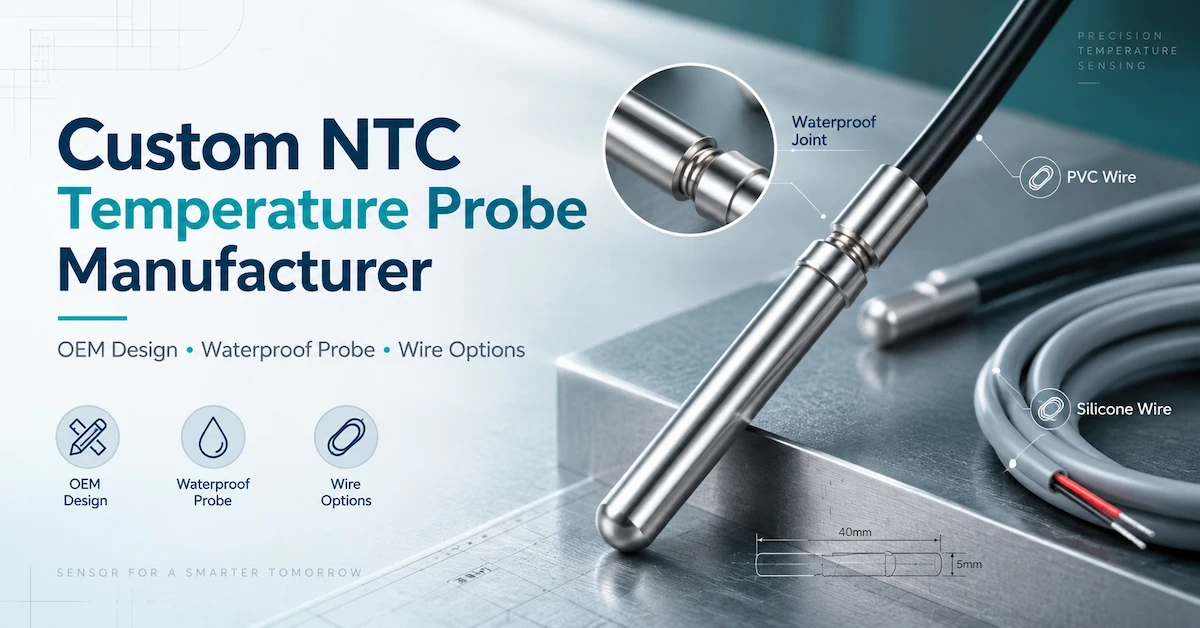
Tianrui provides metal shell NTC temperature sensors for applications requiring stronger protection and durability.
Thin Film Temperature Sensors
Thin film NTC sensors are suitable for applications where space is limited.
Their advantages include:
- Small size
- Low thermal mass
- Fast response
- Flexible integration
They are often considered for:
- Compact appliances
- Electronic devices
- Battery systems
- Precision temperature monitoring
How Do Different Home Appliances Use Temperature Sensors?
Refrigerator Temperature Sensors
Refrigerators require accurate temperature monitoring because the control system must maintain stable cooling conditions.
Typical sensing locations include:
- Refrigerator compartments
- Freezer areas
- Evaporator sections
- Defrost systems
Important requirements include:
Stable Low-Temperature Performance
The sensor must maintain reliable resistance characteristics under cold conditions.
Moisture Resistance
Refrigerator environments often include:
- Condensation
- Ice formation
- Temperature cycling
The sensor design should consider sealing and protection.
Long-Term Stability
Refrigerators usually operate continuously for many years, so sensor consistency is important.
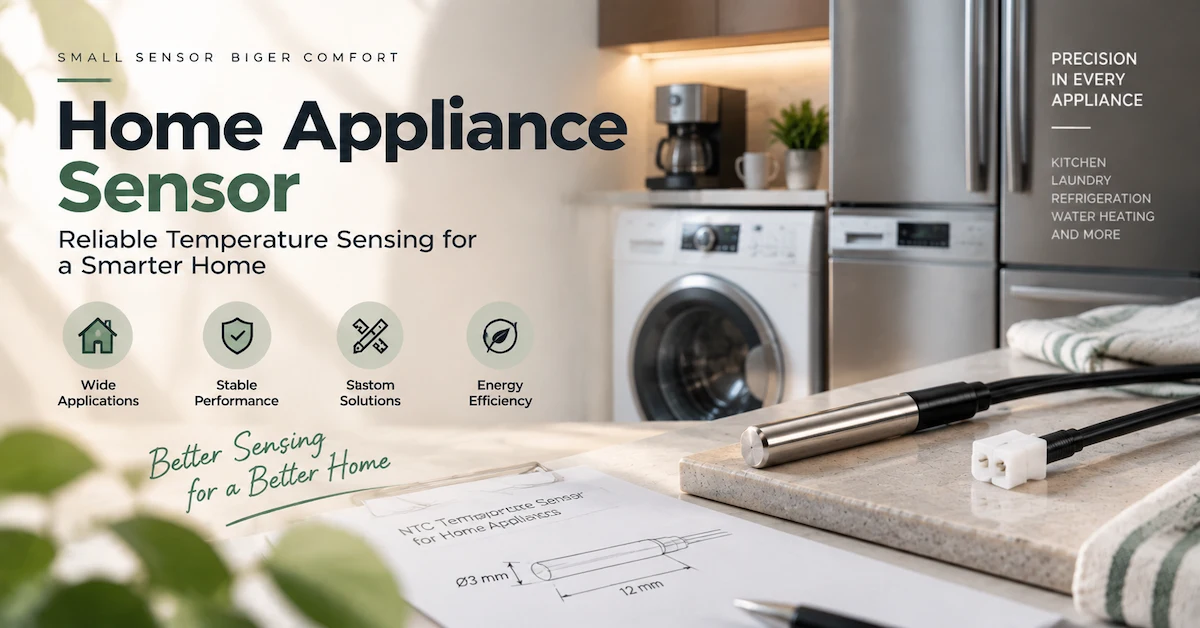
Tianrui provides temperature sensor solutions for home appliance applications.
Washing Machine Temperature Sensors
Washing machines create a different environment.
Sensors may experience:
- Water exposure
- Vibration
- Repeated temperature changes
- Mechanical stress
Important selection factors include:
- Waterproof structure
- Cable reliability
- Mechanical protection
- Stable temperature measurement
A sensor designed for dry conditions may not be suitable for washing equipment without additional protection evaluation.
Coffee Maker and Small Appliance Temperature Sensors
Coffee makers, kettles and similar appliances usually require:
- Fast response
- Compact size
- High-temperature resistance
- Easy assembly
The sensor often works close to heating elements, which means buyers should consider:
- Temperature range
- Distance from heater
- Cable temperature rating
- Thermal response
The smallest sensor is not always the best choice. The correct design depends on how the appliance controls temperature.
Water Heater Temperature Sensors
Water heaters require sensors that can operate near water and continuous heating cycles.
Important considerations include:
- Waterproof structure
- Probe material
- Long-term stability
- Installation method
For water-related applications, buyers should confirm whether the sensor is designed for:
- Surface measurement
- Water tank measurement
- Direct liquid exposure
A stainless-steel housing alone does not automatically define complete waterproof performance.
Key Specifications Buyers Should Confirm Before Purchasing
A common mistake in appliance sourcing is providing only:
“Need a 10K sensor.”
This information is incomplete.
A professional OEM request should include:
| Specification | Why It Matters |
|---|---|
| Resistance value | Matches control circuit requirements |
| B value | Defines resistance-temperature behavior |
| Temperature range | Ensures operating reliability |
| Probe size | Ensures mechanical compatibility |
| Cable length | Supports installation |
| Connector | Ensures electrical integration |
| Environment | Determines protection requirements |
| Quantity | Supports production planning |
The supplier can only recommend the correct sensor when the application information is clear.
Why R25 and B Value Are Important for Home Appliance Sensors
R25 Value
R25 represents the nominal resistance value of an NTC sensor at 25°C.
For example:
- 10K NTC
- 20K NTC
- 50K NTC
However, R25 alone does not define the complete sensor behavior.
Two sensors can both be 10K NTC sensors but provide different readings because their temperature-resistance curves are different.
B Value
The B value describes how the resistance changes with temperature.
OEM buyers should confirm:
- B value
- Reference temperature range
- R-T curve
A mismatch can cause:
- Incorrect temperature calculation
- Poor control performance
- Additional calibration requirements
Tianrui explains NTC parameter selection in its NTC temperature sensor guide.
How to Select the Right Home Appliance Sensor Structure for OEM Production
Selecting the correct Home Appliance Sensor structure is one of the most important decisions during product development. The sensing element may determine the electrical behavior, but the physical structure determines how accurately and reliably the sensor works inside the appliance.
OEM buyers should evaluate:
- Where the sensor will be installed
- How heat transfers to the sensing element
- Whether moisture or vibration exists
- How the sensor connects with the control board
- Whether the design can be reproduced during mass production
A sensor that performs well in laboratory conditions may not provide the same results after installation inside a finished appliance.
Stainless Steel NTC Sensors for Durable Appliance Applications
Stainless steel probe sensors are commonly selected when the appliance requires stronger mechanical protection or exposure resistance.
Typical advantages include:
- Strong housing structure
- Good corrosion resistance
- Stable mechanical performance
- Suitable for compact installation
Common applications:
- Water heaters
- Refrigeration equipment
- Industrial appliances
- Heating systems
Tianrui’s stainless steel NTC temperature sensors provide a structure option for applications where the sensor requires additional physical protection.
However, OEM buyers should not select stainless steel only because it appears more durable.
The actual evaluation should include:
- Probe diameter
- Probe length
- Installation method
- Temperature range
- Cable environment
- Required sealing performance
Plastic Shell Sensors for Compact Appliance Integration
Plastic shell temperature sensors are commonly used when electrical insulation, lightweight construction or specific mounting designs are required.
They may be suitable for:
- Refrigerators
- Washing machines
- Small appliances
- Electronic equipment
Advantages:
- Flexible housing design
- Easy integration
- Good electrical insulation
- Suitable for compact spaces
However, buyers should confirm:
- Housing material
- Temperature capability
- Mechanical strength
- Environmental exposure
The housing should match the appliance design rather than simply choosing the lowest-cost option.
Waterproof Home Appliance Sensors
Many home appliances operate in environments where moisture is unavoidable.
Examples:
- Washing machines
- Water dispensers
- Coffee machines
- Water heaters
For these applications, buyers should evaluate the complete protection structure:
| Evaluation Area | Questions to Confirm |
|---|---|
| Housing | Is the material suitable for moisture exposure? |
| Cable exit | How is water prevented from entering? |
| Encapsulation | Is the internal sensing area protected? |
| Connector | Is the connection area protected? |
| Testing | What validation method is used? |
A waterproof claim should always be connected with a specific product configuration and application condition.
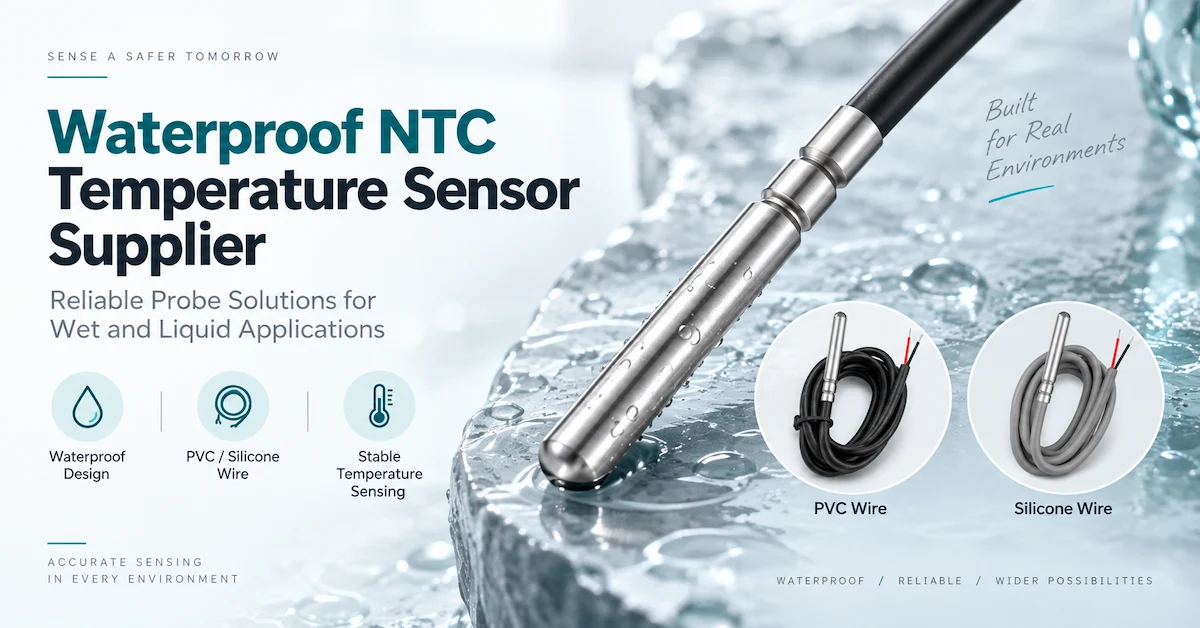
Tianrui provides waterproof NTC temperature sensor solutions for applications requiring additional environmental protection.
How Should OEM Buyers Compare Standard and Custom Home Appliance Sensors?
OEM manufacturers usually have two choices:
- Select an existing standard sensor
- Develop a customized sensor solution
The correct choice depends on project requirements.
| Comparison | Standard Sensor | Custom OEM Sensor |
|---|---|---|
| Development time | Faster | Requires evaluation and sampling |
| Cost | Usually lower initially | Depends on customization |
| Flexibility | Limited | Higher |
| Installation fit | May require adaptation | Designed for equipment |
| Long-term control | Depends on availability | Better specification control |
A standard sensor is suitable when:
- Existing specifications match
- No mechanical changes are needed
- Volume requirements are simple
A custom sensor is more suitable when:
- The appliance has limited space
- Special connectors are required
- Existing sensors cannot match the controller
- Long-term supply stability is important
What Customization Options Are Available for Home Appliance Sensors?
A professional OEM supplier should be able to discuss different customization areas.
Electrical Customization
Possible requirements include:
- Resistance value
- B value
- Resistance tolerance
- Temperature range
These parameters determine whether the sensor can communicate correctly with the appliance controller.
Mechanical Customization
Mechanical customization may include:
- Probe diameter
- Probe length
- Housing shape
- Mounting structure
This is especially important when the sensor must fit inside a specific appliance structure.
Cable and Connector Customization
Cable requirements often affect appliance integration.
OEM buyers should define:
- Cable length
- Cable material
- Temperature resistance
- Connector model
- Terminal configuration
A sensor that meets electrical requirements but cannot fit the appliance wiring system still creates production problems.
Tianrui provides custom temperature sensor solutions supporting different configuration requirements.
How Does the OEM Home Appliance Sensor Development Process Work?
A professional development process usually includes several stages.
Step 1: Application Requirement Analysis
The supplier should understand:
- Appliance type
- Measuring location
- Temperature range
- Working environment
- Expected quantity
The goal is to understand the actual sensing requirement.
Step 2: Sensor Specification Confirmation
The supplier and buyer confirm:
- NTC type
- Resistance value
- B value
- Probe structure
- Cable
- Connector
This stage prevents later specification conflicts.
Step 3: Prototype Development
Samples are produced according to the confirmed requirements.
During this stage, buyers should check:
- Electrical performance
- Physical dimensions
- Installation compatibility
- Appliance operation
Step 4: Customer Validation
The sensor should be tested inside the actual appliance or a representative test environment.
Important checks include:
- Temperature response
- Stability
- Control performance
- Mechanical installation
Step 5: Production Approval
After validation, the approved design becomes the production reference.
The approved documents should include:
- Drawing
- Specifications
- Test records
- Revision information
This prevents differences between approved samples and future production batches.
How Should Buyers Evaluate a Home Appliance Sensor Supplier?
Choosing a supplier requires more than checking whether products exist in a catalog.
OEM buyers should evaluate several areas.
Engineering Support Capability
A reliable supplier should understand:
- Temperature measurement requirements
- Sensor structure selection
- Electrical parameters
- Application limitations
Good engineering communication reduces unnecessary trial and error.
Production Capability
Buyers should understand:
- Manufacturing process
- Equipment capability
- Production consistency
- Quality inspection
A supplier should be able to explain how a customized sensor moves from prototype to production.
Quality Control Capability
Important quality areas include:
| Quality Control Area | What Buyers Should Review |
|---|---|
| Incoming materials | Component quality inspection |
| Assembly process | Manufacturing consistency |
| Electrical testing | Resistance verification |
| Final inspection | Finished sensor quality |
| Change management | Approval process before modifications |
A supplier’s quality system should connect directly with the approved product specification.
Why Sample Validation Is Critical Before Mass Production
Sample approval is one of the most important steps in OEM sensor development.
A common mistake is approving a sample only because:
- The appearance looks correct
- Resistance value is correct
- The sensor fits physically
However, a complete validation should include:
Electrical Validation
Check:
- Resistance value
- Temperature response
- R-T curve
Mechanical Validation
Check:
- Size
- Installation
- Cable routing
- Connector compatibility
Application Validation
Check:
- Sensor performance inside the appliance
- Temperature control behavior
- Long-term stability
The goal is not only to confirm that the sample works, but also to confirm that production can repeatedly manufacture the same product.
What Are the Common Risks When Purchasing Home Appliance Sensors?
Risk 1: Selecting Only Based on Resistance Value
A 10K sensor is not automatically equivalent to another 10K sensor.
Differences may exist in:
- B value
- Temperature curve
- Tolerance
- Physical structure
Risk 2: Ignoring Installation Environment
The same sensor may perform differently in:
- Dry environment
- Wet environment
- High-temperature area
- Refrigeration area
The application condition must be considered during selection.
Risk 3: Changing Components Without Approval
During mass production, changing:
- Cable
- Housing
- Thermistor element
- Encapsulation material
may affect performance.
OEM buyers should require controlled changes.
Risk 4: Comparing Suppliers Only by Price
The lowest price may not represent the lowest total cost.
Additional costs may come from:
- Failed samples
- Redesign
- Production delays
- Quality problems
A supplier should be evaluated based on technical capability and long-term reliability.
How Does Cost Affect Home Appliance Sensor Purchasing Decisions?
The final sensor cost depends on multiple factors.
Important cost factors include:
| Cost Factor | Influence |
|---|---|
| Sensor type | Different technologies have different costs |
| Probe structure | Housing and manufacturing complexity |
| Cable | Length and material requirements |
| Connector | Type and customization |
| Testing | Validation requirements |
| Quantity | Production volume |
For OEM projects, buyers should compare suppliers using the same specifications.
A lower quotation may not include the same:
- Materials
- Testing requirements
- Packaging
- Customization scope
Therefore, price comparison should always be based on a complete specification.
How Can OEM Buyers Prepare a Better Sensor Inquiry?
A high-quality inquiry should include:
Product Information
- Appliance type
- Sensor purpose
- Existing sensor information
Technical Information
- Resistance
- B value
- Temperature range
- Accuracy requirement
Mechanical Information
- Size
- Installation location
- Cable requirement
- Connector
Business Information
- Sample quantity
- Expected annual volume
- Target production schedule
The more complete the information, the faster the supplier can provide a suitable recommendation.
Frequently Asked Questions
What is the most important factor when choosing a Home Appliance Sensor?
The most important factor is whether the sensor matches the appliance control system and installation environment. Electrical compatibility and mechanical integration should be evaluated together.
Can one temperature sensor be used for different appliances?
Sometimes, but not always. Different appliances have different temperature ranges, installation methods and environmental conditions.
Why do OEM appliances need customized temperature sensors?
Because standard sensors may not fit specific mechanical designs, connectors, control requirements or production processes.
What information should I provide to a sensor supplier?
Provide appliance type, temperature range, sensor location, electrical requirements, dimensions, cable and quantity requirements.
Are NTC sensors suitable for home appliances?
Yes. NTC sensors are widely used in many appliances because they provide predictable temperature-resistance characteristics.
Can temperature sensors be waterproof?
Yes, but waterproof performance depends on the complete sensor structure, including housing, sealing and cable design.
How long does OEM sensor development take?
The development time depends on customization level, sample testing requirements and customer approval process.
Should I choose a standard sensor or custom sensor?
Choose a standard sensor when specifications already match. Choose customization when the appliance requires special design requirements.
How do I verify sensor quality before mass production?
Perform electrical testing, mechanical verification and appliance-level validation before approval.
How can I request an OEM temperature sensor quotation?
Prepare your application requirements and contact the supplier with specifications, drawings or sample information.
How Should Buyers Compare Home Appliance Sensor Suppliers for Long-Term Cooperation?
Selecting a supplier for a home appliance sensor project is not only a product decision. It is also a long-term cooperation decision.
For OEM manufacturers, the supplier relationship may continue through:
- Product upgrades
- New appliance models
- Annual production orders
- Cost optimization projects
- Engineering changes
Therefore, buyers should evaluate whether the supplier can support the complete product lifecycle.
A suitable supplier should provide:
- Technical communication during development
- Stable product quality during production
- Flexible customization capability
- Consistent delivery performance
- Support when design changes occur
A supplier that only provides a quotation may not be enough for a long-term OEM relationship.
Supplier Evaluation Checklist for Home Appliance Sensor Projects
Before selecting a supplier, OEM buyers can evaluate the following areas:
| Evaluation Area | Key Questions |
|---|---|
| Product capability | Does the supplier provide the required sensor type? |
| Engineering support | Can they review drawings and application requirements? |
| Customization | Can they modify structure, cable and connector? |
| Quality control | Are testing procedures clearly defined? |
| Production stability | Can they support repeat orders? |
| Communication | Can technical issues be solved efficiently? |
| Documentation | Are specifications and revisions controlled? |
This evaluation helps buyers avoid choosing a supplier only based on product price.
How Can Home Appliance Manufacturers Reduce Sensor Procurement Risks?
Reducing procurement risk starts before placing the first production order.
Create a Complete Sensor Specification
A clear specification should include:
- Electrical parameters
- Mechanical dimensions
- Environmental conditions
- Testing requirements
- Production requirements
A detailed specification reduces misunderstanding between engineering, purchasing and suppliers.
Approve Samples with Clear Records
Sample approval should include:
- Approved product drawing
- Sensor specifications
- Test results
- Sample identification
- Revision information
This ensures that future production uses the same approved design.
Control Engineering Changes
During product lifecycle, suppliers may need to change:
- Material source
- Cable supplier
- Connector supplier
- Production method
Any change that may affect sensor performance should be reviewed before implementation.
How Does Home Appliance Sensor Quality Affect Final Product Performance?
A temperature sensor is a small component, but its influence can extend throughout the appliance system.
For example:
A refrigerator sensor affects:
- Compressor control
- Cooling stability
- Energy consumption
A coffee machine sensor affects:
- Heating control
- Temperature consistency
- User experience
A washing machine sensor affects:
- Heating cycle
- Program control
- Product reliability
Therefore, sensor quality should not be evaluated only by the component itself.
The complete system relationship matters:
Sensor → Controller → Appliance Function → User Experience
Why Custom Temperature Sensor Capability Matters for Appliance OEMs
Different appliance manufacturers often have different requirements.
Two companies producing similar products may still require different sensors because of:
- Different control boards
- Different mechanical structures
- Different installation positions
- Different market requirements
A supplier with customization capability can help optimize:
Sensor Dimensions
Examples:
- Shorter probe
- Smaller diameter
- Special mounting structure
Electrical Parameters
Examples:
- Different resistance values
- Different B values
- Specific tolerance requirements
Cable Solutions
Examples:
- Different lengths
- Different insulation materials
- Different connectors
Tianrui supports customized NTC temperature sensor solutions for different OEM requirements.
How Should Buyers Select Sensors for Different Appliance Categories?
Refrigerator Sensor Selection
Important considerations:
- Low-temperature performance
- Moisture resistance
- Long-term stability
- Compact installation
Common sensor locations:
- Refrigerator compartment
- Freezer compartment
- Evaporator area
The selected sensor should match the cooling control system.
Washing Machine Sensor Selection
Important considerations:
- Waterproof protection
- Vibration resistance
- Temperature cycling
The sensor should maintain stable performance during repeated washing and heating processes.
Coffee Machine Sensor Selection
Important considerations:
- Fast response
- High-temperature capability
- Compact installation
Because heating components operate at elevated temperatures, the sensor structure and cable selection are important.
Water Heater Sensor Selection
Important considerations:
- Moisture exposure
- Continuous heating cycles
- Probe material
- Installation position
For water-related applications, buyers should confirm whether the sensor is designed for:
- Surface temperature measurement
- Tank temperature monitoring
- Liquid contact environments
How Should Buyers Compare Home Appliance Sensor Prices?
Price is an important factor, but it should not be the only decision point.
A complete comparison should include:
| Cost Factor | Evaluation |
|---|---|
| Sensor specification | Are all suppliers quoting the same design? |
| Materials | Are housing and cable equivalent? |
| Testing | Are validation requirements included? |
| Customization | Are special requirements included? |
| Production quantity | Are volumes comparable? |
| Support | Is engineering support included? |
A lower initial price may create additional costs later if:
- Samples fail
- Production changes are required
- Appliance redesign is needed
The goal should be the best overall project value, not simply the lowest unit price.
What Information Helps Suppliers Provide Better Quotations?
A supplier can respond faster when buyers provide:
Application Information
Include:
- Appliance type
- Sensor location
- Temperature range
- Working environment
Technical Information
Include:
- NTC resistance
- B value
- Tolerance
- Accuracy requirement
Mechanical Information
Include:
- Sensor size
- Mounting method
- Cable length
- Connector
Commercial Information
Include:
- Sample quantity
- Annual demand
- Target production schedule
If some information is unknown, buyers should identify it as an open question rather than allowing different suppliers to make different assumptions.
Why Documentation Matters in OEM Sensor Projects
For long-term OEM production, documentation is as important as the physical product.
Important documents may include:
- Product specification
- Technical drawing
- Sample approval record
- Test report
- Change history
Documentation helps maintain consistency when:
- Production volume increases
- Teams change
- Products are upgraded
- Suppliers are reviewed
A controlled documentation process reduces communication problems between engineering and purchasing teams.
How Can Tianrui Support Home Appliance Sensor Projects?
Tianrui focuses on NTC-related temperature sensing products and provides solutions for different application requirements.
For OEM appliance projects, buyers can discuss:
- Sensor type selection
- NTC parameter requirements
- Probe structure
- Cable and connector configuration
- Sample development
The available product range includes:
- NTC thermistors
- NTC temperature sensors
- Metal shell sensors
- Thin film sensors
- Customized temperature sensing solutions
Buyers can review Tianrui’s NTC temperature sensor products and submit project requirements through the contact page.
Additional Frequently Asked Questions
What is the difference between an appliance sensor and an industrial temperature sensor?
The sensing technology may be similar, but appliance sensors usually focus on compact integration, cost control and consumer-product production requirements, while industrial sensors often require stronger protection and more demanding environments.
Can one NTC sensor work for refrigerators and washing machines?
Not necessarily. Although both may use NTC technology, their temperature ranges, moisture exposure, installation methods and controller requirements can be different.
Why do OEM buyers need sensor samples before production?
Samples allow buyers to verify electrical performance, physical installation and actual appliance behavior before committing to mass production.
Can suppliers customize the sensor housing?
Yes. Depending on the project, suppliers may customize housing dimensions, probe structures and mounting methods.
What causes temperature sensor failure in appliances?
Possible causes include:
- Incorrect sensor selection
- Moisture penetration
- Cable damage
- Electrical mismatch
- Installation problems
The failure reason should be analyzed based on the complete system.
How do I know whether a supplier can support OEM production?
Review their engineering communication, customization capability, testing process, production control and experience with similar applications.
Should I choose the cheapest sensor supplier?
The lowest price does not always represent the lowest total cost. Buyers should compare technical capability, quality consistency and long-term support.
Can temperature sensors improve appliance energy efficiency?
Accurate temperature measurement helps appliance control systems operate more effectively, but overall efficiency depends on the complete appliance design.
How often should appliance sensors be replaced?
For OEM products, sensors are normally designed for the expected product lifetime. Replacement depends on appliance condition, operating environment and failure diagnosis.
What should I prepare before contacting a sensor manufacturer?
Prepare:
- Product application
- Existing sensor information
- Technical requirements
- Drawings if available
- Estimated quantity
This allows faster engineering evaluation.
Conclusion
Choosing the right Home Appliance Sensor supplier requires a complete understanding of product requirements, application conditions and long-term production goals. A suitable sensor should not only provide accurate temperature measurement but also integrate smoothly with the appliance design, control system and manufacturing process.
For OEM appliance manufacturers, the best sourcing approach is to evaluate electrical performance, mechanical structure, customization capability, quality control and supplier support together.
A reliable supplier can help transform a temperature sensing requirement into a stable production solution.
Explore Tianrui’s home appliance temperature sensor solutions, review the NTC temperature sensor product range, and contact Tianrui for OEM sensor development discussions.