Quick Answer
A reliable Custom NTC Temperature Probe Manufacturer should be able to match the required R-T curve, engineer the probe housing and cable assembly, provide controlled samples, define appropriate validation methods and reproduce the approved construction during volume production. OEM buyers should evaluate electrical parameters, sensing location, probe dimensions, sealing, cable and connector requirements, environmental exposure, quality controls and change management before approving a custom sensor.
Introduction: Why Custom NTC Probe Sourcing Is More Than Choosing a 10K Sensor
For appliance, HVAC, automotive and industrial equipment manufacturers, a temperature probe becomes part of the control system. Choosing the wrong configuration can create problems that are difficult to see during a simple incoming inspection: the probe may fit mechanically but not match the controller’s R-T curve, or it may pass a room-temperature resistance test while responding too slowly once installed inside the equipment.
The same problem occurs when purchasing begins with an old product photo instead of a controlled specification. A stainless-steel probe, black cable and two-pin connector may look almost identical across suppliers, yet the internal thermistor, B value, cable material, sealing structure and probe dimensions can be different. Working with a custom NTC temperature sensor manufacturer is therefore most valuable when the supplier can convert application requirements into an electrical and mechanical specification rather than simply copy the external appearance. Tianrui currently states that custom projects can involve resistance, B value, temperature range, cable, connector and housing engineering, with support from prototype development through production.
What Is a Custom NTC Temperature Probe Manufacturer?
A Custom NTC Temperature Probe Manufacturer develops and produces assembled temperature probes based on Negative Temperature Coefficient thermistors. An NTC thermistor decreases in resistance as temperature rises, allowing an electronic controller to estimate temperature from the measured resistance.
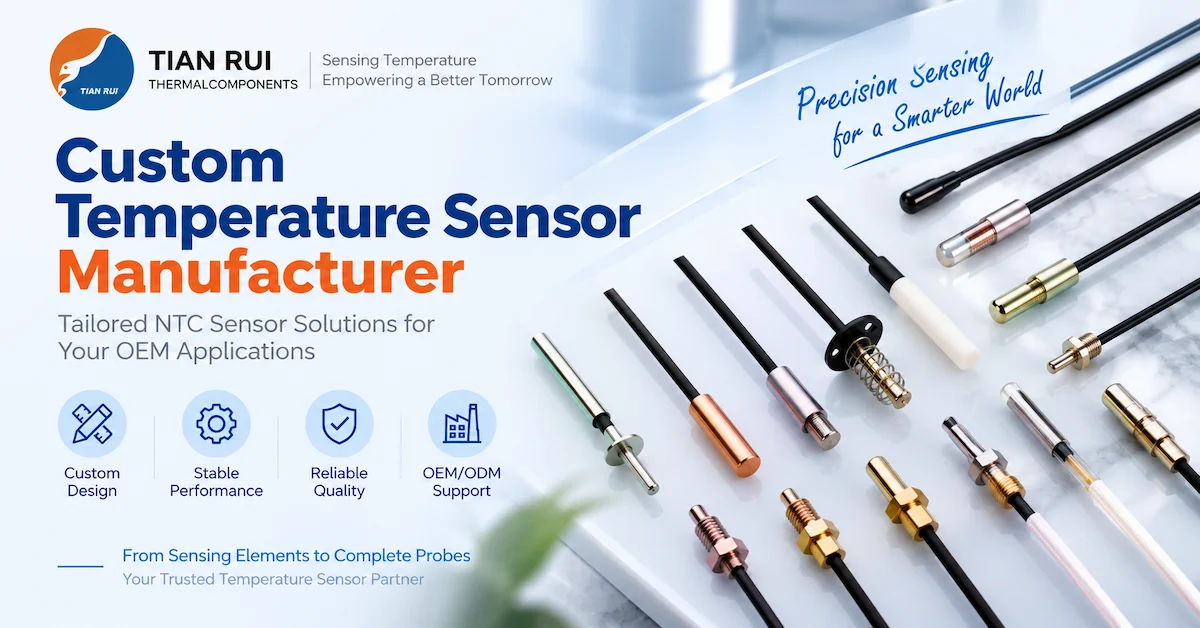
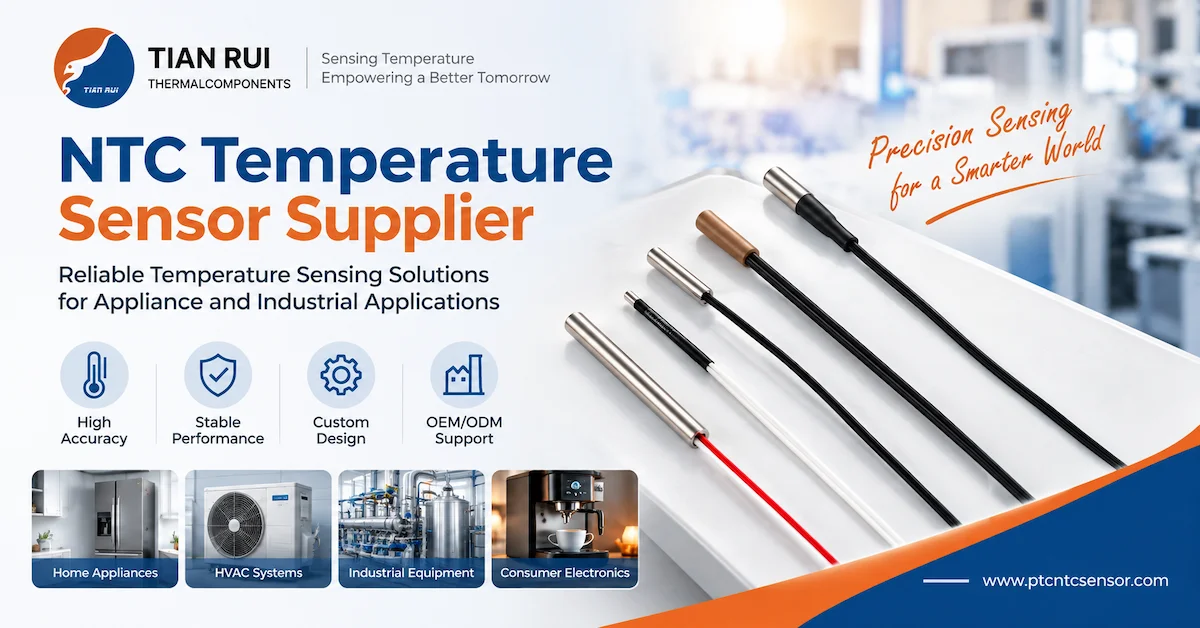
The finished probe usually contains more than the thermistor itself. Depending on the application, it can include the sensing element, electrical connections, encapsulation, stainless-steel or plastic housing, cable, connector, mounting component and sealing structure. Buyers can compare Tianrui’s broader NTC temperature sensor range with its NTC thermistor components to see the difference between a sensing element and an assembled probe. Tianrui’s catalog describes its NTC sensor assemblies as configurable in probe, housing, cable and connector form.
A custom manufacturer becomes particularly useful when the sensor must match a specific control board, mounting position, connector or environmental condition. If a completely standard probe already matches the existing equipment and no design changes are required, a distributor or stocked replacement part may sometimes be the simpler sourcing route.
Which OEM Buyers Usually Need Custom NTC Temperature Probes?
Custom probes are commonly relevant when the sensor is designed into the equipment rather than purchased as an occasional replacement part. Home-appliance manufacturers may need a compact probe for water heaters, coffee machines, refrigerators or washing equipment. HVAC and heat-pump manufacturers may need pipe, coil, air or water-temperature sensing. Automotive and industrial equipment projects may require a more specific housing, cable routing, connector or mounting method.
The design should begin with the sensing point rather than the industry name. “HVAC sensor,” for example, does not tell the manufacturer whether the probe will measure duct air, a pipe surface, a water tank or an evaporator. Tianrui’s application pages cover home appliances, automotive electronics and industrial equipment, but each actual project still needs a location-specific specification.
What Specifications Should You Send Before Requesting a Custom Probe?
An effective RFQ should contain both electrical and mechanical information. “10K NTC probe with one-meter wire” is not enough to establish compatibility. The following table can be used as a practical pre-RFQ checklist.
| Requirement | What the buyer should define | Why it matters |
|---|---|---|
| Sensing location | Air, pipe, liquid, metal surface, tank, coil or internal equipment area | Determines the probe form and thermal contact |
| R25 | Nominal resistance at 25°C | Establishes the reference electrical value |
| B value | B value plus its specified temperature interval | Helps define the R-T characteristic |
| R-T requirement | Resistance limits at application-relevant temperatures | Confirms controller compatibility |
| Tolerance | Required resistance or system-level tolerance | Prevents vague “high accuracy” requirements |
| Temperature range | Normal, storage and temporary exposure | Applies to thermistor, cable, encapsulation and connector |
| Probe dimensions | Diameter, length, thread or other geometry | Determines mechanical fit |
| Cable | Length, conductor and insulation requirements | Affects installation and temperature capability |
| Connector | Connector identity, terminals and pinout | Supports direct OEM assembly |
| Environment | Moisture, liquid, vibration, chemicals or pressure where applicable | Defines qualification requirements |
| Sample quantity | Prototype and pilot quantities | Supports development planning |
| Production forecast | Initial and recurring order demand | Supports material and capacity planning |
Tianrui’s current product-selection guidance similarly asks buyers to prepare operating and storage temperatures, resistance and B value, dimensions, housing, lead wire, connector, application conditions, test requirements and planned quantities before prototype work.
Why R25 Alone Cannot Define a Custom NTC Probe
Two probes can both be labeled “10K” and still behave differently once the temperature moves away from 25°C. R25 describes resistance at one reference temperature. The B value and complete R-T relationship determine how resistance changes as temperature changes.
This creates an important purchasing risk. Suppose an OEM has an existing 10K probe and requests a cheaper replacement from another manufacturer. Both samples pass a 25°C resistance check, but the replacement follows a different curve at 0°C or 80°C. The controller can then calculate a different temperature even though the room-temperature resistance appeared correct.
For replacement or second-source projects, provide the existing R-T table, controller specification or approved sample wherever possible. If those documents are unavailable, identify that information as a technical gap instead of assuming that nominal resistance alone proves compatibility.
How Should You Choose the Probe Structure?
The best probe structure depends on how heat reaches the sensing element and how the sensor is installed. Tianrui’s product range includes metal-shell NTC temperature sensors, plastic-shell assemblies and several specific probe geometries. A metal housing can provide mechanical protection, while a plastic structure may suit an electrically insulated or application-specific mounting arrangement. Neither is universally superior.
A useful way to compare structures is by installation function:
| Probe type | Main design advantage | Buyer should confirm | Typical application direction |
|---|---|---|---|
| Cylindrical metal probe | Compact protected sensing element | Diameter, length, cable exit and thermal contact | Appliances, tanks, equipment |
| Threaded probe | Positive mechanical retention | Thread, sealing method and insertion depth | Process ports, water systems |
| Button/contact probe | Larger surface-contact area | Mounting pressure and thermal interface | Heater or surface measurement |
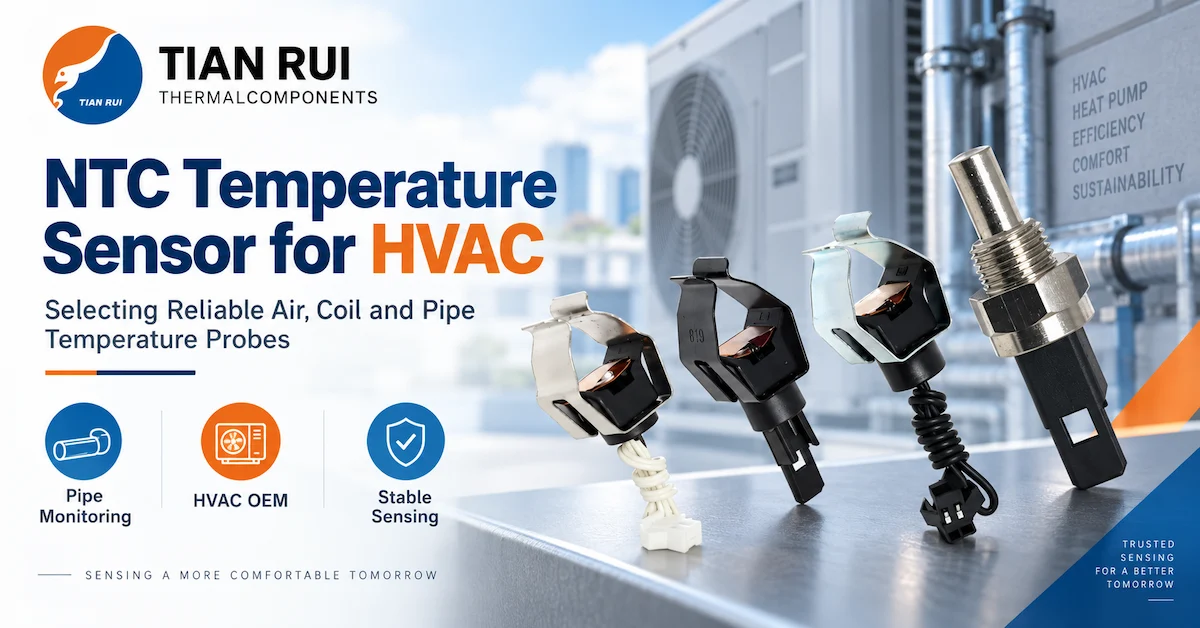
| Pipe-clamp probe | Measures externally without entering the fluid | Pipe diameter and contact repeatability | HVAC and refrigeration pipework |
| Waterproof probe | Designed for wet or liquid-related environments | Exact sealing condition and test requirement | Water heaters, tanks, wet equipment |
| Plastic-shell probe | Application-specific insulation and geometry | Housing dimensions and environmental suitability | Appliances and control systems |
Use Real Product Configurations During Supplier Evaluation
Instead of discussing only generic manufacturing capability, select one or two real products and ask how the supplier controls them.
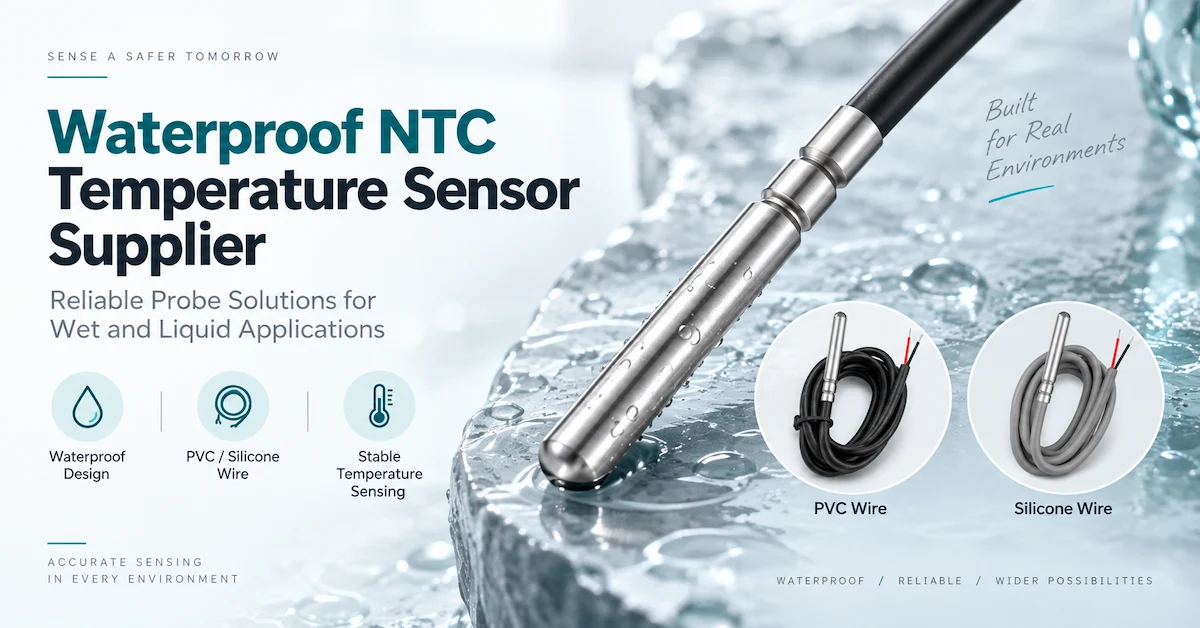
Tianrui’s 3×12mm stainless-steel NTC temperature probe is published with a 3×12mm stainless-steel probe, 10KΩ, B3435, 1% and UL1332 28AWG wire. These values describe that published configuration rather than every custom sensor the company can produce.
Its waterproof stainless-steel NTC probe lists several nominal resistance choices, B25/50 = 3950K ±1%, a specific -20°C to 150°C table entry and applications including water heaters and air conditioners. Again, those figures should be used as a configuration reference rather than automatically copied into an unrelated OEM project.
The pipe-clamp NTC temperature sensor provides another useful structure. Its published specification identifies a G12 clamp, 50KΩ ±1% thermistor, B25/50 = 3950K ±1% and defined cable and assembly components. It is intended for external surface measurement on piping rather than direct immersion.
Probe Housing, Cable and Connector Should Be Engineered Together
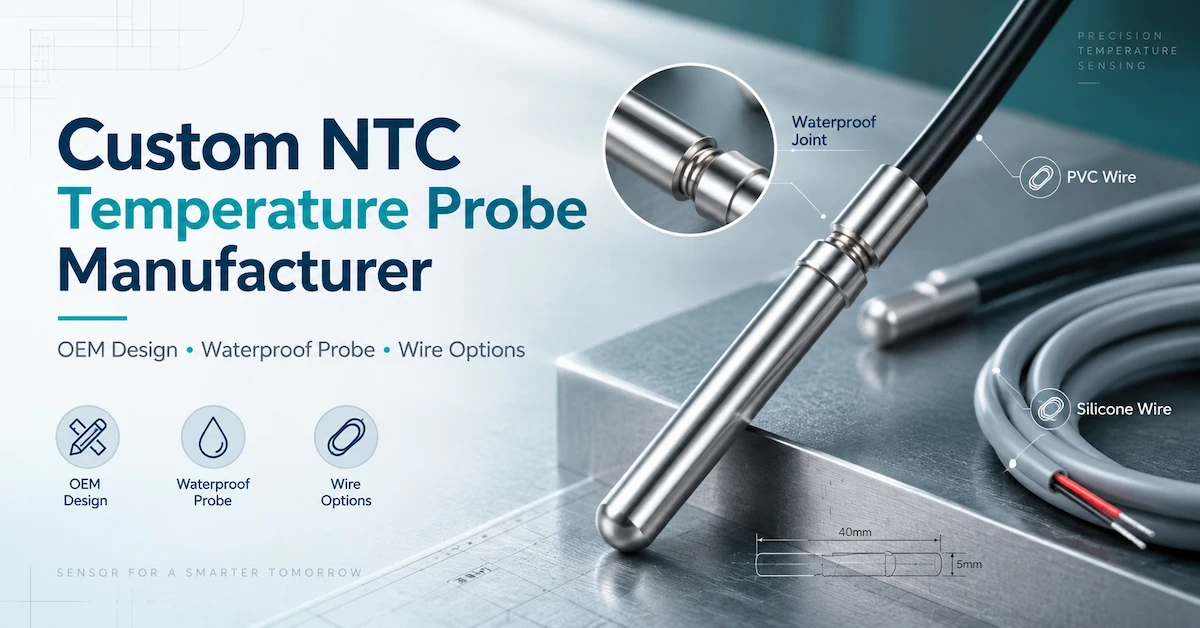
A custom probe is a complete assembly. Changing only one part can affect installation or performance elsewhere. A smaller stainless-steel sheath can alter thermal response; changing cable insulation can change flexibility or temperature capability; moving to a different connector can change the routing space required in the customer’s equipment.
For this reason, cable and connector decisions should not be delayed until after thermistor approval. Provide finished cable length, conductor requirement, insulation conditions, connector identity and any restrictions on bending or routing. If the sensor passes near a heater, motor, wet zone or moving component, describe that condition before samples are made.
Tianrui states that cable, connector and housing engineering are part of its custom sensor offering. The exact combination, however, still needs feasibility review for each project.
How Should Waterproof or Wet-Environment Probes Be Specified?
Do not use “waterproof” as the entire environmental specification. Condensation, splash exposure, intermittent immersion and continuous liquid contact are different conditions. Pressure and chemical compatibility are separate questions again.
For a custom wet-environment probe, define which part of the assembly contacts liquid and whether the cable or connector is also exposed. Review the probe sheath, internal encapsulation, electrical connection and cable exit as one sealing system. A stainless-steel housing by itself does not establish the environmental performance of the complete probe.
Where an ingress rating or customer-specific environmental test is mandatory, put the exact requirement into the RFQ and sample-validation plan. Do not assume a family-level marketing statement automatically applies to every customized cable, housing and connector combination.
How Should a Custom NTC Probe Manufacturer Control Workmanship?
Workmanship should be translated into measurable production controls. Buyers can ask how the thermistor is connected to the lead wires, how the sensing element is positioned inside the housing, how insulation is maintained, how filling or sealing material is applied, how cable exits are supported and how final dimensions are checked.
The goal is not to dictate the supplier’s process before engineering review. It is to identify which manufacturing variations could change the approved result. For example, inconsistent sensing-element depth can affect response; an uncontrolled cable transition can affect mechanical durability; an incorrect connector terminal can create an assembly failure even when the thermistor itself is correct.
A controlled drawing should therefore identify the dimensions and components that matter to the application.
How Should Samples Be Validated Before Production?
Sample approval works best when electrical compatibility, mechanical fit and installed performance are checked separately.
First, confirm resistance at the reference temperature and at other application-relevant points. Second, confirm probe dimensions, cable and connector fit. Third, install the sensor in representative equipment and evaluate its response in the real mounting position. If the project includes moisture, vibration or thermal cycling, add appropriate qualification tests according to the actual risk.
Keep the sample number, drawing revision, electrical specification and test results together. A statement such as “sample approved” is weak if purchasing cannot later identify exactly which construction engineering approved.
What Should Quality Control Cover in Repeat Production?
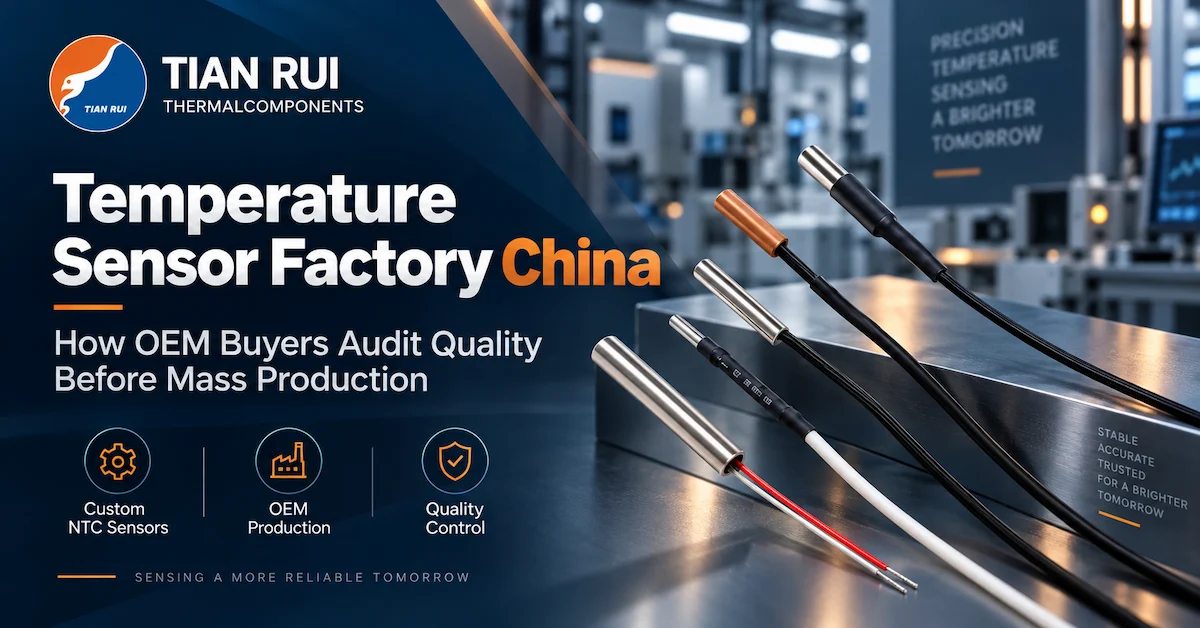
A Custom NTC Temperature Probe Manufacturer should be able to explain how the characteristics approved during development are maintained during production. Relevant controls may include incoming thermistor or component checks, electrical resistance testing, dimensions, cable and connector verification, assembly inspection and project-specific functional or environmental tests.
Qualification and routine inspection should not be confused. A long moisture or temperature-cycling test may be appropriate during development but impractical on every production unit. The supplier and customer should agree which characteristics are checked per unit, per lot or periodically.
If certificates or compliance documents are required, request the exact document, covered model and applicable scope. Do not convert a company certificate or a document for one component into an automatic compliance claim for every customized finished probe.
How Do Custom Probe Options Affect Cost?
The thermistor is only one part of the final cost. Probe material and dimensions, cable length, cable insulation, connector, terminals, sealing process, machining, molding, tooling, sample work, inspection and packaging can all affect quotation.
A useful price comparison therefore requires every manufacturer to quote the same drawing and quality scope. If one quotation includes a connector and waterproof validation while another includes only a bare lead wire, the unit prices are not comparable.
A second cost risk is unnecessary customization. If a standard cylindrical probe already satisfies the electrical and mechanical requirements, developing a new housing may add tooling and qualification work without meaningful product value. Customization should solve a specific equipment problem.
How Should Buyers Evaluate Capacity and Lead Time?
Do not use one factory-wide production number as the only evidence that a custom probe can be delivered on schedule. Capacity for a specific sensor may depend on special cable, connectors, housings, molding, sealing operations and inspection requirements.
Separate the schedule into engineering review, samples, sample revision, pilot production and normal volume production. Clarify when the lead-time clock begins: after RFQ, drawing approval, purchase order, sample approval or material confirmation.
The manufacturer should also identify any long-lead custom component early. A special connector can sometimes control the project schedule even when thermistor production itself is straightforward.
What Does a Practical OEM/ODM Development Process Look Like?
For most custom NTC probe projects, the development path can be kept clear: define the application, confirm electrical requirements, select the housing and mounting structure, define cable and connector requirements, issue a controlled drawing, produce samples, validate them in the intended equipment, freeze the approved revision and release production.
Tianrui states that its custom sensor workflow supports product teams from sensor selection and prototype development through testing and volume production, with customizable resistance, B value, temperature range, cables, connectors and housings. Buyers can review the NTC temperature sensor portfolio before submitting a project.
For a useful first review, send the sensing location, R25, B value or R-T data, target temperature range, probe dimensions, cable, connector, environmental conditions, sample quantity and expected production volume through the Tianrui contact page. Unknown values should be identified as open engineering questions instead of guessed.
Frequently Asked Questions
What Does a Custom NTC Temperature Probe Manufacturer Customize?
Depending on the project, customization can include nominal resistance, B value, tolerance, probe dimensions, housing structure, cable length and insulation, connector, terminals and mounting configuration. Feasibility still needs to be evaluated for the complete combination.
Is a 10K NTC Probe Enough Information for a Quotation?
Usually not for an OEM project. A useful quotation should also define the B value and interval, R-T requirements, tolerance, probe construction, temperature range, cable, connector and installation environment.
Can Two 10K NTC Probes Be Interchanged?
Not automatically. They can have the same R25 while using different B values or R-T curves. Their housings, thermal response, cable and environmental performance may also differ.
Can Probe Dimensions Be Customized?
Yes, probe geometry can be discussed as part of custom development. The manufacturer should review how dimensions influence installation, thermal response, housing construction and manufacturability before releasing a drawing.
Can the Wire and Connector Be Customized?
Tianrui lists cable and connector engineering among its custom sensor capabilities. Provide the required cable length, insulation condition, connector identity, terminals and pin arrangement during RFQ review.
Should I Choose a Stainless-Steel or Plastic Probe?
Choose based on mechanical protection, insulation, mounting and environment rather than assuming one material is universally superior. The complete sensing assembly and installation method matter more than the housing name alone.
How Should a Waterproof Custom Probe Be Tested?
Define the actual exposure first. Then verify electrical performance before and after the agreed moisture, immersion or environmental test. The cable exit and connector conditions should be included where they are exposed in the final equipment.
How Many Temperature Points Should Be Checked During Sampling?
There is no universal number. Select points relevant to the control system’s operating range and decision thresholds. One check at 25°C is often insufficient when the product operates across a broad temperature range.
What Causes Custom NTC Probe Prices to Vary?
Cost can change with the thermistor specification, probe material and geometry, cable, connector, sealing method, tooling, test requirements, packaging and order quantity. Compare suppliers using the same specification.
What Should I Send Before Requesting an OEM Sample?
Provide the application, sensing position, electrical requirements, operating environment, probe dimensions, cable, connector, quantity and validation expectations. A drawing, existing sample or controller R-T specification is particularly helpful.
Conclusion
Choosing a Custom NTC Temperature Probe Manufacturer is ultimately about controlling the relationship between the sensing element, electrical curve, probe construction and the equipment in which the sensor will operate. OEM buyers should define the measurement task first, then confirm R25, B value and R-T requirements, probe geometry, cable, connector, environmental exposure and sample-validation method before approving production. A clear drawing and controlled sample revision make quotations easier to compare and reduce the risk of receiving a technically different part during repeat orders. For a new appliance, HVAC, automotive or industrial sensor project, review Tianrui’s NTC temperature sensor range and submit your custom probe requirements for engineering review and sample discussion.