Quick Answer: What Should Buyers Check When Choosing an Industrial Temperature Sensor Supplier?
A reliable Industrial Temperature Sensor Supplier should provide more than a standard sensing component. Industrial buyers should evaluate electrical compatibility, probe structure, environmental resistance, customization capability and production consistency before selecting a supplier. The right supplier should understand the actual measurement location, controller requirements and operating conditions to provide a temperature sensing solution that can be validated and reproduced during mass production.
For industrial OEM projects, the sensor is not an isolated component. It works together with the control system, mechanical structure and operating environment. A sensor with the wrong resistance curve, unsuitable housing or unstable assembly process may affect equipment performance even if the product looks identical to an approved sample.
Why Choosing the Right Industrial Temperature Sensor Supplier Matters
Industrial equipment often operates under complex conditions, including continuous operation, temperature cycling, vibration, moisture, dust and mechanical stress. In these environments, temperature sensors play an important role in monitoring equipment status and supporting control decisions.
For equipment manufacturers, selecting an Industrial Temperature Sensor Supplier is not only about finding a sensor with the correct resistance value. Buyers also need to confirm:
- Whether the sensor matches the controller input
- Whether the probe structure fits the installation position
- Whether the materials can handle the operating environment
- Whether the supplier can maintain consistency during repeat production
Common industrial applications include:
- Industrial automation equipment
- Heating and cooling systems
- Control cabinets
- Pumps and motors
- Energy equipment
- Processing machinery
- Laboratory equipment
Tianrui provides NTC temperature sensor solutions for different application requirements, including customized probe structures, cables and connectors.
What Is an Industrial Temperature Sensor?
An industrial temperature sensor is a component designed to measure temperature changes in equipment and provide feedback to a control system.
For NTC-based temperature sensors, the sensing element changes resistance according to temperature variation. The electronic controller reads this resistance change and converts it into temperature information.
A complete industrial temperature sensor may include:
| Component | Function |
|---|---|
| NTC thermistor element | Detects temperature changes |
| Probe housing | Protects the sensing element |
| Cable assembly | Transfers electrical signals |
| Connector | Connects with equipment wiring |
| Encapsulation material | Provides protection and stability |
| Mounting structure | Ensures correct installation |
The difference between an NTC thermistor and a finished temperature sensor is important during sourcing. A bare thermistor requires additional customer-side integration, while a finished probe usually includes the mechanical and electrical components required for installation.
Tianrui provides both NTC thermistors and complete NTC temperature sensor assemblies for different OEM applications.
Who Needs an Industrial Temperature Sensor Supplier?
Industrial Equipment Manufacturers
Industrial equipment manufacturers usually require sensors that provide:
- Stable temperature measurement
- Long-term supply reliability
- Consistent production quality
- Customized dimensions
- Easy integration with existing systems
For these customers, the supplier’s ability to support engineering communication is often as important as the product itself.
Automation and Control System Companies
Automation applications usually focus on:
- Accurate temperature feedback
- Stable electrical characteristics
- Compatibility with control boards
- Repeatable sensor performance
The sensor must work correctly with the entire control system instead of only meeting standalone specifications.
Heating and Cooling Equipment Manufacturers
Heating and cooling equipment may require different sensor structures depending on the measurement point.
Examples include:
- Air temperature sensing
- Pipe temperature monitoring
- Surface temperature measurement
- Liquid temperature detection
The correct sensor depends on where the temperature needs to be measured.
What Specifications Should Buyers Provide Before Ordering?
Many sourcing problems happen because buyers provide incomplete information. A request such as “10K temperature sensor” does not define a complete industrial application.
Before contacting an Industrial Temperature Sensor Supplier, buyers should prepare:
| Specification | Details to Confirm |
|---|---|
| Sensor type | NTC sensor, probe sensor or custom assembly |
| Resistance value | R25 requirement |
| B value | Temperature-resistance characteristic |
| Temperature range | Normal and maximum operating conditions |
| Accuracy requirement | Allowed tolerance |
| Installation location | Air, surface, pipe, liquid or equipment area |
| Probe size | Diameter, length and mounting dimensions |
| Cable requirement | Length, insulation and flexibility |
| Connector | Type and wiring configuration |
| Environment | Moisture, vibration, dust or chemicals |
| Quantity | Sample and production requirements |
A complete specification helps suppliers recommend the correct structure instead of making assumptions.
Why R25 and B Value Are Important for Industrial Sensors
R25 Does Not Define the Complete Sensor Performance
R25 represents the nominal resistance value at 25°C, but it does not describe the complete behavior of an NTC sensor.
Two sensors can both be labeled as 10K NTC sensors while having different:
- B values
- Resistance-temperature curves
- Temperature tolerances
- Response characteristics
This means two sensors may appear identical at room temperature but provide different readings at actual operating temperatures.
The R-T Curve Determines Controller Compatibility
For industrial applications, buyers should evaluate:
- R25 value
- B value
- R-T curve
- Operating temperature range
- Measurement tolerance
Tianrui's NTC temperature sensor guide explains the importance of resistance characteristics when selecting NTC sensors.
How to Select the Right Industrial Temperature Sensor Structure
The sensor structure should match the installation environment.
Metal Shell NTC Temperature Sensors
Metal shell sensors are commonly selected when mechanical protection and durability are important.
Advantages include:
- Strong protection
- Stable mechanical structure
- Suitable for compact equipment installation
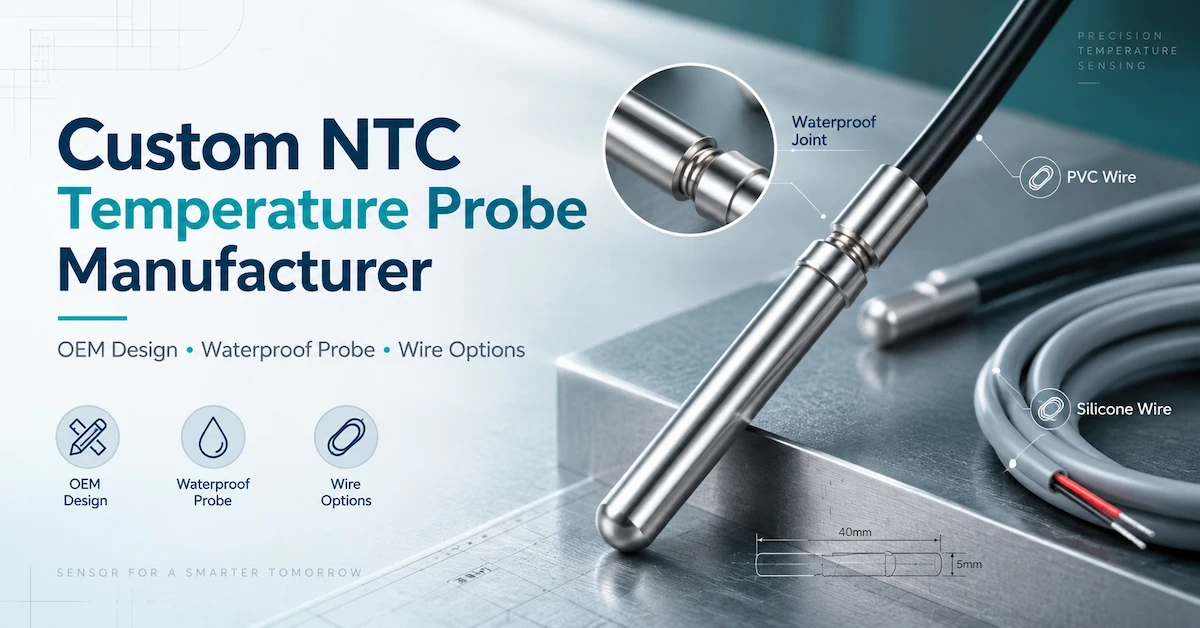
Tianrui provides metal shell NTC temperature sensors for different industrial applications.
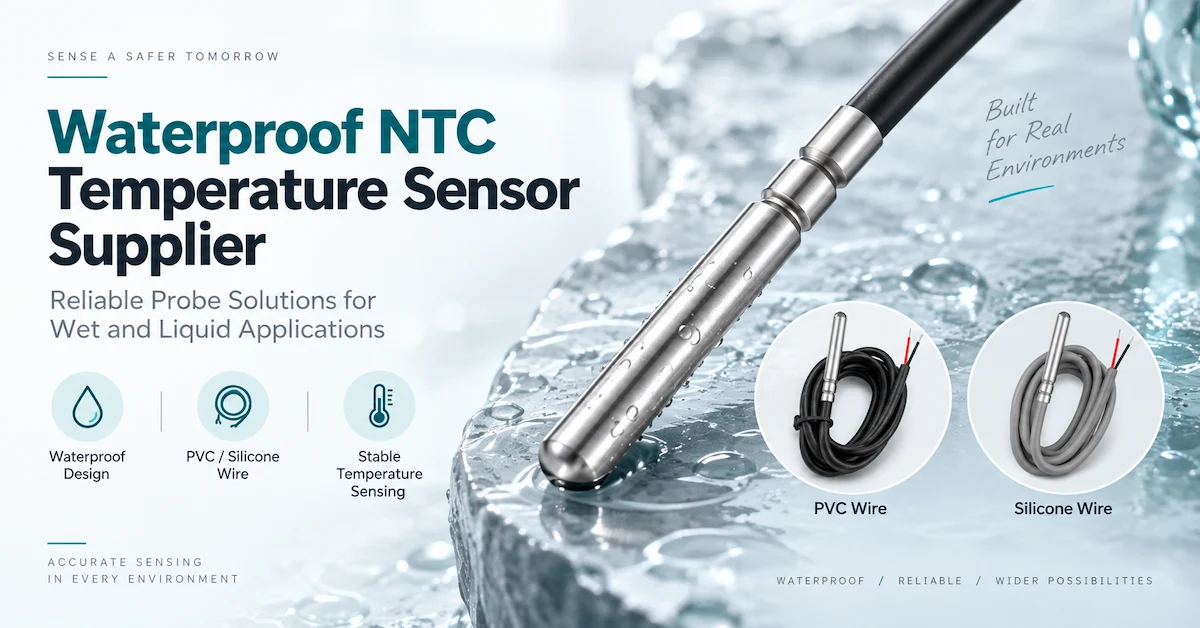
Waterproof NTC Temperature Sensors
When sensors operate in humid or liquid environments, buyers should evaluate:
- Sealing method
- Cable protection
- Housing material
- Environmental testing
A stainless-steel housing alone does not automatically mean the complete sensor is waterproof. The entire assembly needs evaluation.
Pipe Temperature Sensors
Pipe temperature measurement requires attention to:
- Contact position
- Mounting method
- Thermal transfer
- Installation consistency
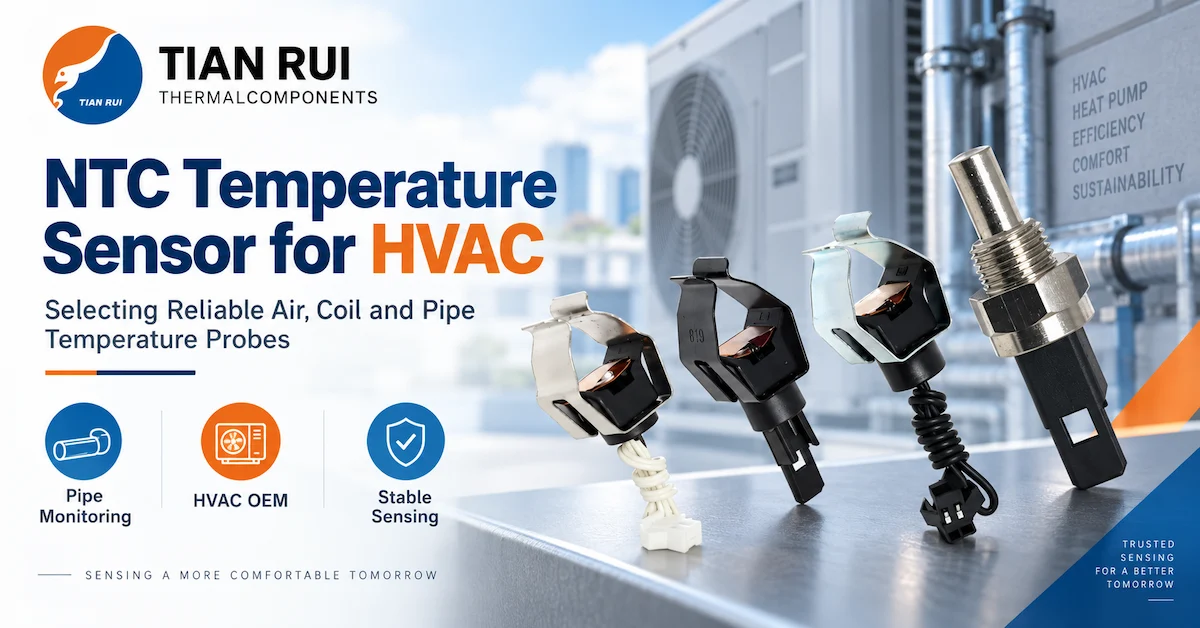
Tianrui provides pipe clamp NTC temperature sensors for external pipe temperature monitoring applications.
How Should Buyers Compare Different Industrial Temperature Sensors?
| Sensor Type | Main Feature | Suitable Applications |
|---|---|---|
| NTC thermistor element | Compact sensing component | Customer-designed assemblies |
| Stainless steel probe sensor | Mechanical protection | Industrial equipment |
| Waterproof NTC sensor | Moisture-resistant structure | Wet environments |
| Pipe clamp sensor | External pipe measurement | HVAC and industrial piping |
| Thin film NTC sensor | Small size and low thermal mass | Compact electronic systems |
The best sensor is not determined only by product category. It depends on the actual application requirements.
Why Customization Is Important for Industrial Temperature Sensors
Many industrial projects cannot directly use standard sensors because of:
- Limited installation space
- Special connectors
- Different cable routing
- Specific temperature ranges
- Unique mounting requirements
A capable supplier should support customization in:
- Resistance value
- B value
- Probe dimensions
- Housing design
- Cable length
- Connector configuration
Tianrui provides custom temperature sensor solutions for OEM projects requiring different sensor configurations.
How Should Industrial Temperature Sensors Be Tested Before Production?
Sample validation should include several stages.
Electrical Testing
Confirm:
- Resistance value
- R-T characteristics
- Temperature response
- Controller compatibility
Mechanical Testing
Check:
- Probe dimensions
- Cable routing
- Connector compatibility
- Installation method
Environmental Testing
Depending on the application, testing may include:
- Temperature cycling
- Moisture exposure
- Vibration testing
- Mechanical stress evaluation
The testing method should match the actual working environment.
What Quality Control Should an Industrial Temperature Sensor Supplier Provide?
A reliable supplier should explain how product consistency is maintained during production.
Important quality-control areas include:
| Quality Area | Key Check |
|---|---|
| Incoming materials | Component inspection |
| Production process | Assembly control |
| Electrical testing | Resistance verification |
| Dimensional inspection | Probe and cable checking |
| Final inspection | Finished product verification |
| Change management | Approval before modifications |
Quality control should connect directly with the approved specification.
A sample approval without production control does not guarantee long-term consistency.
How Does OEM Development Work for Industrial Temperature Sensors?
A typical OEM development process includes:
Step 1: Application Review
Define:
- Measurement location
- Temperature range
- Environmental conditions
- Installation requirements
Step 2: Sensor Specification Confirmation
Confirm:
- Resistance value
- B value
- Probe structure
- Cable and connector requirements
Step 3: Sample Development
The supplier prepares samples according to the approved specification.
Step 4: Customer Validation
The customer tests the sensor inside the actual equipment.
Step 5: Mass Production Approval
After validation, the approved design becomes the production reference.
Buyers can review Tianrui’s NTC temperature sensor products and submit project requirements through the contact page.
Frequently Asked Questions
What should I provide when contacting an Industrial Temperature Sensor Supplier?
Provide the application, temperature range, resistance requirement, probe dimensions, cable information, installation environment and expected quantity.
Are all industrial NTC sensors interchangeable?
No. Different sensors may have different resistance-temperature curves, tolerances, structures and environmental performance.
How do I choose between a thermistor and a finished temperature probe?
A thermistor is suitable when customers design their own assembly. A finished probe is better when the customer needs a ready-to-install sensor.
Can industrial temperature sensors be customized?
Yes. Customization may include resistance, B value, probe size, cable length, connector and housing structure.
Does stainless steel mean the sensor is waterproof?
No. Waterproof performance depends on the complete assembly, including sealing, cable and connection design.
What industries use industrial temperature sensors?
Applications include industrial machinery, HVAC systems, automation equipment, energy systems and electronic devices.
Why is sensor installation location important?
Because the sensor measures temperature at its actual position. Incorrect placement can create differences between measured and real equipment temperature.
How should sensor samples be approved?
Verify electrical performance, mechanical installation and environmental requirements before production approval.
What affects industrial sensor lead time?
Customization level, materials, connectors, testing requirements and production quantity can affect delivery schedules.
How can I request an OEM temperature sensor quotation?
Prepare application information, technical requirements and quantity details, then contact the supplier for engineering review.
Conclusion
Choosing the right Industrial Temperature Sensor Supplier requires evaluating the complete sensing solution rather than selecting a product based only on resistance value or appearance. Industrial OEM buyers should consider electrical characteristics, probe structure, environmental requirements, customization capability and production quality control before approving a supplier.
A reliable supplier should help transform equipment requirements into a stable temperature sensing solution that can be validated and reproduced during mass production.
Review Tianrui’s industrial temperature sensor solutions and contact Tianrui with your application requirements for sensor selection and OEM development.