How Should OEM Buyers Evaluate a Temperature Sensor Factory China?
A Temperature Sensor Factory China should be evaluated on its ability to turn a sensing requirement into a repeatable production specification, not simply on factory photos, a low quotation or the number of sensor models in a catalog. For an OEM buyer, the useful questions are whether the factory understands the required sensing technology, can define electrical and mechanical parameters, can prepare samples against measurable criteria, can control changes after approval and can reproduce the agreed construction during repeat orders. Tianrui presents itself as a Dongguan-based manufacturer of PTC and NTC thermistors, temperature sensors and thermal components, with support extending from requirement review and prototype development to testing and volume production. Buyers can first review the temperature sensor product range before deciding which factory capabilities need to be audited for a specific project.
What Does “Factory” Actually Mean in Temperature Sensor Sourcing?
For a design-in component, “factory” should mean more than having a production address. Ask which operations are performed or controlled in-house, who owns the electrical specification, where probe assembly takes place, how incoming components are inspected, which tests are performed before shipment and who approves process or material changes. A factory may still purchase cables, connectors, metal housings or other components from specialist suppliers, so the important issue is not whether every material is made under one roof; it is whether the manufacturer has control over the specification, incoming quality, assembly process, testing and approved changes. Tianrui’s official company information states that Dongguan Tianrui Electronics Co., Ltd. was founded in 2010 and operates an approximately 5,000 m² facility with automated production equipment and dedicated testing instruments. The company also reports annual production volume close to 100 million pieces; OEM buyers should still confirm capacity specifically for the sensor assembly being quoted rather than treating a company-wide figure as capacity for every model. Review the Tianrui company profile when preparing a supplier audit.
Confirm the Factory’s Real Product Scope Before Comparing Suppliers
The term “temperature sensor” covers different technologies and finished forms, so buyers should establish the product scope before comparing factories. Tianrui’s current product system includes PTC heaters, PTC thermistors, thermostatic PTC heating elements, NTC thermistors and assembled NTC temperature sensors. For temperature-measurement projects, the most relevant path is generally from an NTC thermistor to a finished NTC temperature sensor assembly with an application-specific probe, housing, cable and connector. This distinction matters during factory qualification because manufacturing a bare thermistor and assembling a finished probe involve different process controls.If your project uses another sensing technology, verify that manufacturing and testing capability separately instead of assuming that every product appearing in a temperature-sensor catalog follows the same process.
What Evidence Should You Request from a Temperature Sensor Factory?
Do not build a factory audit around marketing claims such as “high precision,” “stable quality” or “advanced equipment.” Convert each claim into something that can be checked. The following table can be used as a practical supplier-qualification checklist.
| Factory audit area | Evidence or explanation to request | Procurement risk it helps control |
|---|---|---|
| Product technology | Electrical specification,R-T data and product structure | Wrong sensor selected for the controller |
| Engineering ownership | Controlled drawing and specification revision | Supplier and buyer working from different versions |
| Incoming materials | Defined material/component requirements and inspection method | Uncontrolled substitutions |
| Probe assembly | Process flow and critical assembly controls | Variation in position, sealing or connection |
| Electrical testing | Test points,equipment and acceptance limits | Sensors pass appearance checks but fail electrically |
| Mechanical inspection | Probe dimensions, cable and connector checks | Installation problems during assembly |
| Sample control | Sample ID,drawing revision and test record | Approved sample differs from production |
| Production traceability | Batch or lot identification where required | Difficult root-cause investigation |
| Change management | Notification and approval process | Silent material or process changes |
| Capacity planning | Capacity for the exact assembly and order forecast | Delivery risk during volume production |
Send a Complete RFQ Before Asking for a Price
A Temperature Sensor Factory China cannot make an accurate technical recommendation from “10K sensor, one-meter cable, best price.” A useful RFQ tells the factory what must be measured, how the sensor communicates that temperature to the controller, where the probe is mounted and what the complete assembly experiences during operation. Tianrui’s product-selection information asks buyers to prepare operating temperature, thermistor resistance and B value, dimensions, housing, lead wire, connector, application conditions, test conditions, sample quantity and planned production quantity. Giving every candidate factory the same RFQ also makes quotations genuinely comparable instead of comparing different interpretations of an incomplete request.
| RFQ item | Information to provide | Why the factory needs it |
|---|---|---|
| Application | Equipment and sensing location | Establishes the real measurement task |
| R25 | Required resistance at 25°C | Defines a key electrical reference |
| B value | Value and specified temperature interval | Helps define the resistance-temperature curve |
| R-T requirement | Resistance values or controller requirement across relevant temperatures | Confirms electrical compatibility |
| Operating environment | Temperature, humidity, liquid, vibration or other exposure | Guides assembly and material selection |
| Probe structure | Diameter, length, thread, clip or mounting geometry | Confirms mechanical fit |
| Cable | Type,length and routing conditions | Prevents installation and temperature-rating conflicts |
| Connector | Connector and terminal requirement | Supports direct OEM assembly |
| Sample requirement | Quantity and validation plan | Defines development scope |
| Production forecast | Initial order and expected repeat volume | Supports capacity and material planning |
Why R25 and B Value Matter During Factory Qualification
NTC temperature sensing depends on a defined resistance-temperature relationship. R25 tells you the nominal resistance at 25°C, but one room-temperature value does not establish compatibility across the entire operating range. The B value and the relevant R-T data also matter.Consider two samples that both measure close to 10kΩ at 25°C: they may still produce different resistance values at another control point if their curves are different. A purchasing team that approves only the room-temperature resistance may therefore accept a sensor that physically fits but does not match the controller correctly. When qualifying an NTC sensor factory, ask how the electrical characteristic is defined, measured and recorded, then validate the finished sensor with the real controller. Tianrui’s thermistor solution resources provide a useful product-level starting point for discussing thermistor requirements.
How Should Probe Construction Be Compared?
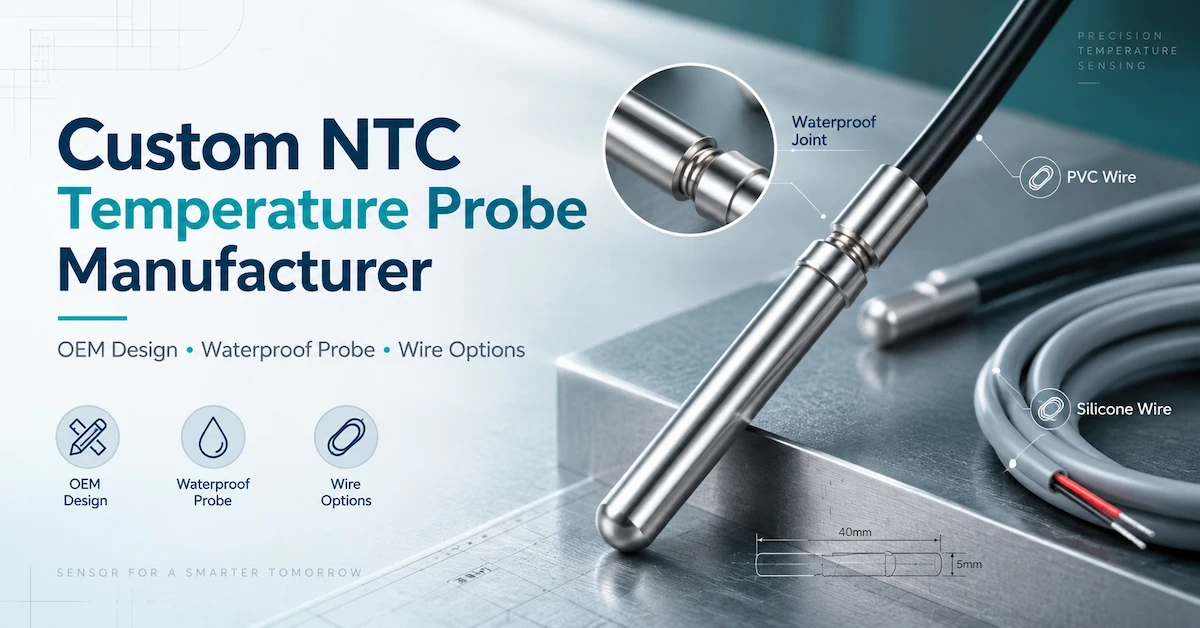
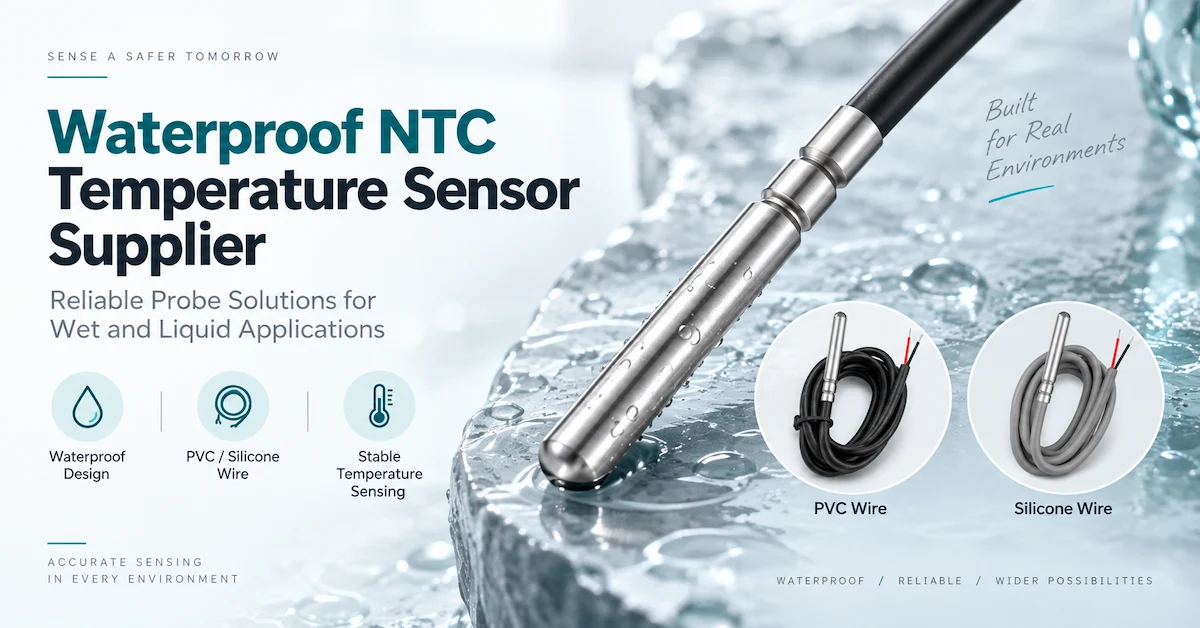
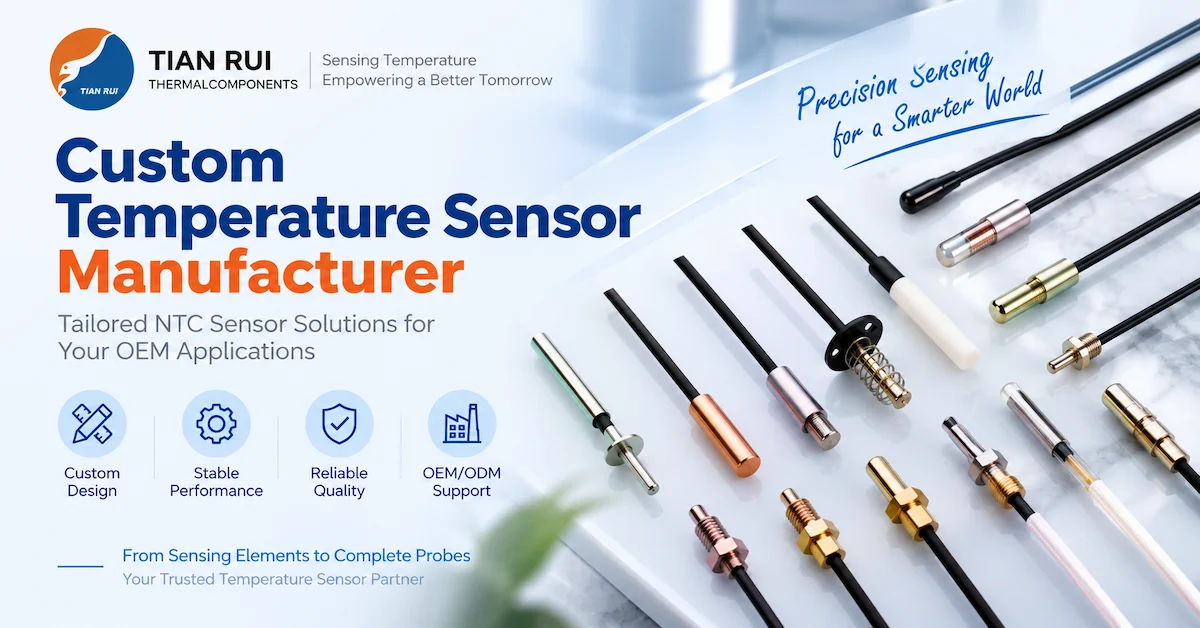
The best probe structure depends on the sensing location rather than on which housing looks more durable. Tianrui currently offers different temperature-sensor structures, including metal shell NTC temperature sensors and plastic shell NTC temperature sensors. A metal probe may suit a mechanically protected insertion or contact-sensing position, while a plastic housing can suit a different mounting or insulation requirement. Neither should be chosen from material name alone. Ask how the sensing element is positioned, how heat reaches it, how the cable exit is constructed and whether the complete probe has been evaluated for the actual environment. The same principle applies to threaded, button, cylindrical and other forms: mechanical geometry is part of the sensing system because it affects mounting and thermal response.
| Sensor form | Main purchasing question | Suitable evaluation focus |
|---|---|---|
| Cylindrical metal probe | Does it fit the hole, pocket or sensing location? | Diameter, length, thermal contact and cable exit |
| Threaded probe | Does thread and insertion depth match the equipment? | Thread specification,sealing and installation torque |
| Contact/button style | Can contact with the measured surface remain consistent? | Contact area, mounting pressure and response |
| Plastic housing | Does the molded form match the equipment structure? | Dimensions, insulation, mounting and environmental exposure |
| Bare/encapsulated thermistor | Will the customer perform final assembly? | Electrical curve, encapsulation and downstream process |
Use a Specific Product to Verify Factory-to-Drawing Capability
A useful factory audit includes at least one real product drawing rather than only a company presentation. Tianrui’s 3×12 mm stainless steel NTC temperature probe provides a simple example: the published specification identifies a stainless-steel probe, 3×12 mm probe size, a 10KΩ/3435/1% NTC configuration and UL1332 28AWG wire. Instead of treating these figures as a universal factory standard, use a product like this to ask practical questions: which parameters are controlled on the drawing, which can be customized, which are verified in production and how a changed cable or probe dimension would be documented. This turns a product listing into a meaningful manufacturing discussion.
How Should Samples Move from Prototype to Mass Production?
A factory qualification process should preserve a clear link between the approved sample and the production specification. A practical sequence is: application requirement → engineering review → drawing and electrical specification → prototype/sample → electrical and dimensional verification → customer equipment validation → approved revision → production release. Tianrui describes a similar development path for NTC sensor projects, beginning with application, temperature range, R25, B value and installation requirements, followed by engineering evaluation, samples, customer validation, specification confirmation and mass production.The important procurement control is the “specification confirmation” stage. Do not approve only a physical sample sitting on an engineer’s desk; link the approved sample to its drawing, electrical data, cable, connector and revision so the purchasing team knows exactly what should arrive in future orders.
What Quality Controls Matter Most in a Temperature Sensor Factory?
Quality control should follow the risks of the product and application. Tianrui’s current manufacturing information describes incoming material inspection, electrical/performance testing, process quality control and final inspection/reliability verification. For an NTC probe, an OEM buyer should ask which of these controls apply to the exact assembly under review and what the acceptance criteria are. Depending on the design, relevant checks may include resistance at defined conditions, dimensions, visual assembly, cable or connector verification and other project-specific environmental or mechanical checks. Qualification tests and routine production inspection should be kept separate: a test used during development does not automatically mean every shipped sensor receives that same test. Ask for a control plan or equivalent explanation that connects each critical specification to an inspection or process-control method.
Temperature Sensor Factory vs Trading Company: Which Is Better for an OEM Project?
A trading company is not automatically a poor sourcing choice, and a factory is not automatically qualified simply because it owns equipment. The correct choice depends on the project. A distributor or trader can be useful when buyers want small quantities, several brands or consolidated sourcing. Direct factory cooperation becomes more valuable when the sensor is designed into the equipment, requires custom electrical or mechanical specifications, needs several sample revisions or must remain consistent over repeat production. For OEM programs, the advantage is shorter technical communication between design, production and quality teams—not the word “factory” itself.
| Sourcing factor | Direct factory relationship | Trader/distributor relationship |
|---|---|---|
| Custom engineering | Easier to discuss directly with production/engineering | May require communication through another layer |
| Small mixed purchases | May not always be the most convenient | Can be useful for consolidated low-volume sourcing |
| Drawing revisions | Usually easier to trace to manufacturing | Depends on communication with the actual factory |
| Process questions | Buyer can request direct manufacturing explanation | Information may come through the intermediary |
| Standard replacement parts | May be unnecessary if no customization is needed | Often practical |
| Long-term OEM design-in | Strong reason to evaluate direct manufacturing control | Requires clear visibility of the actual producer |
Which Applications Need Different Factory Evaluation Criteria?
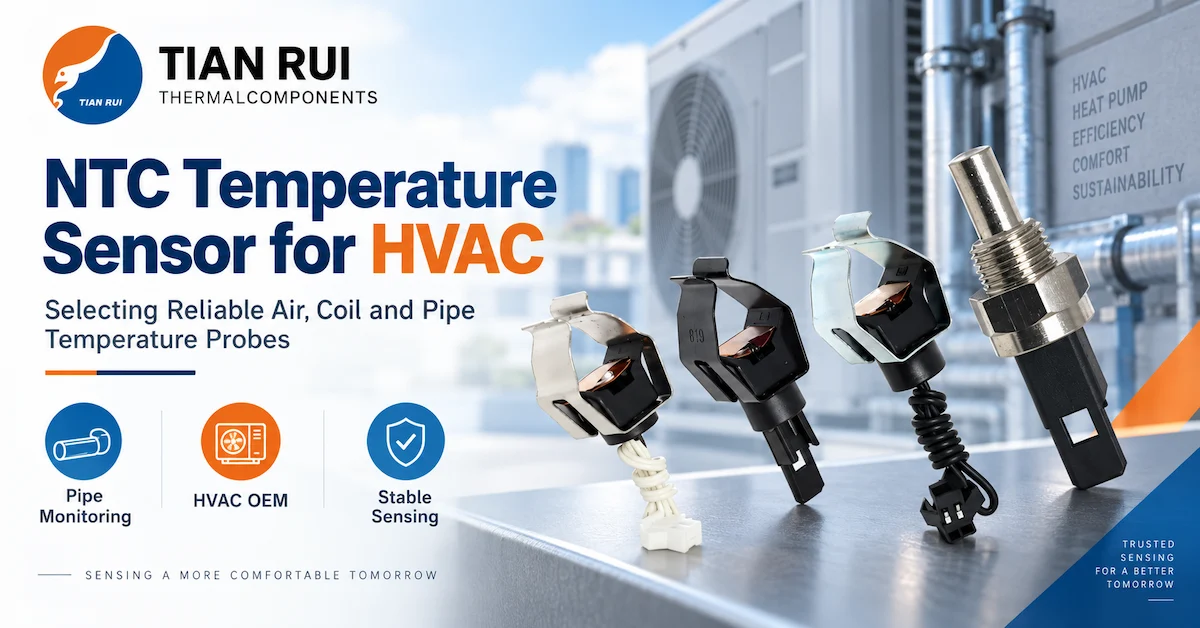
A Temperature Sensor Factory China should not present one probe as a universal solution for every industry.In home appliance applications, buyers may care about compact installation, moisture, repeated thermal cycling and production-line assembly. In automotive electronics, project-specific electrical, mechanical and environmental validation becomes especially important. Industrial equipment projects may involve pipe, surface, enclosure or process-temperature monitoring, while consumer electronics and electrical applications can impose different space, response and integration constraints.A good supplier discussion therefore begins with the actual sensing position, not only the industry name.
How Do You Evaluate Capacity and Lead Time Without Being Misled by a Large Number?
Factory-wide production volume is useful background information, but it does not tell you how quickly one customized probe can be produced. Capacity for a sensor assembly can depend on thermistor availability, metal or plastic housings, cable, connectors, sealing processes, inspection requirements and the time needed for customer approval. Ask a candidate factory to separate prototype timing, sample revision timing, pilot production and normal repeat-order lead time. Also clarify the event that starts the clock: RFQ receipt, drawing approval, purchase order, material confirmation or sample approval. Tianrui’s company information reports large-scale production capability, but OEM buyers should still request project-specific capacity and delivery planning for the selected configuration. This distinction prevents a common sourcing error: using total company output as evidence that any custom model can be delivered immediately.
What Really Determines the Cost of a China-Made Temperature Sensor?
Unit price is influenced by more than the thermistor itself.Probe housing, machining or forming, cable type and length, connector and terminals, encapsulation, custom tooling, testing, packaging, sample work and order quantity may all change the quotation. When comparing factories, make sure each bidder is pricing the same revision and the same scope. A quote that excludes a connector or project-specific test can look cheaper without actually representing a lower finished cost. Ask each supplier to identify tooling charges, sample costs and non-standard inspection requirements separately when applicable. For a custom program, the most useful commercial comparison is same specification + same quantity + same test scope + same packaging requirement, not simply the lowest unit-price column in a spreadsheet.
Which Factory Red Flags Should OEM Buyers Watch For?
Several warning signs deserve attention: the supplier quotes immediately without asking about the application; a “10K” sensor is proposed without checking the required B value or R-T relationship; no controlled drawing is provided for a custom assembly; the supplier cannot explain which sample revision was approved; housing material is used as proof of environmental performance without a defined test; factory capacity is discussed only as one large company-wide number; changes to the cable, connector, thermistor or encapsulation do not require notification; or production inspection is described only as “100% quality check” without explaining what is measured. None of these points alone proves a supplier is unsuitable, but each should trigger a more specific question before a mass-production order is released.
Why Evaluate Tianrui as a Temperature Sensor Factory in China?
Dongguan Tianrui Electronics Co., Ltd. states that it was established in 2010 and operates an approximately 5,000 m² production facility in Dongguan with automated production equipment and dedicated testing instruments.Its current website presents PTC and NTC thermistors, NTC temperature sensors, PTC heating elements and heaters, while its temperature-sensor offering includes configurable probe assemblies, housings, cables and connectors. For an OEM buyer, these published capabilities are a starting point for qualification rather than a substitute for project-specific approval. The next step should be to match your application, drawing, electrical requirements, testing needs and projected order quantity to the actual manufacturing process. You can review Tianrui’s product portfolio and then submit your temperature sensor requirements for engineering and quotation discussion.
Frequently Asked Questions
Is a Temperature Sensor Factory China always cheaper than a distributor?
Not necessarily.Direct factory sourcing can reduce communication layers for customized OEM projects, but total cost also depends on order quantity, engineering work, tooling, testing, logistics and purchasing structure. Compare equivalent specifications and total project scope rather than assuming factory-direct automatically means the lowest landed cost.
What information should I send a Chinese temperature sensor factory?
Provide the application, sensing location, temperature range, R25 and B value or R-T requirements for NTC projects, mechanical dimensions, probe material, cable, connector, environmental conditions, sample quantity and expected production volume. A drawing or reference sample is helpful when available.
How can I tell whether a supplier is a real manufacturer?
Review the company information, ask which processes are controlled in-house, request a manufacturing flow, discuss testing with technical staff and use a real drawing during the audit. The objective is to verify production control, not simply obtain photographs of machines.
Can a temperature sensor factory customize the probe and cable?
Custom probes, housings, cables and connectors can be developed where technically feasible. The buyer should provide installation and electrical requirements first so the manufacturer can confirm the combination rather than assuming every requested feature can be combined without validation.
Are all 10K NTC temperature sensors interchangeable?
No. The same nominal resistance at 25°C does not prove that two sensors share the same B value, resistance-temperature curve, tolerance, construction or response. Compare the complete electrical and mechanical specification before approving an alternative source.
Should I request samples before visiting or auditing the factory?
For many projects, samples are useful before final supplier approval because they reveal whether the factory understood the specification. However, sample success should be connected to a controlled drawing and test record; a good sample without production controls does not prove repeatability.
What tests should be included in temperature sensor quality control?
The answer depends on the application and probe design. Electrical resistance checks, dimensions and assembly verification are common considerations, while environmental, mechanical or response tests should be selected according to the actual failure risks and agreed acceptance criteria.
How should I confirm a supplier’s production capacity?
Ask for capacity and lead time for the exact sensor assembly, including any special cable, connector, housing and testing requirements. Factory-wide output alone cannot show how much capacity is available for one custom model.
What is the typical MOQ for a custom temperature sensor?
There is no universal MOQ that applies to every design. Sample quantities, pilot orders and production MOQs can differ depending on materials, tooling and customization. Request the MOQ after the sensor configuration has been reviewed rather than relying on a generic website number.
How do I request a quotation from Tianrui?
Prepare the application, electrical requirements, dimensions, housing, cable and connector information, operating environment, sample requirement and expected volume, then use Tianrui’s contact page to submit the project. If some parameters are unknown, identify them as open questions instead of guessing.
Conclusion
Choosing a Temperature Sensor Factory China should be treated as a technical supplier-qualification process, not simply a price search. OEM buyers should confirm product scope, electrical characteristics, probe construction, sample control, testing methods, production traceability, change management and project-specific capacity before approving mass production. The strongest supplier relationship is one in which the approved sample, drawing, electrical specification and production controls all describe the same product.Tianrui’s published capabilities provide a foundation for PTC and NTC sensor projects, but every customized assembly should still be evaluated against its actual application requirements. To start a new project, review the NTC temperature sensor range and send Tianrui your RFQ, drawing or reference sample for technical review and quotation.