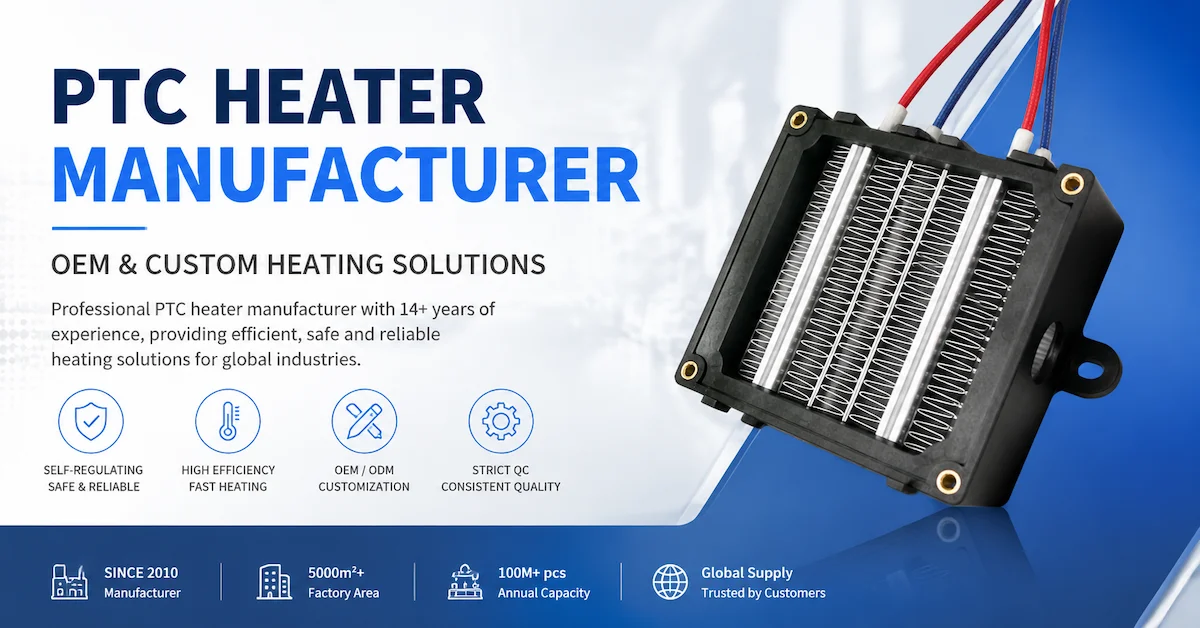
What Is PTC Heating Technology?
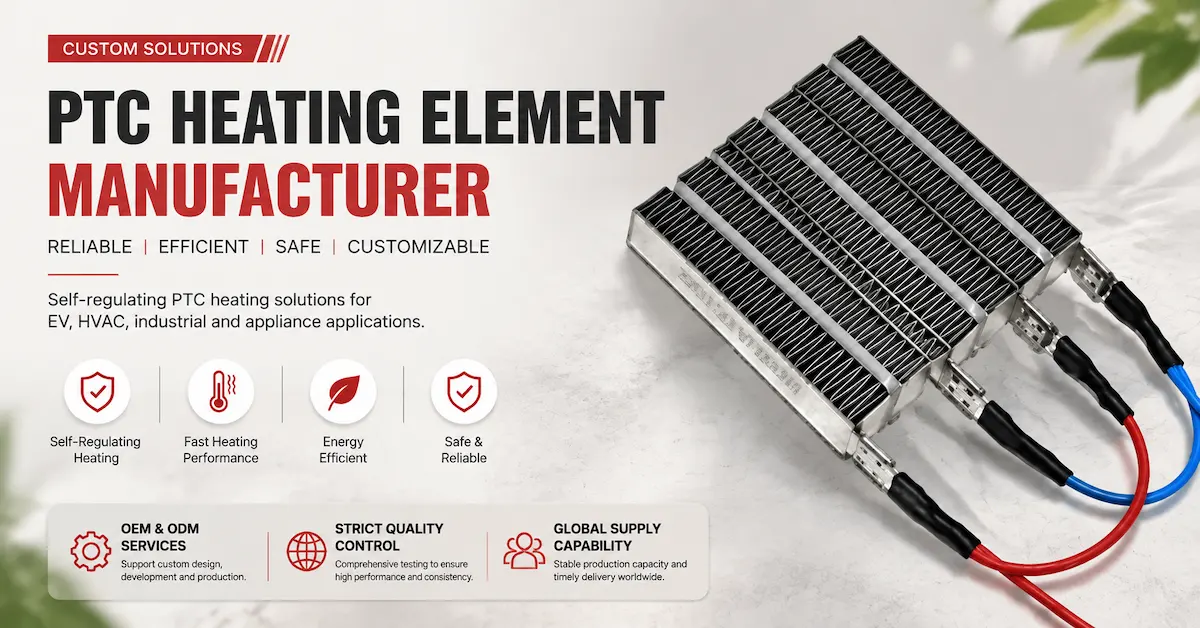
PTC Heating Technology uses Positive Temperature Coefficient ceramic materials to convert electrical energy into controlled heat. Unlike a fixed-resistance heating element, a PTC ceramic heater increases its electrical resistance as its temperature rises, which naturally reduces current and limits additional heat generation.
This self-regulating behavior makes PTC heating particularly useful where manufacturers need fast electric heating, compact installation, stable thermal performance and reduced overheating risk.
Typical applications include:
- HVAC auxiliary heating
- electric vehicle cabin heating
- windshield defrosting
- battery thermal management
- industrial air heating
- control cabinet heating
- drying equipment
- household and commercial appliances
For OEM engineers, however, understanding the working principle is only the first step. Heater performance is also influenced by voltage, wattage, Curie characteristics, ceramic geometry, airflow, heat transfer, ambient temperature and installation conditions.
Tianrui develops PTC heater solutions for customized thermal applications and supports projects from application requirements and product design through material selection, drawings, tooling and technical evaluation.
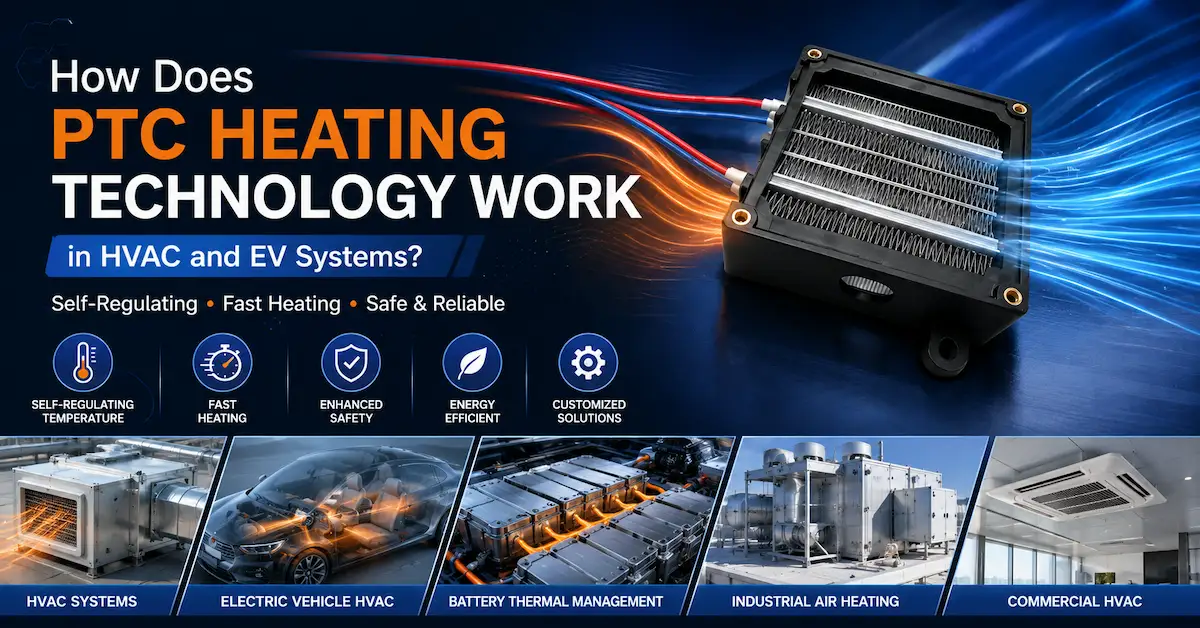
How Does PTC Heating Technology Work?
The basic heating process begins when electrical current passes through a PTC ceramic element.
At a relatively low temperature, the material has lower resistance and allows higher current flow. This creates rapid heat generation during startup.
As the ceramic temperature increases, its resistance also increases. Near the designed transition region, the resistance rises much more sharply, which reduces current and limits additional heating.
The heater therefore moves toward a thermal equilibrium rather than continuing to increase temperature at the same power level.
PTC Heating Process at a Glance
| Operating Stage | Electrical Behavior | Thermal Result |
|---|---|---|
| Cold start | Relatively lower resistance | Higher initial heating output |
| Temperature rising | Resistance increases | Current begins to decrease |
| Transition region | Resistance rises rapidly | Heating output becomes limited |
| Thermal equilibrium | Heat generation balances heat loss | More stable operating temperature |
| Cooling | Resistance decreases again | Heater can increase output as needed |
This behavior is why PTC heaters are often described as self-regulating heaters.
However, self-regulating does not mean the heater will reach one identical temperature under every condition.
The actual operating temperature depends on the complete thermal system.
What Is the Role of PTC Ceramic Material?
The ceramic element is the core of PTC heating technology.
Many PTC heating elements are based on barium titanate ceramic systems whose electrical characteristics can be adjusted through material formulation and processing.
Important factors include:
- ceramic composition
- dopants
- particle preparation
- forming
- sintering conditions
- electrode structure
- element dimensions
These variables influence characteristics such as:
- resistance
- Curie behavior
- heating response
- voltage capability
- thermal stability
- production consistency
Tianrui's PTC heating element technology focuses on ceramic heating materials and customized component development for different electrical and thermal requirements.
Why Material Control Matters to OEM Buyers
Two PTC heaters that look mechanically similar may not perform identically.
Differences in ceramic characteristics can affect:
- startup current
- warm-up speed
- stabilized power
- equilibrium temperature
- response to airflow
- long-term repeatability
For that reason, OEM buyers should not evaluate a PTC heater only by exterior dimensions and rated wattage.
What Does Curie Temperature Mean in a PTC Heater?
Curie temperature is an important material-related concept in PTC ceramic technology.
As the material approaches its transition region, its resistance increases significantly. This strong resistance change is what creates the characteristic PTC self-regulating effect.
But one common engineering mistake is assuming:
Curie temperature = final heater surface temperature
That is not necessarily true.
The actual stabilized heater temperature is influenced by:
- ambient temperature
- airflow
- heat sink structure
- mounting pressure
- heated mass
- enclosure design
- contact area
- operating voltage
For example, the same PTC ceramic element may operate differently when:
- exposed to open air;
- mounted against an aluminum plate;
- installed inside a ventilation duct;
- combined with a fan;
- integrated into a vehicle HVAC module.
The correct PTC selection therefore requires evaluating the complete thermal system, not only the ceramic transition temperature.
How Is PTC Heating Different From Fixed-Resistance Heating?
Traditional resistance heaters and PTC heaters both convert electrical energy into heat, but they behave differently as temperature changes.
| Feature | PTC Heater | Fixed-Resistance Heater |
| Resistance behavior | Increases strongly with temperature | More predictable/fixed characteristic |
| Heating output | Naturally reduces as temperature rises | Usually relies more on external control |
| Overheating tendency | Reduced by PTC effect | Depends heavily on control system |
| Cold-start output | Can be relatively high | Depends on fixed resistance design |
| Temperature regulation | Intrinsic self-regulating behavior | Usually external control required |
| Application flexibility | HVAC, EV, industrial, appliances | Broad electric heating applications |
This does not mean a PTC heater eliminates the need for system controls, sensors, fuses or thermal protection.
The complete equipment still requires proper electrical and thermal safety design.
The main value of PTC technology is that the heating element itself changes its electrical behavior in response to temperature.
Why Is PTC Heating Technology Used in HVAC Systems?
HVAC applications need heating elements that respond quickly to changing airflow and temperature conditions.
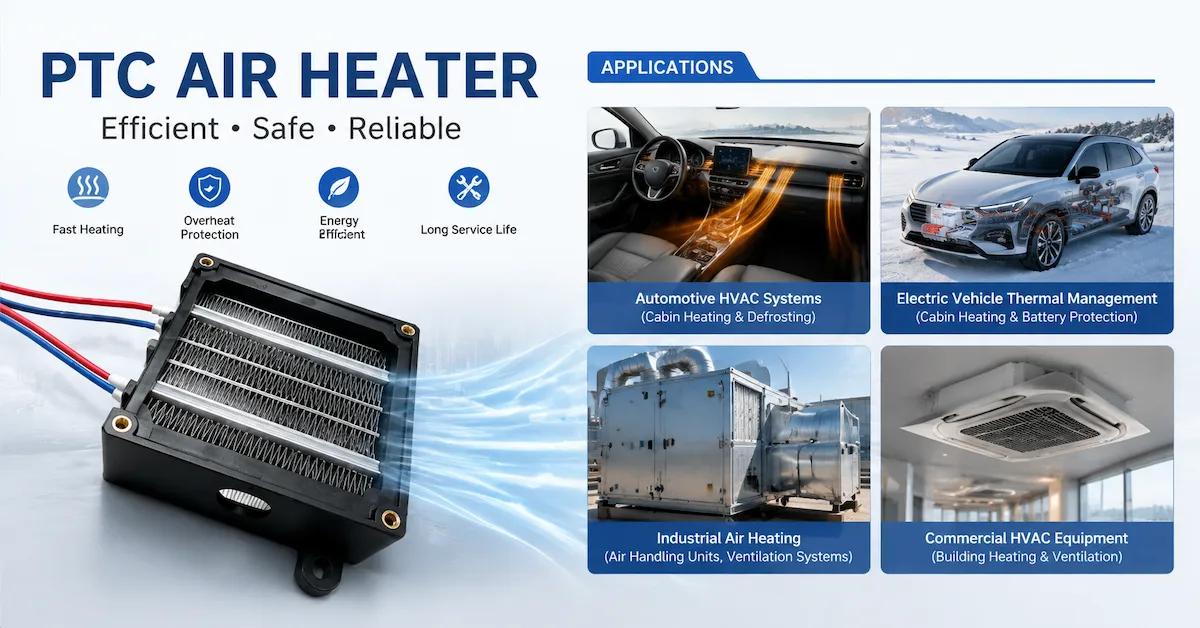
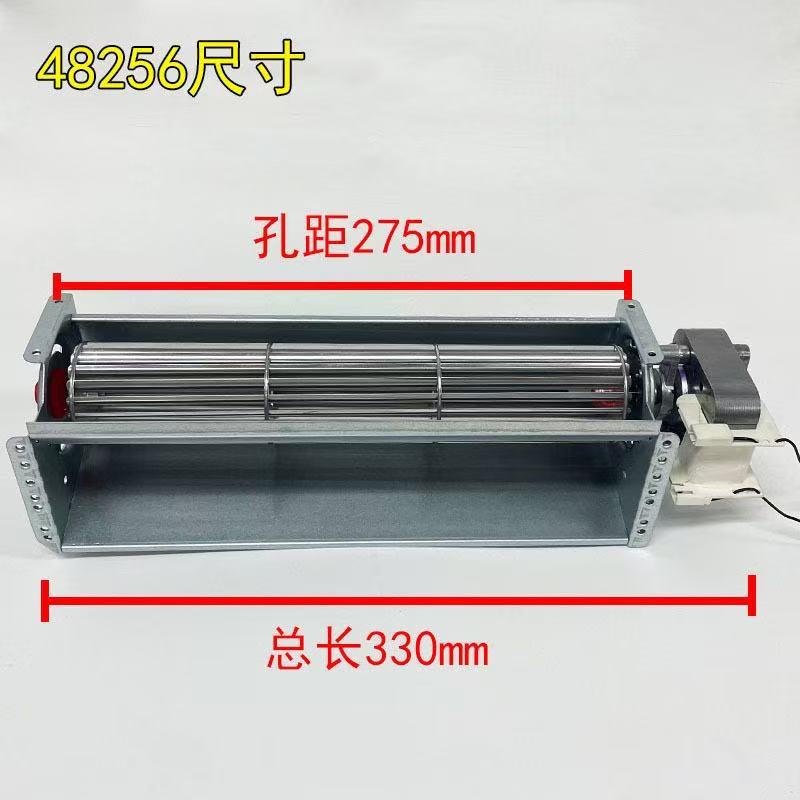
A PTC Air Heater can place ceramic heating elements inside a finned or airflow-oriented assembly so that passing air absorbs heat directly.
Common HVAC uses include:
- auxiliary heating
- ventilation heating
- automotive HVAC
- industrial air handling
- drying equipment
- temperature conditioning
Fast Heating Response
At lower temperatures, the relatively lower PTC resistance allows strong initial heating.
This is valuable when an HVAC system must produce warm air quickly after startup.
Response to Airflow
Airflow removes heat from the heater.
As the PTC element cools, its resistance can decrease, allowing electrical input to rise again within the designed operating behavior.
This creates a useful interaction between:
airflow → ceramic temperature → resistance → heating output
However, airflow must still be considered during heater selection.
A heater tested in still air may behave differently inside a real HVAC duct.
Compact Integration
PTC air heaters can be integrated into:
- HVAC ducts
- blower modules
- air handling equipment
- compact ventilation assemblies
This helps equipment designers fit electric heating into limited installation spaces.
How Is PTC Heating Technology Used in Electric Vehicles?
Electric vehicles create a particularly important application for electrical heating technology.
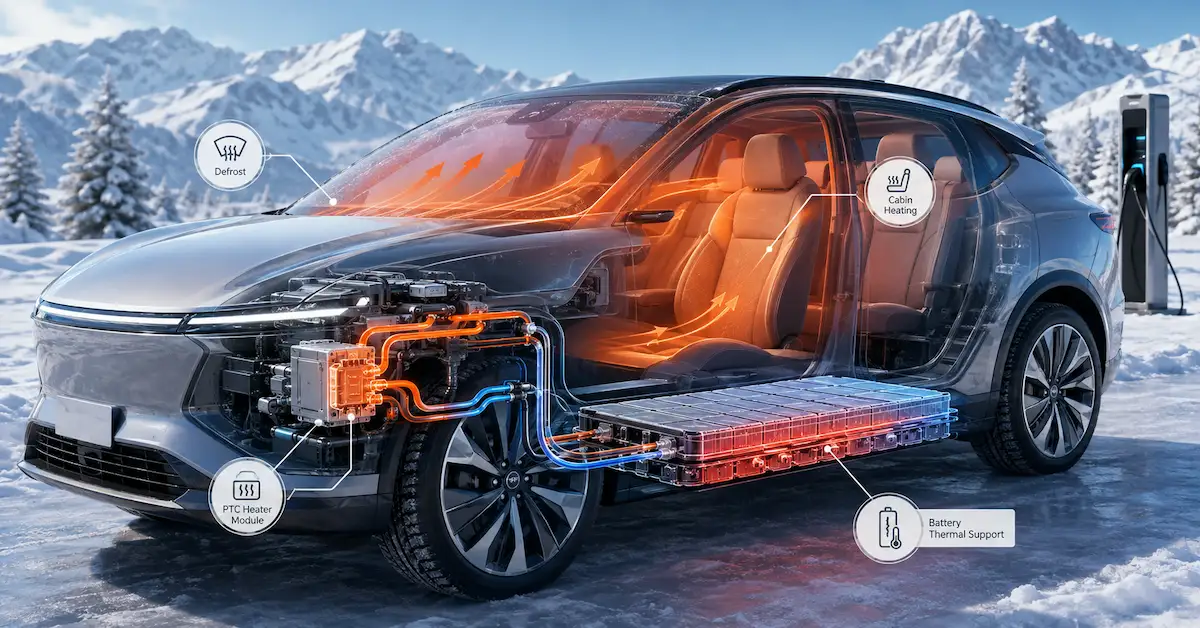
Conventional combustion vehicles can use engine waste heat for cabin heating. Electric vehicles do not have the same continuous source of engine waste heat, so thermal management often depends more heavily on electrical heating systems and heat pumps.
PTC technology can support several functions.
EV Cabin Heating
A PTC air heater can warm air before it enters the passenger compartment.
Benefits include:
- immediate electric heating
- cold-weather cabin comfort
- integration with blower systems
- windshield defrosting support
Battery Thermal Management
Battery performance is affected by temperature.
In cold conditions, thermal-management systems may need to raise battery or coolant temperature before or during operation.
Depending on system architecture, manufacturers may use:
- air heating
- liquid/coolant heating
- combined thermal-management systems
For a deeper application-specific discussion, Tianrui's EV-related PTC products and vehicle heating solutions can be connected with broader PTC heater customization.
Defrosting and Demisting
Electric heating can also help HVAC systems produce warm airflow for:
- windshield defrosting
- demisting
- cold-start visibility
For vehicle manufacturers, response speed can be as important as final cabin temperature.
PTC Air Heater vs PTC Liquid Heater: Which Should You Use?
The appropriate heater depends on what must be heated.
PTC Air Heater
A PTC air heater transfers heat directly to airflow.
Typical applications:
- HVAC modules
- cabin heating
- dryers
- ventilation
- industrial warm-air equipment
Key design variables:
- airflow
- inlet temperature
- fin geometry
- heater dimensions
- power
- pressure resistance
PTC Liquid Heater
A liquid heater transfers heat into water, coolant or another compatible fluid.
Typical applications:
- thermal loops
- battery heating
- water heating
- equipment temperature conditioning
Key design variables:
- liquid compatibility
- flow rate
- sealing
- corrosion resistance
- electrical insulation
- dry-heating conditions
Quick Comparison
| Requirement | PTC Air Heater | PTC Liquid Heater |
| Heating medium | Air | Liquid/coolant |
| Typical system | HVAC/ventilation | Thermal loop |
| Main heat transfer | Direct airflow | Fluid circulation |
| Key design factor | Air volume | Flow and sealing |
| EV use | Cabin HVAC | Battery/coolant heating |
| Industrial use | Air handling/drying | Process/liquid heating |
The choice should follow the complete system architecture rather than simply choosing the heater with the higher nominal wattage.
What Are the Main Advantages of PTC Heating Technology?
PTC technology offers several practical advantages, but each benefit should be understood in engineering terms rather than as a generic marketing claim.
Fast Startup Heating
The electrical behavior of the ceramic can provide strong heat generation during lower-temperature startup conditions.
This supports applications requiring quick warm-up.
Self-Regulating Thermal Behavior
As temperature rises, increasing resistance naturally reduces electrical input.
This can help reduce the risk of uncontrolled temperature rise.
Compact Heating Assemblies
PTC ceramics can be integrated with:
- aluminum fins
- aluminum housings
- insulation films
- fans
- electrical leads
- connectors
This allows manufacturers to design application-specific heating modules.
Flexible Electrical Design
Different heater structures can be developed for different voltage and power requirements, subject to ceramic characteristics and system design.
Reduced Dependence on Constant High Output
Because resistance changes with ceramic temperature, the heater's electrical behavior adapts as operating conditions change.
This is different from a heater that continuously behaves as a fixed-resistance load.
What Are the Limitations of PTC Heating Technology?
A good engineering guide should also explain where PTC technology requires careful design.
Power Changes With Thermal Conditions
PTC heater power is not independent of heat dissipation.
Airflow, ambient temperature and contact conditions can affect stabilized electrical performance.
It Is Not a Substitute for Complete System Safety
Self-regulating behavior does not eliminate the need for:
- proper insulation
- circuit protection
- safe wiring
- applicable thermal protection
- finished-product testing
Curie Temperature Can Be Misinterpreted
Choosing a ceramic solely from a target temperature can lead to poor system performance.
The entire heat-transfer environment must be considered.
Higher Heating Demand Requires System-Level Evaluation
For high-power heating, designers must evaluate:
- available electrical power
- conductor sizing
- current draw
- airflow
- thermal distribution
- control architecture
The heater should be selected together with the electrical and mechanical system.
Which Parameters Matter When Selecting a PTC Heater?
For OEM projects, a useful heater specification should include more than voltage and wattage.
| Parameter | What It Tells the Engineer |
| Rated voltage | Electrical system compatibility |
| Power requirement | Heating capacity |
| Target temperature | Required thermal condition |
| Curie characteristics | Ceramic self-regulating behavior |
| Heater dimensions | Mechanical integration |
| Heating medium | Air, liquid or contact |
| Airflow/flow rate | Heat-transfer conditions |
| Ambient range | Cold/hot operating environment |
| Insulation requirement | Electrical safety needs |
| Wire and connector | System integration |
| Operating cycle | Continuous or intermittent use |
| Quantity | Sampling and production planning |
A manufacturer should ask about these conditions before recommending a custom heater.
How Should Engineers Calculate the Heating Requirement?
A preliminary heater selection begins with the thermal load rather than the catalog wattage.
Engineers should consider:
- mass to be heated
- required temperature increase
- desired warm-up time
- continuous heat loss
- airflow or liquid flow
- insulation
- ambient conditions
For an HVAC system, increasing airflow usually increases the amount of heat that must be transferred to maintain the same outlet temperature.
For an EV, engineers must also balance heating demand against battery energy consumption.
This is why two systems requiring the same target temperature may still need very different heater designs.
What Should You Test Before Approving a PTC Heater?
A heater sample should be tested under conditions that reproduce the real application as closely as possible.
Recommended checks include:
Electrical Performance
Measure:
- startup current
- operating current
- voltage
- initial power
- stabilized power
Thermal Performance
Record:
- warm-up time
- surface temperature
- air or liquid outlet temperature
- temperature distribution
Insulation and Electrical Safety
Depending on the design, evaluate:
- insulation resistance
- dielectric performance
- wire and terminal condition
Application Reliability
Where required, test:
- continuous operation
- heating/cooling cycles
- vibration
- humidity
- low-temperature startup
A heater that works correctly on an open test bench should not automatically be considered qualified for a finished HVAC or EV assembly.
What Information Should You Give a PTC Heater Supplier?
The quality of an OEM proposal depends heavily on the information provided at the start.
A useful RFQ should include:
- end application
- AC or DC voltage
- target power or heating objective
- starting temperature
- target temperature
- maximum dimensions
- airflow or liquid flow
- mounting method
- insulation requirements
- wire requirements
- connector type
- operating environment
- sample quantity
- estimated production volume
If you do not know the exact power or ceramic characteristics, describe the required thermal result instead.
This allows the supplier to evaluate the application rather than simply match a catalog item.
How Does Tianrui Support Custom PTC Heating Projects?
Dongguan Tianrui Electronics focuses on PTC thermistor components and heating products for applications including air-conditioning auxiliary heating, new-energy vehicle air-conditioning and power-battery heating.
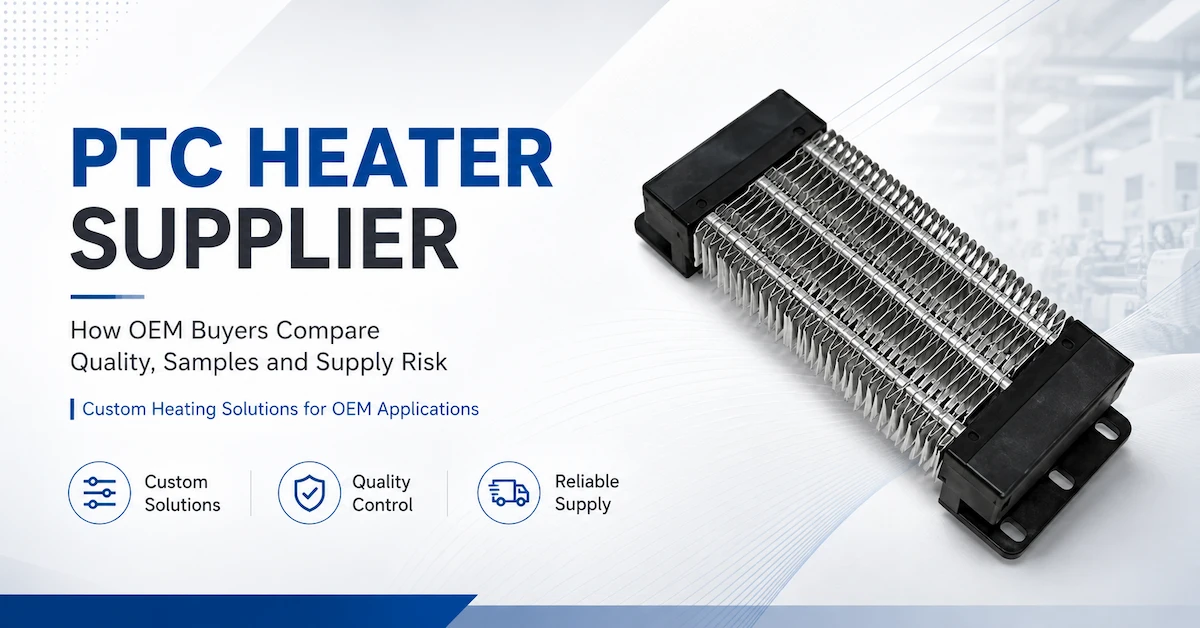
For non-standard projects, Tianrui's custom PTC heater service covers requirement communication, product design, structure and material selection, drawings, mold development, inspection and technical consultation.
Its company profile states that Tianrui was established in 2010, operates an approximately 5,000 m² facility and uses automated production equipment and dedicated testing instruments.
For OEM buyers, these capabilities are most valuable when they are connected to a defined engineering process:
application conditions
→ heater structure
→ ceramic/material selection
→ prototype
→ testing
→ approved specification
→ mass production
The final heater should always be validated against the actual requirements of the customer's finished system.
FAQ About PTC Heating Technology
What does PTC mean in a heater?
PTC stands for Positive Temperature Coefficient. It describes a material whose electrical resistance increases as temperature rises, especially through its characteristic transition region.
How does a PTC heater regulate temperature?
As the PTC ceramic becomes hotter, its resistance increases. Higher resistance reduces current and therefore reduces further heat generation, creating self-regulating thermal behavior.
Is a PTC heater the same as a ceramic heater?
Many PTC heaters use ceramic PTC elements, but “ceramic heater” is a broader term. Buyers should confirm whether a ceramic heater specifically uses positive temperature coefficient technology.
Why is PTC Heating Technology useful for HVAC?
PTC heaters provide fast electric heating and can respond naturally to thermal conditions. Air-heater structures can also be integrated into fans, ducts and HVAC modules.
Why are PTC heaters used in electric vehicles?
EVs require independent heating for functions such as cabin comfort and defrosting because they cannot rely on combustion-engine waste heat in the same way as conventional vehicles.
Is a PTC heater more efficient than every other heater?
Not automatically. System efficiency depends on the complete application, including electrical supply, thermal losses, control strategy and heat-transfer method. The main PTC advantage is its temperature-dependent electrical behavior.
Does a PTC heater need a thermostat?
PTC ceramic provides self-regulating behavior, but the finished product may still require sensors, thermostats, thermal cutoffs or other controls depending on its safety and performance requirements.
What is the difference between an air PTC heater and a liquid PTC heater?
An air heater transfers heat directly to airflow, while a liquid heater transfers heat into water, coolant or another fluid. Each requires a different mechanical and thermal design.
Can PTC heaters be customized?
Yes. Depending on technical feasibility, customization can include voltage, power, dimensions, ceramic characteristics, aluminum structure, insulation, wiring, connectors and mounting features.
What information is needed for a custom PTC heater quotation?
Provide the application, electrical supply, target heating performance, operating temperatures, dimensions, airflow or fluid conditions, mounting, wiring and estimated quantity.
Conclusion
PTC Heating Technology is valuable because the heating element does more than simply convert electricity into heat. Its resistance changes with temperature, creating self-regulating electrical behavior that is useful in HVAC systems, electric vehicles, industrial equipment and other thermal-management applications.
The correct PTC heater should still be selected as part of the complete system.
Engineers need to evaluate:
- voltage and power;
- ceramic characteristics;
- target temperature;
- airflow or liquid flow;
- installation structure;
- insulation;
- operating environment;
- testing requirements.
For HVAC projects, a PTC Air Heater can provide direct airflow heating. For customized OEM applications, Tianrui's PTC heater engineering solutions can support application analysis, structural development and sample evaluation.
Buyers with drawings or defined thermal requirements can contact Tianrui to discuss a suitable PTC heating direction.