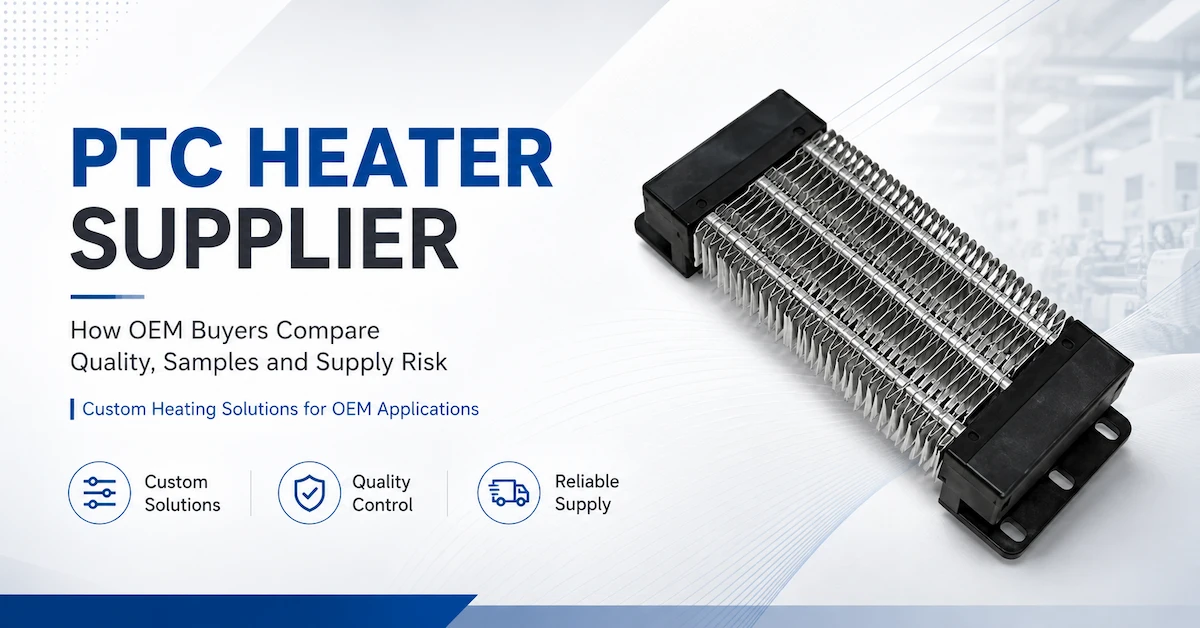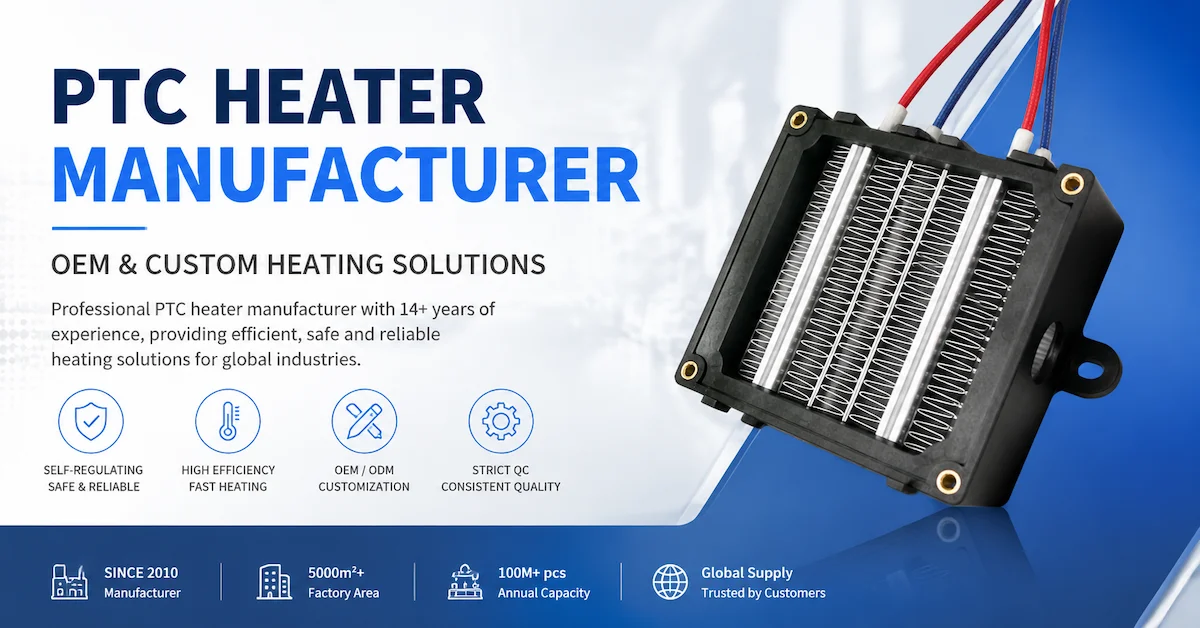
How Should OEM Buyers Choose a PTC Heater Manufacturer?
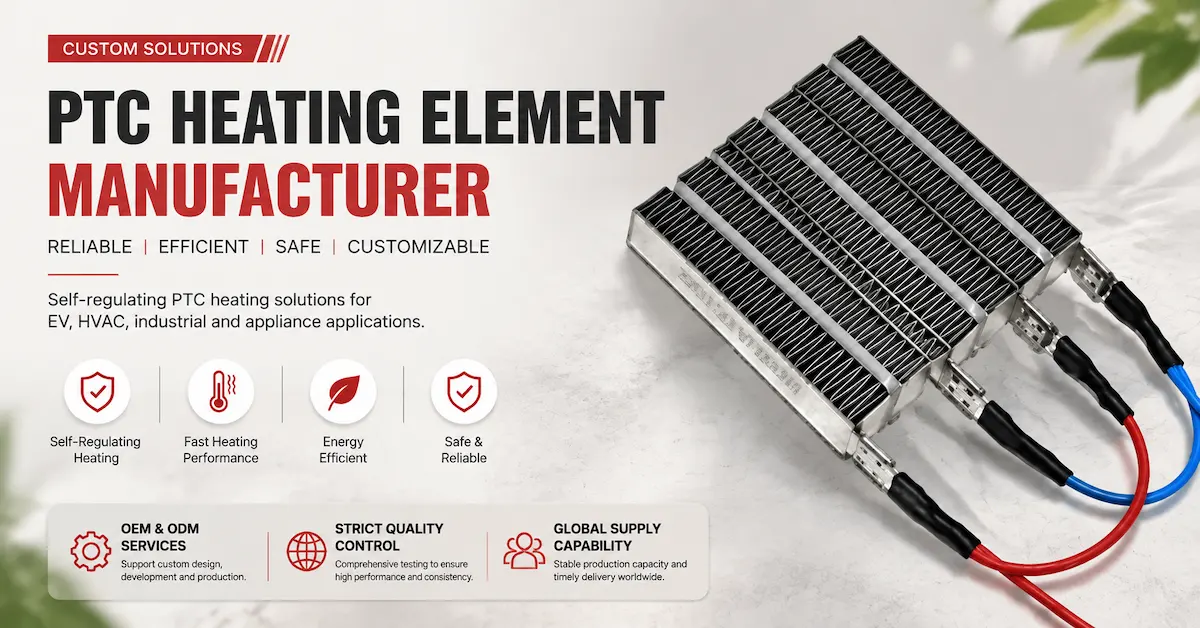
A reliable PTC Heater Manufacturer should be able to do more than supply a heating element with the requested voltage and wattage. For OEM equipment manufacturers, the right supplier must understand the operating environment, recommend an appropriate heater structure, establish measurable performance requirements, support prototype validation, and maintain consistent production quality.
The most important purchasing question is not simply whether a manufacturer can supply a PTC heater. It is whether the manufacturer can deliver a heater that performs reliably inside your specific equipment under real operating conditions.
For example, a 220V PTC air heater designed for a clothes dryer may have very different thermal, mechanical, and airflow requirements from a PTC heater installed inside an electrical control cabinet.
Similarly, a PTC heating element used in a hair straightener cannot automatically be applied to an electric vehicle heating system, even when both products use Positive Temperature Coefficient ceramic technology.
For OEM buyers, successful supplier selection depends on five fundamental considerations:
-
Application compatibility: Does the heater meet the equipment's actual heating requirements?
-
Engineering capability: Can the manufacturer adapt electrical characteristics, dimensions, materials, and assembly structures?
-
Verification capability: Can performance be evaluated through repeatable sample and application testing?
-
Production consistency: Can the approved design be reproduced across production batches?
-
Commercial reliability: Are tooling, pricing, delivery conditions, quality responsibilities, and long-term supply expectations clearly defined?
This guide explains how to evaluate these factors and prepare a more effective sourcing process.
Buyers can also review the available PTC Heater product range before defining their project requirements.
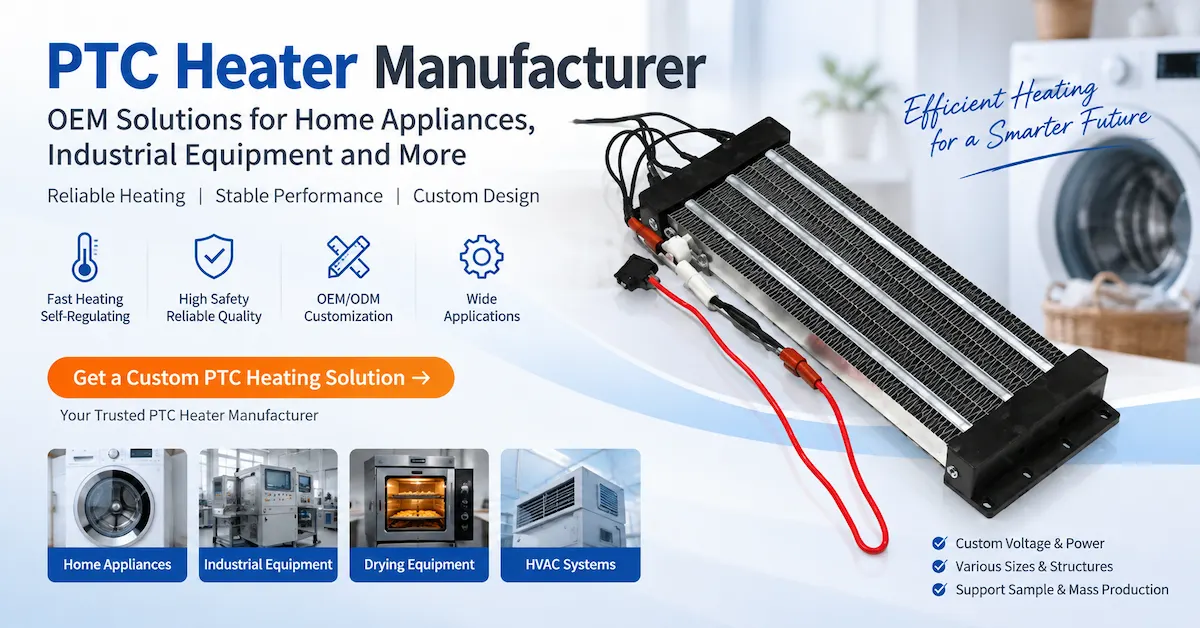
What Makes a PTC Heater Manufacturer Different From a General Component Supplier?
A PTC heater supplier may offer standard products selected primarily by voltage, power, dimensions, and price.
A manufacturer supporting OEM development should be able to discuss additional engineering questions that affect performance after the heater is integrated into the finished equipment.
These questions include:
-
How will the heater transfer heat to air, liquid, or a solid surface?
-
What happens when the surrounding temperature changes?
-
How does power consumption vary during startup and steady-state operation?
-
What happens if airflow becomes restricted?
-
Which electrical insulation requirements apply?
-
Can the heater dimensions, mounting features, wires, and connectors be customized?
-
How will production quality be controlled against the approved sample?
The distinction becomes particularly important when developing non-standard equipment.
Standard PTC Heater vs Custom OEM PTC Heater
| Evaluation Factor | Standard PTC Heater | Custom OEM PTC Heater |
|---|---|---|
| Electrical specifications | Existing catalog options | Selected or developed for project requirements |
| Mechanical dimensions | Fixed standard dimensions | May be adapted to available installation space |
| Heating performance | Based on published product conditions | Evaluated against application-specific conditions |
| Mounting structure | Standard mounting method | May support customized brackets or housings |
| Insulation design | Existing product construction | Reviewed against the equipment's electrical requirements |
| Wires and connectors | Standard configuration | May be customized |
| Sample validation | Standard inspection and product evaluation | Project-specific verification plan |
| Tooling | Usually unnecessary | May require development or tooling |
| Best suited for | Replacement parts and compatible standard equipment | OEM development and specialized applications |
Not every project requires complete customization.
If a standard heater already meets the electrical, thermal, mechanical, and safety requirements, modifying the design may introduce unnecessary cost and qualification work.
However, when an existing product cannot meet the required dimensions, heating response, mounting conditions, or environmental demands, a custom PTC heater manufacturer becomes a more valuable engineering partner.
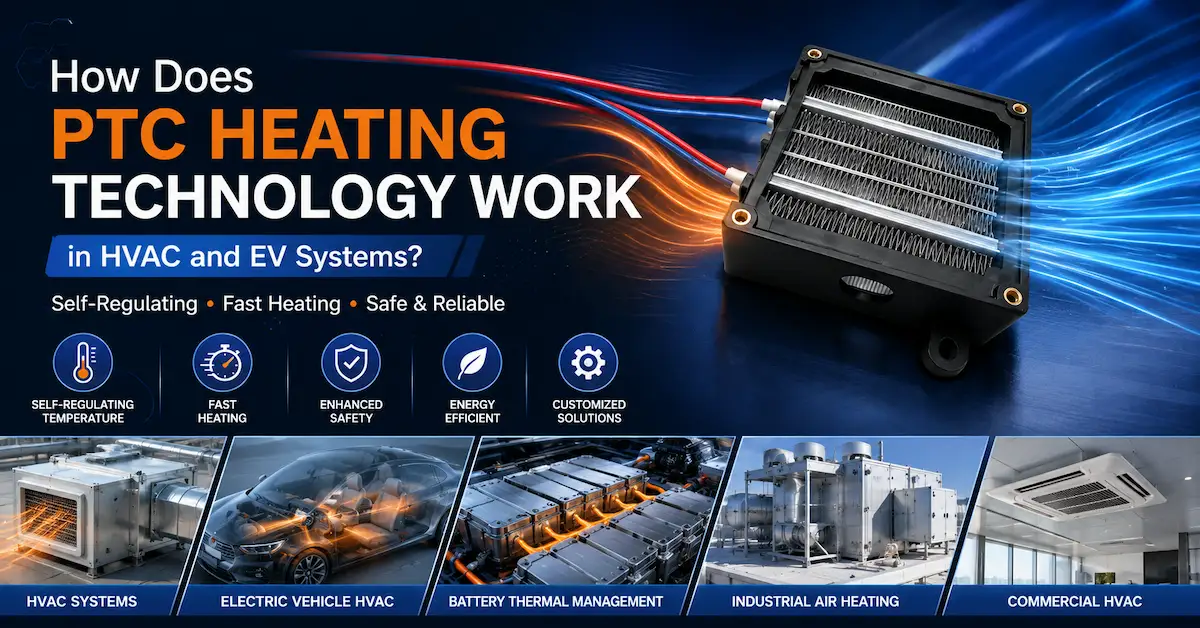
How Does PTC Heating Technology Affect OEM Heater Selection?
PTC stands for Positive Temperature Coefficient.
In ceramic PTC heating elements, electrical resistance rises significantly as the material approaches its designed transition temperature range.
This change in resistance creates a self-regulating heating effect.
When electrical power is first applied, the ceramic element may draw relatively high current, depending on its temperature and resistance characteristics.
As the ceramic heats up, its resistance increases. Under approximately constant applied voltage, this reduces current and electrical power.
The result is a heater that naturally adjusts its heat generation in response to temperature and heat removal.
However, the actual thermal behavior depends on the ceramic composition, voltage, physical construction, and surrounding conditions.
Why Curie Temperature Matters
The Curie temperature is an important characteristic of many ceramic PTC materials.
It is associated with the temperature region where electrical resistance begins increasing sharply.
For OEM engineers, this temperature helps characterize the heating element's electrical behavior.
However, the Curie temperature is not necessarily the same as the finished appliance's operating temperature.
For example, the following temperatures may be different:
-
Internal ceramic temperature
-
Aluminum housing surface temperature
-
Air outlet temperature
-
Heated object temperature
-
Temperature measured by an external sensor
The differences depend on heat transfer, airflow, thermal contact, surrounding materials, and operating conditions.
A manufacturer should therefore confirm the temperature characteristic required by the application rather than selecting a PTC element from its Curie temperature alone.
Does a Self-Regulating PTC Heater Eliminate Overheating Risks?
No.
Self-regulation helps limit electrical power as ceramic temperature increases, but it does not replace a complete equipment safety design.
Blocked ventilation, incorrect voltage, insufficient insulation, wiring faults, combustible nearby materials, and mechanical installation errors can still create hazardous conditions.
An OEM heater assembly may require independent temperature monitoring, thermal cutoffs, fuses, airflow supervision, protective grounding, or other safety measures.
The appropriate protection strategy depends on the equipment and applicable standards.
A professional supplier should explain both the advantages and limitations of the heating technology.
Which PTC Heater Type Is Best for Your Application?
Choosing the correct heater architecture is often more important than selecting the highest available power rating.
PTC heaters are available in multiple configurations, each designed to address different thermal and installation requirements.
PTC Heater Construction Comparison
| Heater Type | Main Characteristics | Typical Applications | Critical Selection Factors |
|---|---|---|---|
| Bare ceramic PTC heating element | Compact ceramic heat source | Small heating assemblies, appliance modules | Electrode design, thermal contact, mounting |
| Finned PTC air heater | Ceramic heater combined with aluminum heat-transfer fins | Dryers, ventilation, warm-air equipment | Airflow, pressure drop, fin spacing |
| PTC heater with integrated fan | Heating module and blower combined | Drying cabinets, dish warmers, small appliances | Air distribution, fan reliability, noise |
| Aluminum-shell PTC heater | Ceramic element integrated with metal housing | Cabinets, compact industrial equipment, appliance heating | Housing temperature, mounting, electrical isolation |
| Insulated-film PTC heater | Electrical insulation layer integrated into heater construction | Hair straighteners, curling appliances, compact contact heating | Insulation integrity, heat transfer, dimensions |
| Automotive PTC heater | Heater architecture adapted to vehicle applications | EV cabin heating and battery thermal systems | Vehicle voltage, vibration, thermal cycling, system controls |
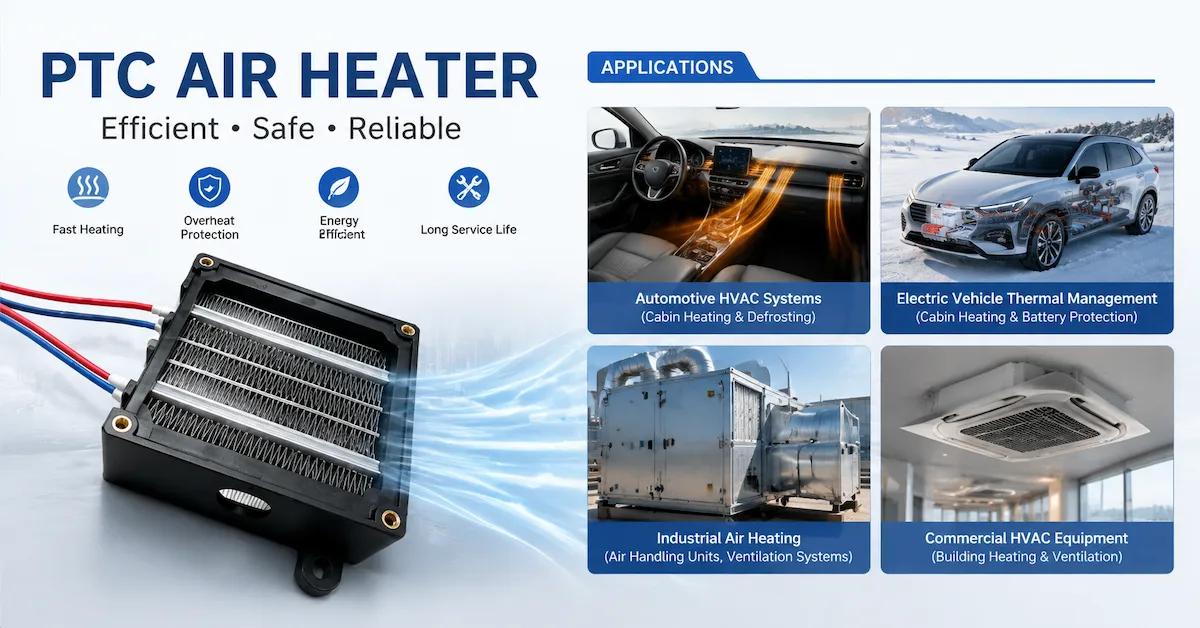
1. PTC Air Heaters for Forced-Air Equipment
PTC air heaters are commonly used in equipment that requires air to pass through or around a heated structure.
Finned and corrugated aluminum structures increase the available heat-transfer area.
These designs are relevant to dryers, ventilation systems, warming cabinets, and industrial air-heating equipment.
Airflow is a critical engineering variable.
If airflow changes, ceramic temperature, power consumption, air outlet temperature, and heating capacity may also change.
A heater selected without considering airflow may perform differently from the original laboratory specification.
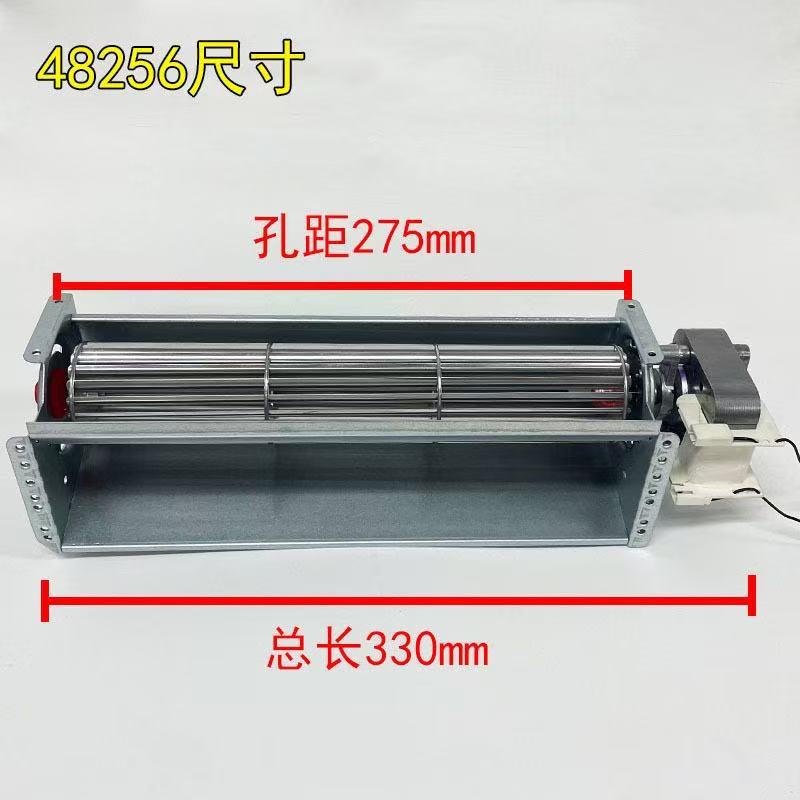
For applications that require broad airflow distribution, Tianrui offers a cross-flow fan PTC heater series.
The published series includes 220V configurations with nominal power options of 600W, 900W, 1200W, and 1800W.
These values describe listed product options, not guaranteed performance under every operating condition.
2. Aluminum-Shell PTC Heaters for Compact Integration
An aluminum-shell PTC heater combines the heating element with a metal structure that can provide mechanical support and heat transfer.
The housing design may simplify mounting in compact equipment.
Depending on the construction, heat can be transferred to a surface or surrounding air.
However, the relationship between ceramic temperature and housing surface temperature must be evaluated.
Buyers should also confirm whether electrical insulation is provided between energized components and accessible metal surfaces.
For reference, Tianrui provides aluminum-shell PTC heating products for different equipment requirements.
3. Insulated PTC Heaters for Contact Heating
Electrical insulation becomes particularly important when a heater operates close to conductive components or user-accessible surfaces.
Insulated PTC heating structures may incorporate a thermally conductive electrical isolation layer.
These products can be relevant to compact appliances and contact-heating applications.
Typical engineering considerations include insulation thickness, dielectric performance, operating temperature, mechanical stress, and heat-transfer resistance.
Buyers developing hair-care appliances can review PTC heaters with insulated film.
The insulation layer must be qualified as part of the complete heater assembly. A rigid ceramic element should not be assumed to be flexible simply because it includes a thin insulating film.
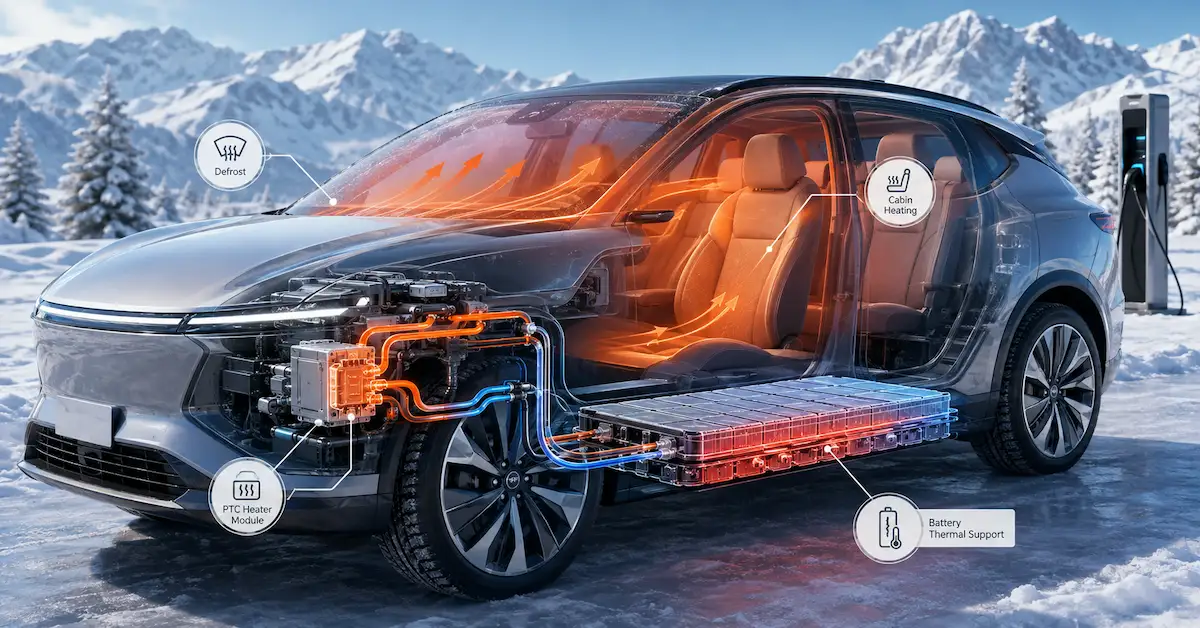
4. PTC Heaters for Electric Vehicles
Electric vehicle heating systems require special consideration because the heater interacts with the vehicle's electrical supply, thermal management architecture, and control strategy.
Important requirements may include voltage operating range, current limitation, electrical isolation, vibration resistance, thermal cycling, environmental protection, and diagnostic behavior.
An air-heating module for passenger-compartment heating is also fundamentally different from a heater intended to transfer heat into battery coolant.
For vehicle projects, begin with the relevant PTC Heater for Electric Vehicle product category.
Do not assume that every listed vehicle heater is suitable for direct coolant contact or every automotive voltage architecture. Configuration suitability must be confirmed through a project-specific review.
How Should OEM Buyers Define PTC Heater Technical Specifications?
One of the most common procurement problems is receiving quotations based on incomplete technical requirements.
An RFQ that only states “220V, 1000W PTC heater” does not provide enough information to evaluate the actual heating system.
The supplier must understand the operating conditions and required thermal result.
Essential PTC Heater Specification Checklist
| Parameter | Information Required | Why It Matters |
|---|---|---|
| End application | Appliance or equipment type | Determines the thermal and safety context |
| Nominal voltage | AC/DC and voltage value | Guides electrical configuration |
| Operating voltage range | Minimum and maximum voltage | Supports electrical variation assessment |
| Startup current | Acceptable initial current | Affects power supply and switching component sizing |
| Heating power | Required thermal output and rating conditions | Supports heater selection |
| Ceramic characteristics | Relevant resistance-temperature behavior | Influences self-regulating behavior |
| Target temperature | Air, surface, object, or liquid temperature | Defines the heating objective |
| Ambient temperature | Minimum, nominal, and maximum | Affects startup and heat loss |
| Airflow | Flow rate and operating conditions | Determines convective heat transfer |
| Dimensions | Maximum length, width, and height | Ensures mechanical compatibility |
| Insulation | Resistance and dielectric requirements | Supports electrical safety |
| Mounting | Bracket, screws, clamps, or other method | Affects heat transfer and assembly |
| Wire specifications | Gauge, insulation, length, temperature rating | Supports electrical integration |
| Connector | Type, pinout, and mating connector | Ensures system compatibility |
| Environmental conditions | Humidity, dust, vibration, condensation | Influences materials and reliability |
| Qualification | Required tests and acceptance criteria | Supports engineering approval |
| Purchase quantity | Samples and forecast volume | Supports production planning |
These specifications should be discussed before the supplier prepares a final technical quotation.
Rated Power vs Startup Power vs Steady-State Power
A PTC heater's electrical power may vary during operation.
Startup conditions can involve different current and power levels from those observed after the heater reaches thermal equilibrium.
For a constant-voltage supply, the simplified electrical relationship is:
Electrical power = Voltage × Current
For a resistive element under an approximately steady operating condition:
Electrical power = Voltage² / Resistance
Because PTC resistance changes with temperature, electrical power also changes.
This means that a nominal 1000W product designation does not necessarily represent constant power consumption throughout operation.
For comparison testing, the manufacturer should identify the conditions under which power was measured.
These conditions may include supply voltage, ambient temperature, airflow, measurement duration, and assembly configuration.
Why Airflow Must Be Included in the Specification
Forced-air heating is a system-level process.
Airflow affects how quickly heat is removed from the ceramic element and transferred into the surrounding environment.
At higher airflow, the heater may operate at a different thermal equilibrium.
At lower airflow, ceramic temperature may increase while self-regulation reduces electrical power.
Therefore, a heater that performs adequately at one airflow rate may not deliver the same useful heating output at another.
This is particularly important for dryers, HVAC modules, and equipment with variable-speed fans.
How Can OEM Engineers Estimate Required PTC Heater Power?
Before contacting a PTC heater factory, engineers should estimate the heating demand of the equipment.
A preliminary calculation can help determine whether a proposed power range is reasonable.
However, final heater selection still requires testing with the actual thermal system.
Example: Estimating Power for an Air-Heating Application
For a simplified steady-flow air-heating system:
Required thermal power ≈ Air mass flow × Specific heat capacity × Temperature rise
Consider an illustrative application with these assumptions:
| Input | Example Value |
|---|---|
| Airflow | 60 m³/h |
| Approximate air density | 1.2 kg/m³ |
| Air mass flow | 0.020 kg/s |
| Specific heat capacity of air | 1005 J/(kg·K) |
| Desired temperature increase | 20°C |
The ideal thermal power transferred to the airflow is approximately:
0.020 × 1005 × 20 = 402W
This calculation indicates that around 402W of useful thermal transfer would be required under the stated assumptions.
It does not mean a 402W PTC heater will necessarily satisfy the application.
Real equipment may experience:
-
Heat loss through the enclosure
-
Air leakage
-
Nonuniform airflow
-
Changes in air properties
-
Heat absorbed by surrounding structures
-
Differences between rated and actual heater output
-
Startup and transient heating demands
The required electrical power must account for those factors and the heater's actual operating behavior.
For contact heating, engineers may instead begin by estimating the energy required to raise the temperature of a material, together with the permitted heating time and expected heat losses.
Important: This is an illustrative engineering calculation, not a performance claim for any particular Tianrui product.
Providing even a preliminary heating calculation can make the manufacturer's technical evaluation more efficient.
PTC Heater Applications: What Should Manufacturers Validate?
Different industries require different acceptance criteria.
Using the same heater design and test procedure for every application can lead to avoidable reliability problems.
Household Appliances and Commercial Drying Equipment
Household and commercial equipment may require compact heating structures, controlled airflow, acceptable noise levels, and predictable warm-up behavior.
Common applications include:
-
Clothes dryers
-
Dish-warming equipment
-
Drying cabinets
-
Electric heating appliances
-
Hair-care devices
-
Small food-warming equipment
For these products, buyers should evaluate heating uniformity, enclosure temperature, fan interaction, thermal protection, and repeated operating cycles.
A heater that reaches the correct temperature in an open test may perform differently after installation inside a plastic or metal housing.
The manufacturer's sample should therefore be evaluated within the complete appliance whenever possible.
Tianrui's home appliance heating applications provide additional context for relevant product categories.
HVAC and Ventilation Equipment
HVAC applications often require continuous or intermittent forced-air heating.
Important considerations include airflow distribution, temperature rise, duct geometry, pressure drop, vibration, and compatibility with the control system.
If the system uses variable fan speed, qualification should include the permitted operating range rather than only the nominal airflow point.
Buyers should also verify the behavior of the heater when airflow is reduced or interrupted.
Electrical Cabinet Heating and Industrial Automation
Industrial electrical cabinets may require heating to reduce condensation risk and maintain suitable operating conditions.
The heater should be selected according to enclosure size, ambient temperature, humidity, ventilation, and thermal losses.
The objective is generally to maintain an appropriate internal environment, not simply generate the highest possible temperature.
A PTC cabinet heater may be useful because of its self-regulating characteristics.
However, condensation control still depends on the enclosure design, humidity conditions, temperature distribution, and operating strategy.
Related applications can be explored through Tianrui's industrial heating solutions.
Electric Vehicles and Battery Thermal Management
Vehicle heating projects introduce electrical and environmental demands beyond those found in many household appliances.
Manufacturers may need to evaluate:
-
Vehicle supply-voltage variation
-
Startup and operating current
-
Thermal cycling
-
Mechanical vibration
-
Electrical isolation
-
Moisture exposure
-
Packaging constraints
-
Diagnostic and control interfaces
The heater must also be compatible with the vehicle's overall thermal management system.
For battery applications, engineers should distinguish between heating cabin air and heating battery cells or coolant.
A manufacturer should not recommend direct immersion of an air heater without an appropriate liquid-heating design.
Hair-Care and Personal-Care Equipment
Hair straighteners and curling appliances may require compact contact-heating components.
The relevant specifications often include heating time, contact surface temperature, temperature distribution, electrical insulation, and repeated thermal cycling.
An insulated PTC heater can be considered where its structure suits the application.
However, temperature regulation and protection must be evaluated at the finished appliance level, especially for equipment that may come into contact with the user.
How Do Ceramic Materials and Manufacturing Processes Affect PTC Heater Quality?
The ceramic element is central to the heater's electrical and thermal characteristics.
Many ceramic PTC heating elements use barium-titanate-based semiconductor materials.
Their properties depend on composition, processing conditions, microstructure, and electrode construction.
The resulting resistance-temperature behavior influences current flow and self-regulating performance.
Important Manufacturing Stages
PTC heater manufacturing and assembly can involve ceramic material preparation, forming, sintering, electrode processing, structural integration, wiring, and electrical testing.
For OEM procurement, the important issue is whether critical characteristics are controlled and traceable.
The buyer should ask which processes are completed in-house and which, if any, are performed by qualified external suppliers.
This distinction matters because final assembly capability does not automatically prove that every upstream ceramic manufacturing operation occurs inside the same factory.
Ceramic Consistency
Variation in ceramic characteristics can affect electrical resistance and thermal behavior.
Manufacturers should therefore define appropriate controls for material acceptance and relevant electrical properties.
The required tolerances depend on the heater design and application.
Electrode and Electrical Contact Quality
Poor electrical contact can increase local resistance and cause unwanted heating at the connection interface.
Depending on the design, electrode material, contact method, mechanical pressure, and thermal cycling can affect long-term reliability.
Manufacturers should evaluate these interfaces rather than focusing only on the ceramic body.
Mechanical Assembly and Heat Transfer
For an aluminum-shell or finned heater, the relationship between the ceramic element and the heat-transfer structure is particularly important.
Mechanical tolerances, thermal contact, housing geometry, and assembly repeatability can influence useful heating output.
A visually similar replacement assembly is not necessarily thermally equivalent.
For specialized development requirements, Tianrui describes its PTC heating element customization services, including structure, materials, drawings, and technical consultation.
What Tests Should a PTC Heater Manufacturer Perform Before OEM Approval?
Sample testing should determine whether the proposed heater satisfies the operating requirements of the actual equipment.
A heater that becomes hot when connected to power has not necessarily passed engineering qualification.
The OEM and manufacturer should agree on measurable acceptance criteria before testing begins.
Recommended Prototype Validation Matrix
| Test | Purpose | Evaluation Focus |
|---|---|---|
| Cold-start electrical test | Evaluate startup behavior | Current, voltage, initial power |
| Warm-up performance test | Measure heating response | Time to target temperature |
| Steady-state thermal test | Verify thermal equilibrium | Power, surface temperature, useful output |
| Voltage variation test | Evaluate electrical operating range | Current and temperature changes |
| Minimum airflow test | Evaluate reduced cooling | Heater temperature and delivered heat |
| Blocked-airflow test | Assess abnormal ventilation conditions | Safety response and maximum temperatures |
| Insulation resistance test | Assess electrical isolation | Resistance under specified test conditions |
| Dielectric withstand test | Assess insulation integrity | Compliance with defined test voltage and duration |
| Thermal cycling test | Evaluate repeated temperature changes | Mechanical and electrical stability |
| Power cycling test | Evaluate repeated switching | Startup behavior and connection integrity |
| Humidity or condensation test | Assess moisture-related risk | Insulation and component condition |
| Vibration test | Assess mechanical reliability | Fixings, connections, structural integrity |
| Endurance test | Evaluate operating durability | Performance drift and physical degradation |
This matrix is a recommended OEM evaluation framework. It does not imply that every test is required for every application or that a particular supplier has already completed every test.
The scope, methods, sample sizes, and acceptance limits must be established for the specific project.
Why Testing Conditions Matter
A test result is meaningful only when the operating conditions are recorded.
For example, a reported maximum surface temperature without the corresponding voltage, airflow, ambient temperature, and mounting arrangement may provide limited engineering value.
Likewise, a warm-up time measured in open air may not predict the response of a heater installed inside a finished appliance.
A useful test report should identify:
-
Test sample identification
-
Test method and equipment
-
Electrical supply conditions
-
Environmental conditions
-
Installation configuration
-
Measurement locations
-
Recorded results
-
Defined acceptance criteria
-
Pass/fail assessment
-
Report date and revision
Buyers should request the relevant evidence before approving a custom design for mass production.
How Should OEM Buyers Evaluate PTC Heater Factory Quality Control?
Manufacturing quality should be evaluated as a controlled process rather than a general marketing promise.
A factory may produce an acceptable prototype but still experience variation during larger production runs.
OEM buyers therefore need to understand how the approved design will be reproduced.
Incoming Material Control
Incoming inspection should address materials and purchased components that affect product performance.
Depending on the construction, these may include ceramic heating elements, electrodes, aluminum structures, insulation materials, terminals, wires, and connectors.
The manufacturer should identify critical incoming characteristics and appropriate inspection methods.
In-Process Quality Control
Production control should focus on operations where variation can affect electrical, mechanical, or thermal performance.
Examples include component positioning, electrical connections, insulation placement, assembly dimensions, and mounting structures.
The manufacturer should have a method for detecting and correcting significant process deviations.
Final Product Inspection
Final inspection criteria should be based on approved technical requirements.
Possible checks include dimensions, visual condition, electrical characteristics, insulation, continuity, and applicable functional performance.
The exact inspection plan depends on product design, risk, and customer requirements.
A single universal inspection checklist is unlikely to be sufficient for every PTC heater architecture.
Batch Consistency and Traceability
For repeat OEM orders, buyers should establish how the manufacturer links production batches to approved specifications and material records.
Relevant questions include:
-
Are production lots identifiable?
-
Can major materials and components be traced?
-
Are changes to critical processes controlled?
-
Are inspection results retained?
-
How are nonconforming products handled?
-
How are customer complaints investigated?
-
What happens if an approved material becomes unavailable?
Traceability and engineering change control are especially valuable when the heater is integrated into equipment with long service lives.
Which Certifications and Safety Standards Should OEM Buyers Check?
Safety and compliance requirements depend on the final product, target market, voltage, installation environment, and intended use.
A manufacturer's general statement that it follows international standards is not the same as evidence that a specific heater model or finished appliance holds a particular certification.
For household and similar electrical appliances, the IEC 60335 series may be relevant.
IEC 60335-1 covers general safety requirements for household and similar electrical appliances, while application-specific Part 2 standards may also apply.
For automotive electrical and electronic equipment, the ISO 16750 series provides environmental testing references for relevant vehicle components and systems.
These standards do not automatically establish that a particular PTC heater is certified or suitable for every application.
OEM procurement teams should confirm the relevant editions, product scope, certification pathway, and required test evidence.
Safety Questions Worth Asking
| Safety Area | Question for the Manufacturer |
|---|---|
| Electrical insulation | What insulation configuration is used, and how is it verified? |
| Abnormal operation | What happens under restricted airflow or incorrect operating conditions? |
| Overtemperature protection | What additional system protection may be needed? |
| Mechanical safety | Can terminals, housings, and mounting features withstand expected stresses? |
| Fire-related risk | Which nearby materials and temperature limits must be considered? |
| Environmental protection | How is moisture, dust, or vibration resistance established? |
| Regulatory compliance | Which specific standards and test reports apply to the proposed configuration? |
Buyers should request actual documentation rather than assuming compliance from general product descriptions.
For applications involving user contact, medical equipment, or vehicle safety systems, a more detailed review may be necessary.
How Can Buyers Compare PTC Heater Manufacturers Objectively?
Selecting a PTC heater factory solely from catalog claims or quoted prices can make supplier evaluation inconsistent.
A structured scorecard helps procurement and engineering teams compare suppliers using the same decision criteria.
Example: 100-Point PTC Heater Manufacturer Evaluation Scorecard
| Evaluation Category | Suggested Weight | Evidence to Request |
|---|---|---|
| Engineering and application understanding | 25 | Requirement review, proposed architecture, technical responses |
| Prototype testing and validation | 20 | Sample reports, test methods, acceptance criteria |
| Quality management and process control | 20 | Inspection plans, traceability procedures, process controls |
| Customization and manufacturing capability | 15 | Drawings, tooling approach, production process information |
| Commercial and supply reliability | 10 | Quotation details, lead-time plan, capacity discussion |
| Technical documentation and change control | 10 | Revision controls, specifications, change notification process |
| Total | 100 | Application-specific assessment |
This is an illustrative procurement tool, not an official certification or independent supplier ranking.
OEM buyers can adjust the weights based on project risk.
For example, a low-risk standard appliance heater may place greater emphasis on commercial terms.
An automotive or safety-critical heating application may require substantially greater emphasis on engineering evidence, qualification, traceability, and formal approval.
A high score should never override a critical safety or technical nonconformity.
What Determines the Price of a Custom PTC Heater?
PTC heater cost depends on more than the ceramic material and nominal wattage.
A quotation can be influenced by electrical design, physical dimensions, heat-transfer structure, insulation, mounting, tooling, purchased components, inspection requirements, and production volume.
For custom projects, buyers should distinguish between unit price and total project cost.
Main Cost Drivers
| Cost Factor | Potential Impact |
|---|---|
| Ceramic characteristics | Material selection and production requirements |
| Dimensions and geometry | Tooling, material usage, manufacturing complexity |
| Aluminum structures | Housing and heat-transfer component cost |
| Insulation requirements | Material selection and validation |
| Integrated fan | Motor, impeller, assembly, and testing |
| Custom wiring and connectors | Purchased components and assembly labor |
| Tooling and development | Initial non-recurring engineering cost |
| Qualification requirements | Testing, sample preparation, documentation |
| Production volume | Purchasing efficiency and manufacturing economics |
| Packaging and logistics | Protection, shipping, and handling |
A lower quoted price does not always represent a lower total cost.
If a heater requires redesign, fails qualification, or causes recurring production defects, the downstream cost can outweigh the original price difference.
Questions to Ask About MOQ and Lead Time
Minimum order quantity and lead time should be confirmed for the specific product or custom project.
Buyers should ask whether quotations distinguish between:
-
Engineering sample quantity
-
Pilot production quantity
-
Standard production MOQ
-
Tooling development time
-
Sample preparation time
-
Production lead time after approval
-
Repeat-order lead time
These figures can change with the selected heater configuration, materials, and order volume.
Avoid assuming a standard MOQ or delivery schedule applies to every OEM PTC heater project.
How to Reduce Total Sourcing Risk
The most effective cost-control strategy is often to identify technical risks before tooling and volume commitments.
Clear requirements, representative prototypes, documented acceptance criteria, and controlled production changes can reduce avoidable development cycles.
A reliable manufacturer should be willing to discuss these issues during the quotation process.
How Should a Custom PTC Heater Project Move From Design to Mass Production?
A structured development process reduces uncertainty between the customer's equipment requirements and the manufacturer's production activities.
Stage 1: Requirement Definition
The OEM provides its application description, required thermal result, electrical supply, operating environment, dimensions, and expected production volume.
If available, the customer should also provide mechanical drawings, previous test results, and details of the equipment's control system.
Stage 2: Engineering Review
The supplier reviews the proposed requirements and identifies an appropriate heater architecture.
This may involve selecting a standard product, adapting an existing assembly, or developing a custom structure.
Important questions include electrical characteristics, heat-transfer method, materials, insulation, mounting, and integration.
Stage 3: Prototype Development
The manufacturer prepares an agreed sample configuration.
The customer and supplier should confirm which characteristics are being evaluated and how revisions will be recorded.
Stage 4: Application Validation
The heater is tested against the agreed requirements.
Ideally, validation includes installation inside representative equipment, using realistic electrical and environmental conditions.
Any nonconformities should be reviewed before approving the design.
Stage 5: Production Preparation
After design approval, the parties establish the released specifications, inspection criteria, relevant manufacturing controls, and commercial conditions.
The approved design should be identifiable through an appropriate revision or specification reference.
Stage 6: Mass Production and Ongoing Support
Production begins according to the agreed configuration.
Subsequent changes to critical materials, dimensions, electrical characteristics, or assembly methods should be controlled.
For longer-term OEM programs, manufacturers and buyers should also discuss repeat-order consistency and product change notifications.
This process turns a catalog inquiry into a defined manufacturing project with clearer responsibilities.
Why Consider Dongguan Tianrui Electronics for an OEM PTC Heater Project?
Dongguan Tianrui Electronics Co., Ltd. is a China-based manufacturer focused on PTC thermistor components and heating products.
The company was established in 2010 and reports a manufacturing facility of approximately 5,000 square meters, automated production equipment, and specialized testing instruments.
Its published product portfolio includes PTC ceramic heating elements, air heaters, integrated fan-heater modules, aluminum-shell heaters, insulated heating structures, and vehicle-related heating products.
These product categories allow OEM buyers to begin with existing structures before deciding whether additional customization is necessary.
Application-Oriented Heating Solutions
Tianrui provides heating solutions relevant to household appliances, industrial equipment, HVAC applications, and new-energy vehicles.
The appropriate product must still be selected according to the equipment's actual electrical and thermal requirements.
OEM Heating Element Customization
The company's published customization services include requirement communication, product design, structural and material selection, drawings, mold development, inspection, and technical consultation.
Customers with a non-standard heating requirement can begin by discussing the equipment application rather than immediately selecting a fixed catalog model.
For more information, visit Tianrui's PTC Heater Customization Solutions.
Product Selection and Technical Communication
For a standard product inquiry, buyers should identify the closest available product family and request the relevant specification.
For custom development, buyers should provide enough information to support an engineering review.
Company background and published manufacturing information are available on the Tianrui Electronics About Us page.
Project-specific capability, test scope, certification evidence, MOQ, and delivery commitments should be confirmed directly with the manufacturer before purchase approval.
What Information Should You Send in a PTC Heater RFQ?
A detailed RFQ helps a supplier understand the project and reduces unnecessary quotation revisions.
It also allows procurement teams to compare different manufacturers using consistent technical assumptions.
OEM PTC Heater RFQ Template
Project Information
-
Company name:
-
Equipment or application:
-
Target sales market:
-
Development stage:
-
Estimated annual purchasing quantity:
Electrical Requirements
-
Nominal voltage:
-
AC or DC:
-
Minimum and maximum voltage:
-
Required heating power:
-
Maximum permitted startup current:
-
Control method:
-
Electrical insulation requirements:
Thermal Requirements
-
Material or medium to be heated:
-
Initial temperature:
-
Target temperature:
-
Required heating time:
-
Ambient operating temperature:
-
Airflow or liquid flow, if applicable:
-
Maximum permitted heater surface temperature:
Mechanical Requirements
-
Maximum installation dimensions:
-
Mounting method:
-
Required housing material:
-
Wire length and specifications:
-
Connector requirements:
-
Available drawings or reference samples:
Environmental and Quality Requirements
-
Humidity or condensation exposure:
-
Dust or liquid exposure:
-
Vibration requirements:
-
Operating duty cycle:
-
Expected service conditions:
-
Applicable testing or compliance requirements:
-
Required inspection documents:
Commercial Requirements
-
Sample quantity:
-
Pilot order quantity:
-
Forecast production quantity:
-
Target delivery schedule:
-
Destination market:
-
Required packaging or labeling:
Not every field will be known during early development.
If the power rating or ceramic characteristics have not been determined, provide the required thermal result and mechanical constraints.
That information gives the manufacturer a stronger basis for evaluating the heating solution.
OEM buyers can submit their requirements through the Tianrui Electronics Contact Us page to discuss a suitable product configuration or custom heating project.
What Are the Most Common Mistakes When Sourcing PTC Heaters?
Several sourcing mistakes repeatedly create difficulties during heater integration and production.
Mistake 1: Selecting Only by Wattage
A nominal wattage does not fully describe the heater's thermal behavior.
Voltage, airflow, structure, temperature, and operating conditions must also be considered.
Mistake 2: Confusing Curie Temperature With Final Equipment Temperature
The ceramic transition characteristic does not directly define the air outlet or heated object temperature.
System-level heat transfer must be evaluated.
Mistake 3: Assuming PTC Heaters Never Overheat
Self-regulation does not eliminate all electrical, mechanical, or thermal hazards.
Equipment-level safety measures remain important.
Mistake 4: Testing Only One Operating Condition
A heater may behave differently during cold startup, minimum airflow, high ambient temperature, or abnormal operation.
Qualification must reflect foreseeable service conditions.
Mistake 5: Approving a Sample Without Production Controls
A successful prototype does not automatically establish batch consistency.
The approved configuration and critical acceptance criteria should be controlled during manufacturing.
Mistake 6: Comparing Quotations With Different Technical Assumptions
One supplier may quote a bare ceramic element while another quotes a heater with housing, fan, wiring, and insulation.
These quotations are not directly comparable unless the scope is clarified.
Mistake 7: Assuming All PTC Heaters Have the Same Energy-Saving Performance
Self-regulation can reduce electrical power after a heater warms up, but overall energy consumption depends on the complete system and its operating conditions.
Nearly all electrical energy consumed by resistance heating ultimately becomes heat. Therefore, claims about percentage energy savings require a defined comparison and measured operating conditions.
A responsible manufacturer should explain the expected system-level benefit rather than promise universal savings.
Frequently Asked Questions About PTC Heater Manufacturers
1. What is a PTC Heater Manufacturer?
A PTC Heater Manufacturer develops or produces heating components and assemblies using Positive Temperature Coefficient ceramic technology. These products may include ceramic heating elements, finned air heaters, aluminum-shell heaters, integrated fan-heater modules, and custom heating assemblies.
For OEM buyers, the manufacturer's ability to match electrical, thermal, mechanical, and quality requirements is more important than simply offering a large catalog.
2. Where Can I Find a Custom PTC Heater Manufacturer in China?
China has manufacturers and suppliers serving household appliances, industrial heating, HVAC, and vehicle-related applications.
Dongguan Tianrui Electronics is one manufacturer offering PTC heating components and customized heating solutions.
When evaluating any Chinese PTC heater manufacturer, buyers should review technical capability, prototype testing, production controls, and application compatibility before placing volume orders.
3. Can PTC Heaters Be Customized for OEM Equipment?
PTC heaters may be customized depending on the manufacturer and product architecture.
Possible customization areas include voltage, resistance-temperature characteristics, heating structure, dimensions, mounting, insulation, wiring, and connectors.
However, not every characteristic can be independently changed without affecting other performance requirements.
Engineering review and testing are necessary to establish a feasible configuration.
4. What Is the Difference Between a PTC Heater and a Traditional Resistance Heater?
Both technologies convert electrical energy into heat.
A conventional resistance heater generally uses material with a more stable resistance over its operating temperature range.
A ceramic PTC heater uses temperature-dependent resistance to reduce electrical power as its temperature increases into the designed transition region.
This self-regulating characteristic can simplify some thermal-control requirements, but it does not eliminate the need for appropriate equipment-level control and protection.
5. Are PTC Heaters More Energy Efficient Than Conventional Heating Elements?
PTC heaters can offer useful self-regulation, especially in applications where heating demand changes over time.
However, they are not automatically more energy-efficient in every system.
Electrical resistance heating is already highly effective at converting consumed electricity into heat at the point of use.
Actual energy consumption depends on insulation, controls, operating duration, airflow, target temperature, and heat losses.
Energy-saving claims should be supported by comparative testing under equivalent conditions.
6. How Do I Select the Right Voltage and Power for a PTC Heater?
Start with the equipment's available electrical supply and required heating result.
Define voltage range, required temperature rise, heating time, ambient temperature, airflow or thermal load, and available installation space.
The selected heater should then be evaluated under realistic operating conditions.
For custom equipment, the manufacturer's engineering review can help determine whether a standard rating is appropriate or a different heater configuration is required.
7. What Tests Should Be Completed Before Mass Production?
Relevant tests may include cold-start electrical behavior, warm-up time, steady-state heating, voltage variation, insulation, abnormal airflow, thermal cycling, vibration, and durability.
The necessary tests depend on the application.
Acceptance criteria should be agreed upon before qualification, and results should be linked to the approved product configuration.
8. Can a PTC Heater Be Used in Electric Vehicles?
Yes, PTC heaters are used in vehicle heating applications.
However, the correct heater architecture depends on the vehicle's voltage system, thermal management design, installation environment, and applicable requirements.
Cabin air heating and battery coolant heating should be treated as different applications.
Automotive projects require appropriate system-level engineering and validation before production approval.
9. What Are the Typical MOQ and Lead Time for Custom PTC Heaters?
MOQ and lead time vary according to design complexity, tooling, materials, production volume, and testing requirements.
A standard catalog product may have different commercial conditions from a newly developed OEM heater.
Buyers should request separate information for engineering samples, pilot production, and volume manufacturing.
Specific quantities and timelines should be confirmed in the project quotation.
10. What Should I Check Before Selecting a PTC Heater Factory?
Begin with application compatibility and engineering support.
Then evaluate sample performance, product specifications, quality controls, manufacturing consistency, documentation, and commercial terms.
Ask whether the supplier can provide a configuration suitable for your actual equipment rather than relying only on advertised wattage or general safety claims.
For critical projects, technical approval and supplier qualification should be completed before significant purchasing commitments.
Conclusion
Choosing a PTC Heater Manufacturer is an engineering and supply-chain decision, not simply a comparison of heater prices. Successful OEM sourcing depends on matching the heater structure to the application, confirming thermal and electrical performance, validating safety requirements, and establishing repeatable manufacturing quality.
Dongguan Tianrui Electronics supports PTC heating component selection and custom development for different equipment applications. If you are planning a new heating system or evaluating an existing design, share your voltage, heating requirements, installation drawings, operating conditions, and expected production volume through Tianrui's PTC Heater Project Inquiry page to discuss an appropriate heating solution.