How Do You Choose a Reliable PTC Heater Supplier for OEM Production?
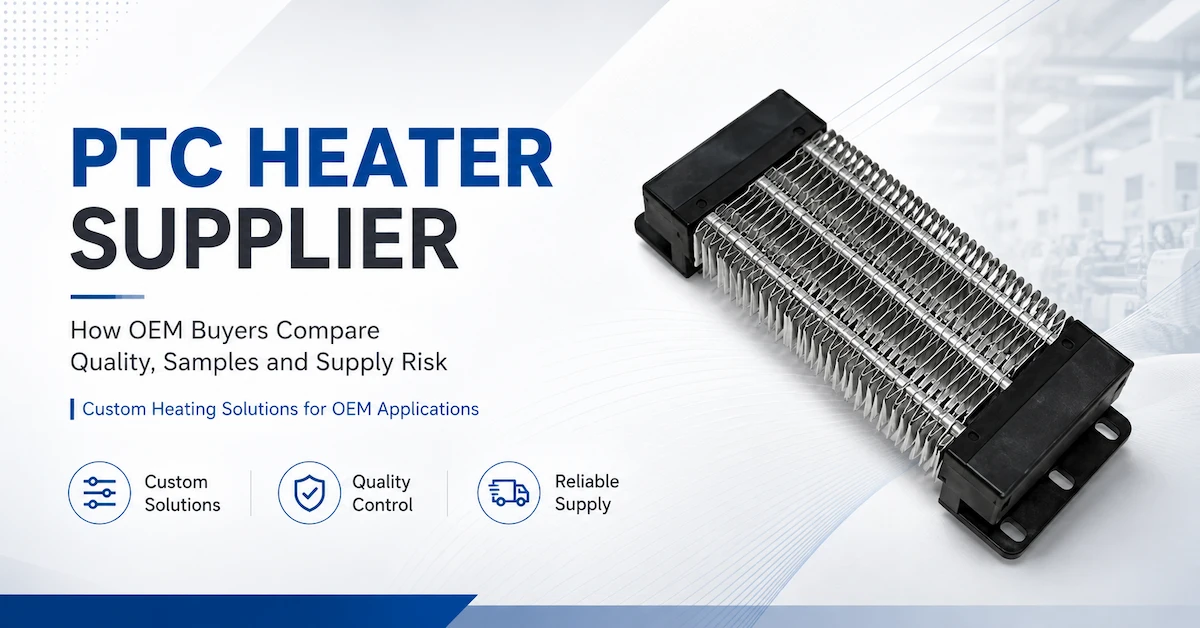
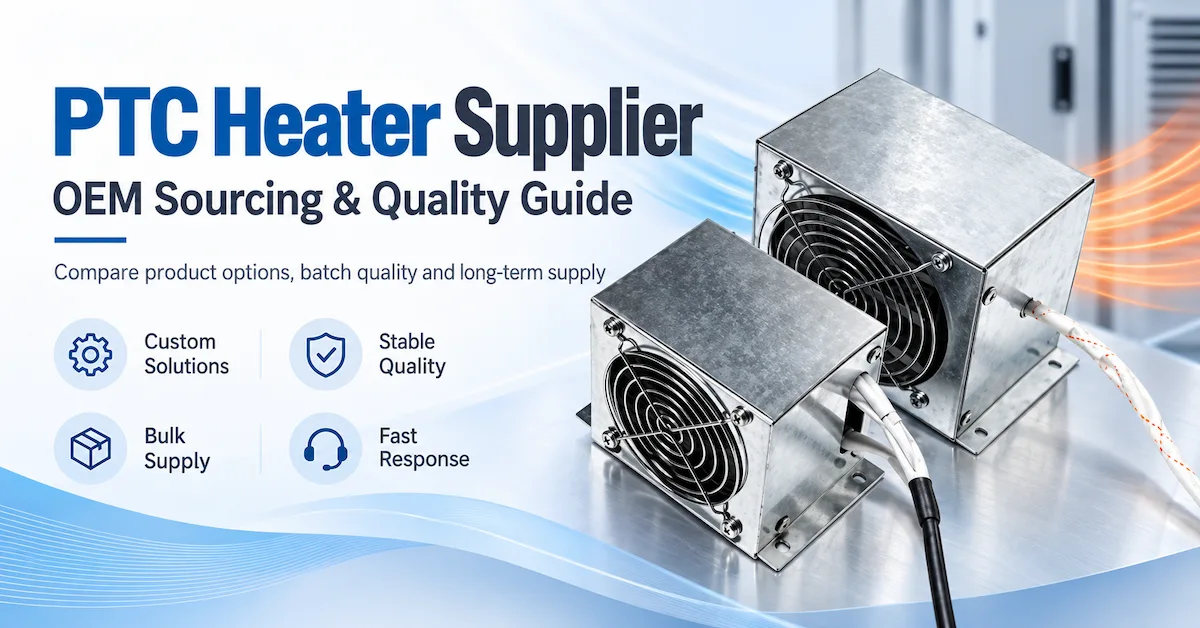
A reliable PTC Heater Supplier should provide more than a competitive unit price. For OEM manufacturers and international procurement teams, the right supplier must deliver suitable heating components, consistent batch quality, clear technical documentation, transparent commercial terms, and dependable support throughout the product's manufacturing lifecycle.
The most effective sourcing process evaluates three connected requirements:
Technical compatibility: The supplied heater must match the electrical, thermal, mechanical, and environmental requirements of the finished equipment.
Commercial suitability: Pricing, minimum order quantity (MOQ), tooling charges, payment conditions, lead times, and delivery responsibilities must support the purchasing program.
Long-term supply reliability: The supplier must be able to maintain approved product specifications, control engineering changes, resolve quality problems, and support repeat production.
For example, two suppliers may both offer a 220V PTC air heater with a nominal rating of 1000W. However, the products may differ in ceramic characteristics, aluminum fin design, wiring, electrical insulation, installation dimensions, airflow requirements, and actual operating power.
The lowest-priced product is not necessarily the most economical choice if it requires redesign, additional testing, or repeated production adjustments.
For international OEM buyers, the better purchasing question is:
Which supplier can consistently deliver the approved PTC heating assembly at an acceptable total cost, with clearly defined quality and supply responsibilities?
This guide explains how to answer that question using a practical supplier qualification framework.
Buyers exploring available configurations can first review the PTC Heater product range from Tianrui Electronics.
What Types of Buyers Need a PTC Heater Supplier?
PTC heaters are used across different equipment categories, but purchasing requirements vary significantly by customer type.
A procurement manager purchasing replacement heaters for an existing appliance may prioritize dimensional compatibility, stock availability, and repeat-order pricing.
An R&D engineer developing a new heating system may require technical collaboration, custom samples, material information, and design adjustments.
A distributor may focus on product variety, bulk purchasing terms, packaging, and availability across several customer applications.
PTC Heater Buyer Segmentation
| Buyer Type | Primary Purchasing Requirements | Common Supplier Expectations |
|---|---|---|
| Household appliance OEM | Repeatable heating performance, competitive cost, safety | Stable specifications, bulk production |
| HVAC equipment manufacturer | Airflow compatibility, temperature control, durability | Application support, consistent performance |
| Industrial equipment OEM | Reliable operation, environmental resistance | Custom structures, documentation |
| Electrical cabinet manufacturer | Compact heating, moisture control, easy installation | Standardized dimensions, reliable replacement supply |
| Electric vehicle component manufacturer | Electrical compatibility, vibration resistance, thermal management | Engineering review, qualification support |
| Hair-care appliance manufacturer | Compact heater dimensions, insulation, thermal response | Custom heating elements, sample development |
| Heating module integrator | Component compatibility, assembly flexibility | Heater and fan integration options |
| Distributor or wholesaler | Product variety, order flexibility, price stability | Clear catalogs, dependable replenishment |
The appropriate purchasing strategy should reflect the buyer's role.
For a standardized product, purchasing efficiency may matter more than engineering customization.
For a custom heater integrated into thousands of finished appliances, supplier qualification and configuration control are usually more important than obtaining the lowest initial quotation.
When Is a Direct Manufacturer Preferable?
A direct manufacturing relationship may be beneficial when a project requires customized dimensions, non-standard electrical characteristics, proprietary tooling, or repeated engineering revisions.
Working directly with a manufacturer may simplify communication about drawings, inspection specifications, and production changes.
However, a qualified distributor can be useful when an OEM needs small quantities of standard products, multiple brands, or regional stocking arrangements.
The best supplier model depends on the project's actual requirements.
Which PTC Heater Products Should You Source?
The first step in selecting a supplier is identifying the correct heater architecture.
PTC heating technology is available in several configurations. These products are not interchangeable simply because they share Positive Temperature Coefficient ceramic characteristics.
PTC Heater Product Comparison
| Product Type | Main Characteristics | Typical Applications | Important Purchasing Considerations |
|---|---|---|---|
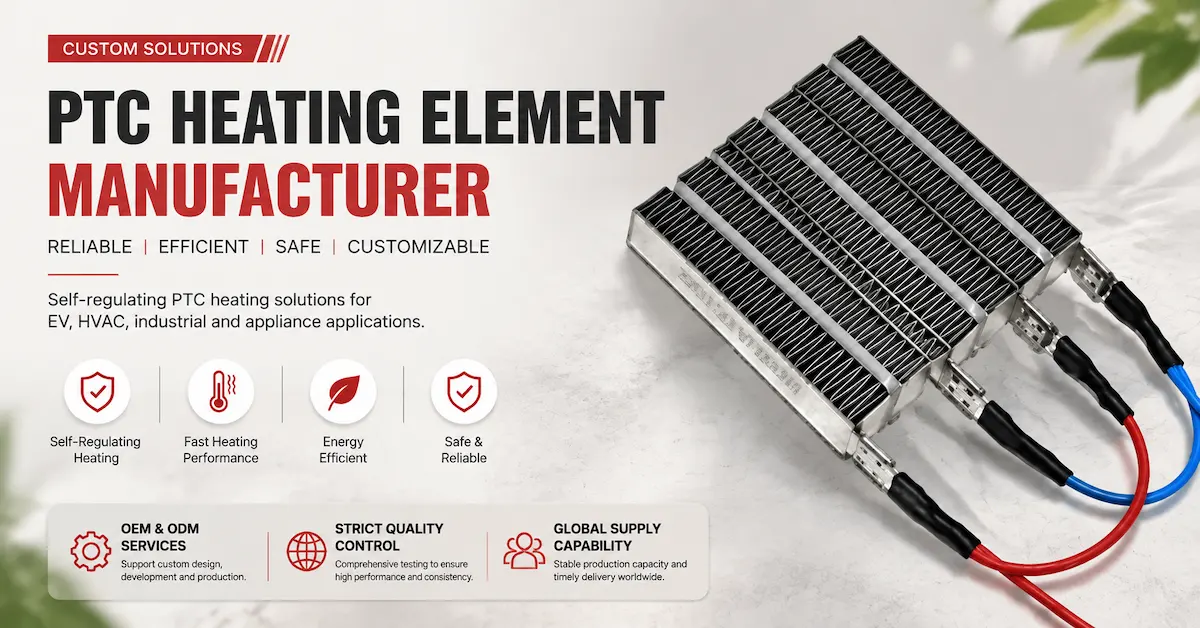
| PTC ceramic heating element | Compact self-regulating ceramic component | OEM heating assemblies | Resistance-temperature behavior, dimensions, electrodes |
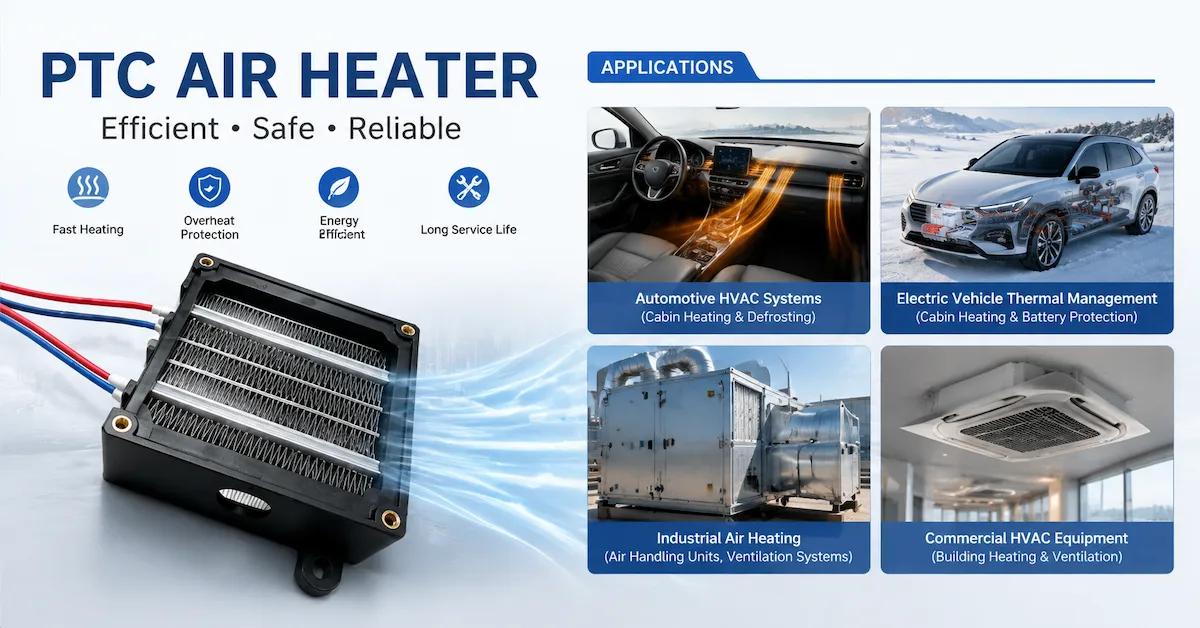
| Finned PTC air heater | Ceramic heater with aluminum heat-transfer structure | Dryers, ventilation, HVAC | Airflow, nominal power, fin construction |
| PTC heater with integrated fan | Combined heating and airflow module | Drying cabinets, warming equipment | Fan specifications, noise, mounting, electrical connections |
| Aluminum-shell PTC heater | Ceramic heating structure with metal housing | Industrial cabinets, compact appliances | Housing design, insulation, thermal contact |
| Insulated PTC heater | Heating element with electrical isolation structure | Hair-care devices, specialized appliances | Insulation performance, dimensions, temperature |
| Vehicle PTC heater | Heater configured for vehicle-related applications | Electric vehicles, cabin heating | Electrical system, vibration, operating environment |
| Custom PTC heating assembly | Application-specific structure and configuration | Specialized OEM equipment | Engineering requirements, tooling, validation |
PTC Air Heater Suppliers for Drying and Ventilation Equipment
PTC air heaters typically use ceramic heating elements integrated with aluminum heat-transfer structures.
The aluminum fins increase the available surface area for heat transfer.
These products are relevant to clothes dryers, drying cabinets, warm-air equipment, and certain industrial heating applications.
When evaluating suppliers, buyers should request the conditions associated with the stated heater power.
The actual electrical power and heating performance may change with airflow, inlet air temperature, operating voltage, and the ceramic element's temperature.
For example, Tianrui lists a 220V corrugated PTC air heater series with nominal power options of 1000W, 1500W, 1600W, 1800W, and 2000W.
These catalog options provide a useful starting point for equipment selection. Buyers should confirm the exact configuration and performance conditions before purchasing.
Integrated PTC Fan Heater Suppliers
A heater with an integrated fan can reduce the number of separate components that an OEM must source and assemble.
However, combining a heater and fan introduces additional purchasing considerations.
The supplier must account for both thermal and airflow performance.
Important requirements include fan speed, airflow distribution, operating noise, bearing design, electrical supply, mounting dimensions, and potential vibration.
Tianrui offers a 220V cross-flow fan PTC heater series with listed 600W, 900W, 1200W, and 1800W configurations.
Such modules may be suitable for equipment that requires distributed warm airflow rather than localized heating.
Compact PTC Heaters and Aluminum-Shell Assemblies
Compact equipment may not have enough installation space for a large finned heater.
An aluminum-shell structure can provide mounting features and assist with heat transfer.
Relevant applications include compact appliances, industrial heating modules, and electrical cabinets.
Buyers should check whether the metal housing is electrically isolated from energized parts and whether the mounting method meets the application's temperature and mechanical requirements.
Different product options can be reviewed in the PTC Heater with Shell category.
Automotive PTC Heater Supply
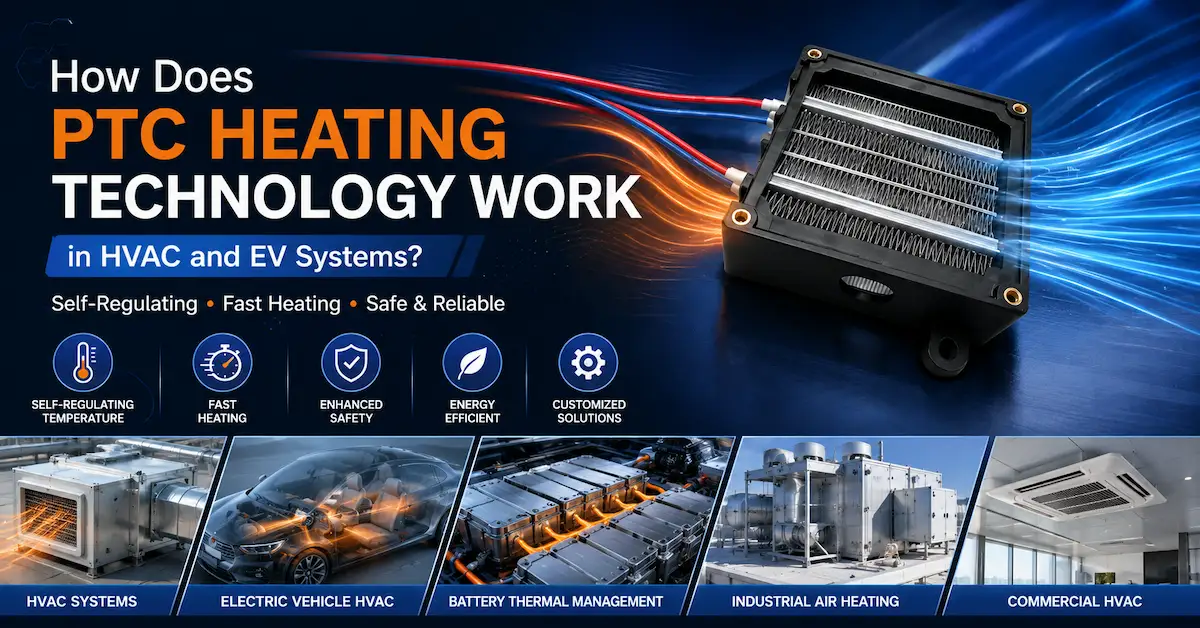
Electric vehicle applications may involve different voltage systems, environmental exposure, and qualification requirements from ordinary household appliances.
An automotive heater should not be selected solely because its nominal wattage appears suitable.
The buyer must establish whether the heater is intended for cabin air heating, surface heating, or another defined thermal function.
Explore the PTC Heater for Vehicle category for relevant product directions.
The exact vehicle application and compliance requirements should be reviewed before supplier approval.
What Technical Specifications Must a PTC Heater Supplier Confirm?
An effective purchasing specification should describe the heater as part of an operating system.
A request such as “Need 220V PTC heater, 1000W, best price” rarely provides enough information for accurate comparison.
The supplier must know what is being heated and the conditions under which the heater operates.
Essential PTC Heater Procurement Specifications
| Parameter | Required Information | Importance |
|---|---|---|
| Rated voltage | Nominal AC or DC supply | Determines electrical compatibility |
| Operating voltage range | Minimum and maximum expected voltage | Establishes operating limits |
| Rated power | Power and reference measurement conditions | Supports thermal selection |
| Startup current | Maximum expected initial current | Affects switching and power supply design |
| PTC characteristics | Relevant resistance-temperature behavior | Influences heater operation |
| Target temperature | Air, surface, object, or liquid temperature | Defines heating objective |
| Ambient temperature | Minimum and maximum | Affects thermal performance |
| Heating medium | Air, solid surface, or other medium | Determines heat-transfer structure |
| Airflow | Flow rate and installation arrangement | Critical for forced-air products |
| Dimensions | Maximum size and tolerances | Ensures installation compatibility |
| Mounting | Brackets, holes, clamps, or other structures | Affects assembly and heat transfer |
| Insulation | Electrical isolation requirements | Supports equipment safety |
| Wiring | Wire gauge, length, insulation | Ensures electrical integration |
| Connector | Connector type and pin configuration | Supports assembly compatibility |
| Operating cycle | Continuous, intermittent, or repeated cycling | Influences qualification |
| Expected purchase volume | Samples, pilot production, annual forecast | Supports commercial planning |
Why Nominal Wattage Is Not Enough
PTC ceramic heaters are self-regulating because electrical resistance increases as the material enters its designed temperature-transition region.
Under approximately constant applied voltage, increasing resistance reduces current and electrical power.
Therefore, startup power and stabilized power may differ.
A heater's nominal wattage does not necessarily describe its power consumption at every operating condition.
For meaningful supplier comparison, buyers should request:
-
Voltage used during testing
-
Ambient temperature
-
Initial heater temperature
-
Airflow or other cooling conditions
-
Power measurement timing
-
Stabilized power, where applicable
-
Temperature measurement locations
Without these details, nominal power ratings from different suppliers may not represent equivalent performance.
Curie Temperature Is Not the Appliance Temperature
For many ceramic PTC heating materials, Curie temperature is associated with a significant change in electrical resistance.
It does not directly define the final temperature of the surrounding air, housing, or heated object.
The actual equipment temperature depends on heat generation, thermal resistance, airflow, contact conditions, insulation, and heat losses.
A supplier should explain these relationships instead of using Curie temperature as a universal substitute for thermal performance testing.
How Should You Compare Quotations From Different PTC Heater Suppliers?
A fair supplier comparison requires every manufacturer or distributor to quote against the same technical and commercial requirements.
Otherwise, differences in price may reflect different product configurations rather than genuine cost advantages.
The Quotation Normalization Method
Before ranking offers, confirm that every quotation refers to the same:
-
Heater configuration and electrical rating
-
Drawing revision and critical dimensions
-
Required materials and components
-
Wiring, connectors, and mounting accessories
-
Inspection and testing requirements
-
Estimated purchasing quantity
-
Packaging specifications
-
Trade terms and delivery responsibilities
For custom products, the quotation should also identify any tooling or engineering charges.
PTC Heater Quotation Comparison Table
| Quotation Item | Supplier A | Supplier B | Supplier C |
|---|---|---|---|
| Product configuration | To confirm | To confirm | To confirm |
| Nominal voltage and power | To confirm | To confirm | To confirm |
| Technical specification revision | To confirm | To confirm | To confirm |
| Unit price at agreed quantity | To confirm | To confirm | To confirm |
| Sample charge | To confirm | To confirm | To confirm |
| Tooling charge | To confirm | To confirm | To confirm |
| Custom wiring included | Yes/No | Yes/No | Yes/No |
| Testing documentation included | Yes/No | Yes/No | Yes/No |
| MOQ | To confirm | To confirm | To confirm |
| Production lead time | To confirm | To confirm | To confirm |
| Trade term and named place | To confirm | To confirm | To confirm |
| Packaging | To confirm | To confirm | To confirm |
| Warranty or defect handling | To confirm | To confirm | To confirm |
This table prevents buyers from comparing different supply scopes as though they were identical.
Understand the Total Cost of Procurement
The purchasing cost of a heating component may include more than the invoiced unit price.
For an OEM project, consider:
Total procurement cost = Component cost + Tooling + Qualification + Logistics + Quality-related costs + Inventory-related costs
Not every cost will apply to every order.
However, the model helps identify differences that may otherwise be overlooked.
Consider a hypothetical example.
Supplier A offers a unit price of $8.50, while Supplier B offers $8.20.
At an annual order volume of 10,000 units, the direct price difference is $3,000.
If changing to Supplier B requires $5,000 in additional testing and requalification, the first-year financial benefit disappears under those assumptions.
This is an illustrative purchasing calculation, not a quotation or pricing claim for Tianrui products.
The lesson is that unit price should be evaluated alongside the cost of introducing and maintaining the supplier.
How Much Does a PTC Heater Cost in Bulk?
There is no universal wholesale price for PTC heaters.
Pricing varies according to the heater's electrical characteristics, construction, materials, dimensions, accessories, testing requirements, and purchase volume.
A bare ceramic heating element and a complete fan-heater assembly cannot be meaningfully compared using only wattage.
Factors Affecting Bulk PTC Heater Prices
Ceramic material and electrical characteristics
Different ceramic compositions and manufacturing requirements can affect component costs.
Heater size and geometry
Larger or specialized structures may require additional material or tooling.
Aluminum housing and heat-transfer components
Machining, forming, material selection, and finishing affect costs.
Insulation requirements
Additional insulation materials or verification requirements may increase assembly and testing costs.
Fan integration
A complete heating module may include a motor, impeller, housing, bearings, wiring, and mounting hardware.
Customization
Non-standard connectors, wiring, drawings, or mechanical structures may introduce development costs.
Order volume
Larger volumes may create purchasing and manufacturing efficiencies, but discounts depend on the supplier's actual production economics.
Should Buyers Choose the Cheapest PTC Heater Supplier?
Not automatically.
The lower-priced option may be appropriate when the product is technically equivalent, quality requirements are satisfied, and supply terms are acceptable.
However, lower pricing should not compensate for unknown material substitutions, inadequate electrical testing, or inconsistent production.
Buyers should establish minimum technical and quality requirements before assigning commercial scores.
This prevents a low price from outweighing a critical product risk.
What MOQ Should You Expect From a PTC Heater Supplier in China?
Minimum order quantity depends on the product and the supplier's manufacturing arrangement.
A standard catalog heater may have a different MOQ from a customized PTC heating assembly.
For procurement planning, distinguish between four purchasing stages.
Engineering Samples
Small quantities are used to evaluate whether the proposed heater configuration meets the application's requirements.
The supplier may need to prepare special drawings or modified components.
Pilot Production
A limited production run helps evaluate manufacturing repeatability and integration into the customer's equipment.
Pilot quantities should be selected according to the project's validation and production needs.
Initial Commercial Order
The first approved production order establishes the practical purchasing and delivery process.
It should refer to an approved technical configuration.
Repeat Production Orders
Once the product enters routine manufacturing, the supplier and customer may establish regular purchasing quantities, delivery schedules, and forecasting arrangements.
For OEM programs, a staged purchasing agreement can be more effective than negotiating only a single bulk MOQ.
Specific sample quantities, pilot volumes, and production minimums must be confirmed by the individual supplier.
How Should Buyers Evaluate PTC Heater Sample Quality?
Samples are important because they establish the product configuration that may later be purchased in larger quantities.
However, a sample that becomes hot when connected to a power supply does not necessarily meet the requirements of the finished equipment.
Supplier qualification should evaluate measurable characteristics under relevant operating conditions.
Recommended PTC Heater Sample Inspection Checklist
| Inspection Area | What to Verify |
|---|---|
| Visual condition | Damage, assembly quality, visible defects |
| Dimensions | Critical installation measurements |
| Electrical characteristics | Resistance or other applicable parameters |
| Startup behavior | Initial current and power |
| Heating response | Time to defined thermal condition |
| Stabilized performance | Power and temperature under specified conditions |
| Electrical insulation | Resistance and dielectric properties where required |
| Airflow compatibility | Performance at defined operating airflow |
| Wiring and connectors | Compatibility and mechanical integrity |
| Abnormal operation | Behavior under relevant foreseeable faults |
These are proposed evaluation areas. Exact test methods and acceptance criteria should be agreed upon for the project.
Define Acceptance Criteria Before Testing
An effective sample specification should contain four elements:
Parameter → Test condition → Acceptance limit → Recorded result
For example, an OEM may define the maximum permitted warm-up time under a specific voltage, ambient temperature, airflow, and installation configuration.
The supplier and customer can then compare the measured results with an agreed limit.
This is more reliable than approving the sample based on a general statement that heating performance is satisfactory.
Establish an Approved Reference Configuration
After qualification, the approved sample should be linked to controlled technical documents.
These may include:
-
Released mechanical drawing
-
Electrical specification
-
Critical material and component requirements
-
Test and inspection plan
-
Wiring diagram
-
Packaging specification
-
Approved revision identifier
A physical reference sample can be useful, but it should not replace written specifications.
The written requirements allow future production batches to be evaluated against the approved design.
How Can a PTC Heater Supplier Maintain Batch-to-Batch Consistency?
For repeat OEM production, consistent supply is often more valuable than an excellent first sample.
A manufacturer must control the characteristics that affect heater performance.
Depending on the design, important components can include ceramic heating elements, electrodes, aluminum structures, insulation materials, wiring, and connectors.
Incoming Quality Control
Incoming inspection should focus on materials and components that affect critical product characteristics.
Relevant checks may include material identity, dimensions, electrical properties, and component conformity.
The sampling method should reflect the risk associated with each characteristic.
In-Process Quality Control
Production processes should be monitored to identify deviations before finished products are released.
Depending on the heater design, this may include:
-
Ceramic element positioning
-
Electrical connections
-
Insulation installation
-
Mechanical assembly
-
Critical dimensions
-
Terminal and wire attachment
-
Mounting structure
The buyer should ask how process deviations are recorded and corrected.
Final Inspection
Final testing should confirm that the produced heaters meet the approved specification.
Possible checks include electrical properties, dimensions, insulation, appearance, and functional heating behavior.
The relevant test conditions should be documented.
A manufacturer may apply different inspection frequencies for different characteristics. Buyers should not assume that every measurement is performed on every heater.
Traceability
Traceability helps manufacturers investigate problems affecting specific production lots.
An effective traceability approach may connect:
Production lot → Critical materials → Manufacturing records → Inspection results → Shipment
The level of traceability should match the product risk and customer requirements.
Statistical Quality Control
For higher-volume programs, buyers may discuss appropriate process capability indicators or acceptance sampling methods.
For example, critical dimensions or electrical characteristics may be monitored using statistical methods where the process and available data make this meaningful.
Acceptance Quality Limit (AQL) sampling can support certain inspection activities, but it is not a guarantee that a shipment contains no defects.
Safety-critical characteristics may require additional controls.
The inspection approach should therefore reflect engineering risk rather than relying on a single generic quality percentage.
What Documents Should You Request Before Approving a PTC Heater Supplier?
Documentation should establish what has been approved, how it will be inspected, and which requirements apply.
A useful supplier documentation package may include:
| Document | Purpose |
|---|---|
| Product datasheet | Identifies electrical and thermal characteristics |
| Mechanical drawing | Defines dimensions and mounting |
| Wiring specification | Defines connections and accessories |
| Material information | Supports material and compliance assessment |
| Sample test report | Documents qualification results |
| Inspection specification | Defines acceptance criteria |
| Process or quality-control plan | Describes agreed production controls |
| Packaging specification | Supports transportation and receiving inspection |
| Revision record | Tracks approved product changes |
| Applicable compliance evidence | Supports requirements of the finished product and target market |
Not every document is required for every purchase.
A standard component purchased for a low-risk application may need less extensive documentation than a custom heater used in a regulated product.
Product Compliance and Certification
Compliance requirements depend on the intended application and destination market.
For household and similar electrical appliances, the IEC 60335 family of standards may be relevant.
For environmental testing, the IEC 60068 series can provide methods relevant to temperature changes, vibration, and other conditions.
For certain electrical and electronic equipment placed on the European Union market, applicable RoHS requirements may need consideration.
These references support compliance planning. They do not establish that a specific heater automatically conforms to the standards.
Buyers should request evidence applicable to the exact product configuration.
How Should You Audit a PTC Heater Factory?
A supplier audit should verify actual capability rather than simply confirm that production equipment is present.
For a custom OEM heater, the audit should investigate how requirements become controlled production outputs.
Key Factory Audit Areas
Manufacturing scope
Which manufacturing and assembly operations are completed in-house? Which components are purchased externally?
Engineering capability
Can the supplier review drawings, explain heating behavior, and support appropriate design changes?
Equipment and maintenance
Are important production and testing devices maintained and suitable for the required work?
Measurement capability
Are relevant inspection instruments controlled and calibrated where necessary?
Material management
How are incoming materials identified, accepted, stored, and issued to production?
Production control
How are work instructions, approved drawings, and process changes managed?
Quality management
How are nonconforming products identified, segregated, corrected, and investigated?
Customer communication
Who is responsible for technical questions, quotation revisions, quality complaints, and delivery updates?
A supplier does not need the most complex factory infrastructure to be suitable for every project.
The objective is to confirm that its controls are appropriate for the product and purchasing risk.
Example PTC Heater Supplier Scorecard
| Evaluation Category | Suggested Weight |
|---|---|
| Product and application compatibility | 25 |
| Manufacturing and production controls | 20 |
| Quality evidence and traceability | 20 |
| Commercial terms and cost transparency | 15 |
| Delivery and supply continuity | 10 |
| Technical communication and responsiveness | 10 |
| Total | 100 |
This scoring model is an illustrative internal procurement tool, not an independent ranking.
A buyer may adjust the weights depending on application risk.
A critical technical or compliance failure should prevent approval regardless of the total score.
How Important Are Production Capacity and Delivery Reliability?
Production capacity matters, but headline capacity figures do not always indicate how quickly a specific custom heater can be delivered.
A manufacturer may produce multiple component families using different assembly lines, materials, and processes.
For purchasing decisions, buyers should distinguish between general company capacity and capacity available for the exact proposed product.
Questions to Ask About Capacity
-
Is the proposed heater an existing production item?
-
Does it require dedicated tooling or equipment?
-
Which materials have long replenishment times?
-
What is the planned production batch size?
-
How is capacity allocated among customers?
-
Can production support forecast increases?
-
What happens if an important machine becomes unavailable?
Specific answers provide more useful purchasing information than a general claim of large annual output.
Lead Time Is Not One Number
For an OEM project, total delivery time may include:
Engineering review → Sample preparation → Customer testing → Design approval → Material purchasing → Production → Inspection → Transportation
Different stages may overlap, but the dependencies must be understood.
An initial development order should not automatically use the same lead-time estimate as a mature repeat order.
How to Improve Delivery Predictability
Procurement teams can improve planning by providing rolling forecasts, confirming approved drawings early, and issuing orders with clear delivery requirements.
For recurring programs, buyer and supplier may establish:
-
Forecast review intervals
-
Order confirmation procedures
-
Material purchasing responsibilities
-
Agreed production lead times
-
Shipment milestones
-
Escalation contacts
-
Inventory or buffer-stock arrangements, if commercially justified
These arrangements should be documented rather than assumed.
How Do You Manage Long-Term PTC Heater Supply Risk?
A PTC heater may remain part of an OEM product for several years.
During that time, the supplier's raw materials, equipment, purchased components, and operating costs may change.
A reliable sourcing strategy must therefore address what happens after the first successful delivery.
Engineering Change Control
A critical procurement requirement is preventing unapproved changes to the supplied heater.
Depending on the design, changes to the following may affect performance:
-
Ceramic material or electrical characteristics
-
Heater dimensions
-
Aluminum housing or fin structure
-
Electrical insulation
-
Terminals
-
Wires and connectors
-
Fan or motor components
-
Assembly methods
Buyers should establish which changes require advance notification or approval.
For qualified OEM products, even a seemingly small component substitution can trigger additional engineering evaluation.
Material Availability
The manufacturer should identify major components that could affect supply continuity.
For custom projects, a buyer may ask whether alternative materials are available and what testing would be necessary before substitution.
An alternative component should not be accepted solely because it appears similar.
Supplier Corrective Action
Quality problems can occur even when a supplier has established controls.
The important issue is how the problem is investigated and resolved.
A useful corrective-action process should identify:
-
The affected product and production lot
-
The observed nonconformity
-
Immediate containment actions
-
Root-cause investigation
-
Corrective and preventive measures
-
Verification of effectiveness
-
Customer communication and closure
Buyers may request a formal corrective-action report for significant problems.
Second-Source Planning
Dual sourcing can reduce dependence on a single supplier, but qualified heater substitution requires care.
Two products with the same nominal voltage and power may have different heating responses, electrical behavior, mounting dimensions, and insulation characteristics.
An alternative supplier may need its own validation and approval process.
Therefore, a second-source strategy should be planned early enough to accommodate qualification work.
How Should International Buyers Manage PTC Heater Shipping and Import Requirements?
International procurement introduces commercial and logistical requirements beyond the heater itself.
Buyers should confirm the agreed trade term, named delivery location, packaging, shipping documents, and import responsibilities before placing the order.
EXW, FCA, FOB, and DAP: Why Trade Terms Matter
Incoterms define different responsibilities between buyers and sellers.
For example, an EXW quotation and an FOB quotation do not represent identical delivery obligations.
FCA, FOB, and DAP arrangements allocate different responsibilities for transport, risk transfer, and delivery.
The appropriate term depends on the transportation method and purchasing arrangement.
Procurement teams should specify the Incoterms version and named place when agreeing on commercial conditions.
Packaging Requirements
Heating assemblies may contain delicate electrical connections, thin aluminum fins, ceramic components, or exposed terminals.
Packaging should protect the actual product construction.
For example, a finned PTC heater may require measures that prevent fin deformation during transportation.
A complete heater module may also need protection for connectors, fan components, and mounting hardware.
Packaging requirements should be confirmed during quotation rather than after production.
Receiving Inspection
When the shipment arrives, the buyer should verify relevant information such as:
-
Part number and revision
-
Quantity
-
Production lot identification
-
Packaging condition
-
Critical dimensions or characteristics
-
Agreed inspection documents
Receiving inspection should reflect the approved supply agreement and product risk.
A strong supplier relationship does not eliminate the value of checking incoming shipments.
Which PTC Heater Supplier Is Suitable for Different Applications?
Supplier selection should reflect how the heater interacts with the finished equipment.
A manufacturer experienced in compact appliance heating may not automatically meet every requirement of an automotive thermal management project.
Household Appliance OEM
Appliance manufacturers often need predictable heating characteristics, practical assembly dimensions, and competitive repeated-order pricing.
For a clothes dryer, heater and airflow compatibility are particularly important.
For a compact kitchen appliance, mounting and insulation may be more significant.
A buyer should compare suppliers according to the relevant application rather than using one generic heater specification.
Related product directions are available through Tianrui's home appliance applications.
Industrial Cabinet and Automation Equipment
Industrial cabinet heating may be intended to reduce condensation risk and maintain equipment within a suitable environmental range.
The heater must be selected according to enclosure volume, temperature conditions, ventilation, and heat loss.
Additional considerations may include mounting, service access, operating duty cycle, and compatibility with cabinet controls.
HVAC and Air-Heating Equipment
HVAC and ventilation applications should be evaluated with the actual airflow system.
The heater's performance can change with fan speed, duct configuration, inlet temperature, and airflow restriction.
Buyers should request operating data under conditions representative of their equipment.
Electric Vehicle Equipment
Automotive projects may require more extensive environmental and electrical qualification.
The supplier should understand the vehicle's voltage architecture, heating application, mechanical constraints, and required documentation.
Vehicle-related product listings are useful starting points but do not replace project-specific engineering approval.
Specialized OEM Heating Equipment
For products with unusual dimensions, installation methods, or thermal requirements, a standard heater may not be suitable.
In these cases, a customized heating assembly may reduce integration difficulties.
The supplier and customer should determine whether the project requires modification of an existing design or new tooling.
Tianrui describes application-specific product development through its Custom PTC Heater Solutions.
Why Consider Tianrui Electronics as a PTC Heater Supplier?
Dongguan Tianrui Electronics Co., Ltd. is a China-based manufacturer specializing in PTC thermistor components and thermal products.
Established in 2010, the company reports an approximately 5,000-square-meter facility equipped with automated manufacturing equipment and specialized testing instruments.
Its published portfolio covers PTC heating elements, PTC air heaters, heater assemblies with fans, aluminum-shell products, insulated heating structures, and other application-oriented components.
This product range allows potential OEM customers to evaluate different heater architectures before selecting or developing a suitable configuration.
Product Selection Support
Tianrui's product categories provide an initial reference for buyers sourcing heating components for appliances, industrial equipment, and other thermal applications.
Buyers can compare existing heater structures and discuss whether a standard design meets their requirements.
Custom OEM/ODM Development
Tianrui also publishes services covering customer requirement communication, heating product design, structure and material selection, drawing preparation, tooling-related development, and technical consultation.
These services are relevant when an OEM project requires non-standard dimensions or specialized heating configurations.
For more information, review the Tianrui PTC Heater Customization Solution.
Manufacturing Background
The company describes manufacturing and testing capabilities on its About Us page.
Its published annual production figure concerns the wider PTC component business and should not be treated as a guaranteed annual capacity for a particular finished heater assembly.
Specific production capacity, MOQ, qualification evidence, and lead time should be confirmed for the proposed model.
Supporting Long-Term OEM Purchasing
For repeat purchasing, potential customers should discuss approved specifications, inspection methods, production planning, and product change control.
A well-defined supplier agreement helps align engineering expectations with commercial purchasing requirements.
Buyers can contact Tianrui with application requirements and drawings for product selection or custom development discussions.
A Practical OEM Supplier Qualification Example
Consider a hypothetical manufacturer developing a commercial drying cabinet.
The equipment requires a PTC heater that operates from a 220V supply and works with a defined airflow system.
The purchasing team identifies several available heater configurations.
Instead of selecting the lowest-priced component immediately, the project team follows a structured process.
Step 1: Establish the Application
The engineering team defines cabinet dimensions, airflow, desired air temperature, operating cycle, and available electrical power.
It also identifies relevant abnormal operating conditions.
Step 2: Compare Supplier Proposals
The team requests technical information from candidate suppliers using the same project requirements.
Suppliers propose suitable heater configurations and clarify rated power conditions.
Step 3: Evaluate Samples
The engineering team tests each sample inside a representative cabinet.
It records startup current, warm-up time, stabilized operating behavior, air temperature, and relevant abnormal-condition results.
Step 4: Review Commercial Conditions
The procurement team compares unit prices, tooling charges, MOQ, lead time, packaging, and quality responsibilities.
Step 5: Approve the Configuration
The selected design receives a controlled part number, drawing revision, and acceptance specification.
Step 6: Validate Pilot Production
The customer evaluates pilot units before moving to routine production.
Step 7: Establish Repeat-Order Controls
The supplier and customer agree on forecast planning, inspection documentation, and change notification requirements.
This is an illustrative procurement scenario, not a claim about a completed Tianrui customer project.
Its value lies in showing why technical qualification and purchasing management must work together.
A 90-Day Framework for Onboarding a New PTC Heater Supplier
Supplier onboarding becomes easier when responsibilities and deliverables are organized into stages.
The following schedule is an example planning framework. Actual project timing depends on customization complexity, testing requirements, and material availability.
| Stage | Main Activities | Expected Output |
|---|---|---|
| Days 1–15 | Define requirements, identify suppliers, send RFQs | Technical and commercial comparison |
| Days 16–30 | Review proposals, drawings, and sample plans | Shortlisted configurations |
| Days 31–45 | Receive and evaluate applicable samples | Recorded qualification results |
| Days 46–60 | Complete supplier review and required revisions | Approved technical baseline |
| Days 61–75 | Prepare or evaluate pilot production | Manufacturing readiness assessment |
| Days 76–90 | Finalize supply terms and repeat-order controls | Purchasing and quality agreement |
This framework should be adjusted to the risk of the finished equipment.
Complex automotive or other highly controlled applications may require significantly longer qualification processes.
Supplier Approval Checklist
Before approving a supplier, confirm:
-
The heater configuration matches the application.
-
Electrical and thermal specifications are documented.
-
Sample acceptance criteria have been satisfied.
-
Critical dimensions and materials are controlled.
-
Quality and traceability responsibilities are clear.
-
Commercial terms are documented.
-
MOQ and lead time have been confirmed.
-
Change notification requirements are established.
-
Contact persons for engineering and quality issues are identified.
-
The first production order refers to the approved configuration.
What Information Should You Include in a PTC Heater RFQ?
A complete RFQ helps suppliers prepare more relevant quotations and reduces unnecessary back-and-forth communication.
Technical Information
Application: Identify the appliance, equipment, or thermal system.
Heating requirement: Explain the desired thermal result, target temperature, and operating conditions.
Voltage: State AC or DC supply, nominal voltage, and operating range.
Heater architecture: Specify a preferred structure if known, such as finned air heater, heater with fan, or aluminum-shell heater.
Mechanical requirements: Provide drawings, dimensions, mounting method, and installation restrictions.
Operating environment: Define temperature, humidity, airflow, vibration, and other relevant exposure.
Electrical connections: Identify wiring, terminals, connectors, and insulation requirements.
Testing: State required inspection or qualification criteria.
Commercial Information
Purchase stage: Engineering samples, pilot order, or volume production.
Quantity: Provide expected order quantity and annual purchasing forecast.
Customization: Identify non-standard dimensions, accessories, or packaging.
Delivery: Specify destination and required schedule.
Documentation: State which drawings, inspection reports, or compliance documents are needed.
Copy-Ready RFQ Example
Subject: OEM PTC Heater RFQ – Application Review and Bulk Supply
We are developing an OEM heating application and are looking for a suitable PTC heater supplier.
Application: [Equipment type]
Power supply: [AC/DC voltage and range]
Required heating performance: [Target temperature, warm-up time, operating conditions]
Available dimensions: [Length × Width × Height]
Heating method: [Forced air / Contact heating / Other]
Wiring and connector: [Requirements]
Expected sample quantity: [Quantity]
Estimated annual order volume: [Quantity]
Destination market: [Country or region]
Please advise a suitable product configuration, technical specifications, sample options, MOQ, production lead time, and quotation terms.
We can provide drawings or additional application details for technical evaluation.
A structured inquiry helps the supplier identify the right product direction before issuing a formal offer.
For product selection and OEM quotations, submit your project through the Tianrui Electronics Contact Us page.
Common Mistakes When Choosing a PTC Heater Supplier
Mistake 1: Comparing Prices Before Comparing Specifications
Two quotations may refer to products with different structures, materials, or inspection requirements.
Align the technical scope before evaluating price.
Mistake 2: Assuming Every PTC Heater Has Identical Self-Regulating Behavior
PTC resistance-temperature behavior depends on the ceramic material and product construction.
Different heaters may have significantly different operating characteristics.
Mistake 3: Treating Self-Regulation as a Complete Safety System
Self-regulating heating can reduce power as temperature rises, but additional safety measures may still be necessary.
Electrical insulation, abnormal operation, and equipment protection must be evaluated.
Mistake 4: Ignoring Airflow Requirements
Forced-air heater performance depends on the actual airflow environment.
A heater selected without airflow information may not provide the expected thermal result.
Mistake 5: Purchasing Custom Heaters Without Approved Drawings
A physical sample alone may not define all critical requirements.
Controlled specifications reduce ambiguity during repeat production.
Mistake 6: Assuming Published MOQ and Lead Time Apply to Every Product
Commercial conditions may differ between standard and custom configurations.
Always confirm the quotation for the specific project.
Mistake 7: Failing to Control Component Substitutions
Changes to ceramic elements, insulation, wiring, or fans may affect performance.
Define supplier change-notification obligations before mass production.
Mistake 8: Evaluating Only the First Shipment
Long-term supplier performance depends on repeated quality, timely delivery, and effective problem resolution.
Monitor results across production batches rather than relying entirely on initial qualification.
Frequently Asked Questions About PTC Heater Suppliers
1. What should I look for in a reliable PTC Heater Supplier?
A reliable supplier should understand the target application, provide suitable technical specifications, support necessary samples, and maintain controlled production quality. For repeat OEM purchasing, also evaluate quotation transparency, lead-time planning, quality documentation, and engineering change control.
The best supplier is not necessarily the one with the largest catalog or lowest price. It is the one whose products and operating processes match the project's requirements.
2. Where can I find a PTC Heater Supplier in China?
China has manufacturers, distributors, and trading companies supplying PTC heating components for appliance, industrial, HVAC, and vehicle-related applications.
Dongguan Tianrui Electronics is one manufacturer offering PTC heating products and customization services.
When selecting a supplier, verify the exact product configuration, manufacturing scope, inspection capability, and commercial conditions before approving a production order.
3. What is the difference between a PTC Heater Supplier and a PTC Heater Manufacturer?
A PTC heater supplier is a company that sells or supplies heaters to customers. It may be a manufacturer, distributor, or trading company.
A manufacturer performs relevant production or assembly operations.
Direct manufacturing relationships can be useful for custom development and repeat OEM production, while distributors may be more convenient for certain standard purchasing requirements.
The appropriate choice depends on project complexity and supply needs.
4. Can I buy PTC heaters in bulk with customized specifications?
Customization may be available for voltage, electrical characteristics, dimensions, heater structure, mounting, insulation, wiring, connectors, and packaging.
Technical feasibility depends on the chosen construction.
Custom products may require engineering review, development samples, tooling, and additional qualification.
The supplier should confirm which requirements can be modified before issuing a quotation.
5. How much do wholesale PTC heaters cost?
Wholesale pricing depends on heater type, materials, dimensions, electrical specifications, accessories, inspection requirements, and purchase quantity.
A bare ceramic component and an integrated fan-heater assembly have different cost structures.
Buyers should request quotations using identical specifications and quantities, then compare total purchasing costs rather than unit price alone.
6. What is the typical MOQ for OEM PTC heaters?
There is no universal MOQ for every PTC heater.
Standard items, modified products, and completely customized assemblies may have different minimum quantities.
Engineering samples and pilot orders may also follow different commercial arrangements from routine production orders.
Request the MOQ for your specific configuration and expected purchase volume.
7. How long does PTC heater production take?
Production lead time depends on material availability, product complexity, order quantity, tooling requirements, and manufacturing schedules.
Custom development may require additional engineering and qualification time.
Buyers should separate sample preparation, customer approval, manufacturing, inspection, and shipping when planning the delivery schedule.
8. Are PTC heaters safer than traditional resistance heaters?
PTC ceramic heaters have a self-regulating characteristic that can reduce electrical power as ceramic temperature rises.
This may help limit certain overheating risks.
However, it does not eliminate all hazards.
Appropriate insulation, electrical protection, mechanical installation, abnormal-operation testing, and applicable equipment safety requirements remain necessary.
9. Can a PTC Heater Supplier provide products for electric vehicles?
Some suppliers offer PTC heaters intended for vehicle-related applications.
However, suitability depends on the vehicle voltage system, thermal function, operating conditions, and qualification requirements.
Buyers should distinguish between cabin air heating, contact heating, and liquid-based thermal management.
A product's vehicle-related marketing description is not a substitute for technical and compliance verification.
10. How do I ensure consistent quality when ordering PTC heaters repeatedly?
Begin with an approved specification and representative qualification samples.
Establish incoming material requirements, critical process controls, relevant inspection methods, and traceability expectations.
For repeat orders, confirm that the supplier uses the approved configuration and communicates changes affecting critical materials or product characteristics.
Review batch quality and delivery performance throughout the purchasing relationship.
11. What documents should a PTC Heater Supplier provide?
Depending on the product and application, relevant documents may include technical datasheets, mechanical drawings, wiring information, test reports, inspection specifications, packaging requirements, and applicable compliance evidence.
Custom OEM projects may also require revision records and agreed change-control procedures.
The exact documentation package should be defined during supplier qualification.
12. Is it better to purchase directly from a PTC heater factory?
Direct purchasing can be useful when the project requires custom engineering, recurring volume production, or close control of specifications.
However, purchasing directly from a factory is not automatically the best choice for every order.
A distributor may provide advantages for standard components or local stock availability.
Compare the complete technical, commercial, and logistical requirements before deciding.
Conclusion
Choosing the right PTC Heater Supplier requires balancing product compatibility, quotation transparency, manufacturing consistency, and long-term delivery reliability. For OEM buyers, the strongest purchasing strategy is to define technical requirements, evaluate representative samples, agree on quality controls, and establish clear commercial and change-management procedures before repeat production.
Dongguan Tianrui Electronics offers PTC heating components and custom heating solutions for different OEM applications. If you need standard heaters, customized assemblies, or bulk purchasing support, contact Tianrui Electronics with your voltage, heating requirements, drawings, operating conditions, and estimated quantity to discuss a suitable product configuration and quotation.