What Is a PTC Heater for Electric Vehicles?
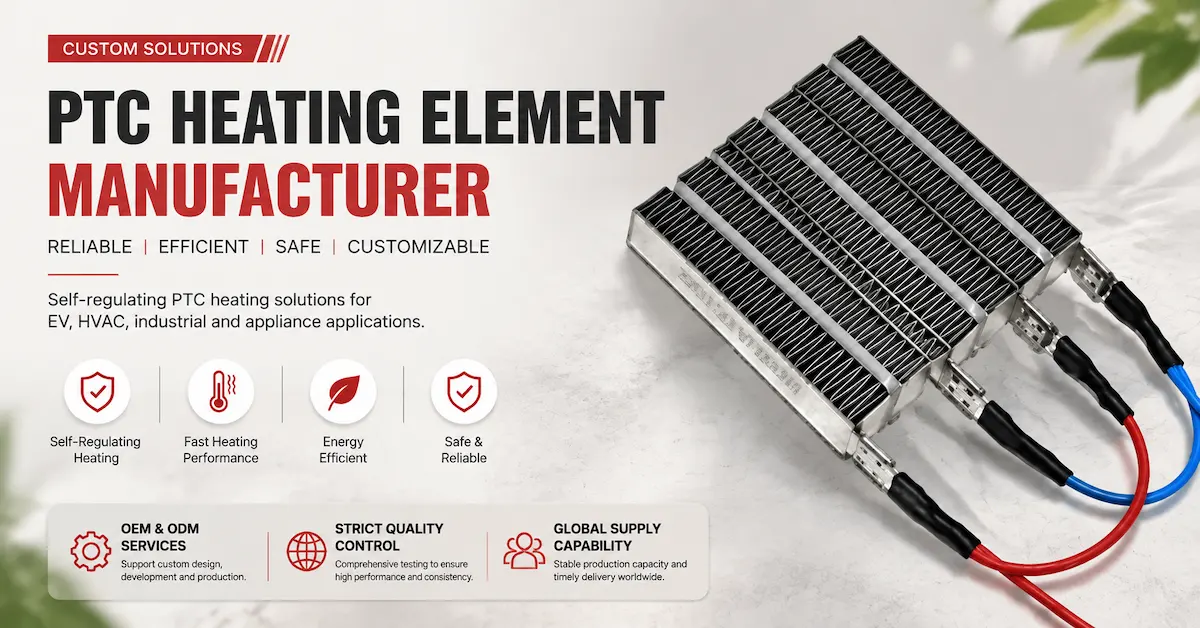
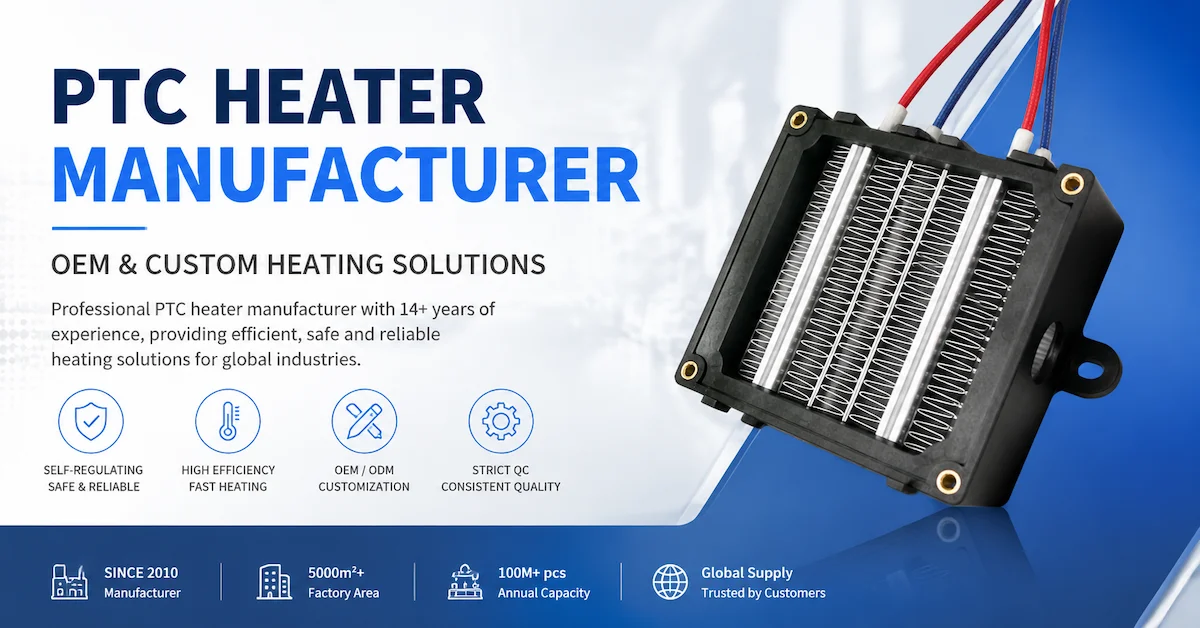
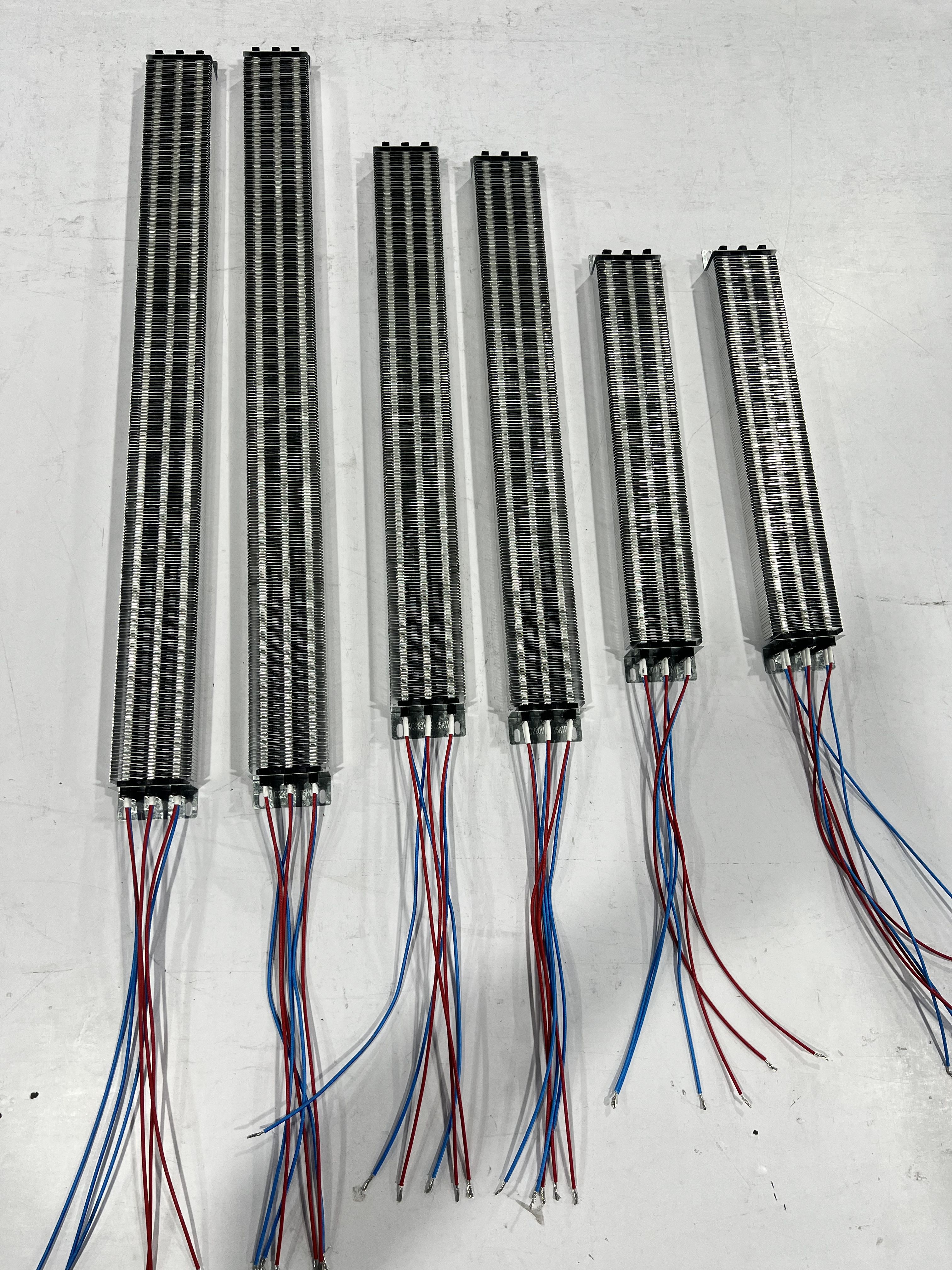
A PTC Heater for Electric Vehicle is an electric heating component designed to provide efficient thermal management for modern electric vehicles.
Unlike traditional vehicles that use engine waste heat for cabin heating, electric vehicles do not have a combustion engine producing continuous heat. Therefore, an independent heating system is required to maintain passenger comfort and support battery operation in cold environments.
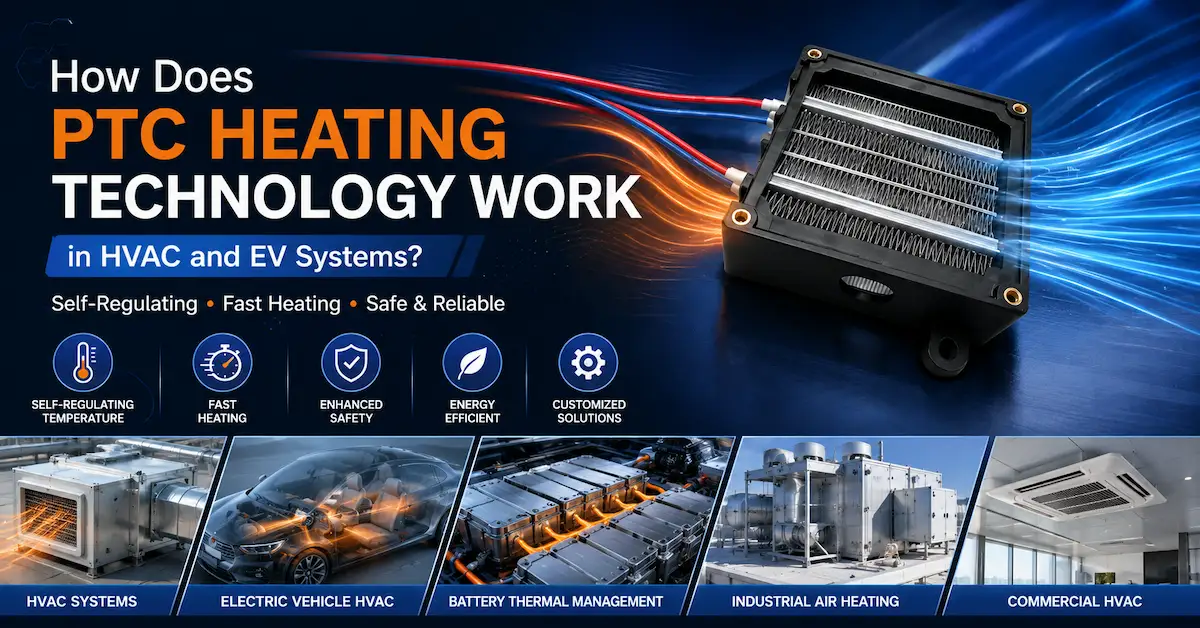
PTC heaters use Positive Temperature Coefficient ceramic heating elements. When electrical current passes through the PTC material, the heater generates heat and automatically increases resistance as temperature rises. This self-regulating characteristic helps maintain stable heating performance and improves operational safety.
For electric vehicle manufacturers, a suitable PTC heater supplier should provide solutions that consider:
- heating power requirements;
- vehicle voltage system;
- installation space;
- thermal management design;
- safety requirements;
- long-term reliability.
Tianrui provides PTC heater solutions for different applications, including EV cabin heating, battery thermal management and customized OEM heating systems.
Why Do Electric Vehicles Need PTC Heaters?
Electric vehicles require efficient heating systems because their powertrain does not generate the same waste heat as internal combustion engines.
A reliable heating solution directly affects:
- passenger comfort;
- battery efficiency;
- driving range;
- charging performance;
- vehicle safety.
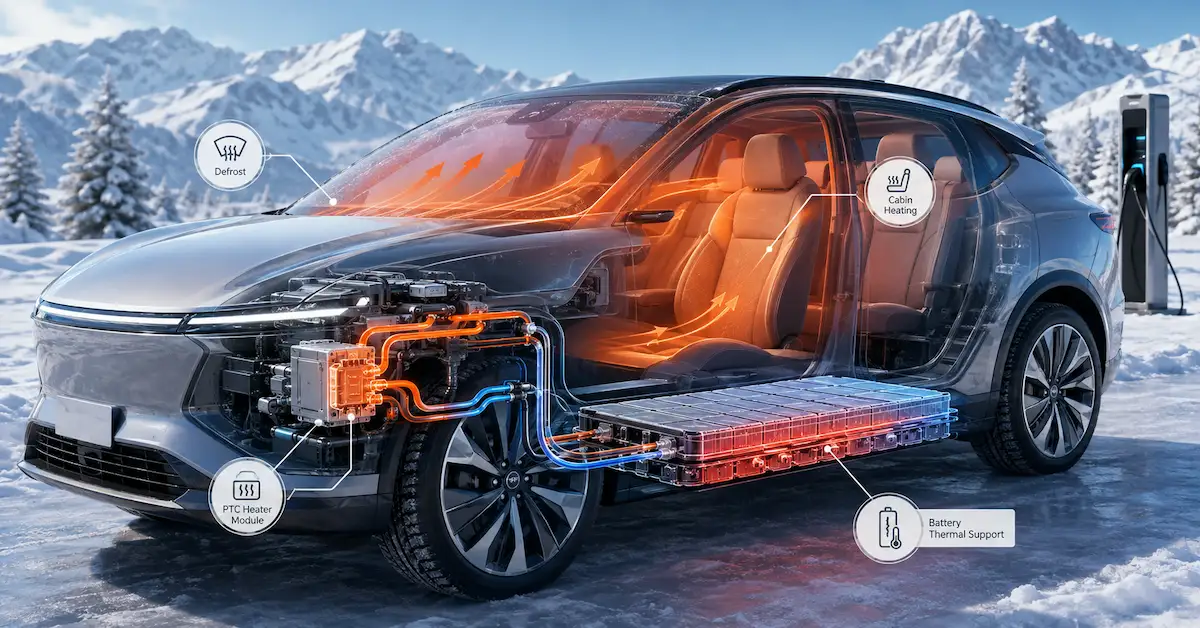
PTC heaters are widely used in EV thermal management because they provide fast heating response, stable operation and compact integration.
Cabin Heating Applications
Passenger comfort is one of the most important functions of an EV heating system.
During cold weather conditions, the vehicle cabin requires rapid temperature adjustment.
PTC heaters can provide:
- quick warm air output;
- stable temperature control;
- independent heating operation.
Compared with traditional heating methods, PTC heaters can operate immediately after power activation without waiting for engine heat generation.
Common applications include:
- passenger electric vehicles;
- electric buses;
- commercial EVs;
- special electric vehicles.
Battery Thermal Management Applications
Battery temperature has a significant influence on EV performance.
Low temperatures may affect:
- charging efficiency;
- battery output;
- driving range;
- battery lifespan.
PTC heaters can support battery thermal management by providing controlled heating during cold conditions.
Applications include:
- battery pack preheating;
- charging preparation;
- energy storage systems;
- electric vehicle thermal loops.
For battery-related applications, manufacturers should evaluate:
- heating capacity;
- temperature control accuracy;
- reliability under cycling conditions;
- compatibility with the thermal system.
Defrosting and Demisting Applications
Cold weather creates challenges for vehicle visibility and safety.
PTC heaters can support:
- windshield defrosting;
- air conditioning heating;
- moisture removal.
Fast heat generation helps improve driving safety during winter operation.
How Does an EV PTC Heater Work?
The working principle of an electric vehicle PTC heater is based on the positive temperature coefficient characteristics of ceramic materials.
The heating process includes several stages:
| Working Stage | Performance |
|---|---|
| Power activation | Electrical energy converts into heat |
| Temperature rise | PTC ceramic resistance increases |
| Stable heating | Output automatically regulates |
| Temperature recovery | Heater adjusts according to conditions |
The main process is:
- Electrical current passes through the PTC ceramic element.
- The ceramic material generates heat.
- Temperature increases rapidly.
- Resistance rises automatically.
- Heating output becomes more stable.
This self-regulating function helps reduce overheating risks and simplifies temperature control design.
What Are the Main Types of PTC Heaters Used in Electric Vehicles?
Different EV applications require different heater structures.
A professional EV PTC Heater Supplier should provide suitable solutions based on the vehicle thermal management system.
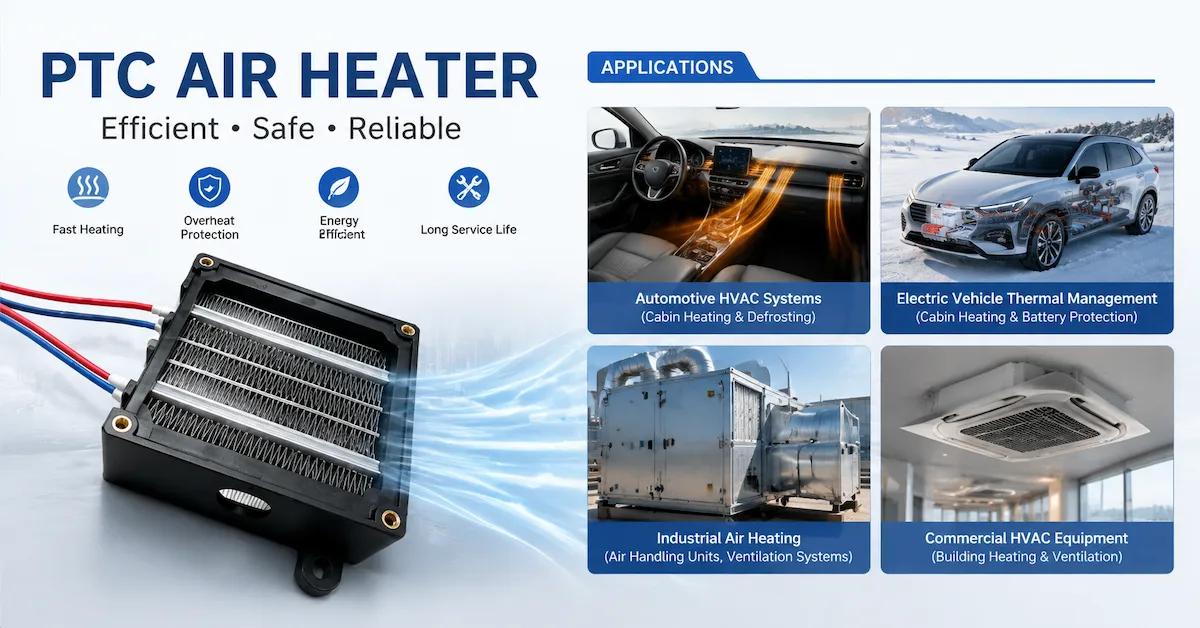
PTC Air Heater for Electric Vehicles
Air PTC heaters directly heat airflow passing through the heating element.
They are commonly used for:
- cabin heating;
- ventilation systems;
- air conditioning systems.
Advantages include:
- fast heating response;
- compact structure;
- easy integration.
Tianrui provides PTC Air Heater solutions for applications requiring efficient air heating performance.
PTC Liquid Heater for Electric Vehicles
Liquid PTC heaters heat coolant or thermal fluids circulating through the vehicle system.
They are suitable for:
- battery heating loops;
- thermal management systems;
- cooling circuits.
Advantages include:
- uniform heat distribution;
- better integration with liquid cooling systems;
- suitable for battery applications.
Automotive PTC Heater
Automotive PTC heaters are designed specifically for vehicle applications.
They require consideration of:
- vibration resistance;
- temperature cycling;
- installation limitations;
- long service life.
Applications include:
- electric passenger vehicles;
- electric buses;
- commercial vehicles.
What Are the Advantages of PTC Heaters for Electric Vehicles?
Fast Heating Performance
One of the biggest advantages of PTC heaters is rapid heat generation.
Compared with systems depending on external heat sources, PTC heaters can provide heating immediately after activation.
Benefits include:
- faster cabin temperature adjustment;
- improved passenger comfort;
- better cold-weather performance.
Self-Regulating Temperature Control
PTC ceramic materials naturally adjust resistance according to temperature changes.
This provides:
- overheating protection;
- stable operation;
- simplified control systems.
High Safety and Reliability
Safety is critical in electric vehicle applications.
PTC heaters provide:
- controlled temperature behavior;
- reduced overheating risk;
- stable heating performance.
Compact Design
Space is limited inside electric vehicles.
PTC heaters offer:
- lightweight structure;
- flexible installation;
- integration with vehicle thermal systems.
Energy Efficient Operation
Efficient heating is important because EV heating systems directly consume battery energy.
A suitable PTC heater design helps balance:
- heating performance;
- power consumption;
- vehicle range.
What Technical Parameters Should You Consider When Selecting an EV PTC Heater?
Choosing the right PTC Heater for Electric Vehicle requires more than checking heating power.
For EV manufacturers and thermal system developers, the heater should be evaluated according to the complete vehicle application.
Important parameters include:
| Parameter | Why It Matters |
|---|---|
| Voltage | Must match vehicle electrical architecture |
| Heating Power | Determines thermal output capability |
| Heating Efficiency | Affects battery energy consumption |
| Temperature Range | Influences operating reliability |
| Size and Weight | Determines installation feasibility |
| Air or Liquid Flow | Ensures proper heat transfer |
| Insulation Performance | Supports electrical safety |
| Response Time | Affects heating speed |
| Durability | Supports vehicle lifetime requirements |
Voltage Compatibility
Electric vehicles may use different voltage platforms, including:
- 12V systems;
- 24V systems;
- 48V systems;
- high-voltage EV systems.
The selected PTC heater must match the vehicle electrical system.
Incorrect voltage selection may result in:
- insufficient heating output;
- excessive current;
- unstable operation;
- reduced service life.
Heating Power Requirements
Heating power determines how much thermal energy the heater can provide.
The required power depends on:
- cabin size;
- battery capacity;
- ambient temperature;
- heat loss;
- vehicle operating conditions.
A higher power rating does not always mean better performance.
The heater should be matched to the complete thermal management design.
Temperature Control Performance
EV applications require stable temperature control.
Engineers should evaluate:
- temperature response;
- self-regulation characteristics;
- operating stability;
- protection performance.
PTC technology helps maintain safer operation by increasing resistance as temperature rises.
Installation Dimensions
Electric vehicles have limited installation space.
Before selecting a heater, buyers should confirm:
- mounting location;
- available space;
- airflow direction;
- connection position;
- mechanical interface.
A supplier with customization capability can help optimize the heater structure according to vehicle design requirements.
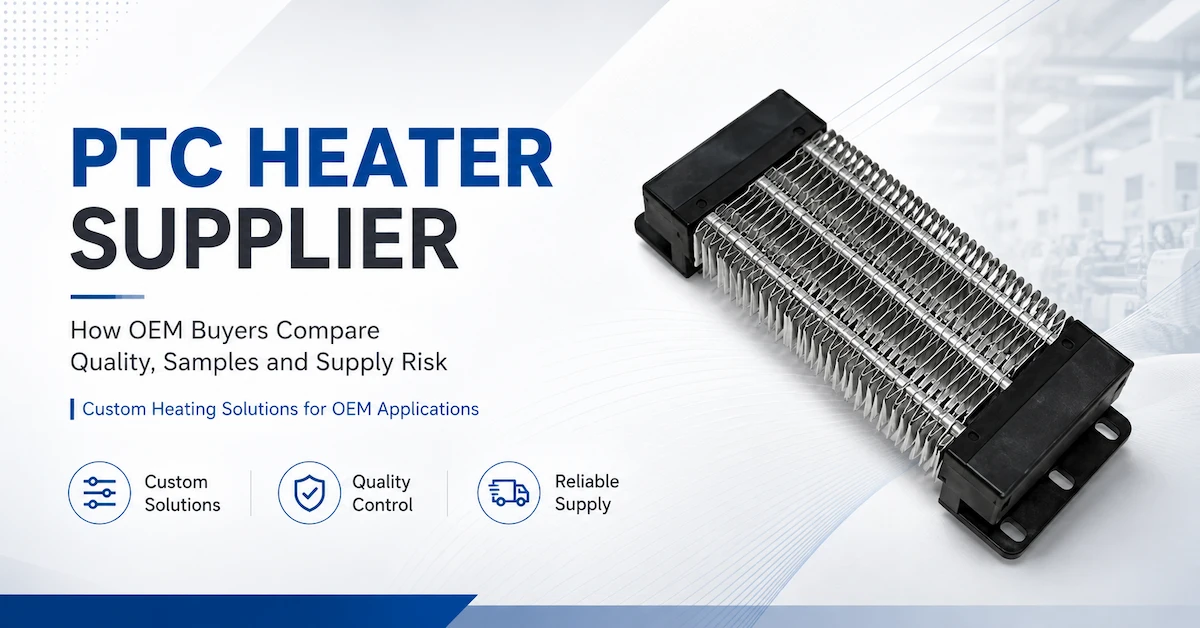
How to Choose a Reliable PTC Heater Supplier for Electric Vehicles?
Selecting an EV heating supplier requires evaluating technical capability, manufacturing experience and long-term cooperation potential.
A reliable supplier should support the complete process:
Application analysis
→ Technical recommendation
→ Prototype development
→ Testing validation
→ Mass production
Evaluate EV Heating Application Experience
Electric vehicle applications have higher requirements than general industrial heating.
A capable supplier should understand:
- thermal management systems;
- vehicle operating conditions;
- heating efficiency requirements;
- safety considerations.
The supplier should be able to discuss the relationship between:
- heater power;
- battery consumption;
- cabin temperature;
- thermal efficiency.
Check Customization Capability
EV manufacturers often require customized heater solutions.
Customization may include:
- voltage;
- power output;
- heater dimensions;
- airflow structure;
- liquid channel design;
- wiring;
- connectors;
- mounting structure.
A supplier with OEM capability can adjust the heater according to vehicle platform requirements.
Tianrui provides customized PTC heater solutions according to different application requirements, supporting product development from technical discussion to customized production.
Evaluate Manufacturing and Testing Capability
For automotive applications, consistent quality is essential.
A qualified supplier should have control over:
- raw materials;
- heating elements;
- assembly process;
- electrical testing;
- performance validation.
Typical testing includes:
| Test Item | Purpose |
|---|---|
| Electrical performance test | Verify voltage and power |
| Temperature test | Confirm heating behavior |
| Insulation test | Ensure electrical safety |
| Durability test | Evaluate long-term reliability |
| Dimension inspection | Confirm vehicle integration |
Why Is PTC Ceramic Technology Important for EV Heaters?
The PTC ceramic heating element is the core component of the heater.
Its characteristics influence:
- heating efficiency;
- temperature response;
- stability;
- service life.
The ceramic material determines how the heater responds when temperature changes.
Important factors include:
- material formulation;
- ceramic processing;
- electrode design;
- thermal conductivity.
A supplier with strong PTC ceramic knowledge can provide more stable heating performance and better customization support.
Tianrui develops PTC heating components based on ceramic technology and provides solutions for different thermal management applications.
What Is the OEM Development Process for EV PTC Heaters?
For electric vehicle projects, suppliers usually need to work closely with customers during development.
Step 1: Application Requirement Analysis
The supplier reviews:
- vehicle type;
- heating purpose;
- voltage system;
- power requirements;
- installation limitations.
Step 2: Technical Proposal
The supplier evaluates:
- suitable heater structure;
- heating capacity;
- thermal solution;
- connection design.
Step 3: Prototype Development
Samples are developed according to:
- customer specifications;
- drawings;
- application conditions.
Step 4: Testing and Validation
Customers evaluate:
- heating performance;
- installation compatibility;
- reliability;
- system integration.
Step 5: Mass Production
After approval, the supplier establishes:
- production specifications;
- inspection standards;
- quality control procedures.
This process helps ensure that production units maintain the same performance as approved samples.
What Are Common Applications of EV PTC Heaters?
Passenger Electric Vehicles
PTC heaters help provide:
- cabin heating;
- windshield defrosting;
- cold-weather comfort.
Electric Buses
Large passenger vehicles require reliable heating systems because of:
- larger cabin volume;
- longer operating hours;
- frequent temperature changes.
Commercial Electric Vehicles
Applications include:
- delivery vehicles;
- logistics vehicles;
- electric trucks.
Requirements often include:
- high reliability;
- long operating cycles;
- stable heating output.
Special Electric Vehicles
Examples include:
- mining vehicles;
- airport vehicles;
- industrial transport vehicles.
These applications often require customized thermal solutions.
PTC Heater for Electric Vehicle vs Heat Pump System
Modern EVs may use either PTC heaters, heat pumps or a combination of both.
| Comparison | PTC Heater | Heat Pump |
|---|---|---|
| Heating Response | Fast | Moderate |
| Low Temperature Performance | Strong | Depends on conditions |
| System Complexity | Lower | Higher |
| Installation | Easier | More complex |
| Control | Simple | More advanced |
Many EV manufacturers combine both technologies to balance:
- heating speed;
- energy efficiency;
- driving range.
FAQ About PTC Heater for Electric Vehicle
What is a PTC heater used for in an electric vehicle?
A PTC heater provides electric heating for EV cabin comfort, battery thermal management and defrosting applications.
Why do electric vehicles need PTC heaters?
Electric vehicles do not have engine waste heat, so they require independent heating systems to maintain cabin temperature and support battery operation in cold environments.
How does an EV PTC heater work?
A PTC heater uses ceramic heating elements that increase resistance as temperature rises, providing stable and self-regulating heating performance.
What types of PTC heaters are used in electric vehicles?
Common types include air PTC heaters, liquid PTC heaters and customized automotive PTC heater assemblies.
Can PTC heaters be customized for electric vehicles?
Yes. Suppliers can customize voltage, power, dimensions, wiring, connectors and installation structures according to vehicle requirements.
How do I choose an EV PTC heater supplier?
Evaluate technical capability, automotive application experience, customization ability, testing methods and production consistency.
Are PTC heaters safe for electric vehicles?
PTC heaters provide self-regulating temperature characteristics, but the complete vehicle system still requires proper electrical and thermal safety design.
What affects EV PTC heater performance?
Performance depends on power rating, voltage, airflow or liquid flow, installation design, ambient temperature and thermal management strategy.
What information should I provide when requesting an EV PTC heater quotation?
Provide vehicle application, voltage, heating target, installation space, operating conditions, quantity and technical requirements.
Conclusion
Selecting the right PTC Heater for Electric Vehicle requires evaluating more than heating output.
A suitable EV heating solution should balance:
- heating performance;
- energy efficiency;
- safety;
- installation requirements;
- reliability;
- supplier capability.
For electric vehicle manufacturers and thermal management system developers, working with an experienced supplier can reduce development risks and improve product reliability.
Tianrui provides PTC heating solutions for automotive and industrial applications, supporting customized designs according to customer requirements.
For EV projects, buyers can review:
to discuss application requirements, drawings or customized heating needs.