How Should You Choose a Waterproof NTC Temperature Sensor Supplier?
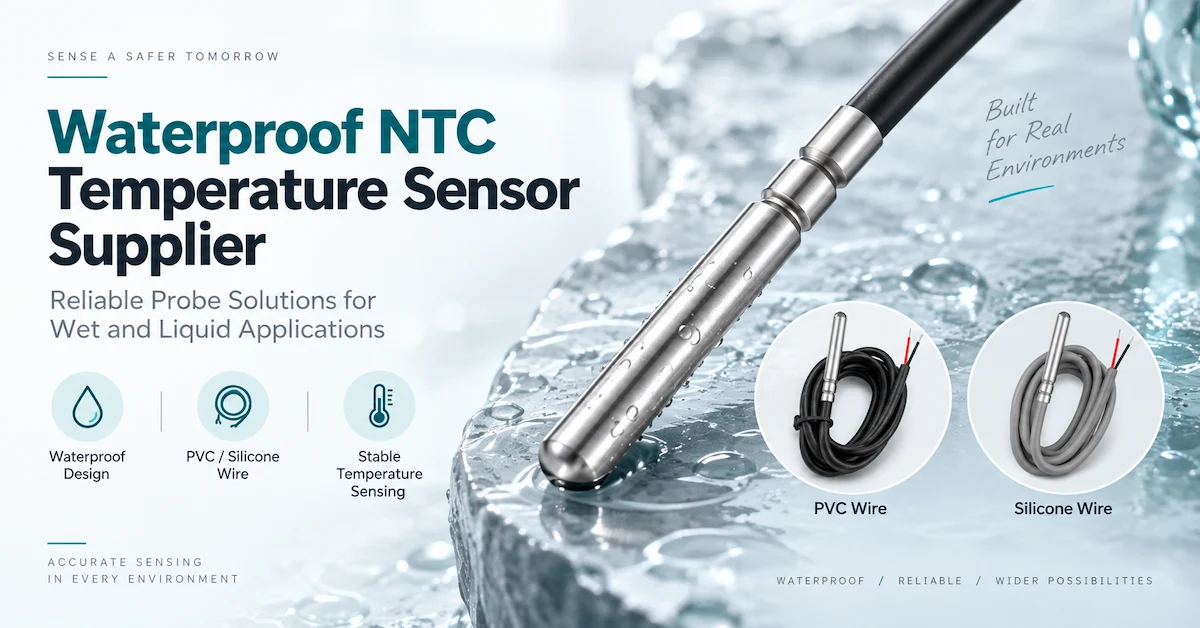
Choose a Waterproof NTC Temperature Sensor Supplier by evaluating the complete sensor assembly rather than the word “waterproof” in a product title. For OEM projects, the supplier should be able to define the NTC resistance-temperature characteristic, probe structure, cable exit, sealing method, connector, mounting arrangement and the conditions under which moisture protection is expected to work. A stainless-steel tube alone does not establish that an assembled sensor is suitable for continuous immersion, pressurized liquid, condensation or chemical exposure.
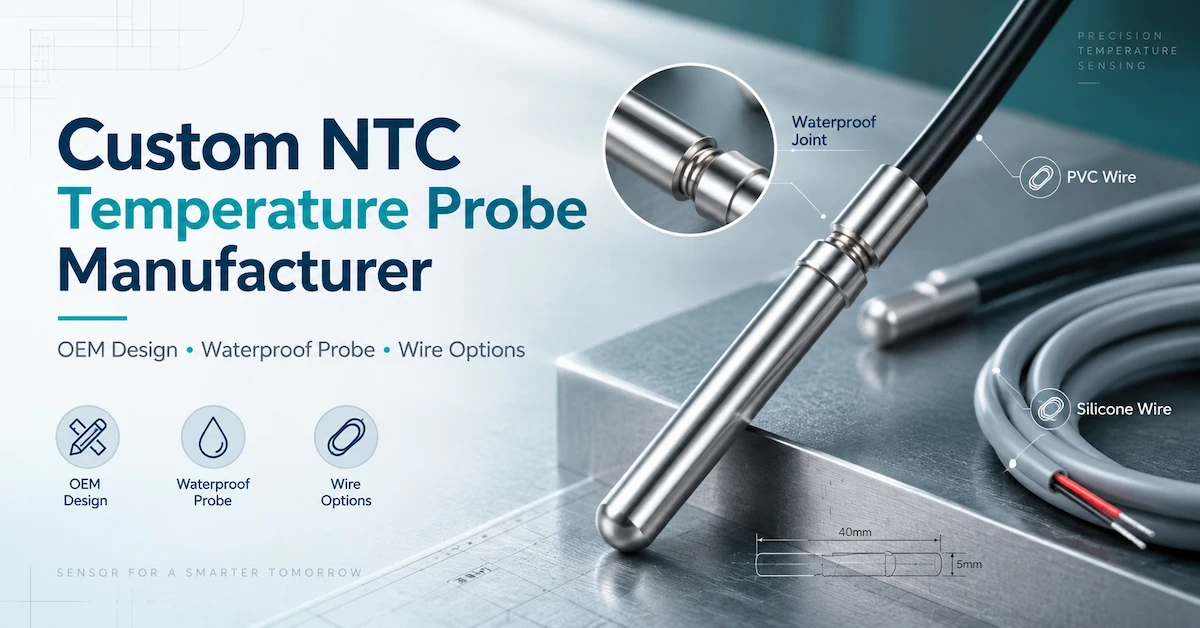
Tianrui’s NTC temperature sensor range includes assembled temperature probes for different environments, while its metal-shell NTC sensor category includes a product specifically listed as a waterproof NTC temperature sensor for air-energy tanks. The purchasing task is therefore to move from a broad product label to a controlled specification for your actual equipment.
What Does “Waterproof” Need to Mean in Your Project?
The word “waterproof” can describe very different operating conditions. A probe exposed occasionally to condensation is not working under the same conditions as a sensor continuously immersed in a hot-water tank. A sensor inside a thermowell is also different from one whose metal housing and cable seal are directly exposed to the liquid. Before comparing suppliers, define whether the sensor will face splashing, condensation, temporary immersion, continuous immersion, pressurized water or another fluid.
This distinction matters because moisture can enter through more than the visible metal housing. The cable exit, internal filling material, electrical joint, connector and any transition between different materials can affect the complete assembly. A supplier should therefore discuss sealing at the assembly level. Buyers should also separate ingress protection from chemical resistance and pressure capability; one does not automatically prove the others.
Which Buyers Need a Waterproof NTC Probe?
Waterproof or moisture-resistant NTC probes are relevant when temperature measurement takes place near water, condensation or other fluids. Common OEM projects include heat-pump water tanks, water heaters, air-conditioning equipment, washing appliances, water dispensers, pipework, liquid-processing equipment and related thermal-control systems. Tianrui’s published waterproof probe specifically lists water heaters, air conditioners and foot tubs among its application examples.
However, not every project needs an immersed metal probe. A pipe-clamp sensor can measure the outside surface of a pipe without entering the liquid, while an enclosed air sensor can monitor temperature in a humid compartment. The best construction depends on what temperature the controller actually needs to know. Selecting a more heavily sealed probe than necessary can increase size, thermal mass, cost or response time without solving a real design problem.
Start with the Electrical Curve Before Discussing Waterproof Construction
Water protection does not correct an electrical mismatch. For an NTC-based sensor, the buyer should first confirm R25, B value and its reference interval, resistance tolerance and the resistance-temperature relationship required by the controller. Two waterproof probes can look nearly identical and both be described as 10K sensors while producing different resistance values at the temperatures where the equipment operates.
Tianrui’s waterproof stainless-steel NTC probe publishes a B25/50 value of 3950K ±1% and lists several nominal resistance options. Its page title mentions 5K, 10K, 15K, 20K, 50K and 100K versions, while the displayed specification table lists a subset of those options. For an actual order, the selected resistance value and complete R-T requirement should therefore be confirmed on the project specification rather than inferred from the family title.
What Should Be Included in a Waterproof NTC Sensor RFQ?
Send each candidate supplier the same requirement package. This allows engineering teams to evaluate the same conditions and prevents quotation differences from being hidden behind vague terms such as “waterproof probe.”
| RFQ Item | What the Buyer Should Specify | Why It Matters |
|---|---|---|
| Measurement location | Tank, pipe, appliance cavity, water circuit or other location | Defines the true sensing environment |
| NTC characteristic | R25, tolerance, B value and B-value interval | Confirms controller compatibility |
| R-T requirement | Resistance limits at important temperatures | Prevents one-point matching at 25°C only |
| Exposure type | Condensation, splash, immersion or continuous liquid contact | Defines the sealing requirement |
| Liquid or medium | Water or other process medium | Supports material and sealing review |
| Temperature range | Normal, storage and temporary exposure | Applies to the complete assembly |
| Pressure | State whether the sensor experiences pressure | Prevents “waterproof” being mistaken for pressure-rated |
| Probe structure | Diameter, length, thread or insertion arrangement | Ensures mechanical fit |
| Cable | Length, insulation and routing conditions | Cable can become the weak point |
| Connector | Type, terminals and pinout | Supports direct production integration |
| Response requirement | Test medium and response definition | Makes sample results comparable |
| Quantity | Prototype, pilot and expected production volume | Supports commercial and capacity planning |
Waterproof, Water-Resistant and Immersion-Ready Are Not Automatically the Same
A useful supplier should explain the condition behind its protection statement. If an ingress-protection rating is offered, request the exact part number or construction covered, test method, cable configuration and any limitations. Tianrui’s waterproof probe page uses family-level language referring to IP67 or higher protection as a typical feature, while its specific specification table separately lists electrical and operating-temperature values. For OEM approval, buyers should confirm which protection level actually applies to the quoted configuration rather than extending a general feature statement to every variation.
The same caution applies to operating temperature. The product’s specific table lists an operating range of -20°C to 150°C, while broader feature text on the page describes wider ranges that may be available for other configurations. These are not automatically the same claim. The drawing and quotation for the actual part should state the required range and materials that support it.
Compare Probe Structures by the Way They Contact the Medium
A Waterproof NTC Temperature Sensor Supplier may offer cylindrical probes, threaded probes, bullet-type structures, tank probes or externally mounted pipe sensors. The choice should follow the installation rather than a generic idea that one structure is “more professional.”
| Probe Structure | Main Advantage | Key Question Before Approval | Typical Direction |
|---|---|---|---|
| Cylindrical stainless-steel probe | Compact protected sensing element | How is the cable exit sealed? | Tanks, appliances, pockets |
| Threaded metal probe | Mechanical retention at an opening | Is thread, seal and pressure requirement defined? | Water circuits, equipment ports |
| Bullet-type probe | Easy insertion into a pocket or medium | Is direct immersion approved for this assembly? | Water heaters, appliances |
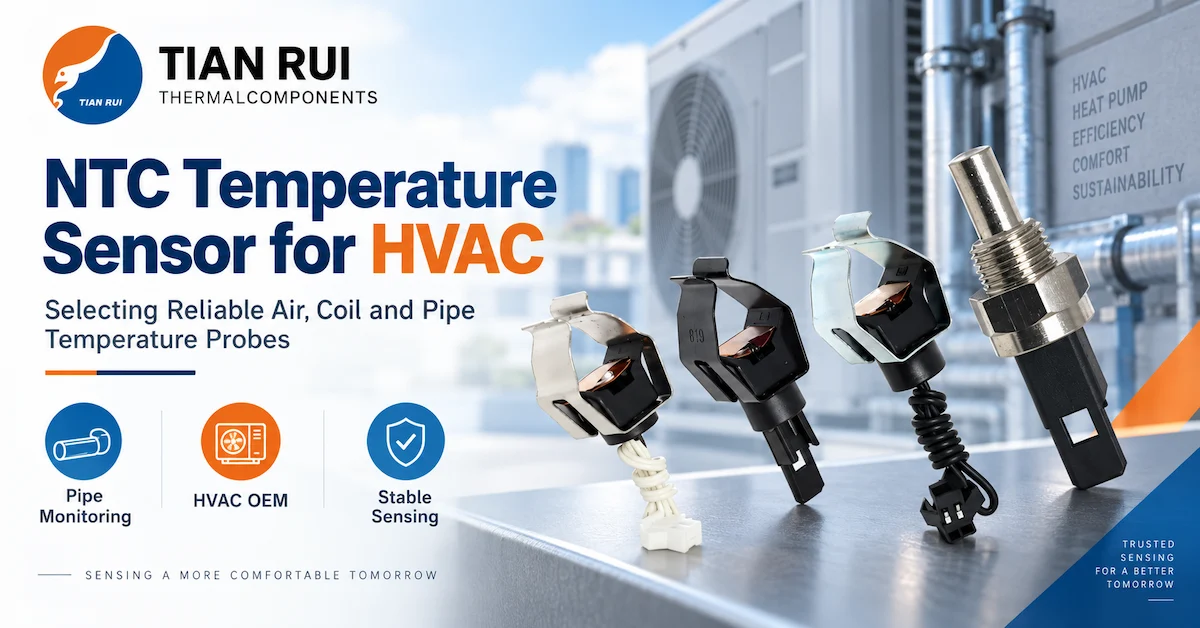
| Pipe-clamp sensor | No direct fluid contact | Does clamp fit and thermal contact stay consistent? | HVAC and pipe monitoring |
| Plastic-shell probe | Application-specific insulation and geometry | Does the housing suit moisture and installation conditions? | Appliance assemblies |
Tianrui also lists bullet-type NTC temperature sensors for liquid-related applications and pipe-clamp NTC sensors for non-invasive pipe temperature measurement. These different structures illustrate why “water temperature sensing” does not always require the same probe design.
Why the Cable Exit Deserves as Much Attention as the Metal Probe
The cable transition is one of the first areas an OEM engineer should review. A robust metal housing may provide mechanical protection, but the assembly can still fail if moisture reaches internal joints through an inadequately controlled cable exit. Ask how the cable is supported, how sealing material is applied, how dimensions or fill depth are controlled and whether bending near the transition affects the intended protection.
Cable selection also depends on temperature, flexibility, routing and the surrounding environment. If the sensor is placed in a water heater, heat-pump tank or humid HVAC assembly, define whether the cable itself will be wet or whether only the probe body is exposed. Connector location matters too: keeping the connector in a protected zone creates a different sealing problem from placing it inside a condensation-prone enclosure.
Stainless Steel Helps, but It Does Not Define the Complete Sensor Rating
Tianrui’s waterproof NTC product uses a stainless-steel probe concept, and its product descriptions reference stainless-steel materials such as 304 and 316 for different configurations. Stainless steel can provide mechanical strength and corrosion resistance, but buyers should not convert a material description into a universal compatibility claim.
If the sensor will contact a process liquid, cleaning agent or chemically treated water, disclose the medium and operating conditions to the supplier. Material compatibility may depend on grade, temperature, concentration and exposure time. The same principle applies to pressure. A sealed stainless-steel probe may be appropriate for wet service but should not be assumed to have a particular pressure rating unless the quoted assembly has been evaluated for that requirement.
How Should Samples Be Tested Before OEM Approval?
A Waterproof NTC Temperature Sensor Supplier should support sample evaluation against a written specification rather than relying on a visual inspection. Separate the test plan into electrical matching, environmental exposure, mechanical fit and installed performance. Electrical testing confirms that the NTC element follows the agreed resistance limits. Environmental testing checks the complete assembly after the intended moisture exposure. Mechanical inspection confirms dimensions, cable and connector fit. Finally, installed testing verifies whether the probe measures the temperature needed by the controller.
A practical sample record should identify the drawing revision, sample number, electrical configuration, probe and cable construction, exposure conditions and measured results before and after testing. If a leak, resistance drift or response problem appears, this record makes it easier to distinguish a sealing issue from an NTC-element or installation issue.
Do Not Approve Waterproof Performance from One Short Immersion Test
A quick water test may reveal an obvious leak, but it does not necessarily represent years of temperature cycling, cable movement or long-term moisture exposure. The qualification plan should reflect the actual equipment. For example, a heat-pump tank probe may repeatedly move between different water temperatures; a refrigeration sensor may experience condensation and drying cycles; a washing appliance may combine moisture, vibration and detergent exposure.
The test does not need to be unnecessarily complicated. The objective is to reproduce meaningful risks. Agree on exposure duration, temperature, number of cycles and acceptance criteria according to the project. If a particular IP or customer test is mandatory, put that requirement into the quotation and drawing before samples are made.
What Quality Controls Should a Waterproof NTC Supplier Explain?
For repeat production, ask how the supplier controls the elements that influence sealing and electrical consistency. Useful discussion points include incoming thermistor and cable requirements, probe dimensions, internal electrical connections, encapsulation or filling, cable-exit construction, resistance testing, visual inspection and lot identification. Tianrui’s current website describes production support covering requirement review, prototype development, testing and volume production, with incoming, process and final quality controls.
The exact inspection plan should still be confirmed for the waterproof part being ordered. A qualification test performed during development is not automatically a routine test on every shipped probe. Buyers should know which characteristics are checked per unit, per lot or periodically, and which results are available with the shipment when required.
How Do You Compare Supplier Claims Without Over-Specifying the Product?
Over-specification can be as problematic as an incomplete RFQ. Requiring a particular sealing adhesive, housing material or construction simply because it appeared in a previous design may prevent the supplier from proposing a better manufacturable solution. Instead, define the functional requirement first: operating temperature, electrical curve, exposure, fit, response and required validation.
Then ask each supplier to explain how its construction meets those conditions. Once samples are approved, freeze the relevant materials and process characteristics in the controlled specification. This approach preserves engineering flexibility during development while reducing uncontrolled substitutions during mass production.
What Determines Waterproof NTC Sensor Cost?
Waterproofing adds cost only as part of a complete design. The commercial result can be affected by probe material and dimensions, threading or machining, cable type and length, connector, sealing process, test requirements, tooling, packaging and order quantity. A low unit price is not directly comparable if the quote excludes the connector or validation required by another supplier.
When evaluating a Waterproof NTC Temperature Sensor Supplier, compare the same drawing and inspection scope. Ask whether sample fees, tooling or special testing are separate, and distinguish prototype quantity from production MOQ. For custom projects, the buyer should also ask which component has the longest procurement cycle; a special connector or cable can influence lead time more than the NTC element itself.
How Should OEM/ODM Development Move from Sample to Production?
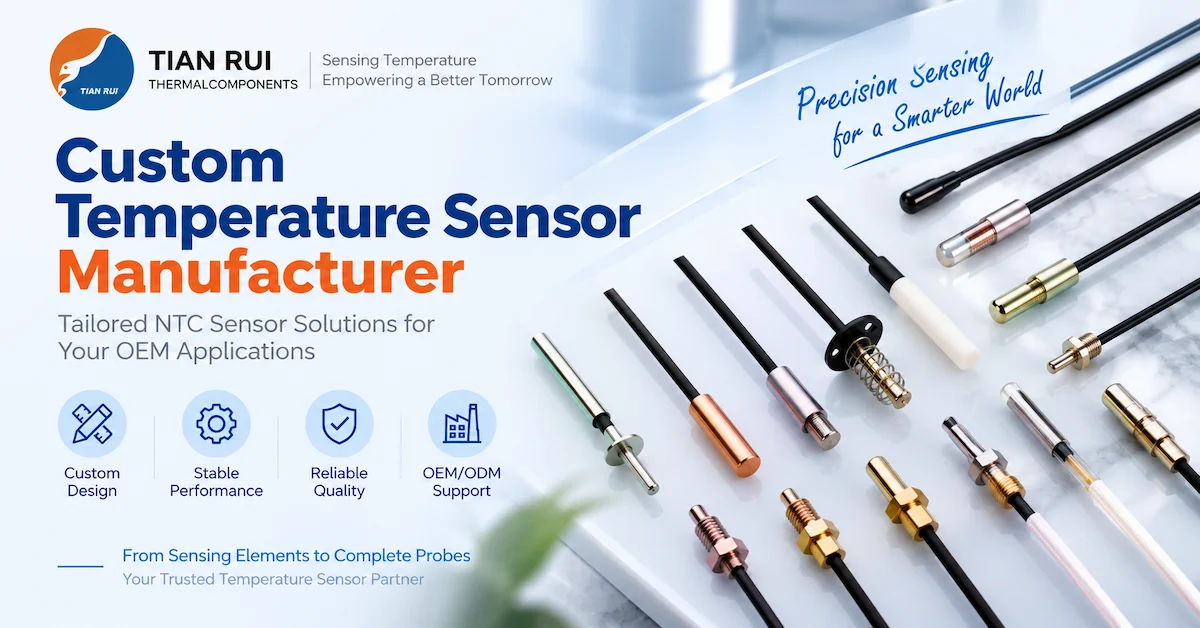
A controlled development process can follow this sequence: application definition, electrical requirement, environmental requirement, structure proposal, drawing confirmation, prototypes, electrical and moisture validation, installation test, approved revision and volume production. Tianrui states that its OEM/ODM support can include configurable resistance, B value, temperature range, cables, connectors and housings, with projects moving from requirements review through prototype testing to volume production.
For a waterproof sensor project, the approval package should clearly identify which surfaces can contact water, whether the cable is exposed, which seal structure was sampled and which environmental tests were passed. This avoids a common sourcing problem in which purchasing orders a part that shares the same external dimensions but differs internally from the sample approved by engineering.
When Should You Use Tianrui’s Waterproof NTC Probe as a Starting Point?
Tianrui’s Waterproof NTC Temperature Sensor for Air Energy Tanks is a relevant starting point for buyers developing heat-pump tanks, water-heating equipment, air-conditioning systems and other wet-temperature applications. The published product page identifies a stainless-steel NTC probe, B25/50 3950K ±1%, several resistance configurations and a specific table showing -20°C to 150°C operation for the listed configuration.
Use these published values as discussion inputs rather than automatically copying them into a new project. Send your target resistance, controller curve, operating and storage temperatures, medium, probe dimensions, exposure type, cable, connector and order forecast through the Tianrui contact page. The supplier can then confirm whether an existing configuration fits or whether a custom probe needs to be evaluated.
Frequently Asked Questions
What should I ask a Waterproof NTC Temperature Sensor Supplier first?
Ask what environmental condition the quoted “waterproof” construction is designed to withstand. Then confirm the NTC electrical curve, probe dimensions, cable construction and test method. A protection label without a defined configuration and condition is not enough for OEM approval.
Is an IP67 NTC sensor suitable for continuous immersion?
Do not assume so from the label alone. Confirm the applicable test, exact product construction and whether the intended exposure involves temporary or continuous immersion. If continuous liquid contact is required, state it explicitly in the RFQ and obtain project-specific confirmation.
Can a stainless-steel NTC probe be used directly in water?
Some assemblies are designed for liquid-temperature sensing, but stainless steel alone does not prove suitability. Confirm the complete probe, cable seal, medium, temperature, pressure and intended duration of exposure.
Are 10K waterproof NTC sensors interchangeable?
No. Two probes may both be 10K at 25°C and still use different B values, R-T curves, tolerances or mechanical constructions. The controller requirement and complete probe specification should be compared before replacing an existing sensor.
What B value is commonly offered for waterproof probes?
Tianrui’s published waterproof air-energy-tank probe lists B25/50 = 3950K ±1%. That does not mean B3950 is correct for every controller. Follow the equipment’s required R-T characteristic when selecting or customizing the sensor.
Can the probe size and cable length be customized?
Tianrui lists configurable housings, cables and connectors within its custom sensor offering. Provide dimensions, installation constraints, cable length and connector requirements so feasibility can be reviewed before sampling.
What is the difference between a waterproof probe and a pipe-clamp sensor?
A waterproof probe may be designed for direct or protected exposure to moisture or liquid depending on the construction. A pipe-clamp sensor attaches externally to a pipe and measures surface temperature without contacting the fluid directly. The correct choice depends on the sensing objective and installation.
How should waterproof samples be validated?
Check the electrical characteristics first, then expose the finished probe to the agreed moisture or immersion conditions and repeat the relevant measurements. Also inspect sealing, cable condition, mechanical fit and installed response. Record the test against the exact sample revision.
What information is needed for a waterproof NTC sensor quotation?
Provide R25, B value and interval, R-T requirements, operating temperature, exposure type, medium, probe size, cable and connector, installation method, sample quantity and expected production volume. If pressure or a formal ingress rating matters, state that separately.
What is the MOQ and lead time for a custom waterproof NTC probe?
There is no universal MOQ or lead time that can be assumed for every configuration. They can depend on housing, cable, connector, tooling, testing and volume. Request project-specific sample and production terms after the specification is reviewed.
Conclusion
Choosing a Waterproof NTC Temperature Sensor Supplier requires more than finding a stainless-steel probe with “waterproof” in its product name. OEM buyers should define the actual moisture or liquid exposure, match the NTC resistance-temperature curve to the controller, review the complete sealing path, confirm cable and connector requirements, and validate samples under conditions that represent the real equipment. Product-family claims and broad ratings should then be converted into an approved drawing and test requirement for the exact configuration being purchased. Tianrui’s waterproof NTC temperature sensor provides a starting point for heat-pump, water-heating, HVAC and related projects; buyers can send Tianrui their application and OEM specifications for sensor selection, sample planning and quotation.