Quick Answer: How Should OEMs Select Heaters Across Voltage Variants?
For a product family using 12V, 24V, 48V, and 220V supplies, OEMs should define one common mechanical platform while assigning voltage-specific part numbers to heating elements, electrical connections, and protection components. A reliable PTC heater selection guide must include a master BOM, voltage compatibility matrix, controlled assembly identifiers, and qualification requirements for each variant. Shared components should only be approved after confirming electrical, thermal, and mechanical compatibility.
Key Takeaways
-
Multi-voltage product standardization does not mean using the same heating element at every voltage.
-
Mechanical brackets, housings, and airflow channels may be shared when their dimensions and operating conditions permit.
-
PTC ceramic elements, electrical insulation, switching devices, and power connections often require voltage-specific evaluation.
-
A PTC heater with fan may have separate heater and motor supply requirements.
-
A master BOM should identify common components, dedicated components, approved substitutions, and engineering revisions.
-
Each electrical variant should have a defined test plan, even when some mechanical qualification evidence can be reused.
-
Part-number control, connector keying, work instructions, and final electrical testing help reduce assembly errors.
-
OEM manufacturers should qualify the complete heating assembly before approving volume production.
Why Do Multi-Voltage OEM Products Need a Separate Heater Selection Strategy?
A manufacturer may sell the same equipment platform in several markets or develop different electrical versions for different customers.
One configuration may operate from a nominal 12V DC supply. Another may use 24V DC or 48V DC. A separate version may connect to a nominal 220V AC supply.
The external appearance and mechanical functions of these products may be similar, but their electrical architectures are not interchangeable.
For a single heating component, the purchasing team mainly needs to determine whether the selected model satisfies the application specification.
For a multi-voltage product family, the engineering team must answer additional questions:
-
Which components can be shared across product versions?
-
Which components require unique part numbers?
-
Can the same housing and mounting arrangement support all variants?
-
Do fan motors and heating elements use the same voltage?
-
How can manufacturing prevent incorrect component installation?
-
Which qualification tests can be reused?
-
How should supplier changes be managed across multiple versions?
These questions affect both engineering development and procurement operations.
The hidden cost of uncontrolled variants
Without a standardized platform strategy, different engineering teams may select separate heating assemblies for similar products.
This can lead to:
-
Duplicate mechanical components.
-
Unnecessary tooling variations.
-
Excessive inventory complexity.
-
Conflicting drawings.
-
Incorrect component substitutions.
-
Assembly and service errors.
-
Additional qualification work.
-
Difficult engineering change management.
However, standardization should not be pursued at the expense of electrical safety or thermal performance.
The objective is to maximize justified component reuse while maintaining correct voltage-specific engineering controls.
This article focuses on that OEM platform-management problem.
For general heater selection, refer to Tianrui's existing PTC Heater Selection Guide. For detailed low-voltage electrical design, its 12V vs. 24V PTC Heater Guide provides complementary information.
Which PTC Heater Components Can Be Shared Across 12V, 24V, 48V and 220V?
The most important design distinction is between mechanically reusable components and electrically rated components.
A component should be marked as common only when its intended use is supported for every relevant product variant.
Table 1. Common vs. Dedicated Components in Multi-Voltage OEM Heaters
| Component | Potentially Shared? | Main Restriction | Recommended BOM Treatment |
|---|---|---|---|
| External mechanical housing | Yes, conditionally | Temperature, electrical separation, geometry | Common after qualification |
| Mounting bracket | Yes, conditionally | Dimensions, load, thermal expansion | Common after fit and durability checks |
| Air duct | Yes, conditionally | Airflow and heat distribution | Common if performance is acceptable |
| External grille | Yes, conditionally | Surface temperature, airflow restriction | Common after thermal verification |
| PTC ceramic heating element | Usually no | Voltage and resistance-temperature characteristics | Dedicated variant |
| Heating element electrodes | Possibly | Current, contact design, construction | Approved by exact configuration |
| Electrical insulation | Not automatically | Working voltage, insulation architecture, conditions | Dedicated or separately approved |
| Fan motor | Only if supply requirements match | Voltage, current, speed, temperature | Dedicated or common with a qualified supply |
| Wiring harness | Usually variant-specific | Conductor rating, connector arrangement, routing | Controlled variant |
| Power switching components | Usually variant-specific | AC/DC operation, current and transient behavior | Dedicated electrical design |
| Mechanical fasteners | Possibly | Strength, temperature, electrical function | Common after verification |
| Temperature sensor | Possibly | Temperature range, location, controller compatibility | Common after qualification |
| Product label | No | Voltage and electrical information | Dedicated variant |
This is an engineering decision framework, not a statement that these parts are interchangeable in Tianrui's catalog.
Common mechanical platform
An OEM may aim to preserve the same housing envelope, mounting pattern, and external airflow channel.
Doing so can reduce mechanical redesign and tooling variation.
For example, several versions may use the same bracket interface even when their internal heating elements differ.
However, the shared housing must be evaluated against the highest relevant operating temperature and the electrical configuration of each model.
Dedicated electrical configurations
A heater rated for 12V DC must not be assumed suitable for 48V DC or 220V AC.
Likewise, a fan rated for one supply cannot be connected directly to another voltage without an appropriate and qualified electrical arrangement.
Even where different product families have similar dimensions, their electrical characteristics and protection requirements may differ.
Why a common housing does not establish a common safety design
A 220V AC appliance may require different insulation coordination, protective arrangements, wiring separation, and assembly controls from a low-voltage DC version.
The mechanical housing may be identical while the internal electrical design remains different.
This distinction should be documented in the engineering drawings and master BOM.
How to Build a PTC Heater Voltage and BOM Compatibility Matrix
A master BOM provides the foundation for multi-voltage product standardization.
It connects each finished-equipment SKU to the exact heating element, fan, electrical connections, controller, and mechanical assembly.
The following matrices illustrate how an OEM can organize its product family.
All example part numbers in the following matrices are hypothetical internal OEM identifiers. They are not Tianrui catalog model numbers or confirmed available products.
Step 1: Define the product-family architecture
First, establish which electrical variants are required.
For example:
-
12V DC equipment.
-
24V DC equipment.
-
48V DC equipment.
-
220V AC equipment.
The OEM should also define which functions, physical dimensions, and thermal performance requirements are intended to remain common.
Table 2. Master Voltage and Product Compatibility Matrix
| Platform Item | 12V DC | 24V DC | 48V DC | 220V AC |
|---|---|---|---|---|
| Equipment variant | OEM-12 | OEM-24 | OEM-48 | OEM-220 |
| Input supply | 12V DC system | 24V DC system | 48V DC system | 220V AC system |
| Heater element ID | HT-12-A | HT-24-A | HT-48-A | HT-220-A |
| Heater electrical design | 12V-specific | 24V-specific | 48V-specific | AC-specific |
| Mounting bracket | MB-C01* | MB-C01* | MB-C01* | MB-C01* |
| External airflow housing | AH-C01* | AH-C01* | AH-C01* | AH-C01* |
| Fan assembly | Confirm supply | Confirm supply | Confirm supply | Confirm supply |
| Wiring harness | WH-12-A | WH-24-A | WH-48-A | WH-220-A |
| Power and protection design | DC-specific | DC-specific | DC-specific | AC-specific |
| Electrical label | LB-12 | LB-24 | LB-48 | LB-220 |
| Qualification record | QR-12 | QR-24 | QR-48 | QR-220 |
Common items marked with an asterisk are only provisionally shared. They require documented compatibility and qualification.
Step 2: Separate common parts from dedicated parts
Instead of maintaining four unrelated BOMs, the OEM can create a common platform assembly and separate electrical variant kits.
Table 3. Example Master BOM Structure
| GOOD Level | Component | Part Number | Classification | Change-Control Requirement |
|---|---|---|---|---|
| Platform | External housing | AH-C01 | Proposed common part | Revalidate affected variants if geometry changes |
| Platform | Mounting bracket | MB-C01 | Proposed common part | Fit and thermal assessment |
| Platform | Air outlet grille | GR-C01 | Proposed common part | Airflow and temperature checks |
| Electrical kit | 12V heating assembly | HT-12-A | Dedicated | 12V configuration approval |
| Electrical kit | 24V heating assembly | HT-24-A | Dedicated | 24V configuration approval |
| Electrical kit | 48V heating assembly | HT-48-A | Dedicated | 48V configuration approval |
| Electrical kit | 220V heating assembly | HT-220-A | Dedicated | AC configuration approval |
| Electrical kit | Wiring harness | WH-XX | Variant-specific | Electrical drawing approval |
| Electrical kit | Power switching/protection | EP-XX | Variant-specific | Electrical and fault verification |
| Final assembly | Voltage identification label | LB-XX | Variant-specific | Assembly inspection |
This structure distinguishes common mechanical interfaces from dedicated electrical assemblies.
Step 3: Establish approved compatibility rules
An OEM should not approve a component substitution merely because it physically fits.
The approval record should define:
-
Compatible equipment versions.
-
Permitted electrical supply.
-
Approved mounting arrangement.
-
Required insulation.
-
Relevant performance limits.
-
Applicable drawing revision.
-
Required tests for substitution.
-
Final engineering approval.
Step 4: Identify unapproved combinations
The matrix should explicitly prohibit unsupported combinations.
For example, installing a hypothetical HT-12-A heating element into the OEM-220 appliance should be classified as an invalid assembly.
The manufacturing system should not treat these components as interchangeable.
Step 5: Control the master BOM
Each finished product must have a traceable relationship with its approved component revision.
Where applicable, the manufacturer may use a product lifecycle management system, ERP item controls, or controlled engineering documentation.
A master BOM is valuable only when purchasing, production, inspection, and service teams use the same approved revision.
How Does a PTC Heater with Fan Affect Multi-Voltage Product Design?
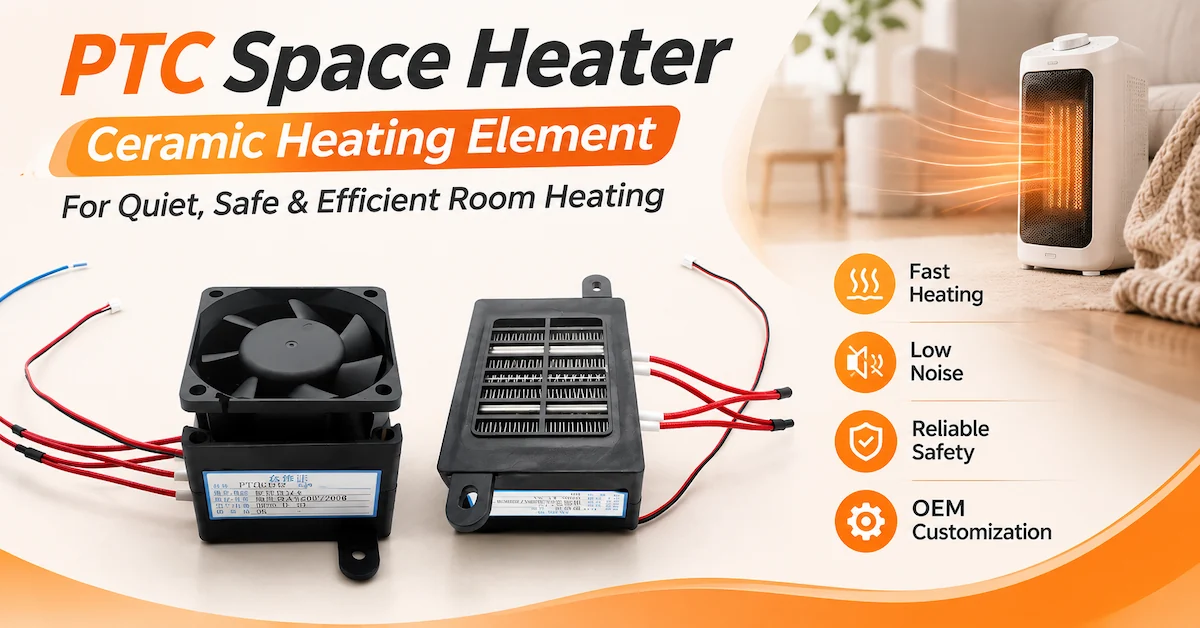
A PTC heater with fan creates an additional electrical interface because the fan and heater may have different power requirements.
The heating element and fan motor must therefore be specified separately.
Heater voltage vs. fan voltage
Consider two possible architectures.
Architecture A: Matched electrical supplies
The fan and heating element are selected for compatible supply arrangements.
This may simplify the system where suitable components exist.
Architecture B: Separate fan supply
The heating element uses the variant's main supply, while the fan operates from a common regulated rail.
For example, a multi-voltage product platform could be engineered around a common fan voltage, provided each equipment variant includes a suitable qualified power-conversion arrangement.
Neither architecture should be assumed without confirming the fan and heater specifications.
Table 4. Heater, Fan, and Harness Configuration Matrix
| Equipment SKU | Main Supply | Heater Assembly | Fan Supply Strategy | Harness | Key Approval Check |
|---|---|---|---|---|---|
| OEM-12 | 12V DC | HT-12-A | Qualified 12V fan supply | WH-12-A | Battery/supply and startup compatibility |
| OEM-24 | 24V DC | HT-24-A | Qualified fan or converter arrangement | WH-24-A | Fan voltage and power distribution |
| OEM-48 | 48V DC | HT-48-A | Qualified fan or converter arrangement | WH-48-A | Converter and electrical protection |
| OEM-220 | 220V AC | HT-220-A | Approved AC fan or isolated low-voltage supply | WH-220-A | Mains insulation, separation, and fault behavior |
All configurations in this table are design examples, not complete off-the-shelf Tianrui product packages.
Real Tianrui product references
Tianrui publishes a 200W 220V Mini PTC Air Heater with Fan.
The product page specifies:
-
Heating assembly rated voltage: 220V.
-
Listed heating power: 200W.
-
Matching fan construction: dual flat-panel axial fans.
The page does not establish that its fan motor can be directly operated at 12V, 24V, or 48V.
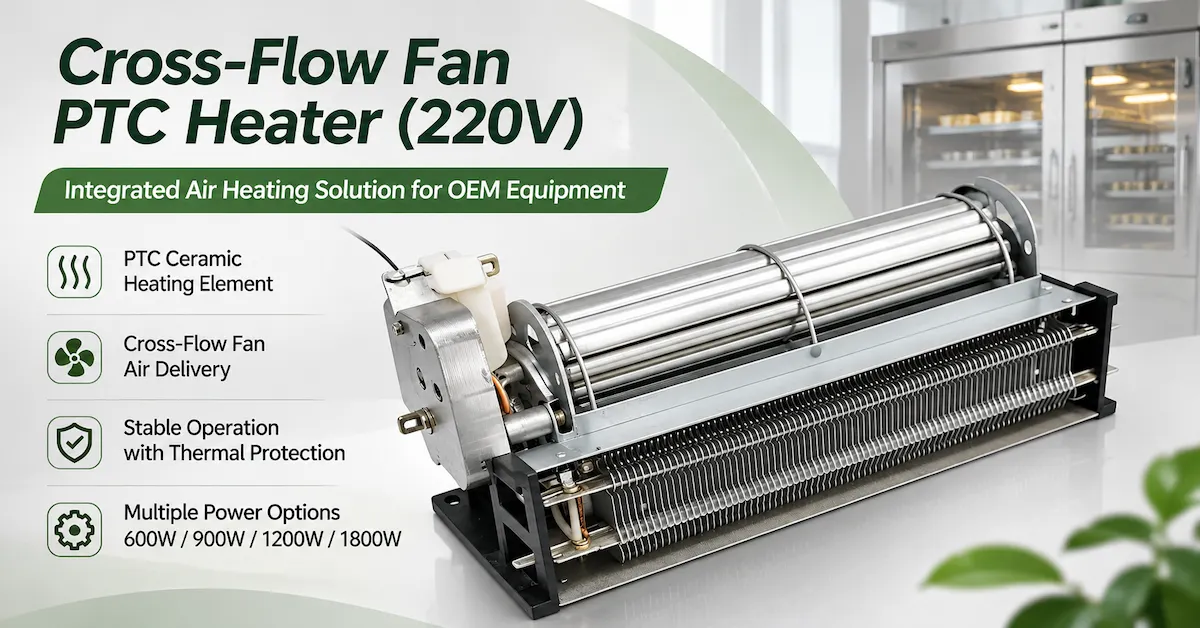
Tianrui also lists a 220V Cross-Flow Fan PTC Heater with published configurations of 600W, 900W, 1200W, and 1800W.
These products are useful references for integrated fan-heater architecture, but they do not establish a complete multi-voltage family.
How should fan assemblies be standardized?
OEM engineers should compare:
-
Fan installation dimensions.
-
Airflow requirement.
-
Static-pressure behavior.
-
Motor supply.
-
Electrical connector.
-
Noise requirement.
-
Temperature suitability.
-
Control interface.
-
Fault detection.
A common fan mounting geometry may be achievable even when the motor or power-supply configuration differs.
For airflow-system engineering, Tianrui's existing PTC Air Heater Fan Curve Guide provides further background without repeating the topic here.
What Specifications Must Remain Different Between Product Variants?
Not every product version can share the same electrical specification.
The OEM should define an electrical interface control document for each version.
Table 5. Variant-Specific Electrical Requirements
| Specification | Low-Voltage DC Variants | 220V AC Variant | Can the Requirement Be Shared? |
|---|---|---|---|
| Rated input voltage | Defined per DC version | Defined for AC supply | No |
| Allowed supply range | Battery or DC supply dependent | AC input tolerance dependent | No |
| PTC ceramic characteristics | Appropriate to each rated design | Appropriate to AC design | Not automatically |
| Cold-start current | Model-specific | Model-specific | Must verify separately |
| Continuous current | Model and load dependent | Model and load dependent | Must verify separately |
| Switching device | DC-rated arrangement | AC-rated arrangement | Not automatically |
| Insulation structure | Based on actual electrical architecture | Based on mains and equipment design | Requires separate assessment |
| Protective devices | Variant-specific coordination | AC-specific coordination | Not automatically |
| Fan motor rating | Exact fan configuration | Exact fan configuration | Only if supply compatibility is established |
| Thermal performance | Tested at intended conditions | Tested at intended conditions | Must verify each version |
Why nominal voltage is insufficient
The manufacturer must also know the permitted supply range, current conditions, control arrangement, and abnormal-operation requirements.
A product described as 220V AC should not automatically be assumed suitable for every nominal 230V market without confirmation of its approved input range.
Likewise, a nominal 12V system may experience different voltage conditions depending on the power source.
Insulation coordination
The IEC 60664-1:2020+A1:2025 insulation coordination standard addresses principles, requirements, and tests relating to clearances, creepage distances, and solid insulation within its specified scope.
For a multi-voltage appliance, this is relevant when determining whether a proposed common housing or electrical layout can support different electrical configurations.
The applicable insulation requirements depend on the complete equipment, not simply the largest nominal voltage in the product family.
Component characterization
IEC 60738-1:2022 describes terminology, inspection procedures, and test methods for directly heated PTC thermistors within its scope.
This provides a useful technical basis for defining component qualification requirements.
Neither reference establishes certification of a Tianrui product or a finished OEM appliance.
How Can OEMs Reduce Heater Model Confusion and Assembly Errors?
Multi-voltage heating assemblies create a specific manufacturing risk: components may look similar while having different electrical ratings.
This risk becomes more important when several product versions share the same production line.
1. Establish distinct part-number rules
An internal part-number system could identify:
HT-[Voltage]-[Construction]-[Revision]
For example:
-
HT-12-AL-A.
-
HT-24-AL-A.
-
HT-48-AL-A.
-
HT-220-AL-A.
These are hypothetical OEM identifiers.
They should not be presented as Tianrui catalog models.
2. Use controlled product labels
Each finished electrical assembly should identify the appropriate rated electrical information.
Where required, identification can include:
-
OEM part number.
-
Electrical rating.
-
Product revision.
-
Manufacturing traceability code.
-
Installation reference.
Label content should comply with the applicable product and market requirements.
3. Prevent electrical misconnection
Different electrical variants should not depend solely on operators recognizing a label.
The OEM should evaluate suitable connector keying, connector families, physical separation, and assembly controls.
For mains and low-voltage circuits, segregation and insulation requirements are particularly important.
4. Build an assembly verification process
Manufacturing checks may include:
-
Scanning the part number.
-
Confirming the product variant.
-
Checking connector compatibility.
-
Verifying heater and fan wiring.
-
Inspecting mounting orientation.
-
Confirming the approved revision.
-
Performing the relevant final electrical tests.
5. Control substitutions and revisions
A purchasing substitution can affect several equipment variants.
Any change should be reviewed according to its impact.
For example, changing a common mounting bracket may require fit evaluation across all variants.
Changing a 48V heater's ceramic construction may require new electrical and thermal testing for that configuration without necessarily changing the other heater variants.
Example change-control matrix
| Engineering Change | Potentially Affected Variants | Recommended Review |
|---|---|---|
| Common housing dimension | All variants using the housing | Fit, thermal, and relevant safety effects |
| 12V ceramic material | 12V version | Electrical and thermal performance |
| Fan motor supplier | Versions using the motor | Airflow, noise, electrical and fault behavior |
| 220V wiring harness | 220V version | Electrical safety, temperature and assembly |
| Common connector location | All affected variants | Routing, separation, mounting, inspection |
Manufacturing principle:
Common parts reduce complexity only when their use is controlled. An uncontrolled common part can propagate one design error across the entire product family.
Which Tests Can Be Shared Across Heater Variants?
Qualification reuse can reduce unnecessary testing, but not every test result can be transferred from one electrical version to another.
The correct approach is to distinguish reusable evidence from required variant-specific verification.
Table 6. Cross-Variant Qualification Reuse Matrix
| Qualification Item | Potential Reuse | Requalification Trigger |
|---|---|---|
| Mechanical housing dimensions | Possible with identical construction | Housing or tooling change |
| Mounting bracket strength | Conditional | Changed weight, stress, temperature, or geometry |
| Assembly fit | Conditional | Heater or connector dimension changes |
| Airflow distribution | Conditional | Changed fan, core resistance, enclosure, or control |
| Acoustic performance | Conditional | Changed fan speed, motor, mounting, or airflow |
| Ceramic electrical characteristics | Generally variant-specific | New heater electrical configuration |
| Startup current | Variant-specific | Voltage, ceramic, supply, or load changes |
| Stabilized electrical power | Variant-specific | Voltage, ceramic, or cooling changes |
| Thermal performance | Variant-specific in the final equipment | Any change affecting heat generation or removal |
| Insulation and dielectric testing | Architecture-specific | Different electrical rating or insulation construction |
| Protective-device behavior | Variant-specific | Changed switching, supply, control, or protection |
| Fan-failure testing | Evaluate affected configuration | Fan, heater, controller, or enclosure change |
| Production traceability | Process may be shared | Part-number or revision-system change |
What can truly be reused?
A validated mechanical drawing may support several variants if the relevant construction and conditions remain unchanged.
A documented test procedure can also be reused across the product family.
However, reusing the test method is different from reusing the test result.
A heater tested at 12V does not establish the electrical or thermal behavior of a 220V version.
What about safety tests?
For household and similar appliances, the IEC 60335-1:2020 general safety standard, including its later amendments as applicable, provides relevant finished-appliance safety requirements within its scope.
The exact product-specific requirements and national or regional adoption must be considered.
Multi-voltage qualification should therefore begin with a documented applicability assessment.
Recommended qualification workflow
Step 1: Identify the shared design elements.
Document common mechanical components and identical construction details.
Step 2: Identify electrical and thermal differences.
Review heater resistance-temperature behavior, rated supply, wiring, switching, controls, and protective devices.
Step 3: Establish a test matrix.
Assign every required test to the applicable product versions.
Step 4: Justify evidence reuse.
Record why an existing test result remains representative.
Step 5: Complete variant-specific testing.
Verify electrical and thermal performance under the intended conditions.
Step 6: Approve the product-family configuration.
Release the master BOM, drawings, and qualification records using controlled revisions.
This process provides a more defensible basis for multi-voltage production than assuming the highest-voltage model automatically qualifies lower-voltage versions.
OEM Example: Managing Three Heater Versions in One Product Family
The following engineering example demonstrates how a manufacturer could structure a multi-voltage PTC heater platform.
This is a hypothetical OEM planning example. All part numbers and design targets are illustrative; they do not represent actual Tianrui products, approved compatibility, measured results, or customer projects.
Project background
An industrial equipment manufacturer is developing a compact cabinet-warming platform.
The mechanical enclosure will remain broadly similar across three versions:
-
12V DC.
-
48V DC.
-
220V AC.
Each version must satisfy its own electrical and thermal requirements.
Step 1: Define the common platform
The manufacturer proposes common external dimensions, a shared mounting bracket, and an identical equipment-side air outlet.
These items are not approved immediately.
They are identified as common-part candidates pending verification.
Step 2: Separate electrical kits
Each version receives its own heater and electrical harness configuration.
Table 7. Three-Version OEM BOM Example
| GOOD Item | OEM-12 | OEM-48 | OEM-220 |
|---|---|---|---|
| Input supply | 12V DC | 48V DC | 220V AC |
| Proposed common mounting bracket | MB-C01 | MB-C01 | MB-C01 |
| Proposed common external housing | AH-C01 | AH-C01 | AH-C01 |
| Heater assembly | HT-12-A | HT-48-A | HT-220-A |
| Fan configuration | FN-12-A | FN-48-A | FN-220-A |
| Wiring harness | WH-12-A | WH-48-A | WH-220-A |
| Protection/control assembly | EP-12-A | EP-48-A | EP-220-A |
| Electrical label | LB-12 | LB-48 | LB-220 |
| Qualification file | QR-12 | QR-48 | QR-220 |
Step 3: Evaluate Tianrui product families
The OEM may begin discussions using these public product references:
For the 12V configuration:
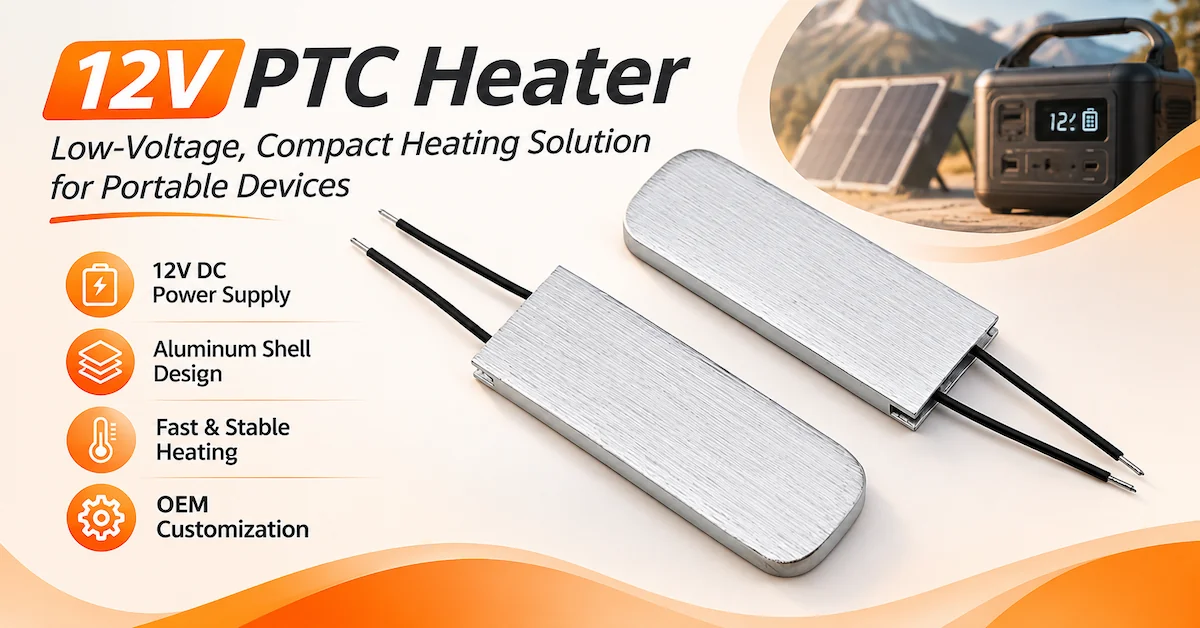
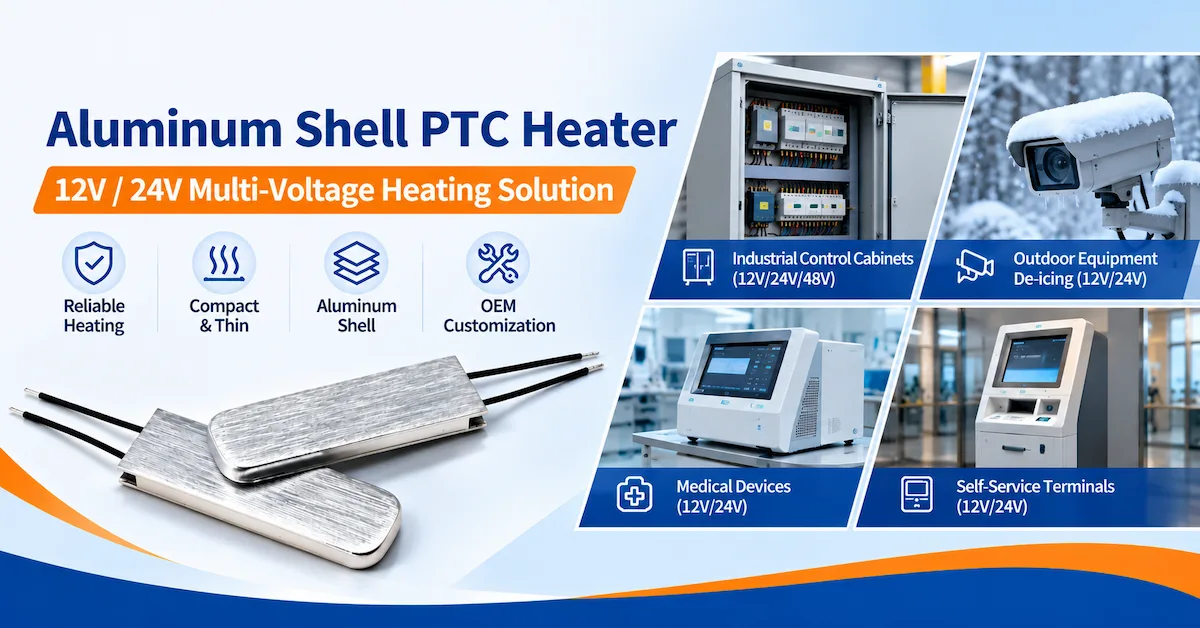
The Aluminum Shell PTC Heater 12V/24V provides a reference for low-voltage aluminum-shell construction.
For the 48V configuration:
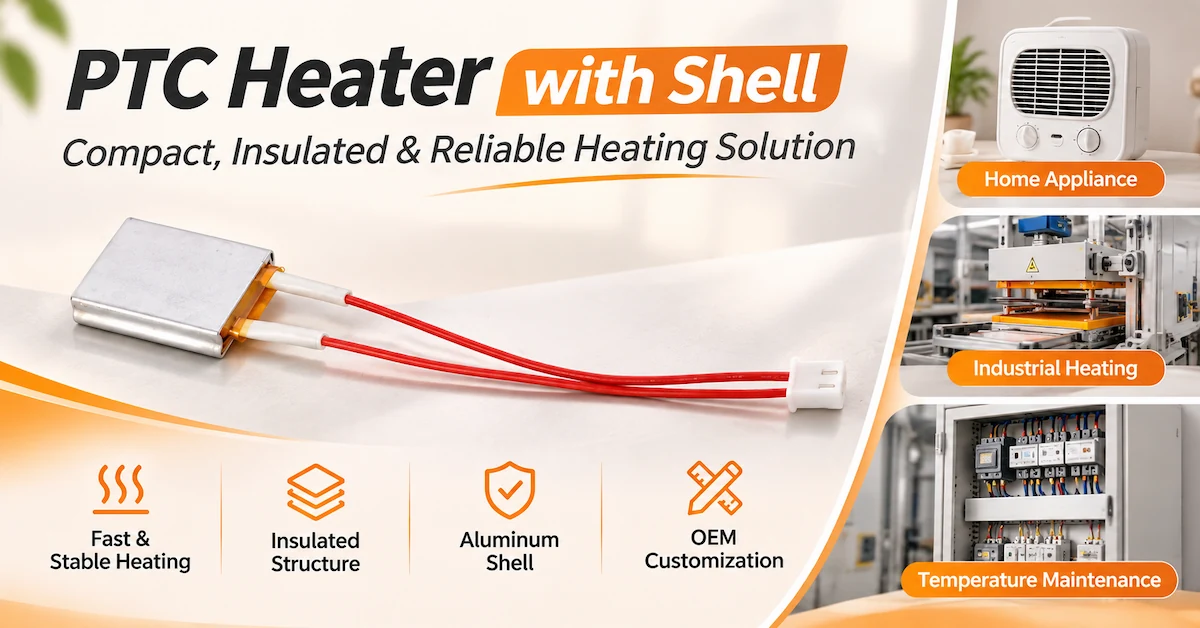
Tianrui's PTC Heater with Insulation Film publishes a 12–48V DC family range with customized power.
For the 220V configuration:
The 220V Mini PTC Air Heater with Fan provides an integrated 220V heating-assembly reference.
These product pages do not establish that the three configurations share the same dimensions, heat output, fan voltage, or mounting hardware.
That compatibility must be developed and validated.
Step 4: Define the qualification plan
The engineering team establishes the following project-specific requirements:
| Requirement | 12V Version | 48V Version | 220V Version |
|---|---|---|---|
| Mechanical fit | Test | Assess reuse; test as needed | Assess reuse; test as needed |
| Electrical startup behavior | Test | Test | Test |
| Useful heating performance | Test | Test | Test |
| Fan airflow and operation | Test | Test | Test |
| Wiring temperature | Test | Test | Test |
| Insulation and electrical safety | Applicable tests | Applicable tests | Applicable tests |
| Fault response | Test | Test | Test |
| Label and part-number verification | Test | Test | Test |
The common housing is approved only if it satisfies the relevant requirements across the platform.
Step 5: Establish procurement controls
Purchasing receives a list of approved part numbers for each version.
Unapproved substitutions require engineering review.
For example, the team cannot install HT-12-A in the OEM-48 product merely because the housing dimensions match.
Step 6: Release the production platform
Once qualification is complete, the manufacturer releases:
-
Approved master BOM.
-
Version-specific electrical BOMs.
-
Mechanical drawings.
-
Wiring schematics.
-
Assembly work instructions.
-
Inspection requirements.
-
Qualification records.
-
Engineering change-control procedures.
What does this example demonstrate?
A shared mechanical platform can reduce unnecessary variation while preserving voltage-specific electrical designs.
The benefit depends on maintaining clear interfaces and controlled qualification evidence.
The goal is not to make every component identical.
It is to identify which components can safely and reliably be standardized.
What Should an OEM Send for Multi-Voltage Heater Development?
An effective RFQ should describe the complete product family rather than one heating element.
This allows the supplier to evaluate potential component commonality and configuration differences.
Table 8. Multi-Voltage PTC Heater RFQ Checklist
| Required Information | What the OEM Should Provide |
|---|---|
| Product family | Equipment platform name and application |
| Voltage variants | 12V, 24V, 48V DC and/or 220V AC |
| Supply range | Minimum and maximum input for each variant |
| Heating requirements | Target temperatures, heating duty, load conditions |
| Product dimensions | Common installation envelope and constraints |
| Existing BOM | Current heater, fan, wiring, and bracket part numbers |
| Common parts target | Components proposed for standardization |
| Fan requirements | Airflow, supply voltage, mounting, control |
| Wiring | Connection diagrams, connectors, cable requirements |
| Insulation | Equipment-specific electrical separation requirements |
| Protection | Existing or required thermal and electrical protective functions |
| Product variants | Annual forecast for each SKU |
| Engineering drawings | 2D/3D drawings and interface specifications |
| Qualification | Test procedures and acceptance criteria |
| Manufacturing requirements | Identification, assembly, inspection, traceability |
| Commercial requirements | Samples, tooling, MOQ, delivery, packaging |
What should the supplier return?
A useful OEM proposal should identify:
-
Suitable standard heater products for initial assessment.
-
Any proposed customized heater configurations.
-
Potential common mechanical parts.
-
Required voltage-specific components.
-
Open technical questions.
-
Necessary prototype and qualification activities.
-
Proposed drawings and documentation.
-
Project-specific sample and commercial conditions.
Tianrui Electronics describes support for custom PTC heater structures, material selection, product design, drawings, and mold development through its PTC Heater Customized Solutions.
A multi-version RFQ can therefore focus on evaluating available product families alongside potential custom construction.
Example OEM Inquiry
Subject: Multi-Voltage PTC Heater Platform — 12V / 24V / 48V / 220V OEM Development
We are developing several voltage variants of one equipment platform and would like to evaluate PTC heating components for standardized production.
Our project includes 12V, 24V, 48V DC, and 220V AC versions.
We want to determine which mechanical components can be shared while maintaining correct heater, fan, wiring, and protection specifications for each electrical version.
We can provide:
-
Equipment drawings and installation constraints.
-
Electrical supply specifications.
-
Heating requirements.
-
Fan specifications.
-
Current BOM and preferred common parts.
-
Sample quantities.
-
Expected annual demand.
Please advise which Tianrui standard or customized PTC heating configurations may be suitable and what additional validation would be required.
We would also like to review potential shared mounting structures, version-specific heater assemblies, and the technical documentation needed for production qualification.
For engineering evaluation, contact Tianrui Electronics with the product-family specifications and BOM.
Frequently Asked Questions About Multi-Voltage PTC Heater Selection
1. Can the same PTC heating element be used for 12V, 24V, 48V and 220V?
Not automatically.
PTC heating elements must be evaluated according to their rated voltage, resistance-temperature characteristics, construction, and intended operating conditions.
A product-family listing that includes several voltages does not mean one physical heating element is rated for every voltage.
Each approved electrical configuration should have a defined specification.
2. What is the main purpose of a multi-voltage PTC heater selection guide?
Its purpose is to help OEM manufacturers manage heater variants across one equipment platform.
The focus is on common and dedicated components, approved part numbers, assembly interfaces, and qualification requirements.
It is different from a general guide explaining which PTC heater to buy for a single product.
3. Can a 12V PTC heater and a 48V PTC heater share the same aluminum housing?
Possibly, if the selected heater assemblies have compatible dimensions, thermal conditions, electrical requirements, and mechanical interfaces.
However, a shared housing cannot be assumed from similar product photographs.
The OEM should verify the complete construction and intended operating conditions.
4. Can different electrical versions share one fan motor?
Only when the fan receives a supply within its approved operating range and the overall arrangement satisfies the equipment requirements.
A manufacturer may evaluate an appropriately regulated common fan supply, but this introduces additional electrical components and qualification work.
Otherwise, separate fan versions may be necessary.
5. What should be included in a multi-voltage PTC heater BOM?
The BOM should identify the finished product variant, heater assembly, fan, mounting components, wiring harness, controller, protective devices, labels, and applicable revisions.
It should also distinguish approved common parts from dedicated electrical components.
6. Can a 220V AC version reuse qualification tests from a 12V DC version?
Some mechanical evidence may be reusable when the construction and operating conditions are sufficiently equivalent.
However, electrical insulation, supply behavior, wiring, thermal performance, and relevant safety testing generally need configuration-specific assessment.
Evidence reuse should be justified and documented rather than assumed.
7. How can OEM manufacturers prevent incorrect heater installation?
Use clear part-number structures, controlled BOMs, variant-specific labels, appropriate connector keying, work instructions, and final electrical verification.
Production and service teams should use the same approved revision information.
8. Does a 48V PTC heater require a separate controller?
It depends on the product's control architecture, heating requirements, and electrical design.
Some functions may be shared across variants when suitable power interfaces and protection are provided.
However, controller output stages, power components, and fault responses must be evaluated for the specific configuration.
9. Can Tianrui customize several PTC heater voltage versions for one OEM platform?
Tianrui publishes low-voltage and AC PTC heater product families and describes custom heater development support.
These provide a basis for discussing a multi-version OEM project.
Exact configuration availability, shared dimensions, tooling, and electrical compatibility should be confirmed through technical review.
10. What information is most important when requesting a multi-voltage OEM quotation?
Provide the product family's voltage variants, required heat output, installation drawings, existing BOM, fan supply requirements, wiring diagrams, insulation needs, and expected production quantities.
A clear common-parts target and qualification plan will help the supplier evaluate how the platform might be standardized.
Conclusion
A successful PTC heater selection guide for multi-voltage OEM equipment should address more than voltage, wattage, and heater dimensions.
When the same equipment platform includes 12V, 24V, 48V, and 220V versions, the engineering challenge becomes one of component standardization, controlled electrical variation, BOM management, and qualification planning.
The most effective approach is to define a common mechanical platform where technically justified while maintaining dedicated electrical specifications for each voltage version.
For equipment manufacturers, the essential requirements are:
-
Common platform definition: Identify shared housings, brackets, and mechanical interfaces.
-
Dedicated electrical BOMs: Assign approved heating elements, fan supplies, wiring, and protection components.
-
Voltage compatibility control: Prevent unsupported component substitutions.
-
Manufacturing identification: Use clear part numbers, labels, and assembly instructions.
-
Qualification planning: Distinguish reusable evidence from tests that must be repeated.
-
Supplier coordination: Provide the complete product-family specification rather than isolated component requests.
-
Change management: Control revisions across engineering, purchasing, production, and service.
A 12V PTC heater may be one variant of a larger product family, while a PTC heater with fan introduces additional motor-supply and airflow considerations.
Neither component should be treated as automatically interchangeable across electrical versions.
The goal is not maximum commonality at any cost.
The goal is a controlled heating platform that uses common parts where justified and preserves voltage-specific safety, performance, and manufacturing requirements.
Dongguan Tianrui Electronics Co., Ltd. publishes aluminum-shell PTC heaters, insulated heating assemblies, and integrated fan-heater products relevant to different voltage and application requirements.
Its custom heater development services provide an opportunity for OEM buyers to discuss shared structures, specialized heating elements, wiring arrangements, and project-specific specifications.
Developing 12V, 24V, 48V, and 220V versions of the same equipment?
Explore Tianrui's PTC Heater Product Range, review its Custom PTC Heater Solutions, or contact Tianrui Electronics for an OEM platform review.
Send your voltage-version matrix, master BOM, mechanical drawings, heater and fan specifications, electrical diagrams, and estimated annual quantities.
These documents provide the starting point for evaluating standard or custom heating assemblies, defining common and dedicated components, and establishing a practical qualification plan.
Email:
Phone:
+86 135 3277 2961
A well-controlled multi-voltage heating platform can simplify engineering coordination, reduce avoidable part-number complexity, and support consistent production across an OEM product family—without compromising the need for configuration-specific verification.