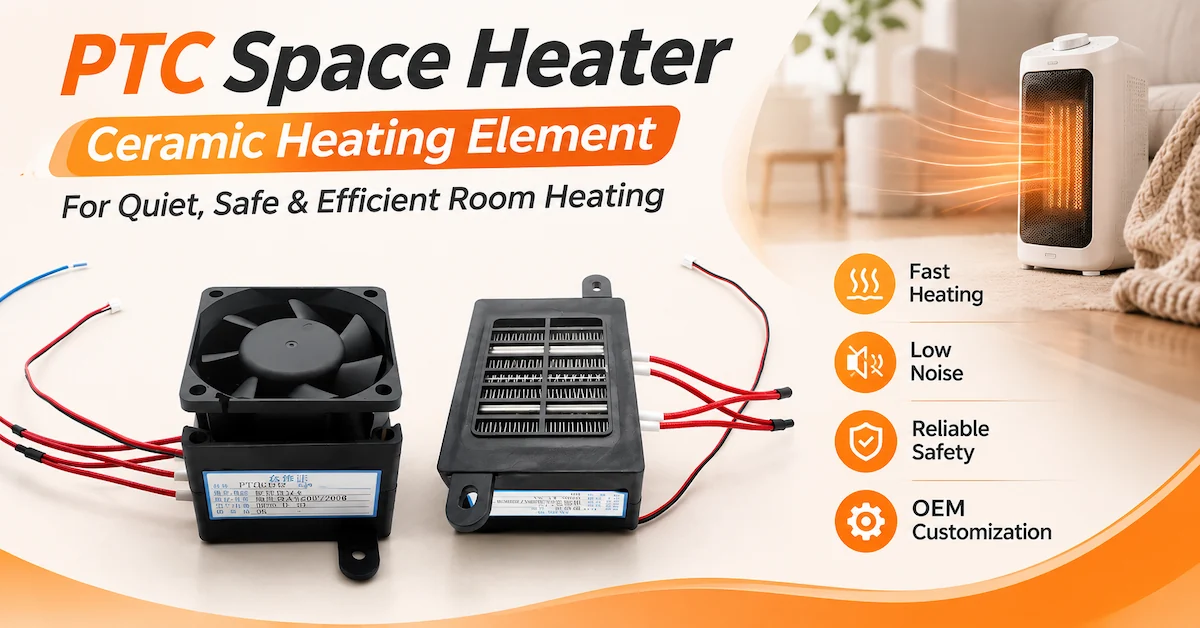
Quick Answer: A PTC Space Heater uses positive temperature coefficient ceramic heating elements to generate heat, typically transferring it into a room through forced airflow. For OEM appliance manufacturers, choosing the right ceramic core requires evaluating room heat loss, electrical power, airflow, thermostat response, operating noise, and safety under abnormal conditions. The PTC element's self-regulating behavior is useful, but complete heater performance and safety depend on the surrounding components and finished appliance design.
Key Takeaways
-
A PTC Ceramic Space Heater should be sized against the intended heating duty, not selected from room area alone.
-
Ceramic resistance changes with temperature, so electrical heating power may vary with airflow and operating conditions.
-
An integrated fan-heater assembly can simplify mechanical integration, while a separate heating core gives OEMs greater freedom in fan and enclosure design.
-
Fan airflow, static pressure, and outlet geometry influence warm-air delivery and acoustic performance.
-
PTC self-regulation does not provide precise room-temperature control by itself.
-
Thermostats, temperature sensors, thermal cutoffs, and other protective devices must be selected according to the appliance design.
-
A quiet motor does not guarantee a quiet finished space heater; grille noise, airflow restrictions, and housing vibration also matter.
-
OEM qualification should include heating performance, electrical loading, noise, blocked airflow, fan failure, and relevant tip-over or abnormal-operation tests.
-
The best supplier proposal should identify a suitable heating component, installation requirements, validation responsibilities, and production specifications.
1. What Makes a PTC Space Heater Suitable for OEM Appliance Development?
A space heater must deliver comfortable heat while operating within defined electrical, acoustic, and thermal constraints.
For an OEM manufacturer, the central challenge is integrating the heating element into a finished appliance rather than simply finding a ceramic component with the correct nominal wattage.
A complete heater typically includes:
-
PTC ceramic heating elements.
-
Heat-transfer fins or another suitable heating structure.
-
A fan or blower, where forced convection is required.
-
Electrical insulation and wiring.
-
A temperature-sensing and control system.
-
An enclosure, inlet, and outlet grille.
-
Appropriate protective devices.
Each part influences the performance of the finished appliance.
For example, a ceramic heating core may generate sufficient heat under laboratory conditions, but a restrictive inlet grille can reduce airflow. The resulting changes in element temperature may alter electrical power and cause high temperatures around the heater housing.
A suitable PTC Space Heater Heating Element must therefore be evaluated as part of the complete airflow and thermal system.
Which buyers benefit from this approach?
| Buyer Type | Main Requirement | Key Purchasing Concern |
|---|---|---|
| Portable heater brands | Compact, comfortable heating | Product safety, noise, assembly cost |
| Home appliance OEMs | Repeatable heating performance | Electrical specifications, component consistency |
| Ceramic fan heater manufacturers | Appropriate PTC heating core | Power, dimensions, airflow compatibility |
| Thermal management engineers | Controlled heat transfer | Temperature rise, mounting, sensor placement |
| OEM purchasing managers | Reliable component supply | Testing, quality control, customization, MOQ |
This guide is intended for equipment manufacturers and product development teams.
It is not a consumer buying guide or a substitute for final appliance certification.
2. How Does a PTC Ceramic Space Heater Work?
Positive temperature coefficient ceramic heating elements change their electrical resistance as temperature changes.
In a PTC heater designed for self-regulating operation, resistance rises significantly within a particular temperature region.
At a constant voltage, the simplified relationship is:
P = V² / R
Where:
-
P = electrical power.
-
V = applied voltage.
-
R = instantaneous electrical resistance.
As the ceramic heats and its resistance increases, the electrical power generally decreases.
When the surrounding air removes heat more effectively, the ceramic may operate at a lower temperature and draw a different amount of electrical power.
What does this mean for appliance engineers?
A PTC heating core does not behave exactly like a constant-resistance heating wire.
Its actual electrical power depends on operating conditions.
Therefore, OEM manufacturers should measure:
-
Cold-start current.
-
Electrical power during warm-up.
-
Stabilized heating power.
-
Heater temperatures under normal airflow.
-
Power and temperature changes when airflow is restricted.
These measurements help determine whether the heating assembly is compatible with the appliance's electrical and thermal design.
Is the PTC ceramic temperature the same as the room temperature?
No.
The ceramic temperature, metal-fin temperature, outlet-air temperature, and room temperature are different measurements.
For example, Tianrui's published MZ11 heating-element table identifies a ceramic Curie temperature of 220°C.
That value should not be interpreted as an outlet-air temperature, room-temperature setpoint, or user-accessible surface temperature.
The finished heater requires appropriate temperature control and validation.
3. PTC Ceramic vs. Conventional Resistance Heating: Which Is Better?
PTC ceramic heaters and conventional resistance elements both convert electrical energy into heat.
The differences concern electrical behavior, heat-transfer structure, operating characteristics, controls, and integration requirements.
Table 1. Heating Technology Comparison for OEMs
| Factor | PTC Ceramic Heating Element | Conventional Resistance Heating Element |
|---|---|---|
| Resistance behavior | Strong temperature-dependent resistance | Often comparatively stable resistance over the operating range |
| Electrical power | Can decrease substantially as ceramic temperature rises | Generally follows applied voltage and element resistance |
| Temperature control | Self-regulation is a useful characteristic; external controls may still be needed | External controls commonly used |
| Heat transfer | Often combined with aluminum fins or a housing | Depends on wire, tube, plate, or another structure |
| Startup behavior | Requires model-specific current verification | Requires element-specific current verification |
| Airflow dependency | Cooling changes ceramic temperature and potentially electrical power | Cooling changes element temperature and heat transfer |
| Safety verification | Complete appliance testing required | Complete appliance testing required |
| OEM suitability | Useful for appropriate compact and forced-air heating designs | Useful for many controlled heating applications |
Important efficiency distinction:
A PTC heater does not automatically convert electricity into room heat more efficiently than a conventional electric resistance heater.
For direct electric resistance heating, nearly all consumed electricity ultimately becomes heat within the heated space.
Potential energy savings from a PTC-based appliance depend primarily on operating time, temperature control, localized heating, standby consumption, and the complete system design.
Likewise, a heat pump is a different technology and can deliver more heat per unit of electricity than direct electric resistance heating under suitable conditions.
For OEM buyers, the strongest reasons to evaluate ceramic PTC technology are its electrical self-regulation, construction flexibility, and application suitability—not an unsupported universal energy-saving percentage.
4. How Much Heating Power Does a PTC Space Heater Need?
Selecting the correct heating power begins with the room's heat-loss requirement.
Floor area alone is not sufficient.
Two rooms with identical dimensions may require different heating capacities because of insulation, outdoor temperature, ventilation, glazing, and air leakage.
Basic heat-loss calculation
For preliminary steady-state heating:
Qtotal = Qtransmission + Qventilation
Transmission heat loss can be estimated using:
Qtransmission = Σ(U × A × ΔT)
Where:
-
U = thermal transmittance of each building element, W/(m²·K).
-
A = exposed surface area, m².
-
ΔT = indoor-to-outdoor temperature difference, K.
Ventilation or infiltration heat loss can be approximated by:
Qventilation = ρ × cp × V̇ × ΔT
Where:
-
ρ = air density.
-
cp = specific heat capacity of air.
-
V̇ = outdoor-air volume flow rate.
Illustrative room-heating example
An OEM is evaluating a compact room heater for a hypothetical space.
Assume:
| Parameter | Illustrative Value |
|---|---|
| Indoor design temperature | 20°C |
| Outdoor design temperature | 5°C |
| Temperature difference | 15 K |
| Combined building heat-loss coefficient, ΣUA | 45 W/K |
| Outdoor-air infiltration/ventilation | 0.004 m³/s |
| Air density | 1.2 kg/m³ |
| Air specific heat | 1005 J/(kg·K) |
Transmission heat loss:
45 × 15 = 675W
Ventilation heat loss:
1.2 × 1005 × 0.004 × 15 ≈ 72W
Total estimated steady-state heating requirement:
Qtotal ≈ 747W
Under these simplified assumptions, the room needs approximately 747W of useful heating to maintain the specified indoor temperature.
Does this mean an 800W PTC heater is sufficient?
Not necessarily.
The calculation does not fully address:
-
Initial room warm-up.
-
Cold furniture and building materials.
-
Uncertainty in infiltration.
-
Changing outdoor temperature.
-
Heater power variation.
-
Thermostat cycling.
-
Heat distribution.
-
Electrical and installation constraints.
An 800W ceramic core might be a candidate for further evaluation, but its actual thermal contribution must be measured in the finished appliance.
For comfort heating, the OEM should define the heating objective clearly: maintaining a room temperature, providing localized warmth, or helping a room recover after a temperature drop.
These are different design targets.
5. Which Tianrui PTC Space Heater Heating Elements Should OEMs Consider?
Tianrui Electronics publishes multiple PTC air-heating configurations relevant to the development of ceramic space heaters and warm-air appliances.
These include ceramic heating cores and integrated fan-heater assemblies.
They are not complete retail-certified room heaters.
Table 2. Tianrui Heating Element Options
| Product | Published Voltage | Published Heating Power | Configuration | OEM Evaluation Direction |
|---|---|---|---|---|
| MZ11 PTC Fan-Type Heating Element | 220V | 800–4000W family | Ceramic heating core for forced-air applications | Ceramic space heater development |
| Mini PTC Air Heater with Fan | 220V | 200W | Heating element with dual axial fans | Compact personal or localized heating |
| PTC Air Heater | 220V | 500–2000W configurations | Aluminum heat-transfer assembly | Separate-fan space heater designs |
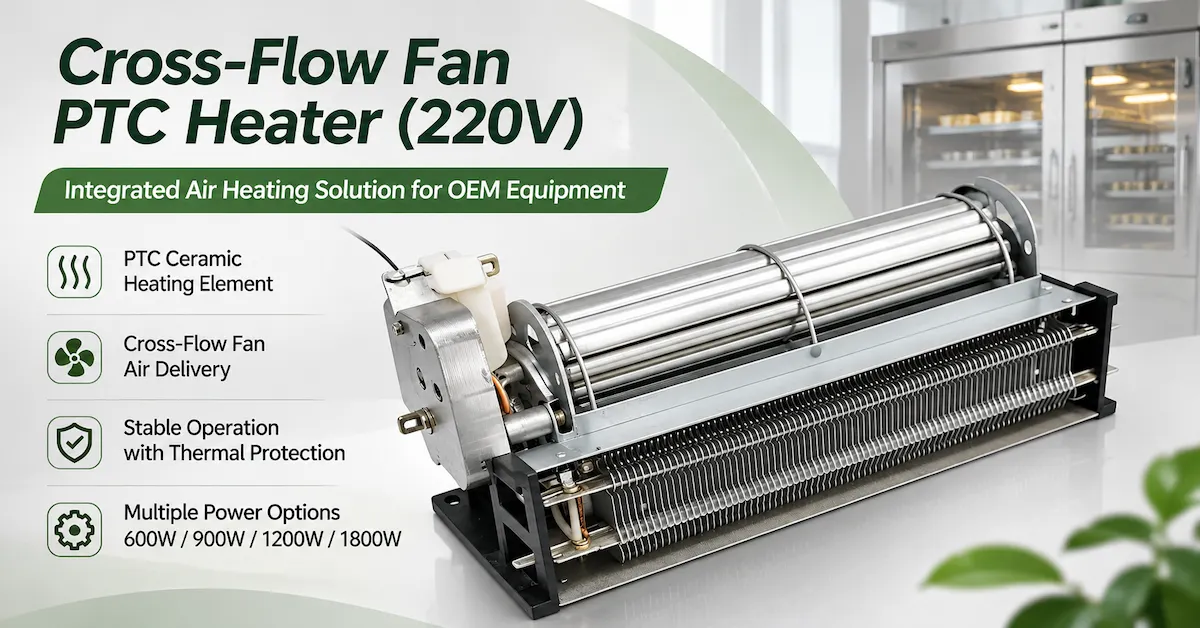
| Cross-Flow Fan PTC Heater | 220V | 600W, 900W, 1200W, 1800W | Integrated cross-flow heating assembly | Wide-outlet warm-air equipment |
These values are taken from Tianrui's published product information.
The availability of a particular configuration, along with its electrical, acoustic, and thermal performance, should be confirmed for the intended OEM application.
MZ11 PTC Fan-Type Heating Elements
The MZ11 PTC Fan-Type Heater is particularly relevant to ceramic heating-core selection.
Tianrui's published model table includes:
| Model | Rated Voltage | Rated Power | Listed Maximum Surge Current | Dimensions |
|---|---|---|---|---|
| MZ11-08A1 | 220V | 800W | 7.3A | 97 × 44 × 15 mm |
| MZ11-10A1 | 220V | 1000W | 9.1A | 120 × 44 × 15 mm |
| MZ11-12A1 | 220V | 1200W | 10.5A | 147 × 44 × 15 mm |
| MZ11-30A1 | 220V | 1600W | 14.6A | 240 × 16 × 24 mm |
The page also publishes a 4000W model for higher-power heating applications.
The listed surge-current figures should be treated as manufacturer catalog values requiring confirmation of the test conditions.
They are not interchangeable with steady-state operating current.
OEM selection note:
The MZ11 heater is a heating component. Fan selection, electrical protection, enclosure design, and final appliance testing remain the responsibility of the equipment development process.
200W Mini PTC Heater with Fan
Tianrui's 200W Mini PTC Air Heater with Fan combines a ceramic heating structure with a dual axial-fan arrangement.
Its compact format may be relevant for localized heating equipment.
It should not be assumed to provide sufficient heat for an entire room without an application-specific thermal assessment.
500W–2000W PTC Air Heater
The 220V PTC Air Heater series provides aluminum heat-transfer assemblies in multiple listed power configurations.
Its product instructions specify forced-air operation and identify air velocity requirements for the published construction.
An OEM should not assume that the heating core can operate safely without its intended airflow.
Which configuration is best?
The decision should be based on whether the manufacturer wants a complete fan-heater subassembly or a separate ceramic heating core.
A separate core can give the equipment designer more control over fan selection, airflow distribution, noise, and enclosure design.
An integrated assembly may simplify mechanical integration, but its suitability still depends on the complete appliance requirements.
6. How Should Fan Airflow Be Matched to a PTC Ceramic Heating Element?
Airflow influences both the heating performance and electrical operating point of a ceramic PTC heater.
The fan must deliver sufficient air through the actual heating assembly.
Catalog free-air airflow is not necessarily the airflow achieved after the fan is installed behind a grille, filter, or heater core.
Basic air-temperature-rise equation
For a preliminary estimate:
Pair = ρ × V̇ × cp × ΔT
Where:
-
Pair = thermal power transferred to air.
-
ρ = air density.
-
V̇ = volumetric airflow.
-
cp = specific heat.
-
ΔT = air temperature rise.
Illustrative calculation
Assume a heater transfers 800W of heat into an air stream.
At:
-
Airflow: 100 m³/h.
-
Air density: 1.2 kg/m³.
-
Specific heat: 1005 J/(kg·K).
The approximate temperature rise is:
ΔT = 800 ÷ (1.2 × (100/3600) × 1005)
ΔT ≈ 24°C
If airflow increases to 150 m³/h with the same useful heating power:
ΔT ≈ 16°C
These are idealized examples.
The actual heater power and heat-transfer rate can change with airflow because of the PTC ceramic's temperature-dependent resistance.
Why higher airflow is not always better
More airflow can reduce the temperature rise of air passing through the heater.
However, it may increase noise or create a draft sensation.
Insufficient airflow can raise local component temperatures and potentially reduce heating power as the ceramic temperature increases.
The correct airflow balances heat delivery, comfort, noise, and safety.
Practical fan-integration checks
An OEM engineer should evaluate:
-
Fan performance at the actual system pressure.
-
Heater-core pressure drop.
-
Inlet and outlet grille restrictions.
-
Air bypass around the heating element.
-
Air-temperature uniformity.
-
Fan motor temperature.
-
Vibration transfer into the housing.
-
Operation at different fan speeds.
For a detailed fan-curve calculation, refer to Tianrui's existing PTC Air Heater Airflow Selection Guide.
7. How Can OEM Brands Design a Quieter PTC Space Heater?
Noise is an important purchasing and product-development consideration for bedrooms, home offices, and other indoor environments.
A quiet ceramic heating element does not guarantee a quiet finished appliance.
Noise often originates in the air-moving and mechanical components.
Main noise sources
Fan motor:
Bearings, electromagnetic effects, and motor operation may generate noise.
Air turbulence:
Restricted inlets, abrupt flow turns, and outlet grilles can create aerodynamic noise.
Housing vibration:
Mechanical vibration may transfer into plastic or metal panels.
Assembly resonance:
Loose parts or unsuitable mounting structures can produce rattling or tonal noise.
Control operation:
Fan-speed switching and other electrical controls may produce changes in perceived sound.
What should the OEM measure?
At minimum, compare the finished appliance under consistent operating conditions.
Potential measurements include:
-
A-weighted sound pressure level.
-
Measurement distance.
-
Fan speed.
-
Operating mode.
-
Background noise.
-
Airflow.
-
Acoustic frequency characteristics.
-
Mechanical vibration.
A sound-pressure reading measured at one distance should not be compared directly with another reading obtained at a different distance or test environment.
Relevant acoustic reference
ISO 3744:2025 — Determination of Sound Power Levels of Noise Sources describes engineering methods for estimating sound power from sound pressure measurements in suitable acoustic environments.
It provides a reference for establishing comparable noise measurements where its scope and test conditions are applicable.
The standard's existence does not establish a noise rating for any Tianrui product.
Design improvements worth evaluating
-
Reduce unnecessary inlet restrictions.
-
Improve the fan's operating point.
-
Use suitable mounting isolation.
-
Avoid housing resonance.
-
Prevent loose fasteners and wiring contact.
-
Improve airflow distribution.
-
Compare fan speeds under equivalent useful heating conditions.
A proposed low-noise fan should be tested inside the finished space-heater enclosure rather than accepted from a motor specification alone.
8. Does a PTC Space Heater Still Need a Thermostat?
Yes, when the finished appliance requires controlled room temperature.
PTC self-regulation primarily responds to ceramic temperature.
A room thermostat responds to room-air temperature or another selected temperature measurement.
These functions are not equivalent.
Ceramic self-regulation
The PTC material changes electrical resistance as its temperature changes.
This influences electrical power.
Room-temperature control
A thermostat or electronic controller determines whether the appliance should continue delivering heat based on the measured room condition.
Independent protection
A safety device responds to defined abnormal conditions and should not depend solely on ordinary comfort-control software.
Recommended functional architecture
| Component | Function | Engineering Consideration |
|---|---|---|
| PTC heating element | Generates heat | Ceramic resistance-temperature behavior |
| Room-temperature sensor | Measures ambient condition | Position, calibration, response |
| Electronic controller | Regulates operating modes | Control logic and fault response |
| Fan | Moves heat into the room | Airflow, noise, thermal suitability |
| Thermal protection | Responds to relevant overheating conditions | Placement and independence |
| Tip-over protection, where applicable | Addresses unstable appliance orientation | Verified appliance-level response |
Where should the temperature sensor be placed?
A sensor located directly in the hot outlet stream may read a higher temperature than the surrounding room.
A sensor positioned near a cold inlet or exposed to external drafts may behave differently.
The ideal position depends on the air path and controller algorithm.
Tianrui offers NTC Temperature Sensor products that may be relevant for appropriate temperature-feedback applications.
Sensor configuration and suitability must be evaluated for the specific heater.
9. What Safety Tests Matter for PTC Space Heater OEM Production?
A PTC space heater is an electrical appliance intended to operate near people and household materials.
The ceramic's resistance behavior does not replace complete safety assessment.
What happens if airflow is blocked?
Restricted airflow reduces heat removal from the heating element.
The ceramic temperature may rise, increasing its electrical resistance and reducing power.
However, nearby wiring, insulation, plastic structures, or accessible surfaces may still reach unacceptable temperatures.
The entire appliance must be evaluated.
Important abnormal-operation scenarios
| Test Scenario | Main Concern | Intended Verification |
|---|---|---|
| Blocked air inlet | Reduced cooling | Temperature and protective response |
| Blocked outlet | Heat accumulation | Housing and internal component temperatures |
| Fan motor failure | Loss of forced airflow | Heater shutdown or safe fault behavior |
| Thermostat malfunction | Incorrect heating demand | Independent protection |
| Sensor disconnection or short | Loss of valid feedback | Controller fault handling |
| Heater tip-over | Exposure of surfaces to abnormal conditions | Appropriate tip-over behavior |
| Unstable supply conditions | Changed current and heating behavior | Electrical compatibility |
| Accumulated dust or lint | Restricted airflow and contamination | Cleaning and abnormal-operation assessment |
| Long-duration operation | Thermal aging | Stable electrical and mechanical performance |
| Cable and connector heating | Electrical contact resistance | Temperature rise and wiring integrity |
Applicable appliance safety references
Two authoritative standards are particularly relevant to the selection and validation of finished space-heating appliances.
IEC 60335-2-30:
The IEC standard for household and similar electric room heaters addresses safety requirements for room-heating appliances within its defined scope. The linked consolidated edition includes the 2009 standard and amendments through 2021.
UL 1278:
The UL standard for movable and wall- or ceiling-hung electric room heaters covers defined categories of electric room-heating equipment. Its published revision information includes changes dated May 29, 2025.
The applicable standard depends on the product configuration, installation type, destination market, and other relevant requirements.
Neither standard proves that a particular Tianrui ceramic heating element or finished OEM space heater is certified.
The final appliance manufacturer must determine and demonstrate conformity with the applicable requirements.
Why component-level testing is insufficient
A heating core can perform acceptably in isolation while the finished appliance presents risks because of enclosure design, wiring, outlet-grille temperatures, or control failures.
Safety qualification must evaluate the complete heater.
10. How Should Ceramic Heating Elements Be Integrated into the Appliance?
Mechanical and electrical integration can determine whether a heating element is suitable for volume production.
Mechanical design
The heater must fit within the permitted installation envelope.
The design should specify mounting points, airflow direction, clearance, and access for assembly.
Electrical connections
Wiring must be selected for its current, temperature exposure, insulation requirements, and mechanical arrangement.
Cold-start current should be considered alongside stabilized operating current.
Plastic enclosure design
Housing materials, internal barriers, and proximity to hot components require attention.
Airflow can change during operation, and thermal testing should reflect normal and abnormal conditions.
Dust and maintenance
The inlet arrangement should balance airflow restriction with appropriate protection from dust or debris.
Maintenance instructions and cleaning accessibility should be established for the complete appliance.
Power-stage coordination
The heater, fan, controller, and protection system should have a defined operating sequence.
For example, a fan may need to operate before or after heater energization depending on the qualified design.
The appropriate sequence should be established by engineering evaluation rather than copied from another appliance.
11. Which Applications Require Different PTC Space Heater Designs?
The word "space heater" covers several appliance categories.
The same heating core may not be appropriate for every application.
Desktop and personal heating
Compact devices may prioritize low power, small size, and localized comfort.
A 200W fan-integrated heater may be a useful component to evaluate, but its ability to warm a particular space depends on the operating conditions.
Portable room heaters
These products typically require more substantial heating capacity and careful consideration of tip-over behavior, power cords, accessible temperatures, and airflow.
Wall-mounted heaters
Mechanical installation, mounting strength, airflow direction, and applicable safety requirements are important.
Quiet residential heaters
Acoustic performance and thermostat behavior may be major product differentiators.
Table 3. Application-Based Design Priorities
| Application | Main Engineering Priority | Important Component Requirement |
|---|---|---|
| Desktop personal heater | Localized warm airflow | Compact heating and fan assembly |
| Portable room heater | Heating capacity and safety | Ceramic core, protection, enclosure integration |
| Bedroom-oriented heater | Low noise and stable control | Fan selection, acoustic design, temperature sensing |
| Wall-mounted room heater | Installation and heat distribution | Mounting geometry and appropriate airflow |
| Commercial localized heating | Intended heating duty | Suitable power and mechanical structure |
These are application directions, not approved use claims for every Tianrui catalog model.
12. OEM Engineering Example: Developing a Quiet Ceramic Room Heater
The following scenario illustrates how an OEM brand could evaluate a heater design.
This is a hypothetical engineering example and does not represent a documented Tianrui customer project or factory test result.
Project requirements
A manufacturer plans a fan-forced ceramic space heater for a defined indoor heating application.
The preliminary targets are:
| Parameter | Illustrative Requirement |
|---|---|
| Rated supply | 220V AC |
| Preliminary steady-state room heat loss | Approximately 750W |
| Candidate ceramic core | 1000W catalog model |
| Temperature control | Room-temperature feedback |
| Fan operation | Multiple speed settings |
| Product objective | Comfortable heating with controlled noise |
| Safety evaluation | Normal and abnormal operation |
Step 1: Select a candidate heating core
The team considers a 1000W MZ11-series component.
The manufacturer's catalog provides a preliminary electrical rating and dimensions.
These data are used for initial packaging and circuit planning.
The actual thermal performance must still be tested.
Step 2: Review electrical loading
The catalog lists a maximum surge-current value for the MZ11-10A1 model.
The team confirms the test conditions and determines whether the switching components, wiring, and electrical protection are suitable.
Step 3: Select the fan
The manufacturer measures actual airflow through the intended heater core and grille arrangement.
The selected fan must provide suitable heating performance without creating unacceptable noise.
Step 4: Define temperature control
A room-temperature sensor is positioned and evaluated to avoid inappropriate influence from the heater's own outlet airflow.
The controller is tested for stable operation around the target setpoint.
Step 5: Evaluate operating noise
The appliance is assessed at different fan speeds under repeatable conditions.
The team examines both sound level and objectionable tonal characteristics.
Step 6: Validate abnormal operation
Testing includes relevant blocked-airflow, fan-failure, thermostat-failure, and tip-over conditions.
Appropriate protective measures are evaluated.
Step 7: Approve production samples
The final design is accepted only after the required heating, electrical, acoustic, mechanical, and safety criteria have been satisfied.
Engineering lesson:
A 1000W heating element is a starting point for product development, not proof that a completed space heater will deliver a specific room-temperature rise, noise level, or safety performance.
13. How Can OEM Buyers Evaluate a PTC Space Heater Heating Element Supplier?
A suitable supplier should support engineering discussions beyond nominal wattage.
For OEM purchasing managers, the strongest evaluation focuses on technical fit, documentation, sample validation, and manufacturing consistency.
Supplier qualification checklist
| Evaluation Area | Question to Ask |
|---|---|
| Product selection | Which ceramic heating cores suit the target appliance? |
| Electrical performance | What voltage, power, and startup-current data are available? |
| Thermal characteristics | Under what airflow conditions was performance measured? |
| Mechanical design | Can the dimensions and mounting structure fit our enclosure? |
| Insulation | What construction and test evidence are relevant? |
| Customization | Can the structure, wiring, or mounting be reviewed? |
| Sample testing | Can prototype evaluation requirements be agreed? |
| Manufacturing control | How are critical dimensions and electrical characteristics inspected? |
| Change management | How are approved designs maintained across orders? |
| Commercial terms | What are the configuration-specific MOQ, tooling, and lead-time conditions? |
Tianrui OEM development support
Dongguan Tianrui Electronics Co., Ltd. describes customization support for PTC heating structures, material selection, technical drawings, and development work.
The company offers several ceramic heating-element and fan-heater configurations.
Buyers can review its Custom PTC Heater Solutions.
Specific customized voltages, dimensions, output ratings, and protection requirements should be confirmed through an engineering review.
Standard vs. customized ceramic heating core
A standard heating element may reduce initial development effort when the existing dimensions and operating characteristics match the product.
A customized solution may be worthwhile when the equipment requires a different electrical configuration, housing geometry, installation structure, or thermal interface.
Both approaches require validation.
The correct decision should consider total installed cost, development expense, qualification effort, and expected production volume.
14. What Should a PTC Space Heater OEM RFQ Include?
A detailed Request for Quotation helps the heating-element supplier evaluate the actual application.
Table 4. OEM Ceramic Space Heater RFQ Checklist
| RFQ Item | Required Information |
|---|---|
| Application | Portable heater, wall-mounted heater, desktop heater, or other appliance |
| Target market | Countries or regions of sale |
| Rated voltage | AC/DC and permitted supply range |
| Desired electrical power | Target operating range |
| Heating objective | Room heating, localized warmth, or temperature maintenance |
| Estimated heating load | Design calculation or thermal requirement |
| Fan arrangement | Integrated or separate |
| Airflow requirement | Target flow and system restrictions |
| Acoustic requirement | Defined operating modes and measurement conditions |
| Temperature control | Sensor, thermostat, and controller requirements |
| Protective functions | Relevant abnormal-operation and safety objectives |
| Installation dimensions | Drawings and available space |
| Wiring | Lead length, connector, and routing requirements |
| Environmental conditions | Ambient temperature, dust, humidity, and usage |
| Testing requirements | Thermal, electrical, acoustic, and safety validation |
| Sample quantity | Engineering development requirement |
| Production quantity | Initial order and forecast annual demand |
| Commercial terms | MOQ, tooling, delivery, and packaging |
Example Technical Inquiry
Subject: Ceramic PTC Heating Element for OEM Space Heater Development
We are developing a PTC Space Heater for our appliance product line and are evaluating suitable ceramic heating elements.
Our design requires controlled warm airflow, appropriate electrical performance, low operating noise, and compatibility with the relevant finished-appliance safety requirements.
We can provide our target voltage, heating load, enclosure dimensions, fan specifications, temperature-control arrangement, and estimated production volume.
Please advise:
-
Which Tianrui ceramic heating elements are suitable for preliminary evaluation.
-
Whether an existing MZ11 model can support our requirements.
-
What cold-start and stabilized electrical test information is available.
-
Which airflow conditions should be used during prototype testing.
-
Whether mounting or wiring customization is feasible.
-
Which technical documents can support our engineering evaluation.
-
What sample, MOQ, tooling, and lead-time conditions apply.
We plan to validate the heating assembly in our completed appliance before approving a production configuration.
For a project-specific quotation, contact Tianrui Electronics with the available technical details.
Frequently Asked Questions About PTC Space Heaters
1. What is a PTC Space Heater?
A PTC Space Heater is an electric heating appliance using positive temperature coefficient ceramic elements.
The ceramic changes resistance as temperature rises, affecting electrical power.
Most fan-forced models use airflow to transfer heat into the surrounding space.
Finished-appliance performance depends on the heating core, fan, controls, housing, and operating conditions.
2. What is the difference between a PTC Ceramic Space Heater and a conventional electric heater?
Both use electricity to generate heat.
A PTC ceramic element has a pronounced temperature-dependent resistance characteristic that can reduce electrical power at elevated ceramic temperatures.
A conventional resistance element generally has a different electrical behavior.
The appropriate choice depends on the complete appliance design, control requirements, and performance objectives.
3. Is a PTC ceramic heating element automatically safe against overheating?
No.
Its self-regulating behavior can reduce electrical input under certain thermal conditions.
However, the surrounding appliance may still experience unsafe temperatures during blocked airflow, fan failure, or other abnormal conditions.
Appropriate equipment-level protection and validation are necessary.
4. How do OEMs calculate the heating power needed for a room?
Estimate transmission heat loss through walls, windows, and other surfaces, along with ventilation and infiltration heat loss.
Use suitable design indoor and outdoor temperatures.
Warm-up time, thermal mass, and operating conditions should also be considered.
Room area alone is not enough for an accurate calculation.
5. Does a PTC Space Heater need a fan?
Many ceramic space heaters use fans to transfer heat from the ceramic elements into the air.
Some PTC heating constructions use natural convection or conduction instead.
The selected heating core must be operated according to its intended heat-removal conditions.
A forced-air heating element should not be assumed safe for fanless operation.
6. How can manufacturers reduce ceramic space heater noise?
Evaluate fan selection, system airflow resistance, inlet and outlet grille geometry, housing vibration, and component mounting.
Noise should be measured on the finished appliance using consistent test conditions.
A low-noise motor specification alone is not sufficient.
7. Does a PTC Space Heater require a thermostat?
A room thermostat or temperature-control system is generally needed when the appliance must maintain a defined room-temperature setting.
The ceramic's self-regulating behavior responds to its own temperature rather than directly measuring the room.
Independent thermal protection may also be required.
8. Can Tianrui provide heating elements for custom room heaters?
Tianrui publishes MZ11 ceramic fan-heater elements, mini fan-heater assemblies, and additional PTC air-heating configurations.
The company also describes support for customized heater solutions.
Specific design feasibility, sample availability, and electrical configurations should be confirmed directly.
9. What certifications should OEM space heater manufacturers verify?
The applicable requirements depend on the destination market and finished product.
Standards such as IEC 60335-2-30 and UL 1278 may be relevant within their respective scopes.
The OEM should determine the applicable conformity requirements and obtain suitable evidence.
A component's published specifications do not establish certification of the finished heater.
10. What information should buyers send to a PTC Space Heater Heating Element supplier?
Provide the target application, voltage, heating duty, fan specifications, installation drawings, expected operating temperatures, control arrangement, safety requirements, and estimated purchasing quantity.
Including these details helps the supplier evaluate suitable ceramic cores and customized configurations.
Engineering samples should be validated before mass-production approval.
Conclusion
Developing a reliable PTC Space Heater requires coordinated decisions about ceramic heating elements, room heat loss, warm-air delivery, temperature control, acoustic performance, and safety.
For appliance OEMs and space heater brands, the first priority is to define the intended heating duty.
The second is to select a PTC Space Heater Heating Element with appropriate electrical and mechanical characteristics.
The third is to verify how that heating element performs inside the complete appliance.
A PTC Ceramic Space Heater can provide useful self-regulating electrical behavior, but that characteristic does not replace thermostat control, fan engineering, abnormal-operation protection, or finished-appliance qualification.
The most important OEM selection criteria are:
-
Heating capacity: Calculate the required heat input for the intended space or localized heating application.
-
Ceramic core selection: Evaluate voltage, electrical power, startup current, dimensions, and heat-transfer requirements.
-
Fan integration: Match actual airflow to the heater core and enclosure.
-
Temperature control: Use appropriate sensors and independent protective functions.
-
Acoustic performance: Verify noise and vibration in the finished product.
-
Safety validation: Assess relevant normal and abnormal operating conditions.
-
Supplier qualification: Establish controlled specifications, testing, and repeatable manufacturing requirements.
Dongguan Tianrui Electronics Co., Ltd. supplies PTC ceramic heating elements and air-heating assemblies that can be evaluated for appropriate OEM heating applications.
Its published product range includes MZ11 fan-type ceramic heating elements, compact 200W fan-heater assemblies, and higher-power PTC air-heating configurations.
Looking for a PTC ceramic heating element for your next space heater project?
Explore the Tianrui MZ11 PTC Fan-Type Heater, review its PTC Heating Solutions, or contact Tianrui Electronics for technical consultation and an OEM quotation.
When submitting your inquiry, include the required voltage, heating power, room-heating objective, fan arrangement, installation dimensions, temperature-control requirements, testing expectations, and estimated order quantity.
Email:
Phone:
+86 135 3277 2961
A properly specified ceramic heating core, coordinated fan and temperature-control design, and comprehensive equipment validation provide the foundation for reliable space-heating appliances and successful long-term OEM cooperation.