TL;DR: For an OEM electronic device requiring the same electrical heating power, a 24V PTC Heater generally draws half the current of a 12V PTC Heater. This can reduce cable voltage drop, resistive wiring losses, and current-related demands on connectors and switching devices. However, a 24V heater is not automatically more efficient or thermally superior. The correct Low Voltage PTC Heater must match the actual supply-voltage range, cold-start current, thermal load, insulation requirements, and equipment architecture. A 12V-rated heater should not be connected to 24V without explicit manufacturer approval.
Electronic equipment manufacturers frequently choose between 12V and 24V DC heating architectures when developing compact devices, portable equipment, industrial controllers, and specialized thermal-management systems.
At first glance, the decision may seem straightforward. A 12V PTC Heater operates from a nominal 12V supply, while a 24V PTC Heater operates from a nominal 24V supply.
However, supply voltage affects far more than the product's electrical label.
For a given power requirement, the selected voltage influences current demand, wire sizing, connector selection, voltage drop, switching-device requirements, and potentially the overall power-distribution architecture.
PTC ceramic behavior introduces an additional consideration: the heater's resistance changes with temperature.
Consequently, its electrical power and current are not necessarily constant from cold start to stabilized operation.
A heater that works correctly with a laboratory power supply may perform differently when connected through a long cable to a battery or compact electronic controller.
The correct design objective is to choose a low-voltage heating system that delivers the required useful heat at the heater terminals under all specified operating conditions, without exceeding the electrical and thermal limits of the finished device.
This guide compares 12V and 24V PTC heating solutions across four engineering criteria: electrical current, wiring losses, thermal behavior, and OEM integration.
It also explains how to evaluate real Tianrui PTC products, calculate preliminary electrical requirements, and prepare a complete technical specification for customized low-voltage heating applications.
How Do 12V and 24V PTC Heaters Compare Side by Side?
The first decision is whether the equipment's electrical architecture is better suited to 12V or 24V.
Both voltages can support self-regulating ceramic heaters, provided the heater has been designed and qualified for the selected supply.
Table 1. 12V vs. 24V PTC Heater Engineering Comparison
| Comparison Dimension | 12V PTC Heater | 24V PTC Heater | Engineering Recommendation |
|---|---|---|---|
| Current at equal electrical power | Higher current | Approximately half the current | Consider 24V when distribution current is a significant constraint |
| Cable voltage drop | Greater absolute drop for the same circuit resistance and power | Lower current reduces absolute drop | Verify actual voltage at the heater terminals |
| Resistive wiring loss | Higher at equal power and cable resistance | Approximately one-quarter of the 12V case | Important for longer cable runs |
| Existing equipment compatibility | Suitable for qualified 12V architectures | Suitable for qualified 24V architectures | Prefer the device's existing electrical bus when practical |
| Switching components | Must handle higher current at equal power | Lower current, but higher voltage rating required | Check both current and voltage limits |
| Thermal performance | Depends on the actual heater design | Depends on the actual heater design | Do not assume voltage alone determines heat output |
| Battery integration | Depends on battery voltage range and protection | Depends on battery voltage range and protection | Verify the complete battery operating envelope |
| Product availability | Standard and customizable configurations may exist | Standard and customizable configurations may exist | Confirm exact product specifications |
The fundamental electrical advantage of a higher voltage is reduced current for a given power level.
However, the equipment's existing supply, connector system, insulation architecture, and thermal requirements remain critical.
Key Takeaways
-
A nominal 60W load draws approximately 5A at 12V or 2.5A at 24V under the simple constant-power relationship.
-
Higher current increases resistive losses when the wiring resistance remains unchanged.
-
A 24V PTC heater is not interchangeable with a 12V heater simply because their shapes or nominal power ratings are similar.
-
Cold-start current should be verified separately from stabilized operating current.
-
Battery-powered equipment must account for the actual battery voltage range, not only its nominal voltage.
-
The voltage measured at the heater terminals matters more than the nominal output voltage printed on the power supply.
-
The ceramic's Curie temperature does not establish the final equipment temperature.
-
OEM qualification should include electrical, thermal, mechanical, and abnormal-operation testing.
Why Does Voltage Selection Change Current and Wiring Requirements?
The basic electrical power relationship is:
P = V × I
Where:
-
P = electrical power in watts.
-
V = voltage in volts.
-
I = electrical current in amperes.
Rearranging the equation:
I = P / V
For the same power, doubling voltage halves current.
Example: a hypothetical 60W heating requirement
Consider an OEM electronic device requiring approximately 60W of electrical heating input at a particular operating point.
At 12V:
I = 60 / 12
I = 5A
At 24V:
I = 60 / 24
I = 2.5A
Table 2. Theoretical Current at Different Power Levels
| Assumed Electrical Power | Current at 12V | Current at 24V |
|---|---|---|
| 12W | 1.0A | 0.5A |
| 24W | 2.0A | 1.0A |
| 36W | 3.0A | 1.5A |
| 60W | 5.0A | 2.5A |
| 96W | 8.0A | 4.0A |
| 120W | 10.0A | 5.0A |
These calculations assume the same electrical input power at each voltage.
They do not describe actual startup or stabilized power measurements for a specific Tianrui heater.
Why does this matter for OEM manufacturing?
Higher current influences the requirements for several components.
Wiring:
Conductors must carry the expected current without unacceptable heating or voltage drop.
Connectors:
Contacts must be rated for the required current, voltage, temperature, and operating environment.
Switching devices:
Relays, MOSFETs, and other devices must handle the actual electrical conditions.
Power supplies:
Startup current and steady-state demand must be considered.
Protection:
Fuses and other protective devices must be coordinated with the equipment design.
In equipment with long cable runs or several heating devices, current-related requirements can become an important reason to evaluate a higher-voltage architecture.
However, changing the supply voltage of an existing product is not always economical or practical.
How Much Cable Voltage Drop Can Occur in 12V vs. 24V Heating Systems?
Voltage drop occurs when current flows through conductors, terminals, connectors, and other resistive components.
For a simplified DC circuit:
Vdrop = I × R
Where:
-
Vdrop = voltage lost across the circuit resistance.
-
I = electrical current.
-
R = resistance of the complete current path.
The resistance should account for both supply and return conductors, along with relevant contacts.
Illustrative wiring calculation
Suppose a hypothetical heater requires 60W at its nominal operating point.
Assume the total resistance of the supply and return circuit, including relevant connections, is 0.10Ω.
At 12V and 5A:
Vdrop = 5 × 0.10
Voltage drop = 0.50V
At 24V and 2.5A:
Vdrop = 2.5 × 0.10
Voltage drop = 0.25V
What percentage of the supply voltage is lost?
For the 12V system:
0.50 / 12 × 100 = 4.17%
For the 24V system:
0.25 / 24 × 100 = 1.04%
Under the stated assumptions, the 24V architecture has a lower percentage voltage drop.
Table 3. Illustrative Cable Voltage Drop Comparison
| Parameter | 12V System | 24V System |
|---|---|---|
| Assumed electrical power | 60W | 60W |
| Nominal current | 5A | 2.5A |
| Assumed circuit resistance | 0.10Ω | 0.10Ω |
| Calculated voltage drop | 0.50V | 0.25V |
| Voltage drop percentage | 4.17% | 1.04% |
This is a simplified comparison using nominal current values.
A real PTC heater changes its current as its temperature and terminal voltage change. Exact operation requires evaluating the complete circuit and heater characteristics together.
Why voltage at the heater terminals matters
A power supply may provide 12V at its output while the heater receives less voltage because of wiring and connection losses.
A PTC heater's electrical power depends on its actual applied voltage and operating resistance.
Consequently, excessive voltage drop can change heating performance.
For reliable design verification, engineers should measure voltage directly at the heater terminals during startup and stabilized operation.
How Do Wiring Losses Affect Low Voltage PTC Heater Efficiency?
Electrical power dissipated in resistive wiring can be estimated using:
Ploss = I² × R
This relationship shows why current is important.
Under the same circuit resistance, doubling current produces four times the resistive loss.
Comparing the hypothetical 60W systems
At 12V, using 5A and 0.10Ω:
Ploss = 5² × 0.10
Ploss = 2.50W
At 24V, using 2.5A and 0.10Ω:
Ploss = 2.5² × 0.10
Ploss = 0.625W
The calculated wiring loss in the 12V example is four times that of the 24V example.
Why this matters
Power dissipated in wiring becomes heat outside the intended heating element.
This may increase local temperatures in cables, connectors, or enclosed electrical compartments.
It also means that part of the power supplied by the system is not delivered to the intended heating component.
Is a 24V heater inherently more energy efficient?
No.
A 24V electrical architecture can reduce distribution losses when delivering the same power through the same wiring resistance.
That does not establish that a 24V PTC ceramic converts electricity into useful heat more efficiently than a comparable 12V ceramic heater.
The final equipment's energy consumption depends on heat losses, operating duty, temperature control, and thermal design.
The relevant comparison should consider the complete system.
Engineering recommendation
For equipment with longer wiring runs, significant heater current, or multiple heaters, compare the total electrical-distribution losses of the available architectures.
For a compact electronic product with very short wiring and an existing 12V supply, the benefit of changing to 24V may be relatively small.
Why Can't a 24V PTC Heating Element Simply Run at 12V?
A ceramic PTC heating element has temperature-dependent resistance.
Changing its supply voltage changes its electrical heating behavior.
A lower voltage may substantially reduce power and prevent the element from reaching the desired operating condition.
A higher-than-approved voltage may introduce excessive electrical and thermal stress.
Real product example: Tianrui MZ41 Ceramic PTC Heating Element
Tianrui publishes the following model:
MZ41-1610-120-30±20%
Its listed specifications include:
| Parameter | Published Value |
|---|---|
| Model | MZ41-1610-120-30±20% |
| Rated operating voltage | 24V DC |
| Resistance at 25°C | 30Ω ±20% |
| Curie temperature | 120°C ±10°C |
| Listed surface temperature | 130°C ±7°C |
| Dimensions | 16 × 9.5 × 1.4 mm |
| Electrode | Silver electrode with edge |
Product reference: MZ41 Ceramic PTC Heating Element.
Theoretical comparison at 12V and 24V
Assume the ceramic has a resistance of 30Ω at a defined reference temperature.
At 24V:
I = 24 / 30 = 0.80A
P = 24² / 30 = 19.2W
At 12V:
I = 12 / 30 = 0.40A
P = 12² / 30 = 4.8W
Under this simplified fixed-resistance calculation, halving voltage reduces electrical power to one-quarter.
What does the calculation prove?
It demonstrates the sensitivity of resistive power to applied voltage when resistance is held constant.
It does not prove that the MZ41 heater consumes exactly 19.2W throughout operation at 24V or 4.8W throughout operation at 12V.
The resistance changes as the ceramic heats.
The actual thermal equilibrium may be substantially different at each supply voltage.
OEM selection rule:
A 24V-rated ceramic element should not be treated as a qualified 12V heater without manufacturer confirmation and application testing.
Likewise, a 12V-rated product must not be connected to 24V simply to obtain faster heating.
How Should Engineers Size the Power Supply for a Low Voltage PTC Heater?
Power-supply selection should account for the heater's actual operating conditions, not just its nominal wattage.
PTC ceramic resistance can vary significantly with temperature.
This means current at the beginning of operation may differ from stabilized current.
Why cold-start behavior matters
A cold heater may have relatively low resistance.
Depending on the product, the resulting startup current can be significantly higher than its stabilized operating current.
A power supply selected only from the nominal stabilized wattage may enter current limiting or shut down during startup.
Important power-supply parameters
| Parameter | Engineering Purpose |
|---|---|
| Nominal output voltage | Matches the approved heater |
| Output voltage tolerance | Confirms allowable supply range |
| Continuous current rating | Supports stabilized operation |
| Peak or transient current capability | Supports expected startup behavior |
| Current-limit behavior | Determines response to high initial demand |
| Thermal protection | Protects the power supply under faults |
| Output ripple and regulation | Relevant to connected electronics |
| Environmental rating | Matches equipment operating conditions |
Why an arbitrary power-supply margin is insufficient
It is common to select a supply with some additional current capacity.
However, a fixed percentage cannot replace actual startup-current data.
For example, specifying a 20% margin over nominal steady-state current does not guarantee that the supply can handle a much larger initial current.
The correct approach is to measure or obtain the expected current profile and select a power supply that supports it.
Power-supply current limiting
Some electronic power supplies reduce their output voltage when current demand reaches a limit.
Others may temporarily shut down or repeatedly attempt to restart.
These behaviors can interact with a cold PTC heater.
The OEM should verify whether the power supply and heater can start reliably together at the lowest expected ambient temperature.
Multiple heaters
If a device uses several heating elements, engineers must determine whether they start simultaneously.
Simultaneous startup can produce greater combined current demand.
Staggered startup may be considered when supported by the equipment architecture, but control and protective requirements must still be evaluated.
What Changes When a PTC Heater Is Powered by a Battery?
Battery-powered equipment adds another important consideration: nominal battery voltage is not the same as its complete operating-voltage range.
Actual voltage depends on the battery chemistry, cell configuration, state of charge, temperature, and electrical load.
Battery voltage range
A battery described as 12V or 24V may operate above or below that nominal value.
The exact range must be defined for the specific battery system.
For example, some battery configurations have substantially different fully charged and discharged voltages.
A PTC heater should therefore be qualified over the permitted system voltage range.
Battery current capability
The battery and its protection circuitry must be capable of supplying the heater's startup and operating current.
The design should consider:
-
Battery discharge limits.
-
Battery-management protection.
-
Voltage sag under load.
-
Cable and connector losses.
-
Ambient temperature.
-
Simultaneous operation of other equipment.
Battery runtime
For a preliminary estimate:
Energy (Wh) = Electrical Power (W) × Operating Time (h)
A hypothetical heater consuming a constant 60W for 30 minutes requires:
60 × 0.5 = 30Wh
This is an ideal energy estimate.
Actual energy use may differ because PTC electrical power changes during operation.
The system also consumes energy through controllers, fans, and other components.
Why startup at low battery voltage matters
A heater may be able to start at a fully charged battery voltage but provide insufficient heating at the minimum permitted system voltage.
The OEM should evaluate the complete operating range.
Automotive and mobile equipment
Equipment powered from vehicle electrical systems may experience additional voltage variation and electrical transients.
These conditions require application-specific protection and qualification.
A generic 12V or 24V PTC heater should not automatically be considered automotive-qualified.
Which Tianrui 12V and 24V PTC Heater Products Are Relevant?
Dongguan Tianrui Electronics Co., Ltd. publishes several heater families that include low-voltage configurations.
The products should be evaluated according to their actual construction and specific electrical requirements.
Table 4. Tianrui Low-Voltage PTC Product Comparison
| Product | Published Voltage Information | Construction | OEM Evaluation Focus |
|---|---|---|---|
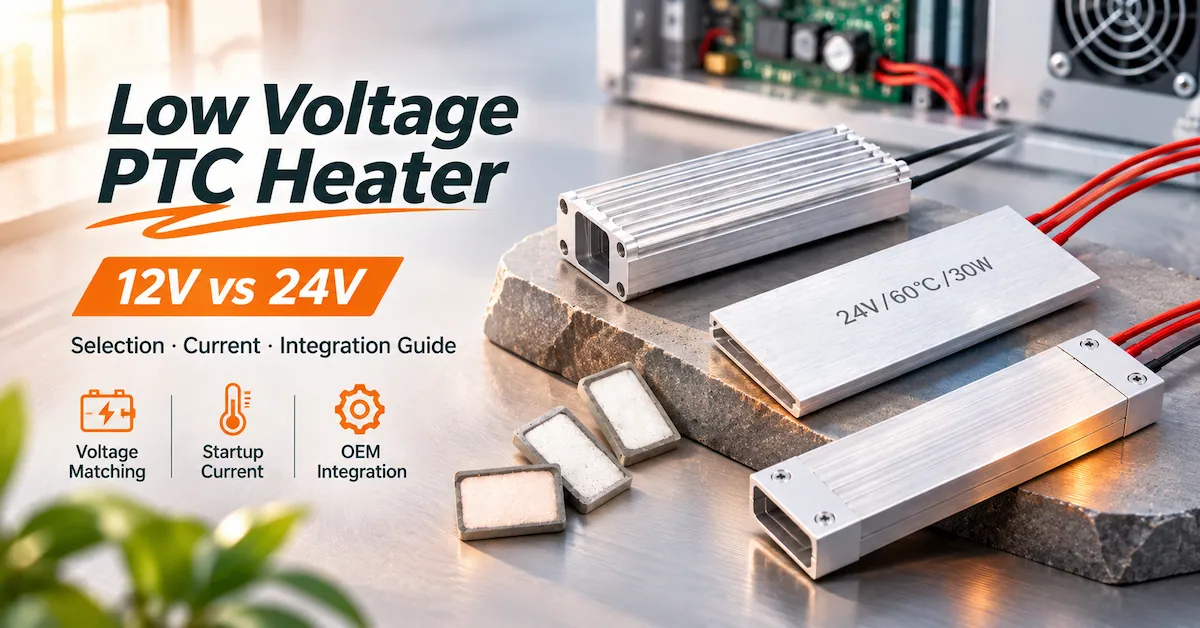
| Aluminum Shell PTC Heater 12V/24V | Product images identify 3.7V, 5V, 12V and 24V; page lists a broader family range | Aluminum-shell PTC assembly | Compact equipment, mechanical integration |
| MZ41 Ceramic PTC Heating Element | Specific model: 24V DC | Rectangular ceramic element | Custom low-voltage heater development |
| 24V 30W PTC Heating Plate | 24V, 30W published configuration | Aluminum-shell heating plate | Compact contact-heating designs |
| PTC Heater with Insulated Film | Published family includes 12–240V AC/DC and customization | Insulated heater construction | Electrical isolation and compact integration |
| PTC Heater with Insulation Film | Published family lists 12–48V DC and 100–240V AC | Polyimide-film insulated PTC assembly | Low-voltage insulated heating applications |
These specifications describe different product listings and families.
A family voltage range is not proof that every voltage, shape, power rating, or temperature combination is available.
Before ordering, request confirmation of the exact model and applicable product specification.
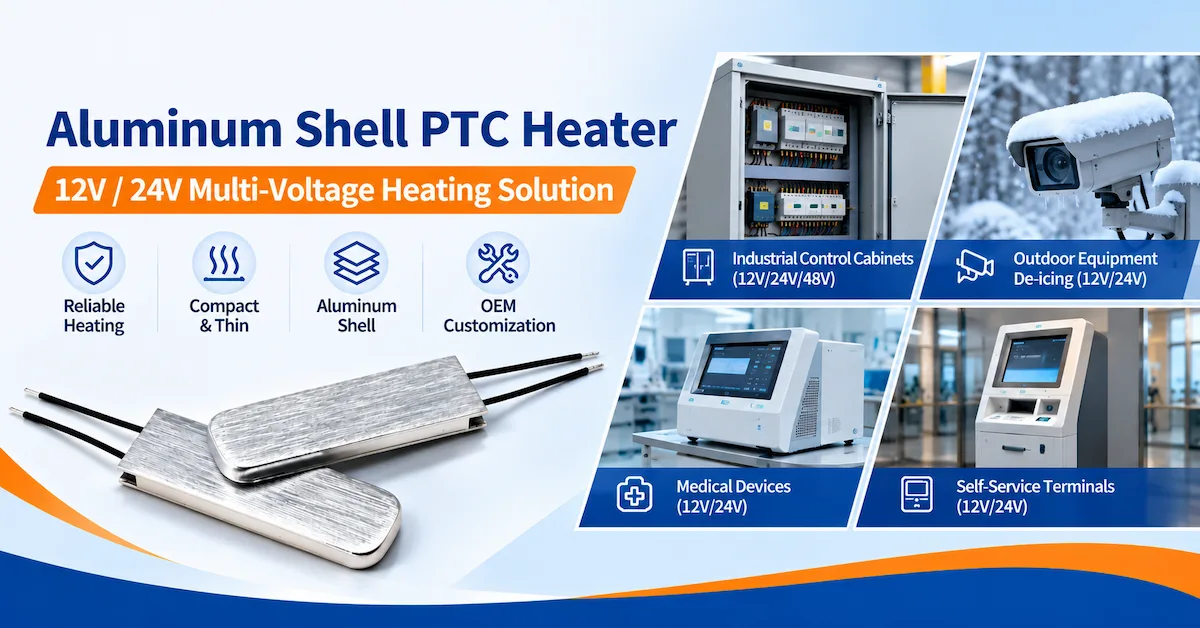
Aluminum Shell PTC Heater for 12V and 24V projects
The Aluminum Shell PTC Heater 12V/24V page includes low-voltage product references.
The aluminum housing can provide mechanical support and a defined heat-transfer surface.
However, its published range covers several configurations.
Buyers should confirm the actual power, dimensions, temperature behavior, and insulation requirements for the intended 12V or 24V version.
MZ41 24V Ceramic PTC Heating Element
The MZ41 is useful for engineers who already have a suitable heater housing or are developing a customized assembly.
Its published electrical characteristics provide a starting point for preliminary analysis.
The ceramic element must still be evaluated with suitable electrodes, insulation, mounting, and thermal loading.
24V 30W PTC Heating Plate
Tianrui publishes a 24V, 30W aluminum-shell heating plate associated with aquarium and related warming applications.
For OEM use, the buyer should confirm actual electrical and temperature behavior.
Important:
The product page describes aquatic use, but low voltage alone does not establish safe immersion or a verified waterproof rating.
Any application involving water or condensation requires relevant sealing, insulation, corrosion, and equipment-level safety evaluation.
Insulated low-voltage heating products
Insulated-film PTC assemblies may be useful where the heater must be separated electrically from surrounding metal components.
The insulation structure affects both electrical safety and thermal transfer.
The exact model's electrical rating and insulation performance should be confirmed before integration.
Which Low Voltage PTC Heater Structure Best Fits an Electronic Device?
The electrical supply is only one selection dimension.
The engineer must also determine how heat will move from the PTC element into the intended load.
Bare ceramic PTC element
A bare ceramic element may suit OEMs developing custom thermal structures.
The equipment manufacturer must address electrodes, electrical isolation, mechanical loading, and heat transfer.
Aluminum-shell PTC heater
An aluminum shell can provide mechanical protection and a useful thermal interface.
This may simplify contact heating or localized heating inside equipment.
Insulated PTC heater
An insulated design may be suitable where electrical separation is necessary.
However, the insulating layer introduces thermal resistance.
Finned or fan-assisted heater
Air-heating applications depend on convection and airflow.
The selected fan and heating element must be compatible.
For a low-voltage design, both the fan and heater may place current demands on the shared supply.
Table 5. Heater Architecture Selection
| Equipment Requirement | Potential Heater Construction | Main Integration Concern |
|---|---|---|
| Compact contact heating | Aluminum-shell PTC heater | Thermal contact and housing dimensions |
| Custom heating assembly | Ceramic PTC element | Electrode and insulation design |
| Electrically insulated heating | Insulated-film PTC heater | Dielectric performance and thermal resistance |
| Warm-air generation | Finned PTC heater | Airflow and operating temperature |
| Integrated warm-air module | PTC heater with fan | Combined current and fault behavior |
The best solution is the configuration that meets the complete electrical and thermal requirements.
A nominal 12V heater should not be selected solely because the finished equipment uses a 12V battery.
The required heating output and operating conditions must also be considered.
How Should Engineers Calculate the Required Thermal Load?
The heating capacity should be determined from the intended application rather than selected arbitrarily from a catalog.
For a solid object, the thermal energy required for a temperature increase can be estimated using:
E = m × cp × ΔT
Where:
-
E = thermal energy.
-
m = object mass.
-
cp = specific heat capacity.
-
ΔT = required temperature increase.
Illustrative heating requirement
Consider an OEM device that must warm a 0.15 kg aluminum component from 20°C to 50°C.
Assume the specific heat capacity is approximately 900 J/(kg·K).
The required temperature rise is 30°C.
E = 0.15 × 900 × 30
E = 4,050J
If the desired ideal warm-up time is 120 seconds:
P = 4,050 / 120
Required average useful heating power ≈ 33.8W
This is a simplified theoretical estimate.
It excludes environmental losses, thermal energy stored in the heater assembly, and the changing electrical power of a PTC element.
How does this influence voltage selection?
The thermal requirement can be used to screen potential heater configurations.
Suppose an actual design requires approximately 40W of electrical input under a particular operating condition.
The corresponding nominal current would be approximately:
-
12V: 3.33A.
-
24V: 1.67A.
However, these values do not determine whether a particular PTC heater can deliver the required heat.
The actual heating performance must be measured under representative conditions.
Thermal load and ceramic temperature
A large or highly conductive load may remove heat rapidly.
A lightly loaded heater may operate at a higher ceramic temperature and lower stabilized power.
Therefore, a heater's nominal Curie temperature should not be treated as the finished equipment's operating setpoint.
For accurate target-temperature requirements, external temperature feedback may be appropriate.
When Should OEMs Use External Temperature Control?
PTC ceramics provide temperature-dependent self-regulation.
However, the temperature of the finished equipment depends on the entire thermal system.
A passive PTC heater may be sufficient when a relatively broad operating temperature range is acceptable.
For applications requiring tighter temperature control, a thermostat or electronic feedback system may be needed.
Passive PTC self-regulation
This uses the ceramic's inherent resistance-temperature behavior.
It can simplify the control system when the operating conditions are predictable and the resulting temperatures satisfy the application requirements.
Thermostat control
A thermostat switches heating according to the measured temperature and defined operating band.
This may be suitable for equipment that needs relatively simple temperature maintenance.
Electronic feedback control
An electronic controller can use a temperature sensor and switching device to regulate heating.
This can support adjustable temperature settings, monitoring, and integration with other equipment functions.
Switching-device selection
For DC heating systems, the switching device must support:
-
The actual operating voltage.
-
Expected startup current.
-
Continuous current.
-
Thermal dissipation.
-
Appropriate control behavior.
-
Relevant fault conditions.
A MOSFET or relay should not be chosen only from the heater's nominal stabilized wattage.
PWM and duty-cycle control
Some systems use pulse-width modulation or time-proportional switching.
These methods may be appropriate in qualified designs, but their interaction with PTC temperature and resistance must be evaluated.
Rapid switching should not be assumed to provide better performance in every application.
Temperature sensor integration
A temperature sensor should be located where it measures the temperature relevant to the heating objective.
Tianrui offers NTC Temperature Sensors that may be considered for suitable feedback applications.
The sensor's resistance characteristics, temperature range, construction, and controller compatibility must be verified.
What Electrical and Thermal Safety Checks Are Important at 12V and 24V?
Lower voltage does not eliminate electrical or thermal hazards.
A 12V or 24V heating circuit can carry substantial current.
High current can heat conductors and connectors if they are unsuitable or damaged.
The heater itself can also reach temperatures capable of damaging nearby materials.
Essential safety considerations
Overcurrent protection:
Protective devices should be selected according to wiring, power supply, and equipment requirements.
Connector integrity:
Contacts should withstand the expected current and temperature.
Electrical insulation:
The construction must provide the isolation required by the finished equipment.
Cable routing:
Wires should avoid uncontrolled exposure to hot surfaces or sharp edges.
Thermal protection:
Self-regulating ceramic behavior does not automatically replace independent equipment protection.
Abnormal operation:
Evaluate relevant conditions such as blocked airflow, failed control, poor contact, and supply faults.
SELV and low-voltage terminology
The presence of a 12V or 24V supply does not automatically establish that the complete circuit satisfies all requirements for a safety extra-low-voltage system.
The power-source construction, isolation, fault protection, and applicable standard must also be considered.
Relevant standards
IEC 60738-1:2022 provides general specifications and test methods for directly heated PTC thermistors.
IEC 60335-1:2020, together with applicable amendments and particular requirements, addresses safety for household and similar electrical appliances, including relevant DC-powered products within its scope.
The applicable requirements depend on the final equipment and intended market.
Referencing a standard does not mean that every Tianrui product has been certified to it.
How Can OEM Engineers Validate a Low Voltage PTC Heater Prototype?
A low-voltage heater should be tested as part of the actual electrical and thermal system.
A successful bench test using a laboratory power supply does not automatically prove reliable operation with the intended battery, wiring, controller, or enclosure.
Table 6. Recommended OEM Validation Matrix
| Test | What to Measure | Why It Matters |
|---|---|---|
| Cold-start current | Current versus time | Power-supply and switch sizing |
| Terminal voltage | Actual voltage at heater terminals | Detects distribution losses |
| Stabilized electrical power | Voltage, current, power | Confirms operating condition |
| Minimum supply voltage | Heating and startup behavior | Verifies low-voltage performance |
| Maximum supply voltage | Current and temperature | Evaluates electrical limits |
| Cable voltage drop | Supply-to-heater difference | Checks wiring design |
| Connector temperature | Temperature during expected duty | Evaluates electrical contacts |
| Warm-up time | Target-object temperature versus time | Confirms heating performance |
| Thermal-load variation | Power and temperature response | Evaluates PTC self-regulation |
| Repeated startup | Electrical and thermal response | Assesses operating duty |
| Abnormal operation | Relevant fault behavior | Supports safety assessment |
| Thermal cycling | Performance before and after cycles | Evaluates long-term integration |
Record complete test conditions
A meaningful test report should identify:
-
Heater model and revision.
-
Power-supply type.
-
Supply voltage.
-
Voltage measured at the heater.
-
Ambient temperature.
-
Starting temperature.
-
Thermal load.
-
Cable configuration.
-
Measurement equipment.
-
Acceptance criteria.
Without these conditions, results from different prototypes may not be comparable.
What should the manufacturer verify?
For recurring OEM orders, the manufacturer and customer should agree on the critical inspection characteristics.
These may include resistance, dimensions, insulation, wiring, connections, and functional heating performance.
Production should follow an approved configuration.
OEM Engineering Example: Choosing 12V or 24V for a Compact Electronics Heater
The following example demonstrates an engineering decision process.
This is an illustrative scenario, not a documented Tianrui customer project or factory test result.
Project background
An OEM is developing an electronic instrument that requires localized heating during low-temperature operation.
The equipment can be designed around either a 12V or 24V DC electrical architecture.
The heater must operate through a cable harness between the electronics compartment and the heated component.
Engineering requirements
The team establishes:
-
Nominal heating demand: approximately 60W at a defined operating point.
-
Available voltage architectures: 12V or 24V DC.
-
Limited space for wiring.
-
Defined warm-up time.
-
Temperature-sensitive nearby electronics.
-
Repeatable operation over the expected temperature range.
Option A: 12V architecture
The preliminary nominal current is:
60 / 12 = 5A
The engineering team must verify that the power supply, connectors, switching device, and harness support the required current.
Cable voltage drop becomes an important consideration.
Option B: 24V architecture
The preliminary nominal current is:
60 / 24 = 2.5A
Under otherwise comparable electrical-distribution assumptions, the lower current can reduce wiring losses.
However, the 24V supply architecture and components must also meet the equipment requirements.
Technical comparison
| Factor | 12V Architecture | 24V Architecture |
|---|---|---|
| Nominal current for 60W | 5A | 2.5A |
| Cable current demand | Higher | Lower |
| Resistive cable loss | Higher with equal circuit resistance | Lower with equal circuit resistance |
| Power-supply compatibility | Requires suitable 12V supply | Requires suitable 24V supply |
| Heater selection | Qualified 12V configuration | Qualified 24V configuration |
| Thermal performance | Requires testing | Requires testing |
| Development cost | Depends on existing architecture | Depends on existing architecture |
How should the team decide?
If the equipment already uses a qualified 12V supply and the wiring can handle the heater's actual electrical requirements, retaining 12V may be the practical choice.
If the product has significant heating current, longer wiring, or an existing 24V distribution bus, a qualified 24V heater may provide integration advantages.
The final decision should use actual heater data, power-supply requirements, installed wiring resistance, and thermal test results.
The design should not assume that a 12V and 24V heater with the same nominal wattage are electrically or thermally interchangeable.
How Should OEM Buyers Specify a Custom Low Voltage PTC Heater?
Customization may be appropriate when standard products do not match the equipment's voltage, dimensions, connection system, or required thermal behavior.
Tianrui describes support for structural design, material selection, drawings, and custom PTC heater development.
Technical customization requirements
| Customization Area | Information to Provide |
|---|---|
| Voltage | 12V, 24V, or defined operating range |
| Electrical performance | Current limits, startup behavior, nominal power |
| Heating objective | Target temperature and thermal load |
| Ceramic characteristics | Relevant resistance-temperature requirements |
| Heater construction | Ceramic, aluminum-shell, insulated, air-heating |
| Mechanical interface | Dimensions, mounting, contact surface |
| Wiring | Length, conductor, insulation |
| Connector | Part number and electrical ratings |
| Environment | Temperature, humidity, vibration |
| Control system | Passive PTC, thermostat, electronic feedback |
| Validation | Required electrical and thermal tests |
| Production | Sample quantity, MOQ, annual forecast |
Customization and manufacturing feasibility
Not every combination of voltage, temperature, power, and dimensions is technically feasible.
Ceramic resistance characteristics and geometry are interconnected.
Changing the voltage or ceramic size may influence current, thermal behavior, and mechanical requirements.
The manufacturer should review the complete application before confirming a custom configuration.
Explore Tianrui's PTC Heater Customization Solutions for further information.
What Should OEM Procurement Teams Check Before Mass Production?
Before approving a low-voltage PTC heater, the purchasing and engineering teams should establish a controlled product specification.
This reduces the risk of receiving a component that appears similar to the approved sample but behaves differently.
Production approval requirements
-
Approved electrical specification.
-
Operating voltage and current limits.
-
Required thermal-performance conditions.
-
Mechanical drawings.
-
Wiring and connector specifications.
-
Insulation requirements.
-
Critical inspection characteristics.
-
Sample qualification records.
-
Approved bill of materials where applicable.
-
Product revision and change-control requirements.
Supplier capability
A suitable manufacturer should be able to discuss the application, review technical information, support sample evaluation, and agree on relevant production-quality requirements.
Tianrui Electronics describes manufacturing and OEM customization capabilities on its About Us page.
Specific production capacity, MOQ, test reports, and delivery terms should be confirmed for the selected heater.
Commercial evaluation
The purchasing team should compare the total installed cost, not just the unit price.
For example, a 24V design may reduce wiring losses but require an additional power converter if the equipment uses only 12V.
The converter introduces cost, energy losses, space requirements, and additional components.
Conversely, a 12V heater may be economically preferable when it works directly from an existing qualified supply.
The preferred configuration is the one that meets the electrical and thermal requirements with acceptable integration cost and production risk.
Low Voltage PTC Heater RFQ Checklist for OEM Manufacturers
A complete RFQ should explain the intended equipment and its electrical architecture.
This allows the manufacturer to recommend a suitable heating configuration rather than simply quoting a catalog voltage.
Example OEM Inquiry
Subject: 12V vs 24V PTC Heater for OEM Electronic Equipment
We are developing an electronic device requiring localized heating and are evaluating 12V and 24V DC PTC heater configurations.
Our project requires defined thermal performance, suitable startup current, compact installation dimensions, and compatibility with the intended power supply and wiring harness.
We can provide mechanical drawings, voltage requirements, estimated heating load, control-system information, and expected annual purchasing quantity.
Please advise:
-
Which standard Tianrui low-voltage PTC heater models may be suitable.
-
Whether 12V and 24V versions are available for the required construction.
-
What startup-current and stabilized-power data can be provided.
-
Whether customized dimensions, insulation, or wiring are possible.
-
What engineering sample and validation procedures are available.
-
What MOQ, tooling, and production lead-time conditions apply.
We would like to evaluate suitable product configurations before approving a production supplier.
To begin an engineering review, contact Tianrui Electronics with the available technical requirements.
Frequently Asked Questions About Low Voltage PTC Heaters
1. What is a Low Voltage PTC Heater?
A Low Voltage PTC Heater is a heating component using positive temperature coefficient ceramic technology designed for a specified low-voltage electrical supply.
Common OEM configurations include 12V and 24V DC products.
The ceramic changes resistance as its temperature changes, influencing electrical power and heating behavior.
The product must still be evaluated for its actual electrical and thermal requirements.
2. Which is better: a 12V PTC Heater or a 24V PTC Heater?
Neither voltage is universally better.
For the same nominal electrical power, a 24V heater requires approximately half the current of a 12V heater.
This may reduce cable voltage drop and wiring losses.
However, the best choice depends on the equipment's existing power supply, cable layout, heater specification, thermal requirements, and total integration cost.
3. Can I connect a 12V PTC heater to a 24V power supply?
Not unless the manufacturer explicitly approves the operating conditions.
Doubling voltage can significantly increase electrical power at a given resistance.
Because PTC resistance is temperature-dependent, the actual response must be evaluated.
An unapproved voltage increase may exceed the heater's electrical and thermal limits.
4. Can a 24V PTC heater operate at 12V?
It may generate heat, but correct performance is not guaranteed.
At a fixed resistance, halving voltage reduces electrical power to one-quarter.
The ceramic's actual resistance changes during operation, so stabilized performance must be verified.
A 24V heater should not be treated as a qualified 12V product without manufacturer confirmation.
5. Why does a low-voltage PTC heater draw high current at startup?
Cold ceramic resistance can differ significantly from stabilized operating resistance.
Depending on the design, relatively low initial resistance can produce a higher startup current.
The actual profile depends on supply voltage, starting temperature, and heater construction.
Power supplies and switching devices should be selected using verified current requirements.
6. Does a 24V PTC heater consume less electricity than a 12V heater?
Not necessarily.
For two heaters delivering equivalent useful heating performance, energy consumption depends on the complete system.
A 24V architecture may reduce wiring losses under comparable conditions.
However, that does not establish lower ceramic heating energy consumption.
The correct comparison should measure complete equipment energy use under the same heating duty.
7. Can a PTC heater operate directly from a battery?
Some low-voltage PTC heaters may be suitable for battery-powered equipment.
The battery's voltage range, discharge capability, protection circuitry, and operating temperature must be considered.
The heater should be qualified over the complete expected electrical operating range.
A nominal 12V or 24V label alone is insufficient.
8. Does a low-voltage PTC heater require a thermostat?
Not every application requires external temperature control.
However, PTC self-regulation does not necessarily maintain the finished equipment at a precise temperature.
Applications with defined temperature setpoints or independent safety requirements may need a thermostat, temperature sensor, controller, or protective device.
9. Can Tianrui customize 12V and 24V PTC heaters?
Tianrui publishes low-voltage heater families and describes OEM customization involving electrical specifications, housing structures, dimensions, materials, and heating components.
The availability of a specific 12V or 24V configuration should be confirmed.
Custom development feasibility, sample quantities, MOQ, and lead time depend on the project.
10. What information is needed for a low-voltage PTC heater quotation?
Provide the equipment application, nominal and maximum voltage, thermal requirements, available dimensions, desired heater structure, wiring, connector details, operating environment, and purchasing quantity.
For battery-powered equipment, include the battery operating-voltage range.
Engineering drawings and warm-up requirements are particularly useful for customized projects.
Conclusion
Selecting a Low Voltage PTC Heater is an electrical and thermal system-design decision, not simply a choice between two voltage labels.
A 12V PTC Heater may provide a practical solution when the equipment already uses a suitable 12V supply and the wiring and switching components can handle the required current.
A 24V PTC Heater may offer advantages where current demand, cable voltage drop, or electrical-distribution losses are important design constraints.
However, these advantages must be evaluated alongside the actual heater characteristics, power-supply architecture, startup behavior, and thermal requirements.
For OEM electronics manufacturers, five questions should guide the decision:
-
Does the selected heater match the complete supply-voltage range?
-
Can the power supply handle actual cold-start and stabilized current requirements?
-
Is the voltage drop through the wiring and connectors acceptable?
-
Does the heater deliver the required thermal performance under representative operating conditions?
-
Can the complete design meet the necessary safety, reliability, and production requirements?
A qualified heater must satisfy all five considerations.
Dongguan Tianrui Electronics Co., Ltd. provides ceramic PTC heating elements, aluminum-shell heaters, insulated heating products, and customized heating solutions, including published low-voltage configurations.
For equipment requiring nonstandard electrical characteristics, dimensions, insulation, or mounting, the company offers OEM heater development discussions.
Looking for a 12V or 24V PTC heater for your next electronic product?
Explore Tianrui's PTC Heater Products, review its Custom PTC Heating Solutions, or contact Tianrui Electronics for an OEM technical evaluation.
Provide your supply-voltage range, expected heating load, startup-current requirements, available installation space, wiring details, and estimated production quantity.
Email:
Phone:
+86 135 3277 2961
A properly matched voltage architecture, verified PTC heater performance, and controlled production specification provide the foundation for reliable low-voltage heating in OEM electronic equipment.