TL;DR: A PTC Fan Heater combines a positive temperature coefficient ceramic heating element with a fan to distribute warm air. Axial-fan assemblies are often practical for compact appliances with relatively low airflow resistance, while cross-flow fan heaters are particularly useful for wide, elongated outlets such as those found in drying and warming cabinets. Centrifugal blowers may be preferable when the duct system requires greater pressure capability. OEM engineers should compare installed airflow, outlet temperature uniformity, noise, electrical performance, mechanical fit, and abnormal-operation safety before selecting a heating assembly.
For household appliance manufacturers, HVAC equipment companies, and OEM product engineers, selecting the right PTC Fan Heater requires more than comparing rated wattage and nominal voltage.
A fan heater is an integrated thermal system. Its performance depends on how the fan moves air, how the PTC ceramic transfers heat, and how the surrounding enclosure distributes that air to the intended location.
Two heating assemblies with similar electrical ratings may produce very different results inside the same appliance.
One configuration may generate a concentrated airflow stream, while another distributes warm air across a wide outlet.
A heater designed for a compact personal appliance may not work effectively inside a long drying cabinet. Similarly, an elongated cross-flow heater may not provide sufficient pressure for equipment with restrictive ducts or dense filters.
Noise, vibration, installation space, wiring, and safety protection also influence the final product.
The best PTC Fan Heater is the configuration that delivers the required temperature and airflow distribution inside the finished appliance while satisfying acoustic, electrical, mechanical, and safety requirements.
This guide compares axial, cross-flow, and centrifugal fan architectures, explains how to test warm-air uniformity, and examines product configurations published by Dongguan Tianrui Electronics Co., Ltd..
It is designed to help appliance OEMs and HVAC manufacturers evaluate suitable fan-heating solutions before sample approval and volume purchasing.
How Do Axial, Cross-Flow, and Centrifugal PTC Fan Heaters Compare?
Fan architecture is one of the most important decisions in a forced-air heating system.
The fan determines how air enters the assembly, moves through the heater, and reaches the final equipment outlet.
Table 1. Fan Architecture Comparison for OEM Heating Equipment
| Comparison Dimension | Axial Fan PTC Heater | Cross-Flow Fan PTC Heater | Centrifugal Blower with PTC Heater |
|---|---|---|---|
| Air movement | Primarily along the fan's rotational axis | Along a wide outlet created by a long impeller | From the inlet through a rotating impeller and into a discharge path |
| Typical outlet geometry | Compact, approximately circular or rectangular | Long, narrow, and elongated | Depends on blower housing and duct connection |
| Main design advantage | Compact integration | Wide air distribution | Useful pressure capability for suitable duct systems |
| Airflow resistance | Often better suited to relatively unrestricted paths | Requires careful matching to housing and outlet resistance | Frequently considered for higher-resistance duct systems |
| Noise behavior | Depends on fan design, speed, and installation | Can suit low-noise designs, subject to testing | Depends on blower type, speed, and system design |
| Mechanical integration | Usually compact | Long and relatively narrow | Requires suitable blower and duct geometry |
| Typical applications | Small warming devices and compact appliances | Drying cabinets, dish warmers, elongated air outlets | Ducted HVAC and specialized air-handling equipment |
| Key limitation | Air delivery may decline under restrictive conditions | Sensitive to housing and outlet design | May require additional space and duct integration |
The table describes general engineering tendencies, not guaranteed performance rankings.
A well-designed axial fan may outperform a poorly matched cross-flow assembly in a specific application.
Likewise, a particular cross-flow fan may satisfy moderate pressure requirements.
The final choice should be based on the actual installed operating conditions.
Key Takeaways
-
Choose an axial PTC fan heater when compact size and straightforward airflow integration are important.
-
Consider a Cross Flow Fan PTC Heater when the appliance requires an elongated, wide warm-air outlet.
-
Evaluate centrifugal blowers when the system contains ducts, filters, or other significant airflow restrictions.
-
Fan type alone does not determine temperature uniformity; heater geometry, plenums, baffles, and outlet design also matter.
-
Noise claims should be supported by measurements under defined operating conditions.
-
PTC ceramic self-regulation does not eliminate the need for equipment-level safety verification.
-
For OEM production, heater power, fan motor power, airflow, mounting, wiring, and control requirements should be specified separately.
How Does a PTC Fan Heater Generate and Distribute Warm Air?
A PTC fan heater combines two primary functions: electrical heat generation and forced-air movement.
The ceramic heating element generates thermal energy through electrical resistance.
The fan transfers air through or across a heating structure, allowing thermal energy to enter the moving air.
PTC ceramic heating principle
PTC stands for Positive Temperature Coefficient.
In suitable ceramic PTC materials, electrical resistance rises significantly as temperature approaches a designed transition region.
At a fixed voltage, this resistance increase generally reduces current and electrical power.
The simplified electrical relationship is:
P = V² / R
Where:
-
P is electrical power.
-
V is applied voltage.
-
R is the ceramic's instantaneous resistance.
Because resistance changes with temperature, the ceramic's electrical power can change as the heating element warms or cools.
Why the fan changes ceramic behavior
The fan removes heat from the heating assembly.
Greater or reduced airflow changes the rate of heat removal and may change the ceramic's temperature and electrical operating point.
This means that a PTC heater may consume different power when used with different fans or airflow restrictions.
Heat generation and air distribution are separate requirements
A heating element can generate sufficient heat while the appliance still suffers from poor warm-air distribution.
For example, an appliance may have an adequately powered heater but deliver most of the warm air through only one side of its outlet.
The result could be uneven warming or drying.
Increasing heater wattage does not necessarily resolve this problem.
The airflow path may need redesign.
Engineering implication
A PTC Fan Heater Manufacturer should be able to discuss the complete fan-heater assembly, including airflow, heating structure, electrical characteristics, mechanical integration, and relevant verification methods.
The ceramic element and fan should not be treated as completely independent design decisions.
When Is an Axial PTC Fan Heater the Best Choice?
Axial fans move air primarily in a direction parallel to the rotating shaft.
They are commonly used where compact construction and a relatively direct airflow path are desirable.
Advantages for compact appliances
An axial-fan assembly may be practical when an OEM requires:
-
A relatively small equipment footprint.
-
Localized warm airflow.
-
Straightforward fan mounting.
-
Integration into a compact housing.
-
Moderate airflow resistance.
-
A relatively short airflow path.
For these applications, an axial fan can offer a useful balance between airflow, physical size, and integration complexity.
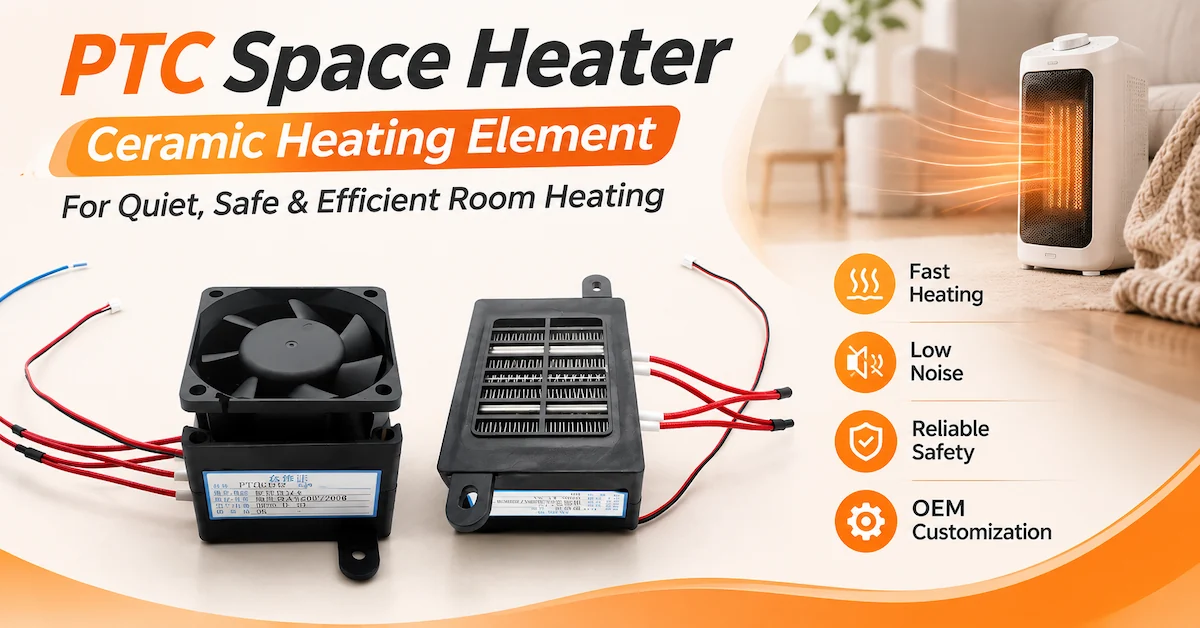
Example: Tianrui 200W Mini PTC Air Heater with Fan
Tianrui publishes a compact fan-assisted heating assembly.
The 200W 220V Mini PTC Air Heater with Fan has the following listed characteristics.
| Parameter | Published Specification |
|---|---|
| Product | Mini PTC Air Heater with Fan |
| Rated voltage | 220V |
| Rated heating power | 200W |
| Heating material | PTC ceramic |
| Fan arrangement | Dual-fan, flat-panel axial fan |
| General structure | Compact fan-assisted heating assembly |
This product provides a relevant starting point for OEMs developing smaller warm-air devices.
However, the listing does not establish the actual airflow, pressure-flow curve, noise level, or thermal performance under every installation condition.
These parameters should be verified during equipment development.
What are the limitations of axial fans?
A compact axial fan may deliver suitable airflow in an open or relatively unrestricted configuration.
However, additional resistance from filters, tightly spaced fins, duct bends, and protective grills can reduce the installed airflow.
The manufacturer should not assume that a published free-airflow value equals the airflow through the final heater.
When should another fan type be considered?
An alternative may be required when the appliance needs a much wider discharge opening or must overcome substantial duct resistance.
In these circumstances, cross-flow or centrifugal configurations may deserve evaluation.
Why Are Cross-Flow Fan PTC Heaters Suitable for Wide Appliance Outlets?
A cross-flow fan, also called a tangential fan, uses an elongated cylindrical impeller.
Its configuration can create airflow across a relatively wide outlet.
This makes it particularly relevant to appliances where heat must be distributed across a long, narrow region.
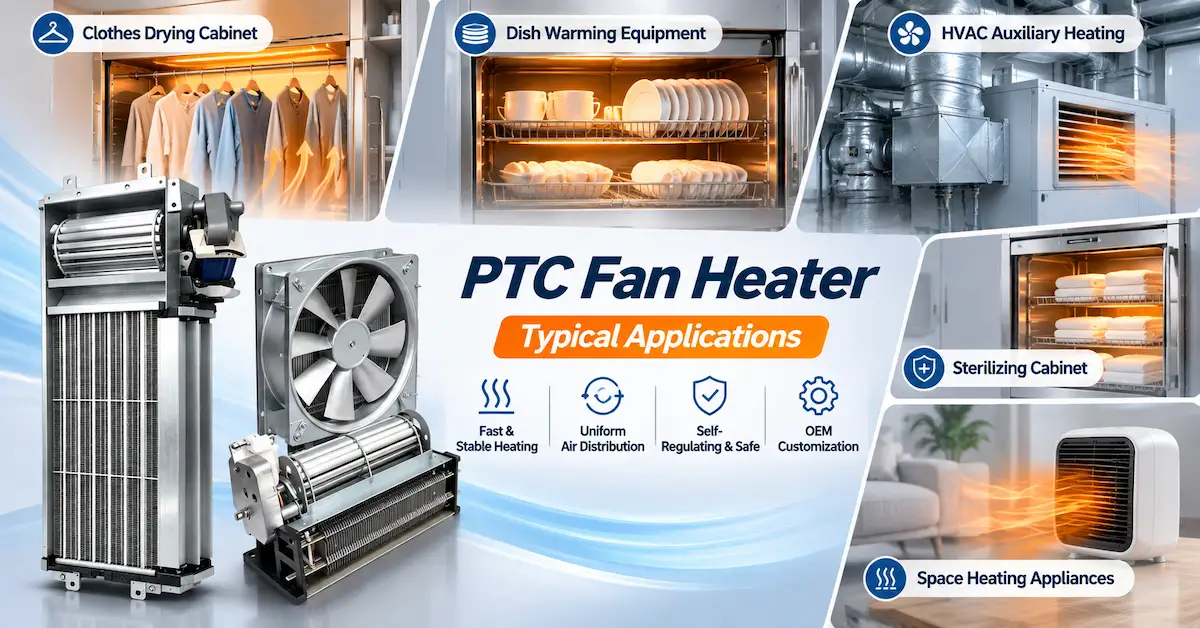
Typical OEM applications
A Cross Flow Fan PTC Heater may be considered for:
-
Clothes-drying cabinets.
-
Dish-warming equipment.
-
Heat-preservation cabinets.
-
Certain sterilizing or warming equipment, subject to application requirements.
-
Compact commercial warming products.
-
Selected HVAC auxiliary heating applications.
-
Equipment requiring an elongated warm-air outlet.
Why outlet shape matters
Consider a cabinet with several trays arranged across a wide interior.
A compact axial fan may create a concentrated airflow stream.
Additional ducts or deflectors might be required to distribute heat across the trays.
A suitable cross-flow assembly can provide a wider starting airflow pattern.
However, even heat distribution depends on the complete enclosure.
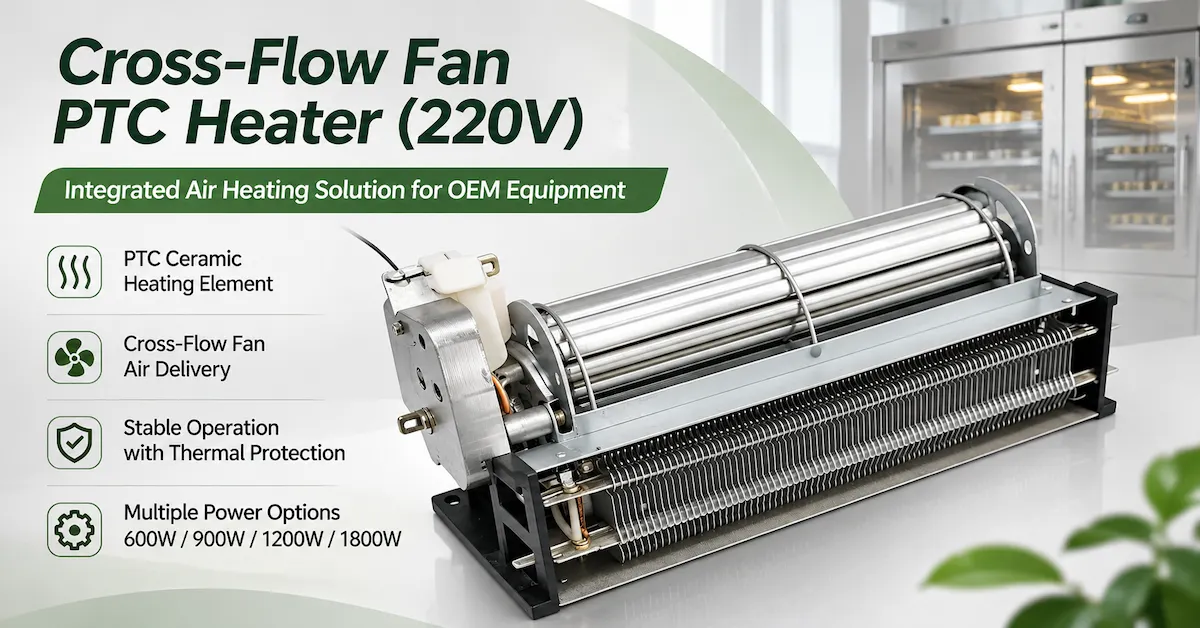
Real Tianrui product: 600W–1800W Cross-Flow Fan PTC Heater
Tianrui publishes a Cross-Flow Fan with PTC Heater for Kitchen Equipment.
The product family includes several nominal power configurations.
Table 2. Tianrui Cross-Flow Fan Heater Published Specifications
| Specification | Published Information |
|---|---|
| Product type | Cross-Flow Fan PTC Heater |
| Rated voltage | 220V |
| Available heating-power options | 600W, 900W, 1200W, 1800W |
| Fan architecture | Cross-flow/tangential |
| General heating structure | PTC ceramic heating element with heat-transfer components |
| Dimensions | Customization discussed on product page |
| Applications | Kitchen equipment, drying and warming appliances |
The nominal values are published product-family ratings.
Actual airflow, noise, temperature distribution, and electrical behavior should be confirmed for the selected configuration.
Does cross-flow automatically mean uniform temperature?
No.
A cross-flow fan may create a wide airflow pattern, but that does not guarantee equal airflow or temperature at every position.
Potential sources of uneven distribution include:
-
Inlet restrictions.
-
Uneven heater placement.
-
Internal obstructions.
-
Incorrect fan-to-heater spacing.
-
Outlet geometry.
-
Enclosure recirculation.
-
Local heat losses.
For an OEM product, airflow and temperature uniformity should be verified in the final enclosure.
When Should OEM Engineers Consider a Centrifugal Blower?
Centrifugal blowers may be appropriate when the heating system must move air through ducts or other restrictive components.
The impeller and housing arrangement can provide useful pressure capability.
However, the correct blower depends on its performance curve and intended operating conditions.
Typical applications
Centrifugal configurations may be considered for:
-
Ducted auxiliary HVAC heating.
-
Industrial air-handling assemblies.
-
Equipment with restrictive air filters.
-
Warming systems requiring longer airflow paths.
-
Specialized machines with compact duct connections.
Pressure capability vs. airflow
A fan must supply the required airflow while overcoming the resistance of the installed system.
This requires evaluating the fan's available pressure at the operating airflow.
A blower with a high advertised maximum airflow may not deliver that value once installed behind restrictive components.
Does centrifugal mean better?
Not universally.
A centrifugal blower may provide the necessary operating performance for a restrictive duct system, but it could introduce additional size, power, cost, or acoustic considerations.
A compact axial fan may be more suitable for a relatively open appliance.
A cross-flow unit may be preferable for an elongated outlet.
Engineering decision:
Use the actual pressure-flow characteristics and equipment requirements rather than ranking fan types by name.
For deeper analysis of fan curves and system resistance, see Tianrui's PTC Air Heater Airflow Selection Guide.
How Can OEMs Verify Warm-Air Distribution Uniformity?
Temperature uniformity is particularly important for appliances that warm or dry products distributed across a cabinet.
An OEM should not approve a heating assembly based only on the temperature measured at the center of the outlet.
Outlet temperature mapping
A practical preliminary method is to measure temperature at several positions across the intended outlet.
For a wide rectangular outlet, a three-row, five-column measurement grid can help identify uneven heating.
The measurement locations should be defined according to the actual airflow geometry.
Illustrative temperature-mapping example
Consider an appliance outlet with five measurement positions across its width and three rows.
The following hypothetical temperatures are recorded after the system reaches a defined operating condition.
Table 3. Illustrative Outlet Temperature Distribution
| Outlet Row | Position 1 | Position 2 | Position 3 | Position 4 | Position 5 |
|---|---|---|---|---|---|
| Upper | 40°C | 41°C | 43°C | 42°C | 39°C |
| Middle | 41°C | 43°C | 44°C | 43°C | 40°C |
| Lower | 39°C | 42°C | 43°C | 41°C | 38°C |
The maximum temperature is 44°C.
The minimum temperature is 38°C.
The temperature spread is:
ΔTspread = Tmax − Tmin
ΔTspread = 6°C
This is an illustrative test example, not a measured result for a Tianrui heater.
Is a 6°C temperature spread acceptable?
That depends on the equipment.
For a general warm-air appliance, the spread might be acceptable if all required operating conditions are satisfied.
For a process requiring tighter thermal uniformity, it may be unacceptable.
The OEM should specify:
-
Measurement locations.
-
Required operating temperature.
-
Maximum allowable temperature.
-
Minimum allowable temperature.
-
Permitted temperature spread.
-
Airflow conditions.
-
Stabilization period.
-
Measurement method.
Temperature alone is not enough
Two regions may have similar temperatures but different airflow rates.
For drying equipment, the local airflow rate can influence moisture removal even when temperatures are comparable.
Therefore, relevant applications should evaluate both temperature distribution and air velocity.
Recommended distribution test
-
Install the fan-heater assembly inside the intended enclosure.
-
Operate at the specified supply voltage and fan setting.
-
Allow the system to reach the defined operating condition.
-
Record inlet-air temperature.
-
Measure outlet temperature at the agreed positions.
-
Measure local airflow or air velocity where appropriate.
-
Calculate the temperature spread.
-
Check the result against the OEM acceptance criteria.
-
Repeat under relevant alternative operating conditions.
This procedure provides a measurable basis for comparing axial and cross-flow designs.
How Does Fan Selection Affect Noise and Vibration?
Noise performance is important for household appliances, HVAC equipment, and products used in occupied spaces.
However, a fan described as "silent" or "low noise" should not be assumed to satisfy a particular acoustic target without testing.
What creates noise in a fan heater?
Potential sources include:
-
Aerodynamic turbulence.
-
Fan blade interaction with surrounding structures.
-
Motor electromagnetic effects.
-
Bearing noise.
-
Mechanical imbalance.
-
Housing vibration.
-
Airflow restrictions.
-
Resonance within the appliance enclosure.
Noise can change significantly after the fan is installed.
A fan that sounds quiet during a bench test may generate more noise when mounted inside a resonant metal or plastic housing.
Cross-flow vs. axial noise
Cross-flow fans can be suitable for appliances designed around wide, relatively gentle airflow.
Axial fans can also operate quietly when appropriately sized and installed.
Neither architecture automatically guarantees a lower acoustic level.
The result depends on the actual fan, operating speed, required airflow, housing, and measurement conditions.
What noise specifications should OEM buyers request?
| Acoustic Parameter | Why It Matters |
|---|---|
| Measured sound level | Supports comparison under defined conditions |
| Measurement distance | Affects reported sound-pressure level |
| Operating speed | Influences aerodynamic and motor noise |
| Supply voltage | Establishes comparable operating conditions |
| Installation configuration | Identifies effects of ducts and housings |
| Background noise | Helps interpret measurement results |
| Measurement method | Supports repeatable testing |
| Vibration information | Helps identify structural noise risks |
A standalone dB(A) figure is not sufficient for a fully comparable acoustic evaluation unless the test conditions are specified.
Relevant technical reference
IEC 60704-1:2021 provides general requirements for measuring airborne acoustical noise from household and similar electrical appliances within its scope.
For fan-performance measurement, ISO 5801:2017, as amended in 2025, provides standardized airway test methods for applicable fan types.
These standards can inform suitable testing procedures. Citing them does not establish that any particular Tianrui product has been tested or certified to them.
How Should Fan Motor Power and Heating Power Be Specified?
One frequent procurement misunderstanding is treating heater power and fan motor power as the same specification.
A PTC fan-heating assembly may contain two distinct electrical loads:
-
The PTC ceramic heating element.
-
The fan motor.
The total system input may also include control electronics.
Electrical input relationship
A simplified system relationship is:
Ptotal = Pheater + Pfan + Pcontrol
Where:
-
Ptotal = total electrical input.
-
Pheater = electrical power entering the PTC heater.
-
Pfan = fan motor electrical power.
-
Pcontrol = control-system electrical power.
The heater's electrical input may vary as its temperature changes.
Why product labels need clarification
An advertised "900W PTC Fan Heater" may refer to the nominal heater rating rather than the total electrical consumption of the complete assembly.
For a custom OEM project, this distinction matters when choosing:
-
Electrical wiring.
-
Fuses and protection.
-
Connectors.
-
Switching components.
-
Power-distribution capacity.
-
Equipment energy-consumption requirements.
Tianrui 350W/353W cross-flow example
Tianrui publishes a 350W/353W Cross-Flow PTC Heater for Boiler Heat Exchanger Applications.
Its product listing identifies a heating configuration around 350W/353W, while the technical table separately lists an 11W fan input.
These published figures should be clarified during technical quotation.
An OEM should confirm which rating applies to the heater, which applies to the fan, and what the complete assembly consumes under defined operating conditions.
Recommended purchasing specification
Request separate values for:
-
PTC heater nominal power.
-
Fan motor rated power.
-
Total assembly input.
-
PTC cold-start current.
-
Fan motor starting characteristics, where relevant.
-
Stabilized operating power.
-
Supply voltage and tolerance.
This helps prevent electrical-system sizing errors.
Which Tianrui PTC Fan Heater Products Are Suitable for OEM Evaluation?
Tianrui Electronics publishes several fan-assisted PTC heating products.
The following product configurations provide useful starting points for home appliance and HVAC projects.
Table 4. Tianrui PTC Fan Heater Product Comparison
| Tianrui Product | Published Voltage | Published Heating Configuration | Fan Architecture | Application Direction |
|---|---|---|---|---|
| 200W Mini PTC Air Heater with Fan | 220V | 200W | Dual axial fans | Compact warm-air equipment |
| 600W–1800W Cross-Flow Fan PTC Heater | 220V | 600W, 900W, 1200W, 1800W | Cross-flow/tangential | Drying and warming cabinets |
| 350W/353W Cross-Flow PTC Heater | 220V | 350W/353W described | Cross-flow | Equipment-specific warm-air assemblies |
| 1000W–2000W Corrugated PTC Air Heater | 220V | 1000W–2000W options | Requires an appropriate air-moving system | OEM equipment with existing blower |
The final product in the table is a heater core or air-heating assembly rather than necessarily a complete integrated fan-heater unit.
This distinction is important when comparing supplier quotations.
What should buyers verify for each model?
The product page provides preliminary information, but final selection should confirm:
-
Exact product configuration.
-
Heater and fan scope of supply.
-
Rated voltage.
-
Operating voltage range.
-
Heater electrical input.
-
Fan motor input.
-
Airflow and pressure characteristics.
-
Temperature distribution.
-
Noise behavior.
-
Dimensions and mounting.
-
Electrical insulation.
-
Sample and production conditions.
A published product-family rating does not guarantee that every listed configuration is available or qualified for every application.
How Much Heating Power Does a PTC Fan Heater Need?
The required heating power depends on airflow, inlet-air temperature, target temperature rise, and heat losses.
For a preliminary air-heating calculation:
Pair = ρ × V̇ × cp × ΔT
Where:
-
Pair = thermal power transferred to air.
-
ρ = air density.
-
V̇ = volumetric airflow.
-
cp = specific heat capacity of air.
-
ΔT = required air-temperature increase.
Example: compact drying equipment
Assume an OEM drying appliance requires:
| Parameter | Illustrative Value |
|---|---|
| Airflow | 120 m³/h |
| Inlet-air temperature | 22°C |
| Target outlet temperature | 40°C |
| Required temperature increase | 18°C |
| Assumed air density | 1.2 kg/m³ |
| Assumed specific heat | 1005 J/(kg·K) |
Convert airflow:
120 ÷ 3600 = 0.0333 m³/s
Calculate the required heat transfer:
Pair = 1.2 × 0.0333 × 1005 × 18
Pair ≈ 724W
The simplified calculation indicates that approximately 724W of useful thermal power must enter the airflow under the stated assumptions.
This does not establish that a nominal 900W PTC heater will meet the requirement.
Actual electrical power may vary with ceramic temperature, and some heat may transfer to the housing rather than directly into the intended air stream.
Why rated wattage cannot determine the final choice
A 900W model and a 1200W model may operate differently depending on their actual ceramic characteristics and airflow.
The correct choice should be supported by measured thermal performance under the intended conditions.
The calculation is useful for screening candidate power ratings before prototype testing.
How Should PTC Fan Heaters Be Integrated into Household Appliances?
A suitable fan-heater assembly must fit within the final equipment without creating electrical, mechanical, airflow, or maintenance problems.
Mechanical installation
Important requirements include:
-
Overall assembly dimensions.
-
Fan and heater orientation.
-
Mounting-hole positions.
-
Air inlet clearance.
-
Outlet dimensions.
-
Connector accessibility.
-
Cable exit direction.
-
Service access.
-
Allowances for manufacturing tolerances.
Thermal separation
The heater should be positioned to avoid unacceptable local temperatures at adjacent components.
Materials near the heater may include plastic housings, electrical insulation, wiring, connectors, and structural supports.
Their permissible temperatures must be evaluated.
Electrical integration
The OEM should confirm:
-
Heater supply voltage.
-
Fan motor supply voltage.
-
Current requirements.
-
Wiring and connectors.
-
Switching components.
-
Temperature-control system.
-
Electrical protection.
-
Relevant grounding and insulation requirements.
The fan and heater may require separate electrical circuits or coordinated control arrangements depending on the design.
Fan and heater sequencing
Some equipment may benefit from operating the fan before or after energizing the heating element.
For example, a design might use a short post-heating fan run to remove residual heat.
However, the appropriate sequence depends on the assembly and equipment requirements.
There is no universal fan-delay time suitable for every PTC heater.
The sequencing should be established through testing.
What Applications Benefit Most from Cross-Flow PTC Fan Heaters?
A cross-flow heating assembly can be useful when the desired warm-air distribution is relatively wide.
Clothes-drying equipment
Drying equipment may require warm air to move across a large region.
Important engineering considerations include:
-
Airflow distribution.
-
Lint accumulation.
-
Temperature uniformity.
-
Repeated heating cycles.
-
Fan reliability.
-
Maintenance accessibility.
An elongated cross-flow arrangement may provide a useful starting geometry.
The finished drying system still requires complete airflow and temperature validation.
Dish warmers and heat-preservation cabinets
Cabinet-style equipment may require warm air across several shelves.
The designer should assess whether the airflow reaches each shelf adequately.
A wide outlet alone does not guarantee even cabinet temperature.
Internal baffles and recirculation paths may still be necessary.
HVAC auxiliary heating
An HVAC manufacturer should evaluate the heater with the intended blower or fan, duct geometry, and control system.
The equipment may operate at different fan speeds and inlet temperatures.
The heater should be qualified for the relevant conditions.
Compact personal heating appliances
A smaller axial-fan assembly may be more practical when the product has a compact enclosure and localized airflow requirement.
Cross-flow construction may not provide meaningful benefits if the required outlet is small.
Application selection matrix
| Application | Main Requirement | Likely Starting Architecture |
|---|---|---|
| Compact personal warmer | Small footprint and localized airflow | Axial fan |
| Dish-warming cabinet | Wide warm-air distribution | Cross-flow fan |
| Clothes-drying cabinet | Air distribution across a larger region | Cross-flow or other qualified air system |
| Restrictive HVAC duct | Required airflow against system resistance | Appropriate duct-rated blower |
| Small equipment enclosure | Compact heating and circulation | Axial or other suitable compact fan |
| Equipment with existing blower | Heating within existing airflow | Standalone PTC air-heating core |
These are initial design directions, not universal model recommendations.
How Should OEM Engineers Test a PTC Fan Heater Before Mass Production?
An effective qualification plan should examine the complete fan-heater assembly inside the intended appliance.
A basic power-on test cannot establish airflow, noise, thermal uniformity, or long-term suitability.
Table 5. Recommended OEM Validation Matrix
| Test | Measurement | Engineering Purpose |
|---|---|---|
| Electrical startup | Heater and fan starting current | Verify electrical supply |
| Stabilized operation | Heater power, fan power, temperatures | Establish operating conditions |
| Airflow | Volumetric flow or relevant velocity measurements | Confirm air delivery |
| Outlet temperature map | Temperatures at defined positions | Evaluate thermal uniformity |
| Fan speed variation | Airflow and temperature response | Evaluate different operating modes |
| Noise test | Acoustic result under defined conditions | Verify appliance requirements |
| Vibration test | Mechanical response and mounting | Assess installation reliability |
| Reduced airflow | Heater and surrounding temperatures | Evaluate restricted cooling |
| Fan failure | Thermal and protective response | Assess abnormal operation |
| Supply variation | Performance at specified voltage limits | Verify electrical compatibility |
| Thermal cycling | Performance across repeated cycles | Evaluate durability |
| Insulation verification | Relevant electrical measurements | Support safety assessment |
| Extended operation | Performance over specified duty | Evaluate intended use |
What makes test results comparable?
The test report should identify the product model, voltage, airflow condition, ambient temperature, enclosure configuration, measurement positions, test duration, and acceptance criteria.
If these conditions differ, comparing two heater results may be misleading.
Safety considerations
The PTC ceramic's resistance increase can reduce electrical power at elevated temperatures.
However, it does not guarantee that a stalled fan, blocked outlet, or failed controller cannot cause excessive temperatures elsewhere in the appliance.
Appropriate independent protection should be determined through equipment-level risk assessment.
What Should a PTC Fan Heater Manufacturer Provide for OEM Development?
A PTC Fan Heater Manufacturer should be evaluated according to its ability to support the intended technical requirements.
For customized projects, the supplier should be able to discuss the complete assembly rather than only the ceramic heating element.
Important engineering information
| Requirement | Supplier Discussion |
|---|---|
| Heating capacity | Nominal power and actual operating behavior |
| Fan selection | Axial, cross-flow, or suitable external blower |
| Air distribution | Outlet geometry and expected airflow pattern |
| Noise | Measurement conditions and acoustic performance |
| Dimensions | Available configurations and customization feasibility |
| Electrical connection | Heater and fan voltage, wiring, connectors |
| Temperature control | External sensors and control requirements |
| Safety | Relevant insulation and fault testing |
| Quality | Inspection criteria and production consistency |
| Manufacturing | Drawings, samples, tooling, production planning |
Tianrui's public OEM information describes support for product requirements, structure design, material selection, drawings, and mold development.
Buyers can review its PTC Heater Customized Solutions for the company's general customization approach.
Project-specific capability, testing arrangements, MOQ, and lead times should be confirmed during technical discussions.
Why supplier qualification matters
A successful prototype does not automatically guarantee repeatable production.
The OEM should establish controlled specifications for critical electrical and mechanical characteristics.
For integrated fan-heater assemblies, the approved fan model, motor specification, wiring, heater structure, and mounting arrangement may all affect performance.
Important substitutions should be reviewed before being introduced into production.
OEM Engineering Example: Selecting a Fan Heater for a Dish-Warming Cabinet
The following scenario illustrates how a manufacturer could compare axial and cross-flow heating designs.
This is a hypothetical engineering example, not a documented Tianrui customer project or factory test.
Project background
An OEM is designing a cabinet containing several warming shelves.
The equipment requires warm-air circulation across the cabinet interior.
The engineering team is evaluating two designs.
Option A:
A compact PTC heater with an axial fan.
Option B:
A cross-flow PTC heater with an elongated outlet.
Initial requirements
The equipment must satisfy:
-
A defined supply voltage.
-
A target operating-temperature range.
-
Acceptable warm-air distribution across the cabinet.
-
An acoustic requirement appropriate to its use.
-
Available installation dimensions.
-
Relevant electrical and thermal safety requirements.
Option A: Axial fan design
The axial fan may provide straightforward integration in a relatively compact assembly.
However, additional airflow-guiding components could be necessary to distribute warm air across the cabinet.
Option B: Cross-flow fan design
The cross-flow assembly may provide a wider initial airflow pattern.
This could simplify air distribution in an elongated cabinet.
However, the complete enclosure must still be evaluated for temperature variation, noise, and airflow resistance.
Prototype comparison
The engineering team should install both candidates in representative equipment.
Then measure:
-
Required airflow.
-
Temperature at several cabinet locations.
-
Warm-up time.
-
Electrical consumption.
-
Noise under specified conditions.
-
Nearby material temperatures.
-
Relevant abnormal-operation behavior.
Decision process
If the axial design satisfies all requirements and provides easier integration, it may be preferable.
If the cross-flow design provides a more suitable distribution pattern and meets the remaining requirements, it may be selected instead.
If neither achieves the required uniformity, the OEM should review the cabinet's internal airflow path before simply increasing heating power.
Engineering lesson:
Selecting the correct fan type can reduce airflow-distribution problems, but performance must be demonstrated in the complete appliance.
How Can OEM Buyers Compare Total Fan-Heater Integration Cost?
The purchased heater price is only one part of the total equipment cost.
An integrated fan-heater assembly may reduce some component sourcing and installation operations.
However, it may also have higher purchase costs or require additional qualification.
Main cost factors
-
PTC ceramic specifications.
-
Heater power and dimensions.
-
Fan motor and impeller design.
-
Aluminum heat-transfer structure.
-
Housing and mounting brackets.
-
Wiring and connectors.
-
Temperature-control components.
-
Engineering customization.
-
Product testing.
-
Production quantity.
-
Tooling and packaging.
Compare equal scope of supply
Before comparing quotations, identify whether each offer includes:
-
PTC heating core.
-
Fan motor.
-
Fan wheel or impeller.
-
Housing.
-
Electrical wiring.
-
Connectors.
-
Mounting brackets.
-
Protective components.
-
Testing and documentation.
A quotation for a heater core alone should not be compared directly with the price of a complete fan-heater assembly.
Standard vs. custom assembly
A standard assembly may be cost-effective when its electrical and mechanical characteristics already match the equipment.
A custom assembly may be worthwhile when it reduces mounting complexity, wiring operations, or other recurring integration requirements.
The final choice should consider total installed cost and production consistency.
MOQ and lead time
MOQ and lead time depend on the selected product, customization requirements, tooling, material availability, and purchasing quantity.
The supplier should distinguish engineering samples from recurring production orders.
No universal MOQ or delivery period should be assumed.
PTC Fan Heater OEM RFQ Checklist
A detailed Request for Quotation helps the manufacturer identify a suitable fan-heater architecture.
Table 6. OEM Fan Heater RFQ Requirements
| Category | Information to Provide |
|---|---|
| Application | Clothes dryer, dish warmer, HVAC unit, or other equipment |
| Heating objective | Warm-up, temperature maintenance, or drying |
| Fan preference | Axial, cross-flow, or engineering recommendation |
| Heater voltage | Nominal and permitted range |
| Fan voltage | Motor electrical requirement |
| Heating capacity | Required thermal performance |
| Airflow | Target volume flow or relevant velocity |
| Inlet conditions | Air temperature and operating environment |
| Outlet requirements | Temperature and distribution target |
| Noise | Required acoustic performance and test condition |
| Dimensions | Available installation envelope |
| Air path | Duct, outlet, filter, and grille arrangement |
| Wiring | Cable and connector requirements |
| Control | Fan speed, heater control, temperature sensors |
| Safety | Applicable equipment and fault requirements |
| Testing | Required airflow, thermal, acoustic, and electrical tests |
| Sample quantity | Engineering evaluation needs |
| Production forecast | Initial and annual quantities |
| Commercial conditions | Tooling, MOQ, lead time, packaging |
Example OEM Inquiry
Subject: Cross-Flow vs. Axial PTC Fan Heater for Appliance OEM Project
We are developing a warm-air appliance and are evaluating PTC fan-heating assemblies.
Our equipment requires a defined heating capacity, suitable warm-air distribution, low-noise operation, and compact mechanical integration.
We would like to compare axial and cross-flow fan configurations.
We can provide electrical requirements, equipment drawings, outlet dimensions, airflow targets, operating-temperature requirements, and estimated purchasing quantities.
Please advise which standard Tianrui PTC fan-heater configurations may be suitable and whether customized dimensions, wiring, or mounting arrangements are available.
We would also like to discuss sample validation, acoustic testing, airflow distribution, quality-control requirements, MOQ, and production lead time.
For an application-specific evaluation, contact Tianrui Electronics with your equipment details.
Frequently Asked Questions About PTC Fan Heaters
1. What is a PTC Fan Heater?
A PTC Fan Heater combines a positive temperature coefficient ceramic heating element with a fan or blower.
The ceramic generates heat, while the fan moves air across the heating structure.
This allows thermal energy to be distributed through the intended equipment.
Actual heating performance depends on electrical input, airflow, ceramic characteristics, and installation conditions.
2. What is the difference between an axial PTC fan heater and a cross-flow PTC fan heater?
An axial fan primarily moves air along its shaft axis and can be useful in compact heating assemblies.
A cross-flow fan uses an elongated impeller to create airflow across a relatively wide outlet.
Cross-flow designs may be useful for warming cabinets and equipment with long discharge openings.
The correct choice depends on the required airflow, pressure resistance, noise, and mechanical layout.
3. Is a Cross Flow Fan PTC Heater quieter than an axial fan heater?
Not necessarily.
Noise depends on fan design, speed, airflow resistance, housing vibration, and installation.
Cross-flow fans may be suitable for applications requiring broad, gentle airflow, but they are not universally quieter.
Acoustic measurements under defined operating conditions should be used for comparison.
4. Does a PTC Fan Heater provide uniform air temperature automatically?
No.
PTC ceramic provides temperature-dependent electrical behavior, but uniform air temperature depends on heater geometry and airflow distribution.
A wide outlet does not guarantee even temperature across the complete appliance.
Multi-point temperature and airflow testing may be necessary.
5. How do I calculate the required PTC fan-heater wattage?
For forced-air heating, estimate useful thermal power using airflow, air density, specific heat, and required temperature increase.
The simplified relationship is Pair = ρ × V̇ × cp × ΔT.
The result provides a preliminary thermal requirement.
Actual heater selection must account for PTC power variation, heat losses, and equipment conditions.
6. Can a PTC Fan Heater operate if the fan stops?
The ceramic may reduce its electrical power as its temperature rises.
However, adjacent components can still experience excessive temperatures.
Fan-stall and restricted-airflow conditions should be evaluated as part of equipment-level safety verification.
Independent protective measures may be necessary.
7. Can Tianrui customize a PTC Fan Heater for OEM appliances?
Tianrui describes custom heater development, drawing support, material selection, structural design, and mold development.
Specific changes to fan arrangements, dimensions, wiring, or heater construction require engineering confirmation.
Sample validation should be completed before mass-production approval.
8. What is the difference between heater power and fan motor power?
Heater power refers to electrical energy entering the PTC heating element.
Fan motor power refers to electricity consumed by the air-moving motor.
The total assembly may also include control electronics.
OEM buyers should request separate electrical specifications and confirm whether the quoted product rating includes the fan.
9. What applications are suitable for cross-flow PTC fan heaters?
Potential applications include clothes-drying cabinets, dish warmers, low-profile warm-air appliances, and selected HVAC auxiliary heating designs.
Cross-flow fans are particularly relevant where the equipment needs a wide or elongated outlet.
Suitability must be verified for the actual duct resistance and operating conditions.
10. How should I choose a PTC Fan Heater Manufacturer in China?
Evaluate the manufacturer's product configurations, technical support, customization capabilities, sample testing, quality control, and commercial conditions.
Request the complete fan-heater specification, including airflow, fan motor characteristics, heating power, dimensions, electrical safety requirements, and applicable test evidence.
Supplier selection should be based on technical compatibility and reliable production support rather than price alone.
Conclusion
Choosing a PTC Fan Heater for household appliances and HVAC equipment requires a complete understanding of fan architecture, air distribution, heating performance, and system integration.
An axial-fan configuration can be a practical solution for compact equipment with relatively straightforward airflow requirements.
A Cross Flow Fan PTC Heater may provide advantages for products requiring warm air across a wide, elongated outlet.
Centrifugal blowers may be worth considering when the equipment must overcome greater airflow resistance.
However, no fan type is universally superior.
For OEM engineers, five factors should guide the selection:
-
Airflow architecture: Choose the fan type according to the actual equipment layout and air-delivery requirements.
-
Thermal distribution: Verify outlet temperature and airflow uniformity under representative conditions.
-
Acoustic performance: Evaluate fan noise and vibration in the finished appliance.
-
Electrical and safety integration: Confirm heater and motor power, wiring, control, and relevant abnormal-operation behavior.
-
Production suitability: Establish mechanical drawings, sample validation, quality requirements, and repeat-order specifications.
A qualified PTC Fan Heater Manufacturer should be able to discuss these requirements and help the OEM evaluate suitable product configurations.
Dongguan Tianrui Electronics Co., Ltd. supplies ceramic PTC heating components, compact fan-assisted heaters, cross-flow heating assemblies, and customized thermal solutions.
For appliance and HVAC manufacturers, Tianrui's published 200W axial-fan configuration and 600W–1800W cross-flow product family provide practical starting points for technical evaluation.
Looking for an OEM PTC fan-heating assembly for your next appliance or HVAC project?
Explore Tianrui's PTC Fan Heater products, review its Custom PTC Heating Solutions, or contact Tianrui Electronics to discuss a suitable heating configuration.
Share your equipment drawings, voltage requirements, heating capacity, target airflow, outlet dimensions, noise requirements, and estimated purchasing quantity.
Email:
Phone:
+86 135 3277 2961
A properly selected fan architecture, verified thermal and acoustic performance, and controlled OEM production specification provide the foundation for reliable PTC fan-heating applications.