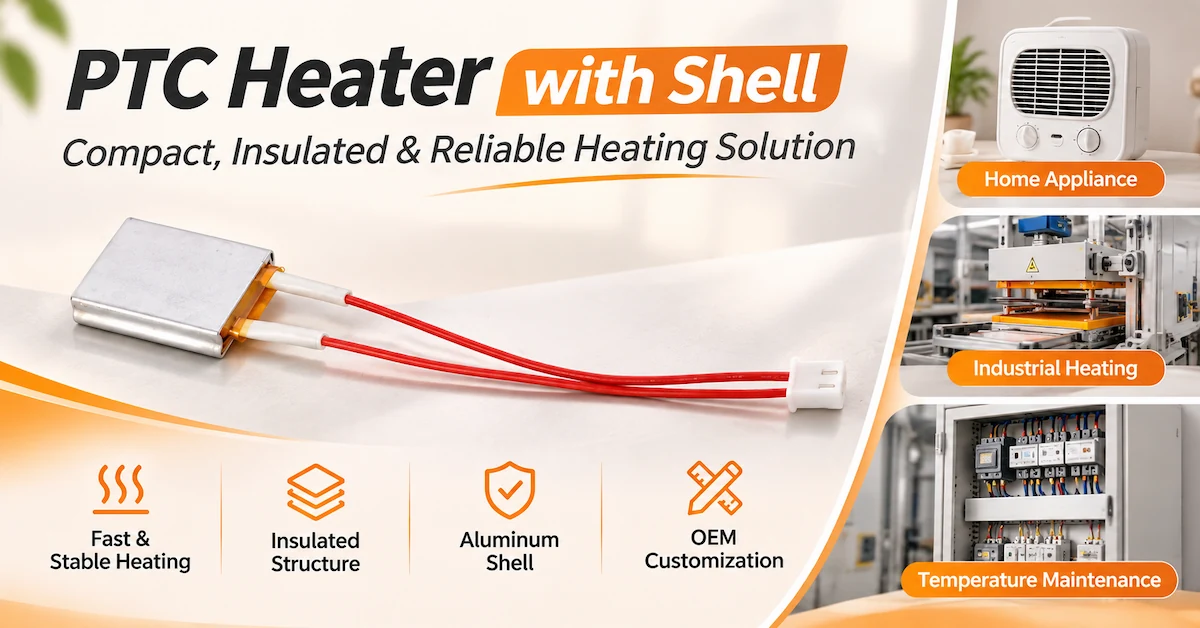
TL;DR: A PTC Heater with Shell combines positive temperature coefficient ceramic elements with a protective metal housing and, where required, electrical insulation. The shell transfers heat, provides mechanical support, and defines how the heater fits into an appliance or industrial assembly. For OEM buyers, the critical decisions concern housing material, insulation performance, thermal contact resistance, mounting tolerances, and production consistency—not just rated voltage or advertised temperature. The best configuration is the one that meets these requirements under verified operating conditions.
A heater can meet its catalog electrical specification and still perform poorly inside the finished equipment.
The reason is often mechanical or thermal rather than electrical.
An aluminum housing may distribute heat effectively, but an unsuitable mounting interface can create air gaps that restrict heat transfer. An insulating layer may provide necessary electrical separation, but its thickness can increase thermal resistance. A housing may fit a prototype perfectly yet interfere with the enclosure after manufacturing tolerances and thermal expansion are considered.
These issues matter to appliance OEMs, industrial equipment manufacturers, and thermal management engineers developing equipment that requires predictable contact heating or controlled air heating.
A PTC Heater with Shell provides an integrated heating structure, but its performance depends on how the ceramic, insulation, metal housing, electrical connections, and mounting features work together.
Dongguan Tianrui Electronics Co., Ltd. manufactures PTC heating components and publishes several aluminum-shell heater configurations for appliance and industrial applications.
This guide explains how to evaluate those configurations, identify design risks, and prepare a technical specification for a customized heating assembly.
Key Takeaways
-
The shell is part of the thermal system. It affects heat transfer, mounting, structural protection, and temperature distribution.
-
Electrical insulation and heat conduction must be engineered together. A design that improves one may compromise the other.
-
Aluminum is a practical housing material for many OEM heaters, but its suitability depends on temperature, corrosion exposure, geometry, and mechanical requirements.
-
Contact pressure and surface flatness affect useful heat transfer. A higher catalog wattage cannot always compensate for poor thermal contact.
-
Mounting tolerances must account for production variation and thermal expansion.
-
PTC self-regulation does not replace equipment-level temperature control or electrical safety verification.
-
A custom housing should be justified by measurable requirements, such as installation geometry, thermal performance, insulation, or assembly efficiency.
-
Production approval should use controlled drawings, defined test conditions, and representative samples.
How Do Different PTC Shell Heater Designs Compare?
The first engineering decision is whether the housing will transfer heat primarily through direct contact, natural convection, or forced airflow.
These constructions should not be treated as interchangeable.
Table 1. PTC Heater with Shell Construction Comparison
| Construction | Main Heat-Transfer Path | Mechanical Characteristic | Suitable OEM Direction |
|---|---|---|---|
| Flat aluminum-shell heater | Conductive transfer through an external surface | Compact contact face | Appliance warming surfaces and industrial contact heating |
| Rectangular metal-housing heater | Conduction through housing and mounting interface | Rigid, enclosed heating module | Industrial fixtures and equipment assemblies |
| Finned or comb-shaped aluminum heater | Convection from an enlarged external surface | Extended fins and screw-mounting options | Control cabinets and air-heating applications |
| Custom-profile shell heater | Defined by housing and ceramic arrangement | Application-specific dimensions | Restricted installation spaces and specialized OEM equipment |
Selection rule:
Choose the housing according to the required heat-transfer interface and installation geometry before comparing nominal power.
For example, a finned heater designed to warm air may not provide the flat contact surface needed by a metal fixture.
Likewise, a smooth conductive housing may be unsuitable for an application that depends on substantial airflow across exposed fins.
1. What Is Inside a PTC Heater with Shell?
A PTC shell heater is an assembled heating component rather than a standalone piece of ceramic.
The exact construction varies, but a typical insulated design may include several functional layers.
Main components and their functions
| Component | Primary Function | Critical Engineering Consideration |
|---|---|---|
| PTC ceramic element | Generates electrical heat | Resistance-temperature behavior and rated voltage |
| Electrodes | Supply electrical current | Contact integrity and electrical compatibility |
| Electrical insulation | Separates energized parts from other structures | Dielectric strength and thermal resistance |
| Aluminum housing | Transfers heat and supports the assembly | Geometry, flatness, and material properties |
| Internal pressure structure | Maintains component contact | Assembly pressure and long-term stability |
| End insulation or sleeves | Protects electrical terminations | Temperature and mechanical suitability |
| Lead wires or terminals | Connects the heater to the equipment | Cable rating, strain relief, and routing |
| Mounting features | Secures the heater | Dimensional tolerances and thermal expansion |
Tianrui's published PTC Heater with Shell describes one assembly using PTC ceramic, aluminum components, corrugated pressure parts, a stainless steel spring component, nickel-plated copper terminals, and a PPS electrode sheath.
That component description applies to the published construction; it should not be assumed that every Tianrui aluminum-shell heater uses the identical internal arrangement.
Why does the internal stack-up matter?
Every layer must fulfill a function.
An electrode needs reliable electrical contact.
An insulation layer must provide appropriate electrical separation.
The metal shell needs an effective thermal path to the target surface or surrounding air.
The mounting arrangement must hold these components together without imposing unacceptable stress.
If one layer is poorly specified, the complete assembly may underperform even when the ceramic itself meets its requirements.
2. Which Tianrui Aluminum Shell PTC Heaters Can OEM Buyers Evaluate?
Tianrui publishes aluminum-shell products in different power ranges and mechanical configurations.
These products provide starting points for engineering evaluation rather than universal solutions for every equipment design.
Table 2. Published Tianrui PTC Heater with Shell Product Options
| Product | Published Configuration | Main Construction | Potential Application |
|---|---|---|---|
| Aluminum Shell PTC Heater | Family range: AC/DC 5–380V; 50–270°C ±10°C | PTC ceramic, insulation layer, aluminum shell | Industrial heating and drying equipment |
| 220V 30W PTC Heater Plate | 220V, 30W | Compact aluminum-shell plate | Small appliances and localized heating |
| Metal Housing PTC Conductive Heater | Listed 110V/220V, 950W, up to 260°C | Aluminum-cased conductive heater | Larger contact-heating and industrial equipment |
| Comb-Shaped Aluminum Alloy PTC Heater | 220V; 100W, 150W, 200W | Finned aluminum structure with screw mounting | Industrial cabinets and air heating |
The published values represent specific listings or product-family ranges. Not every voltage, temperature, power rating, and dimension is necessarily available in every combination.
Aluminum Shell PTC Heater
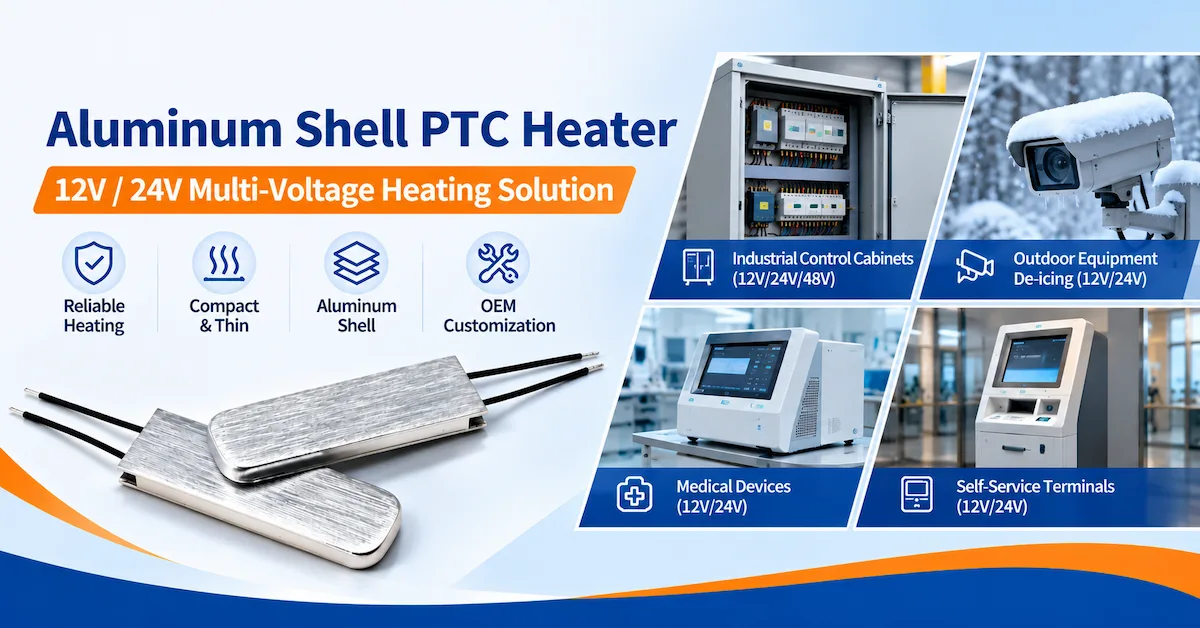
Tianrui's Aluminum Shell PTC Heater is described as an externally pressed structure combining ceramic heating elements, insulation, and an aluminum alloy housing.
The housing provides mechanical support and a heat-transfer surface.
Its suitability depends on the selected electrical configuration, mechanical design, and actual operating conditions.
Compact 220V 30W Heater
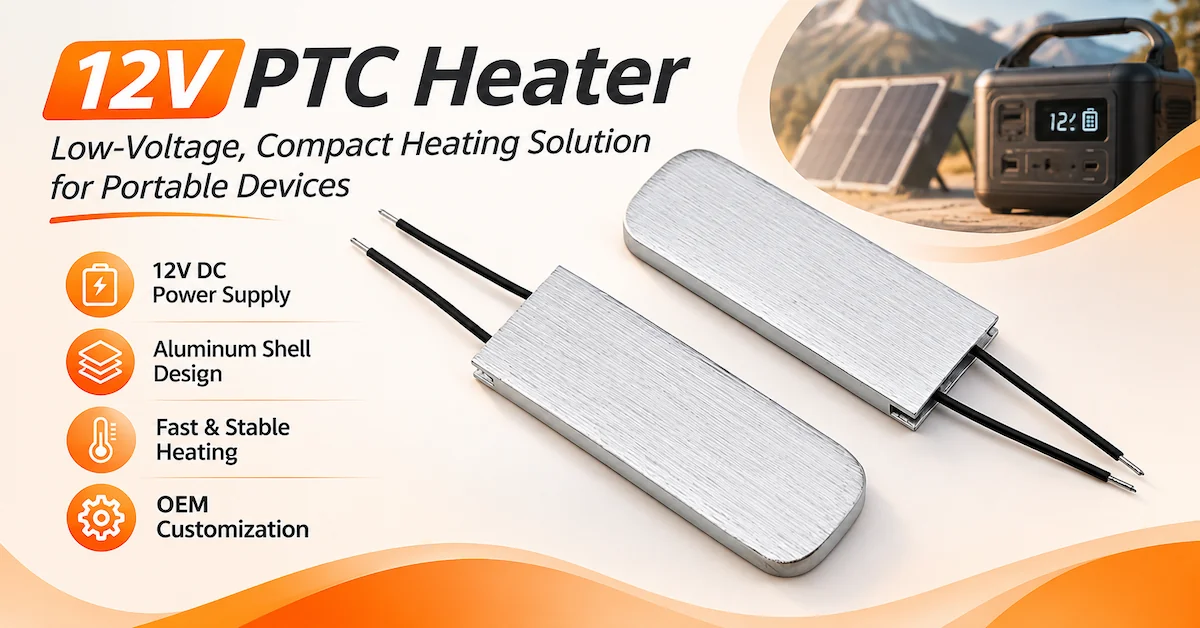
The 220V 30W Aluminum-Shell Heating Plate may be considered for compact heating applications.
Its relatively small nominal power makes it relevant to applications where the required heat input and mounting area are limited.
However, its actual loaded surface temperature and heating time must be verified in the equipment.
950W Metal-Housing Conductive Heater
The 950W Metal Housing PTC Conductive Heater is listed with 110V/220V options and a temperature specification up to 260°C.
It may be evaluated for industrial or commercial contact-heating applications.
Electrical configuration, operating temperature, mounting method, and thermal performance should be confirmed for the exact selected version.
Comb-Shaped Aluminum Heater
The 220V 100W–200W Comb-Shaped PTC Heater provides a different geometry.
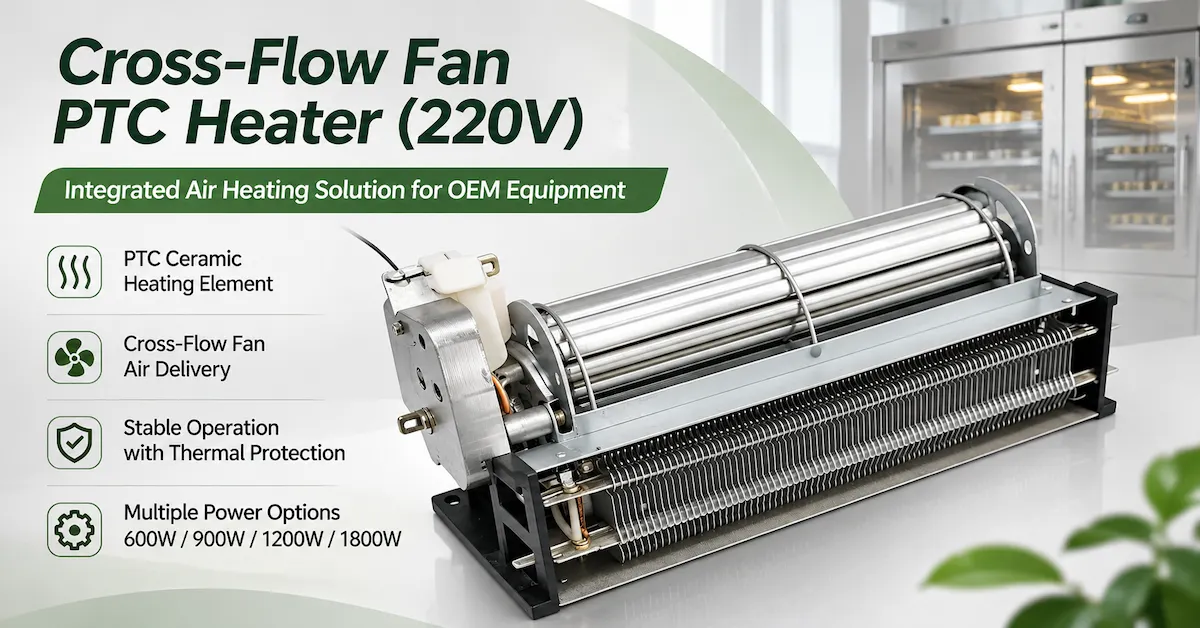
Its extended aluminum structure is intended for air heating, while screw-mounted features support equipment integration.
It is relevant when natural or forced convection is the primary heat-transfer mechanism.
For further options, review Tianrui's PTC Heater with Shell product category.
3. How Does the Aluminum Housing Transfer Heat?
A shell heater must move energy from the ceramic to the intended load.
The complete thermal path can be represented as:
PTC Ceramic → Internal Contact → Insulation → Aluminum Housing → External Interface → Heated Object
For an air-heating configuration, the final transfer may occur from the housing or fins to moving air.
Thermal resistance in a heater assembly
A simplified relationship is:
Q = ΔT / Rth
Where:
-
Q = transferred heat rate in watts.
-
ΔT = temperature difference across the thermal path.
-
Rth = thermal resistance in K/W.
A larger thermal resistance requires a greater temperature difference to transfer the same heat rate.
Where can thermal resistance occur?
Potential sources include:
-
Microscopic gaps between components.
-
Electrical insulation layers.
-
Incomplete contact between ceramic and metal.
-
Housing geometry.
-
Poor external mounting contact.
-
Unintended air gaps.
-
Contaminated or oxidized contact surfaces.
The ceramic may therefore operate at a significantly different temperature from the final heated surface.
Why the shell does more than protect the ceramic
An aluminum housing can also distribute heat laterally.
This is useful when the ceramic heating area is smaller than the intended working surface.
However, a larger or thicker shell adds thermal mass.
The design must balance heat spreading, useful heat delivery, warm-up behavior, and installation constraints.
The correct objective is not the highest possible housing temperature.
It is the required temperature or heat flux at the intended load under defined operating conditions.
4. How Should Electrical Insulation Be Balanced with Heat Transfer?
Electrical insulation is one of the most important design considerations for an Aluminum Shell PTC Heater.
In an insulated configuration, the material between energized components and the metal housing must provide appropriate electrical separation.
That insulation also affects the thermal path.
The insulation thickness trade-off
For an idealized uniform layer:
R = t / (k × A)
Where:
-
R = thermal resistance.
-
t = layer thickness.
-
k = thermal conductivity.
-
A = effective heat-transfer area.
As thickness increases, thermal resistance generally increases if the material and area remain unchanged.
Illustrative insulation comparison
Assume an engineering team is evaluating a hypothetical insulating material with:
-
Thermal conductivity: 0.5 W/(m·K).
-
Effective transfer area: 0.002 m².
-
Useful heat flow: 60W.
These assumptions are for calculation only; they are not Tianrui material specifications.
| Insulation Thickness | Idealized Thermal Resistance | Calculated Temperature Difference at 60W |
|---|---|---|
| 0.3 mm | 0.30 K/W | 18°C |
| 0.6 mm | 0.60 K/W | 36°C |
The thicker layer doubles the idealized thermal resistance under the same assumptions.
However, the calculation ignores contact resistance, nonuniform heating, material variation, and the changing power behavior of the PTC ceramic.
Engineering implications
A thinner insulation layer may improve heat transfer, but it cannot be selected solely for thermal performance.
The design must meet its electrical insulation requirements.
Similarly, a material that passes a dielectric test may still create excessive thermal resistance.
A successful insulation design must satisfy both electrical separation and thermal performance requirements.
What should OEM engineers request?
Ask the supplier to clarify:
-
Insulation material type.
-
Nominal thickness.
-
Relevant thickness tolerance.
-
Temperature suitability.
-
Electrical insulation test conditions.
-
Thermal properties when available.
-
Mechanical integrity after assembly.
-
Performance following thermal cycling.
These requirements should be evaluated for the complete heater structure.
5. Aluminum vs. Stainless Steel vs. Copper: Which Shell Material Is Better?
Aluminum is widely used for PTC heater housings because it combines relatively high thermal conductivity, low density, and practical manufacturing characteristics.
However, the appropriate material depends on the application.
Table 3. Housing Material Selection
| Material | Thermal Characteristic | Main Advantage | Main Limitation | Potential Design Direction |
|---|---|---|---|---|
| Aluminum alloy | Relatively high thermal conductivity | Lightweight, machinable, good heat spreading | Corrosion exposure and thermal expansion require evaluation | Standard conductive and finned housings |
| Stainless steel | Lower conductivity than aluminum | Mechanical durability and certain corrosion-resistance advantages | Greater thermal resistance for comparable geometry | Specialized protective housings |
| Copper | Very high thermal conductivity | Strong potential for localized heat spreading | Higher density and material cost | Specialized thermal interfaces |
These are general material-design comparisons, not a claim that Tianrui currently sells all three housing options.
Tianrui's published shell-heater products primarily identify aluminum housing constructions.
Why aluminum is often selected
Aluminum can support:
-
Compact metal housings.
-
Heat-spreading surfaces.
-
Finned profiles.
-
Machined mounting features.
-
Lightweight heating assemblies.
It can be suitable for industrial heating equipment and small appliances.
When may stainless steel be considered?
Some applications require particular corrosion resistance, durability, or structural properties.
A stainless steel housing may be considered during custom engineering.
However, lower thermal conductivity can introduce a different temperature distribution and greater resistance to heat transfer through the wall.
The selected grade and geometry must be evaluated.
When may copper be considered?
Copper can be useful where high thermal conductivity is especially valuable.
However, additional weight, cost, corrosion considerations, and manufacturing requirements may make it less attractive for some equipment.
Material selection decision
The OEM should specify the actual operating environment.
Important variables include ambient temperature, moisture, cleaning agents, mechanical loads, contact pressure, and desired heat-transfer behavior.
Material selection should reflect the complete system rather than a single thermal-conductivity number.
6. Why Do Contact Pressure and Surface Flatness Affect Heater Performance?
Even a well-designed aluminum housing may transfer heat poorly if its external contact surface does not fit the heated object properly.
Metal surfaces are not perfectly flat at microscopic scale.
Surface irregularities create localized gaps.
Air trapped inside those gaps can increase thermal resistance.
Main contact-design variables
Surface flatness:
Determines how evenly the heater can contact the target.
Surface roughness:
Influences microscopic contact conditions.
Clamping force:
Helps maintain the intended interface but can introduce mechanical stress.
Thermal interface materials:
May help fill surface irregularities when suitable for the application.
Mounting location:
Determines how force is distributed across the housing.
Thermal expansion:
Can change contact pressure during heating and cooling.
Why more pressure is not always better
Increasing clamping force may improve contact in some arrangements.
However, excessive force can distort the housing or damage internal components.
PTC ceramics are brittle compared with many metallic structural materials.
The assembled heater must be protected against unsuitable bending and compression.
Recommended mounting approach
OEM engineers should define the mounting method using controlled drawings.
The drawing should identify:
-
Contact surface.
-
Mounting points.
-
Fastener requirements.
-
Supported clamping arrangement.
-
Permitted deformation.
-
Electrical clearance.
-
Cable exit route.
-
Inspection method.
A supplier's standard housing should not be modified by drilling, bending, or machining unless that operation is approved for the specific assembly.
7. How Do Mounting Tolerances and Thermal Expansion Affect Fit?
A Custom PTC Heater with Shell must fit the equipment during production and remain suitable throughout its operating temperature range.
Room-temperature dimensions alone do not provide the complete answer.
Metal housings expand when heated.
Different materials can expand at different rates.
Basic thermal expansion equation
ΔL = α × L × ΔT
Where:
-
ΔL = change in length.
-
α = linear thermal expansion coefficient.
-
L = original length.
-
ΔT = temperature increase.
Illustrative mounting calculation
Consider a hypothetical assembly with:
-
Aluminum housing length: 120 mm.
-
Steel mounting structure length: 120 mm.
-
Temperature rise: 100°C.
-
Assumed aluminum expansion coefficient: 23 × 10⁻⁶/K.
-
Assumed steel expansion coefficient: 12 × 10⁻⁶/K.
Estimated aluminum expansion:
ΔL = 23 × 10⁻⁶ × 120 × 100
ΔL ≈ 0.276 mm
Estimated steel expansion:
ΔL = 12 × 10⁻⁶ × 120 × 100
ΔL ≈ 0.144 mm
Differential expansion:
0.276 − 0.144 = 0.132 mm
These values are illustrative assumptions. Actual coefficients depend on material grade and temperature.
Why this matters
If the housing is rigidly fixed at both ends, differential expansion may create stress.
Possible outcomes include:
-
Housing distortion.
-
Mounting movement.
-
Changing contact pressure.
-
Fastener loading.
-
Stress on internal heater components.
-
Reduced long-term mechanical stability.
Possible engineering responses
Depending on the application, designers may consider suitable mounting clearances, controlled fastening arrangements, or features accommodating thermal movement.
These solutions must be checked against the required electrical insulation, mechanical strength, and thermal contact.
Mounting tolerance checklist
| Critical Dimension | Main Risk | Recommended Verification |
|---|---|---|
| Overall shell length | Enclosure interference | Worst-case dimensional check |
| Shell width and thickness | Insufficient installation clearance | Fit verification |
| Mounting-hole positions | Fastener misalignment | Datum-based inspection |
| Contact-surface flatness | Poor thermal transfer | Defined flatness measurement |
| Cable exit position | Wire interference | Assembly routing review |
| Connector clearance | Electrical or mechanical conflict | Installation-envelope check |
| Thermal growth allowance | Stress during operation | Heated-condition evaluation |
Engineering rule:
The acceptable housing dimensions should be established from the complete mounting design, not independently from a heater catalog drawing.
8. Which Applications Are Suitable for a PTC Heater with Shell?
Different shell configurations serve different heating objectives.
The intended heat-transfer mechanism should determine the selection.
Industrial control cabinets
A finned or comb-shaped aluminum heater may be suitable for maintaining temperature within certain electrical enclosures.
The design should account for cabinet size, heat losses, circulation, condensation conditions, and electrical clearances.
The heater itself does not automatically remove moisture from a sealed cabinet.
Household appliance heating
A compact aluminum-shell heater may be considered in devices requiring localized warming or temperature maintenance.
Important factors include mounting area, operating voltage, user-accessible temperatures, and the appliance's control system.
Industrial fixtures and equipment surfaces
Contact-heating assemblies can be evaluated where heat must be transferred through a defined metal interface.
The design should prioritize contact pressure, flatness, thermal resistance, and dimensional consistency.
Air-heating equipment
Finned aluminum-shell heaters can transfer heat into natural or forced airflow.
Air velocity, inlet temperature, flow restriction, and housing geometry influence their operating behavior.
When is a standard shell heater not the best choice?
A standard configuration may be unsuitable when:
-
The installation envelope is too restricted.
-
The housing cannot maintain adequate contact.
-
The required electrical isolation is not established.
-
The operating environment is incompatible with the materials.
-
The equipment needs a specialized heat-transfer profile.
-
The product requires additional safety or regulatory qualification not demonstrated for the heater.
In these cases, the OEM may need a custom design or a different heating technology.
9. How Is a Custom PTC Heater with Shell Developed?
OEM customization should begin with measurable engineering requirements.
Changing the external housing shape without reviewing the thermal and electrical consequences can create new problems.
Step 1: Define the application
Establish the heated object, required operating temperature, voltage, duty cycle, and installation environment.
Step 2: Develop the thermal structure
Evaluate the ceramic arrangement, heat-transfer area, housing geometry, and insulation requirements.
Step 3: Review mechanical drawings
Define the shell dimensions, mounting points, contact surfaces, lead-wire routing, and tolerance requirements.
Step 4: Assess electrical construction
Confirm the relevant insulation arrangement, electrode connections, cable specifications, and intended protective measures.
Step 5: Produce engineering samples
Representative samples allow the OEM to evaluate thermal performance and installation compatibility.
Step 6: Validate the complete equipment
Test the heater under actual loading and relevant abnormal conditions.
Step 7: Freeze the approved configuration
Once qualified, establish controlled specifications and inspection requirements for production.
Tianrui's Custom PTC Heater Solutions describe support for structural design, material selection, drawings, mold development, and technical consultation.
Specific customization options should be confirmed through engineering review.
10. What Tests Should OEM Buyers Require Before Production?
A heater should not be approved solely because it reaches a nominal temperature when energized.
The finished assembly should demonstrate suitable mechanical, thermal, and electrical performance.
Table 4. PTC Shell Heater OEM Validation Matrix
| Test | Measurement | Main Purpose |
|---|---|---|
| Cold-start current | Current versus time | Evaluate electrical loading |
| Stabilized electrical power | Voltage, current, power | Verify operating characteristics |
| Loaded thermal performance | Target-object temperature versus time | Confirm useful heating |
| Shell temperature mapping | Multiple housing positions | Evaluate thermal distribution |
| Contact performance | Temperature difference across interface | Assess heat-transfer effectiveness |
| Insulation resistance | Electrical isolation measurement | Support insulation verification |
| Dielectric withstand | Defined electrical test | Evaluate insulation integrity |
| Leakage-current testing | Relevant equipment conditions | Assess electrical safety |
| Dimensional inspection | Critical housing dimensions | Confirm assembly compatibility |
| Flatness inspection | Contact-surface geometry | Reduce installation variation |
| Thermal cycling | Mechanical and electrical changes | Evaluate repeated temperature exposure |
| Humidity exposure | Insulation and material condition | Assess environmental suitability |
| Vibration or mechanical loading | Mounting and connector integrity | Evaluate application stresses |
| Restricted heat removal | Heater and surrounding temperatures | Assess abnormal operation |
| Extended operation | Electrical and thermal stability | Evaluate intended duty |
Test conditions must be defined
For meaningful results, document the operating voltage, ambient temperature, thermal load, mounting arrangement, contact conditions, sensor positions, test duration, and acceptance criteria.
A product described as self-regulating should still be evaluated when heat removal changes.
Relevant standards
IEC 60738-1:2022 addresses general terms and test methods for directly heated PTC thermistors.
IEC 60664-1:2020 and applicable amendments address insulation-coordination principles for relevant low-voltage equipment, including clearance, creepage, and solid-insulation considerations.
ASTM D5470 provides a method for evaluating thermal transmission properties of relevant thermally conductive electrical insulation materials.
These references support engineering evaluation, but their scope must be considered carefully.
They do not establish that a specific Tianrui heater has been certified or that it complies with every finished-appliance requirement.
11. How Should Shell Heater Quality Be Controlled During Manufacturing?
The production process affects heater performance as well as the nominal design.
Potential variation can arise from ceramic characteristics, electrode construction, insulation placement, pressure assembly, housing dimensions, and electrical connections.
Critical-to-quality characteristics
| Manufacturing Area | Critical Characteristic | Possible Consequence of Variation |
|---|---|---|
| PTC ceramic | Electrical resistance characteristics | Changed power and temperature behavior |
| Electrode assembly | Contact consistency | Unstable electrical performance |
| Insulation layer | Material placement and integrity | Thermal or electrical performance variation |
| Pressed housing | Mechanical assembly condition | Poor internal contact |
| Aluminum shell | Dimensions and geometry | Equipment fit or heat-transfer variation |
| External contact face | Flatness | Nonuniform thermal interface |
| Wiring | Connection integrity and strain relief | Intermittent or damaged connection |
| Final inspection | Defined acceptance measurements | Inconsistent production qualification |
Why approved samples matter
A prototype establishes a reference configuration.
That reference should be supported by a drawing revision, technical specification, and relevant test data.
If the supplier changes the ceramic material, insulation, housing alloy, or assembly method, the impact should be reviewed before production continues.
What should the purchasing manager request?
Appropriate documentation may include:
-
Controlled product drawing.
-
Electrical specifications.
-
Housing dimensions and tolerances.
-
Insulation requirements.
-
Material information.
-
Relevant sample test reports.
-
Inspection criteria.
-
Revision-control arrangements.
-
Packaging requirements.
The exact documentation depends on the application and contractual agreement.
12. OEM Engineering Example: Resolving Heat Transfer and Mounting Risks
The following example illustrates an engineering decision process.
It is a hypothetical scenario, not a verified Tianrui customer project or measured factory result.
Project background
An OEM is developing an industrial fixture that uses an aluminum-shell PTC heater to warm a metal component.
The application requires:
| Requirement | Illustrative Target |
|---|---|
| Electrical supply | 220V AC |
| Useful heat-transfer requirement | 60W under a defined test condition |
| Heating method | Contact conduction |
| Housing material | Aluminum |
| Mounting | Metal bracket with defined contact surface |
| Engineering concerns | Insulation, contact pressure, thermal expansion |
| Qualification | Thermal, electrical, and mechanical testing |
The engineering team identifies two possible problems.
Problem 1: Excessive insulation thermal resistance
The existing insulation arrangement produces too large a temperature difference between the ceramic and the external housing.
The team considers an alternative insulating material or adjusted thickness.
However, any change must preserve the required electrical separation.
Decision:
Compare candidate insulation configurations using defined thermal and electrical tests.
Problem 2: Mounting stress during operation
The aluminum heater housing expands more than the steel mounting structure under the illustrative temperature change.
The rigid mounting arrangement may create excessive stress.
Decision:
Review the fixing arrangement and allowable thermal movement without compromising contact performance.
Proposed validation process
First, measure the heater's electrical power and external shell temperature under the intended load.
Second, measure the target-object temperature and determine whether useful heat transfer is sufficient.
Third, evaluate insulation performance using the appropriate electrical tests.
Fourth, check mounting geometry at room temperature and during repeated heating cycles.
Finally, approve the design only when the combined thermal, electrical, and mechanical acceptance criteria are satisfied.
What does this example demonstrate?
A PTC heater can meet its rated power requirement but still fail the equipment's intended heating or installation requirement.
The correct solution may involve insulation, mounting, or housing changes rather than simply increasing wattage.
13. When Is a Custom PTC Heater with Shell Worth the Investment?
Standard aluminum-shell heaters can reduce development work when their configuration already matches the equipment.
Custom designs may provide value when important interface requirements cannot be met.
Standard vs. custom shell-heater selection
| Purchasing Consideration | Standard Shell Heater | Custom Shell Heater |
|---|---|---|
| Initial product evaluation | Existing configuration available | May require development |
| Housing dimensions | Fixed or limited options | Application-specific design |
| Mounting geometry | Must match existing design | Can be reviewed for the project |
| Insulation structure | Existing construction | Potential design adjustment |
| Engineering verification | Application-level testing needed | New configuration qualification needed |
| Tooling | May avoid new tooling | May introduce tooling cost |
| Production integration | May need brackets or adapters | May reduce integration operations |
| Best fit | Stable, compatible equipment design | Specialized or high-volume OEM project |
Compare total installed cost
A useful purchasing model is:
Total Installed Cost = Heater Purchase Cost + Mounting Components + Wiring + Assembly Labor + Testing + Amortized Tooling
A lower component quotation does not necessarily lead to a lower total equipment cost.
Conversely, customization is not automatically economical for every project.
The relevant decision depends on required technical performance, development cost, annual purchasing volume, and manufacturing complexity.
MOQ, samples, and lead time
MOQ and lead time should be confirmed for the exact configuration.
A standard heater and a newly tooled custom housing may have different production requirements.
Buyers should clarify engineering-sample quantities, pilot production, tooling responsibility, and recurring order conditions before approval.
14. How Should OEM Buyers Evaluate a PTC Heater with Shell Manufacturer?
An effective supplier evaluation should cover both technical suitability and repeatable manufacturing.
Technical capability
Can the manufacturer explain ceramic behavior, insulation choices, and shell heat transfer?
Can it review the actual installation environment?
Mechanical engineering support
Can the supplier discuss mounting drawings, dimensional tolerances, contact surfaces, and wiring routes?
Electrical verification
Can relevant insulation and electrical characteristics be assessed for the selected design?
Prototype support
Can engineering samples be evaluated against defined acceptance criteria?
Manufacturing consistency
Can the approved construction be reproduced using controlled materials and inspection procedures?
Commercial readiness
Can the supplier clarify tooling, MOQ, quotation basis, delivery conditions, and communication responsibilities?
The strongest supplier proposal is one that addresses the complete engineering requirement rather than offering only a nominal power and temperature range.
15. PTC Heater with Shell OEM RFQ Checklist
A detailed Request for Quotation helps the manufacturer identify the correct product configuration.
Table 5. Technical RFQ Requirements
| Category | Information to Provide |
|---|---|
| Equipment type | Industrial machine, household appliance, heating fixture, or cabinet |
| Heating objective | Warm-up, temperature maintenance, contact heating, or air heating |
| Heated object | Material, dimensions, and thermal mass |
| Initial temperature | Starting temperature |
| Target temperature | Required operating temperature |
| Warm-up time | Maximum acceptable time |
| Electrical supply | AC/DC, nominal voltage, supply range |
| Power requirement | Estimated thermal load and electrical limits |
| Shell type | Flat, rectangular, finned, or specialized geometry |
| Housing material | Aluminum or requested alternative |
| Overall dimensions | Available installation envelope |
| Contact surface | Required area and flatness |
| Mounting arrangement | Drawings, fixing points, mechanical constraints |
| Insulation | Electrical isolation requirements |
| Cable and connector | Length, position, type, temperature requirements |
| Operating environment | Ambient temperature, humidity, vibration, contamination |
| Controls | Sensor, thermostat, or electronic controller |
| Testing | Thermal, electrical, mechanical, and environmental checks |
| Sample quantity | Engineering evaluation requirement |
| Production demand | Initial and annual estimated quantities |
| Commercial requirements | MOQ, tooling, lead time, packaging |
Example OEM Technical Inquiry
Subject: Custom PTC Heater with Shell for Industrial OEM Equipment
We are developing an industrial heating assembly and are evaluating aluminum-shell PTC heaters.
Our application requires a defined operating voltage, reliable contact heating, electrical insulation, and compatibility with a restricted installation space.
We can provide the heated-object material, thermal requirements, available dimensions, mounting drawings, and estimated production quantity.
Please advise:
-
Which existing Tianrui aluminum-shell heater models may be suitable.
-
Whether a custom housing is required for our mounting geometry.
-
What insulation configurations can be evaluated.
-
How contact pressure and housing flatness should be specified.
-
What electrical and thermal test information is available.
-
Whether engineering samples can be produced for evaluation.
-
What tooling, MOQ, and production lead-time conditions apply.
We would like to confirm the technical design before approving a production configuration.
For technical discussions, contact Tianrui Electronics and provide the available engineering drawings.
Frequently Asked Questions About PTC Heaters with Shell
1. What is a PTC Heater with Shell?
A PTC Heater with Shell is an assembled heating component combining PTC ceramic elements with a protective housing, usually metal, and electrical insulation where required.
The shell can provide mechanical support, a heat-transfer interface, and mounting features.
Its actual thermal performance depends on the internal construction and installation conditions.
2. What is the advantage of an Aluminum Shell PTC Heater?
An aluminum housing can distribute heat, provide structural support, and simplify certain mounting arrangements.
Aluminum is also relatively lightweight and suitable for various manufactured profiles.
However, housing suitability still depends on insulation, contact pressure, electrical supply, operating environment, and equipment-level testing.
3. Does the aluminum shell make a PTC heater electrically insulated?
Not automatically.
Electrical isolation depends on the internal insulating structure, electrodes, terminals, and complete assembly.
A metal housing should not be assumed electrically safe solely because an insulation layer is mentioned in the product description.
Appropriate electrical verification is required.
4. Is thicker insulation always better for a PTC shell heater?
No.
Greater insulation thickness may provide benefits for certain electrical or mechanical requirements, but it can also increase thermal resistance.
The correct material and thickness must satisfy both electrical isolation and useful heat-transfer requirements.
5. Does an aluminum-shell PTC heater need a thermostat?
PTC ceramic has self-regulating electrical characteristics, but this does not guarantee precise temperature control at the final heated surface.
Applications with specific temperature accuracy or independent safety requirements may still need suitable sensors, controllers, and protective devices.
6. Can a PTC heater housing be customized?
Tianrui describes support for customized heater structures, dimensions, materials, drawings, and mold development.
Actual feasibility depends on the required electrical, thermal, and mechanical design.
The supplier should review the application before confirming a customized configuration.
7. What mounting tolerances matter most?
Critical dimensions may include shell length, width, thickness, mounting-hole positions, contact-surface flatness, and connector clearance.
Thermal expansion can also affect fit and contact pressure.
The required tolerances should be established from the complete equipment design.
8. Can a PTC Heater with Shell operate without a fan?
Some designs use contact conduction or natural convection and may not require a fan.
Other configurations rely on forced airflow to remove heat.
The correct operating arrangement depends on the specific heater design.
A forced-air heater should not be approved for fanless operation without appropriate validation.
9. What determines the cost of a custom shell heater?
Important factors include ceramic specification, housing material, insulation, dimensions, mounting features, wiring, tooling, testing, and order volume.
Buyers should compare the total installed cost rather than the component price alone.
10. What should buyers ask a PTC Heater with Shell supplier before ordering?
Provide the required voltage, heating objective, target temperature, installation dimensions, housing material, insulation requirements, mounting conditions, and estimated purchasing quantity.
Ask for applicable technical drawings, engineering samples, testing information, quality-control requirements, and commercial terms.
A sample should be approved against measurable specifications before mass production.
Conclusion
Selecting the correct PTC Heater with Shell requires understanding the complete relationship between the ceramic heating element, electrical insulation, metal housing, external heat-transfer interface, and mechanical mounting structure.
For industrial equipment manufacturers and appliance OEMs, the shell is not simply a protective cover.
It is a functional part of the heating system.
An Aluminum Shell PTC Heater may offer practical advantages in heat distribution, mechanical support, and equipment integration, but its suitability must be demonstrated under the intended operating conditions.
The most important engineering decisions involve:
-
Housing structure: Select the correct conductive or air-heating geometry.
-
Insulation design: Balance electrical isolation with acceptable thermal resistance.
-
Thermal contact: Define suitable flatness, pressure, and mounting conditions.
-
Material selection: Evaluate thermal, mechanical, and environmental requirements.
-
Dimensional compatibility: Verify tolerances and thermal expansion.
-
Quality control: Establish controlled drawings, representative samples, and production inspection.
-
OEM economics: Compare the total installed cost of standard and customized configurations.
A Custom PTC Heater with Shell becomes valuable when standard products cannot meet the equipment's thermal, electrical, or mechanical requirements.
Dongguan Tianrui Electronics Co., Ltd. supplies aluminum-shell PTC heaters, conductive heating assemblies, finned heater configurations, and customized heating solutions for OEM equipment.
The company's published product range includes compact 220V 30W heating plates, 100W–200W comb-shaped heaters, 950W metal-housing conductive heaters, and broader aluminum-shell product families.
Looking for a customized aluminum-shell PTC heater for your equipment?
Explore Tianrui's PTC Heater with Shell products, review the Custom PTC Heater Solutions, or contact Tianrui Electronics for an application-specific technical evaluation.
For an effective OEM inquiry, provide your operating voltage, required heating performance, housing dimensions, mounting drawings, insulation requirements, expected duty cycle, and estimated production quantity.
Email:
Phone:
+86 135 3277 2961
A well-designed shell, verified electrical insulation, controlled mounting interface, and repeatable manufacturing process provide the foundation for reliable PTC heating assemblies and long-term OEM cooperation.