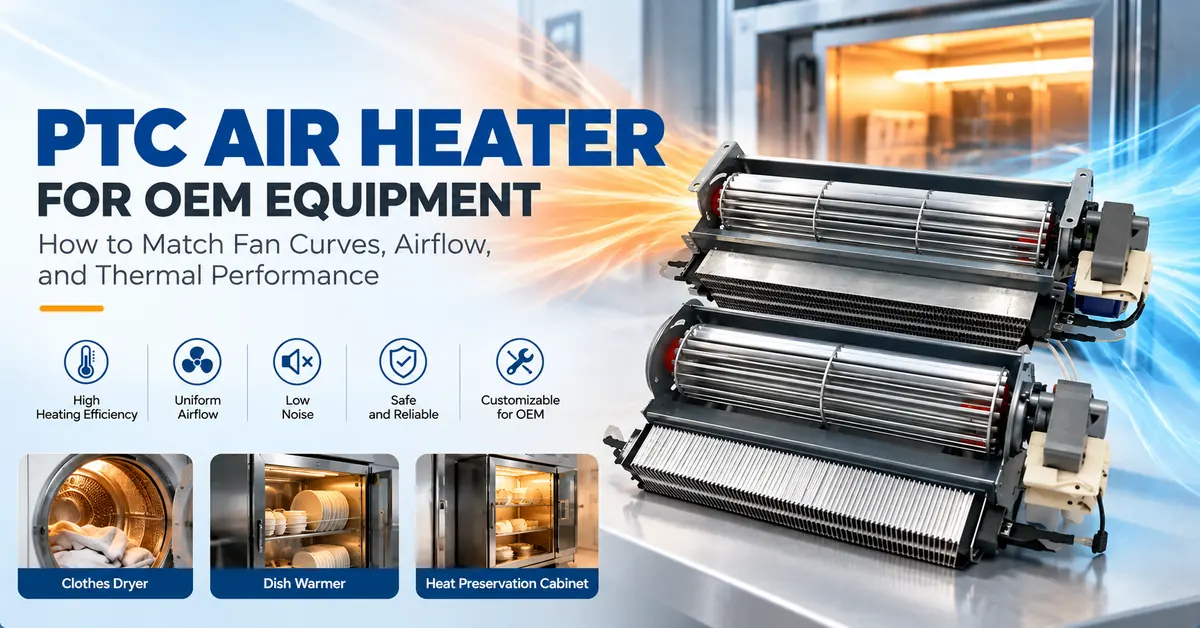
Selecting the right PTC Air Heater for OEM equipment involves much more than choosing a heating element with the correct voltage and nominal power. The heater must operate within a complete thermal system that includes airflow, fan performance, electrical supply, mechanical installation, temperature control, and safety protection.
For appliance manufacturers, industrial equipment suppliers, HVAC designers, and OEM procurement teams, one of the most common mistakes is treating a heater's rated wattage as a guarantee of its final heating performance.
A 1,000W heating module may produce different outlet-air temperatures when installed in two machines with different fan speeds, duct restrictions, inlet temperatures, and enclosure dimensions. Its actual electrical power can also change because of the temperature-dependent resistance of the PTC ceramic.
The correct approach is to evaluate a PTC Air Heater together with its fan, airflow path, thermal load, and intended operating conditions.
This guide explains how to:
-
Estimate the heating capacity required by an OEM application.
-
Compare standalone PTC heaters with integrated fan-heater assemblies.
-
Match fan curves to airflow resistance and heater geometry.
-
Understand PTC self-regulating behavior and its limitations.
-
Compare published PTC air heating configurations.
-
Validate prototypes under realistic operating and fault conditions.
-
Evaluate a PTC Air Heater Manufacturer for customized production.
-
Prepare a technical RFQ that reduces quotation errors and unnecessary development delays.
For companies developing new warm-air equipment, Tianrui Electronics' PTC Heater product range provides several starting configurations, including corrugated heating elements and fan-integrated assemblies.
1. What Is a PTC Air Heater, and How Does It Work?
A PTC Air Heater is an electrical heating assembly that uses a positive temperature coefficient ceramic heating element to transfer heat into moving air.
PTC means Positive Temperature Coefficient. In commonly used ceramic PTC heating materials, electrical resistance increases significantly as the ceramic approaches its designed transition temperature.
When power is applied, the ceramic generates heat through electrical resistance. As its temperature rises, its resistance changes, influencing current consumption and heating power.
This temperature-dependent behavior provides a self-regulating characteristic.
How the heating process works
A typical PTC air heating system follows this sequence:
-
Electrical power is applied to the PTC heating element.
-
The ceramic generates heat.
-
Heat transfers through electrodes, conductive structures, and heat-transfer surfaces.
-
Airflow removes heat from the heating assembly.
-
The ceramic temperature changes according to the balance between electrical heating and heat removal.
-
The electrical resistance adjusts as the ceramic temperature changes.
-
The system reaches an operating condition determined by voltage, airflow, inlet temperature, and thermal load.
The important engineering point is that the heater's operating temperature is not determined by the ceramic material alone.
Airflow directly influences how quickly the heater loses heat. Therefore, the same heating element can exhibit different electrical and thermal behavior when paired with different fans.
What does self-regulating heating actually mean?
At a fixed supply voltage, increasing PTC resistance generally reduces electrical current and power as the ceramic approaches its high-resistance operating region.
This mechanism can reduce the tendency toward uncontrolled heating compared with a fixed-resistance element operating under similar conditions.
However, a PTC heating element does not automatically maintain a precise air temperature.
The actual outlet temperature depends on:
-
Ceramic resistance-temperature characteristics.
-
Operating voltage.
-
Heater geometry.
-
Airflow rate.
-
Inlet-air temperature.
-
Fin construction and thermal contact.
-
Heat losses.
-
Enclosure geometry.
-
Operating duration.
Likewise, the ceramic transition temperature is not equivalent to the final outlet-air temperature.
An OEM product requiring accurate temperature control may still need an independent sensor, electronic controller, thermostat, or thermal protection device.
For more information about the ceramic material and heating structure, explore Tianrui's PTC Heating Element Solutions.
2. Which OEM Buyers Need a PTC Air Heater?
PTC air heating solutions are relevant to manufacturers that need electrically generated heat transferred into circulating air.
However, not every heating application requires the same construction.
| OEM Buyer | Typical Equipment | Main Engineering Requirement |
|---|---|---|
| Appliance manufacturers | Clothes dryers, dish warmers, drying cabinets | Compact construction and controlled warm-air distribution |
| HVAC equipment manufacturers | Auxiliary air heaters, ventilation units | Airflow compatibility and thermal capacity |
| Industrial equipment OEMs | Drying boxes, warming chambers | Continuous operation and thermal uniformity |
| Electrical enclosure manufacturers | Control cabinets, equipment housings | Condensation management and low-temperature operation |
| Commercial kitchen equipment manufacturers | Food-warming cabinets, drying equipment | Temperature consistency and cleaning considerations |
| Consumer product manufacturers | Compact warm-air appliances | Noise, dimensions, electrical safety, and assembly |
| Automation equipment integrators | Specialized thermal modules | Custom mounting, control integration, and repeatability |
An integrated heater-and-fan assembly may be attractive when a manufacturer wants to reduce the number of separately sourced components.
Conversely, a standalone heating core may be preferable when the equipment already has a qualified blower, air duct, and control system.
When is a PTC Air Heater not the correct solution?
A forced-air heater should not automatically be selected for every thermal requirement.
For direct surface heating, an aluminum-shell PTC heater or another contact-heating design may provide better thermal coupling.
For liquid heating, a purpose-designed liquid heater is normally required.
For applications demanding extremely precise temperature regulation, external control and feedback may be necessary.
Explosive atmospheres, aggressive chemical environments, and specialized safety-critical equipment introduce additional requirements. A standard heater should not be considered suitable for these conditions without appropriate engineering assessment and qualification.
The first purchasing decision should therefore be whether the application truly requires air heating, rather than simply requiring a heat source.
3. PTC Air Heater with Fan vs. Standalone Heating Element
One of the most important OEM design decisions is whether to source a standalone heating element or a complete PTC Air Heater with Fan.
Both configurations can be suitable, but they create different engineering responsibilities.
Standalone corrugated PTC air heater
A standalone corrugated heater typically uses ceramic PTC elements coupled to an aluminum heat-transfer structure.
The corrugated fins increase the surface area exposed to moving air.
This arrangement is useful when the customer already has a suitable blower or fan within the finished equipment.
The OEM is responsible for validating airflow distribution, mechanical mounting, electrical connections, and the performance of the heater within the existing ventilation system.
Integrated axial-fan PTC heater
An axial-fan arrangement combines a heating element with a fan that moves air through or across the heater.
This can simplify assembly in compact products.
However, axial fans are sensitive to system resistance. A fan that delivers adequate airflow in open conditions may deliver much less after installation behind restrictive grills, filters, or heating fins.
The fan must therefore be evaluated at its actual working pressure.
Cross-flow fan PTC heater
A cross-flow or tangential fan uses a relatively long cylindrical impeller to move air across a wide outlet.
This construction can be useful for appliances requiring a broad air-distribution pattern.
Examples include drying cabinets, dish warmers, and equipment with elongated air outlets.
A cross-flow design still requires verification of pressure resistance, acoustic behavior, and airflow uniformity.
Comparison of heater architectures
| Heater Configuration | Main Advantage | Engineering Limitation | Suitable OEM Application |
|---|---|---|---|
| Standalone corrugated heater | Flexible integration with existing airflow | Requires external fan and duct validation | Industrial dryers, HVAC systems |
| PTC heater with axial fan | Compact integrated arrangement | Airflow may decline significantly with restriction | Small warm-air appliances |
| Cross-flow PTC fan heater | Broad air distribution | Requires suitable housing and fan operating point | Warming cabinets, dish dryers |
| Customized heating assembly | Mechanical and thermal adaptation | Requires engineering approval and prototype testing | Specialized OEM equipment |
Selection recommendation:
Choose the heater architecture according to the complete airflow system, not simply the rated heating power.
A PTC Air Heater with Fan is not automatically superior to a standalone heater. Its value depends on whether the integrated fan matches the customer's air path and operating requirements.
4. Which PTC Air Heater Configurations Does Tianrui Offer?
Dongguan Tianrui Electronics Co., Ltd. publishes several PTC air heating configurations suitable for preliminary OEM evaluation.
The following examples are drawn from the company's public product listings. The stated figures are published product options, not guaranteed performance across all operating conditions.
Published product comparison
| Published Product | Voltage | Listed Heating Power | Main Structure | Intended Application |
|---|---|---|---|---|
| Mini PTC Air Heater with Fan | 220V | 200W | Ceramic heater with dual-fan axial arrangement | Compact warm-air equipment |
| Cross-Flow Fan PTC Heater | 220V | 600W, 900W, 1200W, 1800W | PTC heating module with cross-flow fan | Drying and warming cabinets |
| Corrugated Electric PTC Air Heater | 220V | 1000W, 1500W, 1600W, 1800W, 2000W | Corrugated aluminum heat-transfer structure | Dryers and drying boxes |
| Cross-Flow PTC Heater for Boiler Equipment | 220V | 350W or 353W | Cross-flow fan and PTC heating module | Application-specific warm-air equipment |
Buyers can inspect several representative products:
200W Mini PTC Air Heater with Fan
This product is listed with a 220V supply, 200W heating rating, ceramic heating structure, and dual-fan axial configuration.
It provides a reference for compact fan-integrated heating assemblies.
600W–1800W Cross-Flow Fan PTC Heater
This product family combines heating and air circulation, with listed power options of 600W, 900W, 1200W, and 1800W.
The product page also describes customization of assembly dimensions.
1000W–2000W Corrugated PTC Air Heater
This product family is intended for air-heating applications such as dryers and drying boxes, using a corrugated aluminum structure.
It provides a starting point for OEMs that already have an airflow system.
What should buyers verify before ordering?
These published ratings do not establish a complete performance specification.
For each selected configuration, request confirmation of:
-
Whether power refers to the heater alone or an entire fan-heater assembly.
-
The conditions under which rated power is measured.
-
Actual operating voltage range.
-
Heating power after thermal stabilization.
-
Cold-start and maximum current.
-
Fan power consumption, where applicable.
-
Operating airflow and pressure drop.
-
Dimensions and mounting tolerances.
-
Available product-specific test information.
This verification prevents buyers from assuming that two assemblies with the same nominal wattage will perform identically.
5. How to Calculate the Required PTC Air Heater Capacity
A reliable design starts with the required thermal result.
For forced-air heating, the first calculation estimates the amount of heat needed to raise a specified airflow through a desired temperature difference.
Basic airflow heating equation
For an initial steady-state estimate:
P_air = ρ × Q × cp × ΔT
Where:
-
P_air = thermal power transferred to the air, in watts.
-
r = air density, in kg/m³.
-
Q = volumetric airflow, in m³/s.
-
cp = specific heat capacity of air, in J/(kg·K).
-
ΔT = outlet temperature minus inlet temperature, in K or °C.
Air density and specific heat depend on operating conditions. They should be selected for the intended temperature, pressure, and air composition.
For preliminary calculations near room temperature, engineers sometimes use approximately 1.2 kg/m³ for air density and 1005 J/(kg·K) for specific heat capacity.
These are illustrative assumptions, not product specifications.
Example: estimating warm-air heating demand
Assume an equipment manufacturer requires:
-
Airflow: 100 m³/h.
-
Inlet-air temperature: 20°C.
-
Target outlet-air temperature: 35°C.
-
Temperature increase: 15°C.
-
Assumed air density: 1.2 kg/m³.
-
Assumed specific heat: 1005 J/(kg·K).
Convert airflow into cubic meters per second:
100 ÷ 3600 = 0.0278 m³/s.
The estimated thermal power transferred to the air becomes:
P_air ≈ 1.2 × 0.0278 × 1005 × 15
P_air ≈ 503W
The example indicates that approximately 503W of thermal energy must be transferred to the air to achieve the specified temperature rise under those assumptions.
It does not establish that a catalog heater rated at 500W will meet the requirement.
The selected heater must also account for losses, actual operating power, temperature-dependent electrical behavior, and variations in airflow.
Why is electrical wattage different from delivered air heat?
Electrical input is not always identical to the heat measured in the intended air stream.
Some energy may initially heat the ceramic, metal fins, mounting structures, and surrounding equipment.
Heat can also escape through the enclosure or conduct into connected mechanical parts.
Additionally, fan motor power should be identified separately from heater input when calculating system electricity consumption.
For a more complete engineering assessment, distinguish:
-
Electrical power entering the heating element.
-
Electrical power consumed by the fan.
-
Heat transferred into the desired airflow.
-
Heat lost to surrounding structures.
-
Transient heat stored in the equipment.
-
Stabilized power under the actual operating conditions.
How does airflow affect outlet temperature?
Suppose approximately 500W is transferred to the air.
Under the same simplified assumptions:
| Airflow | Approximate Ideal Air Temperature Rise |
|---|---|
| 50 m³/h | 29.9°C |
| 80 m³/h | 18.7°C |
| 100 m³/h | 14.9°C |
| 150 m³/h | 10.0°C |
These are theoretical heat-balance examples with constant transferred power.
They are not test results or performance guarantees for Tianrui products.
A real PTC heater does not necessarily maintain constant electrical power when airflow changes.
At lower airflow, the ceramic may become hotter and increase its resistance, reducing electrical heating power.
At higher airflow, greater cooling can alter the ceramic resistance and electrical operating point.
The final outlet temperature must therefore be measured under actual operating conditions.
6. Why Fan Curve Matching Matters More Than Free-Airflow Ratings
A fan's advertised maximum airflow is not necessarily the airflow that will pass through the heating assembly.
Maximum free-air delivery is generally measured under conditions with relatively little external resistance.
Once the fan is integrated into an OEM product, it must overcome pressure losses caused by the system.
These losses can come from:
-
Heating fins.
-
Air filters.
-
Protective grills.
-
Duct bends.
-
Narrow inlet openings.
-
Outlet restrictions.
-
Internal baffles.
-
Mechanical obstructions.
-
Dust accumulation.
The airflow delivered by the fan depends on its operating point.
Understanding the fan performance curve
A fan performance curve describes the relationship between airflow and pressure capability under defined test conditions.
As system resistance increases, the operating airflow often decreases.
The installed operating point occurs where the fan characteristic intersects the resistance characteristic of the actual system.
For OEM heating equipment, this means the heating element and fan should be evaluated together.
A high-airflow fan with inadequate pressure capability may perform poorly behind a restrictive finned heater.
Similarly, a fan capable of high pressure may introduce unnecessary noise, electrical consumption, or mechanical complexity if the system requires only modest airflow resistance.
Four steps for fan and heater matching
Step 1: Define the required airflow.
Determine the minimum and preferred airflow needed to achieve the thermal objective.
Include expected variation across operating modes.
Step 2: Estimate total system pressure loss.
Evaluate the heater core, ducts, filters, grills, and other restrictions.
Pressure loss should be considered at the intended airflow rate rather than treated as a fixed value under all conditions.
Step 3: Select a fan with an appropriate operating point.
Use the fan's pressure-flow performance information to identify whether it can deliver the required airflow after integration.
Where available, request measured fan performance data.
Step 4: Validate the assembled equipment.
Measure actual airflow, power consumption, and outlet-air temperature with the heater installed.
Include different fan speeds, electrical supply conditions, and expected filter or duct restrictions.
What information should a fan supplier provide?
A useful fan specification may include:
| Fan Parameter | Why It Matters |
|---|---|
| Airflow-pressure curve | Identifies likely installed operating point |
| Rated voltage and frequency | Confirms electrical compatibility |
| Motor power | Contributes to total system consumption |
| Fan speed | Influences delivery and acoustic performance |
| Static pressure capability | Helps assess resistance tolerance |
| Acoustic performance | Important for appliances and occupied spaces |
| Operating temperature | Confirms suitability near warm-air components |
| Bearing and motor design | Relevant to expected duty and maintenance |
| Mounting dimensions | Determines mechanical integration |
| Performance tolerances | Supports production acceptance limits |
For formal fan performance evaluation, ISO 5801:2017, including its 2025 amendment, provides a standardized framework for testing fan performance using standardized airways.
Its relevance is to fan-performance measurement; mentioning the standard does not imply that a particular Tianrui fan has been independently tested or certified to it.
7. How to Select PTC Air Heater Specifications for OEM Production
The technical specification should connect the equipment's thermal requirements with the physical and electrical characteristics of the proposed heater.
The following table can serve as a starting point for engineering discussions.
Technical specification checklist
| Specification | What to Define | Why It Matters |
|---|---|---|
| Rated voltage | AC/DC, nominal voltage and tolerance | Electrical compatibility |
| Heating power | Nominal and stabilized input under stated conditions | Thermal capability |
| Cold-start current | Initial current and test conditions | Switch, relay and wiring selection |
| PTC material characteristics | Relevant resistance-temperature behavior | Self-regulating performance |
| Ceramic transition temperature | Material-related transition region | Thermal design |
| Airflow | Minimum, nominal and maximum | Heat transfer and temperature rise |
| Pressure drop | Across the heater at specified airflow | Fan selection |
| Inlet temperature | Minimum and maximum | Defines thermal operating conditions |
| Outlet temperature | Target and allowable limits | Equipment performance |
| Heater dimensions | Length, width, height and tolerances | Mechanical integration |
| Fin construction | Material, geometry and spacing | Heat transfer and airflow resistance |
| Electrical insulation | Required dielectric and insulation performance | Electrical safety |
| Wiring and connector | Temperature rating, type and dimensions | Assembly compatibility |
| Operating duty | Intermittent or continuous | Thermal and durability evaluation |
| Environmental conditions | Humidity, dust, vibration and exposure | Reliability |
| Production requirements | Quantity, inspection and documentation | Sourcing and quality consistency |
Is higher wattage always better?
No.
A larger heating element may introduce additional current demand, cost, thermal stress, and packaging requirements.
It may also increase pressure drop or occupy space needed for the airflow path.
A properly selected lower-power design can sometimes better satisfy an application with modest thermal demand and limited installation space.
Conversely, insufficient heating capacity may lead to excessive warm-up time or failure to maintain the required operating temperature.
The preferred design is therefore the one that meets the defined thermal requirement with acceptable margins and manageable system risks.
8. How Do Materials and Manufacturing Affect Heating Performance?
A PTC air heater is an assembly of interacting electrical, ceramic, and mechanical components.
Its performance is influenced by more than the heating material itself.
PTC ceramic
Ceramic PTC heating materials commonly use barium-titanate-based compositions whose electrical characteristics are adjusted through material formulation and manufacturing processes.
Important characteristics include:
-
Resistance behavior.
-
Transition temperature.
-
Electrical stability.
-
Ceramic geometry.
-
Manufacturing consistency.
-
Thermal cycling performance.
Variations in material processing can affect electrical and thermal characteristics.
Electrode construction
Electrodes provide the electrical interface to the ceramic.
Their design influences electrical contact, mechanical integrity, and heat transfer.
A suitable manufacturing and inspection process should consider contact resistance, electrode integrity, and the reliability of electrical connections.
Aluminum heat-transfer structures
Aluminum is commonly used for finned air-heating assemblies because of its thermal conductivity and relatively low mass.
Fin geometry influences the area available for heat exchange.
However, increasing fin density is not always beneficial.
Closer fin spacing may increase heat-transfer area while also increasing resistance to airflow.
The preferred structure balances heat transfer against pressure drop and manufacturability.
Insulation and mounting components
Insulating structures help manage the separation between energized components and accessible or grounded metal surfaces.
Mounting parts must also withstand the expected temperature and mechanical load.
Materials should be selected with regard to:
-
Maximum operating temperature.
-
Electrical insulation requirements.
-
Mechanical strength.
-
Thermal expansion.
-
Humidity exposure.
-
Assembly consistency.
-
Required service life.
A reliable PTC Air Heater Manufacturer should be able to discuss how these construction choices affect product performance.
Tianrui describes customized structure, material selection, engineering drawings, and mold development within its PTC Heater Customization Solutions.
9. What Safety Protections Does a PTC Air Heater Need?
Self-regulating heating is valuable, but it does not eliminate the need for complete equipment-level safety engineering.
The finished product must be assessed according to its intended use, installation conditions, and applicable requirements.
What happens if the fan stops?
When forced airflow stops, the rate of heat removal may decline sharply.
The ceramic temperature may increase, causing its resistance to rise and reducing electrical power.
However, this does not prove that all surrounding parts remain within acceptable temperatures.
Adjacent plastic structures, wiring, dust, insulation materials, or mounting components may still become excessively hot.
Therefore, fan-failure testing should examine the entire assembly rather than only the ceramic temperature.
Important safety scenarios
1. Fan failure
Determine the thermal behavior if airflow stops while heating remains energized.
2. Blocked inlet
Evaluate the system with reduced intake airflow.
3. Blocked outlet
Determine whether heated air accumulates inside the enclosure.
4. Voltage variation
Evaluate behavior at the maximum and minimum applicable supply voltages.
5. Control failure
Consider what happens if an electronic controller commands continuous heating.
6. Abnormal environmental temperature
Verify whether the heater remains suitable when inlet air or surrounding structures are already hot.
7. Electrical insulation failure
Assess insulation, protective grounding, wiring, and component separation as appropriate.
Potential protective measures include independent temperature sensing, thermal cutoffs, fan monitoring, suitable overcurrent protection, protective earthing, and control-system fault detection.
The correct combination depends on the product architecture.
For household and similar electrical appliances, relevant safety requirements may include the applicable IEC 60335 standards. IEC 60335-1 establishes general safety requirements, while particular appliance types may require additional applicable provisions.
For industrial electroheating equipment, IEC 60519-1 may also be relevant within its defined scope.
These standards are engineering references, not proof of product certification. Compliance and test documentation must be confirmed for the exact equipment and destination market.
10. Common PTC Air Heater Applications and Environmental Conditions
A heater suitable for one product should not automatically be transferred into another without reviewing its operating environment.
Clothes dryers and drying cabinets
These applications require the heating element to work with airflow that may contain moisture, lint, or other contaminants.
Important considerations include:
-
Airflow stability.
-
Lint or dust accumulation.
-
Warm-up time.
-
Drying temperature.
-
Fan failure.
-
Service access.
-
Repeated heating cycles.
A corrugated heater may be suitable when the OEM already has a fan and ventilation path.
A cross-flow integrated assembly may be considered when the equipment needs broad air distribution.
HVAC auxiliary heating
HVAC systems commonly operate across a wide range of inlet-air temperatures and fan speeds.
The heating module must be evaluated with the actual blower and duct configuration.
Engineers should consider minimum airflow, supply-voltage variation, outlet temperature limits, and interactions with the control system.
Industrial electrical cabinets
Electrical enclosures may require moderate heating to help manage internal temperatures and reduce condensation risk.
The heating objective is not necessarily to make the cabinet hot.
Instead, the system may need to maintain suitable internal conditions relative to ambient temperature and humidity.
Heater positioning, air circulation, dew-point conditions, and temperature-sensitive components are important.
Commercial warming equipment
Cabinet warmers and similar appliances benefit from controlled heat distribution.
A cross-flow fan may help distribute warm air along an elongated outlet, but actual uniformity depends on the complete internal airflow path.
For equipment associated with food or utensils, cleaning, materials, temperature limits, and applicable hygiene requirements also matter.
Industrial process equipment
Drying and process-heating equipment may introduce challenging duty cycles, dust, vapors, or elevated inlet temperatures.
PTC heating components should be selected only after the environmental and process requirements are defined.
For additional application context, see Tianrui's Home Appliance Heating Solutions.
11. How Should OEM Engineers Validate a PTC Air Heater Prototype?
A prototype should not be approved merely because it becomes hot when connected to electricity.
The purpose of engineering validation is to determine whether the heater meets measurable requirements inside the actual equipment.
A meaningful validation plan should be agreed upon before sample testing.
Recommended prototype validation matrix
| Test | Measurement or Observation | Engineering Purpose |
|---|---|---|
| Cold-start test | Initial current, power and temperature response | Evaluate electrical stress and warm-up |
| Stabilized operation | Power, airflow, inlet and outlet temperatures | Confirm steady operating performance |
| Minimum-airflow test | Temperature and electrical behavior | Evaluate low-flow conditions |
| Maximum-airflow test | Heating output and temperature rise | Confirm high-flow performance |
| Fan-stop test | Component and enclosure temperatures | Evaluate airflow-loss behavior |
| Inlet obstruction | Airflow reduction and thermal response | Assess intake restrictions |
| Outlet obstruction | Pressure and temperature behavior | Assess discharge restrictions |
| Voltage variation | Current, power and temperature | Verify supply-range compatibility |
| Thermal cycling | Performance change over repeated cycles | Evaluate repeatability |
| Extended operation | Temperature and component condition | Assess intended duty |
| Insulation evaluation | Insulation resistance and dielectric performance | Support electrical safety |
| Noise evaluation | Acoustic behavior at relevant operating points | Confirm equipment requirements |
| Environmental exposure | Results under defined humidity or vibration conditions | Assess application-specific reliability |
Acceptance criteria should be specified by the OEM and agreed with the supplier.
The figures used for approval must come from the final design requirements and applicable standards, not from arbitrary generic limits.
Test the heater in the real installation
An open-bench test is useful during early development, but it cannot fully reproduce a finished machine.
The final enclosure may contain:
-
Airflow restrictions.
-
Heat-sensitive plastics.
-
Metal brackets.
-
Wiring bundles.
-
Filters.
-
Insulation.
-
Multiple air outlets.
-
Electronic controls.
All of these can affect thermal performance.
For example, an air heater installed near a plastic duct wall may create localized temperatures that are not apparent from a measurement at the center of the outlet.
Multiple measurement positions may therefore be needed.
Measure more than the hottest point
Recommended thermal measurements include:
-
Inlet-air temperature.
-
Outlet-air temperature at multiple locations.
-
Ceramic or heater-body temperature, where measurable.
-
Nearby enclosure surface temperature.
-
Wire and connector temperature.
-
Fan motor temperature.
-
Ambient temperature.
It is equally important to measure electrical power and airflow during the same test.
Without synchronized test conditions, temperature measurements may be difficult to interpret.
Define a repeatable test procedure
To compare alternative heater samples fairly, keep major test conditions consistent.
Document:
-
Applied voltage.
-
Ambient temperature.
-
Inlet-air temperature.
-
Fan operating condition.
-
Airflow or pressure condition.
-
Heater installation.
-
Temperature measurement positions.
-
Test duration.
-
Measurement equipment.
-
Acceptance criteria.
This makes technical discussions with a supplier more productive and reduces the risk of approving an unsuitable component.
12. How Should OEM Buyers Evaluate Manufacturing Quality?
For volume production, performance must be repeatable rather than limited to one successful prototype.
Quality planning should begin with the characteristics that affect the finished equipment.
Critical-to-quality characteristics
Depending on the design, important characteristics may include:
-
Ceramic electrical characteristics.
-
Heating element resistance.
-
Heater dimensions.
-
Electrode quality.
-
Fin geometry and attachment.
-
Electrical insulation.
-
Wire and terminal connections.
-
Mounting accuracy.
-
Fan operation.
-
Assembly identification.
-
Final functional performance.
The manufacturer's inspection methods should correspond to the agreed technical specification.
Incoming material control
Ceramics, electrodes, aluminum components, insulation materials, fans, and wiring should be checked according to the applicable purchasing and quality requirements.
Changes in these materials may influence thermal performance or reliability.
Process control
Assembly processes should control relevant dimensions, contact conditions, and electrical connections.
A replacement fan with the same nominal voltage but a different performance curve, for example, may change the heating behavior of the complete assembly.
Final inspection
Final inspection requirements may include electrical checks, visual examination, dimensional verification, and functional testing.
The sampling plan, acceptance limits, measurement equipment, and records should be agreed for the product.
Supplier documentation
For higher-volume OEM programs, consider requesting:
-
Controlled product drawings.
-
Approved specification revisions.
-
Incoming material requirements.
-
Critical inspection criteria.
-
Sample inspection reports.
-
Traceability information.
-
Change-notification procedures.
-
Agreed reliability test documentation.
These are recommended qualification documents. The availability of any specific report or test must be confirmed with the manufacturer.
Dongguan Tianrui Electronics Co., Ltd. describes its manufacturing and testing capabilities on its company website. Buyers should request project-specific evidence when qualifying a particular heater.
13. What Determines the Cost of a Custom PTC Air Heater?
The purchase price depends on more than nominal wattage.
Different heater structures can have substantially different material, assembly, testing, and tooling requirements.
Main cost factors
PTC ceramic configuration
Ceramic size, electrical characteristics, and the number of heating elements influence material and assembly costs.
Aluminum structure
Fin dimensions, geometry, material usage, and processing requirements affect manufacturing cost.
Integrated fan
A PTC Air Heater with Fan includes an additional mechanical and electrical subsystem.
Fan selection can influence component cost, assembly operations, inspection, and long-term service requirements.
Mechanical customization
Nonstandard dimensions or specialized mounting features may require design changes or tooling.
Electrical connections
Custom cable assemblies, connectors, protective components, or control interfaces may affect cost.
Testing requirements
Additional validation, environmental testing, or documentation may increase engineering and qualification effort.
Production volume
Order volume influences material purchasing, setup costs, and manufacturing planning.
Why the cheapest quotation may not be the lowest-cost solution
A low unit price is valuable only when the product performs correctly and supports stable production.
An unsuitable fan-heater combination can cause:
-
Additional prototype rounds.
-
Airflow redesign.
-
Mechanical rework.
-
Excessive temperatures.
-
Noise problems.
-
Component replacement.
-
Production delays.
-
Warranty and service costs.
OEM buyers should compare the total cost of integration and qualification, not merely the unit price.
MOQ and lead-time planning
Minimum order quantity and delivery time depend on the selected product, customization requirements, materials, tooling, and production schedule.
A standard product inquiry may have different commercial conditions from a newly developed assembly.
For planning, request separate confirmation of:
-
Sample quantity and availability.
-
Prototype development requirements.
-
Tooling needs.
-
Sample approval process.
-
Pilot production quantity.
-
Mass-production MOQ.
-
Expected production lead time.
-
Repeat-order conditions.
No fixed MOQ or production lead time should be assumed without project confirmation.
14. How to Choose a PTC Air Heater Manufacturer for OEM Production
A suitable PTC Air Heater Manufacturer should understand both the heating element and the air-handling system into which it will be installed.
For customized projects, buyers should evaluate engineering communication and validation capabilities alongside price and production capacity.
Questions to ask a potential manufacturer
Can the manufacturer explain the heating architecture?
The supplier should distinguish ceramic heating characteristics from complete system performance.
Can it evaluate fan integration?
For fan-assisted designs, the supplier should discuss airflow, fan type, physical installation, and possible pressure restrictions.
Can it work with drawings and application requirements?
Custom equipment often requires dimensional, material, or connection changes.
Can it support sample evaluation?
Samples should be developed against defined performance and safety requirements.
Can it provide relevant quality information?
Buyers should understand which critical characteristics are controlled and how approved specifications are maintained.
Can it support repeat production?
Supplier qualification should consider long-term availability, component changes, commercial conditions, and production consistency.
Manufacturer vs. distributor
A distributor may be suitable for standard components with known specifications and limited customization requirements.
Working directly with a manufacturer becomes more valuable when the application requires engineering modifications, prototype evaluation, or coordinated mechanical and electrical integration.
For buyers with established designs, the most important question is whether the supplier can maintain the approved configuration.
For new-product development, the ability to discuss system requirements and resolve integration problems may be equally important.
15. OEM/ODM PTC Air Heater Customization with Tianrui Electronics
Tianrui Electronics publishes PTC ceramic heating elements, air heaters, fan-integrated heating products, and customized heater solutions.
Its OEM/ODM support is relevant to customers evaluating application-specific structures and electrical requirements.
The company's public customization information describes consultation, requirements review, design support, material selection, and potential mold development.
Step 1: Define the complete application
Provide information about the finished equipment rather than only requesting a particular wattage.
The technical team should understand the intended thermal function, available installation space, electrical supply, and airflow path.
Step 2: Review possible heater constructions
Depending on the application, a standalone corrugated heater, axial-fan assembly, cross-flow heater, or custom arrangement may be considered.
The preferred option should reflect equipment requirements.
Step 3: Confirm dimensions and electrical specifications
Provide drawings, mounting constraints, voltage limits, wiring details, and temperature requirements.
Mechanical and electrical compatibility should be established before sample approval.
Step 4: Evaluate prototypes
Engineering samples should be assessed using the intended fan, enclosure, and control configuration.
Record relevant temperature, airflow, electrical, and abnormal-operation results.
Step 5: Approve the production configuration
After satisfactory evaluation, confirm drawings, critical specifications, inspection requirements, and change-control expectations.
Step 6: Discuss commercial production
Confirm MOQ, tooling arrangements, lead time, packing requirements, and repeat-order plans.
These details should be settled for the specific project.
For custom development, visit Tianrui's PTC Heater OEM/ODM Solutions.
16. PTC Air Heater RFQ Checklist for OEM Buyers
An effective request for quotation should help the supplier understand what the heater must achieve.
The following checklist can be used when preparing a PTC air heating project.
| RFQ Item | Information to Submit |
|---|---|
| Equipment type | Dryer, HVAC unit, warming cabinet or other application |
| Required function | Warm-up, temperature maintenance, drying or condensation control |
| Rated voltage | AC/DC and nominal operating voltage |
| Voltage range | Minimum and maximum supply conditions |
| Thermal requirement | Target temperatures and warm-up time |
| Airflow | Required or measured flow rate |
| Fan details | Existing fan model, fan curve or proposed fan arrangement |
| Duct resistance | Pressure drop or relevant airflow restrictions |
| Installation space | Maximum dimensions and drawings |
| Heater preference | Standalone, axial-fan or cross-flow assembly |
| Operating environment | Ambient range, humidity, dust and vibration |
| Electrical connection | Wire length, terminals and connectors |
| Control system | Thermostat, controller, sensors and protective devices |
| Safety requirements | Applicable equipment standards and fault conditions |
| Sample requirements | Quantity and target evaluation schedule |
| Order volume | Estimated annual or production quantity |
| Commercial requirements | Target market, delivery destination and purchasing conditions |
Not all items must be finalized at the first inquiry.
However, providing more complete engineering information can help the supplier identify potential mismatches before making a product recommendation.
Example OEM inquiry
Subject: Custom PTC Air Heater with Fan for Drying Cabinet OEM Project
We are developing a compact commercial drying cabinet and are evaluating a PTC air heating module.
Our preliminary electrical supply is 220V AC. We require controlled warm airflow through an enclosed duct and would like to compare a standalone corrugated PTC heater with an integrated cross-flow fan assembly.
We can provide installation drawings, temperature requirements, airflow targets, and estimated annual purchasing volume.
Please advise which available configurations may be suitable, what additional engineering information is required, and how sample evaluation and customization can be arranged.
This type of inquiry is more useful than requesting a quotation based only on nominal power.
To discuss a project, contact Tianrui Electronics and provide the available engineering drawings and operating requirements.
17. Frequently Asked Questions About PTC Air Heaters
1. What is the main advantage of a PTC Air Heater over a conventional resistance-wire heater?
The main difference is its temperature-dependent electrical resistance.
A ceramic PTC heater can reduce its electrical power as the ceramic temperature rises toward its high-resistance region.
This provides a self-regulating characteristic that can be useful for air-heating equipment.
However, overall efficiency, safety, and temperature performance depend on the complete system. External controls and protective devices may still be required.
2. How do I choose between a PTC Air Heater with Fan and a standalone PTC heating element?
Choose according to the equipment's existing airflow architecture.
A standalone heater may be appropriate when an OEM already has a suitable blower and duct system.
An integrated fan-heater module may simplify component integration for a compact appliance.
In either case, check installed airflow, electrical compatibility, pressure drop, thermal performance, safety, and mechanical dimensions before approving the design.
3. Does a PTC Air Heater always consume its rated power?
No.
Nominal wattage is associated with stated operating or test conditions.
Actual electrical power can vary with supply voltage, ceramic temperature, airflow, and heat transfer.
A heater may draw different power at startup and after thermal stabilization.
For accurate system energy calculations, request measured power data under conditions representative of the intended equipment.
4. How can I determine the required fan airflow for a PTC heating module?
Begin with the thermal power needed to achieve the required air-temperature increase.
The relationship between thermal power, mass airflow, and temperature difference provides a preliminary estimate.
Then evaluate the fan's pressure-flow curve against the system's pressure losses.
Finally, measure performance in the finished equipment because a theoretical calculation cannot capture all heat losses and installation effects.
5. What happens if airflow through a PTC heater becomes blocked?
Reduced airflow generally decreases heat removal from the heating element.
The ceramic temperature may rise, increasing resistance and reducing electrical power.
Nevertheless, surrounding components may still experience excessive temperatures.
The finished equipment should therefore undergo appropriate restricted-airflow and fan-failure evaluations, with independent protection where necessary.
6. Can a PTC Air Heater be customized for different voltages and dimensions?
Customized configurations may be possible depending on ceramic characteristics, available structures, electrical requirements, and production feasibility.
Tianrui publishes products with different power ratings and describes customization of heater structures and dimensions.
Buyers should provide the actual voltage range, thermal requirement, dimensions, wiring, and expected order quantity for engineering review.
An existing 220V heater should not be assumed suitable for another voltage without confirmation.
7. Is a higher-power PTC Air Heater always better for industrial drying?
No.
The appropriate heating capacity depends on airflow, starting temperature, desired outlet temperature, heat losses, operating time, and equipment design.
Excessive nominal power may increase electrical and mechanical requirements without improving the process.
Insufficient power may prevent the equipment from meeting its intended thermal duty.
The selected heater should satisfy a defined operating requirement rather than simply provide the highest available wattage.
8. How can OEM buyers verify the quality of a PTC Air Heater Manufacturer?
Buyers should evaluate product specifications, engineering support, sample validation, manufacturing processes, inspection methods, and production consistency.
Request relevant technical drawings, test conditions, material information, and agreed quality criteria.
For fan-integrated assemblies, fan specifications and airflow verification are also important.
Supplier approval should be based on evidence relevant to the actual product, not only general marketing claims.
9. What information is required to obtain an accurate custom PTC Air Heater quotation?
A useful quotation request should include equipment application, voltage, required thermal result, airflow, installation dimensions, operating environment, heater configuration, control requirements, and estimated purchasing quantity.
Drawings and fan information are especially helpful for projects involving forced-air heating.
If some specifications are not yet known, describe the performance objective and request an engineering discussion before selecting a catalog model.
10. Can one PTC Air Heater design be used for HVAC, drying cabinets, and industrial equipment?
A common heating architecture may be adaptable to several applications, but qualification should be performed for each intended installation.
HVAC systems, drying cabinets, and industrial process equipment can have different airflow, duty-cycle, contamination, acoustic, temperature, and safety requirements.
Even when the rated voltage and wattage are similar, the installed thermal behavior may differ.
The safest purchasing approach is to validate the heater within the final equipment under representative operating conditions.
Conclusion
Selecting a PTC Air Heater for OEM equipment is fundamentally a system-engineering decision.
Rated voltage and nominal wattage provide a starting point, but they do not fully describe heating performance. A successful design also requires appropriate airflow, fan pressure capability, heat-transfer geometry, electrical integration, mechanical compatibility, and thermal validation.
For equipment manufacturers considering a PTC Air Heater with Fan, the most important technical task is to match the fan's actual operating point with the heater's airflow resistance and the required thermal output.
For projects using standalone corrugated heaters, engineers should verify how the existing blower and duct system affect the ceramic operating temperature, electrical power, and outlet-air conditions.
A reliable PTC Air Heater Manufacturer should be able to support these decisions through meaningful technical communication, suitable product options, customization discussions, and sample evaluation.
Tianrui Electronics supplies PTC heating components and publishes several air-heating configurations for appliance and industrial applications. Its customization services provide a starting point for OEM customers requiring nonstandard heating structures or application-specific integration.
Before placing a production order, confirm the actual operating requirements, validate engineering samples, and establish clear technical and commercial acceptance criteria.
Looking for a custom PTC air heating solution for your OEM equipment?
Explore Tianrui's PTC Air Heater products or contact the Tianrui technical and sales team with your voltage requirements, target heating performance, airflow information, installation drawings, and estimated order quantity.
A complete technical inquiry is the first step toward selecting a heating assembly that fits your equipment and supports reliable volume production.