A PTC Heating Module is an integrated electric heating assembly that uses positive temperature coefficient ceramic elements to produce heat while adjusting its electrical resistance as the ceramic temperature changes. For industrial OEM equipment, the right module must do more than generate heat: it must transfer that heat effectively, fit the available installation space, operate within electrical limits, and maintain predictable performance throughout production.
The best Industrial PTC Heating Module is not necessarily the one with the highest rated wattage. It is the one that delivers the required heat to the correct location under real operating conditions, while meeting mechanical, electrical, environmental, and safety requirements.
This distinction matters for manufacturers of industrial control cabinets, automation equipment, instrumentation enclosures, process fixtures, and temperature-controlled assemblies.
For example, an electrical enclosure may require moderate heating to reduce condensation risk, while an industrial fixture may need a heating plate with consistent thermal contact. Although both applications can use PTC ceramic technology, their heating requirements and mechanical designs are different.
This guide explains how OEM engineers and purchasing teams can:
-
Select suitable PTC heating module configurations.
-
Calculate preliminary enclosure heat-loss requirements.
-
Understand ceramic self-regulating characteristics.
-
Design reliable thermal interfaces and mounting structures.
-
Compare aluminum-shell, insulated, ceramic, and air-heating modules.
-
Evaluate electrical protection and temperature-control requirements.
-
Prepare meaningful environmental and reliability tests.
-
Assess manufacturing quality and batch consistency.
-
Develop a technically complete Custom PTC Heating Module specification.
-
Reduce purchasing risks before mass production.
Dongguan Tianrui Electronics Co., Ltd. manufactures PTC heating components and supports customized heating solutions for industrial and OEM applications. Buyers can review the company's PTC Heater product range and custom heating solutions before discussing their equipment requirements.
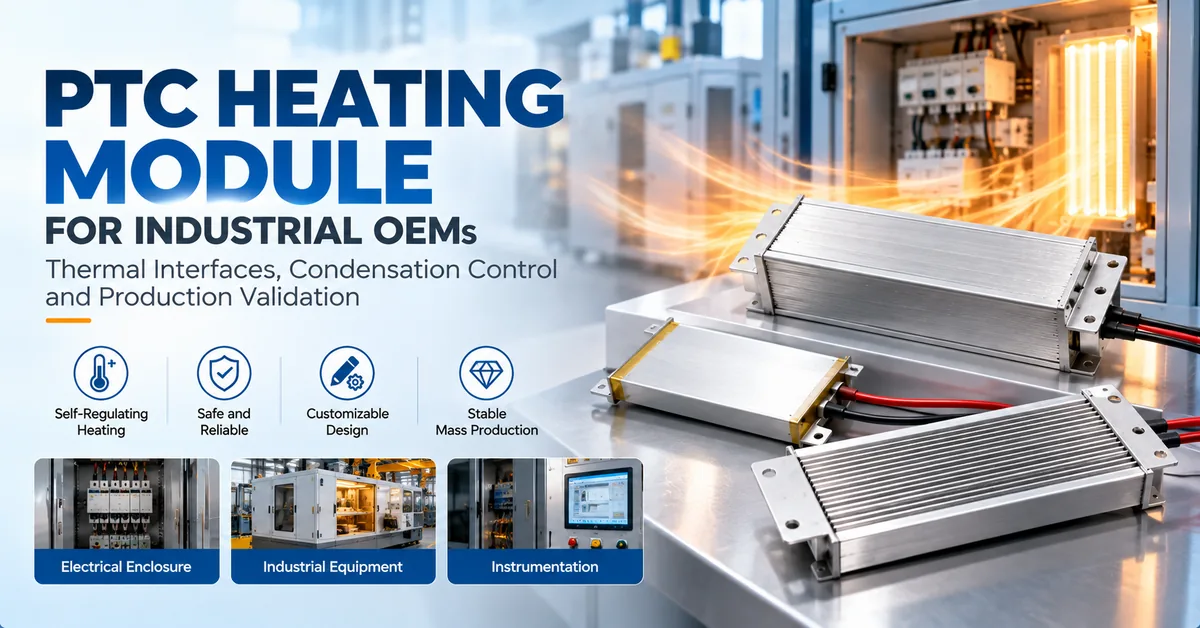
1. What Is a PTC Heating Module?
A PTC Heating Module is a heating unit built around one or more positive temperature coefficient ceramic elements, often combined with thermal conductors, electrical insulation, metal housings, electrodes, wiring, connectors, and mounting structures.
PTC ceramic materials are designed to exhibit a substantial increase in electrical resistance as their temperature approaches a particular transition region.
Under a fixed supply voltage, this resistance increase generally reduces current and electrical heating power.
This behavior creates a self-regulating heating characteristic that is useful in many compact and industrial heating applications.
How does a PTC heating module work?
The basic heating process involves five stages:
-
Electrical power is supplied to the ceramic heating element.
-
Electrical resistance generates heat inside the ceramic.
-
Heat moves through electrodes and structural materials.
-
The heating module transfers thermal energy to an adjacent surface, flowing air, or another intended medium.
-
The ceramic resistance changes according to its operating temperature and heat-transfer conditions.
The electrical and thermal processes continuously interact.
At a fixed voltage, the approximate instantaneous power relationship is:
P = V² / R
Where:
-
P = electrical power in watts.
-
V = voltage across the heating element.
-
R = its instantaneous electrical resistance.
This simplified relationship is useful for understanding resistive heating, but the resistance of a PTC ceramic is not constant.
As its temperature changes, its resistance changes too.
The actual current, power, and operating temperature therefore depend on the ceramic characteristics, supply conditions, and heat removed from the assembly.
Is a PTC heating module automatically temperature controlled?
PTC ceramics provide temperature-dependent electrical behavior, but they are not equivalent to a complete precision temperature-control system.
A module may have a self-regulating equilibrium temperature while the connected metal plate, enclosure air, or heated object remains at a different temperature.
Accurate system-level temperature control may still require an NTC temperature sensor, thermostat, controller, or independent thermal protection device.
For OEM engineers, the critical distinction is between limiting the ceramic's heating behavior and controlling the temperature of the final equipment.
2. Who Should Use an Industrial PTC Heating Module?
Industrial PTC heating systems are useful when equipment requires electrically generated heat in a compact form.
The most suitable configuration depends on whether the application needs surface heating, enclosure heating, forced-air heating, or localized temperature maintenance.
| OEM Customer | Typical Equipment | Primary Heating Requirement |
|---|---|---|
| Industrial automation manufacturers | PLC cabinets, controller housings | Condensation control and temperature maintenance |
| Electrical equipment OEMs | Switchgear-related enclosures, distribution equipment | Localized warming in qualified designs |
| Instrument manufacturers | Measurement devices and environmental monitoring instruments | Temperature stabilization |
| Process equipment manufacturers | Small thermal chambers and heated fixtures | Controlled process heating |
| Printing equipment OEMs | Printing and material-handling equipment | Localized heat transfer |
| HVAC manufacturers | Auxiliary heating assemblies | Heating under specified operating conditions |
| Packaging machinery manufacturers | Specialized warming and drying components | Repeatable thermal performance |
| Industrial electronics manufacturers | Electronic enclosures and sensitive control equipment | Low-temperature operating support |
When is a custom module preferable?
A standard heating element may be adequate when the electrical supply, mechanical installation, and operating conditions are already compatible with an existing product.
Customization becomes more valuable when the equipment has unusual dimensions, mounting locations, voltage requirements, operating temperatures, or connection arrangements.
A Custom PTC Heating Module may also be appropriate when an OEM wants to integrate several components into one assembly to simplify installation.
However, customization should be justified by measurable engineering or procurement benefits.
A specially shaped heater is not automatically better than a standard component if the standard component already meets the application requirements.
Applications that require additional caution
PTC modules should not be assumed suitable for direct liquid immersion, hazardous explosive atmospheres, medical patient-contact systems, or high-voltage battery systems without application-specific design and qualification.
The presence of a PTC ceramic element alone does not establish suitability for these environments.
3. What Types of PTC Heating Modules Are Available?
Different module constructions solve different heating problems.
Understanding the architecture is essential because products that use the same PTC technology may have very different heat-transfer characteristics.
Ceramic PTC heating elements
These are the underlying heat-generating components.
They may be used in a larger custom assembly, but they generally require consideration of electrodes, electrical insulation, thermal coupling, and mounting.
Tianrui offers ceramic PTC heating elements for applications where the customer may need to develop an application-specific structure.
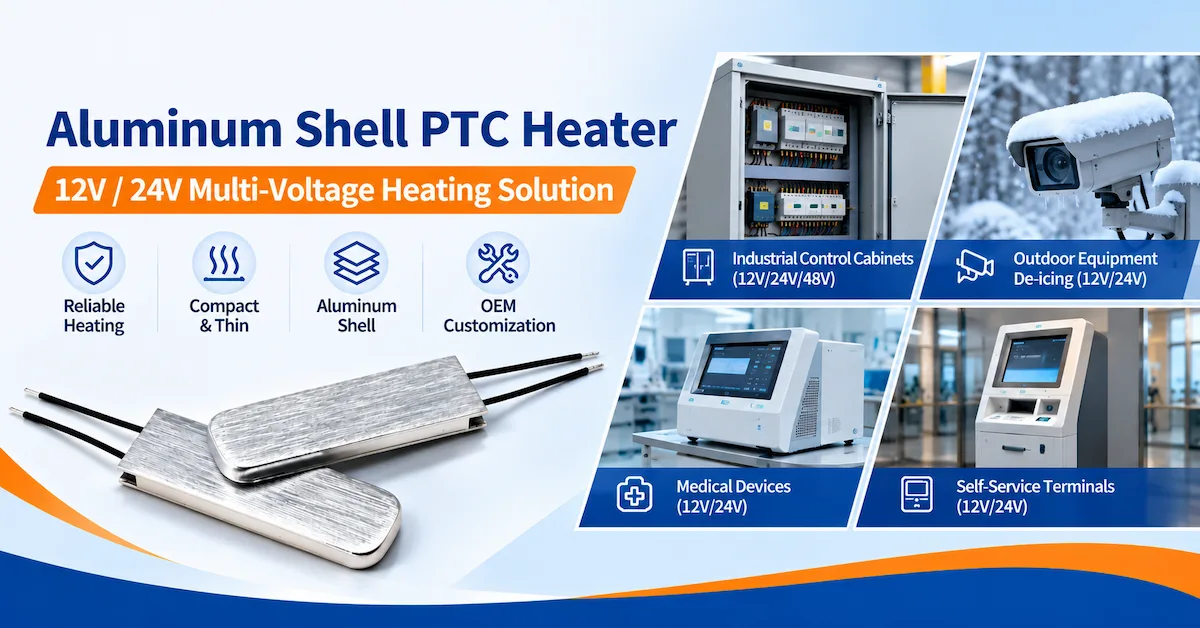
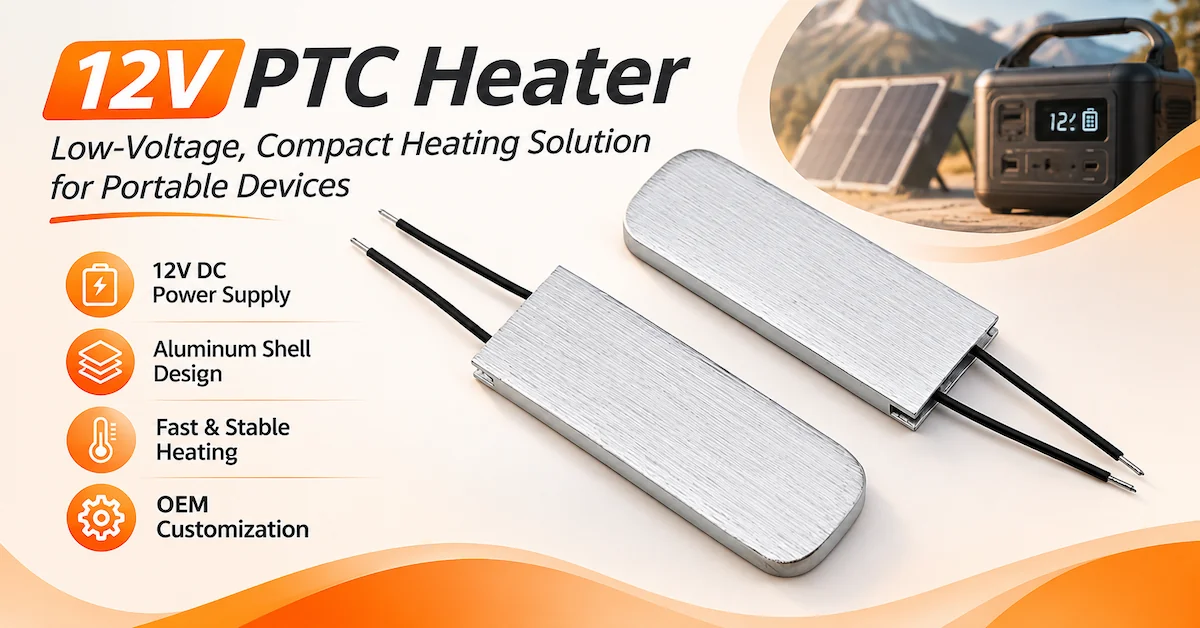
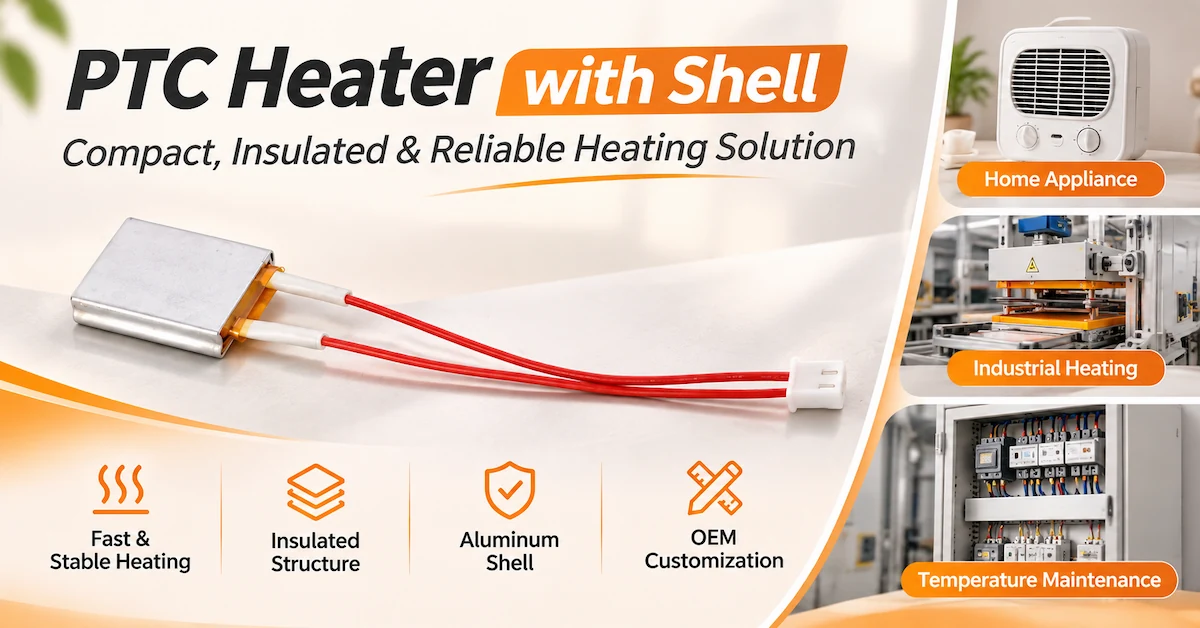
Aluminum-shell PTC heating modules
An aluminum-shell module surrounds or supports the ceramic heating element with a metal enclosure.
The aluminum housing can provide mechanical support and an interface for transferring heat.
Depending on the design, heat may be delivered to a contact surface or transferred to moving air.
This construction can be useful in compact industrial equipment where the heater needs a defined mounting shape.
Explore Tianrui's aluminum-shell PTC heater for a representative construction.
Insulated PTC heating modules
Some assemblies incorporate insulating structures between the heating element and surrounding conductive materials.
These designs are relevant when electrical isolation is an important part of the equipment architecture.
The insulating material must still allow sufficient thermal transfer.
Tianrui's PTC heater with insulating film demonstrates this category.
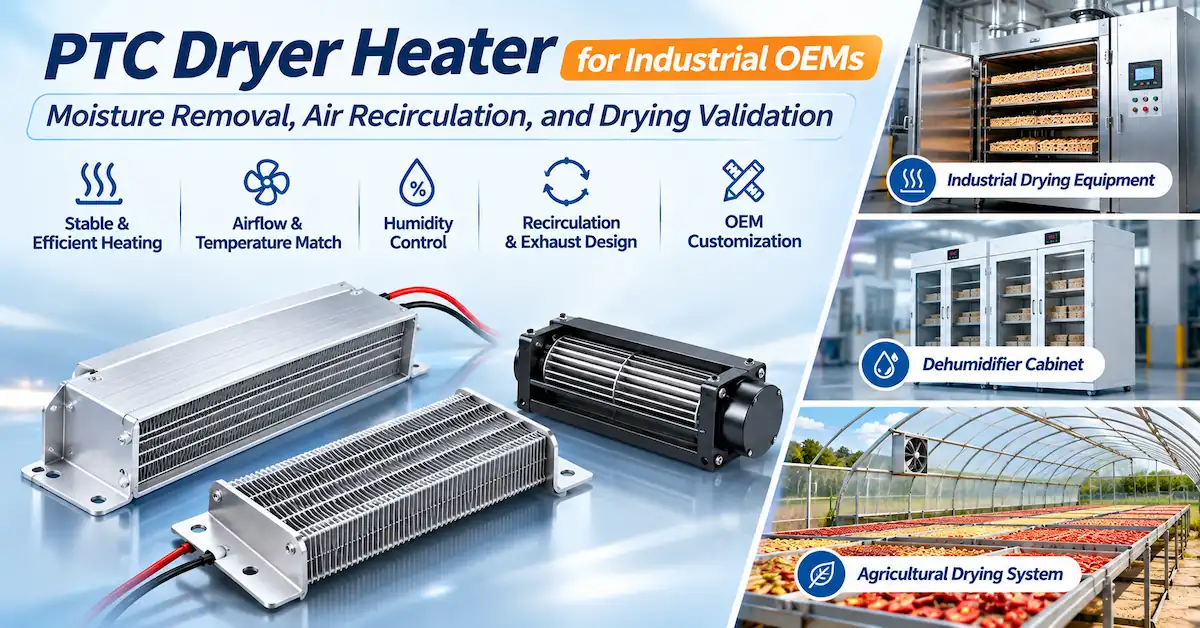
Finned PTC heating assemblies
Finned structures increase the area available for heat transfer to air.
They are typically relevant when a module works with a natural-convection or forced-air heating system.
Unlike a contact-heating plate, a finned heater depends strongly on airflow and installation conditions.
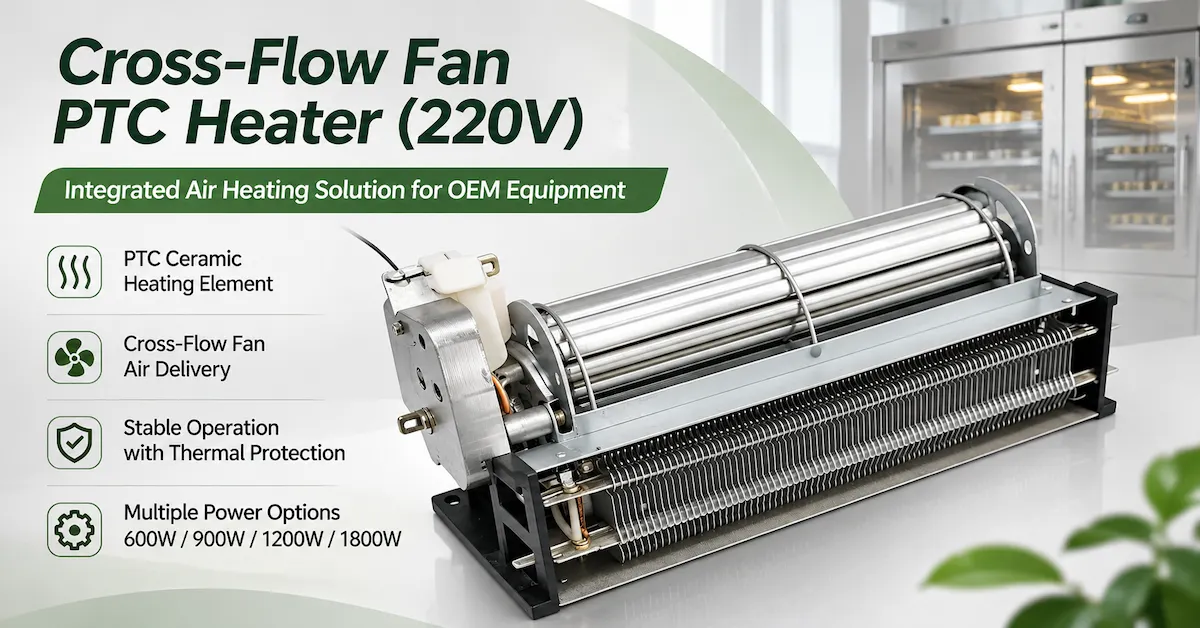
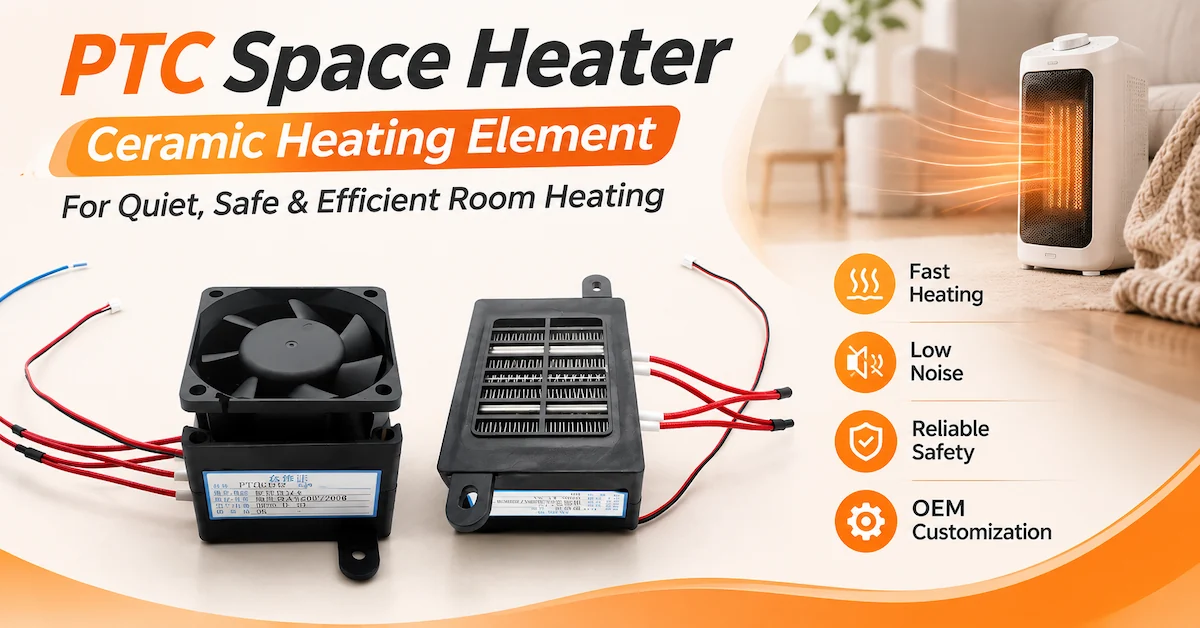
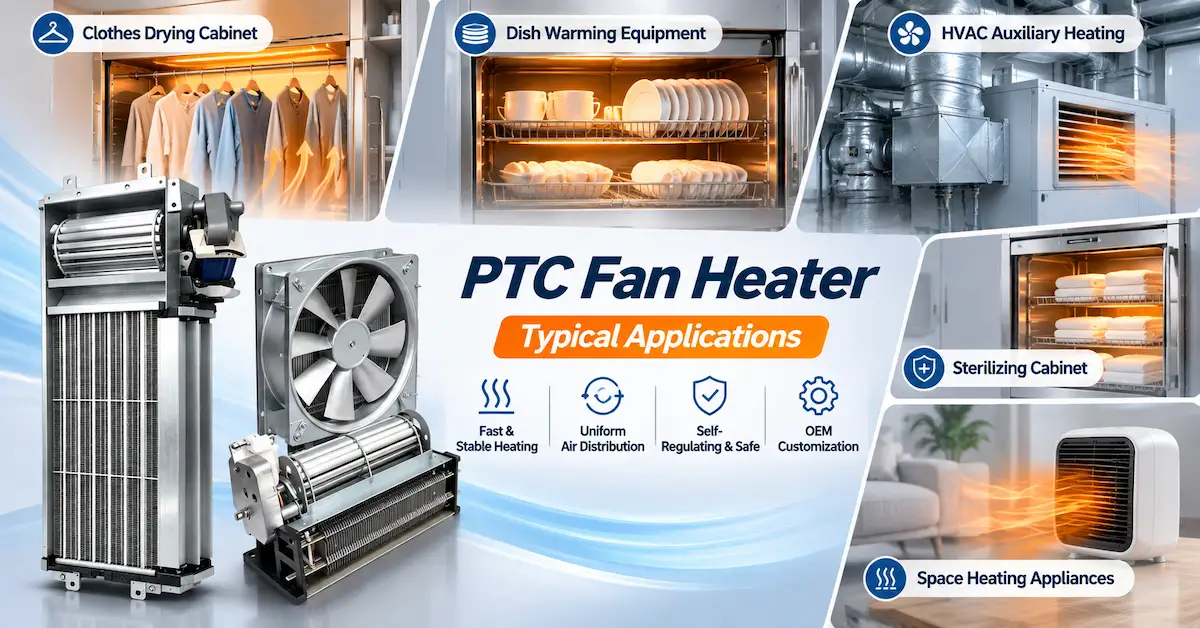
Integrated fan-heating modules
These modules combine PTC heating elements with a fan or blower.
They can simplify the supply of a complete warm-air component, but they require validation of fan performance, airflow resistance, wiring, and system temperature.
For applications where airflow is the primary concern, OEM engineers can evaluate Tianrui's PTC air heating products.
Structural comparison
| Module Type | Heat Transfer Method | Main Advantage | Important Selection Factor |
|---|---|---|---|
| Ceramic PTC element | Conductive or application-defined | Flexible integration | Electrical interface and insulation |
| Aluminum-shell module | Contact conduction or convection | Mechanical integration | Housing temperature and thermal contact |
| Insulated PTC module | Heat through insulating material | Electrical separation | Insulation performance and thermal resistance |
| Finned PTC heater | Convection to air | Increased air-contact surface | Airflow and pressure drop |
| Fan-integrated PTC module | Forced-air convection | Integrated air movement | Fan reliability and system airflow |
| Custom industrial module | Application-specific | Fit to OEM mechanical design | Technical validation and production consistency |
The appropriate architecture should be selected according to the intended heat-transfer path, not only the nominal power rating.
4. How to Calculate Heating Requirements for an Industrial Enclosure
One of the most useful applications for a PTC heating module is temperature maintenance inside an industrial equipment enclosure.
The objective may be to prevent excessive cooling or reduce the likelihood of condensation on sensitive components.
Before choosing the heater, engineers should estimate how much thermal energy the enclosure loses to its environment.
Basic steady-state heat-loss calculation
A simplified enclosure heat-loss equation is:
Q = U × A × ΔT
Where:
-
Q = heat-loss rate in watts.
-
U = overall heat-transfer coefficient in W/(m²·K).
-
A = effective heat-transfer area in m².
-
ΔT = temperature difference between the enclosure interior and surrounding environment.
This calculation estimates steady-state heat loss through the enclosure surfaces.
It does not automatically include ventilation leakage, cable openings, equipment self-heating, internal thermal gradients, or transient warm-up requirements.
Example: preliminary enclosure heater sizing
Consider a hypothetical industrial control enclosure with the following assumed conditions:
| Parameter | Example Value |
|---|---|
| Effective enclosure surface area | 0.75 m² |
| Overall heat-transfer coefficient | 2.5 W/(m²·K) |
| Minimum external temperature | -5°C |
| Desired average internal temperature | 12°C |
| Temperature difference | 17°C |
The estimated heat loss is:
Q = 2.5 × 0.75 × 17
Q ≈ 31.9W
Under these simplified assumptions, maintaining the stated average temperature requires approximately 32W of net heating to offset the calculated surface losses.
This does not mean that any heater advertised as 32W or 40W will necessarily maintain the required enclosure temperature.
Actual power delivered by a PTC module can change with its operating temperature.
Additional heat losses or installation restrictions may also exist.
The OEM should therefore select a candidate design with an appropriate engineering margin and validate it in the actual enclosure.
This example is an illustrative heat-balance calculation, not a published performance test for a Tianrui product.
Why does warm-up time matter?
Steady-state heat loss is only one part of the requirement.
If equipment starts at a very low temperature, the heater must also warm the air and internal components.
The approximate energy required to raise a mass through a temperature difference is:
E = m × cp × ΔT
The heating time depends on the available net heating power and heat losses during warm-up.
A system that can maintain 12°C after reaching steady operation may still take too long to reach that temperature following a cold start.
For projects with defined startup requirements, engineers should evaluate both steady-state heat maintenance and transient warm-up performance.
5. How Can a PTC Heating Module Help Reduce Condensation Risk?
Condensation is a common concern in electrical cabinets, instrumentation housings, and equipment exposed to changing ambient conditions.
It occurs when a surface is colder than the dew-point temperature of the surrounding moist air.
A heating module may help by raising internal temperatures and reducing the likelihood that critical surfaces fall below the dew point.
However, heating does not remove moisture from the enclosure by itself.
Understanding dew point
The dew point depends on the actual moisture content of the air.
For example, air at approximately 20°C and 60% relative humidity has a dew point near 12°C.
If a component surface falls below that temperature while exposed to the same moist air, condensation may form.
The precise dew point should be calculated from measured temperature and relative humidity.
Why heating alone may be insufficient
An enclosure can contain cold structural surfaces even when the measured air temperature appears acceptable.
Metal mounting plates, external walls, door panels, and cable-entry regions may be colder than the air near the heater.
If moist air enters during door opening or through imperfect seals, the moisture load can also change.
Therefore, an anti-condensation heating strategy may involve:
-
Appropriate enclosure sealing.
-
Controlled ventilation where applicable.
-
Heater placement.
-
Air circulation.
-
Temperature monitoring.
-
Humidity or dew-point monitoring.
-
Suitable operating setpoints.
-
Condensation testing.
Where should the module be installed?
For enclosure air heating, placement should encourage useful heat distribution without exposing nearby wiring or electronic components to excessive local temperatures.
For a conduction-heating design, the heater should be mounted to an intended thermal surface with adequate contact.
The best location depends on the equipment layout and environmental conditions.
A low-mounted heater is sometimes useful for natural-convection designs, but it should not be treated as a universal installation rule.
Does higher temperature always improve condensation control?
No.
Excessive internal temperature can reduce the service margin of electronic components and increase energy consumption.
The goal should be to maintain appropriate conditions for the equipment, not to maximize enclosure temperature.
A temperature controller or appropriately designed hygrostat may help avoid unnecessary heating.
For related industrial applications, see Tianrui's Industrial Automation Heating Solutions.
6. Why Thermal Interface Design Determines Heating Performance
For contact-heating applications, the interface between the PTC module and the target surface can be as important as the ceramic element itself.
A poorly designed interface may prevent useful heat from reaching the component being heated.
The ceramic could become relatively hot while the intended surface remains below the target temperature.
What creates thermal resistance?
Several layers may exist between a heating element and the target surface:
-
Ceramic heating material.
-
Electrode or conductive layer.
-
Electrical insulation.
-
Metal housing.
-
Contact interface.
-
Mounting plate.
-
Target equipment component.
Each layer introduces some thermal resistance.
The total thermal resistance influences the temperature difference required to transfer a given heat flow.
Basic thermal resistance relationship
For a simplified steady-state conduction path:
ΔT = Q × Rth
Where:
-
ΔT = temperature difference across the thermal path.
-
Q = heat-transfer rate.
-
Rth = thermal resistance in K/W.
Suppose an assembly transfers 25W through an interface with an effective thermal resistance of 0.8 K/W.
The estimated temperature drop is:
ΔT = 25 × 0.8
ΔT = 20°C
This means the temperature on one side of the thermal path may be approximately 20°C higher than on the other under the assumed conditions.
If the thermal resistance is excessive, useful heating performance can deteriorate.
The PTC ceramic may also reach its high-resistance operating region sooner, reducing electrical input.
The numerical example illustrates the thermal relationship and does not describe a specific Tianrui product.
How can OEM engineers improve thermal contact?
Potential methods include:
-
Improving surface flatness.
-
Selecting suitable mounting geometry.
-
Using controlled contact pressure.
-
Reviewing surface roughness.
-
Evaluating qualified thermal interface materials.
-
Reducing unnecessary insulating thickness.
-
Preventing mechanical distortion.
-
Allowing for thermal expansion.
Each improvement must be checked against electrical insulation and mechanical safety requirements.
Increasing metal-to-metal contact is not acceptable if doing so compromises necessary electrical isolation.
Why is mounting pressure important?
Excessively low pressure can create poor thermal contact.
Excessively high pressure may damage ceramic components, deform the housing, or introduce assembly stress.
The correct mounting force depends on the specific module construction.
Buyers should request installation instructions or engineering guidance for the selected design.
7. Electrical Specifications OEM Engineers Must Confirm
A custom heater must match the entire electrical system.
The following parameters should be documented before prototype approval.
| Specification | Meaning | OEM Engineering Concern |
|---|---|---|
| Nominal voltage | Intended electrical supply | Electrical compatibility |
| Operating voltage range | Permitted supply variation | Safe performance at voltage extremes |
| AC/DC requirement | Type of electrical supply | Appropriate component and system design |
| Cold resistance | Resistance before substantial self-heating | Startup current behavior |
| Operating resistance | Resistance at a specified thermal condition | Stabilized electrical load |
| Nominal power | Published input under stated conditions | Preliminary thermal capacity |
| Stabilized power | Input after reaching thermal equilibrium | Continuous heating performance |
| Startup current | Current during initial energization | Switch and power-supply sizing |
| Insulation resistance | Electrical isolation characteristic | Equipment safety |
| Dielectric withstand | Insulation verification under defined conditions | Electrical qualification |
| Leakage current | Unintended current through insulating paths | Application-specific safety |
| Wiring temperature rating | Maximum permitted conductor temperature | Long-term reliability |
| Terminal and connector rating | Electrical and thermal connection limits | Assembly compatibility |
Why startup current must be evaluated
PTC resistance can be significantly different when the ceramic is cold compared with its resistance at elevated temperature.
This can produce a startup current that differs from the stabilized operating current.
The exact behavior depends on the ceramic characteristics, supply voltage, and connected circuit.
Power supplies, switching devices, wiring, and protective components should be selected based on the actual expected current profile.
Can a 220V heating module be used at 110V?
Not without checking the design.
A different applied voltage changes the electrical heating behavior.
The resulting power and equilibrium temperature may differ substantially.
A heater's published voltage should not be treated as an arbitrary recommendation.
The intended voltage, operating range, and relevant test conditions must be confirmed with the manufacturer.
Does the heater require an external thermostat?
That depends on the application.
A PTC element's natural resistance increase does not establish precise control of the finished equipment temperature.
For a cabinet requiring a controlled temperature band, a thermostat or electronic temperature controller may be useful.
For equipment requiring independent over-temperature protection, additional protective devices may be necessary.
Tianrui also supplies NTC Temperature Sensor assemblies, which may be considered when an OEM system requires external temperature feedback.
8. Custom PTC Heating Module: Materials and Construction
A Custom PTC Heating Module should be designed as a complete assembly rather than a ceramic element with arbitrary external parts.
Material selection affects heat transfer, electrical safety, mechanical reliability, and manufacturability.
PTC ceramic material
Ceramic PTC heating elements commonly use barium-titanate-based semiconductor materials.
Their resistance-temperature characteristics depend on material composition, processing, and geometry.
Important engineering considerations include:
-
Resistance at specified temperatures.
-
Transition-temperature behavior.
-
Voltage characteristics.
-
Thickness and surface dimensions.
-
Thermal cycling stability.
-
Manufacturing consistency.
Aluminum housing
Aluminum housings can provide mechanical support and distribute heat.
Their geometry affects surface area, thermal mass, and mounting compatibility.
An aluminum shell may be particularly useful for equipment requiring a compact contact-heating interface.
However, housing temperature and electrical isolation must be evaluated.
Electrical insulating materials
Insulation may include appropriate films, sleeves, molded components, or other engineered layers.
Suitable materials depend on voltage, temperature, environment, and mechanical requirements.
An insulating layer can improve electrical separation while adding thermal resistance.
Both effects must be considered during design.
Electrodes and connections
Electrodes and terminals must provide reliable electrical contact.
Connection failures may cause intermittent heating, localized temperature rise, or equipment malfunction.
Wire insulation and connector materials should withstand actual operating temperatures, including temperatures close to the heater.
Fastening and mounting materials
Mounting clips, brackets, fasteners, and support frames must maintain their function during repeated thermal cycling.
Differences in thermal expansion can create stress in ceramic or metal components.
This is especially relevant when a heater is fixed rigidly between materials with different expansion characteristics.
Design for assembly
Industrial OEM buyers should consider the time and complexity required to install the heating module.
An assembly with clearly defined mounting points and an appropriate electrical connection may reduce installation errors.
However, these benefits should be verified for the actual equipment and assembly process.
Tianrui describes support for drawings, structural customization, material selection, and mold development through its PTC Heater Customization Service.
9. Comparing Tianrui PTC Heating Products for Module Integration
Dongguan Tianrui Electronics publishes several heating components that can be considered as starting points for OEM projects.
The following comparison uses publicly listed product configurations.
These products are not interchangeable without electrical and thermal evaluation.
| Tianrui Product | Published Configuration | Construction | Potential Engineering Direction |
|---|---|---|---|
| 30W PTC Heater Plate | 220V, 30W | Aluminum-shell heating plate | Compact contact heating |
| Aluminum Shell PTC Heater | Multiple configurable designs | Ceramic element with aluminum housing | Equipment-specific heating assembly |
| PTC Heater with Insulating Film | Insulated heating-element construction | Heating core with insulation structure | Applications requiring electrical isolation |
| Ceramic PTC Heating Element | Ceramic heating component | Ceramic element | Custom module development |
| Corrugated PTC Air Heater | Published 220V models from 1000W to 2000W | Finned air-heating assembly | Forced-air heating integration |
Option 1: 30W aluminum-shell heating plate
Tianrui lists a 220V 30W PTC Heater Plate.
This configuration provides a reference for a compact heating plate with an aluminum shell.
For an OEM project, the rated voltage and nominal power provide only preliminary selection information.
Further confirmation should include the test conditions for the nominal rating, operating surface temperature, electrical insulation, dimensions, and installation requirements.
Option 2: Aluminum-shell PTC heater
Tianrui's Aluminum Shell PTC Heater is another representative construction for heating assemblies.
The product page describes a ceramic heating structure combined with an insulation layer and aluminum housing.
For custom industrial applications, buyers should discuss mounting geometry, thermal contact, and the intended operating environment.
Option 3: Insulated PTC heater
A PTC Heater with Insulating Film may provide a useful starting point when electrical isolation is a central requirement.
The key technical question is whether the insulation structure meets the electrical requirements while allowing sufficient useful heat transfer.
Its suitability must be established using the exact module design and operating conditions.
Option 4: Ceramic PTC heating element
For manufacturers developing a completely new assembly, a ceramic heating element can offer greater structural flexibility.
This approach requires additional engineering work around electrodes, insulation, mounting, and thermal interfaces.
Explore Tianrui's PTC Thermostatic Heating Element range.
What should buyers compare first?
Before comparing price, buyers should establish:
-
Required thermal function.
-
Electrical supply.
-
Target surface or air temperature.
-
Maximum available dimensions.
-
Heat-transfer mechanism.
-
Insulation requirements.
-
Environmental exposure.
-
Required operating duty.
-
Prototype acceptance criteria.
A standard catalog part should not be approved solely because its nominal power appears sufficient.
10. How to Integrate an Industrial PTC Heating Module into Equipment
A reliable integration project should follow a structured engineering process.
Step 1: Define the heating objective
Start by stating what must be heated and why.
Examples include maintaining minimum enclosure temperature, warming a metal fixture, or supplying supplementary heat to an industrial assembly.
Avoid using an unclear requirement such as "fast heating" without defining a measurable target.
Step 2: Establish the operating environment
Document the expected ambient temperature range, humidity, vibration, contamination, supply conditions, and duty cycle.
Outdoor installations may present different requirements from equipment operating inside climate-controlled factories.
Step 3: Calculate the initial thermal requirement
Use an appropriate heat-loss or heat-capacity model.
For enclosure maintenance, surface heat-loss calculations may provide a starting point.
For contact heating, evaluate thermal mass and thermal resistance.
For forced-air heating, airflow and heat-transfer calculations are more relevant.
Step 4: Select a module architecture
Decide whether the application is better served by a ceramic element, aluminum-shell assembly, insulated module, or fan-assisted heater.
The selection should reflect how heat reaches the intended location.
Step 5: Review mounting and wiring
Evaluate fixing methods, thermal expansion, electrical isolation, cable routing, and maintenance access.
Nearby heat-sensitive materials should be identified.
Step 6: Define control and protection
Determine whether the equipment needs an external thermostat, temperature sensor, thermal cutoff, current protection, or fault-detection system.
These decisions should be made at equipment level.
Step 7: Test the complete assembly
Install the candidate heater in the intended equipment and evaluate its actual performance.
Confirm both normal operating behavior and relevant abnormal conditions.
Step 8: Freeze the approved design
After successful validation, establish a controlled drawing, specification, inspection plan, and approved sample configuration.
This helps prevent unreviewed changes during production.
11. What Safety and Environmental Tests Should OEMs Perform?
Industrial PTC heating modules operate in environments where electrical faults and thermal damage can have serious consequences.
A ceramic's self-regulating characteristic should be regarded as one design feature rather than a replacement for a complete safety assessment.
Recommended validation matrix
| Test Category | Recommended Evaluation | Purpose |
|---|---|---|
| Electrical startup | Current and power at initial energization | Verify supply and switching compatibility |
| Stabilized operation | Power and temperature after thermal equilibrium | Confirm continuous performance |
| Voltage variation | Behavior at specified voltage limits | Evaluate operating margins |
| Cold-start operation | Performance at minimum ambient temperature | Verify startup capability |
| Thermal cycling | Repeated heating and cooling | Evaluate mechanical and electrical stability |
| Mounting stress | Fastener and interface condition | Detect mechanical weaknesses |
| Thermal interface | Heater and target-surface temperatures | Confirm effective heat transfer |
| Insulation | Relevant insulation and dielectric checks | Support electrical safety |
| Extended operation | Performance over defined operating periods | Evaluate intended duty |
| Humidity exposure | Specified humidity conditions | Evaluate environmental suitability |
| Vibration | Application-defined vibration profile | Evaluate electrical and mechanical connections |
| Abnormal operation | Defined control or thermal faults | Assess protective behavior |
Acceptance limits should come from the OEM's design requirements and applicable standards.
A sample passing a short functional test does not prove suitability for continuous industrial use.
What happens during abnormal temperature conditions?
If the heated object cannot remove sufficient heat, the PTC ceramic may become hotter and increase its resistance.
This tends to reduce the electrical power generated by the heating element.
However, the module housing, wires, mounting points, and surrounding components can still become too hot.
Therefore, fault evaluation should include the complete equipment.
Why does temperature cycling matter?
Ceramic materials, metals, insulation, and mounting parts expand and contract differently.
Repeated heating and cooling can introduce mechanical stress.
This may affect contact quality, fastening, insulation, or electrical connections.
For long-term OEM applications, thermal cycling is an important part of reliability assessment.
Relevant technical standards
IEC 60738-1:2022 provides terminology and test methods for directly heated positive temperature coefficient thermistors.
IEC 60519-1:2020 addresses general safety requirements for industrial electroheating and electromagnetic processing equipment within its stated scope.
The applicable requirements depend on the finished product and destination market.
Referencing these standards is not a claim that Tianrui's individual modules have been certified to them. Any required compliance documentation must be confirmed for the exact product.
12. Manufacturing Quality Control for Custom PTC Heating Modules
OEM qualification should focus on characteristics that directly influence equipment performance.
Incoming materials
Incoming material inspection may address ceramic properties, housing dimensions, electrodes, insulation materials, wiring, and connectors.
Material changes can affect thermal behavior and mechanical compatibility.
Ceramic and electrical consistency
For products with specified resistance characteristics, inspection should evaluate electrical behavior using defined test conditions.
Measurements must be comparable between batches.
A resistance measurement without a specified temperature or electrical test condition may be insufficient for meaningful quality assessment.
Mechanical assembly
Important assembly characteristics include:
-
Housing dimensions.
-
Mounting features.
-
Electrode installation.
-
Insulation placement.
-
Contact condition.
-
Cable routing.
-
Connector installation.
-
Visual defects.
Functional testing
Final product checks should reflect the approved design.
Depending on the module, testing may include startup current, stabilized electrical input, insulation checks, dimensional inspection, and thermal performance verification.
Batch traceability
For repeat OEM purchasing, the customer should discuss how critical materials, manufacturing batches, and design revisions can be identified.
Traceability is particularly useful when investigating performance differences between production batches.
Change management
A controlled change process should address modifications to the ceramic, electrodes, insulation, housing, wiring, or manufacturing methods.
A change that appears small may influence thermal performance or safety.
Buyers should agree on which changes require notification or renewed validation.
Tianrui describes its manufacturing facility and testing capabilities on its About Us page. Project-specific quality records and acceptance methods should be confirmed during supplier qualification.
13. How Does Customization Affect Cost, MOQ, and Lead Time?
A custom heating module can reduce integration complexity when it is properly designed.
However, customization may also introduce tooling, qualification, material, and production costs.
Main cost drivers
| Cost Factor | Potential Impact |
|---|---|
| Ceramic specification | Influences material and manufacturing requirements |
| Housing construction | Changes material usage and processing |
| Insulation system | Affects component cost and assembly |
| Nonstandard dimensions | May require tooling or special processing |
| Cable and connector design | Adds material and assembly requirements |
| Functional testing | Influences inspection time and equipment |
| Reliability verification | Adds qualification work |
| Production quantity | Affects unit economics and planning |
| Packaging requirements | Influences handling and transportation |
Standard module vs. custom module
A standard heating module may offer simpler purchasing when it already fits the equipment.
A custom design may become economically attractive if it eliminates additional brackets, reduces assembly operations, or solves a recurring compatibility issue.
The correct comparison should include the total cost of integration.
Avoid comparing only the unit price
A low-cost heater can become expensive if it causes:
-
Repeated engineering changes.
-
Mounting modifications.
-
Additional thermal insulation.
-
Electrical redesign.
-
Assembly difficulties.
-
Reliability problems.
-
Production interruptions.
Buyers should compare both component price and overall implementation cost.
What about MOQ and production lead time?
MOQ and lead time depend on the selected construction, material availability, tooling, sampling requirements, and production schedule.
For a Custom PTC Heating Module, ask the supplier to distinguish prototype conditions from production conditions.
A useful commercial quotation should clarify sample quantities, tooling requirements, expected production quantities, inspection scope, and delivery terms.
These values should be confirmed for each project rather than assumed to be universal.
14. OEM/ODM Custom PTC Heating Module Development with Tianrui Electronics
Tianrui Electronics is a Dongguan-based manufacturer focused on PTC thermal components and customized heating solutions.
The company describes support for customer requirements, product design, material selection, drawings, inspections, and mold development.
For an OEM considering a new heating module, this provides a starting point for engineering collaboration.
Phase 1: Application requirement review
The customer explains the equipment type, heating purpose, voltage, physical dimensions, environmental conditions, and expected production volume.
Incomplete requirements can be identified before design work begins.
Phase 2: Technical configuration discussion
The appropriate module structure is evaluated.
This may involve choosing a ceramic heating element, aluminum-shell construction, insulated design, or integrated heating assembly.
Phase 3: Drawing and component confirmation
Mechanical drawings, electrical interfaces, installation details, and material requirements are reviewed.
Special tooling may be considered when needed.
Phase 4: Sample development
Samples provide the opportunity to evaluate installation fit and initial performance.
Actual sample availability and development arrangements should be discussed with the supplier.
Phase 5: Customer testing
The OEM performs agreed testing under representative equipment conditions.
Testing may reveal whether design adjustments are necessary.
Phase 6: Production specification approval
Following sample acceptance, the parties confirm controlled drawings, inspection requirements, production quantities, and commercial arrangements.
Phase 7: Mass-production planning
The supplier and customer coordinate material requirements, production scheduling, inspection expectations, and delivery arrangements.
Learn more about Tianrui's Custom PTC Heater Development Services.
15. How to Evaluate a PTC Heating Module Manufacturer
Selecting a supplier should involve more than comparing product photographs and catalog prices.
A suitable industrial heating module supplier should understand the relationship between electrical behavior, thermal transfer, mechanical integration, and production consistency.
Engineering competence
Can the supplier discuss the actual thermal requirements?
Can it distinguish ceramic temperature from target-surface temperature?
Can it explain how housing and mounting design influence heat transfer?
Product configuration
Does the supplier offer a suitable starting architecture?
Can the proposed module fit the required installation space?
Are customization requests technically feasible?
Testing and verification
Can the supplier describe relevant electrical and thermal inspection methods?
What information is available for sample evaluation?
Can production acceptance requirements be agreed?
Manufacturing consistency
How are critical dimensions and electrical characteristics controlled?
How are materials and design revisions managed?
What information can be provided for repeat orders?
Commercial support
Can the supplier discuss sample quantities, production MOQ, lead-time requirements, and packaging specifications?
Can communication continue from prototype evaluation through volume purchasing?
Supplier qualification checklist
| Evaluation Question | Why It Matters |
|---|---|
| Is the supplier experienced with the required heater architecture? | Reduces selection risk |
| Can it review technical drawings? | Supports custom integration |
| Are electrical conditions clearly defined? | Prevents rating misunderstandings |
| Are thermal test methods available? | Supports meaningful validation |
| Can the supplier discuss insulation and mounting? | Improves integration quality |
| Are quality requirements documented? | Supports production consistency |
| Are sample approval procedures clear? | Reduces development uncertainty |
| Can commercial terms be confirmed? | Improves sourcing planning |
| Is there a defined change-control process? | Protects repeat-order consistency |
The most suitable manufacturer is the one that can meet the project's technical and commercial requirements with evidence.
16. PTC Heating Module RFQ Checklist for Industrial OEMs
A detailed RFQ helps the supplier recommend a suitable product and identify potential engineering issues.
The following checklist can be shared with the purchasing and engineering teams before requesting a quotation.
| RFQ Information | Details to Provide |
|---|---|
| Project application | Industrial enclosure, fixture, instrument, or equipment |
| Heating objective | Condensation control, warm-up, temperature maintenance |
| Electrical supply | AC/DC, nominal voltage, voltage range |
| Thermal target | Target surface or ambient temperature |
| Thermal load | Estimated heat loss or heated mass |
| Ambient conditions | Minimum and maximum temperature |
| Humidity conditions | Expected moisture and condensation exposure |
| Mechanical dimensions | Available installation space |
| Mounting method | Surface contact, bracket, clip, or other arrangement |
| Thermal interface | Target material, contact area, interface requirements |
| Insulation requirements | Electrical isolation and dielectric considerations |
| Wiring | Cable length, conductor type, connector requirements |
| Control system | Thermostat, sensor, controller, protective devices |
| Operating duty | Continuous, intermittent, or controlled cycles |
| Reliability requirements | Thermal cycling, vibration, humidity, duration |
| Documentation | Drawings, test reports, agreed inspection criteria |
| Development quantity | Required sample quantity |
| Production quantity | Expected order and annual volume |
| Commercial requirements | Delivery destination, packaging, timeline |
Example technical inquiry
Subject: Custom PTC Heating Module for Industrial Equipment Enclosure
We are developing an industrial electronic enclosure that requires temperature maintenance and condensation-risk reduction.
Our project has defined electrical and mechanical limitations, and we are evaluating a compact PTC heating module with an appropriate mounting structure.
We would like to discuss:
-
Suitable PTC ceramic and aluminum-shell configurations.
-
Electrical and thermal operating characteristics.
-
Required mounting and insulation arrangements.
-
Sample development and test conditions.
-
Customization options for wiring and dimensions.
-
Production MOQ, quality documentation, and delivery planning.
We can provide equipment drawings, ambient temperature requirements, and estimated production quantities.
Please review the application and advise which available or customized module designs may be suitable.
For project evaluation, contact Tianrui Electronics with your technical specifications and drawings.
17. Frequently Asked Questions About PTC Heating Modules
1. What is the difference between a PTC Heating Module and a PTC heating element?
A PTC heating element is the heat-generating component based on positive temperature coefficient material.
A heating module generally includes additional structures such as a housing, electrodes, insulation, wiring, mounting components, or heat-transfer surfaces.
The module is intended to be integrated into equipment with less component-level assembly work.
However, the exact scope of a product called a heating module varies by supplier. OEM buyers should confirm which components are included in the quotation.
2. What is the best Industrial PTC Heating Module for electrical cabinets?
The appropriate module depends on enclosure dimensions, ambient temperature, heat loss, humidity conditions, mounting, and required temperature control.
For a compact enclosure, a suitable aluminum-shell heating assembly may be considered.
For larger enclosures, air circulation and heater placement may become more important.
Buyers should estimate heating demand and validate the final installation rather than selecting a heater by power rating alone.
3. Can a Custom PTC Heating Module maintain an exact temperature without a controller?
Not necessarily.
PTC ceramic adjusts its resistance according to its own temperature, but the temperature of the final heated surface or enclosure depends on heat transfer and environmental conditions.
Applications requiring precise temperature limits may need an external sensor and controller.
The complete system should be tested to establish achievable temperature stability.
4. How do I calculate the wattage required for a PTC heating module?
The calculation depends on the heating task.
For an enclosure, a steady-state estimate may use the overall heat-transfer coefficient, surface area, and temperature difference.
For heating a solid object, consider its mass, specific heat, required temperature rise, and available heating time.
These calculations provide preliminary thermal requirements. The actual module must be validated because PTC electrical power changes with operating conditions.
5. Can a PTC module be used for industrial anti-condensation heating?
Yes, a properly designed heating module can help maintain suitable temperatures and reduce condensation risk.
However, heating does not eliminate moisture.
The system may also require enclosure sealing, airflow management, temperature sensing, or humidity monitoring.
The design should consider the coldest relevant surfaces and expected dew-point conditions, not only the average internal air temperature.
6. Is an aluminum-shell PTC heater better than a ceramic-only heating element?
Neither design is universally better.
An aluminum shell can provide mechanical support and a useful heat-transfer surface.
A ceramic element may offer greater flexibility when an OEM is developing a specialized assembly.
The correct selection depends on electrical isolation, mounting space, required heat transfer, production cost, and available engineering resources.
7. What tests should be performed before mass production?
Recommended testing may include electrical startup, stabilized operation, temperature distribution, insulation verification, thermal cycling, mounting integrity, humidity exposure, and applicable abnormal-operation checks.
The actual test plan should reflect the finished equipment's intended use and relevant safety requirements.
Testing should be documented using defined conditions and acceptance criteria.
8. Can Tianrui customize PTC heater dimensions, insulation, and wiring?
Tianrui's public customization information describes support for structural design, material selection, drawings, molds, and application-specific heater development.
Potential customization may involve module dimensions, housing design, and electrical integration.
The feasibility of a specific configuration should be reviewed with the company's engineering team using the customer's drawings and requirements.
9. What determines the MOQ and lead time for a Custom PTC Heating Module?
MOQ and delivery conditions depend on whether the product is standard or customized, the materials required, tooling, engineering verification, and production quantity.
New module designs may require additional development and sample approval before mass production.
Buyers should request project-specific commercial confirmation rather than relying on generic estimates.
10. How should OEM purchasing managers compare PTC Heating Module suppliers?
Compare suppliers according to technical compatibility, product documentation, sample support, manufacturing controls, inspection methods, design-change management, and commercial terms.
A lower unit price does not necessarily provide the lowest total equipment cost.
The supplier should be able to discuss how the proposed heater will operate inside the buyer's equipment and how approved specifications will be maintained during repeat production.
Conclusion
Selecting a PTC Heating Module for industrial equipment requires a complete understanding of the heating task, not simply a comparison of nominal wattage, voltage, or catalog dimensions.
For enclosure heating, preliminary heat-loss calculations help engineers estimate thermal demand. For condensation-risk reduction, the design must consider humidity, dew point, cold surfaces, and temperature distribution. For contact-heating applications, the thermal interface, mounting pressure, insulation, and material construction can determine how effectively heat reaches the intended location.
An Industrial PTC Heating Module should also be evaluated for startup current, operating power, temperature behavior, environmental exposure, and equipment-level safety.
Before approving mass production, OEM engineers should validate the selected module under representative installation conditions and establish controlled technical specifications.
For customized projects, a reliable manufacturing partner should support engineering discussions, practical module configurations, sample evaluation, and production-quality planning.
Dongguan Tianrui Electronics Co., Ltd. supplies PTC ceramic heating components, aluminum-shell heaters, insulated heating elements, and application-specific heating solutions for OEM customers.
Looking for a Custom PTC Heating Module for your industrial equipment?
Explore Tianrui's PTC Heater products, review its custom PTC heating solutions, or contact Tianrui Electronics for an OEM project review.
Share your electrical supply, required heating performance, operating environment, installation drawings, insulation requirements, and estimated order volume to begin a technical discussion about a suitable heating module for your equipment.