Quick Answer: When Should You Choose a Low MOQ PTC Heater Supplier?
Choose a low MOQ PTC heater supplier when your OEM project needs engineering samples or a limited pilot batch before committing to regular production. The supplier should clarify sample quantities, tooling charges, technical acceptance criteria, and production minimums separately. Most importantly, the approved prototype must be linked to controlled drawings, test records, and a repeatable manufacturing specification before larger orders begin.
Key Takeaways
-
Low MOQ does not necessarily mean low development cost.
-
Prototype samples, pilot orders, and recurring production may have different minimum quantities and pricing.
-
A PTC heater sample should be evaluated under the electrical, thermal, and mechanical conditions of the intended equipment.
-
An approved sample must be linked to a defined component revision and acceptance specification.
-
Pilot-run approval should verify manufacturing repeatability, not merely confirm that the heater works.
-
Buyers should establish responsibilities for tooling, testing, changes, and rejected components before placing an order.
-
A detailed RFQ can help startups and OEM teams obtain quotations that reflect their actual development stage.
For hardware startups, appliance development teams, and small equipment manufacturers, the challenge is often straightforward:
How can you evaluate a custom PTC heating component without committing to full-scale purchasing before the design is proven?
The answer requires more than finding the lowest minimum order quantity.
It requires a supplier willing to discuss the development stage, technical requirements, and commercial constraints before production is approved.
Dongguan Tianrui Electronics Co., Ltd. publishes PTC heating components and describes a process that includes technical requirement reviews, sample preparation, and volume-production planning.
However, a specific low-MOQ arrangement must be confirmed for each model and project.
This guide provides a practical framework for doing that.
What Is the Difference Between Low MOQ, a PTC Heater Sample Order, and a Pilot Run?
These terms refer to different purchasing and engineering decisions.
A supplier's minimum order quantity (MOQ) is the minimum quantity it will accept under a particular commercial arrangement.
A sample order is used primarily to evaluate technical suitability.
A pilot run is used to determine whether the approved design can be manufactured and inspected consistently under representative production conditions.
Table 1. Prototype, Pilot Run, and Production Comparison
| Project Stage | Main Objective | Typical Purchasing Question | Required Approval |
|---|---|---|---|
| Engineering sample | Confirm basic design feasibility | Can we obtain enough samples to test the configuration? | Prototype test approval |
| Revised prototype | Resolve identified design problems | What does another sample iteration cost? | Revised sample approval |
| Pilot run | Validate repeatability and assembly integration | What is the minimum practical pilot quantity? | Pilot quality and process approval |
| Volume production | Supply approved components consistently | What MOQ, unit price, and lead time apply to repeat orders? | Production release |
There is no universal sample quantity or pilot-run MOQ for all PTC heaters.
A standard ceramic element may have different sourcing requirements from a fully customized heater with an aluminum enclosure, insulation, wiring, and connectors.
When does a low MOQ purchasing arrangement make sense?
It may be especially valuable for:
-
Hardware startups validating a new heating product before committing to inventory.
-
OEM R&D teams comparing heating-element configurations.
-
Small equipment manufacturers developing specialized low-volume products.
-
Procurement teams evaluating an alternative heating-component supplier.
-
Engineering prototype managers coordinating design changes and validation samples.
The commercial arrangement should match the stage of development.
A small first order is useful only if the supplier can also support the required technical verification and subsequent purchasing plan.
How Do You Confirm MOQ, Sample Charges, and Tooling Costs?
The first step is to ask the supplier to quote the development stages separately.
A quotation that only states a unit price does not establish the total cost of obtaining a qualified component.
What determines MOQ?
Possible factors include:
-
Standard versus custom heater configuration.
-
Ceramic dimensions and material characteristics.
-
Availability of existing components.
-
Custom tooling or fixtures.
-
Assembly operations.
-
Insulation and housing requirements.
-
Cable and connector specifications.
-
Test and inspection requirements.
-
Material purchasing constraints.
-
Repeat-order volume.
The exact commercial impact must be established by the supplier.
Table 2. Low MOQ PTC Heater Quotation Checklist
| Commercial Item | What the Buyer Should Confirm |
|---|---|
| Engineering sample quantity | Minimum and maximum samples available for evaluation |
| Sample price | Per-unit charge and whether testing is included |
| Design or engineering charge | Cost of application-specific design review |
| Tooling charge | Tool ownership, revisions, and reuse conditions |
| Custom wire or connector charge | Whether included in unit price |
| Additional sample iteration | Cost after a drawing or parameter change |
| Pilot-run minimum | Quantity required for representative manufacturing |
| Production MOQ | Minimum quantity for recurring orders |
| Price breaks | Unit prices at agreed quantity levels |
| Sample preparation lead time | Timing from specification approval |
| Pilot production lead time | Timing after pilot release |
| Repeat-order lead time | Timing under the approved configuration |
| Shipping | Freight responsibility and agreed trade terms |
| Rejected-sample handling | Responsibility for failures and replacements |
Standard products versus custom assemblies
A catalog configuration may be easier to evaluate if the supplier already has the appropriate materials and process arrangements.
A custom ceramic heating element may require confirmation of resistance, voltage, Curie temperature, dimensions, and electrode construction.
A custom aluminum-shell assembly may additionally require mechanical drawings, insulating materials, wiring, and assembly tooling.
For these reasons, low prototype quantity and low production MOQ should be negotiated as separate conditions.
How should buyers compare total development cost?
The buyer should consider:
Total development cost = engineering charges + sample costs + tooling + qualification testing + shipping + approved revisions
This is a budgeting framework, not a fixed Tianrui pricing formula.
A slightly higher prototype quotation may be commercially reasonable if it includes the information needed to prevent repeated engineering changes.
Conversely, a low unit price may have limited value if essential drawings, test data, and revision controls are excluded.
For a broader supplier comparison, see Tianrui's PTC Heater Supplier Guide.
This article concentrates specifically on prototype approval and pilot-run conversion.
What Specifications Should Be Included in a PTC Heater Prototype RFQ?
A supplier cannot reliably recommend a PTC heater based on voltage and wattage alone.
The actual electrical and thermal behavior depends on the heater characteristic and installation environment.
Before requesting a PTC heater prototype, prepare a concise engineering specification.
Table 3. PTC Heater Prototype Specification Worksheet
| Parameter | Information to Provide | Why It Matters |
|---|---|---|
| Application | Product and heating function | Establishes operating conditions |
| Rated voltage | AC/DC and nominal voltage | Defines electrical compatibility |
| Supply range | Minimum and maximum permitted voltage | Supports abnormal and normal-condition evaluation |
| Heating requirement | Target temperature or heat-up objective | Defines useful heating performance |
| Nominal power | Required value with test conditions | Avoids misleading comparisons |
| Starting temperature | Expected minimum and maximum | Influences startup behavior |
| Operating environment | Ambient temperature and cooling conditions | Affects thermal equilibrium |
| Heater construction | Ceramic, aluminum shell, insulated assembly | Determines integration method |
| Dimensions | Available installation envelope | Supports mechanical fit |
| Mounting method | Pressure, fasteners, support arrangement | Affects thermal and mechanical performance |
| Electrical insulation | Applicable equipment requirements | Supports safety evaluation |
| Leads and connectors | Length, terminals, connector type | Supports assembly integration |
| Engineering sample quantity | Required number and test allocation | Helps price development work |
| Pilot quantity | Forecast or preliminary requirement | Supports manufacturing planning |
| Production forecast | Expected repeat-order demand | Supports commercial quotation |
Should OEM buyers provide a drawing?
Yes, when one is available.
A basic installation drawing often clarifies requirements that would otherwise lead to misunderstandings.
It should identify:
-
Overall heater dimensions.
-
Mounting surfaces.
-
Electrical connection locations.
-
Available clearance.
-
Relevant heated surfaces.
-
Temperature-sensitive nearby components.
-
Cable routing.
A drawing need not be a final production release during the earliest concept stage.
However, its revision status should be clearly identified.
Which Tianrui heater configurations can be discussed?
Tianrui publishes several products that illustrate different possible development starting points.
| Product | Verified Product Information | Prototype Review Focus |
|---|---|---|
| MZ41 Ceramic PTC Heating Element | Published 24V DC configuration with specified dimensions, resistance, and Curie temperature | Ceramic electrical characteristics and geometry |
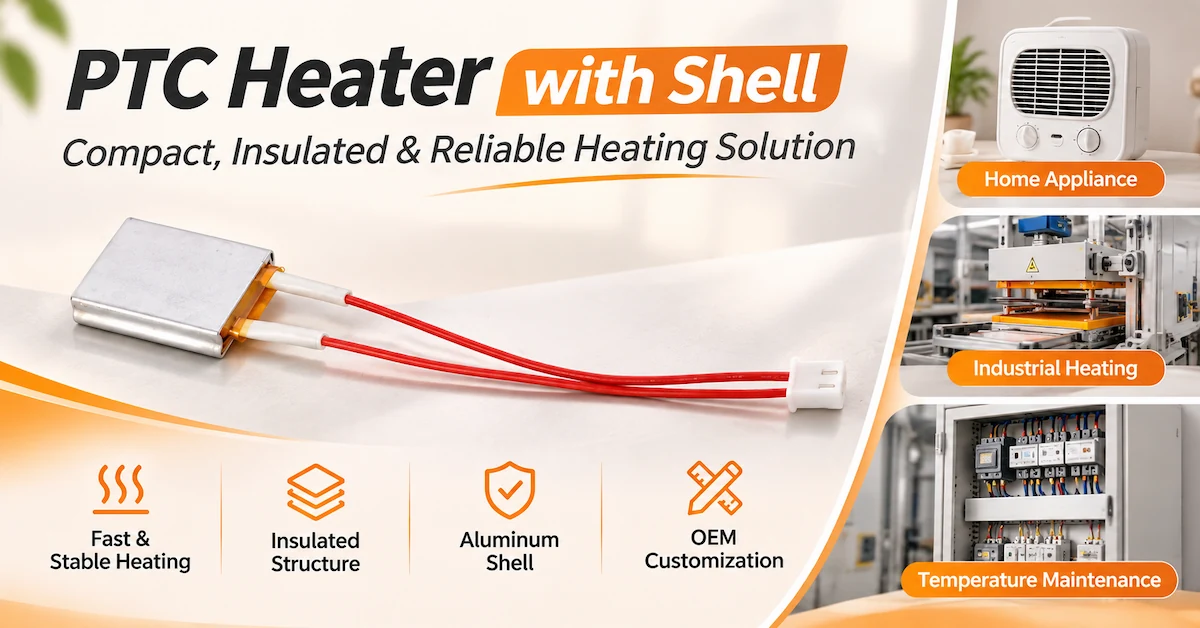
| Aluminum Shell PTC Heater | PTC heating element with an insulation layer and aluminum housing | Housing, thermal contact, mounting and insulation |
| PTC Heater with Insulating Film | Insulated PTC assembly with configurable electrical and structural options | Insulation construction, dimensions and integration |
These are product-development references.
They are not evidence of a confirmed MOQ, sample price, or delivery commitment for a particular project.
The buyer should request model-specific technical and commercial confirmation.
How Should Engineers Approve a PTC Heater Sample?
A prototype sample should not be approved merely because it becomes hot when power is applied.
The sample must satisfy the intended equipment's requirements under defined test conditions.
Before testing begins, agree on the acceptance criteria.
Table 4. PTC Heater Sample Acceptance Worksheet
| Inspection Item | Test Method or Measurement | Acceptance Requirement | Result |
|---|---|---|---|
| Part identification | Label and drawing review | Approved model and revision | Pass / Fail |
| Dimensions | Dimensional inspection | Approved drawing tolerances | Pass / Fail |
| Rated voltage | Specification review | Compatible with equipment supply | Pass / Fail |
| Cold resistance | Measurement at specified temperature | Model-specific range | Pass / Fail |
| Startup current | Current-versus-time measurement | Approved electrical limits | Pass / Fail |
| Heating power | Voltage and current under defined load | Approved power requirement | Pass / Fail |
| Warm-up behavior | Timed temperature measurement | Required heating performance | Pass / Fail |
| Operating temperature | Stabilized thermal measurement | Defined temperature limits | Pass / Fail |
| Temperature distribution | Measurements at critical locations | Approved uniformity requirement | Pass / Fail |
| Insulation | Applicable electrical test | Equipment-specific insulation requirement | Pass / Fail |
| Cable and connector | Visual, dimensional, electrical inspection | Approved assembly drawing | Pass / Fail |
| Mechanical fit | Installation trial | Correct mounting and clearance | Pass / Fail |
| Abnormal operation | Relevant controlled fault tests | Applicable protective requirements | Pass / Fail |
For prototype development, OEM engineers can evaluate Tianrui's MZ41 Ceramic PTC Heating Element and request model-specific electrical specifications, sample availability, and acceptance criteria before proceeding to pilot production.
The results must be recorded using actual measurements.
No universal startup current, warm-up time, or insulation-test voltage should be assumed for every PTC heater.
How many prototype samples are needed?
Sample quantity should reflect the test plan.
For example, a project may need separate specimens for:
-
Mechanical assembly trials.
-
Electrical performance measurements.
-
Thermal testing.
-
Environmental testing.
-
Destructive qualification.
-
Comparison after a design revision.
A component used in destructive testing cannot be treated as an approved reusable production reference.
The engineer should establish the sample allocation before requesting a quotation.
Should samples be tested inside the final equipment?
Where practical, yes.
A heater tested in open air may behave differently from the same component installed in an enclosure.
Cooling conditions, mounting contact, nearby materials, and power-supply behavior can change the actual results.
Testing should therefore progress from component-level verification to representative installed-system evaluation.
Sample approval decision
An engineering sample should receive one of three documented decisions:
| Status | Meaning | Next Action |
|---|---|---|
| Approved | Meets the defined acceptance criteria | Prepare pilot-run documentation |
| Conditionally accepted for further evaluation | Remaining issues are identified and controlled | Complete outstanding validation before production release |
| Rejected | Fails a required criterion | Investigate and revise the specification or design |
A conditional technical evaluation is not equivalent to final production approval.
How Can OEMs Prevent Differences Between Approved Samples and Mass Production?
A successful prototype proves that a particular configuration can meet the test requirements.
It does not automatically prove that future batches will be identical or consistently acceptable.
The transition to production introduces additional variables.
Common sources of variation
These may include:
-
Ceramic material characteristics.
-
Resistance–temperature behavior.
-
Electrode construction.
-
Element dimensions.
-
Insulating material or thickness.
-
Housing dimensions.
-
Assembly pressure.
-
Wire and connector substitutions.
-
Manufacturing process settings.
Not every variation is unacceptable.
The requirement is that critical characteristics remain within approved limits.
What is a golden sample?
A golden sample is a controlled physical reference representing an approved configuration.
For PTC heater development, it may help with visual, dimensional, and assembly comparisons.
However, a golden sample must not replace the technical specification.
A physical part cannot fully describe allowable resistance variation, current behavior, temperature tolerances, or test requirements.
Table 5. Prototype-to-Production Consistency Checklist
| Critical Characteristic | Approved Reference | Production Control |
|---|---|---|
| Ceramic configuration | Model-specific specification | Material and part identification |
| Resistance characteristic | Approved electrical limits | Incoming or process inspection |
| Curie or relevant temperature characteristic | Controlled datasheet | Supplier test and qualification records |
| Mechanical dimensions | Released drawing | Dimensional checks |
| Insulating structure | Approved material and construction | Material and assembly verification |
| Housing and mounting | Released assembly drawing | Manufacturing and fit inspection |
| Wiring and terminals | Approved BOM | Incoming and assembly verification |
| Heater performance | Approved test procedure | Defined production testing |
| Label and identification | Part number and revision | Lot identification |
| Engineering changes | Approved revision record | Change authorization |
What should happen when the supplier changes a material?
The buyer and supplier should agree in advance which changes require notification and approval.
Potentially significant changes may include:
-
Ceramic formulation or source.
-
Electrode material.
-
Insulation construction.
-
Housing material.
-
Connector type.
-
Critical manufacturing process.
-
Assembly location.
The effect of a change should be assessed before the revised component is accepted for production.
This is especially important when a low-volume project moves to higher recurring quantities.
How Do You Move from PTC Heater Sample Approval to a Pilot Run?
The pilot run is a distinct development stage.
Its purpose is to test whether the supplier and OEM can manufacture, inspect, assemble, and document the approved heater configuration consistently.
It should not simply be treated as a larger sample order.
Table 6. Three-Stage PTC Heater Approval Gate Matrix
| Approval Gate | Engineering Sample | Pilot Run | Volume Production |
|---|---|---|---|
| Primary objective | Prove design feasibility | Prove manufacturing repeatability | Supply approved configuration |
| Drawing | Prototype revision | Released pilot revision | Controlled production revision |
| BOM | Preliminary | Approved pilot BOM | Released production BOM |
| Electrical tests | Full engineering evaluation | Defined repeatability checks | Approved routine inspection |
| Thermal tests | Establish performance | Confirm representative units | Periodic or specified verification |
| Mechanical inspection | Fit and dimensions | First-article and in-process checks | Routine inspection |
| Traceability | Sample identification | Pilot lot identification | Production lot records |
| Commercial quantity | Agreed sample quantity | Agreed pilot quantity | Confirmed production MOQ |
| Change control | Engineering revision record | Controlled change approval | Formal production change control |
| Release decision | Engineering sign-off | Pilot approval | Production authorization |
Gate 1: Approve the engineering sample
Before the project advances, confirm:
-
The sample is linked to a defined model and revision.
-
Relevant electrical and thermal tests are complete.
-
Mechanical installation is acceptable.
-
Insulation and other applicable safety requirements have been evaluated.
-
Open technical issues have been resolved or formally dispositioned.
Gate 2: Release the pilot run
The pilot should use representative manufacturing methods and approved materials.
During the pilot, evaluate:
-
Setup repeatability.
-
Assembly consistency.
-
First-article inspection.
-
In-process inspections.
-
Electrical and thermal results.
-
Packaging and handling.
-
Nonconforming-product management.
-
Traceability.
The pilot quantity should be sufficient for its intended validation purpose.
It must be agreed with the supplier and should not be invented from a generic MOQ recommendation.
Gate 3: Authorize volume production
The production release should confirm that:
-
The drawings and BOM are controlled.
-
Testing requirements are approved.
-
Pilot issues are closed.
-
Purchasing and delivery conditions are agreed.
-
Engineering changes have documented approval.
-
Incoming inspection and lot traceability requirements are established.
A passing pilot run is a production-readiness decision—not merely evidence that the heater can generate heat.
What Quality Control Checkpoints Matter Before Full Production?
Low-volume projects can still require disciplined quality control.
In fact, a small pilot may be the best opportunity to identify process weaknesses before repeat orders begin.
Table 7. Pilot-Run Quality Control Checkpoints
| Checkpoint | Main Verification | Typical Record |
|---|---|---|
| Incoming materials | Approved ceramic, housing, insulation and terminals | Material identification record |
| First-article inspection | Dimensions and critical assembly characteristics | First-article report |
| In-process inspection | Relevant assembly and electrical characteristics | Process inspection record |
| Functional testing | Defined resistance, power or heating performance | Test record |
| Final inspection | Identification, construction and required electrical checks | Final inspection report |
| Packaging | Protection and labeling | Packaging approval |
| Pilot review | Yield, defects, test results and corrective actions | Pilot summary and release decision |
What standards can inform qualification?
Depending on the component and application, useful authoritative references include:
IEC 60738-1:2022 — Directly Heated PTC Thermistors
This standard covers terminology, inspection procedures, and test methods for directly heated positive-temperature-coefficient thermistors within its scope.
It can help establish consistent component-level terminology and verification methods.
It does not replace testing of a complete heating appliance.
IEC 60068-2-14:2023 — Change of Temperature Testing
This publication provides methods for testing specimens under specified ambient-temperature changes.
It may be relevant when a PTC heater assembly requires qualification for repeated temperature changes.
Test severity and acceptance criteria must be selected for the intended application.
ISO 9001:2026 — Quality Management Systems
The current ISO 9001 edition provides a framework for establishing and maintaining a quality management system.
Its quality-management principles are relevant to maintaining consistency as a project moves between development and repeat production.
Referencing these standards does not imply that Tianrui or a particular heater product holds a corresponding certification.
Which Documents Should Follow a PTC Heater from Prototype to Production?
The most important transition is from an informal prototype arrangement to a controlled product definition.
Without documentation, even a technically successful sample can create problems during repeat procurement.
Table 8. Required OEM Handover Document Checklist
| Document | Purpose |
|---|---|
| Approved component datasheet | Defines electrical and thermal characteristics |
| Released mechanical drawing | Defines dimensions and mounting |
| Approved BOM | Defines materials and components |
| Test and acceptance specification | Establishes measurable pass/fail limits |
| Prototype test report | Records engineering validation |
| Approved sample reference | Supports construction comparison |
| Pilot-run inspection report | Documents manufacturing repeatability |
| Engineering change record | Tracks revisions and approvals |
| Quality control plan | Defines production inspection |
| Packaging specification | Defines protection and identification |
| Supplier quotation and purchase terms | Controls quantity, pricing and delivery |
How should revisions be managed?
A change to the ceramic, housing, insulation, wiring, or critical process may affect performance.
The OEM should therefore require the supplier to identify:
-
What changed.
-
Why the change was proposed.
-
Which part numbers and revisions are affected.
-
Which tests must be repeated.
-
Who is authorized to approve the change.
-
When the revised configuration may enter production.
Practical rule:
The approved sample, drawing revision, BOM revision, and purchasing specification must all refer to the same product configuration.
Low MOQ PTC Heater Supplier RFQ Template for OEM Buyers
A clear RFQ helps suppliers distinguish between engineering sample requests and recurring production requirements.
It also reduces the risk of receiving quotations that assume different product structures or testing scopes.
Copy-Ready OEM RFQ Email
Subject: Low MOQ PTC Heater Prototype Request — Sample Testing and Pilot-Run Quotation
Dear Tianrui Electronics Team,
We are developing an OEM product that requires a PTC heating element or heating assembly.
Our project is currently in the prototype evaluation stage, and we would like to discuss engineering samples, a possible low-volume pilot run, and future production requirements.
Application Information
-
Product application: [Application]
-
Heater construction: [Ceramic / aluminum shell / insulated assembly]
-
Rated supply voltage: [AC or DC, voltage]
-
Required heating performance: [Temperature, power, or heat-up target]
-
Operating conditions: [Ambient temperature and thermal load]
-
Installation dimensions: [Drawing or dimensions]
-
Wiring and connector requirements: [Details]
-
Required insulation or environmental conditions: [Details]
Purchasing Requirements
-
Engineering sample quantity: [Quantity]
-
Pilot-run quantity: [Estimated quantity]
-
Estimated annual production demand: [Forecast]
-
Target sample schedule: [Date]
-
Target pilot-run schedule: [Date]
Please confirm:
-
Whether a standard model or customized design is more appropriate.
-
The available engineering sample quantity and sample cost.
-
Any design, tooling, or setup charges.
-
The minimum quantity for a pilot run.
-
The MOQ and price breaks for future production.
-
Estimated preparation and production lead times.
-
Available technical drawings and test documentation.
-
The process for approving samples and controlling design revisions.
We can provide our initial specification, drawing, and application information for engineering review.
Please advise the next steps for sample evaluation.
Best regards,
[Company / Contact Person]
What should happen after sending the RFQ?
A useful supplier response should identify:
-
The recommended product configuration.
-
Outstanding technical questions.
-
Proposed sample scope.
-
Commercial assumptions.
-
Required approval documents.
-
Sample and pilot-run expectations.
-
Limitations or technical risks requiring clarification.
Do not treat an RFQ response as final approval of the component.
Engineering suitability still needs to be demonstrated through testing.
Frequently Asked Questions About Low MOQ PTC Heater Suppliers
1. What is the minimum order quantity for a PTC heater?
There is no universal MOQ that applies to every supplier or heater configuration.
A standard ceramic element, customized element, and assembled heater may have different minimum quantities.
Request a quotation for the exact model and purchasing stage.
2. Can I order a PTC heater sample before placing a bulk order?
Suppliers may provide engineering samples for evaluation.
Tianrui's website describes sample preparation and customer testing before volume production planning.
Availability, quantity, price, and timing should be confirmed for the selected configuration.
3. Is a low MOQ PTC heater supplier suitable for hardware startups?
Potentially, yes.
A supplier able to review prototype requirements and discuss sample quantities can be useful for early-stage product development.
However, buyers should assess technical support, documentation, future supply conditions, and total development cost—not MOQ alone.
4. Are PTC heater prototype samples free?
Not necessarily.
Sample charges depend on the product and agreed commercial conditions.
Customized components may involve tooling, engineering, or special testing expenses.
Request a written quotation instead of assuming a free-sample policy.
5. What is the difference between a PTC heater sample and a pilot run?
A sample is used primarily to verify design feasibility and application performance.
A pilot run evaluates whether the approved configuration can be manufactured and inspected consistently using representative production processes.
The two stages should have separate acceptance criteria.
6. What should be tested before approving a PTC heater sample?
The test plan may include dimensions, cold resistance, startup current, operating power, warm-up performance, temperature behavior, insulation, wiring, and installed-system compatibility.
Acceptance limits must come from the approved product and equipment specifications.
7. Can I customize the voltage and dimensions of a PTC heater?
Customization may be possible depending on the ceramic or assembly structure.
Tianrui publishes options involving electrical characteristics, dimensions, electrodes, and certain heater configurations.
Technical feasibility and commercial terms must be confirmed for the individual request.
8. Why can mass-produced PTC heaters differ from approved samples?
Possible causes include material changes, manufacturing variation, assembly differences, or insufficient revision control.
A released specification, inspection plan, and engineering change process help reduce this risk.
9. Can a startup place small repeat orders after prototype approval?
That depends on the supplier's commercial agreement and the approved configuration.
A small engineering sample order does not automatically guarantee the same quantity terms for recurring production.
Confirm the repeat-order MOQ before approving the project budget.
10. What should I send to obtain an accurate low MOQ PTC heater quotation?
Provide the application, voltage, heating requirement, dimensions, installation conditions, required construction, sample quantity, pilot-run forecast, production demand, and applicable test requirements.
An existing heater sample or engineering drawing can make the review more efficient.
Conclusion
Finding a low MOQ PTC heater supplier is not simply about purchasing the smallest possible quantity.
For OEM development teams, the real value is establishing a practical route from initial requirements to an approved component that can be manufactured repeatedly.
A reliable development process should include:
-
Clear commercial confirmation: Separate prototype quantity, sample charges, tooling, pilot MOQ, and production MOQ.
-
Complete technical requirements: Define voltage, power, temperature, dimensions, insulation, and installation conditions.
-
Measured sample approval: Test the heater against agreed electrical, thermal, and mechanical acceptance criteria.
-
Controlled specifications: Link the approved sample to the correct drawing, BOM, and revision.
-
Representative pilot testing: Verify manufacturing repeatability and quality controls.
-
Production readiness: Confirm inspection requirements, change control, commercial conditions, and traceability.
An approved PTC heater prototype is the beginning of the supply qualification process.
A successful PTC heater sample does not eliminate the need for pilot-run verification.
Dongguan Tianrui Electronics Co., Ltd. publishes customizable ceramic PTC heating elements and assembled heater configurations, along with a development process that includes requirement review, engineering samples, and production planning.
For projects requiring prototype evaluation, buyers can review Tianrui's Ceramic PTC Heating Elements, Aluminum Shell PTC Heaters, and PTC Heater with Insulating Film.
Need PTC Heater Samples for an OEM Prototype?
Contact Tianrui Electronics for a Prototype and Pilot-Run Quotation
Share your required voltage, heating performance, dimensions, drawings, sample quantity, pilot-run forecast, and expected production volume.
Ask Tianrui's team to review the technical requirements and confirm whether the required sample, customization, and quantity arrangements are commercially feasible.
Email:
Phone:
+86 135 3277 2961
A well-defined sample acceptance plan, controlled product specification, and documented pilot-run approval process can help OEM teams reduce prototype uncertainty and prepare for repeat production with greater confidence.