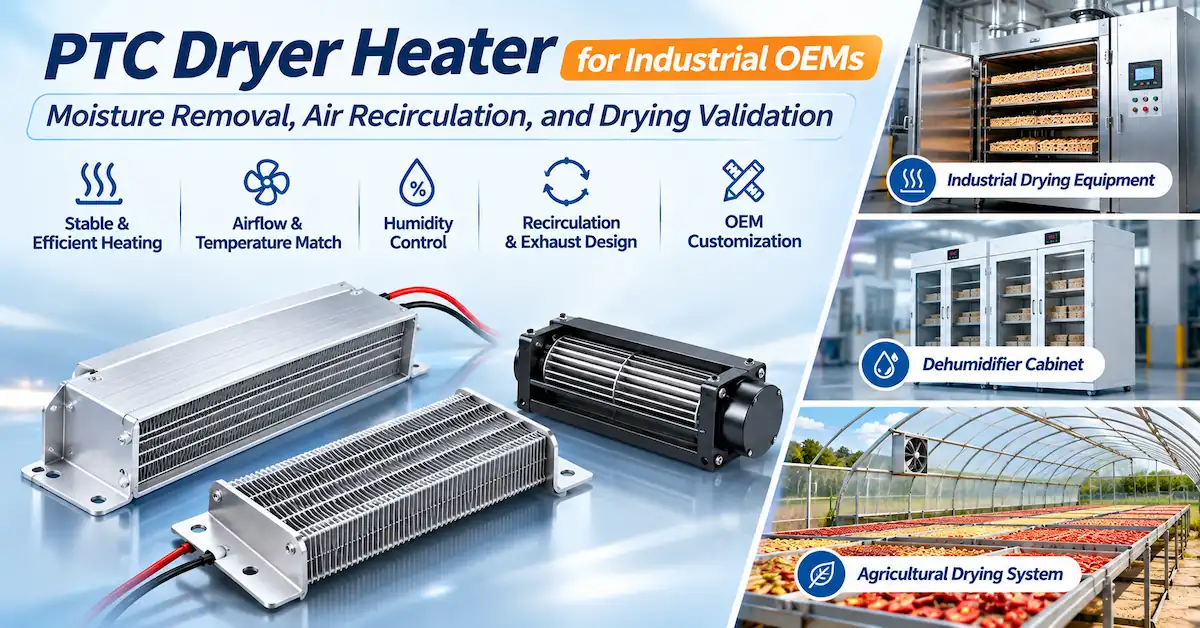
TL;DR: A PTC Dryer Heater supplies controlled electrical heat to an industrial drying system, but heating alone does not remove moisture. Effective drying requires a combination of heat transfer, airflow across the material, and a method of removing water vapor from the system. For OEM equipment, heater selection should begin with the required water-removal rate, allowable product temperature, air recirculation strategy, and exhaust or dehumidification capacity. The selected PTC heater must then be qualified for electrical loading, humid environments, airflow restrictions, and long-term production consistency.
Industrial drying equipment manufacturers face a challenge that is often misunderstood during heating-element selection.
The objective of a dryer is not simply to produce hot air. It is to remove a specified amount of moisture from a product within an acceptable time while maintaining product quality and safe equipment operation.
A heater with a higher nominal wattage does not necessarily shorten a drying cycle if the equipment cannot remove the evaporated water from its air stream.
Similarly, increasing fan airflow may improve air distribution without achieving faster drying if the circulating air has already absorbed substantial moisture.
For manufacturers of industrial drying cabinets, dehumidifier cabinets, agricultural drying equipment, commercial laundry systems, and process dryers, these differences directly affect product performance.
A PTC Dryer Heater provides a heat source using positive temperature coefficient ceramic technology. Its resistance increases significantly within a designed temperature region, allowing electrical heating power to respond to changing ceramic temperature and heat-transfer conditions.
However, successful dryer design still requires appropriate moisture management, airflow engineering, temperature sensing, and protective systems.
The most important purchasing question is not "How many watts does the heater produce?" but "Can the complete dryer remove the required moisture at the specified temperature, airflow, and operating cost?"
This guide explains how to evaluate that question using moisture-balance calculations, heater selection criteria, drying-system comparisons, representative Tianrui products, and practical OEM qualification methods.
Dongguan Tianrui Electronics Co., Ltd. supplies PTC air-heating components and supports application-specific heater development. OEM buyers can explore its PTC Heater products and custom heating solutions when developing industrial drying equipment.
How Do Industrial PTC Drying Systems Compare Side by Side?
The first design decision is how the equipment will remove moisture after it evaporates from the product.
Heating, air circulation, and moisture removal are separate functions.
Table 1. Industrial Drying System Comparison
| Comparison Dimension | Exhaust-Air Dryer | Recirculating Dryer with Controlled Exhaust | Closed-Loop Condensing Dryer |
|---|---|---|---|
| Heating function | Heats incoming air | Heats recirculated and makeup air | Heats or reheats circulating air |
| Moisture removal | Humid air discharged outside | Controlled exhaust removes water vapor | Moisture condensed or otherwise extracted |
| Air recirculation | Limited or none | Partial to substantial recirculation | Generally high recirculation |
| Heat-loss concern | Warm exhaust carries energy away | Balance between exhaust and heat retention | Depends on condensation and heat-recovery system |
| Humidity control | Makeup and exhaust conditions | Exhaust ratio and air conditions | Condensation or dehumidification capacity |
| Main design advantage | Conceptually straightforward moisture removal | Flexible balance between energy use and moisture removal | Can reduce dependence on outdoor makeup air |
| Main engineering challenge | Heating replacement air efficiently | Avoiding moisture accumulation | Managing condensate and dehumidification performance |
| Typical application direction | Ventilated drying tunnels | Industrial drying cabinets | Closed drying and dehumidification equipment |
Selection recommendation:
Choose the drying architecture according to the required moisture-removal process before selecting heater power.
A PTC air heater can provide heat within different dryer architectures, but it cannot replace the system's moisture-removal mechanism.
Key Takeaways
-
Heating air reduces its relative humidity when the moisture content remains constant, but it does not remove water vapor from the air.
-
Actual drying requires moisture to leave the material and subsequently leave the circulating air through exhaust, condensation, adsorption, or another suitable process.
-
Dryer heater power should be sized using moisture evaporation, sensible heating, and system heat-loss requirements.
-
Air recirculation can reduce makeup-air heating demand but may slow drying if moisture accumulates.
-
Exhaust airflow should be evaluated separately from internal recirculation airflow.
-
A PTC heater's self-regulating characteristic does not guarantee a precise drying temperature or complete equipment safety.
-
OEM buyers should test moisture-removal rate, temperature uniformity, humidity, electrical power, and relevant abnormal-operation behavior.
-
Customized heater dimensions, fins, insulation, mounting, and wiring should be specified according to the complete drying system.
1. What Does a PTC Dryer Heater Actually Do?
A PTC Dryer Heater converts electrical energy into heat using positive temperature coefficient ceramic elements.
PTC ceramics exhibit a strong increase in resistance when approaching a designed temperature region.
At approximately constant voltage, increasing resistance generally reduces current and electrical heating power.
The electrical relationship can be expressed as:
P = V² / R
Where:
-
P = electrical heating power.
-
V = applied voltage.
-
R = instantaneous ceramic resistance.
Because resistance changes with temperature, the electrical power of a PTC heater may vary throughout operation.
What happens inside a drying cabinet?
A typical forced-air drying process includes several stages:
-
The fan moves air through the equipment.
-
The PTC heating assembly transfers energy into the airflow.
-
Warm air contacts the moist material.
-
Heat supports evaporation of water from the material.
-
The air absorbs the evaporated moisture.
-
Moist air is exhausted, dehumidified, or otherwise processed.
-
Conditioned air returns to the drying chamber or is replaced by makeup air.
The heating element supplies one part of the required process.
The complete dryer must manage heat transfer and moisture transport simultaneously.
Why self-regulation matters
PTC ceramic resistance changes according to its temperature.
As heat removal changes, the ceramic operating temperature and electrical power may also change.
This can be useful in equipment exposed to changing airflow or thermal loads.
However, the ceramic temperature is not necessarily the same as the temperature of the drying material or circulating air.
Independent temperature sensing and suitable control may still be required.
2. Why Does Heating Air Not Automatically Remove Moisture?
This distinction is essential for industrial drying equipment design.
Relative humidity describes how close air is to saturation at its current temperature.
When moist air is heated without adding or removing water vapor, its humidity ratio remains essentially unchanged.
However, the warmer air can hold more water vapor before reaching saturation, so its relative humidity decreases.
Example: heating humid air
Suppose air enters a heating element at a particular temperature and moisture content.
The heater increases the air temperature.
If no moisture is added or removed across the heater, the quantity of water vapor per unit mass of dry air remains approximately constant.
The relative humidity decreases.
This can increase the air's capacity to absorb additional moisture from a wet product.
However, once the air absorbs moisture, that water must be removed from the system to sustain the drying process.
The problem with fully enclosed recirculation
Consider a sealed cabinet with a heater and fan but no effective moisture-removal mechanism.
Initially, warm air may absorb moisture from the product.
As drying continues, water vapor accumulates inside the cabinet.
The air becomes increasingly humid.
The drying rate may decline because the driving force for evaporation decreases.
Simply increasing heating power may not resolve the problem.
Three methods of managing moisture
Ventilation:
Discharge humid air and replace it with suitably conditioned makeup air.
Condensation:
Cool part of the moist air below its dew point to collect water, then reheat as needed.
Adsorption or desiccant drying:
Use an appropriate moisture-removing material or process.
The best method depends on the required humidity, temperature, equipment size, and energy strategy.
3. How Much Water Must an Industrial Dryer Remove?
A drying system should be sized using the actual amount of moisture to be removed.
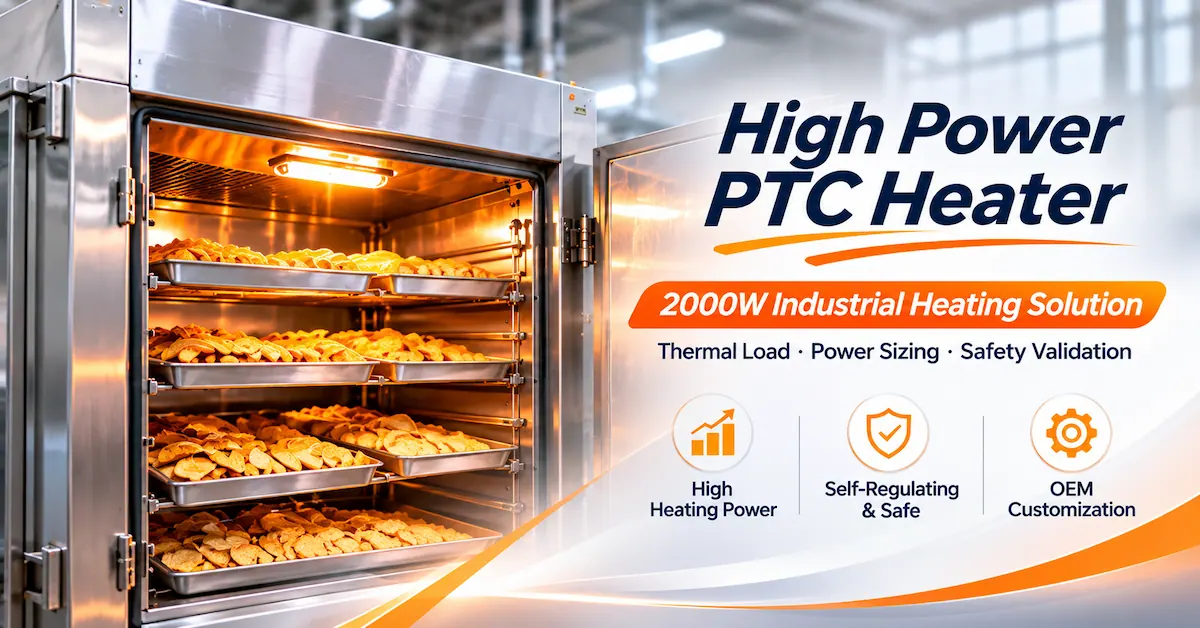
This calculation should be completed before choosing a 1000W, 2000W, or 3000W heater.
Wet-basis moisture content
Wet-basis moisture content is defined as:
Moisture (wet basis) = Water Mass / Total Wet Material Mass
The dry-solid mass is assumed constant when only water is removed.
Illustrative drying batch
Consider an OEM drying cabinet with these hypothetical requirements:
| Parameter | Value |
|---|---|
| Initial wet material mass | 20 kg |
| Initial moisture content | 25% wet basis |
| Target moisture content | 10% wet basis |
| Target drying time | 3 hours |
Initial water mass:
20 × 0.25 = 5 kg
Dry-solid mass:
20 − 5 = 15 kg
At the target 10% wet-basis moisture content, the dry solids represent 90% of the final mass.
Final total mass:
15 / 0.90 = 16.67 kg
Final water mass:
16.67 − 15 = 1.67 kg
Water to remove:
5 − 1.67 = 3.33 kg
Required average evaporation rate
For a three-hour drying process:
3.33 / 3 = 1.11 kg of water per hour
This is the average moisture-removal requirement.
The actual evaporation rate may be higher at the beginning and lower toward the end of the drying cycle.
Why this calculation matters
A heater should not be selected simply because the wet material weighs 20 kg.
The required moisture removal depends on the initial and final water content, the product's properties, and the acceptable cycle time.
Different materials also have different drying characteristics.
The same heater may deliver different results for textiles, grains, coated components, or moisture-sensitive electronic assemblies.
4. How Much Thermal Energy Does Moisture Evaporation Require?
Evaporating water requires thermal energy.
A simplified estimate can be made using the mass of water removed and its latent heat of vaporization.
Basic evaporation energy relationship
Eevap ≈ mwater × hfg
Where:
-
Eevap = evaporation energy.
-
mwater = water mass removed.
-
hfg = latent heat of vaporization at the relevant condition.
For an illustrative preliminary estimate at moderate drying temperatures, use approximately 2400 kJ/kg.
The actual value depends on temperature and process conditions.
Example using the 20 kg drying batch
Water to remove:
3.33 kg
Estimated evaporation energy:
3.33 × 2400 = 7992 kJ
Convert to kWh:
7992 / 3600 ≈ 2.22 kWh
This is an approximate latent-energy requirement.
Average useful power for evaporation
Over three hours:
2.22 / 3 = 0.74 kW
Therefore, the average latent-heat demand is approximately 740W under the illustrative assumptions.
Why a 740W heater is not necessarily enough
The equipment also requires energy to:
-
Raise the material temperature.
-
Warm the liquid water before evaporation.
-
Heat the drying chamber and internal structures.
-
Condition incoming makeup air.
-
Replace heat lost through the enclosure.
-
Compensate for other process losses.
The actual electrical input required may be considerably greater.
The latent-energy estimate should be incorporated into a complete process energy balance.
Important:
Air-heating calculations and evaporation-energy calculations describe interacting energy flows. They should not be added blindly without a consistent system boundary, because doing so may double-count energy already represented in the airflow enthalpy balance.
5. How Much Exhaust Air Is Needed to Remove the Moisture?
The air system must carry evaporated water away from the drying chamber.
A simplified steady-state moisture balance relates water removal to the difference between the moisture content of exhaust and makeup air.
Moisture balance equation
mwater = mdry air × (wexhaust − wmakeup)
Where:
-
mwater = water removed per unit time.
-
mdry air = dry-air mass flow exhausted per unit time.
-
wexhaust = exhaust-air humidity ratio.
-
wmakeup = makeup-air humidity ratio.
Humidity ratio is normally expressed as kilograms of water vapor per kilogram of dry air.
Illustrative exhaust calculation
Assume the required water-removal rate is:
1.11 kg/h
Suppose the exhaust air contains 0.007 kg more water vapor per kilogram of dry air than the makeup air.
Required dry-air exhaust flow:
1.11 / 0.007 ≈ 159 kg dry air/h
The equipment would need an exhaust and makeup-air arrangement capable of supporting approximately this dry-air mass flow under the stated assumptions.
What does this mean for recirculation?
A drying cabinet may circulate much more air internally than it exhausts.
Internal airflow helps distribute heat and remove water vapor from product surfaces.
Exhaust airflow removes moisture from the overall equipment.
The two flow rates should not be confused.
Why actual humidity measurements matter
The moisture pickup of air depends on the actual inlet and exhaust conditions.
Engineers should measure or estimate humidity ratio using suitable psychrometric methods.
Relative humidity alone is not sufficient for a complete moisture balance unless temperature and pressure conditions are also known.
For OEM dryer selection, the heater and air system must be evaluated together.
6. How Should Recirculation and Exhaust Be Balanced?
Air recirculation can help retain heat within the drying equipment.
However, recirculated air may carry increasing moisture.
The challenge is to balance heat retention with sufficient moisture removal.
High exhaust fraction
A larger exhaust fraction can remove humid air more rapidly when suitable makeup air is available.
However, it may increase the energy needed to heat replacement air.
High recirculation fraction
Recirculation can reduce the amount of cool makeup air entering the heater.
This may reduce some sensible heating demand.
However, insufficient exhaust or dehumidification can allow humidity to rise and slow drying.
Controlled recirculation
An OEM may use dampers, sensors, fans, and control logic to adjust exhaust and recirculation during different drying stages.
For example, the equipment may use one airflow strategy during warm-up and another during moisture removal.
The appropriate sequence depends on the product and equipment.
Table 2. Recirculation and Exhaust Trade-Offs
| Design Strategy | Potential Benefit | Main Risk | Engineering Response |
|---|---|---|---|
| Mostly fresh air | Strong moisture-removal potential | Greater makeup-air heating demand | Evaluate exhaust humidity and heat recovery |
| Partial recirculation | Balance moisture removal and heating demand | Requires airflow control | Monitor humidity and temperature |
| High recirculation | Reduced fresh-air heating demand | Moisture accumulation | Provide adequate exhaust or dehumidification |
| Closed-loop condensation | Retains circulating air | Requires effective condensate removal | Verify condenser and reheat operation |
Recommended control approach
For moisture-sensitive applications, measure temperature and humidity at relevant positions.
Possible measurements include:
-
Supply-air temperature.
-
Return-air temperature.
-
Exhaust-air temperature.
-
Exhaust or return humidity.
-
Product temperature.
-
Condensate or moisture-removal rate.
The control system should respond to the actual drying requirement, not merely keep the heater energized.
7. How Should Airflow and Heater Power Be Matched?
Forced-air heating performance depends on airflow and temperature rise.
A simplified sensible air-heating equation is:
Pair = ρ × V̇ × cp × ΔT
Where:
-
Pair = heat transferred to air.
-
ρ = air density.
-
V̇ = volumetric airflow.
-
cp = air specific heat.
-
ΔT = air temperature increase.
Illustrative heater sizing
Assume:
-
Airflow through the heater: 250 m³/h.
-
Heater inlet temperature: 25°C.
-
Target heater outlet temperature: 45°C.
-
Temperature increase: 20°C.
-
Assumed air density: 1.2 kg/m³.
-
Assumed specific heat: 1005 J/(kg·K).
Convert airflow:
250 / 3600 = 0.0694 m³/s.
Calculate:
Pair = 1.2 × 0.0694 × 1005 × 20
Pair ≈ 1675W
This represents the approximate sensible heat needed for the specified air stream and temperature increase.
It is not a complete drying-system energy calculation.
Why the actual PTC rating may differ
A nominal 1800W or 2000W heater does not necessarily deliver that amount of useful heat under every operating condition.
PTC ceramic resistance changes with temperature.
The actual electrical power can also depend on airflow and inlet temperature.
Heat may transfer into surrounding structures instead of entering only the intended air stream.
What should an OEM test?
Measure airflow, heater terminal voltage, current, electrical power, and inlet and outlet temperatures simultaneously.
For dryers with recirculated air, use actual return-air conditions rather than assuming the heater always receives room-temperature air.
For a detailed explanation of fan operating points and duct resistance, see Tianrui's PTC Air Heater Airflow Selection Guide.
8. Which Tianrui PTC Dryer Heaters Are Suitable for OEM Evaluation?
Tianrui Electronics publishes several PTC air-heating products relevant to industrial and commercial drying equipment.
The available product families differ in nominal power, mechanical configuration, and intended use.
Table 3. Tianrui PTC Dryer Heater Comparison
| Product | Published Electrical Configuration | Construction | Potential Application |
|---|---|---|---|
| PTC Dryer Heater for Dehumidifier Cabinet | 220V, 3000W or customized | Aluminum air-heating assembly | Industrial drying cabinets, greenhouse drying systems |
| PTC Air Heater Dryer | 220V, 1500–4500W or customized | Aluminum PTC air heater | Larger industrial drying equipment |
| Corrugated PTC Air Heater | 220V, 1000W–2000W options | Corrugated aluminum heating structure | Commercial drying boxes and cabinets |
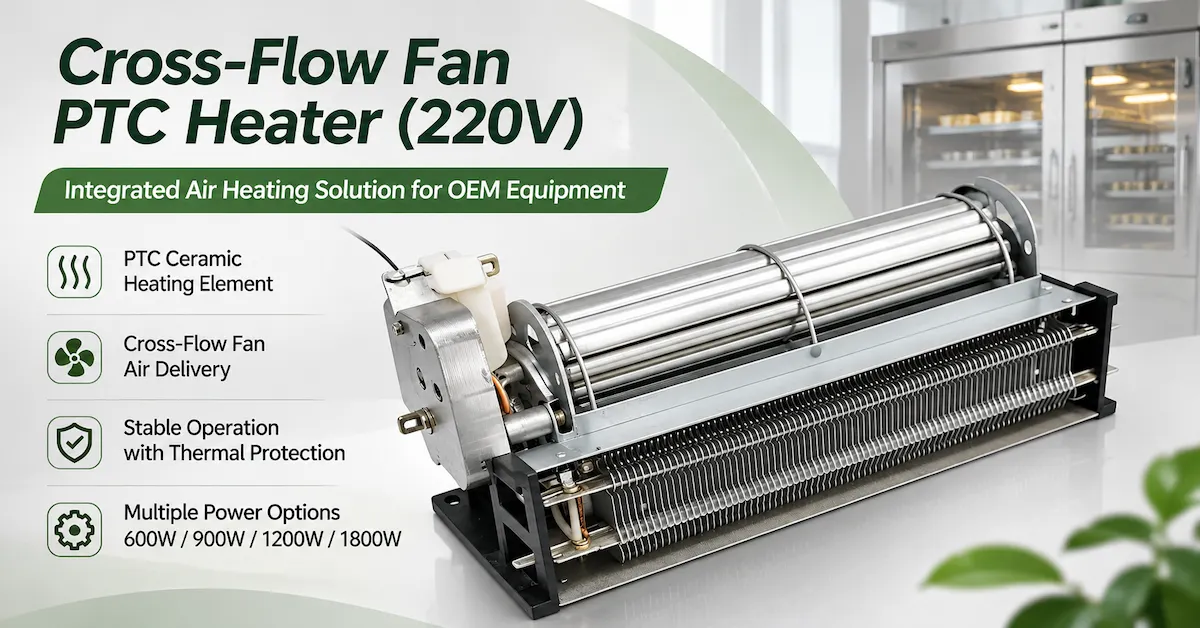
| Cross-Flow Fan PTC Heater | 220V, 600W–1800W options | Integrated fan-heater assembly | Wide cabinet airflow and warming equipment |
These are manufacturer-published catalog ranges. Exact availability, dimensions, temperature behavior, and test conditions must be confirmed for the ordered product.
PTC Dryer Heater for Dehumidifier Cabinets
Tianrui publishes a PTC Dryer Heater for Dehumidifier Cabinet and Industrial Drying Systems.
Its listed specification includes:
-
Nominal voltage: 220V.
-
Listed power: 3000W or customized.
-
Heating medium: air.
-
Material: aluminum.
-
Dimensions: customized.
The product is described for industrial drying cabinets, greenhouse drying equipment, and other moisture-related heating applications.
However, the heater itself is a heat source. The equipment must still have a suitable method for removing moisture from the air.
PTC Air Heater Dryer 1500–4500W
The PTC Air Heater Dryer 1500–4500W product family includes multiple listed power options.
Although its URL mentions 12V and 220V, the specification table identifies 220V.
Buyers should confirm the actual voltage for the required configuration rather than assuming that every power option is offered at both voltages.
This family may be relevant for larger air-heating systems, subject to engineering validation.
Corrugated PTC Air Heater
Tianrui's catalog includes 1000W, 1500W, 1600W, 1800W, and 2000W corrugated PTC air-heater configurations.
These use aluminum heat-transfer structures and are listed for dryers and drying boxes.
They are relevant when an OEM already has a suitable fan and airflow path.
See the PTC Air Heater product category for available configurations.
Cross-Flow Fan PTC Heater
The 600W–1800W Cross-Flow Fan PTC Heater combines a PTC heating component with a cross-flow blower.
Its elongated air-distribution pattern may suit certain drying cabinets.
The actual temperature uniformity, airflow, and acoustic behavior should be measured in the final enclosure.
9. What Makes a PTC Dryer Heater Suitable for High-Humidity Equipment?
Drying equipment frequently operates with warm, moisture-laden air.
This can expose electrical connections, insulation, metal structures, and fans to challenging conditions.
The suitability of a heater depends on its complete construction and the expected environment.
Condensation exposure
During startup, shutdown, or temperature changes, surfaces may fall below the local air dew point.
Condensation can then form on exposed components.
The equipment designer should identify where moisture may collect and whether drainage or protection is necessary.
Corrosion and contamination
Industrial drying air may contain moisture, lint, dust, product residues, or other contaminants.
Material selection and cleaning arrangements should reflect the actual exposure.
A heater described as moisture-resistant should not automatically be considered waterproof or suitable for corrosive chemicals.
Electrical insulation
Insulation must remain appropriate under the intended humidity, temperature, and contamination conditions.
A product's published voltage rating does not establish environmental suitability by itself.
Fan reliability
Fan bearings, motors, wiring, and connectors may experience humid air, elevated temperatures, or contamination.
The complete air-moving system should be evaluated.
High-humidity qualification checklist
| Environmental Concern | Recommended Evaluation |
|---|---|
| Condensation | Inspect likely cold surfaces and liquid accumulation |
| High relative humidity | Verify relevant electrical insulation behavior |
| Dust and lint | Assess accumulation and cleaning requirements |
| Corrosive exposure | Review materials for the intended environment |
| Temperature cycling | Evaluate mounting and electrical connections |
| Continuous operation | Confirm the expected duty and temperatures |
| Shutdown condensation | Evaluate moisture exposure during cooling |
| Cleaning | Determine safe maintenance procedures |
These checks should be adapted to the exact dryer application.
10. Which Industrial Drying Applications Benefit from PTC Heaters?
PTC drying heaters can be evaluated for several types of equipment, but each industry has different process requirements.
Industrial dehumidifier cabinets
These cabinets may be used for moisture-sensitive tools, components, or stored materials.
The heater can assist temperature control, but effective moisture reduction requires an appropriate dehumidification or ventilation process.
For moisture-sensitive electronics, the allowable temperature and humidity range should be defined according to the actual components.
Agricultural drying equipment
Crop, seed, and herb drying systems may require controlled air temperature and humidity.
Excessive temperatures can damage sensitive products.
Drying kinetics, air distribution, and product-specific quality criteria should guide the design.
Commercial textile drying
Textiles and garments can present changing moisture loads during a cycle.
Relevant requirements include temperature uniformity, airflow, lint management, and the prevention of unacceptable material temperatures.
Industrial material drying
Some manufactured components require the removal of surface moisture before subsequent processing.
The heater must be compatible with the material and process.
Where drying releases combustible dust or flammable vapors, special hazardous-process requirements may apply.
A general-purpose PTC heater should not be assumed suitable for such environments.
Food-related drying systems
Food drying may require controlled product temperature, airflow, cleaning, and material compatibility.
The heater is only one part of the process.
Food safety and equipment requirements must be considered independently.
Application comparison
| Application | Main Drying Concern | Important OEM Requirement |
|---|---|---|
| Dehumidifier cabinet | Moisture accumulation | Humidity removal and condensation management |
| Agricultural dryer | Product quality | Controlled temperature and moisture endpoint |
| Textile dryer | Variable wet loads | Airflow, temperature, lint management |
| Industrial component dryer | Repeatability | Defined drying cycle and material compatibility |
| Commercial drying cabinet | Uneven drying | Air distribution and humidity control |
11. How Can OEMs Improve Drying Efficiency Without Increasing Heater Wattage?
Improving a dryer's energy performance does not necessarily mean installing a larger heating element.
The more effective approach is to identify where energy and drying capacity are lost.
Mechanical moisture removal
Where appropriate for the material, pressing, draining, or spinning can remove liquid water before thermal drying.
This may reduce the amount of water that must be evaporated.
Airflow distribution
Uneven airflow can create areas that dry more slowly.
Improved circulation may reduce overall cycle time when airflow distribution is the limiting factor.
Controlled exhaust
Excessive exhaust can waste heat by removing large amounts of warm air.
Insufficient exhaust can allow humidity to accumulate.
The optimum setting depends on the moisture load and makeup-air conditions.
Thermal insulation
Reducing enclosure heat loss may lower the heat input required to maintain operating conditions.
Insulation must remain suitable for the equipment's temperature and safety requirements.
Heat recovery
Appropriate heat-recovery methods may reduce the energy needed to condition makeup air.
The design must consider contamination, condensation, maintenance, and process requirements.
Moisture-based cycle termination
A dryer controlled only by time may continue operating after the material reaches its required moisture level.
Where technically appropriate, a controlled endpoint based on humidity, product mass, or another validated measurement may improve repeatability.
Measuring actual energy efficiency
A useful performance metric is:
Specific Energy Consumption = Total Energy Used / Water Removed
For example, if a hypothetical dryer uses 4.0 kWh during a batch and removes 1.5 kg of water:
SEC = 4.0 / 1.5
SEC ≈ 2.67 kWh/kg of water removed
This is an illustrative calculation, not a Tianrui test result.
For valid comparisons, the complete equipment energy boundary must be defined consistently.
12. What Temperature and Humidity Controls Should a PTC Dryer Use?
PTC self-regulation responds primarily to ceramic temperature.
It does not directly control product moisture content.
A more complete drying system may require several sensors and operating controls.
Supply-air temperature
This indicates the temperature of air entering the drying chamber.
It is useful for controlling the thermal exposure of the material.
Return-air temperature
This helps evaluate the condition of air leaving the product region.
Humidity sensing
Humidity sensors can provide information about the moisture condition of the circulating or exhaust air.
Relative humidity should be interpreted together with temperature.
Product temperature
For temperature-sensitive materials, direct product-temperature measurement may be important.
Airflow monitoring
A fan failure or blocked duct can affect both drying performance and thermal safety.
Relevant systems may require airflow or fan-status monitoring.
Control architecture
Depending on the equipment, the controller may coordinate:
-
PTC heater operation.
-
Fan speed.
-
Exhaust dampers.
-
Makeup-air intake.
-
Temperature setpoints.
-
Humidity limits.
-
Condensation or dehumidification operation.
-
Fault shutdown.
Tianrui also supplies NTC Temperature Sensor assemblies, which may be considered for suitable temperature-feedback applications.
Humidity sensors and other controls must be selected separately according to the system requirements.
13. How Should a PTC Dryer Heater Be Tested Before OEM Production?
A successful heater prototype should demonstrate performance inside the actual dryer.
An open-bench power-on test is not enough.
Table 4. Recommended OEM Dryer Validation Matrix
| Test | Measurement | Purpose |
|---|---|---|
| Cold-start electrical test | Current and power versus time | Assess electrical loading |
| Stabilized operation | Heater voltage, current, power | Confirm operating behavior |
| Airflow measurement | Actual flow through the heater | Verify fan and heater integration |
| Temperature mapping | Multiple chamber locations | Evaluate drying uniformity |
| Humidity measurement | Inlet, return, and exhaust conditions | Assess moisture transport |
| Moisture-removal test | Water removed per unit time | Verify drying performance |
| Exhaust variation | Moisture removal and energy consumption | Evaluate control strategy |
| Recirculation variation | Humidity and temperature response | Assess moisture accumulation |
| Fan failure | Heater and surrounding temperatures | Evaluate abnormal operation |
| Restricted airflow | Temperature and protection response | Assess cooling loss |
| Condensation exposure | Insulation and component condition | Evaluate humid-environment suitability |
| Thermal cycling | Mechanical and electrical changes | Assess durability |
| Extended operation | Performance over intended duty | Evaluate operating stability |
| Final functional inspection | Agreed critical characteristics | Support production release |
Why moisture-removal testing is essential
A heater may achieve the required air temperature but fail to remove moisture at the required rate.
A complete dryer qualification should therefore include actual product-moisture measurements.
Depending on the process, this may involve sample mass, moisture-content testing, condensate measurement, or other appropriate methods.
Define repeatable conditions
Document:
-
Heater model and revision.
-
Applied voltage.
-
Material type and load.
-
Initial moisture content.
-
Target moisture content.
-
Airflow and exhaust conditions.
-
Ambient temperature and humidity.
-
Sensor positions.
-
Test duration.
-
Acceptance criteria.
The resulting evidence is much more useful for procurement than a general statement that the heater provides efficient drying.
14. What Safety Requirements Matter in Industrial Drying Equipment?
Industrial dryers combine electrical heating, moving air, moisture, and potentially combustible materials.
Their safety assessment must cover the complete equipment.
PTC self-regulation is not a complete protective system
The ceramic's resistance increase can reduce electrical input at elevated temperature.
However, nearby components may still overheat.
A dryer may also experience fan failure, blocked airflow, lint accumulation, or control faults.
Important protective considerations
-
Suitable electrical insulation.
-
Overcurrent protection.
-
Appropriate grounding.
-
Fan or airflow monitoring.
-
Temperature-limit controls.
-
Independent thermal protection where required.
-
Safe shutdown behavior.
-
Maintenance and cleaning access.
-
Protection from condensation and contamination.
Industrial electroheating reference
IEC 60519-1:2020 provides general safety requirements for industrial electroheating equipment within its stated scope.
IEC 60738-1:2022 provides component-level terminology and test methods for directly heated PTC thermistors.
The applicable requirements depend on the equipment and destination market.
Referencing a standard does not establish product certification.
Combustible dust and vapors
Some drying processes may release combustible dust, solvent vapor, or other hazardous substances.
These applications can require specialized hazard analysis and equipment protection.
A standard PTC air heater should not be considered suitable for explosive or hazardous atmospheres without explicit qualification.
15. How Can OEM Buyers Evaluate a PTC Dryer Heater Manufacturer?
A qualified PTC Dryer Heater Manufacturer should understand the relationship between heater behavior and the complete drying system.
For commercial and industrial OEM projects, purchasing teams should evaluate both technical capability and manufacturing consistency.
Technical evaluation
Can the supplier explain the heater's actual electrical and thermal operating conditions?
Can it discuss the intended airflow and humidity environment?
Product configuration
Does the supplier offer an appropriate heater structure and power range?
Can installation dimensions and mounting requirements be reviewed?
Customization
Can the supplier evaluate drawings, wiring, heat-transfer geometry, and specialized assembly requirements?
Testing
Can relevant sample test information be supplied or discussed?
Can the OEM establish an agreed validation plan?
Quality control
How are electrical, dimensional, and assembly characteristics inspected?
Can the approved configuration be maintained during repeat orders?
Commercial evaluation
Can MOQ, tooling, sample requirements, and production lead time be confirmed?
Supplier assessment checklist
| Evaluation Area | Main Purchasing Question |
|---|---|
| Heating technology | Can the supplier match the required thermal duty? |
| Product architecture | Is the heater compatible with the dryer airflow system? |
| Humid-environment suitability | What construction and evidence support the intended exposure? |
| OEM customization | Can drawings and nonstandard requirements be reviewed? |
| Testing | What data can support engineering qualification? |
| Quality control | How are critical characteristics inspected? |
| Production consistency | Can repeat orders match the approved design? |
| Change management | Are relevant modifications controlled? |
| Commercial terms | Are project-specific MOQ and delivery conditions clear? |
Tianrui describes heater structure design, material selection, drawing support, mold development, and technical consultation through its PTC Heater Customized Solutions.
Specific performance and commercial requirements should be confirmed during project evaluation.
16. OEM Engineering Example: Selecting a PTC Heater for a Dehumidifier Drying Cabinet
The following example demonstrates how an equipment manufacturer could evaluate a drying heater.
This is a hypothetical engineering scenario, not a documented Tianrui customer project or factory test result.
Project background
An OEM is developing a commercial drying cabinet for moisture-sensitive materials.
The intended equipment uses recirculated warm air and a controlled moisture-removal arrangement.
Initial requirements
| Parameter | Illustrative Value |
|---|---|
| Wet material load | 20 kg |
| Initial moisture | 25% wet basis |
| Final moisture | 10% wet basis |
| Drying time | 3 hours |
| Electrical supply | 220V |
| Heater configuration | To be selected |
| Airflow arrangement | Recirculation with controlled moisture removal |
Stage 1: Determine the moisture load
The required water removal is approximately 3.33 kg.
The average evaporation rate is approximately 1.11 kg/h.
Stage 2: Estimate thermal demand
Using an illustrative 2400 kJ/kg latent heat value, the theoretical evaporation energy is approximately 2.22 kWh.
The total energy required will be greater when accounting for sensible heating and other losses.
Stage 3: Review exhaust requirements
The OEM estimates the required moisture removal through controlled exhaust or another dehumidification mechanism.
Humidity ratio and mass airflow are used to develop the initial moisture balance.
Stage 4: Select candidate heaters
The engineering team considers published Tianrui configurations such as:
-
A 2000W corrugated PTC air heater.
-
A 3000W PTC dryer heater.
Neither is automatically approved based on nominal wattage.
Stage 5: Test the complete cabinet
The team measures actual moisture removal, air temperature, relative humidity, heater electrical power, and airflow.
Stage 6: Evaluate abnormal conditions
The equipment is tested for relevant airflow restrictions, fan failure, control faults, and humid-environment exposure.
Stage 7: Production decision
The final design is selected according to measured drying performance, safety requirements, installation compatibility, and total cost.
Engineering lesson:
A larger heater cannot solve every drying problem. Moisture removal, airflow distribution, and appropriate process control are equally important.
17. PTC Dryer Heater OEM RFQ Checklist
A complete Request for Quotation helps the supplier understand the actual drying duty.
Table 5. Industrial dryer RFQ requirements
| Category | Information to Provide |
|---|---|
| Equipment type | Industrial drying cabinet, dehumidifier cabinet, tunnel dryer, or other equipment |
| Material being dried | Textile, agricultural product, industrial component, or other material |
| Batch size | Wet material mass or production throughput |
| Initial moisture | Starting moisture content |
| Target moisture | Required final moisture content |
| Drying time | Maximum acceptable cycle |
| Temperature range | Allowed air and product temperatures |
| Airflow | Required or existing fan performance |
| Exhaust strategy | Fresh-air, recirculation, or closed-loop drying |
| Humidity conditions | Makeup, return, and exhaust conditions |
| Electrical supply | AC/DC, voltage, permitted range |
| Heating-power requirement | Initial calculation or target performance |
| Heater construction | Corrugated, insulated, integrated fan, or customized |
| Mechanical dimensions | Available installation space and drawings |
| Wiring and mounting | Cable, connector, and fixing requirements |
| Environmental exposure | Humidity, condensation, dust, corrosion |
| Safety requirements | Applicable electrical, thermal, and abnormal-operation conditions |
| Testing | Required thermal, humidity, and reliability verification |
| Sample quantity | Engineering validation requirements |
| Production forecast | Initial order and annual volume |
| Commercial conditions | Tooling, MOQ, lead time, packaging |
Example OEM technical inquiry
Subject: Custom PTC Dryer Heater for Industrial Dehumidifier Cabinet
We are developing an industrial drying cabinet and are evaluating PTC air-heating components for OEM production.
Our equipment requires controlled warm airflow, defined moisture removal, and reliable operation under humid conditions.
We can provide the material load, initial and target moisture content, airflow, drying temperature, operating voltage, and mechanical drawings.
Please advise:
-
Which Tianrui PTC dryer heater models may be suitable.
-
Whether a standard 2000W or 3000W configuration is appropriate for preliminary evaluation.
-
What electrical and thermal performance data are available.
-
Whether customized dimensions and mounting arrangements are feasible.
-
How humidity, condensation, and airflow restrictions should be evaluated.
-
What sample testing and inspection arrangements can be discussed.
-
What MOQ, tooling, and production lead-time conditions apply.
We would like to complete engineering validation before selecting the final heating assembly.
For OEM inquiries, contact Tianrui Electronics with your project requirements.
Frequently Asked Questions About PTC Dryer Heaters
1. What is a PTC Dryer Heater?
A PTC Dryer Heater is an electrical heating component that uses positive temperature coefficient ceramic technology to supply heat to a drying system.
Its ceramic resistance increases significantly within a designed temperature region, generally reducing electrical power as temperature rises.
The heater supports evaporation, but the equipment must also remove the resulting water vapor from its circulating air.
2. Is a PTC Heater for Industrial Drying more efficient than a conventional heater?
Not automatically.
PTC self-regulation can change electrical power according to ceramic temperature and cooling conditions.
However, the energy required to remove moisture depends on the complete drying process.
A fair comparison should measure total energy consumed per kilogram of water removed under equivalent operating conditions.
3. Does heating air remove moisture from a sealed cabinet?
Heating alone does not remove water vapor from the cabinet.
It generally reduces relative humidity while the humidity ratio remains unchanged.
As water evaporates from the material, moisture accumulates unless the system uses exhaust, condensation, adsorption, or another removal method.
4. How do I calculate the required PTC dryer heater wattage?
Begin by determining the mass of water to remove and the required drying time.
Estimate the evaporation energy, sensible heating requirements, and equipment heat losses.
Evaluate the airflow and moisture-removal strategy.
The resulting thermal requirement should then be compared with measured heater performance.
5. Is a 3000W PTC Dryer Heater suitable for dehumidifier cabinets?
A 3000W heater may be suitable for some drying cabinets, depending on the thermal load and system configuration.
The correct selection depends on product moisture content, drying time, airflow, exhaust or dehumidification capacity, and electrical supply.
A 3000W catalog rating alone does not establish suitability.
6. Can a PTC dryer heater operate continuously in high humidity?
Some designs are intended for humid industrial environments.
However, suitability depends on the exact assembly's materials, insulation, connectors, mounting, and operating conditions.
Buyers should request relevant product-specific verification and test the complete equipment.
7. Does PTC self-regulation eliminate the need for thermal protection?
No.
The ceramic may reduce electrical power as temperature rises, but nearby materials can still become too hot.
Fan failure, blocked airflow, electrical faults, and contamination may require independent protection.
The complete dryer should undergo appropriate safety assessment.
8. What is the difference between a PTC dryer heater and a PTC fan heater?
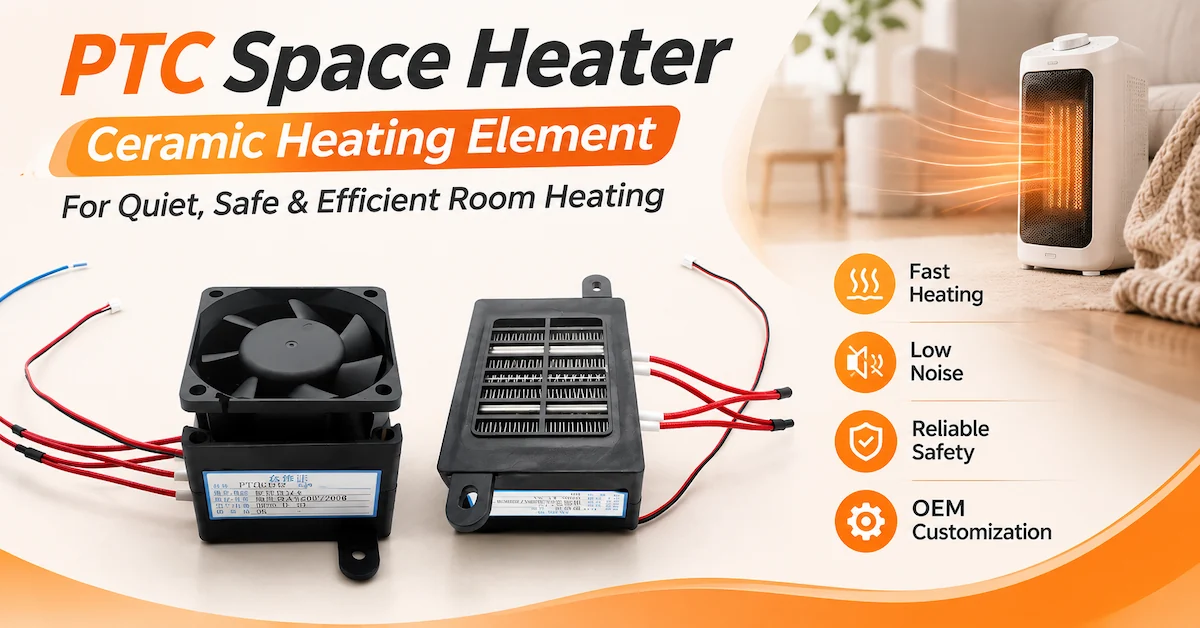
A PTC dryer heater is a heating component intended for drying equipment.
A PTC fan heater combines a PTC heating element with an integrated fan or blower.
A dryer can use a separate heater and existing fan, or a combined fan-heater assembly.
Buyers should clarify the exact scope of supply.
9. Can Tianrui customize a PTC Dryer Heater?
Tianrui describes OEM heater customization involving structure, materials, drawings, and mold development.
Its product catalog includes drying-oriented PTC air-heater configurations.
The feasibility of specific power ratings, dimensions, insulation, and mounting requirements should be reviewed with the manufacturer.
10. What information is needed for an accurate OEM quotation?
Provide the drying material, batch size, starting and final moisture content, required drying time, airflow, humidity conditions, voltage, installation dimensions, and estimated production quantity.
Include drawings and any relevant safety or testing requirements.
This allows the manufacturer to assess suitable heater configurations before preparing a quotation.
Conclusion
Selecting a PTC Dryer Heater for industrial equipment requires more than comparing ceramic heating power, voltage, and product dimensions.
The actual objective of drying is to remove moisture from a material within a specified time while maintaining acceptable temperature, product quality, energy consumption, and equipment safety.
For industrial dryer manufacturers, the most important design considerations are:
-
Moisture-removal demand: Determine the amount of water to be removed and the required drying rate.
-
Thermal load: Calculate the energy required for evaporation, sensible heating, and system losses.
-
Airflow and exhaust: Establish suitable circulation, makeup-air, and moisture-removal strategies.
-
Humidity control: Monitor the relevant air conditions and prevent excessive moisture accumulation.
-
Environmental suitability: Evaluate condensation, insulation, dust, and material exposure.
-
Safety verification: Test the heater and complete equipment under normal and relevant abnormal conditions.
-
OEM production consistency: Establish approved technical specifications, sample validation, and quality requirements.
An Industrial PTC Dryer Heater should be selected according to its verified performance within the complete drying system.
A larger heater does not automatically provide faster moisture removal if the equipment's airflow or dehumidification process is inadequate.
For applications involving industrial drying cabinets, greenhouse drying systems, and commercial drying equipment, a qualified PTC Dryer Heater Manufacturer should be able to discuss heating structures, electrical requirements, installation geometry, customization, and sample validation.
Dongguan Tianrui Electronics Co., Ltd. supplies PTC air-heating components and application-specific drying heater solutions.
Its public catalog includes a 220V 3000W PTC dryer heater for dehumidifier and industrial drying systems, as well as additional higher-power and corrugated air-heater configurations.
Looking for a custom PTC heater for industrial drying equipment?
Explore Tianrui's PTC Dryer Heater for Dehumidifier Cabinets, review its Custom PTC Heating Solutions, or contact Tianrui Electronics for technical consultation and OEM quotation.
Prepare your moisture-removal requirements, airflow conditions, target temperature, operating voltage, installation drawings, environmental requirements, and estimated production quantity.
Email:
Phone:
+86 135 3277 2961
A well-defined moisture balance, appropriately selected PTC heating assembly, and complete OEM qualification process provide the foundation for reliable industrial drying equipment and long-term manufacturing cooperation.