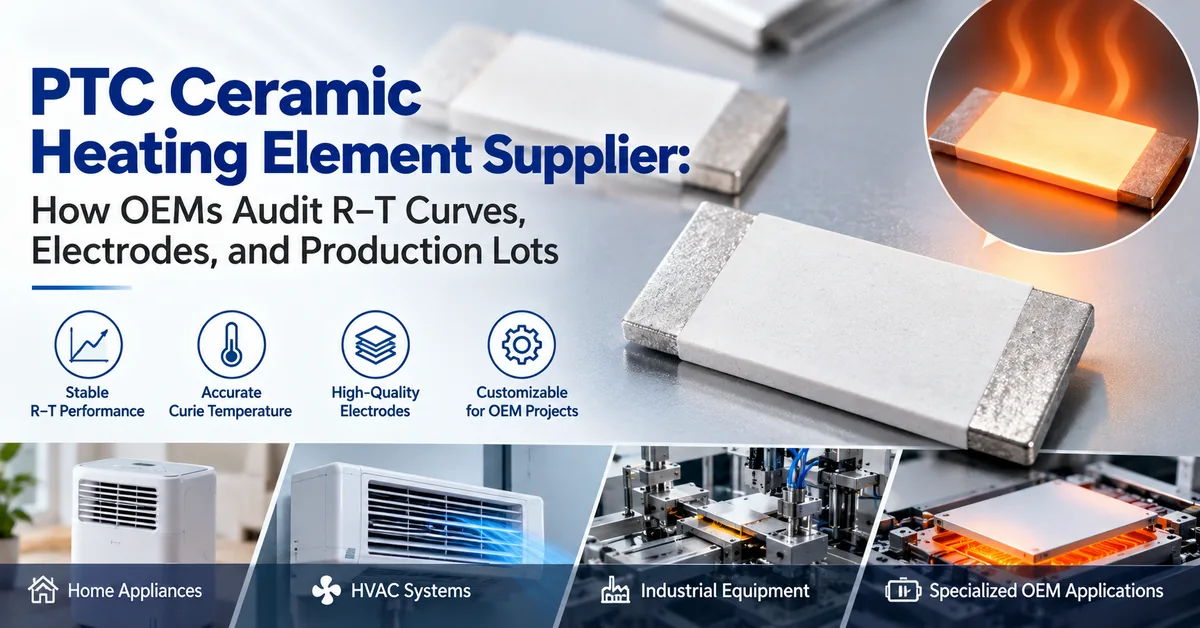
TL;DR: A reliable PTC Ceramic Heating Element Supplier should provide more than a nominal voltage, resistance value, and Curie temperature. OEM buyers should verify the resistance-temperature (R–T) curve, ceramic transition behavior, electrode construction, dimensional tolerances, and batch-to-batch consistency. For customized elements, sample approval must also establish the operating conditions, inspection limits, and change-control requirements that will govern production. A supplier should be approved based on measurable evidence, not catalog specifications or unit price alone.
For OEM equipment manufacturers, ceramic PTC heating elements are critical components that directly influence electrical loading, heating behavior, product reliability, and equipment integration.
However, sourcing these components can be more complicated than purchasing conventional resistors or standard mechanical parts.
Two ceramic PTC elements may have similar dimensions, nominal resistance, and operating voltage while displaying different electrical and thermal behavior.
These differences can arise from ceramic formulation, grain-boundary characteristics, sintering processes, electrode construction, dimensional variation, and the way each element transfers heat into the finished equipment.
As a result, a heating element that works in one prototype may not automatically be suitable for production using components from another manufacturing batch or supplier.
For R&D engineers, quality managers, and technical procurement teams, the central question is therefore not simply:
Which supplier offers the lowest-priced PTC ceramic heater?
A more useful question is:
Which PTC Ceramic Heating Element Supplier can demonstrate that its ceramic characteristics, manufacturing controls, and production inspection methods will consistently meet the approved OEM specification?
This guide explains how to qualify a supplier using technical evidence, representative samples, and a controlled procurement process.
It covers:
-
PTC ceramic material and resistance-temperature characteristics.
-
Verification of Curie temperature and nominal resistance.
-
Electrode materials and electrical contact quality.
-
Ceramic manufacturing and sintering consistency.
-
Published Tianrui ceramic heating element specifications.
-
Standard versus customized component selection.
-
Prototype qualification and production-lot acceptance.
-
Supplier risk management and change control.
-
Tooling, cost, MOQ, and procurement considerations.
-
A practical OEM supplier-audit and RFQ checklist.
Dongguan Tianrui Electronics Co., Ltd. manufactures PTC thermal components and provides custom heating element development support.
OEM buyers can explore the company's PTC ceramic heating element products and custom PTC heating element solutions when evaluating potential component configurations.
How Should OEM Buyers Compare PTC Ceramic Heating Element Suppliers?
A supplier comparison should begin with technical equivalence.
If two manufacturers propose different ceramic formulations, electrode structures, or resistance-temperature characteristics, their products should not be evaluated as direct substitutes based only on quoted price.
Table 1. PTC ceramic heating element supplier evaluation matrix
| Evaluation Dimension | Basic Catalog Supplier | Engineering-Oriented PTC Manufacturer | Evidence OEM Buyers Should Request |
|---|---|---|---|
| Electrical characteristics | Nominal voltage and resistance | Defined resistance-temperature behavior and tolerances | Datasheet, R–T data, electrical test conditions |
| Ceramic material | General material description | Explanation of relevant formulation and transition characteristics | Material specification and approved performance limits |
| Electrode construction | Basic electrode identification | Electrode material, geometry, and qualified contact method | Drawing, electrode specification, inspection criteria |
| Manufacturing consistency | General quality claims | Defined critical process parameters and inspection controls | Process-control information and sample inspection records |
| Customization | Standard sizes or limited changes | Application-specific resistance, temperature, shape, and electrode development | Engineering review and prototype proposal |
| Production qualification | Sample availability | Controlled sample approval and production-release procedures | Approved drawings, test plans, quality agreement |
| Supply continuity | Price and delivery quotation | Lot identification, change notification, and repeat-order planning | Traceability and revision-control requirements |
A manufacturer does not necessarily need to disclose proprietary ceramic recipes to establish technical credibility.
However, the supplier should be able to define the product characteristics that matter to the customer's application and explain how those characteristics are verified.
Key Takeaways
-
Do not qualify a supplier using R25 alone. Request the resistance-temperature characteristics relevant to the complete operating range.
-
Curie temperature is not the finished equipment's operating temperature. The complete heating design must be validated under actual thermal conditions.
-
Electrode construction is a critical interface. Material, adhesion, electrical contact, and assembly methods can affect reliability.
-
Manufacturing consistency matters more than one successful prototype. Compare representative production samples using agreed acceptance criteria.
-
Customization should be evidence-based. Voltage, resistance, ceramic dimensions, and transition characteristics are interconnected and cannot always be changed independently.
-
Approve the supplier and the product configuration together. Production should follow controlled drawings, material specifications, and change-notification requirements.
What Makes a PTC Ceramic Heating Element Different from an Ordinary Heating Resistor?
A ceramic PTC heating element generates heat through electrical resistance, but its resistance is strongly temperature dependent.
PTC stands for Positive Temperature Coefficient.
In commonly used semiconductor ceramic heating materials, resistance increases significantly as the element approaches a designed transition-temperature region.
At a fixed voltage, this resistance increase generally reduces electrical current and heating power.
The basic relationship is:
P = V² / R
Where:
-
P represents electrical power.
-
V represents the voltage applied across the element.
-
R represents its instantaneous electrical resistance.
Unlike a fixed-resistance heater, R changes substantially with temperature.
Therefore, power consumption may vary during startup, warm-up, and stabilized operation.
Why does this affect supplier qualification?
A conventional resistor may be characterized primarily by its nominal resistance, tolerance, temperature coefficient, and power rating.
A PTC ceramic heating element requires additional attention to its nonlinear resistance-temperature behavior.
Two elements with the same resistance at 25°C may behave differently near their transition regions.
One element may begin increasing resistance at a lower temperature, while another may maintain greater electrical input over a wider temperature range.
These differences can influence:
-
Initial electrical loading.
-
Heating response.
-
Stabilized power.
-
Ceramic temperature.
-
Thermal recovery.
-
Interaction with the heated object.
-
Equipment-level protective behavior.
Self-regulation is not complete temperature control
A PTC heating element can naturally reduce electrical heating as its ceramic temperature increases.
However, the target surface, surrounding air, or heated object may operate at a different temperature from the ceramic.
A self-regulating element does not automatically eliminate the need for external temperature sensors, thermal cutoffs, or control systems.
The final equipment must still satisfy its applicable functional and safety requirements.
For OEM buyers, this means supplier evaluation should focus on both the ceramic's characteristics and its performance inside the intended equipment.
Why Is the Resistance–Temperature Curve More Important Than R25 Alone?
The resistance-temperature curve describes how a ceramic element's resistance changes over a defined temperature range.
It is among the most important technical documents that a PTC Ceramic Heating Element Manufacturer can provide.
Understanding R25
R25 generally refers to resistance measured at 25°C.
For ceramic PTC products, the measurement should be made under defined conditions that minimize unwanted self-heating when a zero-power resistance is intended.
A nominal R25 value is useful for identifying a product configuration.
However, it does not fully predict the resistance near the ceramic's transition region.
A real Tianrui product example
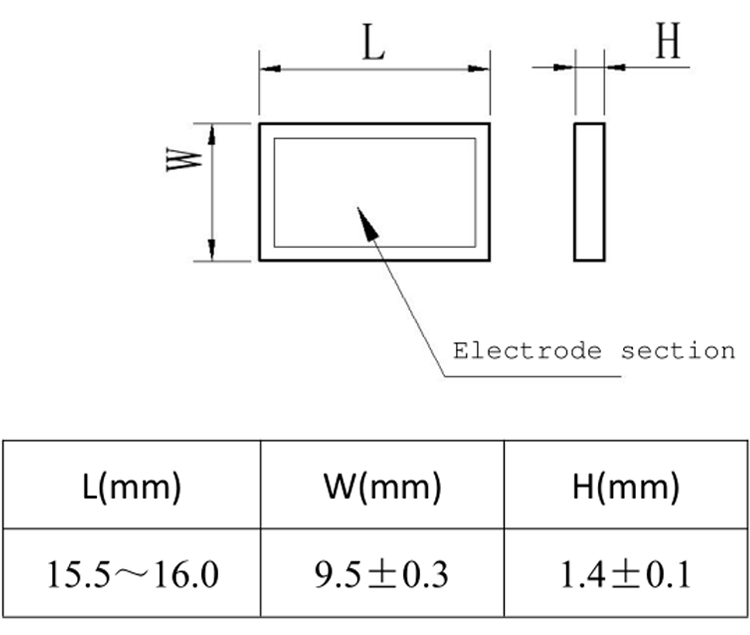
Tianrui publishes a rectangular ceramic PTC heating element with the following model designation:
MZ41-1610-120-30±20%
The public product page lists:
| Parameter | Published Specification |
|---|---|
| Model | MZ41-1610-120-30±20% |
| Dimensions | 16.0 × 9.5 × 1.4 mm |
| Operating voltage | 24V DC |
| Resistance at 25°C | 30Ω ±20% |
| Curie temperature | 120°C ±10°C |
| Listed surface temperature | 130°C ±7°C |
| Electrode | Silver electrode with edge |
These values are published by Tianrui for the specific product listing.
The website does not fully describe every test condition associated with the listed surface-temperature figure.
Therefore, the surface temperature should not be interpreted as a guaranteed result under every installation or cooling condition.
Buyers can inspect the MZ41 Ceramic PTC Heating Element for the manufacturer's published specifications.
What does 30Ω ±20% mean?
Using the nominal resistance and tolerance:
Minimum resistance:
30 × 0.8 = 24Ω
Maximum resistance:
30 × 1.2 = 36Ω
Under the stated tolerance, the nominal R25 acceptance interval is therefore 24–36Ω.
This provides a preliminary resistance acceptance criterion.
However, a component at 24Ω and another at 36Ω may behave differently when energized.
The difference is especially important during initial electrical loading.
Why one resistance measurement is insufficient
A supplier could provide two components that both satisfy the R25 tolerance while having different R–T curves.
For example, their resistance increase near the transition region might occur at different temperatures.
The actual heating behavior could therefore differ even though both pass the same room-temperature resistance check.
For an OEM application, the acceptance plan should consider relevant resistance values across the intended operating range.
Recommended R–T verification
Ask the supplier to provide:
-
The nominal R–T curve.
-
The method used to determine resistance.
-
The relevant temperature points.
-
Allowed resistance tolerances.
-
Transition-temperature definition.
-
Representative sample results.
-
Applicable production inspection limits.
A complete curve may be required for design evaluation, while a smaller set of selected temperatures may be used for routine production checks.
The appropriate approach depends on the application's risk and required performance.

How Should OEM Engineers Verify Curie Temperature and Switching Behavior?
Curie temperature is frequently mentioned in ceramic PTC product descriptions.
However, supplier quotations may use terms such as Curie temperature, switching temperature, transition temperature, and surface temperature without clearly defining the measurement method.
These terms should not automatically be treated as equivalent.
What is Curie temperature?
Barium-titanate-based semiconductor ceramics exhibit ferroelectric-related behavior associated with a temperature-dependent resistance change.
Material formulation and manufacturing conditions influence the transition region.
The exact relationship between the material's Curie temperature and its measured resistance-temperature behavior depends on the product design.
Why the definition matters
A supplier may specify a nominal Curie temperature while the finished heater operates at a different surface temperature.
The surface temperature depends on the balance between electrical heating and thermal losses.
A ceramic element mounted against a large metal heat sink may operate differently from the same element tested in a less thermally conductive arrangement.
Questions suppliers should answer
-
How is the stated Curie temperature defined?
-
What measurement method is used?
-
What is the accepted tolerance?
-
Is the value associated with a ceramic material characteristic or a defined electrical test?
-
What resistance behavior occurs below and above the transition region?
-
How does the element behave under the intended operating voltage?
-
Are production samples tested using the same method?
Avoid confusing temperature specifications
Consider the published MZ41 element.
Its page lists a Curie temperature of 120°C ±10°C and a surface temperature of 130°C ±7°C.
These are two distinct stated characteristics.
The OEM should confirm the test conditions for each and determine which characteristic is relevant to the final equipment.
For applications requiring precise target-surface temperature control, separate equipment-level measurements are necessary.
Supplier qualification rule:
Never approve a custom ceramic element solely because its advertised Curie temperature matches the desired appliance temperature.
Which Ceramic Materials and Manufacturing Processes Affect Product Consistency?
A PTC Ceramic Heating Element Supplier should understand how ceramic processing influences electrical characteristics.
Tianrui's published technical information identifies barium titanate, or BaTiO₃, as a principal material system for its ceramic heating elements.
The company also describes the use of material adjustments and high-temperature sintering to obtain desired PTC characteristics.
Material formulation
The ceramic formulation influences electrical resistance and transition behavior.
Variations in raw materials or processing can affect the resulting characteristics.
For OEM procurement, the important question is not necessarily the supplier's proprietary chemical formula.
Instead, buyers should establish which product characteristics are controlled and how material changes are managed.
Powder preparation and forming
Ceramic manufacturing begins with suitable raw materials and preparation processes.
The formed component must meet dimensional and material requirements before final processing.
Potential quality concerns include:
-
Inconsistent material distribution.
-
Defects introduced during forming.
-
Dimensional variation.
-
Cracking.
-
Density variation.
-
Uncontrolled contamination.
High-temperature sintering
Sintering transforms the formed material into the intended ceramic structure.
This stage influences grain development, electrical properties, mechanical characteristics, and overall consistency.
The supplier should maintain appropriate controls for the characteristics critical to the product.
Electrode processing
Electrical electrodes are added to create the required conductive interfaces.
Electrode materials and processing conditions can influence contact performance and long-term stability.
Final inspection
After manufacturing, the ceramic elements should be evaluated according to the approved specification.
Relevant inspections may include:
-
Visual appearance.
-
Dimensions.
-
Resistance.
-
Selected R–T characteristics.
-
Electrode condition.
-
Functional performance.
Table 2. Manufacturing-process risk assessment
| Manufacturing Stage | Potential Variation | Product Impact | Recommended Evidence |
|---|---|---|---|
| Material preparation | Inconsistent formulation | Resistance and transition variation | Material-control procedure |
| Ceramic forming | Density or dimensional variation | Electrical and mechanical inconsistency | Dimensional and process records |
| Sintering | Variation in thermal processing | Ceramic characteristic changes | Process-control and electrical inspection |
| Electrode processing | Contact or coating variation | Electrical interface problems | Electrode inspection criteria |
| Finishing | Edge damage or cracking | Mechanical weakness | Visual inspection and handling controls |
| Final testing | Inconsistent methods | Unreliable acceptance decisions | Documented test conditions |
A supplier should not need to reveal confidential production parameters to demonstrate that critical product characteristics are controlled.
What matters is whether the approved specification can be reproduced consistently.
Tianrui discusses ceramic materials, electrodes, and custom processing in its PTC Heating Element Manufacturing Solutions.
Why Does Electrode Quality Matter in Ceramic PTC Heating Elements?
The electrode system provides the electrical connection between the ceramic and its external circuit.
Although buyers often focus on resistance and temperature, electrode design can become a critical reliability factor.
Common electrode materials
Tianrui's heating element technical page discusses materials including:
-
Silver electrodes.
-
Silver-palladium alloy electrodes.
-
Nickel electrodes.
Different electrode systems can have different electrical, mechanical, processing, and commercial characteristics.
The correct choice depends on the ceramic design, operating temperature, connection method, and intended equipment.
Electrical contact resistance
Poor electrical contact can introduce additional resistance at the interface.
This may influence current distribution and localized heating.
The complete connection system should therefore be evaluated rather than considering only the ceramic's nominal resistance.
Electrode adhesion
Electrode adhesion affects whether the conductive layer remains mechanically reliable during handling, installation, and repeated operation.
The appropriate verification method depends on the electrode construction and the way electrical connections are attached.
Thermal expansion
Ceramic and metallic materials can expand differently when heated.
Repeated temperature changes may introduce stress at their interfaces.
This makes the electrode and contact structure relevant to thermal cycling and reliability evaluation.
Electrode geometry
The size, position, and shape of the electrode can influence the effective current path.
A custom electrode arrangement may be needed for a specialized heating structure.
However, changing the electrode geometry can also affect the electrical characteristics of the element.
Electrode supplier-audit checklist
| Question | Why It Matters |
|---|---|
| What electrode material is specified? | Establishes the approved conductive interface |
| What electrode geometry is used? | Influences contact and current distribution |
| How is the external connection made? | Determines assembly compatibility |
| How is adhesion evaluated? | Supports connection reliability |
| Are electrodes inspected before shipment? | Helps identify manufacturing defects |
| Can electrode changes be traced? | Supports repeat-order consistency |
For an OEM program, an electrode change should be reviewed as a potentially important engineering modification.
A supplier should not replace an approved electrode construction without evaluating its impact on the product.
Which Tianrui Ceramic PTC Heating Elements Are Available for OEM Projects?
Tianrui publishes several ceramic heating element configurations, including rectangular elements, disc-shaped components, and thermostatic heating elements for specialized applications.
The following examples illustrate why buyers must compare specific product families instead of assuming all ceramic PTC elements share the same electrical characteristics.
Table 3. Published Tianrui ceramic PTC model comparison
| Product or Model | Published Electrical Information | Dimensions | Purchasing Consideration |
|---|---|---|---|
| MZ41-1610-120-30±20% | 24V DC; R25 30Ω ±20%; Curie 120°C ±10°C | 16.0 × 9.5 × 1.4 mm | Compact low-voltage ceramic element |
| MZ9-FJA-1 | 220V AC; listed zero-power resistance 1000–4000Ω; series Curie range 120–260°C | 24 × 15 × 2.5 mm | Higher-voltage thermostatic heating application |
| MZ9-FIA-2 | 220V AC; listed zero-power resistance 1000–4000Ω; series Curie range 120–260°C | 30 × 15 × 2.5 mm | Larger rectangular configuration |
| MZ9-FUD-1 | 350V DC; listed zero-power resistance 4000–8000Ω; Curie 220°C | 24 × 15 × 3.5 mm | Specialized DC heating application |
The MZ9 specifications above come from Tianrui's public thermostatic heating element page.
The broad resistance and temperature ranges shown for some models should be confirmed against the exact datasheet before production selection.
MZ41 rectangular ceramic element
The MZ41 Ceramic PTC Heating Element is a useful reference for low-voltage ceramic heating projects.
Its published specifications include a 24V DC operating voltage and a defined nominal R25 tolerance.
For OEM projects, the manufacturer should confirm the resistance-temperature curve, intended thermal interface, operating conditions, and available sample specifications.
MZ9 thermostatic heating elements
Tianrui's PTC Thermostatic Heating Element page includes several MZ9 configurations.
The listed models illustrate differences in electrical supply, dimensions, and nominal resistance ranges.
These characteristics are relevant when designing heating components for heat-pump-related or similar electric heating equipment.
Disc-shaped ceramic PTC elements
The company's catalog also includes disc-shaped ceramic PTC heating elements.
Disc elements may be relevant when the equipment has a circular installation interface or requires a specific electrode arrangement.
The exact dimensions, voltage, resistance, and heating characteristics should be checked for the selected model.
Why model comparison matters
A 24V element and a 220V element should not be treated as alternatives merely because they use PTC ceramic technology.
Their resistance, ceramic geometry, electrode design, and intended operating conditions may differ substantially.
For high-quality supplier evaluation, request the complete product specification for each candidate.
When Should OEM Buyers Choose Standard or Custom PTC Ceramic Heating Elements?
Standard products may reduce development effort when an existing element satisfies the application.
Custom elements are more appropriate when critical electrical, mechanical, or thermal requirements cannot be met with available products.
Standard ceramic PTC heating element
A standard element may be preferable when:
-
The voltage is compatible.
-
The resistance-temperature characteristics are acceptable.
-
The physical dimensions fit.
-
The electrode arrangement matches the assembly.
-
The thermal behavior has been validated.
-
The product can be sourced under suitable commercial conditions.
Custom ceramic PTC heating element
A Custom PTC Ceramic Heating Element may be needed when:
-
A different resistance range is required.
-
The desired transition behavior is not available.
-
Installation dimensions are nonstandard.
-
The equipment requires a special shape.
-
Electrode construction must be modified.
-
The project needs a defined production acceptance window.
Can all parameters be customized independently?
No.
Resistance, ceramic dimensions, formulation, voltage behavior, and transition characteristics are interconnected.
For example, changing ceramic thickness can influence resistance.
Changing the material formulation can affect transition behavior.
Changing electrode geometry may alter the effective electrical path.
Therefore, custom development should be based on the complete application rather than a list of unrelated target values.
Customization feasibility matrix
| Custom Requirement | Engineering Consideration |
|---|---|
| Different R25 value | Ceramic formulation, geometry, and manufacturing limits |
| Different Curie temperature | Material system and electrical characteristics |
| Smaller dimensions | Manufacturing feasibility and thermal performance |
| Special shape | Forming, tooling, mechanical strength |
| Alternative electrode material | Contact, adhesion, processing, reliability |
| Higher voltage | Electrical characteristics and insulation design |
| Faster warm-up | Actual thermal load and electrical operating behavior |
| Different mounting interface | Electrode and assembly design |
The supplier should evaluate whether the requested specifications can be achieved simultaneously.
Tianrui describes customization of resistance, voltage, temperature, geometry, electrode materials, and mold development.
Buyers can submit drawings through its PTC Heating Element Customization Service.
What Should OEM Buyers Test Before Approving a Ceramic PTC Supplier?
A successful sample approval should demonstrate more than basic heating functionality.
The objective is to confirm that the element meets the electrical, thermal, dimensional, and reliability requirements of the intended equipment.
Stage 1: Incoming sample identification
Each sample should be associated with a supplier part number and configuration.
Record the proposed drawing revision, nominal characteristics, and relevant test conditions.
Stage 2: Room-temperature resistance
Measure resistance under the agreed reference-temperature and measurement conditions.
For a product with a specified R25 tolerance, compare the result against the approved limits.
Stage 3: Resistance-temperature characteristics
Verify the relevant resistance-temperature behavior.
For some applications, selected resistance points may be sufficient for screening.
For others, the complete transition curve may be necessary.
Stage 4: Electrical startup
Record startup current and power under the intended supply conditions.
Consider the lowest expected startup temperature and permitted voltage variation where relevant.
Stage 5: Loaded heating performance
Install the element in the intended thermal assembly.
Measure the temperature of the actual heated object or medium.
Stage 6: Electrode and connection evaluation
Assess the intended electrical connection method.
The test should reflect how the element will be contacted in the finished equipment.
Stage 7: Environmental and durability testing
Use appropriate temperature cycling, operating duty, vibration, or other environmental tests based on the application.
Table 4. Recommended prototype qualification matrix
| Test | Measurement | Why It Matters |
|---|---|---|
| R25 test | Resistance at defined reference conditions | Verifies nominal ceramic characteristics |
| R–T verification | Resistance at specified temperatures | Confirms transition behavior |
| Startup current | Current during initial energization | Supports electrical design |
| Stabilized power | Electrical power after thermal stabilization | Evaluates operating behavior |
| Surface temperature | Temperature at specified locations | Confirms application performance |
| Warm-up response | Temperature versus time | Evaluates heating speed |
| Electrode inspection | Contact condition and relevant integrity checks | Supports connection reliability |
| Dimensional inspection | Length, width, thickness, shape | Confirms assembly compatibility |
| Thermal cycling | Performance before and after defined cycles | Assesses repeated thermal stress |
| Electrical insulation | Applicable assembly-level tests | Supports system safety |
| Abnormal operation | Response under relevant fault conditions | Evaluates equipment risks |
Relevant technical standards
IEC 60738-1:2022 provides general terminology and testing methods for directly heated PTC thermistors.
IEC 60068-2-14:2023 provides environmental test methods involving changes in temperature.
These standards can be useful references when building component specifications and qualification plans.
However, the appropriate tests and acceptance criteria depend on the product and application.
Referencing an IEC standard does not establish that a specific Tianrui element is certified to it.
How Should OEM Buyers Verify Production-Lot Consistency?
An engineering sample may demonstrate that a product can work.
It does not automatically prove that every future production lot will perform consistently.
Production-lot verification is therefore an important supplier-qualification activity.
Define critical-to-quality characteristics
Typical critical characteristics may include:
-
Resistance at the specified reference temperature.
-
Selected R–T points.
-
Transition-temperature behavior.
-
Dimensions.
-
Electrode condition.
-
Visual defects.
-
Relevant functional performance.
Not every characteristic requires the same inspection method or frequency.
The inspection plan should reflect the importance of each characteristic to the finished equipment.
Compare distributions, not only averages
Suppose two suppliers deliver ceramic elements with the same average resistance.
One supplier may have tightly grouped resistance values.
Another may produce a much wider distribution.
Even if the averages match, the second product may create greater variation during equipment assembly.
For this reason, selected production characteristics can be evaluated statistically.
Example: illustrative resistance-lot comparison
Assume an OEM specification requires R25 between 24Ω and 36Ω.
Consider two hypothetical sample sets.
| Measure | Lot A | Lot B |
|---|---|---|
| Nominal target | 30Ω | 30Ω |
| Sample mean | 30.2Ω | 30.0Ω |
| Minimum measured | 28.8Ω | 24.5Ω |
| Maximum measured | 31.6Ω | 35.5Ω |
| Observed spread | 2.8Ω | 11.0Ω |
Both hypothetical sample sets remain inside the stated limits.
However, Lot B shows substantially greater variation.
This may justify further investigation if resistance variation affects the intended application.
These values are illustrative statistical examples, not Tianrui factory measurements.
What should the customer request?
For critical products, consider requesting:
-
Lot identification.
-
Sample size and sampling method.
-
Critical parameter limits.
-
Measurement conditions.
-
Inspection results.
-
Nonconformance handling.
-
Product-change notification arrangements.
What does an approved lot mean?
Lot acceptance should follow the agreed inspection method.
A passing sample does not provide absolute proof that every untested unit is defect-free.
Sampling plans, confidence, and acceptable risk should be chosen according to the application's requirements.
For high-risk applications, additional testing or tighter control may be appropriate.
What Is the Difference Between a Golden Sample and a Production Specification?
OEM buyers frequently approve a reference sample before placing a larger order.
This sample is sometimes called a golden sample.
It provides a useful physical reference for the approved configuration.
However, a golden sample does not replace technical documentation.
What a golden sample can demonstrate
A golden sample can help verify:
-
Appearance.
-
Dimensions.
-
Electrode configuration.
-
Physical compatibility.
-
Reference electrical and thermal behavior.
What it cannot define completely
A single physical sample cannot fully describe:
-
Material acceptance limits.
-
Manufacturing tolerances.
-
Resistance distribution.
-
Production inspection methods.
-
Reliability requirements.
-
Approved component changes.
-
Supplier traceability obligations.
Recommended approval package
A complete OEM approval package may include:
| Document | Purpose |
|---|---|
| Product drawing | Defines dimensions and geometry |
| Electrical specification | Defines resistance and voltage characteristics |
| R–T data | Defines relevant temperature-dependent behavior |
| Electrode specification | Defines electrical interface |
| Approved sample | Provides physical reference |
| Test procedure | Defines measurement conditions |
| Acceptance criteria | Defines allowable results |
| Inspection plan | Defines production verification |
| Revision record | Identifies the approved configuration |
This documentation reduces ambiguity when repeat orders are placed.
A supplier should understand which characteristics are essential and which modifications require customer approval.
How Should Engineering Changes Be Managed After Supplier Approval?
Ceramic heating elements are sensitive to changes in materials, dimensions, and production processes.
A product may appear identical externally while behaving differently electrically.
This makes engineering change control particularly important.
Changes that may require review
Examples include:
-
Material formulation.
-
Powder preparation method.
-
Sintering process.
-
Ceramic geometry.
-
Electrode material.
-
Electrode thickness or configuration.
-
Electrical testing method.
-
Critical production equipment.
-
Manufacturing location.
-
Approved raw material sources.
The supplier and customer should establish which changes require notification and qualification.
Product Change Notification
A Product Change Notification, commonly abbreviated PCN, informs the customer about relevant changes.
A useful PCN may identify:
-
Current and proposed configuration.
-
Reason for change.
-
Affected part numbers.
-
Potential electrical or mechanical impacts.
-
Verification testing.
-
Expected implementation timing.
-
Affected production lots.
-
Customer approval requirements.
Why this matters for OEM manufacturing
A different electrode material or ceramic formulation may still satisfy a basic room-temperature resistance requirement.
However, its behavior during thermal cycling or operation near the transition temperature may differ.
Engineering review helps prevent these changes from being introduced without appropriate validation.
When Is a PTC Ceramic Heating Element Manufacturer Better Than a Trading Supplier?
Some OEM buyers initially compare direct manufacturers with distributors or trading companies.
Neither business model is inherently unsuitable.
The best choice depends on the engineering and purchasing requirements.
Advantages of a direct manufacturer relationship
For specialized ceramic components, direct technical communication may be useful when the project involves:
-
Custom resistance characteristics.
-
Special ceramic shapes.
-
Electrode modifications.
-
Material and process discussions.
-
Prototype qualification.
-
Production inspection requirements.
-
Long-term configuration control.
When a distributor may be suitable
A distributor may be appropriate when the required product is already standardized, qualified, and available under suitable commercial conditions.
The buyer should still verify product traceability and the ability to obtain relevant technical documentation.
Manufacturer qualification questions
A buyer searching for a PTC Ceramic Heating Element Manufacturer should ask:
-
Which ceramic heating element families are available?
-
Which parameters are standard, and which are customizable?
-
What technical information can be provided?
-
How are electrical characteristics verified?
-
What manufacturing controls are relevant?
-
Can engineering samples be evaluated before production?
-
How are approved configurations maintained?
-
What commercial conditions apply to repeat orders?
A manufacturer's value should be judged through its ability to satisfy these requirements, rather than through unsupported claims that direct sourcing always guarantees lower prices.
What Determines the Cost of a Custom PTC Ceramic Heating Element?
The price of a ceramic PTC element depends on more than its size.
Material characteristics, ceramic geometry, electrode construction, production volume, testing requirements, and customization complexity can all influence cost.
Main cost factors
| Cost Factor | Potential Impact |
|---|---|
| Ceramic formulation | Influences material and manufacturing requirements |
| Resistance and transition specifications | May affect process and selection complexity |
| Dimensions and thickness | Influence ceramic forming and material usage |
| Special shapes | May require tooling or processing changes |
| Electrode materials | Affect material cost and processing |
| Testing requirements | Influence inspection effort |
| Production quantity | Affect recurring manufacturing economics |
| Traceability and documentation | Add quality-management requirements |
| Custom tooling | Introduces potential one-time costs |
| Packaging | Influences handling and shipment protection |
Standard versus custom purchasing
A standard ceramic element may provide a simpler purchasing path if it meets the application.
A custom element may be necessary when critical parameters cannot be satisfied by catalog products.
However, the cost of customization should be evaluated together with the benefits it provides.
Illustrative tooling calculation
Suppose a hypothetical OEM project requires $1,500 of application-specific tooling.
If the planned production quantity is 1,000 units, the simple tooling allocation is:
$1,500 ÷ 1,000 = $1.50 per unit
At 5,000 units:
$1,500 ÷ 5,000 = $0.30 per unit
This demonstrates how production volume affects the per-unit allocation of a one-time investment.
The calculation does not include development changes, maintenance, testing, or other commercial costs.
It is an example, not a Tianrui quotation.
MOQ and lead time
Minimum order quantity and production lead time should be confirmed for each product.
A catalog ceramic element may have different commercial terms from a newly developed custom component.
Buyers should request separate information for:
-
Existing standard products.
-
Engineering samples.
-
Custom tooling.
-
Pilot production.
-
Mass-production orders.
-
Repeat purchasing.
Avoid accepting a generic production lead-time promise that does not specify when the lead-time period begins or whether tooling and qualification are included.
How Can OEM Buyers Select a PTC Ceramic Supplier in Three Steps?
A practical supplier-selection process can be organized around technical fit, qualification evidence, and production readiness.
Step 1: Establish electrical and thermal requirements
Action:
Define the intended voltage, resistance, transition characteristics, thermal load, dimensions, and operating environment.
Decision rule:
Eliminate candidates that cannot meet critical product requirements or cannot provide enough technical information for a meaningful evaluation.
Do not rank suppliers by price before establishing engineering compatibility.
Step 2: Verify samples and manufacturing evidence
Action:
Evaluate representative samples using agreed resistance, temperature, dimensional, and electrical tests.
Review the supplier's inspection approach and relevant production controls.
Decision rule:
A supplier should not be approved based only on a successful power-on demonstration.
The sample must satisfy measurable acceptance criteria.
Step 3: Compare production and commercial conditions
Action:
Review total cost, tooling, MOQ, lead time, quality documentation, traceability, and change management.
Decision rule:
Choose a technically qualified supplier that can support the expected production and quality requirements under acceptable commercial conditions.
Table 5. Three-step supplier selection summary
| Step | Main Question | Required Evidence |
|---|---|---|
| Technical fit | Does the element match the application? | Product specification and R–T characteristics |
| Sample qualification | Can the supplier demonstrate acceptable performance? | Test results and approved samples |
| Production readiness | Can the approved configuration be supplied consistently? | Inspection plan, change controls, commercial agreement |
This decision process can help both R&D engineers and procurement managers compare suppliers using consistent criteria.
OEM Engineering Scenario: Qualifying a Custom 24V Ceramic PTC Heating Element
The following example illustrates a supplier-qualification process for a compact OEM heating product.
This is a hypothetical engineering scenario, not a verified Tianrui customer case study or factory test result.
Project background
An OEM is developing a compact electronic device requiring localized heating.
The equipment uses a 24V DC supply and has a restricted installation space.
The engineering team identifies Tianrui's published MZ41 ceramic PTC element as a possible starting point because its nominal voltage and dimensions are relevant to the preliminary design.
Initial product requirements
The team defines:
-
24V DC nominal supply.
-
Compact ceramic dimensions.
-
Defined resistance-temperature behavior.
-
Controlled startup current.
-
Suitable electrode arrangement.
-
Repeatable heating performance.
-
Consistent production supply.
Preliminary component review
The MZ41 listing provides useful starting information, including R25, Curie temperature, and physical dimensions.
However, the OEM still needs additional application-specific data.
Qualification action 1: Request electrical data
The engineering team requests the R–T curve and relevant measurement conditions.
The purpose is to understand whether the element will behave correctly over the complete operating temperature range.
Qualification action 2: Review electrode integration
The OEM evaluates how the silver electrode will connect to the equipment's electrical assembly.
The connection method must be compatible with the element and intended operating duty.
Qualification action 3: Test under thermal load
Samples are installed in the actual heating structure.
The OEM measures startup current, power consumption, and temperature response.
Qualification action 4: Evaluate representative samples
The buyer compares multiple samples and records their electrical characteristics.
The purpose is to assess whether the proposed acceptance limits are appropriate.
Qualification action 5: Establish a production specification
After satisfactory testing, the parties agree on the approved configuration and relevant quality requirements.
Qualification action 6: Review commercial conditions
The purchasing team confirms sample quantities, any required customization, production MOQ, and expected lead time.
What does the example demonstrate?
It shows how a published product specification can support an initial selection without replacing engineering validation.
The strongest supplier relationship is established when technical requirements, inspection methods, and commercial terms are agreed before production.
Which Applications Require the Most Careful Ceramic PTC Supplier Qualification?
Different equipment categories introduce different requirements.
An element suitable for a compact appliance should not automatically be transferred into a more demanding environment.
Household appliances
Appliance manufacturers may prioritize:
-
Heating response.
-
Electrical insulation.
-
Compact dimensions.
-
Repeatable operating behavior.
-
Equipment-level safety requirements.
-
Stable component supply.
HVAC and auxiliary heating
HVAC applications may involve airflow changes, operating-temperature variation, and extended duty cycles.
The ceramic element must be evaluated within its complete heating assembly.
Automotive and battery-related equipment
Automotive applications may introduce vibration, wide temperature ranges, and strict customer-specific qualification requirements.
A general PTC ceramic product should not be assumed automotive-qualified without appropriate evidence.
Industrial instruments
These applications may require controlled thermal behavior, limited electrical noise, compact geometry, and repeatable manufacturing.
The element should be evaluated together with the instrument's sensing and control system.
Specialized OEM heating equipment
Custom machinery may require unusual ceramic shapes, higher operating temperatures, or specific electrical interfaces.
These projects often benefit from engineering consultation before selecting a standard model.
For application development, explore Tianrui's industrial equipment applications and home appliance solutions.
PTC Ceramic Heating Element Supplier RFQ Checklist
An effective Request for Quotation should contain enough information for the manufacturer to evaluate technical feasibility.
A brief request containing only voltage, temperature, and quantity may be insufficient for custom ceramic development.
Table 6. OEM RFQ information
| RFQ Category | Information to Provide |
|---|---|
| Application | Equipment type and heating purpose |
| Supply voltage | Nominal voltage, AC/DC, operating range |
| Resistance | R25 target and permitted tolerance |
| R–T characteristics | Required curve or relevant resistance points |
| Curie behavior | Desired transition characteristics |
| Heating objective | Actual target-surface or medium temperature |
| Ceramic shape | Rectangle, disc, ring, or special geometry |
| Dimensions | Length, width, thickness, tolerances |
| Electrode | Material, geometry, electrical contact method |
| Thermal environment | Ambient temperature and heat-transfer conditions |
| Electrical loading | Startup and stabilized operating requirements |
| Insulation | Applicable assembly-level requirements |
| Testing | Required electrical and environmental verification |
| Quality documentation | Drawing, inspection, and traceability requirements |
| Samples | Quantity and development stage |
| Production demand | Initial and estimated annual volume |
| Commercial terms | MOQ, tooling, lead time, packaging |
Example OEM sourcing inquiry
Subject: Custom PTC Ceramic Heating Element – OEM Technical Evaluation
We are developing an electrical heating product and would like to evaluate a ceramic PTC heating element for our equipment.
Our application requires a defined voltage, resistance-temperature characteristic, compact installation dimensions, and stable electrical behavior.
We are interested in existing Tianrui models and possible customized configurations.
We can provide mechanical drawings, operating conditions, target thermal performance, and estimated production quantities.
Please advise:
-
Which standard models may be suitable.
-
Whether the requested resistance and transition characteristics are feasible.
-
What R–T data and technical specifications can be provided.
-
Which electrode materials and connection arrangements are available.
-
How engineering samples can be evaluated.
-
What production inspection and quality documentation can be discussed.
-
Whether tooling is required.
-
What MOQ and lead-time conditions apply.
We would like to establish a controlled specification before approving production orders.
For technical consultation, contact Tianrui Electronics with your project information.
Frequently Asked Questions About PTC Ceramic Heating Element Suppliers
1. What should I look for in a PTC Ceramic Heating Element Supplier?
Look for a supplier that understands the electrical, thermal, mechanical, and production requirements of the intended application.
The supplier should provide relevant product specifications, discuss resistance-temperature behavior, explain available customization, and support sample evaluation.
For recurring OEM orders, ask about inspection methods, production consistency, traceability, and engineering change management.
Price should be compared after technical compatibility is established.
2. What is the difference between a PTC Ceramic Heating Element Supplier and Manufacturer?
A manufacturer is directly involved in producing the heating components, while a supplier may be a manufacturer, distributor, or trading company.
For standard products, different supply models may be suitable.
For custom ceramic development, direct engineering communication with a manufacturer can be useful.
The purchasing decision should consider technical support, product evidence, quality requirements, and commercial conditions rather than business labels alone.
3. Why is the R–T curve important for PTC ceramic heaters?
The R–T curve describes how resistance changes with temperature.
A ceramic PTC element may have the correct room-temperature resistance but different behavior near its transition region.
This can affect startup current, stabilized power, and heating performance.
OEM engineers should request the relevant resistance-temperature information rather than relying only on a nominal R25 value.
4. Is Curie temperature the same as operating temperature?
No.
Curie temperature is associated with material and transition characteristics.
The operating temperature of the ceramic and the temperature of the final heated object depend on voltage, heat transfer, cooling, and the complete assembly.
A ceramic element with a stated Curie temperature does not guarantee that an appliance or metal surface will maintain that exact temperature.
5. Can Tianrui manufacture a Custom PTC Ceramic Heating Element?
Tianrui publishes customization support for resistance, voltage, temperature characteristics, ceramic dimensions, shapes, and electrode materials.
Its heating element solutions also describe drawing review, material selection, technical consultation, and mold development.
The feasibility of any requested combination must be confirmed through engineering review.
Custom sample arrangements, MOQ, and delivery time should be discussed for the specific project.
6. What electrode materials are available for PTC ceramic elements?
Tianrui's technical information discusses silver, silver-palladium alloy, and nickel electrode materials.
The appropriate construction depends on electrical contact requirements, manufacturing processes, operating conditions, and reliability needs.
Buyers should confirm the material and electrode geometry for the selected model.
Electrode changes should be evaluated before being introduced into approved production.
7. How can OEM buyers check batch-to-batch consistency?
Define critical characteristics such as R25, selected R–T points, dimensions, electrode condition, and relevant functional behavior.
Use an agreed sampling and inspection method.
Compare results against approved limits and review trends across production lots.
A single successful sample does not demonstrate the full consistency of ongoing manufacturing.
8. What testing standards apply to ceramic PTC heating elements?
IEC 60738-1 provides general specifications and test methods for directly heated positive temperature coefficient thermistors.
Environmental testing standards, including relevant parts of IEC 60068, may also inform qualification.
The exact test program depends on the application and product construction.
A supplier's reference to a standard should not be interpreted as proof of certification without supporting evidence.
9. What determines MOQ and lead time for custom ceramic PTC elements?
MOQ and lead time depend on the ceramic specification, shape, electrode configuration, material availability, tooling requirements, engineering verification, and order quantity.
A standard product may have different conditions from a newly developed ceramic configuration.
Buyers should request separate confirmation for samples, pilot quantities, and recurring production orders.
10. What is the fastest way to receive an accurate OEM quotation?
Provide the application, supply voltage, required thermal behavior, resistance or R–T requirements, ceramic dimensions, electrode preferences, and estimated order volume.
Include drawings and any existing reference specifications.
If some electrical parameters have not been finalized, explain the required heating outcome and operating conditions so the manufacturer can review possible solutions.
Conclusion
Selecting a PTC Ceramic Heating Element Supplier requires a technical qualification process that goes beyond nominal voltage, resistance, or unit price.
For OEM equipment, the most important considerations include ceramic resistance-temperature behavior, transition characteristics, electrode construction, manufacturing consistency, and the ability to maintain an approved product configuration during repeat production.
A successful supplier evaluation should answer five questions:
-
Does the ceramic element match the intended electrical and thermal requirements?
-
Can the supplier provide relevant technical data and representative samples?
-
Are electrode, dimensional, and manufacturing characteristics adequately controlled?
-
Can production lots be evaluated against clear acceptance criteria?
-
Are customization, tooling, MOQ, lead time, and change-control requirements agreed before production?
For a Custom PTC Ceramic Heating Element, engineering collaboration becomes particularly important because ceramic formulation, resistance, voltage behavior, dimensions, and electrode design are interconnected.
A supplier should help the customer identify feasible configurations, establish measurable requirements, and develop an appropriate verification process.
Dongguan Tianrui Electronics Co., Ltd. offers ceramic PTC heating elements and customized heating solutions for appliance, HVAC, industrial, and other OEM applications.
The company publishes product information for MZ41 and MZ9 ceramic heating element configurations and describes support for material selection, product drawings, custom shapes, and electrode options.
PTC Ceramic Heating Element Engineering & OEM Sourcing Support
Are you evaluating a new ceramic PTC component or qualifying an alternative supplier for an existing design?
Tianrui Electronics can discuss the required electrical characteristics, ceramic dimensions, electrode construction, application conditions, and possible customization options.
To begin a technical evaluation, prepare:
-
Required voltage and operating range.
-
R25 or resistance-temperature requirements.
-
Target thermal performance.
-
Ceramic shape and dimensions.
-
Electrode and connection requirements.
-
Expected operating environment.
-
Sample evaluation and quality requirements.
-
Estimated purchasing volume.
Explore Tianrui's Ceramic PTC Heating Element Products, review its Custom PTC Heating Element Manufacturing Solutions, or contact Tianrui Electronics for a project-specific OEM quotation.
Email:
Phone:
+86 135 3277 2961
A clear technical specification and evidence-based supplier qualification process provide the foundation for reliable ceramic heating performance, consistent production, and long-term OEM cooperation.