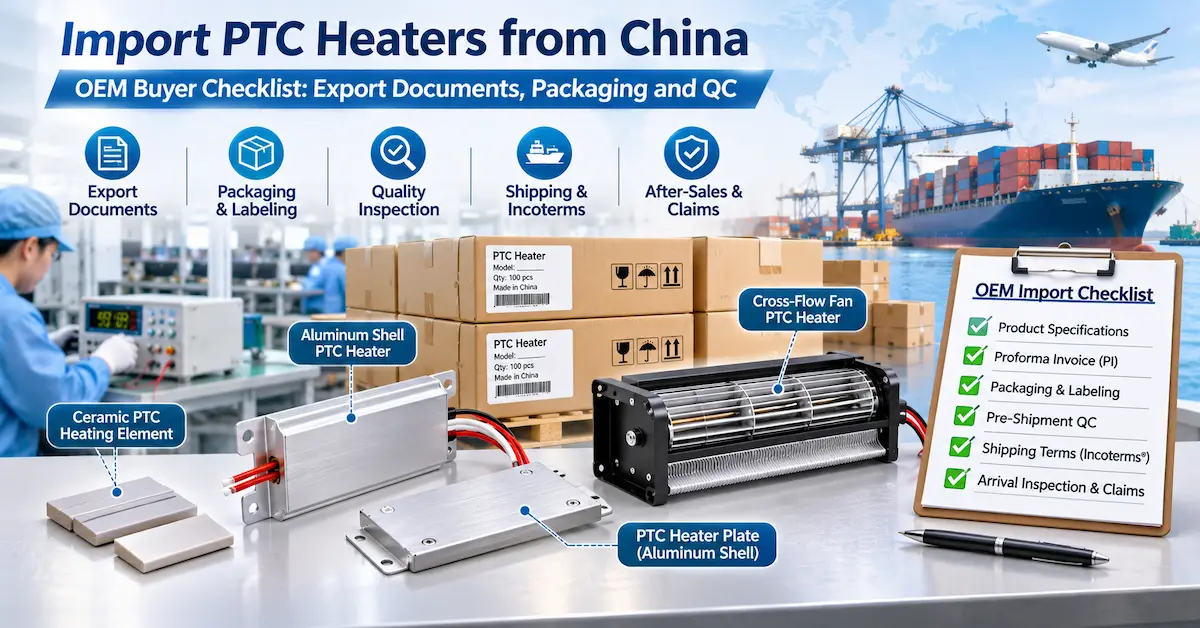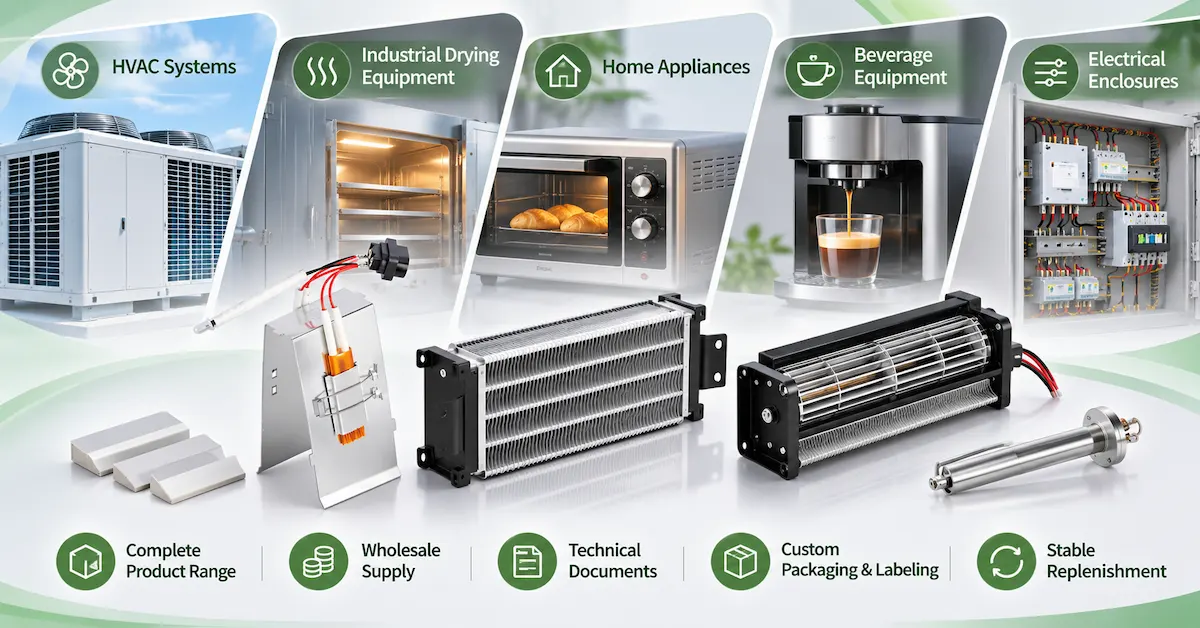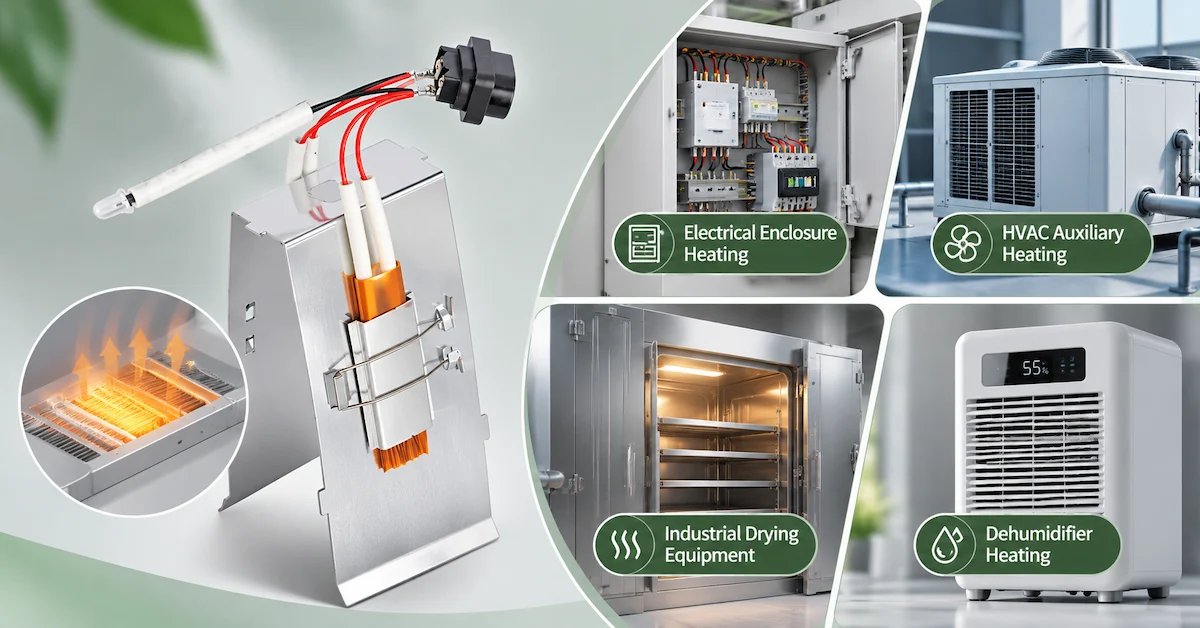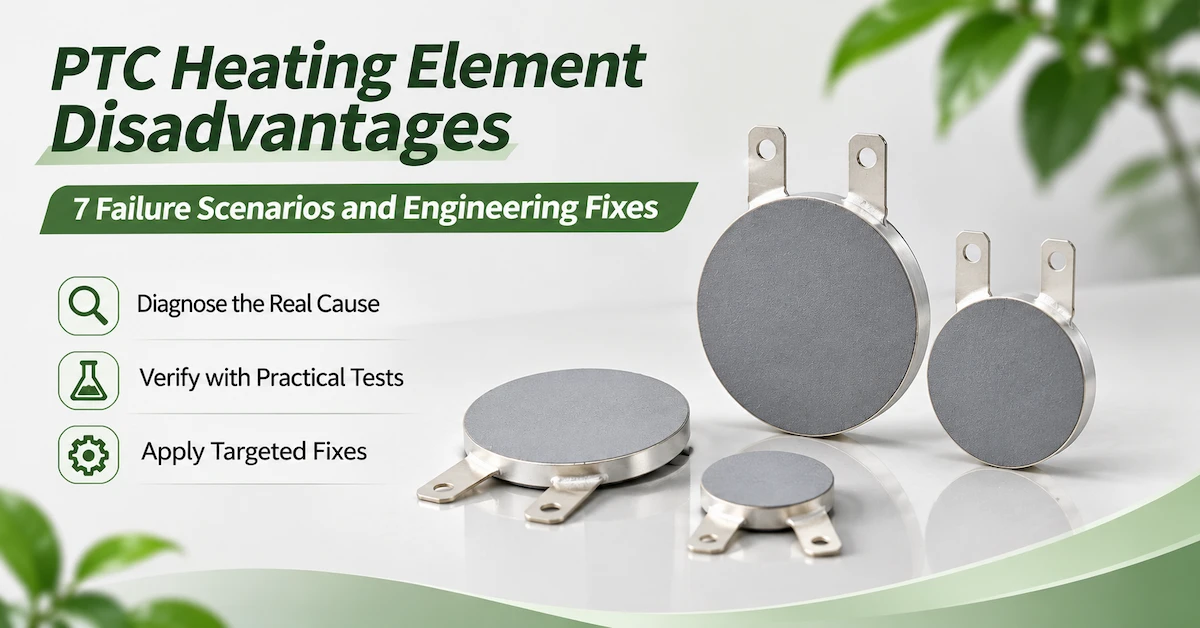
Quick Answer: When Should You Choose a PTC Heater ODM Manufacturer?
A PTC heater ODM manufacturer is a suitable choice when a brand or equipment manufacturer has defined heating objectives but requires engineering support to develop the component structure, electrical configuration, mounting interfaces, and production specifications. ODM cooperation is particularly valuable when new tooling, application-specific validation, or private-label delivery is required. Before development begins, both parties should agree on design responsibilities, approval milestones, tooling ownership, quality documentation, and engineering change procedures.
Key Takeaways
-
ODM development starts with product requirements rather than a finished manufacturing drawing.
-
Electrical, thermal, mechanical, and connection interfaces must be reviewed together.
-
Tooling costs, ownership, maintenance, and acceptance conditions should be agreed before mold development.
-
Prototype approval does not automatically establish production readiness.
-
Private-label packaging requires separate artwork, identification, and regulatory reviews.
-
PPAP or an agreed production approval package should be defined according to customer and industry requirements.
-
Engineering changes must be controlled to protect product consistency and intellectual property.
For appliance brands, HVAC manufacturers, and industrial equipment developers, a heating component is often part of a larger product platform.
The challenge is not simply finding a heater with the correct voltage and power. It is developing a component that integrates into the finished equipment, can be manufactured consistently, and supports the brand's commercial launch.
Dongguan Tianrui Electronics Co., Ltd. provides customized PTC heating-component development in China, including engineering consultation, structural design, material selection, drawings, mold development, and sample preparation.
This guide explains how buyers can organize a development project from initial design requirements to controlled production and private-label delivery.
What Is the Difference Between OEM, ODM, and Custom PTC Heater Manufacturing?
OEM, ODM, and custom manufacturing describe different ways of organizing product development and production.
The actual responsibilities depend on the agreement between the buyer and manufacturer.
Table 1. PTC Heater Development and Purchasing Models
| Purchasing Model | Design Responsibility | Typical Buyer Requirement | Main Deliverable |
|---|---|---|---|
| Standard product purchasing | Supplier's existing design | An approved catalog component | Existing product configuration |
| OEM manufacturing | Primarily buyer-defined design, with agreed supplier support | Production according to approved drawings | Manufactured component |
| Customized OEM manufacturing | Shared engineering input for selected modifications | Modified voltage, housing, mounting, or wiring | Customized component |
| ODM development | Supplier-led or jointly managed component development | Functional requirements requiring engineering development | Newly developed or adapted heating assembly |
| Private-label production | Depends on the underlying manufacturing arrangement | Buyer-specific branding and packaging | Approved branded product and packaging |
Private-label manufacturing is a branding arrangement rather than a separate engineering method. It can be combined with standard purchasing, OEM manufacturing, or ODM development.
Which buyers should consider ODM cooperation?
A PTC heater ODM project may be appropriate for:
-
Appliance brands developing new heating products.
-
HVAC brands designing customized air-heating modules.
-
Industrial equipment manufacturers requiring specialized mounting structures.
-
Electrical heating brands developing differentiated product lines.
-
Private-label buyers seeking controlled branding and packaging.
-
Product design companies requiring manufacturing engineering support.
ODM development may be unnecessary when an existing approved heater already meets all functional, mechanical, electrical, and commercial requirements.
For buyers who already have a complete manufacturing specification, an OEM custom PTC heater arrangement may be more efficient than commissioning an entirely new design.
What Should a PTC Heater ODM Product Requirements Document Include?
A product requirements document, or PRD, translates the buyer's commercial concept into engineering inputs that can be reviewed and validated.
It should describe the required outcome, not merely request a heater with a particular wattage.
For example, a compact appliance brand may require a heater that fits a restricted installation space, reaches a target operating temperature within an agreed time, and connects to an existing control board.
These requirements must be translated into measurable design and acceptance criteria.
Table 2. PTC Heater ODM Product Requirements Document Template
| Requirement Category | Information to Provide |
|---|---|
| Project identification | Project name, product platform, development stage |
| Intended application | Appliance, HVAC equipment, industrial equipment, or other system |
| Target market | Destination country and intended use |
| Electrical supply | AC/DC voltage, operating range, frequency where relevant |
| Electrical limits | Maximum operating current and startup current requirements |
| Thermal objective | Target temperature, heating power, warm-up requirements |
| Heating medium | Air, liquid, or solid contact surface |
| Operating conditions | Ambient temperature, airflow, duty cycle, humidity |
| Installation envelope | Maximum dimensions, mounting positions, clearances |
| Housing requirements | Materials, shape, mechanical interfaces |
| Electrical connections | Wire specification, length, connector, terminal arrangement |
| Safety requirements | Insulation, protection functions, applicable equipment requirements |
| Branding | Logo, product identification, packaging, artwork |
| Validation | Required tests, acceptance criteria, sample quantities |
| Commercial target | Estimated volume, target launch date, cost objectives |
| Engineering deliverables | Drawings, specifications, reports, and approval records |
Where the buyer cannot define a final electrical specification, provide the required thermal result and equipment operating conditions.
The custom PTC heater manufacturer can then evaluate possible design architectures and identify missing information.
Tianrui's PTC Heater Customization Solutions describe engineering support for structural development, material selection, drawings, mold development, and technical consultation.
Who should approve the design inputs?
The buyer should identify the responsible engineering, quality, procurement, and brand-management contacts.
A requirements document should have a revision number and approval date.
Changes to the installation space, power supply, heating target, or launch market should be communicated before the supplier commits to tooling or final design.
How Should Electrical, Thermal, and Mechanical Design Be Confirmed?
A custom PTC heater is an interacting system of heating materials, electrodes, insulation, structural components, and electrical connections.
Changing one design feature may influence several performance characteristics.
Electrical Design
The electrical design review should address:
-
Rated voltage and operating voltage range.
-
Relevant resistance-temperature characteristics.
-
Cold-start current and switching-device compatibility.
-
Heating power under defined conditions.
-
Wiring and connector ratings.
-
Insulation and electrical protection requirements.
Startup-current curves and other electrical characteristics should be obtained through suitable testing of the actual configuration.
A nominal voltage and wattage are insufficient to establish compatibility with the equipment's control circuit.
Thermal Design
The thermal design should define how heat moves from the ceramic element into the equipment.
Important considerations include heat-transfer area, contact conditions, airflow or liquid flow, ambient temperature, and the required heating response.
PTC ceramics exhibit temperature-dependent resistance. This behavior can limit heating power as temperature increases, but it does not guarantee precise equipment temperature control or eliminate the need for appropriate protection devices.
For applicable component-level terminology and testing, IEC 60738-1:2022 provides a technical reference for directly heated positive temperature coefficient thermistors within its scope.
The standard does not independently establish compliance of a complete heating appliance.
Mechanical and Connection Design
Mechanical development should consider:
-
Housing dimensions and tolerances.
-
Mounting brackets and fasteners.
-
Thermal contact surfaces.
-
Ceramic assembly pressure.
-
Insulation placement.
-
Cable routing and strain relief.
-
Connector orientation.
-
Assembly and service access.
The finalized interface drawing should identify critical dimensions, connection positions, and the approved installation envelope.
For a more detailed technical discussion, see the PTC Heating Module Interface Qualification Guide.
Table 3. ODM Engineering Design Review Matrix
| Design Area | Required Confirmation | Approval Evidence |
|---|---|---|
| Electrical | Voltage, current limits, resistance, power | Electrical specification |
| Thermal | Heating objective and operating conditions | Thermal design and test plan |
| Mechanical | Dimensions, mounting, tolerances | Approved engineering drawing |
| Materials | Ceramic, electrodes, housing, insulation | Controlled material specification |
| Connections | Wiring, terminals, connectors | Wiring drawing and component identification |
| Protection | Relevant electrical and thermal safety functions | Risk assessment and validation plan |
| Manufacturability | Assembly method and critical process controls | Manufacturing feasibility review |
Which Tianrui Products Can Serve as ODM Development Starting Points?
An ODM project does not always require a completely new component architecture.
Existing heating structures may provide useful starting points for development, depending on their compatibility with the proposed equipment.
Table 4. PTC Heater Development Reference Products
| Tianrui Product | Published Product Information | Potential ODM Development Focus |
|---|---|---|
| MZ41 Ceramic PTC Heating Element | Model MZ41-1610-120-30±20%; 24V DC; 30Ω ±20% at 25°C; 16 × 9.5 × 1.4mm; Curie temperature 120°C ±10°C | Ceramic geometry, resistance, electrode construction, and electrical characteristics |
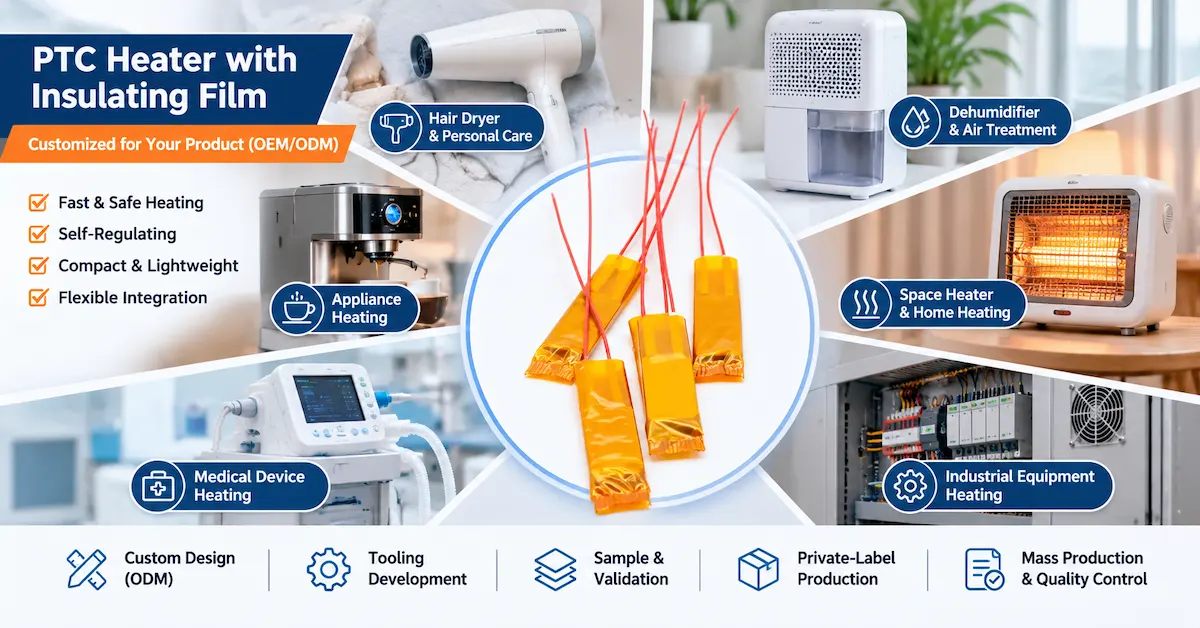
| PTC Heater with Insulating Film | Insulated heating assembly with configurable voltage and dimensions | Insulation construction, shape, installation interface, and wiring |
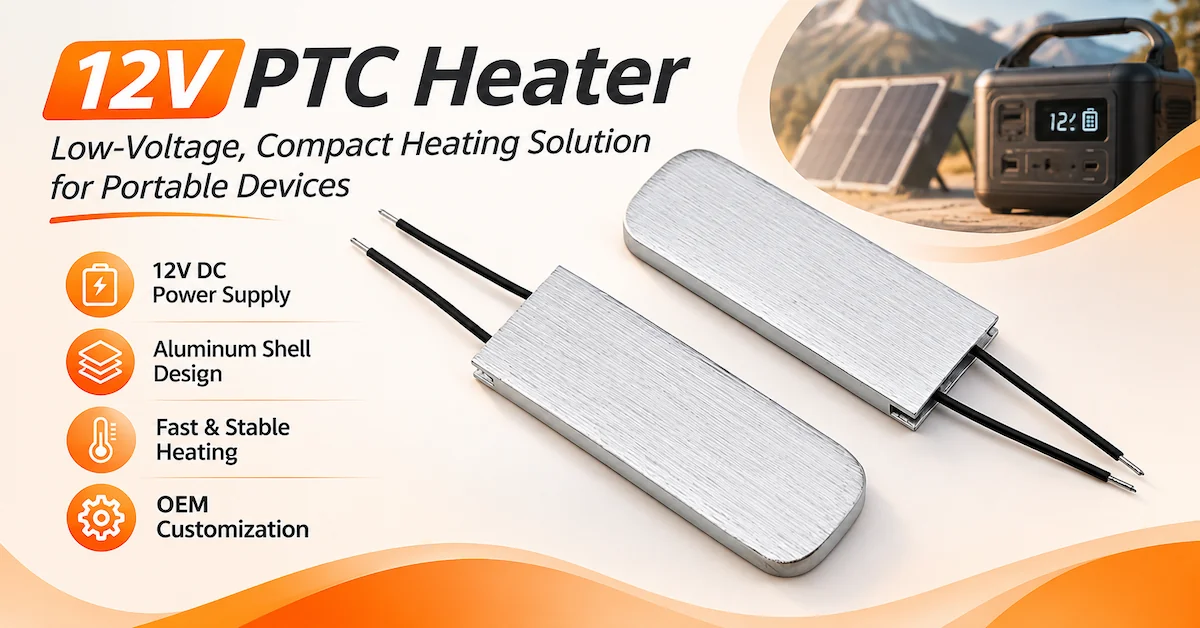
| Aluminum Shell PTC Heater | PTC heating plate, insulation layer, and aluminum housing | Housing geometry, heat-transfer surfaces, mounting, and structural integration |
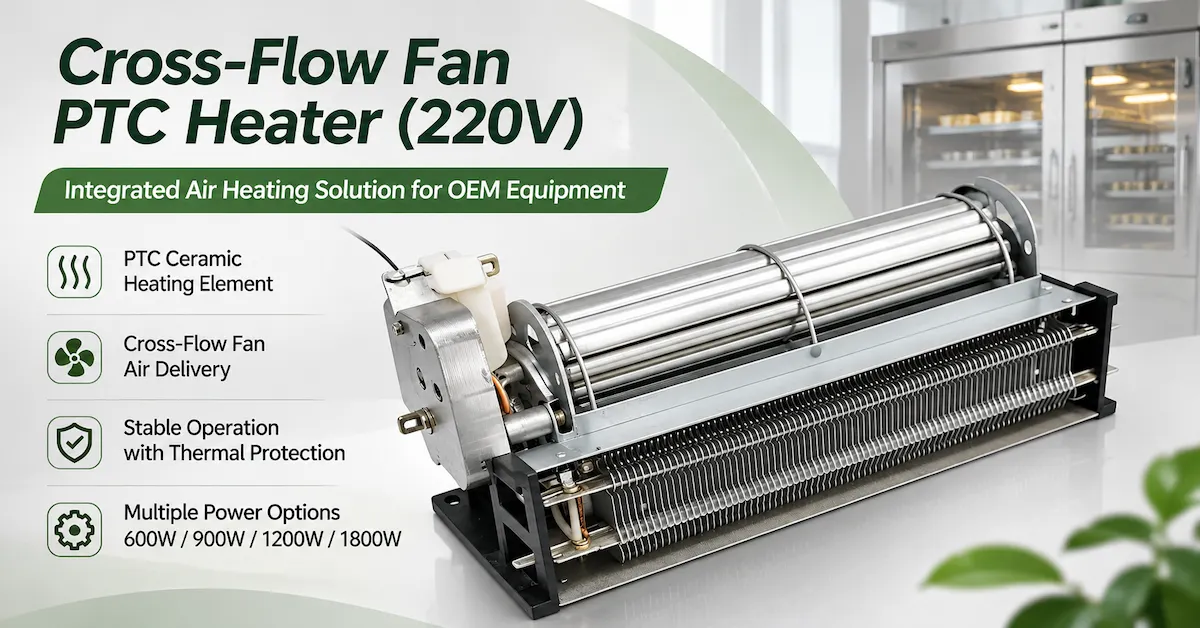
| 220V Cross-Flow Fan PTC Heater | Published 220V product family with 600W, 900W, 1200W, and 1800W options | Air-heating module dimensions, equipment integration, and connection interfaces |
These products represent development references rather than guaranteed solutions for every application.
The MZ41 specifications shown refer to the published model. The cross-flow fan heater values describe a product family with multiple power options.
Any modified configuration requires its own approved specification and relevant validation.
How Should ODM Tooling, Prototype Development, and Validation Be Managed?
A PTC heater ODM project should follow defined approval stages.
This helps prevent the manufacturer from investing in production tooling before the buyer has approved the necessary design inputs.
Table 5. Six-Gate ODM Development Roadmap
| Development Gate | Main Activities | Required Output | Approval Decision |
|---|---|---|---|
| G1: Requirements approval | Application review and feasibility assessment | Approved PRD and development scope | Proceed to design |
| G2: Design approval | Electrical, thermal, and mechanical development | Drawings, preliminary BOM, validation plan | Release sample or tooling work |
| G3: Tooling and prototype | Mold development where required and sample preparation | Tooling records and identified prototypes | Release engineering validation |
| G4: Design validation | Application-specific performance and safety testing | Test reports and resolved design issues | Freeze approved design |
| G5: Production validation | Representative production run and process qualification | Production samples and approval documents | Authorize production |
| G6: Commercial release | Packaging, labeling, documentation, and order review | Approved branded SKU and shipment configuration | Release commercial orders |
The six-gate model is a proposed project-management framework.
It should be adapted to the complexity, commercial requirements, and risks of each development project.
What should a tooling quotation include?
Tooling may be required for a customized housing, bracket, plastic component, stamped metal part, or other non-standard structure.
The quotation should distinguish between one-time engineering expenses and recurring product costs.
Table 6. ODM Tooling and Development Cost Checklist
| Cost Item | Buyer Confirmation |
|---|---|
| Engineering development | Included services and deliverables |
| Mold or tooling charge | Tool type, quantity, and quoted cost |
| Prototype samples | Number of samples and preparation charges |
| Tooling modification | Responsibility for design-related changes |
| Validation testing | Required tests and payment responsibility |
| Tool maintenance | Maintenance arrangements and expenses |
| Tool storage | Storage conditions and retention period |
| Tool replacement | Expected service life and replacement responsibility |
| Private-label artwork | Design, printing, and approval costs |
| Production price | Quantity-dependent recurring unit price |
Tianrui publishes mold-development support, but specific tooling costs, tool life, payment conditions, and ownership arrangements require a project quotation.
How can buyers compare the real development cost?
Consider both non-recurring engineering costs and the expected volume of saleable products.
Illustrative development cost allocation:
Development cost per unit = Total agreed non-recurring development costs ÷ Expected production quantity
For example, assume the following hypothetical expenses:
| Cost Item | Illustrative Amount |
|---|---|
| Tooling | USD 6,000 |
| Engineering samples | USD 1,200 |
| Validation testing | USD 800 |
| Total development cost | USD 8,000 |
| Expected production quantity | 4,000 units |
| Development cost allocation | USD 2.00 per unit |
These figures are hypothetical and are not Tianrui quotations.
The calculation helps buyers compare a lower-cost standard design with a customized development program that may offer stronger product differentiation.
If expected production volume changes, the effective development cost allocation changes as well.
What should be tested before design approval?
The validation plan should cover applicable characteristics such as:
-
Electrical input and startup behavior.
-
Heating power under defined conditions.
-
Temperature distribution.
-
Heating response and equilibrium behavior.
-
Mechanical fit.
-
Insulation performance.
-
Wiring and connector integrity.
-
Relevant environmental and durability conditions.
-
Foreseeable abnormal operating conditions.
Acceptance criteria should be agreed before testing.
Testing should be performed by qualified personnel using suitable procedures and equipment.
For detailed sample acceptance and pilot-run procedures, refer to the Low MOQ PTC Heater Prototype and Pilot-Run Guide.
How Should Private-Label PTC Heater Packaging and Documentation Be Developed?
Private-label delivery requires more than applying a customer's logo to an existing product.
Brand owners should control the identity of the approved component, the accuracy of its commercial description, and the relationship between the product and its packaging.
Private-label capability and available branding methods should be confirmed with the manufacturer before commercial commitments are made.
Product Identification
Depending on the product structure, identification may involve a printed label, an approved marking method, packaging identification, or a combination of these.
The selected method must not compromise insulation, thermal performance, or mechanical integrity.
Packaging Artwork
The buyer should approve artwork files, dimensions, materials, colors, product descriptions, and packaging quantities.
A physical or digital packaging approval sample can help prevent artwork discrepancies before printing.
Table 7. Private-Label Production Approval Checklist
| Deliverable | Required Approval |
|---|---|
| Brand logo | Authorized artwork file |
| Customer part number | Approved commercial identification |
| Manufacturer part number | Internal traceability relationship |
| Product label | Content, dimensions, material, and location |
| Barcode | Correct code and scanning verification where required |
| Individual packaging | Approved protective construction |
| Retail or industrial packaging | Approved artwork and packaging format |
| Outer carton | Quantity, shipping information, and identification |
| Datasheet | Approved product specifications and revision |
| Product photographs | Accurate images and agreed usage rights |
| Instructions | Applicable installation and handling information |
| Regulatory markings | Verified applicability and supporting evidence |
Private-label branding must not obscure legally required manufacturer, importer, origin, safety, or traceability information.
Requirements vary according to the product category, intended use, and destination market.
Brand owners should verify the applicable obligations before artwork approval.
What PPAP or Quality Approval Documents Are Needed Before Mass Production?
A successful engineering prototype does not demonstrate that the manufacturing process will consistently reproduce the approved design.
Production approval should evaluate both the component and the process used to manufacture it.
Is PPAP mandatory for every PTC heater ODM project?
No. PPAP stands for Production Part Approval Process and is commonly associated with automotive supply-chain quality requirements.
The AIAG Production Part Approval Process manual describes a structured approach to demonstrating that production processes can consistently satisfy engineering requirements.
Formal PPAP submission should be determined by the customer, industry requirements, and applicable purchasing agreement.
For appliance and industrial heating projects that do not require formal PPAP, a proportionate production approval package may be more suitable.
Table 8. ODM Production Approval Documentation Matrix
| Document | Purpose | Application |
|---|---|---|
| Approved design drawing | Establish final product configuration | Core requirement |
| Product specification | Define electrical, thermal, and mechanical limits | Core requirement |
| Controlled BOM | Identify approved materials and components | Customized production |
| Process flow | Describe the production sequence | According to project |
| DFMEA | Evaluate design-related failure risks | According to design responsibility |
| PFMEA | Evaluate manufacturing-process risks | According to project |
| Control plan | Define critical production inspections | Recommended |
| Dimensional results | Demonstrate drawing conformity | According to specification |
| Performance test reports | Demonstrate agreed electrical and thermal results | Core requirement |
| Measurement system analysis | Evaluate relevant measurement reliability | Where required |
| Initial process studies | Evaluate relevant process capability | Where required |
| Approved production sample | Establish accepted production configuration | Recommended |
| Part Submission Warrant (PSW) | Document formal PPAP submission | When required by the customer |
This table is a practical document-planning tool, not a complete formal PPAP submission checklist.
The customer should specify the applicable submission level, required records, acceptance conditions, and approval authority where PPAP is contractually required.
Tianrui's ability to prepare a particular formal PPAP package should be confirmed during the project feasibility review.
What should prevent production release?
Production release should be withheld when:
-
Critical design requirements remain unresolved.
-
Required validation tests have not been completed.
-
Production samples differ from the approved specification.
-
Critical material or component substitutions remain unapproved.
-
Mandatory customer or market documentation is missing.
-
Required packaging or labeling has not been approved.
Commercial pressure to meet a launch date should not override unresolved critical quality or safety requirements.
How Should Engineering Changes, Product Versions, and Intellectual Property Be Controlled?
A PTC heater ODM relationship may continue for several years after the initial development project.
Materials, tooling, components, manufacturing processes, and equipment requirements can change during that period.
Without configuration control, products supplied under the same commercial name may no longer correspond to the original approved design.
Engineering Change Management
ISO 10007:2017 provides guidance on configuration management across the product lifecycle.
An ODM project can apply these principles by maintaining approved design baselines, documenting changes, reviewing their effects, and preserving revision history.
Table 9. Engineering Change and Revalidation Matrix
| Proposed Change | Potential Impact | Review or Revalidation Focus |
|---|---|---|
| Ceramic material or formulation | Resistance and heating behavior | Electrical and thermal verification |
| Insulation material | Electrical and thermal protection | Applicable insulation and temperature testing |
| Housing dimensions | Fit and heat transfer | Dimensional and thermal review |
| Connector replacement | Electrical compatibility | Connection, rating, and functional verification |
| Wiring modification | Electrical performance and installation | Cable and connection review |
| Tooling modification | Dimensions and assembly consistency | First-article or production validation |
| Manufacturing-process change | Product consistency | Process review and inspection |
| Label or artwork revision | Identification and market compliance | Artwork and regulatory review |
The scope of revalidation should reflect the technical risk of the proposed change and applicable customer requirements.
Engineering Change Request Template
Each engineering change should identify:
-
Change request number.
-
Affected part number and revision.
-
Description and reason for the change.
-
Impacted materials, drawings, and processes.
-
Risk assessment.
-
Required verification and validation.
-
Customer approval requirements.
-
Effective production date or batch.
-
Disposition of existing inventory.
-
Updated specification and documentation revision.
No significant change should be introduced contrary to the agreed approval procedure.
Who owns the ODM design and tooling?
Design and tooling ownership depend on the development contract.
Paying a tooling charge does not automatically establish ownership of every drawing, manufacturing process, mold, or underlying technology.
The agreement should address:
-
Ownership of pre-existing supplier technology.
-
Ownership or licensing of newly developed designs.
-
Rights to engineering drawings and technical files.
-
Ownership and permitted use of paid tooling.
-
Mold storage, maintenance, transfer, and disposal.
-
Confidentiality obligations.
-
Trademark and artwork usage rights.
-
Product exclusivity, if separately agreed.
-
Responsibilities when the relationship ends.
Project-specific intellectual property arrangements should be reviewed with appropriately qualified legal advisers.
PTC Heater ODM Project Inquiry Template
A structured inquiry helps the manufacturer understand both the technical project and the required commercial deliverables.
Subject: Custom PTC Heater ODM Development and Private-Label Inquiry
Dear Tianrui Electronics Team,
We are developing a heating product for our brand and would like to evaluate a customized PTC heater ODM solution.
Our project requirements include:
-
Product application: [Equipment or product]
-
Target market: [Country or region]
-
Electrical supply: [Voltage and operating range]
-
Heating objective: [Temperature, power, and response requirements]
-
Installation space: [Dimensions or drawing]
-
Housing and mounting requirements: [Details]
-
Wiring and connector requirements: [Details]
-
Expected sample quantity: [Quantity]
-
Estimated annual production volume: [Forecast]
-
Target product launch: [Schedule]
-
Private-label requirements: [Logo, packaging, and identification]
-
Quality approval requirements: [Validation documents or PPAP requirements]
Please provide information regarding engineering feasibility, design deliverables, tooling requirements, prototype development, validation support, production approval, commercial terms, and available private-label arrangements.
We would also like to confirm design ownership, tooling rights, confidentiality, and engineering change procedures before development begins.
Best regards,
[Company Name]
[Project Manager]
Frequently Asked Questions About PTC Heater ODM Manufacturing
1. What does PTC heater ODM mean?
PTC heater ODM refers to a development arrangement in which a manufacturer contributes to designing or adapting a heating component according to the buyer's functional requirements. The exact design responsibilities and ownership arrangements depend on the project contract.
2. What is the difference between OEM and ODM PTC heaters?
OEM manufacturing generally follows a buyer-defined or approved design. ODM typically involves greater manufacturer participation in engineering development, although the boundaries vary between projects.
3. Can a custom PTC heater manufacturer develop a product from an initial concept?
Tianrui describes development support for customer ideas, drawings, structural design, materials, and mold development. The feasibility of a particular concept must be assessed against its technical requirements.
4. Does every ODM project require new tooling?
No. Some projects can adapt existing heating structures, housings, or mounting components. New tooling may be necessary when the required geometry or manufacturing method cannot be achieved using existing resources.
5. How much does custom PTC heater tooling cost?
Tooling costs depend on the structure, materials, tolerances, manufacturing method, and expected production requirements. Buyers should request an itemized tooling quotation rather than assume a fixed development fee.
6. Can PTC heaters be produced under a private brand?
Private-label production may be possible subject to the manufacturer's capabilities, technical limitations, and applicable requirements. Confirm the available marking, packaging, artwork, and branding arrangements before placing an order.
7. Is PPAP required for custom PTC heater development?
Formal PPAP is not universally required. Automotive and other customers may specify it contractually. Other projects may use an agreed production validation package appropriate to their risks and requirements.
8. Can certification from an existing heater be transferred to a new ODM design?
Not automatically. Changes to materials, structure, insulation, wiring, or intended use may affect the relevance of existing evidence. Applicable assessment and documentation requirements must be reviewed for the modified configuration.
9. Who owns the tooling and engineering drawings?
Ownership and usage rights depend on the development agreement. Buyers should explicitly define these conditions before paying tooling or engineering charges.
10. How can buyers prevent unauthorized changes during mass production?
Use approved part numbers, controlled drawings, BOM revisions, engineering change procedures, batch identification, and appropriate revalidation. Significant changes should follow the agreed notification and approval process.
Conclusion
A successful PTC heater ODM project requires a controlled development process that connects engineering requirements with tooling, validation, production quality, and commercial delivery.
Brand owners should establish clear design responsibilities, measurable acceptance criteria, documented development milestones, and agreed intellectual property arrangements before committing to customized production.
When sourcing an OEM custom PTC heater, buyers should also consider how the approved design will be maintained throughout its production lifecycle.
An experienced custom PTC heater manufacturer should be evaluated not only by its initial proposal but also by the clarity of its engineering deliverables and production approval arrangements.
Dongguan Tianrui Electronics Co., Ltd. provides customized PTC heating-component development services, including requirement communication, structural design, material selection, drawings, mold development, and sample preparation.
Explore Tianrui's Custom PTC Heater Solutions to discuss a suitable development direction.
Developing a New PTC Heating Product for Your Brand?
Contact Tianrui Electronics to Submit Your PTC Heater ODM Project Requirements
Share your application, engineering drawings, heating objectives, installation requirements, expected production volume, and branding needs.
Request a project-specific engineering proposal covering design feasibility, tooling, prototypes, validation, production approval, and available private-label delivery arrangements.
Email:
Phone:
+86 135 3277 2961
A clearly defined development agreement and controlled production release can help transform a heating-component concept into a repeatable commercial product.