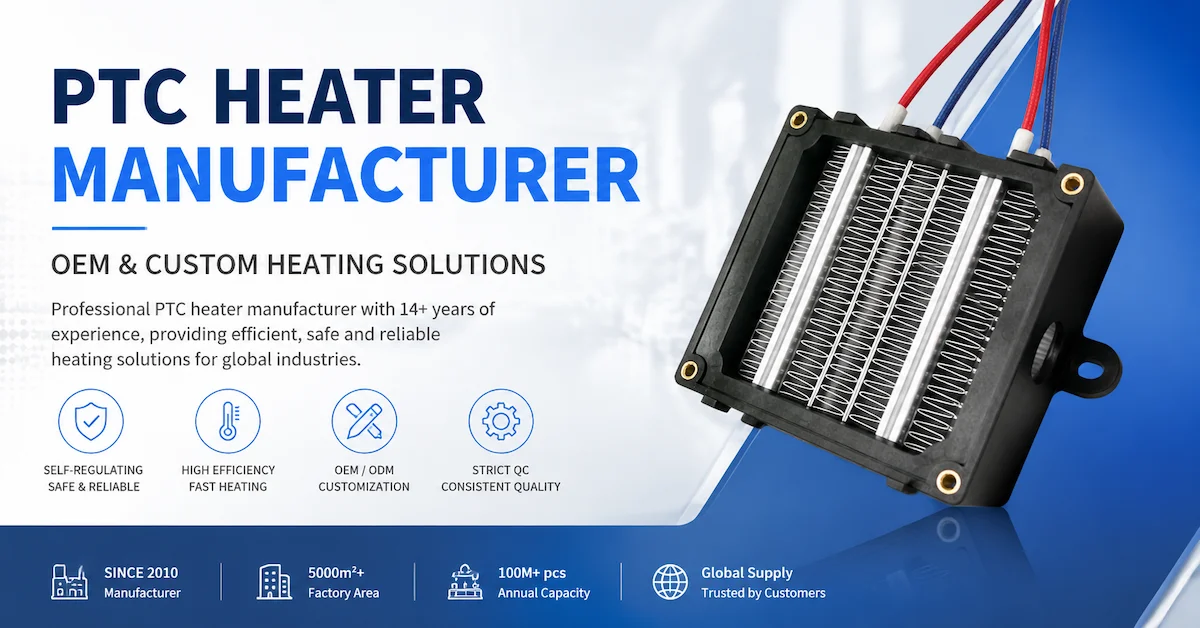
What Is a PTC Ceramic Heater?
A PTC Ceramic Heater is a self-regulating heating component that uses Positive Temperature Coefficient (PTC) ceramic material to generate controlled heat.
Unlike conventional resistance heaters that continuously consume power based on fixed resistance, PTC ceramic heaters automatically adjust their electrical characteristics according to temperature changes.
When the temperature increases:
- Electrical resistance rises
- Current flow decreases
- Heating output gradually reduces
When the temperature decreases:
- Resistance drops
- Current increases
- Heating output increases
This unique self-regulating feature allows PTC Ceramic Heater products to provide safer and more stable heating performance without requiring complicated external temperature control systems.
For OEM manufacturers, selecting a reliable PTC Ceramic Heater Manufacturer is important because the heating component directly affects:
- Equipment safety
- Energy consumption
- Product reliability
- Customer experience
A professional supplier should not only provide heating elements but also support:
- Technical consultation
- Customized design
- Prototype development
- Mass production
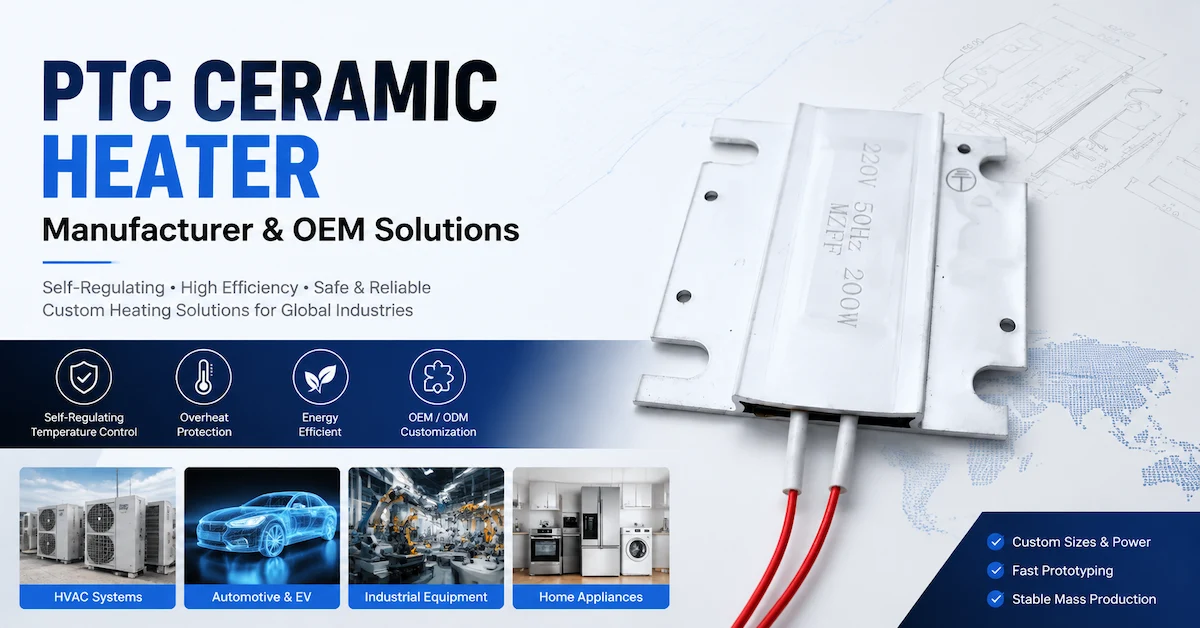
Why Manufacturers Choose PTC Ceramic Heater Technology
Self-Regulating Temperature Control
One of the biggest advantages of PTC ceramic heating technology is automatic temperature regulation.
Traditional heating elements usually require additional components such as:
- Temperature sensors
- Controllers
- Safety switches
PTC Ceramic Heater products naturally control their output through their resistance-temperature characteristics.
Benefits include:
- Reduced overheating risk
- Stable operating temperature
- Simplified circuit design
- Improved system reliability
For equipment manufacturers, this means fewer additional control components and easier product integration.
High Safety Performance
Safety is a critical factor in heating applications.
PTC ceramic heaters provide several safety advantages:
Overheat Protection
When temperature reaches the designed operating point, resistance increases and limits additional heat generation.
Flame-Free Heating
PTC ceramic heating technology does not rely on combustion, making it suitable for enclosed equipment.
Stable Long-Term Operation
The self-regulating feature helps reduce thermal stress during continuous operation.
These advantages make PTC ceramic heaters suitable for:
- HVAC systems
- Automotive applications
- Medical equipment
- Industrial machinery
Main Applications of PTC Ceramic Heater
HVAC Systems
HVAC manufacturers commonly integrate PTC Ceramic Heater components into heating systems.
Applications include:
- Air conditioning auxiliary heating
- Heat pump systems
- Air heating modules
- Ventilation equipment
Why HVAC Manufacturers Choose PTC Ceramic Heater
Advantages:
- Fast heat generation
- Stable temperature output
- Compact structure
- High safety performance
For HVAC suppliers, a reliable PTC Ceramic Heater Supplier can help improve system efficiency while reducing additional temperature control requirements.
Electric Vehicle Thermal Management
The development of electric vehicles has increased demand for efficient heating solutions.
PTC ceramic heaters are used in:
- EV cabin heating systems
- Battery heating systems
- Defrost modules
Electric vehicles require heating components that provide:
- Rapid response
- Low energy consumption
- Reliable operation under different temperatures
PTC heating technology is widely adopted because it provides controlled heating performance without complex mechanical structures.
Industrial Equipment Applications
Industrial equipment often requires heating solutions to prevent:
- Condensation
- Low-temperature damage
- Component failure
Typical applications:
- Electrical cabinets
- Automation systems
- Control equipment
- Machinery protection systems
A customized PTC Ceramic Heater can be designed according to:
- Installation space
- Voltage requirements
- Heating power
- Working environment
Technical Specifications of PTC Ceramic Heater
When sourcing a PTC Ceramic Heater Manufacturer, buyers should evaluate technical parameters carefully.
| Item | Specification |
|---|---|
| Heating Material | PTC Ceramic |
| Working Principle | Positive Temperature Coefficient Heating |
| Voltage | 12V / 24V / 110V / 220V Customized |
| Power Output | Customized according to application |
| Temperature Control | Self-regulating |
| Structure | Heating plate / Module / Assembly |
| Application | HVAC / Automotive / Industrial Equipment |
| Customization | OEM & ODM Available |
Key Components of PTC Ceramic Heater
PTC Ceramic Heating Element
The ceramic element is the core heating component.
Its main functions:
- Convert electrical energy into heat
- Adjust resistance according to temperature
- Maintain stable heating output
The quality of ceramic materials directly affects:
- Heating efficiency
- Temperature stability
- Product lifetime
Conductive Electrodes
Electrodes provide electrical connection and ensure:
- Uniform current distribution
- Stable power transmission
- Reliable operation
Poor electrode design may cause:
- Uneven heating
- Reduced lifespan
- Performance instability
Heat Dissipation Structure
The external structure helps transfer heat efficiently.
Design considerations include:
- Heat distribution
- Airflow conditions
- Installation environment
Different applications require different structural designs, which is why OEM customization is important for industrial buyers.
PTC Ceramic Heater Manufacturing Process, Quality Control, Cost Factors & OEM Guide
How PTC Ceramic Heater Is Manufactured?
For industrial and OEM buyers, understanding the manufacturing process of a PTC Ceramic Heater helps evaluate supplier capability, product consistency, and long-term cooperation potential.
A professional PTC Ceramic Heater Manufacturer should have complete control over:
- Raw material selection
- Ceramic processing
- Electrical performance testing
- Assembly capability
- Quality inspection
- Customized production
The manufacturing process directly determines:
- Heating efficiency
- Temperature stability
- Service life
- Batch consistency
PTC Ceramic Heater Manufacturing Process
1. PTC Ceramic Material Preparation
The first step is preparing the PTC ceramic material.
The ceramic composition determines the heater’s:
- Resistance characteristics
- Curie temperature
- Heating efficiency
- Temperature control performance
During production, manufacturers carefully control:
- Material ratio
- Powder quality
- Mixing uniformity
- Processing conditions
A stable material formulation ensures consistent electrical characteristics between different production batches.
2. Ceramic Forming Process
After material preparation, the ceramic material is formed into designed shapes.
Common structures include:
- Ceramic plates
- Ceramic blocks
- Heating modules
- Customized heating elements
The forming process must maintain:
- Dimensional accuracy
- Structural integrity
- Surface quality
For OEM customers, customized dimensions are important because heating components often need to fit specific equipment designs.
3. High Temperature Sintering
Sintering is one of the most important manufacturing steps.
During this process:
- Ceramic particles bond together
- Material strength increases
- Electrical properties are stabilized
Proper sintering control affects:
- Resistance consistency
- Thermal response
- Product durability
Poor sintering quality may lead to:
- Unstable heating output
- Shorter service life
- Performance variation
4. Electrode Processing
After ceramic forming, conductive electrodes are added.
The electrode layer ensures:
- Efficient electrical conduction
- Uniform heating distribution
- Reliable electrical connection
Manufacturers need to control:
- Electrode thickness
- Bonding strength
- Electrical contact quality
5. Heater Assembly
According to different applications, PTC ceramic heaters can be assembled into:
- Heating plates
- Air heating modules
- Industrial heating assemblies
- Customized heating solutions
Assembly design depends on:
- Application environment
- Heat transfer requirements
- Installation structure
6. Performance Testing
Before shipment, each batch should undergo performance verification.
Common tests include:
Resistance Test
Checks:
- Electrical consistency
- Resistance value accuracy
Power Output Test
Verifies:
- Heating performance
- Power stability
Temperature Response Test
Evaluates:
- Heating speed
- Temperature regulation capability
Aging Test
Confirms:
- Long-term reliability
- Continuous operating performance
Quality Control Standards for PTC Ceramic Heater
When selecting a PTC Ceramic Heater Supplier, buyers should evaluate the supplier’s quality management system.
A reliable supplier should provide:
Incoming Material Inspection
Inspection of:
- Ceramic materials
- Conductive materials
- Structural components
Purpose:
Prevent material variation from affecting final product performance.
Production Process Control
Manufacturing control includes:
- Forming accuracy
- Sintering temperature
- Electrode processing
- Assembly consistency
Process control helps ensure stable production quality.
Final Product Inspection
Before delivery, products should be checked for:
- Appearance quality
- Electrical parameters
- Heating performance
- Reliability
For global OEM customers, consistent quality is essential because heating components are often integrated into finished equipment systems.
How to Choose a Reliable PTC Ceramic Heater Manufacturer?
Selecting the right supplier is one of the most important decisions for equipment manufacturers.
A qualified manufacturer should provide more than products.
They should provide:
- Engineering support
- Custom development
- Stable production
- Quality assurance
1. Evaluate Technical Capability
A capable manufacturer should support customization including:
Electrical Parameters
- Voltage
- Power
- Resistance characteristics
Mechanical Design
- Size
- Shape
- Installation structure
Application Requirements
- Heating environment
- Temperature range
- Operating conditions
This capability allows OEM buyers to develop products suitable for specific applications.
2. Check OEM and ODM Capability
Different industries require customized heating solutions.
A professional OEM PTC Ceramic Heater Supplier should support:
Prototype Development
Process:
Customer requirements
↓
Engineering evaluation
↓
Prototype production
↓
Performance testing
↓
Mass production
Custom Production
Customization may include:
- Heater dimensions
- Heating power
- Voltage design
- Connector options
- Assembly structure
3. Evaluate Production Capacity
For B2B buyers, production capability affects:
- Delivery reliability
- Supply stability
- Market response speed
Important factors:
| Factor | Why It Matters |
|---|---|
| Production Capacity | Supports bulk orders |
| Process Control | Maintains consistency |
| Lead Time Management | Reduces supply risks |
| Quality System | Ensures reliability |
PTC Ceramic Heater Model Comparison
| Type | Working Principle | Advantages | Limitations | Best Applications |
|---|---|---|---|---|
| PTC Ceramic Heater | Self-regulating ceramic resistance | Safe, stable, energy efficient | Requires proper design matching | HVAC, EV, Industrial Equipment |
| Metal Resistance Heater | Fixed resistance heating | Simple structure, low initial cost | Needs external temperature control | General heating applications |
| Silicone Heater | Flexible resistance heating | Easy installation on surfaces | Limited temperature range | Surface heating applications |
Factors Affecting PTC Ceramic Heater Cost
Many buyers ask:
How much does a PTC Ceramic Heater cost?
The final cost depends on several factors.
1. Heating Power Requirements
Higher power requirements usually require:
- Larger heating elements
- More material
- More advanced design
2. Product Customization
Standard products usually have lower costs.
Customized products may require:
- New tooling
- Engineering development
- Prototype testing
Customization factors include:
- Size
- Voltage
- Power
- Structure
3. Order Quantity
Production volume influences:
- Material purchasing
- Manufacturing efficiency
- Unit cost
Large-volume orders usually achieve better cost efficiency.
4. Quality Requirements
Higher requirements may increase cost, including:
- Additional testing
- Reliability verification
- Special materials
However, better quality reduces:
- Product failure risk
- Warranty cost
- Supply problems
OEM PTC Ceramic Heater Solution for Global Buyers
For equipment manufacturers, OEM capability is often more important than selecting a standard heater.
A professional manufacturer should provide a complete solution:
Requirement Analysis
Understanding:
- Application environment
- Heating requirements
- Installation limitations
Engineering Design
Develop:
- Product structure
- Electrical parameters
- Performance targets
Prototype Validation
Testing:
- Heating performance
- Temperature stability
- Compatibility
Mass Production
Providing:
- Stable quality
- Consistent performance
- Reliable delivery
Why Partner with PTCNTCSENSOR for PTC Ceramic Heater Solutions?
PTCNTCSENSOR focuses on temperature control components and heating solutions, providing support for manufacturers requiring reliable thermal management products.
The company’s product capabilities include:
- PTC heating components
- NTC temperature sensing solutions
- Temperature control components
- Customized OEM solutions
For customers requiring customized heating solutions, cooperation can cover:
- Product selection
- Engineering communication
- Custom development
- Production support
Learn more about company capabilities:
About PTCNTCSENSOR:
https://www.ptcntcsensor.com/about-us
Explore available products:
PTCNTCSENSOR Products:
https://www.ptcntcsensor.com/products
Contact the engineering team for customized requirements:
Contact PTCNTCSENSOR:
https://www.ptcntcsensor.com/contact-us
FAQ About PTC Ceramic Heater
1. What is a PTC Ceramic Heater?
A PTC Ceramic Heater is a heating component using positive temperature coefficient ceramic material to achieve self-regulating heating performance.
2. How does a PTC Ceramic Heater work?
When temperature increases, the electrical resistance of the PTC ceramic material rises, automatically reducing power output and controlling temperature.
3. What are the advantages of PTC Ceramic Heater technology?
Main advantages include:
- Self-regulating temperature control
- High safety
- Energy efficiency
- Stable operation
- Long service life
4. Where are PTC Ceramic Heaters used?
Common applications include:
- HVAC systems
- Electric vehicles
- Industrial equipment
- Home appliances
- Medical equipment
5. Can PTC Ceramic Heaters be customized?
Yes.
Manufacturers can customize:
- Voltage
- Power
- Size
- Structure
- Connection methods
6. How do I choose a PTC Ceramic Heater supplier?
Consider:
- Manufacturing experience
- Customization capability
- Quality control system
- Production capacity
- Technical support
7. What information is required for a PTC Ceramic Heater quotation?
Buyers usually provide:
- Operating voltage
- Required power
- Application environment
- Product dimensions
- Quantity requirement
8. What is the MOQ for OEM PTC Ceramic Heater production?
MOQ depends on:
- Product design
- Customization level
- Production requirements
9. How long does PTC Ceramic Heater production take?
Lead time depends on:
- Product complexity
- Sample requirements
- Order quantity
10. Why choose a manufacturer instead of a trading company?
Direct cooperation with a manufacturer provides:
- Better technical communication
- More customization options
- Stable supply
- Better quality control
Conclusion
PTC Ceramic Heater technology provides an efficient and reliable heating solution for modern thermal management applications.
For HVAC manufacturers, automotive suppliers, and industrial equipment companies, choosing the right PTC Ceramic Heater Manufacturer can improve product reliability, reduce development risks, and create long-term supply advantages.
A professional supplier should provide not only heating components but also:
- Engineering support
- OEM/ODM capability
- Quality control
- Stable manufacturing capacity
By selecting an experienced PTC ceramic heating partner, global buyers can develop safer, more efficient, and more competitive products.