TL;DR: A standard PTC Heating Assembly is often the practical choice when its voltage, heating characteristics, dimensions, and connections already satisfy an OEM design. A custom assembly becomes more attractive when the equipment requires specific mounting geometry, wiring, connectors, or production integration. The correct decision depends on four factors: technical compatibility, installation complexity, total installed cost, and production consistency. There is no universal order-volume break-even point; buyers must calculate it using project-specific quotations and assembly costs.
OEM engineers and sourcing managers developing electrical appliances, industrial heating equipment, and temperature-controlled systems frequently face a purchasing decision: should they integrate a standard PTC heater or work directly with a manufacturer to develop a customized heating assembly?
A standard heater may reduce initial development requirements, but it can also introduce additional brackets, wiring operations, or installation adjustments. A custom configuration may simplify final equipment assembly, although tooling, sample approval, and qualification costs must be considered.
The decision becomes particularly important when production volumes increase. Minor assembly difficulties that are manageable during prototyping can become recurring costs during mass production.
In this engineering guide, standard and custom PTC heating assemblies are compared across four main criteria: mechanical tolerances, electrical integration, tooling and installed cost, and production scalability.
The comparison also includes published Tianrui product specifications, engineering calculations, a step-by-step selection process, and an illustrative OEM application scenario.
The objective is to help equipment manufacturers make a technically justified sourcing decision before committing to tooling or production orders.

How Do Standard and Custom PTC Heating Assemblies Compare Side by Side?
Table 1 compares standard catalog heating assemblies with application-specific OEM designs.
The comparison focuses on equipment integration rather than ceramic heating performance alone.
| Comparison Dimension | Option A: Standard PTC Heating Assembly | Option B: Custom OEM PTC Heating Assembly | Recommended Selection |
|---|---|---|---|
| Mounting and dimensional fit | Uses published dimensions and existing mounting features | Housing, bracket, hole positions, and cable exits can be designed around the equipment | Choose standard when fit is acceptable; consider custom when installation requires substantial modification |
| Wiring and electrical interface | Uses existing lead wires, terminals, or connector arrangements | Wiring length, routing, terminals, and connector specifications can be defined for the OEM | Custom is attractive when electrical integration creates recurring assembly work |
| Tooling and total cost | Generally avoids new application-specific heater tooling | May require engineering, tooling, qualification, and minimum production quantities | Compare total installed cost and amortized development expense |
| Prototype and production release | Suitable for rapid evaluation when a compatible product exists | Requires design review, controlled drawings, sample approval, and production qualification | Standard often suits early development; custom may suit stable high-volume programs |
The main engineering trade-off is flexibility versus integration.
A standard PTC heater offers an established physical configuration that can be evaluated without developing every component from the beginning.
A custom assembly allows the electrical, thermal, and mechanical interfaces to be designed around a specific machine.
However, a custom assembly is not automatically more reliable, economical, or suitable. Those outcomes depend on design quality, verification, manufacturing controls, and actual production requirements.
Key Takeaways
-
Choose a standard PTC Heating Assembly when the voltage, temperature behavior, dimensions, insulation, wiring, and mounting features already meet equipment requirements without significant modifications.
-
Consider an OEM PTC Heating Assembly when the equipment requires custom connectors, a defined wiring harness, restricted installation dimensions, specialized brackets, or repeatable high-volume integration.
-
Evaluate total installed cost rather than component price alone. Include heater procurement, secondary parts, installation labor, inspection, tooling, rework risk, and production quantity.
-
Do not approve an assembly solely from catalog wattage. Cold-start current, stabilized power, thermal behavior, electrical insulation, and installation conditions require evaluation.
-
Release production using controlled specifications. Drawings, BOM revisions, inspection criteria, approved samples, and change-control procedures are essential for consistent repeat orders.
The Engineering Method Behind This Comparison: Product Specifications and OEM Qualification Criteria
A useful manufacturer comparison must separate published product characteristics from calculated engineering assumptions.
This guide uses three information categories.
1. Published product information
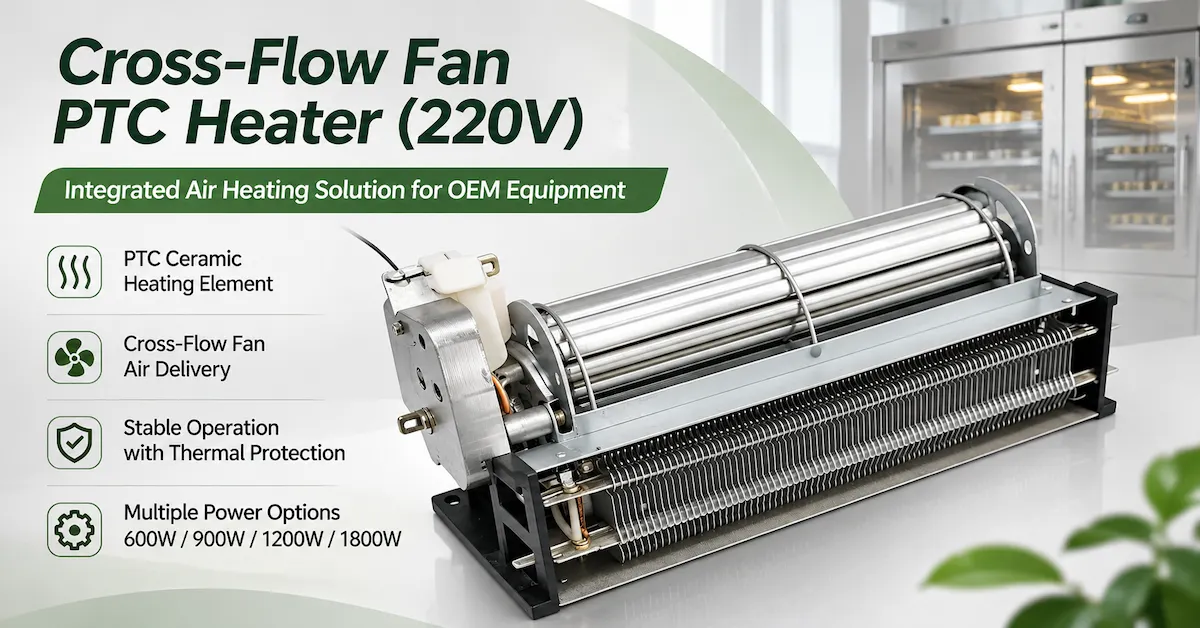
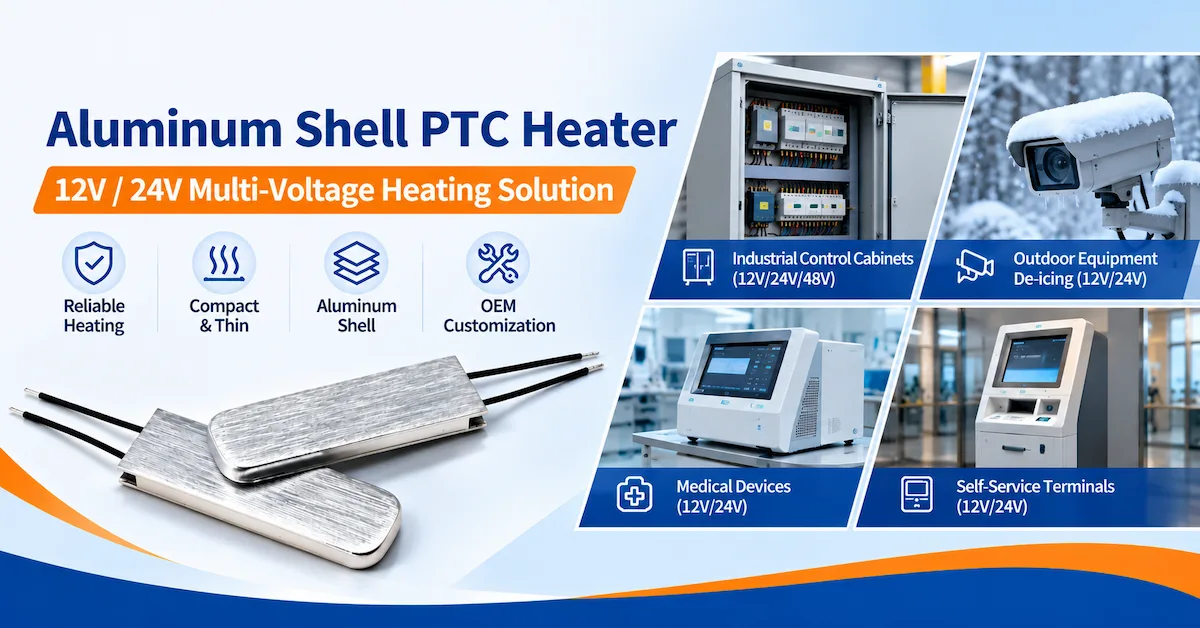
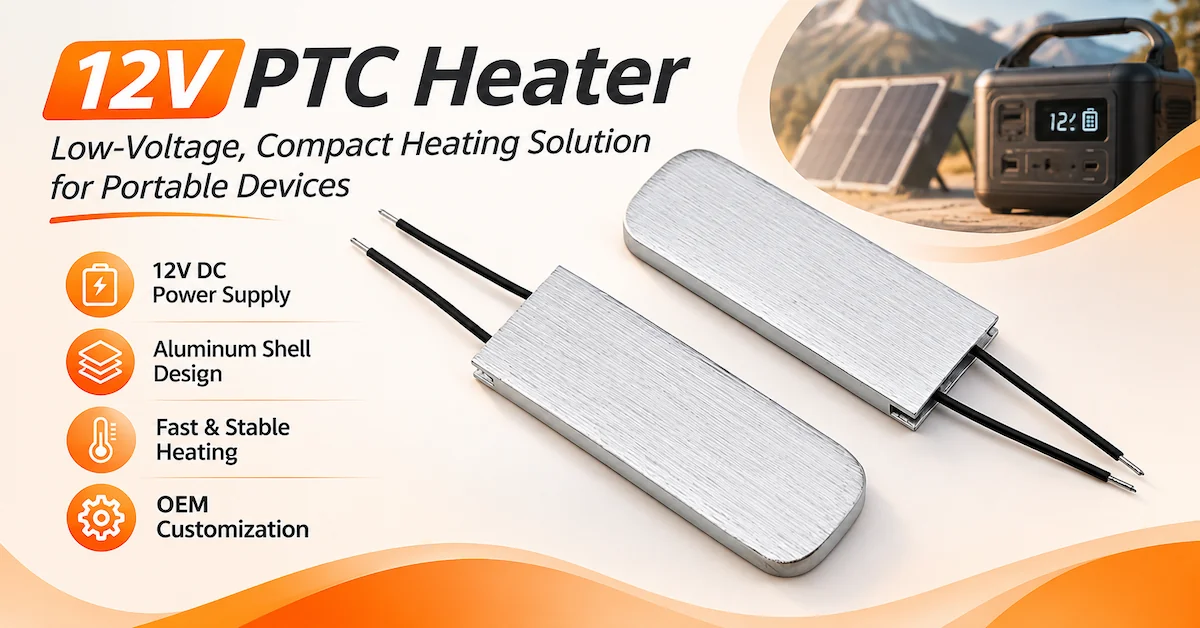
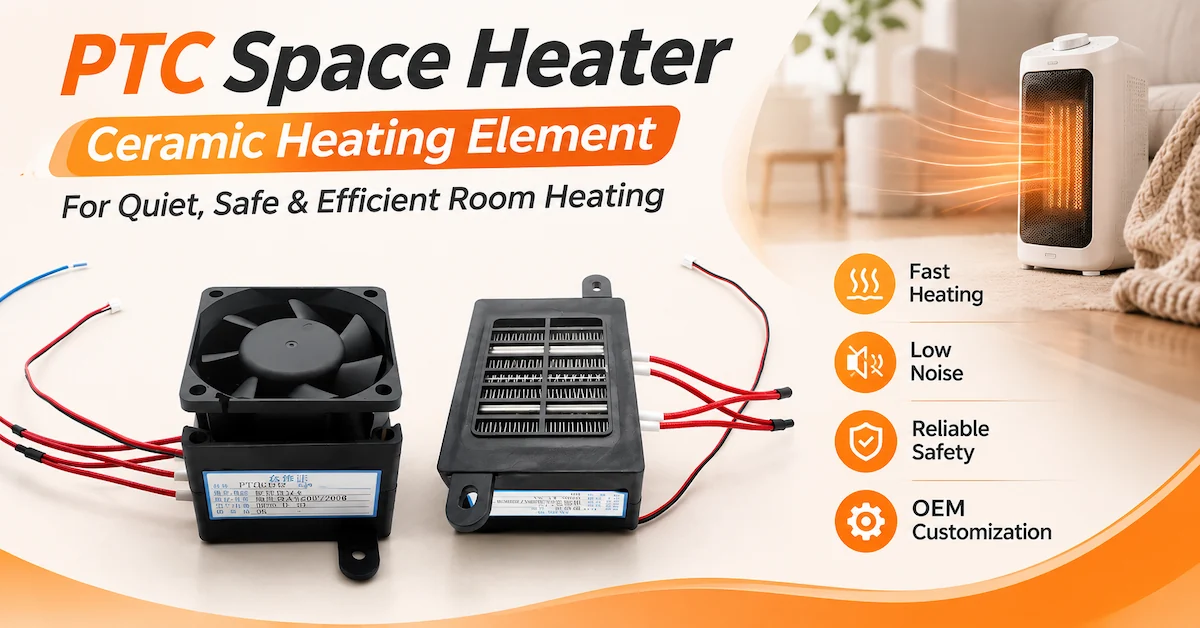
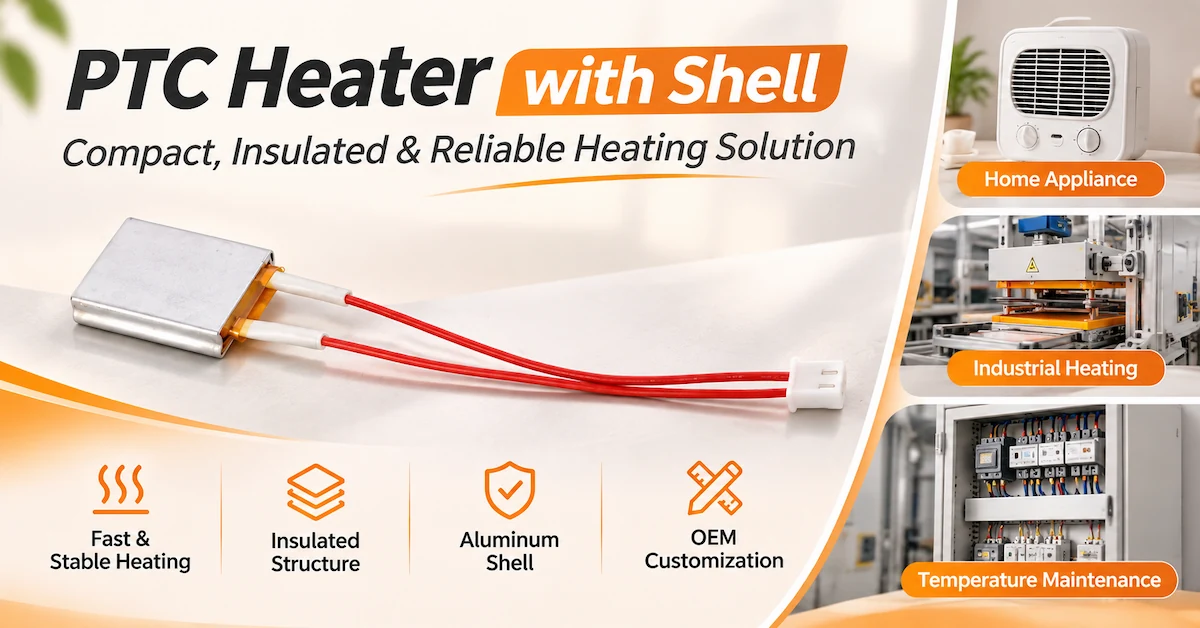
Tianrui Electronics provides several PTC heater configurations, including aluminum-shell heaters, insulated heating elements, compact heating plates, and application-specific heater assemblies.
These products form the basis for identifying practical integration options.
Buyers can explore the company's PTC Heater product range and custom heating solutions.
2. General engineering relationships
Electrical loading, dimensional tolerance accumulation, and cost amortization can be evaluated using established engineering methods.
For example, electrical current can be estimated from power and voltage under defined conditions. Dimensional clearance can be evaluated using maximum and minimum allowable dimensions.
These calculations help engineers identify potential problems before manufacturing samples.
3. Illustrative purchasing scenarios
The financial and tolerance examples later in this guide are hypothetical calculations intended to demonstrate decision-making methods.
They are not Tianrui quotations, factory test records, or verified customer outcomes.
A responsible purchasing decision should replace these assumptions with approved drawings, project-specific quotations, and actual validation results.
Technical review priorities
For a complete heating assembly, engineering assessment should cover five connected systems:
-
The PTC ceramic and its electrical characteristics.
-
The mechanical and thermal-transfer structure.
-
The electrical connection and insulation system.
-
The installation interface with the OEM equipment.
-
The quality and configuration controls required for production.
Ignoring any one of these systems can result in a technically incomplete supplier comparison.
Which PTC Heating Assembly Provides Better Mounting Accuracy and Mechanical Fit?
Mechanical compatibility is one of the first reasons an OEM may consider customized heating assemblies.
A standard heater may have suitable power and voltage ratings while failing to fit the installation space.
Typical problems include mounting-hole misalignment, bracket interference, insufficient connector clearance, or an unsuitable cable exit direction.
These issues can create production difficulties even when the heater itself operates correctly.
Why nominal dimensions are insufficient
Every manufactured component has dimensional variation.
An equipment housing, heater bracket, mounting plate, and connector position may each be within their individual tolerances, but their combined variation can still create an assembly problem.
This is known as tolerance stack-up.
For high-volume production, engineers should evaluate the worst-case combinations of critical dimensions.
Dimensional tolerance example
Consider a hypothetical heating assembly installed inside an equipment opening.
The enclosure opening has a specified width of:
62.0 ± 0.3 mm
The heating assembly has an external width of:
60.0 ± 0.2 mm
The nominal clearance is:
62.0 − 60.0 = 2.0 mm
At the minimum-clearance condition:
Minimum opening = 61.7 mm
Maximum heater width = 60.2 mm
Minimum clearance = 1.5 mm
At the maximum-clearance condition:
Maximum opening = 62.3 mm
Minimum heater width = 59.8 mm
Maximum clearance = 2.5 mm
The allowable clearance therefore ranges from 1.5 mm to 2.5 mm under these assumptions.
This result is not inherently acceptable or unacceptable.
If the heater requires at least 1.5 mm clearance for installation and no additional constraints exist, the dimensions may be acceptable.
If the connector or mounting process requires more clearance, the design may need modification.
Critical mounting features
| Mechanical Feature | Main Risk | Engineering Check |
|---|---|---|
| Overall length and width | Housing interference | Maximum-material condition |
| Mounting-hole spacing | Fastener misalignment | Hole position and datum reference |
| Bracket thickness | Incorrect assembly position | Thickness and flatness |
| Connector position | Collision with nearby parts | Assembly clearance |
| Cable exit location | Excessive bending or tension | Routing envelope |
| Heater contact surface | Inconsistent thermal transfer | Contact geometry and mounting force |
| Fastener engagement | Loose or damaged mounting | Thread and retention requirements |
When does customization become necessary?
Customization should be considered when a standard heater requires additional adapters, manually modified brackets, repeated cable adjustments, or unacceptable installation compromises.
However, if a standard product fits the equipment and satisfies the thermal requirements, custom tooling may provide little additional value.
Engineering recommendation:
Establish critical-to-fit dimensions and allowable tolerances before comparing heater prices.
A low-priced heater that requires repeated manual adjustment can become expensive during mass production.
How Do Wiring and Connector Requirements Affect OEM Heating Assembly Selection?
Electrical integration is another major difference between standard and customized heating assemblies.
The wiring harness determines how the heater connects to the equipment's power supply and control system.
Even a suitable ceramic heating element may create reliability problems if the wiring and connector arrangement are poorly designed.
Standard wiring configuration
A catalog heater may be supplied with fixed lead wires or a predefined terminal arrangement.
This is suitable when the customer can integrate the existing interface without significant modification.
However, some equipment may require a longer harness, a different connector, or a particular cable exit direction.
Custom wiring configuration
A custom assembly can be specified with the required connection architecture, subject to engineering feasibility.
Possible requirements include:
-
Defined cable length.
-
Suitable conductor cross-section.
-
Appropriate wire insulation.
-
Connector manufacturer and part number.
-
Terminal type.
-
Contact arrangement.
-
Pin assignment.
-
Connector orientation.
-
Strain relief.
-
Protective sleeving.
-
Harness routing restrictions.
Why cable temperature ratings matter
The cable may operate close to the heating element or metal housing.
Therefore, the actual conductor and insulation temperatures should be evaluated.
The maximum temperature of the ceramic is not necessarily the same as the temperature experienced by the wire.
Cable routing, thermal contact, airflow, and equipment enclosure conditions all influence the final temperature.
Connector specification comparison
| Parameter | Standard Assembly | Custom Assembly |
|---|---|---|
| Cable length | Existing supplier configuration | Defined by OEM drawing |
| Connector type | May use fixed terminals or standard connector | Selected for customer equipment |
| Pin orientation | Fixed | Application-specific |
| Wiring route | Determined during equipment integration | Can be incorporated into assembly design |
| Strain relief | Existing construction | Defined according to application |
| Replacement compatibility | Requires comparison with existing harness | Can be controlled by approved part number |
Which connector tests are important?
Where applicable, qualification may include terminal retention, electrical continuity, temperature rise, insulation verification, and connector mating evaluation.
Crimped terminals should be manufactured using suitable tooling and the relevant terminal manufacturer's instructions.
Wire pull-force tests and visual inspection may be useful, depending on the connection system.
Practical selection rule
A standard heater is suitable when its existing wiring can be installed reliably without creating unsafe routing or excessive assembly effort.
A customized assembly may be preferable when the equipment requires a controlled connector interface that will be repeated across thousands of finished products.
Which Option Offers Better Electrical Insulation and Safety Integration?
PTC ceramic heating technology provides temperature-dependent resistance behavior, but the complete heating assembly must still satisfy electrical safety requirements.
An OEM should distinguish the ceramic's self-regulating characteristic from the safety of the installed equipment.
Understanding PTC self-regulation
As a ceramic PTC element heats toward its designed transition region, its electrical resistance increases.
At a fixed voltage, this generally reduces electrical current and heating power.
However, adjacent wiring, plastic parts, connectors, and mounting components may still experience excessive temperatures under abnormal conditions.
For this reason, equipment-level safety must be assessed independently.
Standard insulated assembly
A standard insulated heater may already include a metal housing and an insulation system.
This can simplify preliminary design when the assembly's rated conditions align with the application.
However, published product descriptions are not substitutes for the relevant model-specific test information.
Customized insulation system
A custom assembly may need different insulating materials, geometry, or installation interfaces.
Any change to insulation should consider:
-
Operating voltage.
-
Maximum local temperature.
-
Dielectric requirements.
-
Creepage and clearance.
-
Insulation thickness.
-
Thermal resistance.
-
Mechanical pressure.
-
Humidity exposure.
-
Material aging.
-
Relevant fault conditions.
Insulation comparison
| Engineering Requirement | Standard PTC Assembly | Custom PTC Assembly |
|---|---|---|
| Insulation structure | Existing configuration | Can be reviewed for equipment design |
| Electrical rating | Published or confirmed model rating | Must be established for custom configuration |
| Housing material | Existing material | May be adapted |
| Thermal interface | Fixed construction | Application-specific design possible |
| Validation requirement | Confirm suitability for installation | Verify design and relevant modifications |
| Approval documentation | Request model-specific evidence | Define and agree qualification documents |
Can an existing rating be transferred to a custom design?
Not automatically.
Changing insulation material, thickness, housing geometry, terminals, or assembly processes may influence the electrical and thermal characteristics.
The revised design may require additional verification.
For example, a product page describing an IP rating does not establish that a new cable exit or connector modification preserves the same protection level.
Relevant standards
IEC 60738-1 provides general requirements and test methods for directly heated PTC thermistors.
IEC 60335-1 and applicable particular standards may be relevant to household and similar electrical appliances.
Industrial products may be subject to different equipment standards depending on their function and installation.
The applicable standard and edition should be determined for the final equipment and intended market.
Important:
Referencing a standard is not evidence that a particular Tianrui heater has been certified to it. Required compliance information should be requested for the exact product.
When Does a Custom PTC Heating Assembly Become Cheaper Than a Standard Heater?
The cost comparison changes when the purchased heater price is separated from the cost of installing that heater into the finished equipment.
A standard component may have a lower purchase price but require additional wiring, mounting brackets, inspection, and installation labor.
A customized assembly may cost more per purchased unit but reduce those additional operations.
Total installed cost formula
For a simplified comparison:
Total Installed Unit Cost = Purchased Assembly Cost + Additional Components + Installation Labor + Inspection Cost + Amortized Tooling
For a custom design, tooling cost per unit can be estimated as:
Tooling Cost per Unit = Total Tooling Investment ÷ Planned Production Quantity
The calculation should use the expected production quantity over the period in which the tooling investment is being evaluated.
Illustrative cost comparison
Consider an OEM evaluating two alternatives.
Option A: Standard heater assembly
| Cost Component | Illustrative Cost |
|---|---|
| Purchased standard heater | $18.00 |
| Additional harness and bracket | $5.00 |
| Equipment installation labor | $3.00 |
| Additional inspection | $2.00 |
| Total installed cost | $28.00/unit |
Option B: Custom heating assembly
| Cost Component | Illustrative Cost |
|---|---|
| Purchased custom assembly | $24.00 |
| Equipment installation labor | $1.00 |
| Additional inspection | $1.00 |
| One-time tooling investment | $1,800 |
Excluding tooling amortization, the custom assembly costs:
$24 + $1 + $1 = $26.00/unit
The difference between the two alternatives is:
$28 − $26 = $2.00/unit
To recover a hypothetical $1,800 tooling investment:
$1,800 ÷ $2 = 900 units
In this illustrative model, the two alternatives reach the same calculated total installed cost at 900 units.
Above 900 units, the custom assembly becomes less expensive under the stated assumptions.
Below 900 units, the standard assembly has a lower total modeled cost.
These figures are examples only. They are not Tianrui prices, actual tooling quotations, or supplier performance data.
Cost comparison across production quantities
| Planned Quantity | Standard Assembly | Custom Assembly Including Tooling | Lower Modeled Cost |
|---|---|---|---|
| 100 units | $28.00/unit | $44.00/unit | Standard |
| 300 units | $28.00/unit | $32.00/unit | Standard |
| 600 units | $28.00/unit | $29.00/unit | Standard |
| 900 units | $28.00/unit | $28.00/unit | Equal |
| 1,500 units | $28.00/unit | $27.20/unit | Custom |
| 3,000 units | $28.00/unit | $26.60/unit | Custom |
Why the actual break-even point may differ
Real projects must also consider:
-
Engineering development expense.
-
Sample qualification.
-
Design revisions.
-
Tool maintenance.
-
Inventory holding costs.
-
Minimum purchase quantities.
-
Scrap and rework.
-
Inspection requirements.
-
Packaging and transportation.
-
Changes in annual demand.
A custom assembly may also provide engineering benefits that are difficult to express as a simple per-unit saving.
The correct decision should therefore be based on an approved supplier quotation and a realistic production forecast.
How Does Production Volume Affect Standard vs Custom PTC Heating Assembly Decisions?
Production quantity influences the importance of tooling amortization and recurring installation costs.
However, volume alone should not determine the final choice.
Production volume and sourcing strategy
| Production Stage | Typical Purchasing Priority | Standard Assembly Consideration | Custom Assembly Consideration |
|---|---|---|---|
| Engineering prototype | Design flexibility | Useful when an existing configuration fits | Useful when standard designs cannot meet requirements |
| Pilot production | Process validation | Helps avoid premature tooling commitment | Tests whether proposed integration improves assembly |
| Initial mass production | Stable supply and product fit | Suitable if installed costs remain competitive | May become attractive as recurring savings increase |
| Repeated high-volume orders | Consistency and lifecycle cost | Remains appropriate for qualified standard designs | Often worth evaluating when integration costs are significant |
No universal volume threshold applies across all heater designs.
A complex connector customization may be economically justified even for a relatively modest order.
Conversely, a standard assembly can remain the most practical choice for high-volume production when it fits the equipment without modification.
Why engineering revisions affect sourcing strategy
During early product development, equipment dimensions, wiring routes, and heating requirements may change.
A customized assembly developed too early may require tooling modifications or renewed qualification.
OEM teams should therefore assess design maturity before committing to application-specific tooling.
Recommended sourcing approach
During early development, evaluate compatible standard parts whenever practical.
If the equipment requires significant structural or electrical modifications, compare a custom alternative.
Before mass production, calculate the recurring costs of both options and validate the approved configuration.
How Do Engineers Select Between Standard and Custom Heating Assemblies in Three Steps?
A structured decision process can help engineering and purchasing teams narrow their options before requesting quotations.
Step 1: Check electrical and thermal compatibility
Action:
Compare the available heater's voltage, electrical behavior, thermal output, insulation, and operating environment with the equipment requirements.
Decision rule:
If a standard product cannot satisfy a critical electrical, thermal, or safety requirement, it should not be selected simply because its price is attractive.
Investigate an alternative standard configuration or a custom design.
If the electrical and thermal conditions are satisfied, proceed to Step 2.
Step 2: Evaluate mechanical and wiring integration
Action:
Review installation drawings, mounting tolerances, connector compatibility, cable length, and assembly accessibility.
Decision rule:
If the standard heater fits the equipment and can be installed reliably without significant additional work, it remains a strong candidate.
If the design requires custom brackets, wiring adapters, difficult installation operations, or nonstandard mounting arrangements, compare a customized assembly.
Proceed to Step 3 after identifying technically acceptable alternatives.
Step 3: Compare lifecycle cost and production risk
Action:
Calculate purchased cost, additional parts, labor, tooling amortization, inspection, and expected production volume.
Decision rule:
Select the technically qualified alternative that provides an acceptable combination of total cost, production consistency, development risk, and long-term supply.
A lower initial price does not automatically justify accepting repeated manufacturing problems.
Three-step decision checklist
| Step | Primary Question | Required Evidence |
|---|---|---|
| 1. Technical fit | Does it perform correctly and safely? | Electrical specification and relevant test results |
| 2. Integration fit | Can it be installed consistently? | Drawings, tolerance study, wiring verification |
| 3. Production economics | Which option offers the best total value? | Comparable quotations and cost calculations |
If neither option meets the project requirements, the appropriate response is to revise the design or qualification plan rather than accept an unsuitable heater.
OEM PTC Heating Assembly Engineering Scenario: Reducing Installation Complexity
The following worked scenario demonstrates how a manufacturing team might compare standard and customized assemblies.
This is an illustrative engineering example, not a documented Tianrui customer project or verified factory test.
Project background
An OEM is developing an electrically heated industrial equipment module.
The equipment requires a compact PTC heating assembly with:
-
A defined electrical supply.
-
A restricted mounting envelope.
-
An accessible electrical connector.
-
A repeatable wiring route.
-
Controlled insulation and temperature behavior.
-
Stable installation across recurring production orders.
The engineering team is considering a standard aluminum-shell heater.
However, the equipment design requires an additional wiring adapter and a separate mounting bracket.
Engineering challenge
The standard heater satisfies the preliminary heating requirement but introduces three potential integration issues.
Issue 1: Connector orientation
The existing connector arrangement is not aligned with the equipment wiring path.
A separate harness is required.
Issue 2: Mounting compatibility
The heater needs an additional bracket to fit the intended mounting location.
Issue 3: Assembly operations
The production technician must install the bracket, attach the harness, position the heater, and check the completed connection.
These operations increase manufacturing complexity.
Option A: Continue using the standard assembly
The engineering team could retain the standard heater and purchase the adapter components separately.
This avoids custom heater tooling but preserves the additional installation operations.
The standard design may still be the correct choice if purchasing volume is low or design changes remain likely.
Option B: Develop a custom OEM assembly
An alternative is to request a custom heating assembly with:
-
Integrated mounting features.
-
Application-specific connector orientation.
-
Defined wire length.
-
Approved housing dimensions.
-
Controlled electrical insulation.
-
A documented installation interface.
This option could reduce additional assembly components and simplify the final installation process.
However, the custom configuration must be developed and validated before production.
Technical evaluation sequence
1. Dimensional assessment
Review the existing heater and equipment drawings.
Identify the critical mounting and clearance dimensions.
2. Electrical-interface review
Confirm current requirements, connector ratings, wire specifications, and cable routing.
3. Thermal assessment
Determine whether the revised housing or mounting structure changes heat transfer.
A modified assembly should not be assumed thermally equivalent merely because it contains the same ceramic element.
4. Prototype testing
Install samples in the actual equipment.
Record relevant electrical, thermal, and mechanical results.
5. Cost analysis
Compare the total installed cost of the standard and custom approaches.
6. Production qualification
Release the selected design only after documented acceptance.
What can the scenario demonstrate?
The example shows why customization should be evaluated as a complete equipment-integration decision.
It does not establish that custom assemblies always cost less or improve manufacturing quality.
Those results require project-specific quotations, approved test data, and real production measurements.
Recommended evidence for a real customer case study
If Tianrui later publishes a documented OEM project, the strongest case study would include:
| Evidence | Recommended Content |
|---|---|
| Initial challenge | Specific electrical or mechanical incompatibility |
| Original configuration | Existing assembly and installation requirements |
| Engineering modification | Documented wiring, connector, or mounting changes |
| Test method | Defined measurement and acceptance procedure |
| Measured results | Actual installation, electrical, thermal, or cost data |
| Production outcome | Verified approval and relevant production results |
A real, documented case study would provide stronger E-E-A-T evidence than unsupported claims about percentage savings or reliability improvements.
Which Tianrui PTC Heater Models Are Relevant to OEM Assembly Projects?
Dongguan Tianrui Electronics Co., Ltd. publishes several PTC heating products that can be evaluated for different OEM integration requirements.
The products vary in voltage, rated power, housing construction, and intended applications.
Product configuration comparison
| Tianrui Product | Published Characteristics | Relevant OEM Requirement |
|---|---|---|
| Aluminum Shell PTC Heater | Published family lists AC/DC 5–380V and 50–270°C configurations | Mechanical housing and contact-heating integration |
| PTC Heater with Insulated Film | Published family includes 12–240V AC/DC or customized options | Insulation and structural integration |
| 220V 30W PTC Heater Plate | Compact aluminum-shell heating plate | Small equipment assemblies |
| Comb-Shaped PTC Heater | 220V, published 100W/150W/200W options | Screw-mounted heating assemblies |
| MZ12 PTC Insulated Heater | Published insulated heater model series | Model-based electrical and dimensional selection |
Published family ranges should not be interpreted as proof that every combination is available or qualified.
The exact model, voltage, temperature, dimensions, and test conditions require confirmation.
MZ12 published model comparison
Tianrui's MZ12 insulated heater page contains the following model information.
| Model | Rated Voltage | Listed Power | Listed Maximum Surge Current | Published Dimensions |
|---|---|---|---|---|
| MZ12-04A1 | 220V | 400W | 3.7A | 48 × 44 × 15 mm |
| MZ12-06A1 | 220V | 600W | 5.5A | 73 × 44 × 15 mm |
| MZ12-08A1 | 220V | 800W | 7.3A | 97 × 44 × 15 mm |
| MZ12-12A1 | 220V | 1200W | 10.9A | 147 × 44 × 15 mm |
| MZ12-20A1 | 220V | 2000W | 18.2A | 300 × 44 × 15 mm |
The source page additionally lists an electrical-strength value of 2500V for one minute.
Buyers should request the relevant datasheet and test conditions before using this value as an equipment-level acceptance criterion.
These published dimensions also illustrate why a higher-rated-power model cannot simply replace a lower-power model without checking the available installation envelope.
What does the model table tell OEM engineers?
First, power and physical size are related but must be evaluated together.
A module with higher nominal power may occupy significantly more installation space.
Second, startup electrical requirements matter.
The published maximum surge-current values should be considered during preliminary electrical evaluation, with actual applicability confirmed for the selected model and operating conditions.
Third, mounting and connectors remain important.
The table does not define every mechanical or wiring requirement needed for final equipment approval.
Therefore, the published model data should be treated as a starting point for technical review rather than a complete production specification.
How Should a PTC Heating Assembly Manufacturer Validate Production Quality?
After choosing a technically suitable design, OEM buyers should establish the controls needed for consistent manufacturing.
A prototype can demonstrate feasibility.
Mass production requires repeatability.
Incoming material control
Relevant components may include PTC ceramics, electrodes, metal housings, insulation, wires, connectors, and mounting hardware.
Incoming inspection should focus on characteristics that affect product performance and safety.
Mechanical quality control
Critical-to-fit dimensions should be defined on approved drawings.
Mounting-hole positions, housing dimensions, bracket geometry, and connector orientation may require particular attention.
Electrical verification
Appropriate checks may include resistance, power behavior, insulation resistance, and dielectric performance under defined test conditions.
A measured value without the corresponding test conditions may not be meaningful for comparing production batches.
Wiring and connector inspection
Inspection should address the actual connection design.
Relevant requirements may include conductor size, terminal retention, crimp quality, cable length, pin assignment, and connector position.
Thermal verification
A functional test should confirm whether the assembly delivers the required heating behavior.
The test should specify voltage, ambient conditions, installation, measurement points, and test duration.
Recommended production validation matrix
| Test Category | Required Information | Purpose |
|---|---|---|
| Dimensional inspection | Critical drawing dimensions and tolerances | Confirm fit |
| Electrical startup | Voltage, current, timing, ambient temperature | Evaluate startup loading |
| Stabilized performance | Power and thermal condition | Confirm operating behavior |
| Insulation test | Defined test method and acceptance limits | Support safety verification |
| Connector inspection | Terminal and mating requirements | Confirm connection integrity |
| Thermal cycling | Cycle conditions and acceptance criteria | Evaluate repeated thermal stress |
| Vibration, where applicable | Relevant installation and test profile | Evaluate mechanical connections |
| Final functional test | Defined operating conditions | Verify completed assembly |
These are recommended qualification categories, not claims that every Tianrui model has been tested under identical conditions.
Production-release documentation
Before mass production, the customer and supplier should agree on the applicable documentation package.
It may include:
-
Approved assembly drawing.
-
Product specification.
-
Controlled bill of materials.
-
Wiring diagram.
-
Connector specification.
-
Inspection criteria.
-
Test procedure.
-
Approved sample reference.
-
Packaging requirements.
-
Engineering revision records.
-
Change-notification procedure.
Tianrui describes its manufacturing and quality capabilities on the About Tianrui Electronics page.
Project-specific procedures and available records should be confirmed during supplier evaluation.
How Can OEM Buyers Prevent Uncontrolled Heating Assembly Changes?
Engineering change management is particularly important for repeat orders.
A heating assembly can have the same external appearance while using different ceramics, insulation materials, terminals, or manufacturing processes.
Such changes may influence electrical behavior, thermal performance, installation, or reliability.
Changes requiring consideration
Examples include:
-
Ceramic composition or specifications.
-
Heating-element dimensions.
-
Electrode design.
-
Insulation material.
-
Aluminum housing dimensions.
-
Wiring type or length.
-
Connector part number.
-
Mounting configuration.
-
Critical manufacturing process.
-
Inspection requirements.
The supplier and customer should agree on which modifications require notification and approval.
Engineering Change Notice
A controlled Engineering Change Notice, or ECN, may identify the existing revision, proposed modification, reason for change, affected parts, validation requirements, and implementation date.
For safety-critical or performance-critical changes, renewed testing may be necessary.
Why an approved sample is not enough
An approved sample is useful for comparison, but it cannot define every material property, internal component, or acceptance limit.
A controlled specification and BOM provide additional information needed to reproduce the approved design.
Production consistency checklist
Before placing a repeat order, confirm that:
-
The approved drawing revision remains valid.
-
Critical components have not changed without approval.
-
Connector and wiring specifications remain consistent.
-
Inspection requirements are unchanged or formally revised.
-
The required product identification is available.
-
Packaging remains suitable.
-
Any process changes have been reviewed.
These controls can help reduce the risk of receiving mechanically similar but technically different assemblies.
How to Evaluate a PTC Heating Assembly Manufacturer for Long-Term OEM Supply
A qualified PTC Heating Assembly Manufacturer should be evaluated using technical compatibility, manufacturing controls, communication, and commercial reliability.
Technical capability
Can the supplier understand the customer's electrical and mechanical requirements?
Can it discuss heater construction and application-specific customization?
Product design support
Can the supplier review drawings, mounting requirements, insulation, and wiring?
Can potential integration risks be identified before sample approval?
Prototype and qualification support
Can sample requirements and relevant tests be discussed?
Are technical changes documented?
Manufacturing and inspection
Can critical dimensions and electrical characteristics be controlled?
Are suitable inspection methods available for the proposed design?
Commercial support
Can the supplier confirm MOQ, tooling arrangements, lead times, packaging, and repeat-order requirements?
OEM supplier evaluation scorecard
The following weighting is an illustrative procurement framework, not an independently verified supplier rating.
| Evaluation Dimension | Suggested Weight | Main Assessment |
|---|---|---|
| Application and technical fit | 30% | Electrical, thermal, and mechanical compatibility |
| Qualification evidence | 25% | Relevant test methods and documentation |
| Production control | 20% | Inspection, consistency, and change management |
| Commercial conditions | 15% | Total cost, MOQ, and lead time |
| Engineering communication | 10% | Responsiveness and problem-solving capability |
| Total | 100% | OEM supplier evaluation |
The weighting can be adjusted according to project priorities.
For a safety-critical application, qualification evidence may deserve greater emphasis.
For a mature standard product, commercial availability may have greater importance.
The purpose of the scorecard is to support a structured supplier decision rather than rank suppliers using unsupported claims.
PTC Heating Assembly RFQ: What Information Should OEM Buyers Submit?
A complete Request for Quotation helps reduce misunderstandings and unnecessary engineering revisions.
Technical RFQ checklist
| Category | Required Information |
|---|---|
| Application | Equipment type and heating objective |
| Assembly scope | Heater only or complete integrated assembly |
| Electrical supply | Nominal voltage, AC/DC, operating range |
| Heating performance | Required temperature and thermal conditions |
| Physical dimensions | Available envelope and drawings |
| Mounting | Hole positions, brackets, fixing method |
| Tolerances | Critical dimensions and acceptable variation |
| Wiring | Cable type, length, insulation, routing |
| Connector | Manufacturer, series, part number, pinout |
| Insulation | Relevant electrical and thermal requirements |
| Environment | Humidity, vibration, ambient temperature |
| Control system | Thermostat, sensors, protective devices |
| Testing | Required acceptance and reliability tests |
| Documentation | Drawings, reports, BOM and revision controls |
| Sample quantity | Engineering prototype requirements |
| Production volume | Initial and estimated annual demand |
| Commercial requirements | MOQ, tooling, delivery, packaging |
Example OEM inquiry
Subject: Standard vs Custom PTC Heating Assembly for OEM Equipment
We are developing an electrical heating product and would like to evaluate a standard PTC heating assembly against a customized configuration.
Our project requires defined mounting dimensions, electrical insulation, a suitable cable harness, and connector compatibility with our equipment.
We can provide mechanical drawings, electrical operating conditions, thermal requirements, and estimated production quantities.
Please review the application and advise:
-
Whether an existing PTC heater model may be suitable.
-
Which modifications would be required for a custom assembly.
-
What sample and qualification procedures are available.
-
Whether additional tooling may be necessary.
-
How approved specifications and production revisions can be controlled.
-
What MOQ, lead-time, and quotation conditions apply.
We would also like to compare the total integration cost of standard and customized alternatives.
For a project-specific discussion, contact Tianrui Electronics with your equipment drawings and technical requirements.
FAQs
Q1. Is a standard PTC Heating Assembly better than a custom assembly?
Neither option is universally better.
A standard assembly is often suitable when its electrical characteristics, dimensions, insulation, and connections already satisfy the equipment requirements.
A custom assembly becomes attractive when application-specific mounting, wiring, or installation changes provide meaningful engineering or production benefits.
The decision should be based on technical qualification and total installed cost.
Q2. When does a Custom PTC Heating Assembly become more economical?
The break-even point depends on tooling investment and recurring cost savings.
Calculate the difference between the total installed unit cost of the standard and customized alternatives.
Divide the custom tooling expense by the recurring per-unit saving, provided that the custom design actually has a lower recurring cost.
There is no universal production-volume threshold.
Q3. Can Tianrui customize PTC heating assembly dimensions and wiring?
Tianrui publicly describes support for customized PTC heating solutions, drawings, structural design, material selection, and mold development.
Specific modifications to dimensions, wiring, connectors, insulation, and mounting should be reviewed with the engineering team.
Feasibility depends on electrical, thermal, mechanical, and production requirements.
Q4. What is the most important tolerance for an OEM PTC Heating Assembly?
The most important tolerance depends on the installation.
Mounting-hole positions, housing dimensions, contact-surface geometry, connector location, and cable clearance may all be critical.
Engineers should identify dimensions that directly affect fit, thermal contact, electrical safety, or installation repeatability.
Tolerance stack-up analysis helps identify whether combined dimensional variation is acceptable.
Q5. Does a customized PTC heater require additional testing?
Often, yes.
Changes to ceramics, electrical insulation, housing, wiring, or mounting may influence performance and safety.
The revised assembly should be evaluated according to the risks introduced by the modifications.
Testing may include electrical startup, thermal behavior, insulation, mechanical compatibility, and environmental conditions.
The exact plan depends on the application.
Q6. Can an OEM use a PTC heating assembly without an external thermostat?
It depends on the equipment requirements.
PTC ceramic adjusts its resistance as temperature changes, but it does not necessarily regulate the temperature of the finished equipment precisely.
Applications requiring defined temperature limits, external feedback, or independent over-temperature protection may need additional control components.
The complete equipment should be evaluated under normal and abnormal conditions.
Q7. How should buyers compare the quality of different PTC Heating Assembly Manufacturers?
Compare relevant product specifications, engineering communication, sample support, manufacturing controls, and available test documentation.
Ask how critical dimensions, electrical characteristics, connectors, and insulation are inspected.
Also evaluate whether the supplier has suitable revision-control and component-change procedures for repeat production.
General claims about high quality are less useful than verifiable project-specific evidence.
Q8. What information is needed for a custom heating assembly quotation?
Provide the intended application, electrical supply, required thermal performance, dimensions, mounting, wiring, connector specifications, operating environment, and estimated order quantity.
Mechanical drawings and a wiring diagram are particularly useful.
The supplier may request additional information before confirming technical feasibility and commercial terms.
Q9. Can a standard PTC heater be converted into an OEM assembly?
In some cases, a standard heater can serve as the basis for a customized assembly.
Possible modifications include housing geometry, mounting features, wiring, or connectors.
However, the modified product may require renewed validation.
Not every existing heater supports every requested change.
The manufacturer should review the complete requirements before confirming suitability.
Q10. What documents should be approved before mass production?
Important documents may include the assembly drawing, electrical specification, controlled BOM, wiring diagram, connector specification, inspection plan, relevant test procedures, approved sample reference, and revision history.
The required documentation depends on the OEM's quality system and the application's risk level.
Clear production-release documentation helps maintain consistency across future orders.
Conclusion
Standard and customized PTC heating assemblies address different engineering and purchasing requirements.
A standard PTC Heating Assembly is often appropriate when its electrical ratings, thermal behavior, dimensions, wiring, and mounting features are already compatible with the finished equipment.
A Custom PTC Heating Assembly becomes more attractive when the application requires controlled mechanical interfaces, specialized wiring, connector integration, or reduced recurring assembly work.
The correct choice should be based on four questions:
-
Does the proposed assembly meet the electrical and thermal requirements?
-
Can it be installed consistently within the allowable tolerances?
-
Does it provide an acceptable total installed cost over the planned production volume?
-
Can the manufacturer maintain the approved configuration throughout repeat production?
For OEM buyers, the most important distinction is between a heater that works during prototype testing and an assembly that can be manufactured, installed, inspected, and supported consistently.
Dongguan Tianrui Electronics Co., Ltd. offers PTC ceramic heating components, aluminum-shell heaters, insulated heating products, and custom heating solutions for OEM applications.
OEM PTC Heating Assembly Engineering & Technical Support
Developing a heating product that requires specialized dimensions, wiring, connectors, or mounting structures?
Tianrui Electronics can review your requirements and discuss suitable standard or customized heating configurations.
To begin an engineering and purchasing evaluation, prepare:
-
Electrical operating requirements.
-
Heating-performance targets.
-
Mechanical drawings and tolerances.
-
Wiring and connector specifications.
-
Insulation and safety requirements.
-
Sample and qualification expectations.
-
Estimated production quantity.
Explore Tianrui PTC Heating Products, review the company's Custom PTC Heater Solutions, or contact Tianrui Electronics for an OEM quotation.
Contact:
Phone:
+86 135 3277 2961
A technically complete RFQ helps establish the right product configuration, identify integration risks, and support a more reliable transition from engineering prototype to volume production.