Quick Answer: How Do You Import PTC Heaters from China?
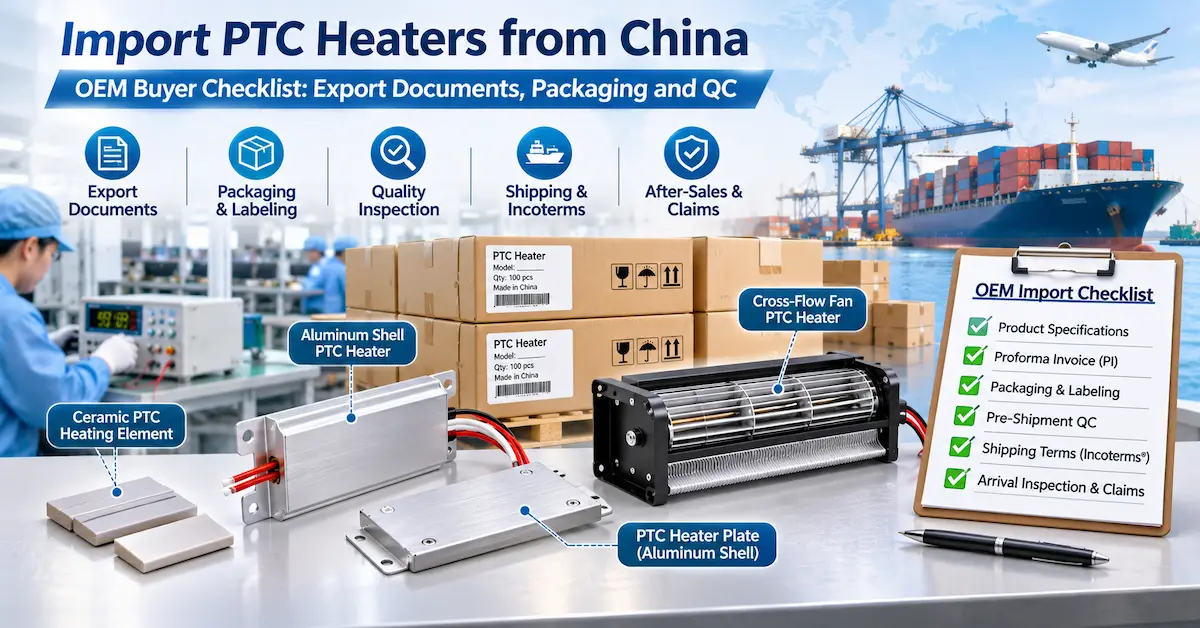
To import PTC heater products from China, first confirm the exact component specifications and destination-market requirements. Obtain a written quotation and proforma invoice, approve engineering samples, agree on packaging and inspection criteria, and confirm shipping responsibilities under the selected Incoterms® rule. Before dispatch, review production-batch inspection results and shipping documents. After delivery, inspect the goods and retain evidence of any discrepancies.
Key Takeaways
-
Confirm the exact PTC heater model, electrical ratings, dimensions, and application requirements before requesting quotations.
-
Review the proforma invoice against the approved product specification and purchase order.
-
Establish packaging, labeling, and shipping-document requirements before production.
-
Conduct appropriate pre-shipment quality inspections using agreed acceptance criteria.
-
Confirm freight, insurance, customs clearance, and risk-transfer responsibilities.
-
Verify destination-specific customs classification and regulatory requirements with qualified local professionals.
-
Retain batch records, inspection reports, and shipment evidence to support potential quality claims.
For international procurement teams, importing a heating component involves both technical and commercial responsibilities.
A suitable product may still create purchasing problems if its specification, packaging, export documentation, or delivery terms are unclear.
Dongguan Tianrui Electronics Co., Ltd. manufactures PTC heating components and related temperature-sensing products in China.
This guide focuses on the import transaction itself, from preparing an RFQ to receiving and inspecting the shipment.
What Product Specifications Should Buyers Prepare Before Requesting a Quotation?
An accurate quotation begins with a clearly identified heating component.
Two PTC heaters with the same nominal voltage or wattage may differ in resistance characteristics, dimensions, insulation, electrical connections, and operating behavior.
Before contacting a PTC heater exporter, prepare the technical information needed to identify the correct configuration.
Table 1. PTC Heater Import RFQ Specification Checklist
| Specification | Information Required |
|---|---|
| Product type | Ceramic element, aluminum-shell heater, air heater, fan heater, or liquid heater |
| Application | Intended equipment and heating function |
| Rated voltage | AC or DC voltage |
| Heating power | Required value and measurement conditions |
| Temperature requirements | Operating temperature and target heating performance |
| Dimensions | Drawing, installation space, and tolerances |
| Electrical insulation | Applicable component and equipment requirements |
| Wiring | Cable length, terminals, and connectors |
| Operating environment | Ambient temperature, airflow, moisture, and other conditions |
| Order quantity | Samples, initial order, and annual forecast |
| Destination market | Import country and intended product application |
| Inspection requirements | Agreed electrical, thermal, and mechanical tests |
| Packaging requirements | Individual protection, carton quantities, and labeling |
For replacement projects, include the original part number, datasheet, drawing, or representative sample.
Which Tianrui PTC heaters can international buyers evaluate?
The following products illustrate different sourcing requirements.
| Product | Published Configuration | Importer Verification Priority |
|---|---|---|
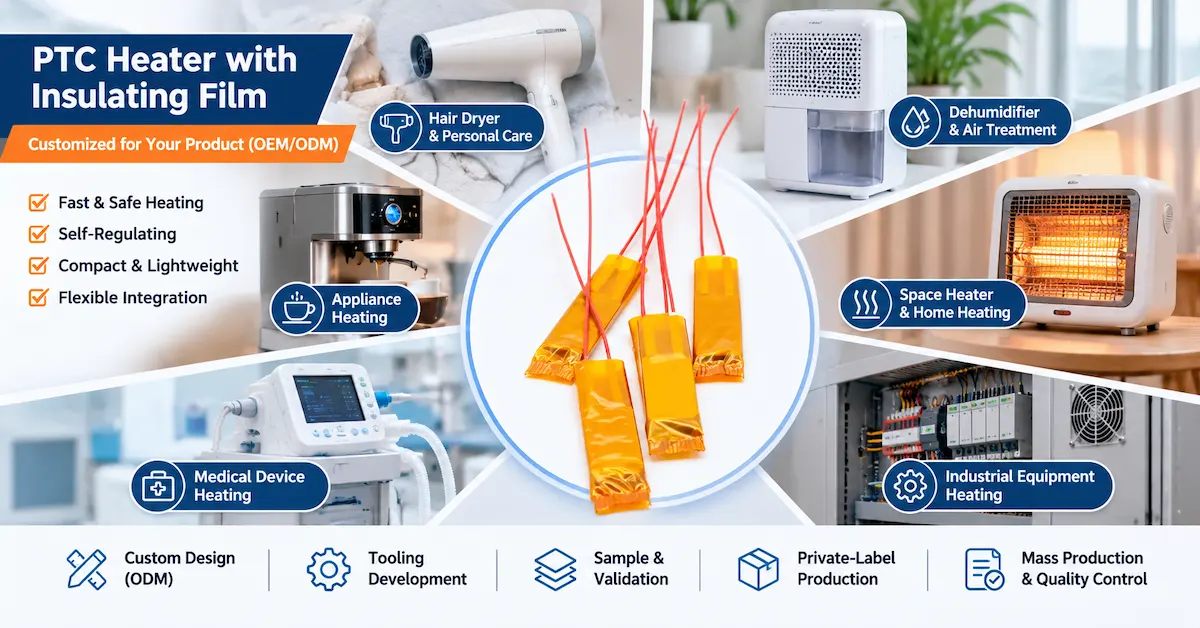
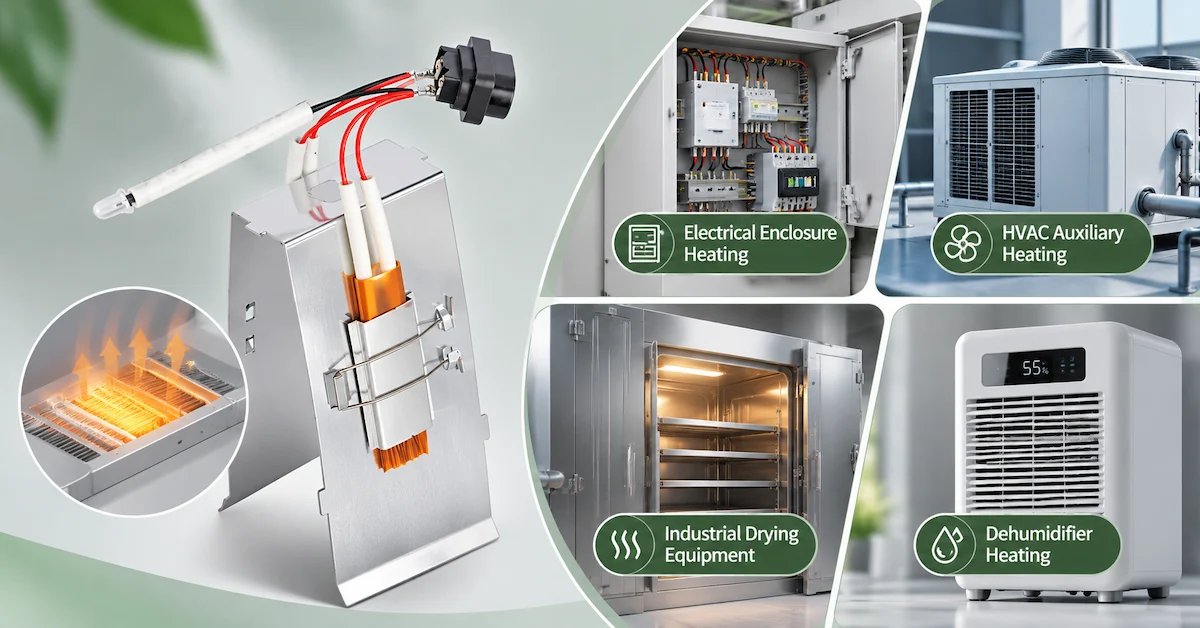
| MZ41 Ceramic PTC Heating Element | MZ41-1610-120-30±20%; 24V DC; 16 × 9.5 × 1.4mm | Ceramic dimensions, resistance, electrode construction, breakage protection |
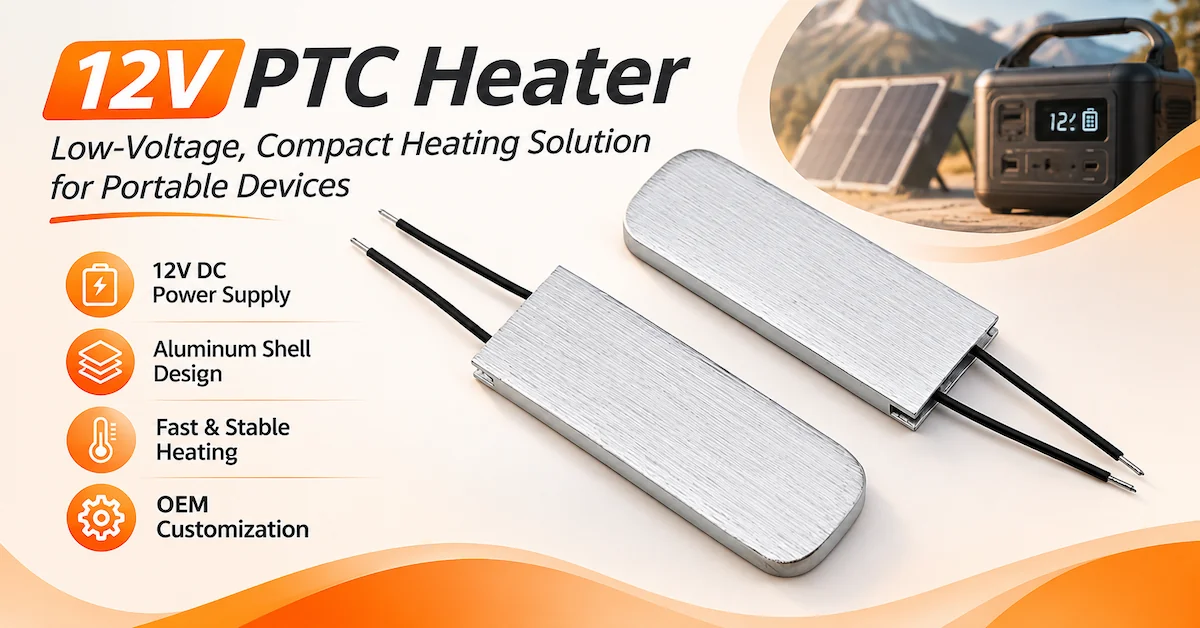
| Low Voltage Aluminum Shell PTC Heater | Multiple voltage and temperature configurations | Exact voltage, housing dimensions, wiring |
| 220V 30W Aluminum Shell PTC Heater Plate | 220V, 30W | Power test conditions, insulation, mounting dimensions |
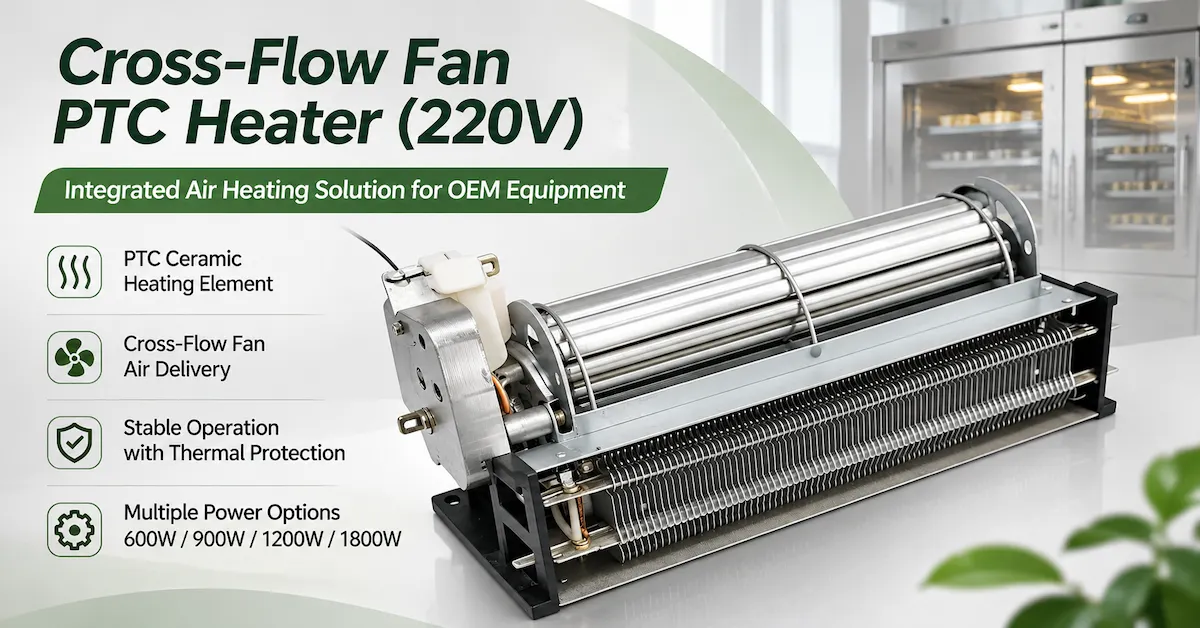
| 220V Cross-Flow Fan PTC Heater | 600W, 900W, 1200W, and 1800W options | Heater and fan electrical ratings, assembly protection, shipping dimensions |
The published values must be linked to the exact ordering configuration.
Series-level specifications should not be combined to create an unverified individual model.
Buyers can also explore Tianrui's PTC Heater Product Range before preparing their sourcing requirements.
How Should Buyers Review a PTC Heater Quotation and Proforma Invoice?
A proforma invoice, commonly called a PI, describes proposed transaction details before the final commercial invoice is issued.
It should accurately reflect the agreed products, quantities, prices, payment arrangements, and delivery terms.
A PI should be reviewed together with the purchase order, approved drawings, and applicable purchasing agreement.
Table 2. Proforma Invoice Review Checklist
| PI Field | Buyer Verification |
|---|---|
| Seller information | Correct legal company name and address |
| Buyer information | Correct purchasing entity and billing details |
| PI number and date | Unique transaction reference |
| Product description | Consistent with approved specifications |
| Model number | Exact ordering code and revision |
| Quantity | Correct quantity for each configuration |
| Unit price | Agreed price and currency |
| Total amount | Correct calculation and additional charges |
| MOQ | Confirmed minimum purchase quantity |
| Payment terms | Deposit, balance, and payment conditions |
| Production lead time | Agreed production schedule and starting condition |
| Delivery term | Selected Incoterms® rule, named place, and edition |
| Packaging | Agreed packaging configuration |
| Inspection | Applicable inspection and release requirements |
| Bank details | Independently verified payment beneficiary |
| Quotation validity | Expiration date and pricing conditions |
Why should the product revision appear in the purchasing documents?
A generic description such as “220V PTC heater” does not identify a complete manufacturing specification.
The buyer should connect the order to an approved part number, drawing, and specification revision.
Where detailed information cannot fit on the PI, reference the relevant technical documents in the purchase order or purchasing agreement.
How can buyers reduce payment-related risks?
Verify the seller's legal identity and payment beneficiary before transferring funds.
If payment instructions change unexpectedly, confirm the change using an independently verified communication channel.
Do not rely exclusively on an email containing new bank details.
The payment schedule, inspection arrangements, and responsibilities for rejected products should be established before the order is confirmed.
What Export Documents, Packaging, and Labels Are Required?
The necessary documentation depends on the shipment, transportation method, destination country, product classification, and purchasing agreement.
There is no universal document package that applies to every PTC heater import.
Table 3. Export and Import Documentation Checklist
| Document | Main Purpose | Requirement |
|---|---|---|
| Proforma Invoice | Preliminary commercial agreement | As agreed |
| Purchase Order | Formal purchasing requirements | As agreed |
| Commercial Invoice | Final transaction and customs valuation information | Generally required |
| Packing List | Carton, quantity, weight, and packing details | Commonly required |
| Bill of Lading | Ocean shipment documentation | Depending on shipment |
| Air Waybill | Air shipment documentation | Depending on shipment |
| Certificate of Origin | Origin verification or applicable preferential treatment | When required |
| Inspection Report | Evidence of agreed quality checks | As contracted |
| Product Datasheet | Technical identification | Recommended |
| Compliance Documentation | Applicable product and market requirements | When legally or contractually required |
| Insurance Certificate | Evidence of cargo insurance | Where applicable |
Commercial invoices and packing lists should be consistent regarding product descriptions, quantities, shipment references, and package information.
How should customs classification be confirmed?
Customs classification must reflect the actual imported product.
A ceramic PTC element, complete fan-heater assembly, and liquid-heating component may require different classification assessments.
Buyers should provide the product's construction, function, and intended use to their customs broker or relevant customs authority.
Do not assume that every PTC heater uses the same HS code.
Import duty, taxes, licensing, and regulatory obligations must be checked for the destination country.
What packaging should an export quality PTC heater use?
Packaging should protect the actual product against reasonably foreseeable handling and transportation conditions.
The required protection depends on its construction.
| PTC Heater Type | Potential Shipping Risk | Packaging Requirement to Discuss |
|---|---|---|
| Ceramic heating element | Cracks, edge damage, electrode damage | Individual separation and cushioning |
| Aluminum-shell heater | Housing deformation and cable damage | Protective separation and controlled packing |
| Finned air heater | Bent fins and damaged terminals | Supports that prevent compression |
| Fan-heater assembly | Impeller, motor, and mounting damage | Mechanical protection and movement restraint |
| Liquid heater | Damage to seals and connections | Protected sealing surfaces and terminals |
These are proposed packaging considerations, not a published Tianrui export-packaging specification.
Buyers should approve the packaging method and request photographs before shipment where appropriate.
What information should appear on carton labels?
Agree on relevant information such as:
-
Supplier and customer references.
-
Product model and revision.
-
Quantity per carton.
-
Batch or lot identification.
-
Gross and net weight.
-
Carton number.
-
Handling instructions.
-
Origin and other markings where required.
If wooden pallets or crates are used, verify applicable destination-market requirements for wood packaging.
How Should OEM Buyers Conduct Pre-Shipment Quality Inspection?
Sample approval and production-batch approval are different activities.
An engineering sample establishes whether a selected configuration can meet the project requirements.
A pre-shipment inspection evaluates whether the manufactured lot satisfies the agreed acceptance criteria.
For detailed prototype development procedures, see Tianrui's Low MOQ PTC Heater Supplier Guide.
Table 4. PTC Heater Pre-Shipment QC Matrix
| Inspection Item | Verification Method | Required Evidence |
|---|---|---|
| Product identity | Compare model and revision with PO | Model identification record |
| Quantity | Count against purchase order | Quantity report |
| Appearance | Visual inspection | Inspection results and defect photographs |
| Dimensions | Measure critical dimensions | Dimensional report |
| Cold resistance | Test at specified reference conditions | Resistance measurements |
| Electrical input | Measure under defined supply conditions | Electrical test results |
| Heating power | Test under agreed thermal conditions | Power measurement record |
| Temperature performance | Measure relevant operating temperatures | Thermal test record |
| Insulation | Applicable electrical safety test | Test results |
| Wiring and terminals | Visual and electrical verification | Connection inspection |
| Fan operation | Relevant functional test for fan assemblies | Functional test results |
| Packaging | Verify protective materials and carton condition | Packing photographs |
| Traceability | Check batch identification | Lot records |
Not every test applies to every heater construction.
Acceptance limits must come from the approved specification and relevant application requirements.
Which quality standards can support inspection?
IEC 60738-1:2022 — Directly Heated Positive Temperature Coefficient Thermistors provides terminology, inspection procedures, and test methods for directly heated PTC thermistors within its scope.
It can support relevant component-level verification but does not replace qualification of the complete heating equipment.
For lot acceptance sampling, ISO 2859-1:2026 provides attribute-based sampling schemes indexed by acceptance quality limit (AQL).
If the parties agree to use this approach, they should define the applicable inspection level, lot size, defect classifications, sampling plan, and acceptance criteria.
A passing sampling inspection does not guarantee that every unit is defect-free. Critical electrical safety characteristics may require additional testing.
Referencing these standards does not establish that Tianrui or a particular heater holds certification.
Practical inspection release record
| Shipment Release Item | Record |
|---|---|
| Purchase order number | ______ |
| Approved product and revision | ______ |
| Production batch | ______ |
| Ordered and manufactured quantities | ______ |
| Sample size or inspection coverage | ______ |
| Electrical and thermal results | ______ |
| Nonconformities | ______ |
| Corrective actions | ______ |
| Final inspection decision | Pass / Hold / Reject |
| Authorized shipment approval | ______ |
Products with unresolved critical nonconformities should not be released as conforming goods.
Any agreed deviation must be documented and authorized appropriately.
How Should Buyers Confirm Delivery Responsibilities, Freight, and Insurance?
One of the most important decisions when you import PTC heater products from China is determining who arranges transportation, bears shipment risk, and completes customs formalities.
The selected Incoterms® rule should match the intended transportation method and purchasing arrangement.
The International Chamber of Commerce's Incoterms® 2020 delivery and risk-transfer guidance explains the differences between delivery, transportation costs, and the transfer of risk.
Table 5. Common Incoterms® 2020 Rules for PTC Heater Imports
| Trade Term | Main Transport Arranged By | Main Risk-Transfer Point | Import Clearance |
|---|---|---|---|
| EXW | Buyer | Goods made available at named place, normally before loading | Buyer |
| FCA | Buyer | Delivery to buyer's nominated carrier or party at named place | Buyer |
| FOB | Buyer | Goods loaded on board at named shipment port | Buyer |
| CIF | Seller | Goods loaded on board at shipment port | Buyer |
| CIP | Seller | Delivery to the contracted carrier at the agreed point | Buyer |
| DAP | Seller | Named destination, ready for unloading | Buyer |
| DDP | Seller | Named destination, import-cleared and ready for unloading | Seller |
FOB and CIF are intended for sea and inland waterway transport.
For containerized goods handed over to a carrier at a terminal, FCA may be more appropriate than FOB.
Why should buyers distinguish transportation costs from shipment risk?
Under certain terms, including CIF and CIP, the seller arranges transportation to the named destination even though risk transfers earlier.
The party paying freight is therefore not necessarily the party bearing shipment risk throughout the journey.
This distinction matters when heating assemblies are damaged during transportation.
What should buyers confirm about insurance?
Check:
-
Which party arranges insurance.
-
Insured value and covered risks.
-
Relevant exclusions and deductibles.
-
Packaging-related coverage conditions.
-
Claims notification deadlines.
-
Required evidence for transportation damage.
CIF and CIP include seller-arranged insurance obligations, but the default coverage requirements differ.
The buyer should confirm whether additional coverage is needed.
Can a supplier offer DDP to every destination?
Not necessarily.
DDP requires the seller to handle import clearance and applicable import duties and taxes under the rule.
Local laws may restrict a foreign seller's ability to perform these obligations.
Confirm legal and operational feasibility with the relevant logistics and customs professionals before selecting DDP.
Incoterms® rules also do not independently determine ownership transfer, payment obligations, product acceptance, warranty terms, or all contractual remedies.
These matters should be addressed separately in the purchasing agreement.
How Should Importers Conduct Arrival Inspection and Preserve Quality-Claim Evidence?
Inspection should begin when the shipment arrives.
External packaging damage should be documented before cartons are discarded or goods are moved into production.
Step 1: Inspect the shipment condition
Check the number of cartons, visible impact damage, moisture exposure, and relevant shipment identification.
Record discrepancies on delivery documents where appropriate.
Step 2: Verify the received products
Compare the delivered model numbers, quantities, and batch identifiers with the purchase order, commercial invoice, and packing list.
Step 3: Conduct incoming quality inspection
Perform the agreed appearance, dimensional, electrical, and functional checks using approved procedures.
Electrical and heating tests should be performed by qualified personnel using appropriate equipment.
Step 4: Isolate nonconforming products
Prevent affected components from entering production or being distributed before the issue is assessed.
Preserve representative samples and relevant packaging.
Step 5: Establish the likely source of the problem
Distinguish between:
-
Transportation damage.
-
Incorrect product configuration.
-
Manufacturing nonconformity.
-
Packaging failure.
-
Installation or application mismatch.
The appropriate claim procedure depends on the evidence and contractual responsibilities.
Table 6. PTC Heater Quality-Claim Evidence Checklist
| Evidence | Purpose |
|---|---|
| Purchase order and PI | Establish agreed transaction requirements |
| Approved datasheet and drawing | Establish product acceptance criteria |
| Commercial invoice | Identify the shipment and commercial value |
| Packing list | Verify package and quantity details |
| Transport document | Establish shipment references |
| Delivery photographs | Document external condition |
| Unpacking photographs or video | Show received product condition |
| Model and batch labels | Identify affected products |
| Incoming inspection results | Demonstrate measured nonconformities |
| Representative defective samples | Support technical investigation |
| Quantity of affected products | Define claim scope |
| Written supplier notification | Document issue reporting |
| Carrier or insurer notification | Support applicable transportation claims |
Submit notifications within the time limits established by the contract, carrier, insurer, and applicable law.
What corrective actions can be requested?
Depending on the investigation and agreed terms, possible resolutions may include replacement, repair, credit, refund, or a documented corrective-action plan.
These remedies are not automatic entitlements for every transaction.
The parties should determine the appropriate resolution based on the evidence and their contractual obligations.
How Can Buyers Verify a Chinese PTC Heater Supplier's Export Capability?
A manufacturer's ability to produce a heater does not automatically establish its ability to manage every export transaction.
International buyers should assess both technical manufacturing capability and commercial documentation readiness.
Table 7. Chinese PTC Heater Export Supplier Audit Matrix
| Audit Area | Evidence to Request | Status |
|---|---|---|
| Company identity | Business registration and contracting entity | Open / Pass / Fail |
| Manufacturing capability | Relevant production information | Open / Pass / Fail |
| Product range | Catalog and exact model specifications | Open / Pass / Fail |
| Technical support | Drawing and application review | Open / Pass / Fail |
| Sample approval | Approved sample and test records | Open / Pass / Fail |
| Export transaction experience | Relevant redacted shipment records where available | Open / Pass / Fail |
| Export arrangements | Exporting entity and logistics responsibilities | Open / Pass / Fail |
| Quality control | Inspection procedures and relevant records | Open / Pass / Fail |
| Packaging | Approved packing specification | Open / Pass / Fail |
| Export documentation | Representative document formats | Open / Pass / Fail |
| Batch traceability | Product and lot identification | Open / Pass / Fail |
| Delivery planning | Agreed production and shipment schedule | Open / Pass / Fail |
| Payment details | Verified company and beneficiary information | Open / Pass / Fail |
| After-sales handling | Written defect and claim arrangements | Open / Pass / Fail |
| Market compliance | Applicable model-specific evidence | Open / Pass / Fail |
Suppliers may legitimately protect confidential customer information.
Redacted shipment records or other appropriate evidence can support evaluation without disclosing sensitive commercial details.
What can buyers verify about Tianrui Electronics?
According to its About Us page, Dongguan Tianrui Electronics Co., Ltd. was established in 2010 and manufactures PTC components in Dongguan, China.
Its published product range includes ceramic heating elements, aluminum-shell heaters, and air-heating assemblies.
Its website also describes technical requirement reviews, sample development, testing, and production planning.
These facts provide a starting point for supplier evaluation.
However, specific export-market experience, documentation availability, production lead times, packaging arrangements, and shipment responsibilities must be confirmed for the proposed transaction.
PTC Heater Export RFQ Template for OEM Importers
Subject: PTC Heater Import Inquiry — OEM Specifications, Export Documents and Pre-Shipment QC
Dear Tianrui Electronics Team,
We are evaluating PTC heating components for import into our market.
Our project requirements are as follows:
-
Destination country: [Country]
-
Product type and model: [Details]
-
Application: [Equipment]
-
Rated voltage and power: [Specifications]
-
Dimensions and wiring: [Drawing or requirements]
-
Sample quantity: [Quantity]
-
Initial order quantity: [Quantity]
-
Estimated annual demand: [Forecast]
-
Required inspection criteria: [Details]
-
Packaging and labeling requirements: [Details]
-
Preferred shipping term and named place: [Details]
Please provide:
-
The recommended product model and technical specification.
-
Sample pricing, MOQ, and bulk-order quotation.
-
A proforma invoice with payment and delivery terms.
-
Available export-document arrangements.
-
Proposed packaging and carton information.
-
Available pre-shipment inspection records.
-
Estimated production and shipment schedules.
-
Applicable product test and compliance documentation.
-
Product traceability and engineering change procedures.
-
Quality-claim and corrective-action arrangements.
We intend to approve the product specification and sample before releasing the production order.
Best regards,
[Company Name]
[Contact Person]
[Country / Region]
Frequently Asked Questions About Importing PTC Heaters from China
1. What documents are needed to import PTC heaters from China?
Common documents include a commercial invoice, packing list, and relevant transportation document. Certificates of origin, inspection reports, and compliance documents may also be required depending on the destination and product.
2. What is the HS code for a PTC heater?
There is no single HS code that should automatically be applied to every PTC heating product. Classification depends on construction, function, and applicable tariff rules. Consult a qualified customs broker or customs authority.
3. Do all Chinese PTC heaters require CE or UL certification?
No universal answer applies. Requirements depend on the destination market, product classification, intended use, and applicable regulations. Verify whether particular markings, assessments, or third-party certifications are legally or contractually required.
4. What should a PTC heater proforma invoice include?
It should identify the seller, buyer, exact product, quantity, price, currency, payment terms, delivery arrangements, and other agreed commercial conditions. Link it to the approved product specification.
5. Can I request samples before importing a bulk order?
Sample availability should be confirmed with the supplier. Engineering samples can help verify dimensions, electrical characteristics, thermal performance, and application compatibility before production approval.
6. Should buyers arrange third-party pre-shipment inspection?
Third-party inspection may be useful for first-time suppliers, high-value shipments, or orders requiring independent verification. Inspection coverage and acceptance criteria should be agreed before production is released.
7. Is FOB or CIF better for importing PTC heaters?
Neither is universally better. The appropriate rule depends on transportation arrangements, insurance requirements, risk allocation, and the buyer's logistics capabilities. For containerized or multimodal shipments, FCA or CIP may also deserve consideration.
8. How should ceramic PTC heating elements be packed for export?
Packaging should prevent component movement, direct impact, ceramic breakage, and electrode damage. The exact packing construction should be approved for the selected product and shipment conditions.
9. What should I do if imported PTC heaters arrive damaged?
Document shipment condition, preserve packaging, identify affected batches, and conduct agreed inspections. Notify the supplier, carrier, and insurer as applicable within relevant deadlines.
10. How can I verify whether a PTC heater exporter is suitable?
Review its legal identity, product specifications, sample results, export arrangements, inspection procedures, packaging, traceability, and written commercial terms. Request relevant supporting documentation before placing the order.
Conclusion
To successfully import PTC heater from China, OEM buyers must coordinate technical specification approval, commercial documentation, quality inspection, and shipment responsibilities.
Selecting a manufacturer is only one part of the transaction.
A controlled import process should include:
-
Exact product identification and approved specifications.
-
Written quotation and proforma invoice verification.
-
Agreed packaging and export-document requirements.
-
Representative sample approval.
-
Documented pre-shipment quality inspection.
-
Clearly defined freight, insurance, and customs responsibilities.
-
Incoming inspection and evidence preservation.
When evaluating a PTC heater exporter, prioritize verifiable information rather than general assurances about international sales or product quality.
An export quality PTC heater should be evaluated against the agreed product specification, applicable market requirements, and defined inspection criteria.
Dongguan Tianrui Electronics Co., Ltd. offers PTC ceramic heating elements, aluminum-shell heaters, and heating assemblies for OEM equipment development and procurement.
Explore its PTC Heater Product Catalog to identify configurations for your project.
Planning to Import PTC Heaters from China?
Contact Tianrui Electronics to Request an OEM Export Quotation
Share your product specifications, destination country, sample requirements, order quantity, inspection criteria, and preferred shipping arrangements.
Ask Tianrui to confirm the available product configuration, commercial terms, packaging, export-document arrangements, and production schedule for your order.
Email:
Phone:
+86 135 3277 2961
A clearly defined purchase specification, documented quality approval, and transparent delivery agreement can help international buyers reduce sourcing uncertainty and establish a more dependable PTC heater supply relationship.