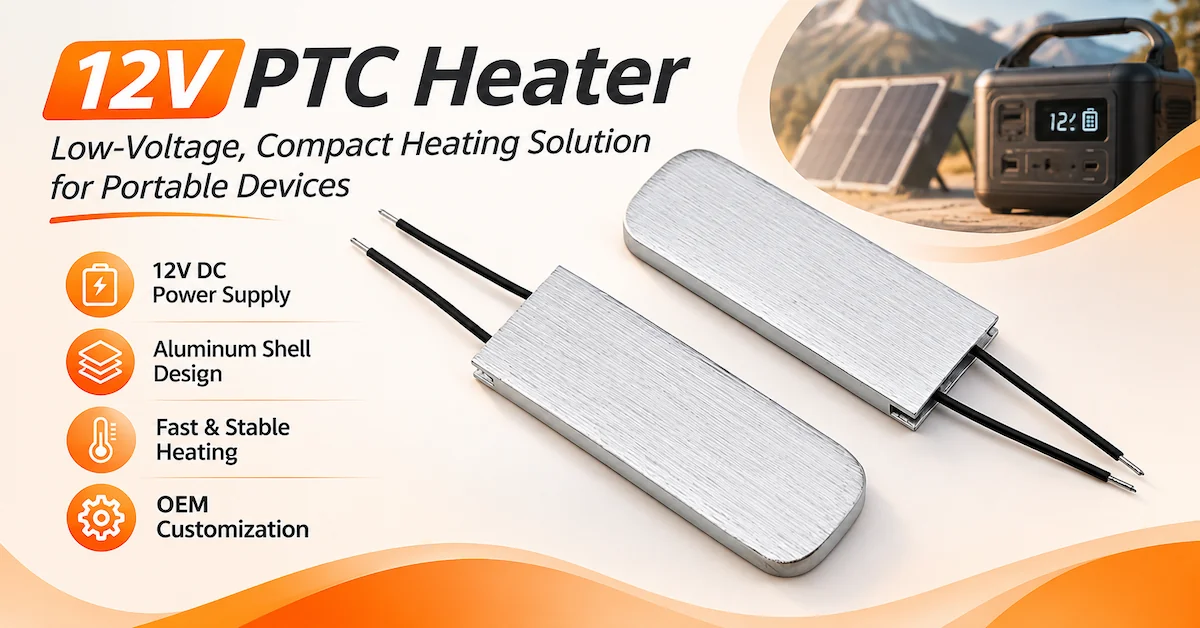
Quick Answer: A 12V PTC Heater uses positive temperature coefficient ceramic technology to generate heat from a nominal 12V electrical supply. For battery-powered OEM equipment, the most important selection criteria are the battery's actual voltage range, heater cold-start current, useful thermal output, runtime, wiring losses, and mounting structure. A 12V Aluminum Shell PTC Heater can provide a practical conductive heating interface, but self-regulation alone does not guarantee accurate temperature control or complete equipment safety.
Key Takeaways
-
A 12V DC PTC Heater must be qualified across the battery's actual operating-voltage range, not only at exactly 12.0V.
-
Cold-start current can differ significantly from stabilized current because PTC ceramic resistance varies with temperature.
-
Battery-management protection, power-supply current limiting, wiring, and switching devices must support the verified startup profile.
-
Battery runtime depends on usable battery energy, heater power over time, auxiliary loads, and operating conditions.
-
An aluminum-shell heater can support compact contact heating, but thermal performance depends on mounting pressure, housing dimensions, insulation, and the heated object.
-
A ceramic heater's self-regulating behavior does not automatically maintain a precise equipment temperature.
-
A qualified 12V heating assembly should be evaluated for voltage sag, thermal performance, insulation, abnormal operation, and manufacturing consistency.
-
OEM buyers should request an approved electrical specification, dimensional drawing, sample testing plan, and production requirements before mass ordering.
1. What Should OEM Buyers Know Before Selecting a 12V PTC Heater?
The main question is whether the heater can deliver the required useful heat throughout the device's actual operating conditions.
Portable electronics and compact 12V equipment often have restricted battery capacity, limited installation space, and sensitive nearby components.
These constraints make heating-element selection different from designing a mains-powered industrial heater.
A suitable PTC element must work with the electrical source and mechanical structure of the finished product.
Who should consider a 12V heating solution?
| OEM Buyer | Typical Heating Objective | Main Engineering Concern |
|---|---|---|
| Portable electronic equipment manufacturers | Localized warming | Battery capacity and available space |
| Battery-powered instrument OEMs | Temperature stabilization | Startup current and feedback control |
| Compact industrial equipment manufacturers | Component or enclosure heating | Voltage range and heat transfer |
| Mobile equipment developers | Low-voltage auxiliary heating | Supply stability and electrical protection |
| Product development engineers | Custom heating assembly | Dimensions, insulation, and thermal performance |
| Purchasing managers | Repeatable component sourcing | Specification consistency and testing |
These applications represent potential design directions. Suitability must be verified for the specific product.
When might a 12V PTC heater be unsuitable?
A 12V heater may not be the best choice if the equipment requires substantially more heat than the battery can reasonably supply.
It may also be unsuitable if the existing battery-management system cannot handle startup current, the available mounting surface is too small, or the required heating temperature exceeds the surrounding materials' limits.
For higher-power equipment, the OEM should evaluate the complete electrical architecture rather than increasing heater current without considering the consequences.
2. How Does a 12V DC PTC Heater Work?
A PTC ceramic heating element has electrical resistance that changes with temperature.
In the self-regulating operating region, resistance rises substantially as the ceramic temperature increases.
Under an approximately constant applied voltage:
P = V² / R
Where:
-
P = electrical power, W.
-
V = voltage across the heating element, V.
-
R = instantaneous resistance, Ω.
As resistance increases, electrical heating power generally decreases.
This characteristic makes PTC ceramic useful for certain heating applications.
However, it is important to distinguish three different temperatures:
-
Ceramic temperature: The temperature of the PTC material.
-
Heater surface temperature: The temperature of the shell, plate, or external heat-transfer surface.
-
Load temperature: The temperature of the device component being heated.
These temperatures are not necessarily equal.
For example, an aluminum-shell heater may have a substantial temperature difference between the ceramic element and the equipment surface because of insulation and contact resistance.
Does a PTC heater automatically maintain 60°C or 80°C?
Not necessarily.
A manufacturer's stated ceramic transition temperature or product temperature specification is meaningful only when its definition and test conditions are understood.
The final equipment temperature depends on:
-
Applied voltage.
-
Heat-transfer interface.
-
Thermal mass.
-
Ambient conditions.
-
Operating duty.
-
Ceramic characteristics.
-
Enclosure and mounting design.
For equipment requiring a narrow temperature range, external temperature measurement and control may be appropriate.
3. Which 12V PTC Heater Construction Is Best for Compact Devices?
The heating structure should be selected according to how heat must reach the target component.
Table 1. Low-Voltage PTC Heater Construction Comparison
| Heating Structure | Main Heat Transfer | Main Advantage | Main Limitation | OEM Application Direction |
|---|---|---|---|---|
| Aluminum-shell PTC heater | Conduction through metal housing | Defined mounting and contact surface | Requires appropriate thermal contact | Compact component heating |
| Insulated-film PTC assembly | Conduction through insulating layer | Electrical separation within a compact construction | Insulation adds thermal resistance | Electrically insulated assemblies |
| Bare ceramic PTC element | Depends on custom assembly | Flexible development potential | Requires electrodes, insulation, and packaging | Custom heater engineering |
| Finned PTC air heater | Natural or forced convection | Heat transfer to air | May need a fan and airflow space | Small air-heating equipment |
Selection recommendation:
Use an aluminum-shell design when a robust, compact contact-heating interface is important. Consider an insulated construction where electrical isolation and packaging constraints are central to the project.
A bare ceramic element should not be treated as a complete ready-to-install heater without the necessary electrical and mechanical design.
4. How Should OEM Engineers Match a 12V Heater to a Battery?
A nominal 12V battery does not necessarily deliver exactly 12.0V during operation.
Battery voltage changes with chemistry, state of charge, temperature, and load current.
The heater should therefore be evaluated across the permitted voltage range of the actual battery system.
What specifications should the battery supplier provide?
| Battery Parameter | Why It Matters |
|---|---|
| Nominal voltage | Initial electrical architecture |
| Maximum operating voltage | Heater electrical and thermal stress |
| Minimum permitted voltage | Heating performance near discharge |
| Continuous discharge current | Sustained heater operation |
| Peak discharge capability | Cold-start current compatibility |
| Usable energy | Expected heating runtime |
| Battery-management protection | Overcurrent and undervoltage behavior |
| Operating temperature range | Cold-weather startup and charging conditions |
What happens when the battery voltage decreases?
PTC heater resistance and electrical power are temperature-dependent.
A lower supply voltage can change the heating equilibrium and extend warm-up time.
It is therefore unsafe to assume that a heater delivering acceptable heat at a fully charged battery voltage will maintain the same performance throughout discharge.
Battery compatibility decision
The buyer should request the heater's approved operating-voltage range.
The battery's minimum and maximum expected voltages must be compared against this requirement.
If the intended supply exceeds the heater's approved range, the design requires an appropriate alternative or a qualified power-conversion arrangement.
Engineering rule:
The label "12V" is a starting point, not a complete electrical specification.
5. Why Is Cold-Start Current Important for a 12V PTC Heater?
Cold-start current is one of the most important parameters in a battery-powered heating design.
PTC ceramic resistance can be relatively low at a particular cold starting condition.
Depending on the heater construction, this may produce a higher initial current than the stabilized operating current.
Simplified current calculation
The electrical relationship is:
I = V / R
Suppose a hypothetical PTC heating element has a cold resistance of 2.4Ω at a defined starting temperature.
At 12V:
I = 12 / 2.4
Initial current = 5A
The corresponding instantaneous electrical power would be:
P = 12 × 5
P = 60W
Now suppose that after heating, the resistance increases to 4Ω while the terminal voltage remains 12V.
I = 12 / 4
Current = 3A
Electrical power:
P = 12 × 3
P = 36W
These calculations illustrate the possible difference between cold and heated electrical conditions.
They are not measurements of a Tianrui product and do not define a complete PTC resistance-temperature curve.
What could happen in a portable device?
If the battery-management system or power supply cannot provide the required startup current, it may reduce the voltage or disconnect the load.
The result may be:
-
Delayed heating.
-
Repeated restart attempts.
-
Inconsistent startup.
-
Controller resets.
-
Battery-protection activation.
-
Unacceptable electrical stress.
What data should OEM engineers request?
A useful supplier test report should identify:
-
Heater model and revision.
-
Applied terminal voltage.
-
Initial ceramic temperature.
-
Current versus time.
-
Peak startup current.
-
Peak-current duration.
-
Stabilized power.
-
Thermal loading.
-
Ambient conditions.
A single nominal power rating is not enough to establish startup compatibility.
6. How Should the Power Supply and Battery Protection Be Selected?
A 12V PTC heater must work with the complete electrical distribution system.
The relevant components may include the battery pack, BMS, fuse, wiring, connector, power switch, and controller.
Battery-management system
For a battery-powered design, the BMS may respond to excessive current, undervoltage, or other defined fault conditions.
An OEM should verify that the heater's intended operating profile does not trigger unwanted battery protection.
The BMS should not be bypassed simply to accommodate a heater with excessive current demand.
DC power supply
If the heater uses an external DC supply, evaluate:
-
Output voltage accuracy.
-
Continuous current capability.
-
Startup-current response.
-
Current-limit behavior.
-
Overload response.
-
Thermal protection.
-
Performance under simultaneous system loads.
Some power supplies enter current limiting or repeatedly restart when the load exceeds their permitted current.
The interaction between the supply and PTC ceramic should be tested.
Switching devices
Relays or MOSFETs must be selected according to actual voltage, current, operating temperature, startup behavior, and relevant fault conditions.
A switching device selected only from stabilized heater wattage may be unsuitable.
Fuses and wiring protection
Fuse selection requires coordination with conductor current capacity, protection objectives, expected startup current, and relevant operating conditions.
A fuse should not be arbitrarily oversized to prevent nuisance trips.
Can multiple PTC heaters start simultaneously?
They may, if the electrical system has been qualified for the combined demand.
However, multiple cold heaters can create a higher total startup current.
The OEM should evaluate simultaneous and sequential startup where applicable.
7. How Long Can a Battery-Powered PTC Heater Run?
Battery runtime is a major concern for portable equipment manufacturers.
The approximate available energy can be estimated from nominal voltage and ampere-hour capacity.
Battery energy equation
E = Vnominal × Capacity
Where:
-
E = nominal battery energy, Wh.
-
Vnominal = nominal battery voltage, V.
-
Capacity = rated battery capacity, Ah.
Illustrative battery calculation
Assume a hypothetical portable device has:
-
Nominal battery voltage: 12V.
-
Rated capacity: 5Ah.
-
Heater operating power: 36W.
-
Fan and electronics consumption: 4W.
Nominal battery energy:
12 × 5 = 60Wh
Total assumed system power:
36 + 4 = 40W
The theoretical runtime using all 60Wh would be:
60 / 40 = 1.5 hours
However, real batteries may not provide all their nominal energy under every operating condition.
Including a usable-energy allowance
Suppose the usable energy under the intended operating conditions is assumed to be 75% of nominal capacity.
Usable energy:
60 × 0.75 = 45Wh
Estimated runtime:
45 / 40 = 1.125 hours
That equals approximately 68 minutes.
Table 2. Illustrative Battery Runtime
| Total Device Power | Assumed Usable Battery Energy | Estimated Runtime |
|---|---|---|
| 20W | 45Wh | 2.25 hours |
| 30W | 45Wh | 1.50 hours |
| 40W | 45Wh | 1.13 hours |
| 60W | 45Wh | 0.75 hours |
These figures are hypothetical, assuming constant electrical power.
Actual results depend on the battery discharge characteristics, temperature, cutoff settings, and the PTC heater's changing electrical consumption.
The 75% allowance is an illustrative assumption, not a general battery derating rule or a Tianrui specification.
Why testing is necessary
Battery voltage may decrease during the heating cycle.
The PTC heater may draw different power as its temperature changes.
A temperature controller may also switch the heater on and off.
Therefore, the correct runtime measurement should integrate actual electrical power over the complete heating cycle.
For an OEM product, report runtime under defined operating conditions—not a theoretical maximum presented as guaranteed performance.
8. How Much Thermal Power Does a Compact 12V Heater Need?
The required heating capacity should be calculated from the intended load.
For a solid component, a preliminary thermal-energy estimate is:
E = m × cp × ΔT
Where:
-
m = heated mass.
-
cp = specific heat capacity.
-
ΔT = temperature increase.
Example: warming an aluminum component
Assume:
| Parameter | Illustrative Value |
|---|---|
| Heated material | Aluminum |
| Mass | 0.20 kg |
| Initial temperature | 20°C |
| Target temperature | 50°C |
| Temperature increase | 30°C |
| Assumed specific heat | 900 J/(kg·K) |
Required energy:
E = 0.20 × 900 × 30
E = 5,400J
Suppose the design target is a 120-second warm-up.
Average useful heat-transfer rate required:
P = 5400 / 120
P = 45W
This is an ideal estimate of useful heating power delivered to the aluminum.
It does not include losses to the surrounding air, energy stored in the heater, or the changing power behavior of a PTC ceramic.
Does this mean a 45W electrical heater is sufficient?
Not necessarily.
The electrical power delivered to the heater is not always equal to the useful heat transferred to the target during a transient warm-up.
The actual requirement depends on:
-
Thermal contact.
-
Insulation.
-
Ambient temperature.
-
Heat lost from the load.
-
Heater warm-up behavior.
-
Target temperature accuracy.
-
Mechanical mounting.
A higher electrical rating may be needed, but it should be determined by prototype testing.
Important design distinction
Rated electrical power describes the heater's electrical input under defined conditions.
Useful heating power describes the rate of heat transfer to the intended load.
OEM buyers should not assume these are identical under all operating conditions.
9. Which Tianrui 12V PTC Heater Products Are Relevant?
Dongguan Tianrui Electronics Co., Ltd. publishes several PTC heating families with low-voltage options.
The available product pages include aluminum-shell structures and insulated-film heaters.
These product families provide starting points for evaluating compact 12V designs.
Table 3. Tianrui Low-Voltage Heater Product Comparison
| Tianrui Product | Published Voltage Information | Construction | Main OEM Evaluation Focus |
|---|---|---|---|
| Aluminum Shell PTC Heater 12V/24V | Product imagery identifies 3.7V, 5V, 12V and 24V; broad catalog range 3.7–480V | Aluminum-shell PTC heating assembly | Compact conductive heating and installation |
| PTC Heater with Insulating Film | Published family range 12–240V AC/DC | Insulated ceramic heater with anodized aluminum body | Electrical insulation and compact mounting |
| PTC Heater with Insulation Film | Published family range 12–48V DC / 100–240V AC | Polyimide-insulated PTC heater | Insulated low-voltage heating applications |
| External-Pressure Aluminum Shell PTC Heater | Published family range AC/DC 5–380V | PTC ceramic, insulation layer, aluminum housing | Customized metal-housing construction |
Important:
These values are published product-family information. They do not prove that every voltage, temperature, power rating, dimension, and housing shape can be combined into a single available model.
The exact 12V configuration must be confirmed before an OEM quotation or production decision.
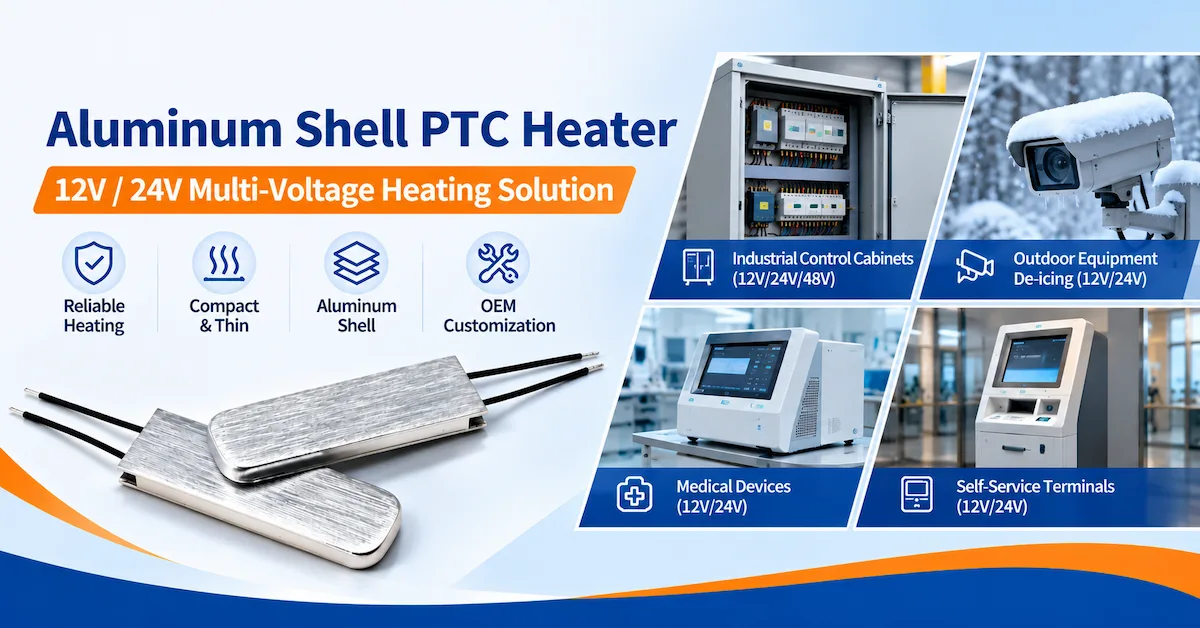
Aluminum Shell PTC Heater 12V/24V
Tianrui's Aluminum Shell PTC Heater for Low-Voltage Applications is the most directly relevant product for this article.
The public product information identifies:
-
Aluminum-shell construction.
-
Low-voltage product options including 12V.
-
Standard and special shapes.
-
A broad product-family temperature range.
An aluminum housing can provide mechanical support and a defined external heat-transfer surface.
However, the site does not provide a complete model-specific 12V current-versus-time curve or battery-runtime guarantee.
Buyers should therefore request the exact 12V electrical specifications and appropriate loaded thermal data.
PTC Heater with Insulating Film
Tianrui's PTC Heater with Insulating Film identifies a family voltage range beginning at 12V.
The product page also describes an anodized aluminum housing and screw-fixing installation.
For a battery-powered device, the key questions are whether the intended configuration is rated for 12V DC and whether its dimensions, insulation, and thermal characteristics match the equipment.
PTC Heater with Polyimide Insulation Film
The PTC Heater with Insulation Film lists a 12–48V DC family range, customized power, and polyimide film construction.
Its published temperature range is associated with the family description and should not be treated as an adjustable device setpoint.
This category may be considered when a compact insulated heating assembly is required.
Which product should the buyer choose?
For a 12V project requiring a metal contact-heating surface, begin by evaluating an aluminum-shell heater.
For an application with a specific electrical-isolation requirement, compare an appropriate insulated-film construction.
Do not choose a product solely because its title includes 12V.
The final model must meet the electrical, thermal, and mechanical specification.
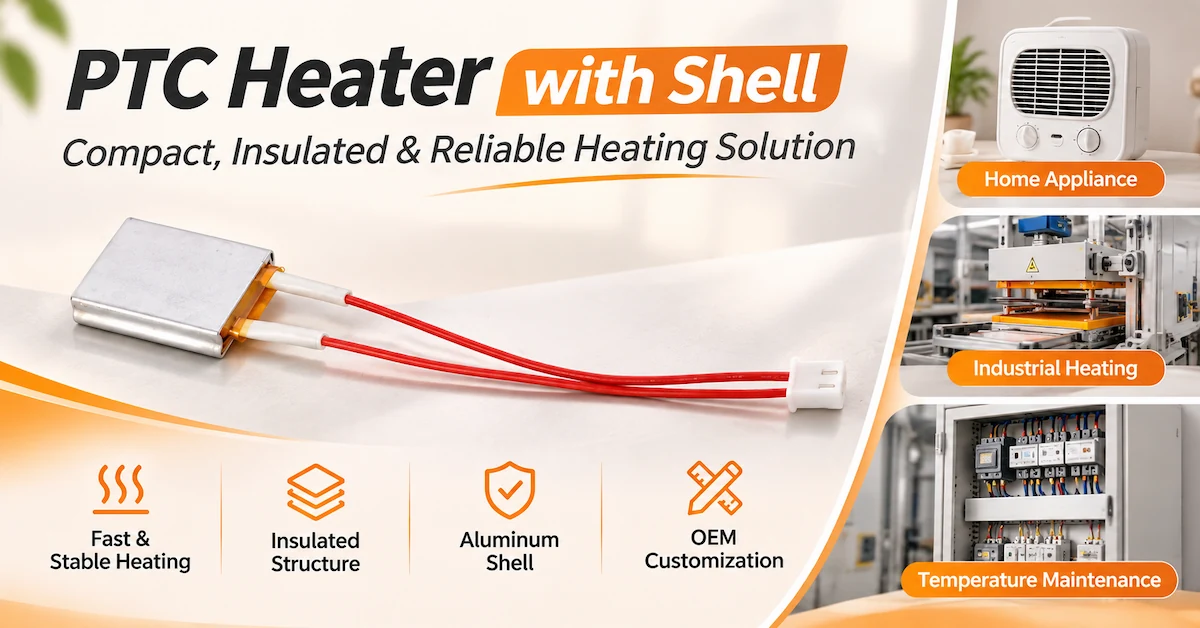
10. Why Is an Aluminum Shell Useful in a 12V PTC Heating Assembly?
A 12V Aluminum Shell PTC Heater combines the ceramic heating element with a metal structure.
The aluminum housing can serve as:
-
A heat-transfer interface.
-
Mechanical protection.
-
A mounting structure.
-
A means of distributing heat over an external surface.
Thermal contact matters
For contact heating, the useful heat path may be:
PTC Ceramic → Internal Insulation → Aluminum Shell → Mounting Interface → Heated Component
Each layer creates some thermal resistance.
A poor contact surface can limit useful heating performance even when the electrical input is sufficient.
Why housing dimensions matter
Compact equipment often has strict installation requirements.
The OEM should specify:
-
Overall heater dimensions.
-
Available contact area.
-
Housing thickness.
-
Mounting-hole locations.
-
Cable exit position.
-
Connector clearance.
-
Permitted surface temperature.
-
Nearby heat-sensitive components.
What about electrical insulation?
A metal housing does not automatically establish electrical isolation.
The internal insulation, terminals, wiring, and complete heater construction must meet the intended equipment requirements.
The buyer should request relevant insulation information for the exact configuration.
What about thermal expansion?
The aluminum housing and surrounding components may expand at different rates.
Mounting arrangements should maintain suitable contact while avoiding excessive mechanical stress.
The final assembly should be tested under repeated thermal cycling when relevant.
11. How Do Wiring Losses and Voltage Sag Affect 12V Heating Performance?
Voltage drop is especially important when a compact heating system draws several amperes.
The battery voltage is not necessarily the same as the voltage at the heater terminals.
Basic voltage-drop equation
Vdrop = I × R
Where:
-
I = current.
-
R = resistance of the complete electrical path.
The relevant resistance includes both supply and return conductors, together with applicable contacts and connections.
Illustrative wiring example
Assume:
-
Nominal heater current: 3A.
-
Total circuit resistance: 0.15Ω.
Voltage drop:
3 × 0.15 = 0.45V
If the battery is delivering 12.0V at its output terminals, the heater terminal voltage would be approximately:
12.0 − 0.45 = 11.55V
Wiring power loss
The resistance-related loss is:
Ploss = I² × R
At 3A:
Ploss = 3² × 0.15
Ploss = 1.35W
This electrical energy becomes heat in the distribution path rather than being delivered at the heater terminals.
Cold-start effect
If the current temporarily increases, voltage drop and instantaneous wiring loss also increase.
The actual current will interact with the heater resistance and power-source response, so the complete operating condition should be measured.
Practical electrical checks
The OEM should verify:
-
Cable conductor suitability.
-
Connector current and temperature ratings.
-
Installed cable length.
-
Contact resistance.
-
Cable routing.
-
Switching-device characteristics.
-
Minimum heater-terminal voltage during operation.
A low-resistance wiring harness can help preserve available supply voltage, but it does not eliminate the need for correct heater selection.
12. Does a 12V PTC Heater Need a Temperature Controller?
The answer depends on the required temperature accuracy and safety objectives.
PTC self-regulation limits electrical power through the ceramic's temperature-dependent resistance.
However, the temperature of the heated equipment component depends on the whole thermal system.
Passive PTC regulation
This may be appropriate when a broad temperature range is acceptable and the resulting operating temperatures have been validated.
Thermostat control
A thermostat can switch heating according to a defined temperature band.
Electronic feedback control
A temperature sensor and controller may be suitable when the equipment requires adjustable setpoints or monitoring.
Independent protection
Safety-related protective devices may be required for abnormal operating conditions.
They should not be replaced by ordinary temperature-control software without an appropriate safety assessment.
Selecting an NTC sensor
Tianrui also supplies NTC Temperature Sensor products that may be considered for compatible feedback-control applications.
The sensor should be chosen according to the actual target temperature, response time, installation requirements, and controller design.
What about PWM control?
Pulse-width modulation or time-proportional control may be appropriate for certain qualified designs.
However, PTC ceramic temperature and resistance change during heating and cooling.
The control method should therefore be evaluated for electrical behavior, switching-device heating, electromagnetic compatibility, temperature stability, and fault response.
It should not be assumed that any PWM frequency or duty cycle is suitable for every PTC heating element.
13. What Safety Standards Matter for Battery-Powered PTC Heaters?
A 12V system may operate at a comparatively low voltage, but it can still create significant thermal and electrical risks.
High-current connections can overheat.
An improperly mounted heater can damage surrounding materials.
Battery faults can also introduce additional hazards.
Component-level PTC reference
The official IEC 60738-1:2022 standard for directly heated PTC thermistors establishes terminology, inspection procedures, and relevant test methods for these components.
For OEM engineers, it provides a useful technical reference when discussing PTC ceramic characteristics and component qualification.
Portable lithium-battery safety
For equipment using relevant rechargeable lithium cells or battery packs, the official IEC 62133-2:2017+A1:2021 consolidated standard describes safety requirements and tests for portable sealed secondary lithium cells and batteries within its scope.
Battery compliance and heater compliance are separate questions.
A compliant battery does not automatically make the complete heated device safe.
Important equipment-level safety checks
| Safety Area | OEM Verification Requirement |
|---|---|
| Battery overcurrent | Confirm protective response under relevant conditions |
| Battery undervoltage | Check safe operation near the permitted lower voltage |
| Cable heating | Evaluate temperature rise at expected current |
| Connector integrity | Verify mechanical and electrical suitability |
| Heater insulation | Assess isolation appropriate to the construction |
| Overtemperature | Evaluate target and surrounding material temperatures |
| Control failure | Confirm appropriate fault behavior |
| Mounting failure | Assess the consequences of reduced thermal contact |
| Environmental exposure | Evaluate applicable moisture, dust, and mechanical conditions |
The final product may be subject to additional requirements depending on its intended use and market.
Mentioning an IEC standard does not mean that a Tianrui heater or the finished OEM device has obtained certification.
14. How Should a 12V PTC Heater Prototype Be Tested?
A prototype should be evaluated with the actual intended power source and mechanical installation.
Testing only with a stable laboratory supply may not reveal the behavior of a device powered by a compact battery.
Table 4. Recommended OEM Validation Matrix
| Test | Measurement | Purpose |
|---|---|---|
| Cold-start current | Current versus time | Assess peak demand |
| Startup at minimum supply voltage | Current, voltage, and warm-up | Confirm low-voltage operation |
| Startup at maximum supply voltage | Current and temperatures | Assess electrical and thermal limits |
| Stabilized electrical power | Voltage and current | Verify operating behavior |
| Battery voltage sag | Voltage at pack and heater terminals | Evaluate delivery losses |
| Heating time | Target temperature versus time | Confirm useful performance |
| Battery runtime | Energy consumed during a defined cycle | Verify operating duration |
| Cable and connector temperature | Temperature rise | Evaluate electrical distribution |
| Thermal contact | Heater and load temperatures | Assess useful heat transfer |
| Insulation verification | Relevant electrical measurements | Assess electrical isolation |
| Controller fault | Output and protective response | Evaluate abnormal operation |
| Mechanical vibration | Mounting and wiring integrity | Assess operating durability |
| Thermal cycling | Performance before and after cycles | Evaluate repeatability |
| Final dimensional inspection | Critical dimensions | Confirm integration consistency |
Why should testing use different states of charge?
The available battery voltage and discharge capability may vary as the battery discharges.
The equipment should be tested at representative battery states and temperatures.
The goal is to establish when the heater meets its required performance and how the product behaves outside normal operating conditions.
Why record complete current profiles?
A single ammeter reading may miss a short peak.
Where relevant, suitable recording equipment should capture current and voltage during startup.
The required measurement bandwidth and sampling method should be selected according to the electrical transient of interest.
What should a qualification report contain?
A useful report identifies the heater revision, battery or power-supply configuration, ambient conditions, load, wiring, test procedure, results, and acceptance criteria.
This gives procurement and engineering teams a repeatable basis for production approval.
15. OEM Engineering Example: Designing a Compact Battery-Powered Heating Module
The following is an illustrative design scenario, not a documented Tianrui customer project or measured factory result.
Project objective
An OEM is developing a portable electronic instrument requiring localized warming in a cool environment.
The device uses a nominal 12V rechargeable battery system.
Preliminary requirements
| Item | Hypothetical Requirement |
|---|---|
| Electrical supply | Nominal 12V battery |
| Target component | Small aluminum structure |
| Heated mass | 0.20 kg |
| Temperature increase | 30°C |
| Desired warm-up time | 120 seconds |
| Estimated useful heating requirement | 45W average during warm-up |
| Heater construction | Aluminum-shell PTC |
| Control | Temperature feedback |
| Main constraints | Battery energy, current, installation space |
Step 1: Calculate useful heat
The preliminary calculation indicates approximately 5400J is needed to heat the aluminum component under ideal assumptions.
For a 120-second warm-up, that corresponds to an average useful thermal input of approximately 45W.
Step 2: Choose a candidate architecture
The engineering team evaluates an aluminum-shell PTC heater with a suitable contact surface.
Its exact electrical rating is selected only after confirming the required temperature and mounting conditions.
Step 3: Define the voltage envelope
The battery supplier provides the operating-voltage limits and discharge characteristics.
The team checks whether the proposed heater remains suitable throughout that range.
Step 4: Verify startup current
The heater is connected through the intended wiring, protection, and switching circuitry.
Cold-start current and terminal voltage are recorded.
Step 5: Test heating performance
The target component's actual temperature is measured during warm-up.
The team checks whether the required heating time is achieved.
Step 6: Estimate operating runtime
The device's energy consumption is recorded through a representative usage cycle.
Battery runtime is calculated using measured energy consumption rather than a constant nominal heater rating alone.
Step 7: Evaluate abnormal conditions
The team checks relevant sensor faults, poor thermal contact, supply interruptions, and protection behavior.
Step 8: Approve production configuration
The selected heater is approved only when the electrical, thermal, mechanical, and safety requirements are satisfied.
Engineering lesson:
A heater with the correct nominal voltage may still be unsuitable if its startup current, mounting geometry, or loaded heating performance does not match the finished device.
16. What Should OEM Buyers Ask a 12V PTC Heater Manufacturer?
Supplier qualification should focus on the manufacturer's ability to support the actual application.
A useful technical proposal includes more than a nominal voltage and temperature range.
Supplier evaluation checklist
| Evaluation Area | Key Question |
|---|---|
| Product suitability | Is a specific 12V DC configuration available? |
| Electrical characterization | Can startup and operating current be confirmed? |
| Voltage range | What minimum and maximum supply voltages are approved? |
| Thermal performance | Under what load conditions is temperature measured? |
| Heater construction | Is aluminum-shell or insulated-film construction suitable? |
| Customization | Can dimensions and wiring be reviewed? |
| Sample development | Are engineering samples available for qualification? |
| Quality control | Which characteristics are inspected during production? |
| Documentation | Can drawings and relevant specifications be provided? |
| Commercial requirements | What MOQ, tooling, and lead-time conditions apply? |
Tianrui OEM customization
Dongguan Tianrui Electronics Co., Ltd. publishes aluminum-shell and insulated PTC heater families with low-voltage options.
Its Custom PTC Heating Solutions describe support for structural design, material selection, technical drawings, mold development, and application consultation.
OEM buyers should confirm whether the required 12V configuration is available as a standard product or needs additional development.
Standard vs. custom heater cost
The total installed cost should consider:
Total Cost = Heater + Wiring + Mounting + Controller + Protection + Assembly + Testing + Amortized Tooling
A standard component may reduce initial development work.
A custom design may improve mechanical integration when the equipment has unusual dimensions or thermal requirements.
However, customization should be justified by measurable design benefits and expected production demand.
MOQ, tooling charges, sample quantities, and lead times should be confirmed for the specific project.
17. 12V PTC Heater OEM RFQ Checklist
A detailed technical RFQ reduces misunderstanding between the equipment manufacturer and heating-element supplier.
Table 5. Recommended RFQ Information
| Category | Information to Provide |
|---|---|
| Application | Portable instrument, compact appliance, industrial electronics, or other equipment |
| Rated supply | Nominal 12V DC |
| Operating-voltage range | Minimum and maximum heater-terminal voltage |
| Battery type | Battery chemistry and pack configuration |
| Battery capability | Continuous current, peak current, usable energy |
| Heater power target | Electrical and useful thermal requirements |
| Heating objective | Warm-up or temperature maintenance |
| Temperature requirements | Starting and target temperatures |
| Installation | Available dimensions and mounting drawings |
| Heating structure | Aluminum shell, insulated film, or custom ceramic assembly |
| Electrical connections | Lead length, connector, and routing |
| Startup requirements | Maximum permissible current and duration |
| Control arrangement | Passive PTC, thermostat, or electronic feedback |
| Environmental conditions | Temperature, humidity, vibration, and contamination |
| Safety requirements | Applicable electrical, thermal, and fault tests |
| Sample quantity | Prototype evaluation demand |
| Production forecast | Initial and annual quantities |
| Commercial terms | Tooling, MOQ, lead time, and packaging |
Example OEM Technical Inquiry
Subject: Custom 12V PTC Heater for Battery-Powered Electronic Equipment
We are developing a portable electronic device and are evaluating a 12V DC PTC heating element for localized heating.
Our design requires appropriate battery compatibility, controlled heating performance, compact installation, and reliable startup.
We can provide the battery operating-voltage range, target temperature, heating load, available installation dimensions, and production forecast.
Please advise:
-
Which standard Tianrui 12V PTC heater products may be suitable.
-
Whether an aluminum-shell or insulated-film structure is recommended.
-
What cold-start and stabilized current information is available.
-
What minimum and maximum operating voltages are supported.
-
Whether the housing, lead wires, and connectors can be customized.
-
What electrical and thermal qualification data can be supplied.
-
What engineering-sample, MOQ, tooling, and lead-time conditions apply.
We would like to evaluate representative samples before confirming the production specification.
For technical inquiries, contact Tianrui Electronics with the relevant electrical and mechanical details.
Frequently Asked Questions About 12V PTC Heaters
1. What is a 12V PTC Heater?
A 12V PTC Heater is a positive temperature coefficient ceramic heating component designed for a specified nominal 12V electrical supply.
Its resistance changes with temperature, influencing electrical current and heating power.
The actual performance depends on the heater structure, voltage range, thermal load, and operating conditions.
2. Is a 12V DC PTC Heater suitable for direct battery operation?
Some models may be suitable.
However, the heater must match the battery's actual operating-voltage range and current capability.
The battery protection system, switching components, wiring, and thermal conditions should also be evaluated.
A nominal 12V label is not sufficient evidence by itself.
3. What causes high startup current in a PTC heater?
PTC ceramic resistance can be different at startup compared with stabilized operation.
Depending on the construction, cold resistance may permit a relatively high initial current.
The actual magnitude and duration must be confirmed for the selected model and starting conditions.
4. How long can a 12V PTC heater operate from a battery?
Runtime depends on usable battery energy and total device electrical consumption.
A preliminary estimate divides usable watt-hours by average system power.
Actual runtime should be tested because battery characteristics, voltage, heater power, and controller duty cycle change during operation.
5. What is the advantage of a 12V Aluminum Shell PTC Heater?
The aluminum housing can provide a compact heat-transfer surface, mechanical support, and convenient mounting.
It may be useful for localized contact heating.
However, the complete assembly must meet the required insulation, temperature, dimensions, and installation conditions.
6. Does a 12V PTC heater need a thermostat?
Not every application requires the same control method.
PTC ceramic provides temperature-dependent electrical self-regulation.
However, precise temperature control at the heated object may require a sensor and controller.
Independent safety protection may also be necessary.
7. Can a 12V PTC heater overheat nearby components?
Yes.
PTC self-regulation does not guarantee that every external surface remains at a safe temperature.
Poor thermal contact, control failure, or unsuitable mounting can create unwanted heating conditions.
The complete device should undergo appropriate thermal and abnormal-operation testing.
8. Can Tianrui customize 12V PTC heating elements?
Tianrui publishes low-voltage PTC heater families and describes OEM customization services.
Potential design discussions include the heating structure, dimensions, materials, insulation, and wiring.
Availability and feasibility must be confirmed for the exact project.
9. What safety standards are relevant to battery-powered PTC devices?
IEC 60738-1:2022 is relevant to directly heated PTC thermistor characterization.
IEC 62133-2:2017+A1:2021 may be relevant to portable rechargeable lithium batteries within its scope.
Other requirements depend on the complete equipment and destination market.
These references do not establish certification of a particular Tianrui product.
10. What information is required for a custom 12V PTC heater quotation?
Provide the battery voltage range, current limits, heating objective, required warm-up time, target temperature, heater dimensions, mounting arrangement, wiring requirements, operating environment, and estimated production quantity.
Engineering drawings and clear acceptance criteria help the manufacturer evaluate a suitable configuration.
Conclusion
Selecting a 12V PTC Heater for battery-powered OEM equipment requires a complete understanding of electrical supply behavior, useful thermal performance, mechanical integration, and product safety.
For portable electronics manufacturers, the most important considerations are not limited to nominal heater wattage.
The battery's voltage range and discharge capability influence whether the heating system can start and operate reliably.
Cold-start current affects the requirements for the BMS, switching devices, connectors, and wiring.
Thermal contact and heater construction determine whether electrical energy reaches the intended component effectively.
Battery capacity and total system consumption determine practical operating runtime.
A 12V DC PTC Heater must therefore be evaluated as part of the complete equipment.
For projects requiring compact conductive heating, a 12V Aluminum Shell PTC Heater may provide a practical starting point.
For designs with more demanding electrical-isolation or packaging requirements, an appropriately qualified insulated construction may be considered.
Before approving an OEM heater, verify five requirements:
-
Battery compatibility: The heater operates within the actual permitted voltage range.
-
Startup current: Electrical components can support the verified cold-start profile.
-
Useful heating performance: The heater meets the target temperature and warm-up requirements.
-
Runtime: Battery capacity supports the intended operating duration.
-
Manufacturing reliability: The approved design can be produced and tested consistently.
Dongguan Tianrui Electronics Co., Ltd. supplies PTC ceramic heating components, aluminum-shell heaters, insulated heating assemblies, and custom PTC solutions for OEM projects.
Its published product families include low-voltage configurations relevant to compact electronic equipment, with project-specific requirements subject to engineering confirmation.
Looking for a 12V PTC heater for your battery-powered product?
Explore Tianrui's 12V/24V Aluminum Shell PTC Heater, review its Custom PTC Heating Solutions, or contact Tianrui Electronics for an OEM technical evaluation.
Share your battery type, minimum and maximum operating voltage, required heating power, warm-up time, mounting drawings, current limits, and estimated annual order quantity.
Email:
Phone:
+86 135 3277 2961
A correctly matched battery system, properly specified PTC heating element, and controlled OEM validation process provide the foundation for reliable compact heating equipment and successful long-term manufacturing cooperation.