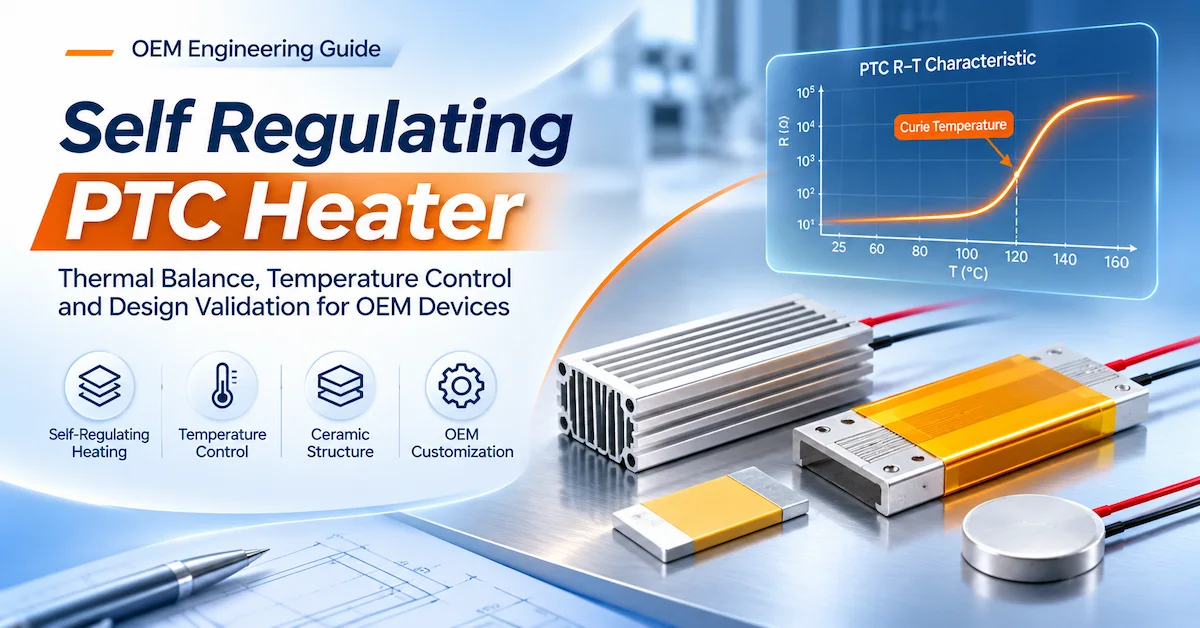
TL;DR: A Self Regulating PTC Heater changes its electrical resistance as ceramic temperature rises, reducing electrical power under appropriate operating conditions. However, self-regulation does not guarantee precise temperature control of the finished equipment. For OEM applications, passive PTC regulation is suitable when moderate temperature variation is acceptable, while thermostats or electronic feedback may be necessary for defined temperature setpoints. Engineers should evaluate resistance-temperature characteristics, thermal load, startup current, sensor placement, and abnormal operating conditions before approving a heater for production.
R&D engineers and equipment manufacturers frequently face a critical thermal-design decision: should they rely on a self-regulating ceramic heating element, add a thermostat, or develop a complete electronic temperature-control system?
The answer depends on the heating objective, temperature accuracy, thermal environment, equipment architecture, and applicable safety requirements.
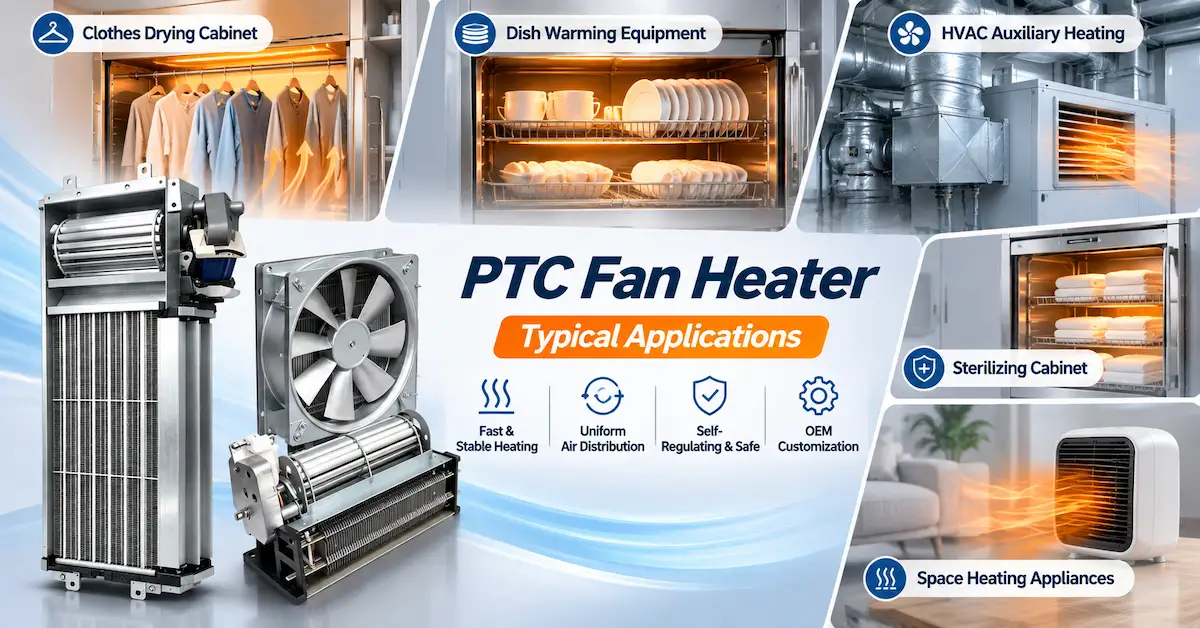
A ceramic PTC heater can reduce its electrical power as its temperature increases. This characteristic makes PTC technology useful in compact appliances, industrial enclosures, auxiliary heating systems, and equipment requiring localized heat.
However, a heater advertised with a Curie temperature of 120°C does not necessarily maintain the final heated object at 120°C.
The ceramic, aluminum housing, surrounding air, and target surface may operate at different temperatures.
Additionally, the heater's operating point changes when airflow, thermal contact, ambient temperature, or electrical supply conditions change.
The most important engineering principle is that PTC self-regulation controls the ceramic's electrical heating behavior, while precise equipment-temperature control requires a complete system-level design.
This guide compares three control architectures, explains the underlying electrical and thermal relationships, examines Tianrui's published PTC heating element specifications, and provides practical engineering calculations and qualification procedures.
It is intended for OEM product engineers, thermal-design teams, appliance manufacturers, and technical procurement managers evaluating standard or customized PTC heating solutions.
Key Takeaways
-
Passive PTC self-regulation can simplify heating-system design when the application does not require a tightly controlled target temperature.
-
Thermostat control is useful when the equipment must maintain a defined temperature range at a specified measurement location.
-
Electronic feedback control offers additional flexibility for adjustable setpoints, different operating modes, and temperature monitoring.
-
A ceramic's Curie temperature is not equivalent to the final working-surface or air temperature.
-
Startup current and stabilized power should be evaluated separately because PTC resistance changes with temperature.
-
Airflow, thermal contact, housing construction, and insulation affect the heater's operating temperature and electrical behavior.
-
A Self Regulating PTC Heating Element must be tested within the intended equipment rather than approved solely from catalog specifications.
-
For custom OEM applications, drawings, electrical data, thermal measurements, and agreed inspection criteria should be established before production release.
How Do Passive PTC Regulation, Thermostat Control, and Electronic Feedback Compare?
The fastest way to determine a suitable control strategy is to compare the required temperature behavior with the capabilities of each architecture.
Table 1. Temperature-Control Architecture Comparison
| Engineering Dimension | Passive PTC Self-Regulation | PTC Heater with Thermostat | PTC Heater with Electronic Feedback |
|---|---|---|---|
| Primary control mechanism | Ceramic resistance changes with temperature | Thermostat switches heater power | Electronic controller adjusts heater operation |
| Temperature reference | Primarily ceramic temperature | Temperature at thermostat location | Temperature at sensor location |
| Adjustable temperature setpoint | Generally limited by the selected heater characteristics | Possible with suitable thermostat | Usually supported by controller design |
| Response to load changes | Automatic electrical response through PTC characteristics | Switching response based on measured temperature | Feedback response according to control algorithm |
| Temperature accuracy | Depends strongly on complete thermal conditions | Depends on thermostat, placement, and thermal dynamics | Depends on sensor, controller, and thermal design |
| Circuit complexity | Relatively simple | Moderate | More complex |
| Additional components | May be minimal | Thermostat and switching arrangement | Sensor, controller, switching hardware |
| Common applications | Simple localized or enclosure heating | Appliances requiring a temperature band | Adjustable or monitored heating equipment |
| Main limitation | Does not precisely regulate the target object | Switching may create temperature variation | Requires control-system engineering and validation |
Selection recommendation:
Start with the required target-object temperature accuracy, not the type of heating element.
If a product can tolerate temperature variation under its intended operating conditions, passive self-regulation may be sufficient.
If the product must maintain a defined temperature band, a thermostat may be appropriate.
If the product requires adjustable operating modes, monitoring, or more sophisticated temperature behavior, electronic feedback may provide additional capabilities.
Regardless of the control strategy, equipment-level protective requirements must be evaluated independently.
The Engineering Basis: How Resistance–Temperature Behavior Controls Heating Power
Self Regulating Ceramic Heater technology is based on the electrical characteristics of positive temperature coefficient semiconductor ceramics.
Tianrui's technical information identifies barium titanate (BaTiO₃) as a principal ceramic material system.
Its electrical characteristics are influenced by composition, manufacturing processes, and ceramic microstructure.
How does a PTC ceramic generate heat?
Electrical current passing through the ceramic generates resistive heat.
The electrical relationships are:
I = V / R
P = V × I = V² / R
Where:
-
I = electrical current in amperes.
-
V = voltage across the heating element.
-
R = electrical resistance in ohms.
-
P = electrical power in watts.
For a PTC ceramic:
R = R(T)
Resistance is a function of temperature.
Therefore:
P(T) = V² / R(T)
Under a fixed applied voltage, increasing resistance reduces electrical power.
This characteristic explains why a ceramic PTC element can naturally reduce its heating input at elevated temperatures.
What happens during warm-up?
During initial energization, the ceramic may be relatively cool and have comparatively low resistance.
Electrical current generates heat.
As the ceramic warms, its resistance changes.
Near the designed transition region, resistance increases significantly, reducing current and power.
The heater eventually approaches an operating condition determined by electrical input and heat removed from the ceramic.
Why does the operating environment matter?
Technical application information published by established PTC component manufacturers, including TDK Electronics, explains that heat-transfer conditions influence PTC heating power.
When a PTC element transfers heat effectively into its surroundings, its temperature and resistance differ from those of a poorly cooled element.
Consequently, electrical power is influenced by both ceramic characteristics and the surrounding thermal design.
This is why an engineer should evaluate the complete heating assembly rather than treating nominal ceramic resistance as a complete performance specification.
What technical data should an OEM request?
| Parameter | Engineering Purpose |
|---|---|
| Resistance at 25°C (R25) | Identifies a reference electrical characteristic |
| R–T curve | Describes resistance across temperature |
| Curie temperature | Characterizes the ceramic's transition behavior |
| Minimum resistance, where specified | Helps evaluate electrical loading |
| Startup current | Supports power supply and switching design |
| Stabilized power | Helps characterize operation under a defined load |
| Rated voltage and operating range | Establishes supply compatibility |
| Ceramic dimensions | Supports mechanical and thermal integration |
| Electrode characteristics | Defines the electrical contact interface |
Not all suppliers publish the complete information online.
For OEM development, product-specific data and test conditions should be requested where relevant.
Which Heater Configuration Gives the Most Predictable Temperature?
The ceramic formulation alone does not determine the temperature experienced by the final equipment.
Heat-transfer structures, insulation, airflow, and thermal loading all influence the result.
Ceramic-only heating element
A ceramic element may be used in a custom assembly.
The OEM is responsible for electrodes, insulation, mounting, and thermal contact.
This offers structural flexibility but requires more component-level engineering.
Aluminum-shell PTC heater
An aluminum-shell heater combines ceramic elements with a metal structure.
The housing provides mechanical support and a heat-transfer interface.
It may simplify equipment installation when the standard product geometry matches the application.
However, the housing temperature can differ from the ceramic temperature.
Insulated PTC heater
An insulated heating element includes materials that provide electrical separation between relevant components.
The insulating layer also influences thermal resistance.
Engineers must verify both electrical insulation and useful heat transfer.
Fan-assisted PTC heater
A fan-assisted heater transfers heat into moving air.
Airflow affects heat removal from the ceramic.
Changing fan speed or restricting the airflow path can alter electrical power and temperature.
Table 2. PTC Heater Construction Comparison
| Heater Construction | Main Heat-Transfer Method | Control Consideration | Suitable OEM Direction |
|---|---|---|---|
| Bare ceramic PTC element | Application-defined conduction | Requires complete assembly evaluation | Custom heating devices |
| Aluminum-shell heater | Contact heating or convection | Housing and target temperatures must be assessed | Appliances and localized heating |
| Insulated PTC element | Heat transfer through insulated construction | Insulation affects thermal resistance | Compact electrical equipment |
| Finned PTC heater | Natural or forced convection | Heat transfer depends on air movement | Air-heating applications |
| PTC heater with fan | Forced-air convection | Fan and heater must be evaluated together | Drying and warm-air equipment |
Engineering rule:
Choose the construction according to the intended heat-transfer path before choosing a temperature-control strategy.
For example, a heating plate intended to warm a metal surface should not be evaluated using only an unloaded ceramic temperature measurement.
Likewise, a fan-assisted air heater requires measurements of inlet and outlet air temperatures under the intended airflow.
Why Is Curie Temperature Different from Actual Operating Temperature?
Curie temperature is associated with the ceramic material's transition characteristics.
It is not a universal thermostat setpoint.
A PTC element can have one temperature while its housing, heated object, and surrounding environment have different temperatures.
Important temperature definitions
| Temperature Term | What It Describes | Engineering Relevance |
|---|---|---|
| Curie temperature | Material-related transition characteristic | Helps characterize the ceramic |
| Ceramic temperature | Actual heating-element temperature | Influences electrical resistance |
| Housing temperature | Temperature of surrounding metal or insulation | Important for mounting and safety |
| Contact-surface temperature | Temperature at the heater/load interface | Relevant to contact heating |
| Target-object temperature | Temperature of the component being heated | Determines application performance |
| Outlet-air temperature | Temperature of discharged air | Relevant to forced-air systems |
Example: Tianrui MZ41 Ceramic PTC Heating Element
Tianrui publishes a ceramic PTC heating element identified as:
MZ41-1610-120-30±20%
Its listed specifications include:
| Parameter | Published Value |
|---|---|
| Model | MZ41-1610-120-30±20% |
| Operating voltage | 24V DC |
| Resistance at 25°C | 30Ω ±20% |
| Curie temperature | 120°C ±10°C |
| Listed surface temperature | 130°C ±7°C |
| Dimensions | 16.0 × 9.5 × 1.4 mm |
| Electrode | Silver electrode with edge |
Product reference: MZ41 Ceramic PTC Heating Element.
The listing distinguishes Curie temperature from surface temperature.
However, the published page does not fully specify the thermal test conditions for the stated surface temperature.
An OEM should therefore request the relevant measurement method before treating it as a guaranteed operating result.
What does this mean for appliance design?
Suppose an appliance requires its working surface to remain at 80°C.
Selecting a ceramic with a Curie temperature near 80°C does not guarantee that the working surface will reach or maintain 80°C.
The external surface may be cooler because heat must pass through an insulating layer and metal housing.
It may also experience different temperatures when a cold object is placed against it.
The target temperature should be verified at the actual working location.
How Much Can R25 Tolerance Change Initial Electrical Loading?
Resistance tolerance is an important consideration for electrical design.
Two elements that share the same nominal resistance can have different initial electrical characteristics within their approved tolerance range.
For the MZ41 example, Tianrui lists:
-
Operating voltage: 24V DC.
-
Nominal R25: 30Ω.
-
Tolerance: ±20%.
The nominal resistance limits are:
Rmin = 30 × 0.8 = 24Ω
Rmax = 30 × 1.2 = 36Ω
Using P = V²/R:
Table 3. Calculated Electrical Values at 24V
| Resistance at 25°C | Calculated Current | Calculated Electrical Power |
|---|---|---|
| 24Ω | 1.00A | 24.0W |
| 30Ω | 0.80A | 19.2W |
| 36Ω | 0.67A | 16.0W |
These values are theoretical electrical calculations using the published R25 tolerance, not measured startup-current or stabilized-power data for the MZ41 product.
The actual resistance changes as the ceramic heats.
Furthermore, the operating resistance may depend on the applied voltage and actual thermal conditions.
Why the calculation matters
The theoretical range shows why OEM electrical design should not be based only on a nominal resistance value.
Electrical loading affects:
-
Power supplies.
-
Switches and relays.
-
Current protection.
-
Wiring.
-
Connectors.
-
Electronic control circuits.
What should engineers verify?
Request the actual current-versus-time and power-versus-time behavior under the intended supply and environmental conditions.
For applications involving repeated starts, confirm the behavior at relevant starting temperatures.
A room-temperature resistance measurement alone does not establish maximum operating current.
How Does Thermal Balance Affect a Self Regulating PTC Heater?
A PTC element generates electrical heat while transferring energy to surrounding materials.
Its operating temperature is influenced by the balance between these processes.
A simplified energy balance is:
C × dT/dt = Pelec − Qloss − Qload
Where:
-
C = effective thermal capacitance.
-
T = heater temperature.
-
Pelec = electrical heating power.
-
Qloss = heat transferred to the environment.
-
Qload = heat transferred into the intended load.
At steady state:
Pelec ≈ Qloss + Qload
This simplified model helps explain why different installations can produce different operating conditions.
Example A: Limited heat removal
A ceramic heater is operated with relatively little cooling.
Its temperature rises, resistance increases, and power tends to decrease.
The heater approaches an equilibrium associated with relatively low heat removal.
Example B: Contact with a metal heat sink
The same heater is installed against a large metal structure.
The metal removes heat more effectively.
The ceramic may operate at a different temperature and resistance.
Its electrical power may consequently differ.
Example C: Forced-air cooling
The ceramic is incorporated into a finned heating assembly.
Airflow removes heat.
Changing airflow alters the heat-transfer conditions and potentially the electrical operating point.
Why this matters for product specifications
A supplier's nominal wattage does not fully describe performance inside every device.
The most useful information is performance measured under defined conditions representative of the intended equipment.
For contact heating, specify the heated material, contact geometry, and target temperature.
For air heating, specify airflow, inlet temperature, and the required outlet condition.
For enclosure heating, specify ambient temperature, enclosure design, and required internal conditions.
When Is an External Thermostat Necessary?
A thermostat may be necessary when the temperature of a particular location must remain within a defined range.
PTC self-regulation responds to ceramic temperature.
A thermostat responds to the temperature measured at its sensing location.
Those locations may not be thermally equivalent.
Applications where passive regulation may be sufficient
Passive self-regulation may be considered when:
-
The application tolerates temperature variation.
-
The load is relatively predictable.
-
The heater has been qualified under representative conditions.
-
Precise setpoint adjustment is unnecessary.
-
Equipment-level safety requirements are satisfied.
Applications where thermostat control may help
Thermostat control may be useful when:
-
A defined operating temperature band is required.
-
The equipment experiences changing ambient conditions.
-
Different loads cause significant temperature changes.
-
The heater must switch off at a specified control temperature.
-
Equipment performance depends on a controlled target location.
Thermostat placement matters
Consider a heater warming a metal plate.
If the thermostat senses the ceramic housing, it may switch off before the metal plate reaches its required temperature.
If the thermostat senses the metal surface, it can provide feedback more directly related to the intended function.
However, mechanical placement, measurement lag, and switching behavior must still be considered.
Why temperature hysteresis matters
Many thermostats use different switching temperatures for turning heating on and off.
This difference is called hysteresis.
Hysteresis can help prevent excessively frequent switching.
However, the resulting temperature variation must remain acceptable for the application.
The control system should be validated under realistic operating conditions.
When Should OEM Engineers Use Electronic Temperature Feedback?
Electronic feedback can provide more flexibility when the heating system has adjustable or complex requirements.
A controller receives a temperature measurement and adjusts heater operation.
The control method may involve on/off switching, time-proportional control, or another appropriate strategy.
The chosen method must be compatible with the heater and electrical system.
Common reasons to use electronic feedback
-
Multiple operating temperatures.
-
User-adjustable temperature settings.
-
Defined warm-up profiles.
-
Temperature monitoring.
-
Different heating modes.
-
Fault detection.
-
Coordination with other equipment functions.
Sensor selection
A temperature sensor should match the required temperature range, measurement accuracy, mounting, environmental conditions, and electronic interface.
Tianrui supplies NTC Temperature Sensor Assemblies that may be considered for equipment requiring temperature feedback.
The selected sensor must be evaluated for the intended temperature and installation conditions.
Control-system risks
Electronic control introduces additional design considerations.
These may include:
-
Sensor failure.
-
Switching-device failure.
-
Software or control faults.
-
Electrical noise.
-
Incorrect sensor placement.
-
Thermal lag.
-
Excessive switching.
-
Control-system power failure.
A feedback controller is not automatically more reliable than passive heating.
It provides additional functionality that must be designed and validated.
Engineering recommendation
Use electronic feedback when its added functionality is necessary for the product requirements.
Avoid adding control complexity solely because it appears more advanced.
Which Tianrui PTC Heating Elements Are Suitable for Different OEM Designs?
Tianrui Electronics publishes ceramic PTC elements, thermostatic heating elements, insulated heaters, and aluminum-shell heating products.
These represent different integration approaches.
Table 4. Tianrui PTC Product Selection Reference
| Product | Published Information | Configuration | Potential OEM Application |
|---|---|---|---|
| MZ41 Ceramic PTC Heating Element | 24V DC, R25 30Ω ±20%, Curie 120°C ±10°C | Rectangular ceramic element | Compact low-voltage heating assembly |
| MZ9-FJA-1 Thermostatic Heating Element | 220V AC, listed resistance range 1000–4000Ω | Rectangular ceramic | Auxiliary heating designs |
| MZ9-FIA-2 Thermostatic Heating Element | 220V AC, listed resistance range 1000–4000Ω | Larger rectangular element | Application-specific heating |
| PTC Heater with Insulated Film | Published family includes 12–240V AC/DC or custom options | Insulated structure | Compact insulated assemblies |
| Aluminum Shell PTC Heater | Published family includes AC/DC 5–380V | Aluminum housing with PTC ceramic | Contact or localized heating |
The published family ranges do not mean every combination of voltage, resistance, dimensions, and temperature is available.
Specific models require datasheet confirmation.
MZ41: compact ceramic integration
The MZ41 element is relevant to engineers developing compact heating assemblies.
It provides a defined nominal voltage, resistance tolerance, and ceramic geometry.
Additional evaluation is needed for the intended heating load and electrical contacts.
MZ9: thermostatic ceramic heating
The MZ9 series includes models with different electrical ratings and dimensions.
Tianrui lists applications such as heat-pump water heaters, heat-pump air-conditioning systems, and related heating equipment.
The OEM should confirm the exact resistance-temperature behavior and thermal performance of the selected model.
Insulated PTC heater
An insulated assembly may simplify electrical integration where a suitable insulation structure is required.
The insulation performance and temperature behavior should be evaluated for the exact configuration.
Aluminum-shell heater
An aluminum housing may provide a convenient heat-transfer and mounting structure.
However, the target-surface temperature depends on the housing geometry and thermal load.
How Should Engineers Calculate the Required Heating Capacity?
The starting point is the actual heating task.
For a solid object, an initial energy calculation is:
E = m × cp × ΔT
Where:
-
m = heated mass.
-
cp = specific heat capacity.
-
ΔT = required temperature rise.
Illustrative OEM example
Suppose an appliance must heat a 0.20 kg aluminum component from 20°C to 65°C.
Assume:
-
Aluminum specific heat capacity: 900 J/(kg·K).
-
Required temperature rise: 45°C.
-
Desired warm-up time: 180 seconds.
The sensible heat requirement is:
E = 0.20 × 900 × 45
E = 8,100J
The ideal average useful heating power is:
P = 8,100 ÷ 180
P = 45W
This is a theoretical minimum under the assumed conditions.
It does not include heat losses or heating of the mounting structure.
It also assumes the relevant thermal power is delivered continuously to the aluminum.
What does this mean for PTC selection?
If a candidate heater cannot deliver sufficient useful heat during the required warm-up interval, it cannot satisfy the target.
A heater advertised as 45W does not automatically provide 45W of useful heat to the aluminum throughout warm-up.
Its actual electrical input may change with ceramic temperature.
Therefore, the calculation should be used to screen potential heater configurations.
Final selection requires measured heating performance under representative conditions.
How Should OEMs Validate Self-Regulating Performance in Three Steps?
A practical engineering decision can be made using three qualification stages.
Step 1: Verify electrical characteristics
Action:
Confirm operating voltage, resistance-temperature behavior, startup current, and stabilized electrical power.
Decision rule:
Do not approve a heater if its electrical characteristics cannot be matched to the equipment power supply and switching system.
Step 2: Verify thermal performance
Action:
Test the heater using the intended mounting arrangement, load, ambient conditions, and control system.
Decision rule:
The target-object temperature and heating response must satisfy the specified requirements.
Step 3: Verify control and fault behavior
Action:
Evaluate changes in thermal load, relevant abnormal operating conditions, and any external temperature-control components.
Decision rule:
The system should meet its defined functional and safety acceptance criteria before production approval.
Table 5. Three-Step Engineering Qualification
| Step | Main Question | Required Evidence |
|---|---|---|
| Electrical qualification | Is the heater compatible with the supply? | Resistance and current/power measurements |
| Thermal qualification | Does it heat the intended load correctly? | Temperature and warm-up test results |
| System qualification | Does it behave acceptably under changes and faults? | Control and abnormal-operation test results |
This sequence helps prevent engineers from selecting a heater solely because its nominal temperature or wattage appears suitable.
OEM Engineering Example: Selecting Temperature Control for a Compact Heating Device
The following example illustrates a design decision using the engineering principles described above.
This is a hypothetical engineering scenario, not a documented Tianrui customer project or measured factory case study.
Project requirements
An OEM is developing a compact electrically heated device.
The equipment has the following design objectives:
-
A nominal 24V DC electrical supply.
-
A defined warm-up period.
-
A target working-surface temperature.
-
Changing thermal load during operation.
-
Limited internal installation space.
-
Repeatable performance during production.
The engineering team considers using a ceramic PTC heating element.
Initial design question
Can the ceramic's natural self-regulating behavior provide adequate temperature control, or does the product require an external sensor?
Option A: Passive PTC regulation
A ceramic PTC element is selected according to its electrical characteristics.
The engineering team evaluates whether the working surface remains within the required temperature range under different loads.
If the resulting variation is acceptable, passive regulation may provide a practical solution.
Option B: PTC heater with thermostat
The equipment uses a thermostat positioned to sense a temperature relevant to the heated object.
The thermostat switches heating according to a defined operating band.
This may improve control of the target location.
However, the team must evaluate temperature lag, switching behavior, and sensor placement.
Option C: PTC heater with electronic feedback
The equipment uses a temperature sensor and electronic controller.
The controller adjusts heater operation to maintain the required temperature behavior.
This may be appropriate when multiple temperature settings or more complex control functions are required.
Proposed validation plan
| Test Requirement | Passive PTC | Thermostat | Electronic Feedback |
|---|---|---|---|
| Loaded warm-up time | Measure | Measure | Measure |
| Stabilized target temperature | Measure | Measure | Measure |
| Temperature after load change | Measure | Measure | Measure |
| Power consumption | Measure | Measure | Measure |
| Control response | PTC material response | Switching behavior | Feedback response |
| Abnormal operation | Evaluate | Evaluate | Evaluate |
| Integration complexity | Assess | Assess | Assess |
How should the final design be selected?
If all three architectures satisfy the required heating function and safety criteria, the OEM can compare system complexity, manufacturing cost, and maintenance requirements.
If passive PTC regulation cannot maintain the required working-surface temperature, a suitable feedback method should be evaluated.
If a simple thermostat provides adequate control, a more complex electronic controller may not be necessary.
The correct choice is the least complicated technically qualified architecture that meets the complete equipment requirements.
What Reliability and Safety Tests Should Be Completed Before Production?
A successful laboratory demonstration is not sufficient for OEM production approval.
The heating assembly should be evaluated according to the expected operating environment and foreseeable fault conditions.
Table 6. Recommended PTC Heater Validation Matrix
| Test | Primary Measurement | Engineering Purpose |
|---|---|---|
| R25 verification | Resistance at reference conditions | Confirm electrical characteristics |
| Startup test | Current and power versus time | Evaluate electrical loading |
| Warm-up test | Target temperature versus time | Verify heating response |
| Stabilized operation | Temperature and power | Determine operating condition |
| Thermal-load change | Power and temperature response | Verify self-regulation |
| Supply-voltage variation | Electrical and thermal behavior | Confirm operating compatibility |
| Restricted heat removal | Heater and surrounding temperatures | Evaluate thermal risk |
| Controller failure | Defined fault response | Assess system behavior |
| Thermal cycling | Performance before and after cycles | Evaluate durability |
| Insulation testing | Relevant electrical isolation characteristics | Support safety evaluation |
| Mechanical inspection | Dimensions and connections | Confirm integration |
| Extended operation | Performance under defined duty | Evaluate intended use |
Important technical distinction
IEC 60738-1:2022 provides general terminology, inspection procedures, and test methods for directly heated positive temperature coefficient thermistors.
It can support component-level specification and verification.
Finished appliances may also be subject to other applicable safety requirements.
Referencing an international standard does not establish certification of a particular heating product.
Why abnormal-operation testing matters
PTC resistance can reduce heating power at elevated ceramic temperatures.
However, nearby wiring, connectors, plastics, and other materials may still experience unacceptable thermal conditions.
An equipment-level safety assessment should address relevant abnormal conditions.
The necessary protective devices depend on the intended product and applicable requirements.
How Can OEMs Reduce PTC Heater Selection and Manufacturing Risks?
A heating design should be technically validated before supplier selection and volume purchasing are finalized.
Risk 1: Selecting by Curie temperature alone
A ceramic's Curie temperature does not guarantee the target-object temperature.
Engineering response:
Specify and measure the temperature of the actual heated load.
Risk 2: Ignoring startup current
Cold resistance and electrical behavior can affect the supply system.
Engineering response:
Request startup-current and power data.
Risk 3: Assuming self-regulation replaces every safety function
The ceramic's natural electrical response does not establish complete equipment safety.
Engineering response:
Perform equipment-level risk assessment.
Risk 4: Incorrect control-sensor placement
A sensor placed far from the target may not represent its temperature accurately.
Engineering response:
Verify sensor positioning and thermal response.
Risk 5: Uncontrolled material changes
Changes in ceramic, electrode, insulation, or housing may influence performance.
Engineering response:
Establish controlled specifications and change-notification procedures.
Risk 6: Comparing nominal ratings without common test conditions
Two heater specifications may be measured under different thermal conditions.
Engineering response:
Request comparable test information before selecting a supplier.
OEM Self Regulating PTC Heater RFQ Checklist
A complete RFQ should describe the heating application rather than only requesting a particular wattage.
Table 7. Technical Information for OEM Quotations
| Requirement | Information to Provide |
|---|---|
| Equipment application | Appliance or industrial equipment type |
| Heating objective | Contact heating, air heating, or enclosure warming |
| Electrical supply | AC/DC, nominal voltage and range |
| Resistance characteristics | R25 or relevant R–T requirements |
| Target temperature | Ceramic, housing, air, or working-surface target |
| Thermal load | Heated mass, contact conditions, or airflow |
| Warm-up time | Required heating response |
| Temperature accuracy | Acceptable variation or control band |
| Control architecture | Passive PTC, thermostat, or electronic feedback |
| Dimensions | Available space and mechanical drawings |
| Insulation | Electrical isolation requirements |
| Wiring | Lead length, connector, terminal |
| Environmental conditions | Temperature, humidity, vibration |
| Safety requirements | Relevant application and destination-market requirements |
| Testing | Required electrical and thermal validation |
| Production quantity | Initial and annual forecast |
| Commercial conditions | Samples, tooling, MOQ, lead time |
Example OEM Technical Inquiry
Subject: Self Regulating PTC Heater for OEM Temperature-Control Application
We are developing an electrical heating product and are evaluating self-regulating ceramic PTC heating elements and integrated heater assemblies.
Our application requires defined electrical characteristics, suitable thermal performance, and controlled operation under changing thermal-load conditions.
We can provide operating voltage, target temperature, available installation space, heating requirements, and estimated production quantities.
Please advise which Tianrui standard models may be suitable and whether a customized configuration is technically feasible.
We would also like to discuss R–T characteristics, startup current, stabilized power, temperature-control requirements, prototype testing, and production specifications.
For technical consultation, contact Tianrui Electronics with the available project information.
Frequently Asked Questions
1. What is a Self Regulating PTC Heater?
A Self Regulating PTC Heater uses a positive temperature coefficient ceramic whose resistance increases significantly within a designed temperature region.
At a fixed supply voltage, increasing resistance generally reduces electrical power.
This provides an intrinsic thermal response, but the final equipment temperature depends on heat transfer and installation conditions.
2. Does a Self Regulating Ceramic Heater maintain an exact temperature?
Not necessarily.
The ceramic's resistance-temperature behavior influences its electrical power, but the external housing or target object may operate at another temperature.
Accurate temperature control may require external sensing and a suitable control strategy.
3. What is the difference between Curie temperature and heater surface temperature?
Curie temperature is associated with the ceramic material's transition behavior.
Surface temperature is the actual temperature measured at a defined location.
The relationship depends on the ceramic, housing, insulation, electrical supply, and heat-transfer conditions.
4. Can a PTC heater work without a thermostat?
Some applications can use passive PTC self-regulation without external thermostat switching.
However, precise temperature requirements or independent safety functions may require additional components.
The complete equipment must be evaluated before deciding that external control is unnecessary.
5. Why does PTC heater power change when airflow increases?
Airflow changes the rate of heat removal from the ceramic.
This can change ceramic temperature and electrical resistance.
Because electrical power depends on resistance, the heater's operating power may change with airflow.
The actual relationship depends on the product and installation.
6. What is the advantage of electronic feedback over passive PTC heating?
Electronic feedback can monitor a selected temperature and adjust heater operation according to the equipment's requirements.
This can support adjustable temperature settings, monitoring, and more complex operating behavior.
However, it introduces additional components and control-system validation requirements.
7. Is a 24V PTC heating element suitable for 12V equipment?
Not automatically.
Changing the applied voltage changes electrical heating power and operating conditions.
A heater designed for 24V may not deliver the required thermal performance at 12V.
The intended voltage range should be confirmed with the manufacturer.
8. What tests should be performed before OEM production?
Important tests may include startup current, stabilized power, temperature response, thermal-load variation, electrical insulation, thermal cycling, and relevant abnormal-operation conditions.
The test plan should reflect the final equipment and agreed acceptance criteria.
9. Can Tianrui customize PTC heating elements?
Tianrui describes customization support for ceramic resistance, voltage, temperature characteristics, dimensions, electrode materials, and heating structures.
The feasibility of a specific design depends on the complete electrical and thermal requirements.
Engineering review and sample testing should be completed before production approval.
10. How should OEM engineers select a PTC heater manufacturer?
Evaluate product specifications, technical communication, customization capability, sample validation, manufacturing consistency, and commercial terms.
A suitable manufacturer should explain how the ceramic's resistance-temperature behavior interacts with the intended thermal load.
Supplier selection should be based on measurable technical evidence and appropriate production controls.
Conclusion
A Self Regulating PTC Heater can provide a practical electrical heating solution because its ceramic resistance changes significantly with temperature.
This characteristic enables the electrical power to respond naturally to changing thermal conditions.
However, self-regulation is not equivalent to precise equipment-temperature control.
For OEM engineers, the correct heater selection requires an understanding of the complete thermal system.
The most important considerations are the ceramic's resistance-temperature characteristics, electrical supply, heat-transfer structure, thermal load, and required control accuracy.
Passive PTC regulation is appropriate when its measured behavior meets the application requirements. Thermostat control is useful when a defined temperature band must be maintained, while electronic feedback may be preferable for adjustable or more complex temperature-control functions.
The final decision should follow a clear qualification process:
-
Verify electrical compatibility.
-
Measure heating performance under representative conditions.
-
Select the necessary control architecture.
-
Evaluate relevant safety and abnormal-operation conditions.
-
Establish approved production specifications.
Dongguan Tianrui Electronics Co., Ltd. offers ceramic PTC heating elements, insulated heaters, aluminum-shell heating assemblies, and customized thermal solutions for OEM equipment.
The company supports discussions involving ceramic characteristics, heater structure, material selection, electrical requirements, engineering drawings, and application-specific development.
Looking for a self-regulating PTC heating solution for your next OEM project?
Explore Tianrui's PTC Heater Products, review its PTC Heating Element Solutions, or contact Tianrui Electronics for technical evaluation and OEM quotation.
Provide your operating voltage, thermal load, target temperature, control requirements, mechanical drawings, and estimated production volume.
Email:
Phone:
+86 135 3277 2961
A well-defined thermal specification, appropriate temperature-control strategy, and evidence-based prototype validation provide the foundation for reliable PTC heating performance and long-term OEM manufacturing.