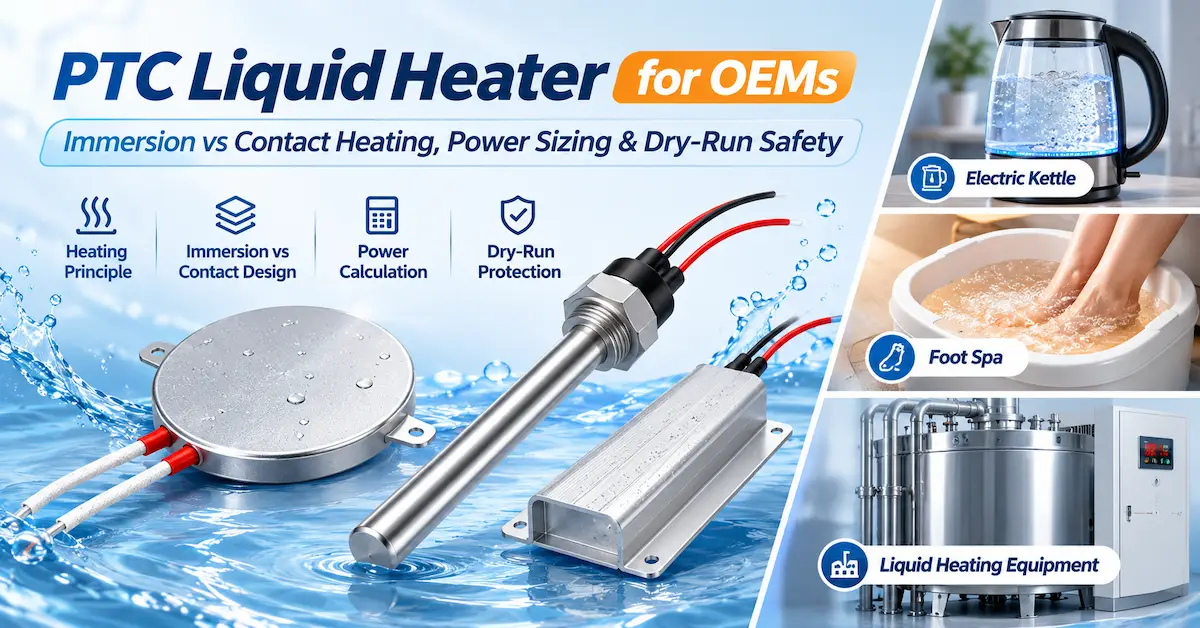
TL;DR: A PTC Liquid Heater uses positive temperature coefficient ceramic elements to heat water or other compatible liquids through an insulated heating assembly. For OEM equipment, direct immersion places a properly sealed heater surface in the liquid, while indirect contact heating transfers heat through a vessel wall or metal heat exchanger. The preferred design depends on liquid compatibility, heating speed, electrical insulation, sealing, maintenance, and dry-run behavior. PTC self-regulation can reduce electrical power as ceramic temperature rises, but it does not eliminate the need for independent equipment-level safety verification.
Electric kettle manufacturers, foot spa brands, liquid-heating equipment OEMs, and industrial appliance developers frequently face an important heating-system decision: should the PTC heating element be immersed directly in liquid or installed outside the liquid chamber?
Both approaches can use positive temperature coefficient ceramic technology, but they create different thermal, mechanical, and electrical requirements.
A direct-immersion heater can transfer heat through a wetted metal surface. An indirect heater transfers heat through a vessel wall or another heat-transfer interface.
The difference affects warm-up time, sealing design, corrosion exposure, cleaning, maintenance, and manufacturing cost.
Another critical consideration is dry-run safety.
A liquid heater normally removes heat through water or another liquid. If the water level becomes too low, the liquid stops circulating, or the heater operates in an empty vessel, its thermal conditions change significantly.
PTC ceramic can reduce electrical power as temperature rises, but the heater housing, nearby plastic parts, seals, wiring, and accessible surfaces may still reach unacceptable temperatures.
The correct PTC Liquid Heater must deliver the required useful heat while maintaining electrical isolation, liquid compatibility, and safe behavior under the equipment's intended and foreseeable abnormal operating conditions.
This guide explains how OEM engineers and purchasing managers should compare immersion and contact-heating designs, calculate thermal requirements, evaluate existing Tianrui products, and qualify customized liquid-heating assemblies.
How Do PTC Immersion Heaters and Contact Heaters Compare?
The first selection decision is the physical heat-transfer arrangement.
Both technologies may use similar ceramic materials, but the wet/dry boundary and installation requirements are different.
Table 1. Immersion vs. contact PTC liquid heating
| Comparison Dimension | PTC Immersion Heater | Indirect Contact PTC Heater | Recommended Selection |
|---|---|---|---|
| Heating method | A sealed heater surface contacts liquid directly | Heat passes through a vessel wall or heat exchanger | Select according to vessel construction and thermal requirements |
| Thermal path | Heater sheath to liquid | Heater, contact interface, vessel wall, then liquid | Consider all thermal resistance layers |
| Electrical insulation | Requires suitable isolation and sealing for liquid exposure | Requires electrical insulation and an appropriate dry-side structure | Verify the exact assembly |
| Corrosion exposure | Wetted materials contact the liquid | Heater may remain outside the liquid; vessel material contacts it | Compare liquid compatibility |
| Cleaning and scaling | Deposits can form on the wetted heater surface | Deposits may form on the vessel's internal heating surface | Consider maintenance access |
| Installation | Requires suitable immersion mounting and sealing | Requires reliable contact pressure and mechanical fixing | Review mechanical drawings |
| Dry-run conditions | Liquid loss can sharply reduce heater cooling | Empty vessels can also reduce heat removal | Both require abnormal-operation verification |
| Typical applications | Foot baths, water tanks, selected liquid heaters | Kettles, warming vessels, compact heating assemblies | Confirm product-specific suitability |
Engineering conclusion:
Direct immersion is not universally faster, safer, or more efficient. A properly designed indirect heater may perform better in an appliance with a suitable metal vessel and excellent thermal contact.
The right choice depends on the complete equipment design rather than the word "immersion" in a product title.
Key Takeaways
-
A PTC Immersion Heater must use a construction specifically qualified for the intended liquid exposure.
-
A standard aluminum-shell PTC heater should not automatically be immersed in water.
-
Ceramic Curie temperature is not the same as the final liquid temperature.
-
Heating power should be calculated from liquid volume, temperature rise, heat losses, and required time.
-
Continuous-flow equipment must also consider flow rate and inlet-to-outlet temperature rise.
-
PTC self-regulation does not establish complete dry-run safety.
-
Electrical insulation, leakage current, sealing, and liquid compatibility require product-specific verification.
-
OEM buyers should establish approved drawings, test conditions, inspection criteria, and commercial requirements before mass production.
What Is a PTC Liquid Heater, and How Does It Work?
A PTC Liquid Heater is an electrical heating component or assembly that uses positive temperature coefficient ceramic technology to generate heat for a liquid-heating application.
PTC ceramic resistance increases significantly within a designed temperature region.
At a fixed applied voltage, increasing electrical resistance generally reduces electrical current and heating power.
The simplified electrical relationship is:
P = V² / R
Where:
-
P = instantaneous electrical power.
-
V = voltage across the heating element.
-
R = instantaneous electrical resistance.
Because ceramic resistance changes with temperature, electrical power is not necessarily constant throughout warm-up and stabilized operation.
How does heat reach the liquid?
A complete liquid-heating assembly typically transfers heat through several layers.
For an immersion design:
PTC Ceramic → Electrode and Insulation → Metal Sheath → Liquid
For an indirect contact design:
PTC Ceramic → Insulation and Housing → Contact Interface → Vessel Wall → Liquid
Each layer influences the temperature difference required to transfer heat.
The ceramic temperature may therefore be considerably different from the liquid temperature.
Does a PTC heater automatically maintain water at a fixed temperature?
Not necessarily.
The ceramic's resistance-temperature characteristics influence electrical input, but the final water temperature depends on the liquid volume, heat transfer, operating conditions, and control system.
An appliance requiring a defined water-temperature setpoint may still need an external temperature sensor and controller.
A thermal cutoff or another protective device may also be required for safety.
For OEM projects, the distinction between component self-regulation and equipment temperature control is essential.
Which Tianrui PTC Liquid Heater Products Are Relevant to OEM Projects?
Dongguan Tianrui Electronics Co., Ltd. publishes several liquid-heating configurations.
These include insulated PTC liquid heaters, immersion assemblies, footbath heaters, and larger electric-boiler heating products.
They should not be treated as interchangeable.
Table 2. Tianrui liquid-heating product comparison
| Product | Published Configuration | Application Direction | Main Verification Requirement |
|---|---|---|---|
| MZ10 PTC Liquid Heater | 12–230V family; 90–500W | Electric kettles, coffee pots, liquid-heating appliances | Exact configuration and wet/dry mounting method |
| Immersed PTC Liquid Heater | Product described for direct immersion | Water tanks, coffee equipment, liquid-heating systems | Sealing, insulation, and wetted material compatibility |
| Foot Spa Immersion PTC Heater | Published 300–1500W family | Foot baths and soaking basins | Liquid safety, dry-run response, and installation |
| Aluminum-Shell Footbath PTC Heater | Published 110V/220V and 400W/600W options | Footbath and personal-care equipment | Exact model construction and electrical safety |
| MZ27 PTC Submerged Boiler Heater | 220V; 2000–10000W series | Electric boilers and larger liquid-heating systems | High-current electrical design and installation |
The published ranges represent product families. They do not guarantee that every combination of voltage, wattage, temperature, and dimensions is available.
MZ10 PTC Liquid Heater
Tianrui's MZ10 PTC Liquid Heater provides specific model information for insulated liquid-heating applications.
The manufacturer's published table includes:
| Model | Rated Voltage | Rated Power | Dimensions |
|---|---|---|---|
| MZ10-Y50A | 230V AC | 500W | Ø80 × 12 mm |
| MZ10-Y20A | 230V AC | 200W | Ø62 × 12 mm |
| MZ10-Y40B | 110V AC | 400W | Ø80 × 12 mm |
The product page also lists maximum surge-current and electrical-strength figures.
However, several entries elsewhere in its model table require clarification before being used for final electrical design.
The MZ10 product listing identifies electric kettles, coffee pots, electric tea kettles, and similar appliances as applications.
The exact installation arrangement should be confirmed because the page does not fully establish whether each configuration is intended for direct immersion or dry-side mounting.
Immersed PTC Liquid Heater
Tianrui's Immersed PTC Liquid Heater is specifically described for direct liquid immersion.
The company identifies applications including water tanks, beverage equipment, and aquaculture temperature control.
For this category, buyers should request details of the sealed structure, wetted materials, installation method, and electrical protection.
Foot Spa Heating Elements
Tianrui also publishes immersed PTC configurations for foot spa appliances and foot basins.
One published family describes power options of 300–1500W and voltage options across several configurations.
The product's intended immersion use should be supported by relevant engineering and safety evidence.
High-Power Boiler Heating
The MZ27 PTC Submerged Electric Boiler Heater represents a different power category.
Its public specifications include models rated from 2000W to 10000W at 220V.
These products are relevant to larger heating systems, not direct substitutes for compact kettle or foot spa heaters.
For a broader overview, explore Tianrui's PTC Liquid Heater product category.
How Much Power Does a PTC Liquid Heater Need?
A preliminary power calculation begins with the liquid mass, desired temperature increase, and heating time.
For sensible heating:
E = m × cp × ΔT
Where:
-
E = required thermal energy in joules.
-
m = liquid mass in kilograms.
-
cp = specific heat capacity in J/(kg·K).
-
ΔT = required temperature increase.
For water, a useful preliminary specific-heat value near ordinary temperatures is approximately 4180 J/(kg·K).
The value varies with temperature, but this approximation is often adequate for early engineering estimates.
Example: heating 1.5 liters of water
Assume an OEM appliance must heat 1.5 liters of water from 20°C to 60°C.
For preliminary calculations, water density is approximately 1 kg/L.
Therefore:
-
Water mass = 1.5 kg.
-
Initial temperature = 20°C.
-
Target temperature = 60°C.
-
Temperature rise = 40°C.
Required thermal energy:
E = 1.5 × 4180 × 40
E = 250,800J
The ideal heating time can be estimated as:
t = E / Puseful
Where Puseful is the average thermal power actually transferred to the water.
Table 3. Ideal water-heating time comparison
| Assumed Constant Useful Heating Power | Ideal Heating Time |
|---|---|
| 200W | 20.9 minutes |
| 400W | 10.5 minutes |
| 500W | 8.4 minutes |
| 600W | 7.0 minutes |
| 1000W | 4.2 minutes |
These values assume constant heat delivery and ignore heat losses and energy stored in the vessel and heater.
They are illustrative engineering calculations, not actual heating-time specifications for Tianrui products.
PTC electrical input changes with ceramic temperature, and useful heat transfer depends on the complete assembly.
The real heating time must therefore be measured.
Why this matters for kettle manufacturers
An OEM developing a fast-boiling electric kettle may require considerably more heating capacity than a 200W or 500W heater can provide under practical conditions.
A lower-power PTC element may be more suitable for temperature maintenance, compact appliances, or applications with longer acceptable heating times.
The heating requirement—not simply the product category—must determine the specification.
How Should OEMs Calculate Power for a Continuous-Flow Liquid Heater?
A batch heater raises the temperature of a fixed liquid volume.
A continuous-flow heater must heat liquid as it passes through the system.
For a simplified steady-state flow calculation:
Positive = ṁ × cp × ΔT
Where:
-
ṁ = liquid mass flow rate in kg/s.
-
cp = liquid specific heat.
-
ΔT = required temperature increase.
Example: continuous water heating
Suppose an OEM requires:
-
Water flow: 0.4 L/min.
-
Inlet temperature: 20°C.
-
Outlet temperature: 40°C.
-
Required temperature rise: 20°C.
Approximate mass flow:
0.4 ÷ 60 = 0.00667 kg/s.
Required useful thermal power:
Puseful = 0.00667 × 4180 × 20
Puseful ≈ 557W
A nominal 500W heater cannot automatically be assumed to meet this requirement, since even the ideal useful heat demand is approximately 557W.
What happens if flow increases?
At 1.0 L/min with the same 20°C temperature rise:
Puseful ≈ 1393W.
This illustrates why a heater suitable for a low-flow water dispenser may be inadequate for a higher-flow appliance.
Additional flow-system considerations
The OEM should evaluate:
-
Minimum and maximum flow rates.
-
Inlet-water temperature range.
-
Pressure drop.
-
Flow distribution.
-
Heater surface temperature.
-
Pump characteristics.
-
Flow interruptions.
-
Scale accumulation.
-
Outlet temperature control.
The final heater should be evaluated inside the complete fluid system.
Why Does Heat-Transfer Structure Matter in Liquid Heating?
A heater's electrical rating does not determine how effectively its heat reaches the liquid.
Thermal resistance can exist between the ceramic and water.
For indirect contact heating, the thermal path may include several components:
-
PTC ceramic.
-
Electrode structure.
-
Electrical insulation.
-
Aluminum housing.
-
Contact interface.
-
Vessel wall.
-
Liquid-side heat-transfer boundary.
Each layer influences the required temperature difference.
Thermal resistance relationship
A simplified conduction relationship is:
Q = ΔT / Rth
Where:
-
Q = heat-transfer rate.
-
ΔT = temperature difference.
-
Rth = thermal resistance.
Suppose an illustrative thermal interface transfers 150W through an effective resistance of 0.3 K/W.
The corresponding temperature difference is:
ΔT = 150 × 0.3
ΔT = 45°C
This illustrates how thermal resistance can create a substantial difference between the heater and the heated surface.
It is not a measured characteristic of a Tianrui model.
How can engineers improve thermal contact?
Possible measures include:
-
Appropriate housing flatness.
-
Suitable contact pressure.
-
Improved mounting geometry.
-
Controlled interface materials.
-
Reduced unintended air gaps.
-
Appropriate thermal-spreader design.
Any changes must preserve required electrical insulation and mechanical integrity.
Liquid-side heat transfer
For immersion heaters, heat transfer also depends on circulation around the wetted surface.
Insufficient circulation, deposits, or vapor formation can alter local temperature conditions.
A manufacturer should evaluate the intended water level, flow conditions, and heating duty.
Is a PTC Immersion Heater Automatically Waterproof and Safe?
No.
A heating element intended for immersion must be designed and qualified as a complete liquid-exposed assembly.
The PTC ceramic itself should not be assumed suitable for direct water contact.
In a properly engineered immersion heater, energized components must be separated from the liquid through suitable insulation and sealing.
Critical immersion requirements
Electrical isolation:
The design must prevent unacceptable electrical contact between energized components and liquid or accessible parts.
Sealing:
The assembly must resist liquid ingress under the specified conditions.
Wetted material compatibility:
Components contacting water or other liquids must be appropriate for the intended medium.
Mechanical integrity:
Installation joints and seals must withstand expected thermal and mechanical conditions.
Temperature behavior:
The heater must remain suitable under normal operation and relevant fault conditions.
What about IP ratings?
An ingress-protection rating applies to a defined tested construction under specified conditions.
An IP rating associated with one configuration should not automatically be transferred to another design.
For immersion applications, also consider liquid temperature, pressure, immersion depth, repeated thermal cycling, and seal aging.
Food-contact applications
Kettle and beverage equipment may introduce requirements for materials that contact drinking water or food.
The manufacturer and OEM should verify applicable material requirements for the destination market.
A metal housing being described as corrosion-resistant does not, by itself, establish drinking-water or food-contact suitability.
Why Is Dry-Run Protection Critical for Liquid PTC Heaters?
Dry-run operation occurs when a liquid heater is energized without the intended heat-removing liquid, or when liquid flow is insufficient.
Examples include:
-
An empty electric kettle.
-
A foot bath with insufficient water.
-
A circulation pump failure.
-
A blocked liquid channel.
-
A failed liquid-level sensor.
-
A water tank that has leaked or drained.
What happens to the PTC ceramic?
When heat removal decreases, the ceramic temperature may rise.
Its electrical resistance can increase, reducing electrical input.
This is a useful self-regulating characteristic.
However, lower electrical input does not guarantee that every part of the heater or appliance remains at a safe temperature.
A metal sheath, vessel bottom, seal, connector, or nearby plastic part may still become excessively hot.
What dry-run protection should an OEM consider?
Depending on the application, possible measures include:
-
Independent thermal cutoffs.
-
Temperature sensors.
-
Liquid-level detection.
-
Flow switches or flow sensing.
-
Pump monitoring.
-
Control-system fault detection.
-
Suitable overcurrent protection.
-
Automatic shutdown logic.
Not every application requires the same combination.
The final protective arrangement should follow an equipment-level risk assessment.
Recommended dry-run test matrix
| Abnormal Condition | Main Measurement | Safety Objective |
|---|---|---|
| Empty vessel | Heater and adjacent component temperatures | Evaluate operation without water |
| Low water level | Temperature and electrical response | Assess partial immersion or reduced cooling |
| Pump failure | Heater temperature and protective response | Evaluate loss of circulation |
| Blocked flow | Local temperatures and control behavior | Assess restricted liquid movement |
| Temperature sensor fault | Controller and protective response | Evaluate incorrect feedback |
| Stuck switching device | Temperature rise and independent protection | Assess uncontrolled energization |
| Repeated dry/wet transitions | Seals, insulation, and electrical behavior | Evaluate recovery and durability |
The relevant acceptance criteria should be defined for the finished equipment.
An OEM should not rely solely on a promotional statement that PTC technology eliminates dry-boiling hazards.
How Should Electric Kettle Manufacturers Select a PTC Heater?
Electric kettles require attention to heating speed, water-contact materials, electrical safety, cleaning, and boiling behavior.
Start with the heating objective
The OEM should determine whether the product needs:
-
Rapid boiling.
-
Controlled warming.
-
Temperature maintenance.
-
A defined beverage temperature.
-
Repeated heating cycles.
These functions may require different heating capacities and control strategies.
Immersion vs. indirect contact
An immersion heater exposes an appropriately sealed heating surface to water.
An indirect heater may be positioned beneath or around a metal vessel.
The selected arrangement affects manufacturing, cleaning, and maintenance.
Key specifications
| Requirement | Engineering Question |
|---|---|
| Water capacity | How much water must be heated? |
| Heating time | What is the maximum acceptable warm-up time? |
| Electrical supply | Which voltage and current conditions apply? |
| Heater structure | Is the heater immersed or dry-side mounted? |
| Food-contact materials | Which materials contact the water? |
| Temperature control | Is boiling or a lower setpoint required? |
| Dry-run protection | How is empty-vessel operation handled? |
| Cleaning | Can mineral deposits be removed safely? |
A PTC heater that is suitable for warming water may not satisfy a rapid-boiling requirement.
The target heating time must be verified.
How Should Foot Spa OEMs Evaluate Immersion Heaters?
Foot spa equipment introduces an important combination of liquid exposure and user contact.
A heater used in a water-filled foot massager should be evaluated as part of the complete appliance.
Main engineering concerns
-
Appropriate water temperature.
-
Warm-up time.
-
User-accessible surface temperatures.
-
Electrical isolation from the water.
-
Liquid sealing.
-
Corrosion resistance.
-
Compatibility with permitted bath additives.
-
Pump and circulation behavior.
-
Water-level detection.
-
Dry-run protection.
Why the heater's Curie temperature is not the footbath temperature
The ceramic temperature can be substantially higher than the water temperature.
The water temperature depends on thermal transfer, water mass, circulation, and control.
Therefore, the ceramic's transition temperature should not be treated as the water-temperature setpoint.
A separate temperature sensor may be needed for controlled user-facing operation.
Foot spa product selection
Tianrui's liquid-heater catalog includes footbath-oriented designs, including published 400W and 600W aluminum-shell configurations.
OEM buyers should review the exact selected model and request sealing, electrical insulation, and relevant safety information.
The PTC Liquid Heater range provides an overview of these product categories.
Applicable equipment requirements
IEC 60335-2-32:2024 addresses particular safety requirements for massage appliances, including water-filled foot massagers within its scope.
The appropriate requirements depend on the finished appliance's design and market.
Mentioning the standard does not establish certification of a specific Tianrui heater.
How Do Scaling and Corrosion Affect PTC Liquid Heaters?
Water-heating equipment can experience mineral deposits, corrosion, and changes in heat-transfer performance.
These factors should be considered during material selection and durability testing.
Mineral scale
When heated water contains dissolved minerals, deposits may accumulate on wetted surfaces.
Scale can increase thermal resistance and affect local temperature distribution.
The amount of scale depends on water chemistry, temperature, operating cycles, and equipment design.
Corrosion
Wetted materials must be selected according to the liquid composition.
Water containing additives, salts, or cleaning agents may behave differently from clean water.
A material suitable for one application may not be appropriate for another.
Material selection
Possible heater constructions may involve aluminum alloys, stainless steel, and other engineered materials.
However, the selected material must be evaluated for the intended liquid and operating conditions.
The manufacturer should not assume that all metals are suitable for every chemical or aqueous medium.
Recommended durability checks
-
Repeated heating cycles.
-
Exposure to representative water chemistry.
-
Inspection of wetted surfaces.
-
Seal integrity after thermal cycling.
-
Electrical insulation after exposure.
-
Heating performance after deposit formation.
-
Mechanical integrity of mounting components.
For appliances requiring frequent cleaning, maintenance procedures should also be considered.
Which Safety Standards Apply to Liquid-Heating Appliances?
The applicable safety requirements depend on the finished equipment and its intended use.
A PTC heating component's self-regulating characteristic does not replace the appliance safety assessment.
IEC 60738-1:2022
This standard provides general specifications, terms, and test methods for directly heated positive temperature coefficient thermistors.
It can support the characterization of PTC ceramic components.
IEC 60335-2-15:2024
This standard addresses particular safety requirements for household and similar appliances for heating liquids.
Its scope includes several appliance categories relevant to kettle and beverage-heating manufacturers.
IEC 60335-2-32:2024
This standard addresses massage appliances, including water-filled foot massagers within its scope.
It is relevant when designing suitable foot spa equipment.
Product-specific verification
Depending on the product, relevant testing may include:
| Test Category | Main Purpose |
|---|---|
| Electrical insulation | Verify isolation of energized components |
| Leakage-current assessment | Evaluate electrical safety under specified conditions |
| Dielectric withstand | Assess insulation under defined testing |
| Temperature rise | Verify permissible component and accessible temperatures |
| Liquid ingress | Evaluate sealing and wet-environment suitability |
| Abnormal operation | Evaluate dry-run, blocked flow, or control faults |
| Mechanical construction | Verify mounting and structural integrity |
| Environmental durability | Assess aging, corrosion, and thermal cycling |
No standard should be cited as proof of Tianrui product certification without corresponding evidence.
How Should OEM Engineers Validate a PTC Liquid Heater Prototype?
A successful prototype must demonstrate more than the ability to heat water.
The final equipment should meet defined thermal, electrical, mechanical, and safety requirements.
Table 3. Recommended PTC Liquid Heater validation matrix
| Test | Measurement | Purpose |
|---|---|---|
| Startup current | Current versus time | Evaluate electrical loading |
| Heating time | Liquid temperature versus time | Confirm thermal performance |
| Stabilized power | Voltage, current, electrical input | Establish operating characteristics |
| Temperature uniformity | Temperatures at defined liquid locations | Evaluate distribution |
| Water-level variation | Heater and liquid temperature | Evaluate reduced liquid volume |
| Dry-run operation | Heater, vessel, and nearby material temperatures | Assess abnormal operation |
| Flow interruption | Temperature and protective response | Evaluate circulation failure |
| Leakage current | Electrical measurement under defined conditions | Support safety verification |
| Insulation resistance | Electrical isolation | Assess insulation integrity |
| Sealing | Liquid ingress or leakage | Verify wet-environment construction |
| Corrosion exposure | Material and surface condition | Evaluate medium compatibility |
| Thermal cycling | Performance before and after cycles | Evaluate durability |
| Extended operation | Performance over specified duty | Assess application suitability |
Establish repeatable test conditions
Each test should document:
-
Heater model and revision.
-
Applied voltage.
-
Liquid type.
-
Liquid volume or flow rate.
-
Initial temperature.
-
Ambient conditions.
-
Sensor positions.
-
Installation configuration.
-
Test duration.
-
Acceptance criteria.
An open-bench demonstration is not equivalent to validation inside the finished kettle, footbath, or liquid-heating assembly.
How Can OEM Buyers Select Between Immersion and Contact Heating in Three Steps?
A structured decision process helps engineering and procurement teams compare technically suitable alternatives.
Step 1: Define the liquid and heating duty
Action:
Identify the liquid, volume, inlet temperature, target temperature, heating time, and operating cycle.
Decision rule:
Reject products that cannot meet critical thermal requirements or are incompatible with the intended liquid.
Step 2: Evaluate the wet/dry boundary
Action:
Determine whether direct immersion or external contact heating is more suitable for the equipment construction.
Review sealing, electrical insulation, corrosion resistance, mechanical integration, cleaning, and servicing.
Decision rule:
Choose immersion only when the complete assembly is designed and qualified for the relevant liquid exposure.
Step 3: Compare qualification and production costs
Action:
Evaluate heater price, mounting, sealing, testing, tooling, maintenance, and expected production quantity.
Decision rule:
Select the technically qualified configuration that provides the most appropriate total cost and production reliability.
Selection summary
| Step | Main Question | Required Evidence |
|---|---|---|
| Thermal sizing | Can the heater meet the heating requirement? | Calculation and prototype performance |
| Structural selection | Is the wet/dry design appropriate? | Drawings, material and sealing information |
| Production qualification | Can the design be manufactured reliably? | Test results, quality requirements, commercial terms |
This process avoids choosing a heater solely from its rated wattage or advertised self-regulating characteristics.
What Should a PTC Liquid Heater Manufacturer Provide for OEM Projects?
A suitable PTC Liquid Heater Manufacturer should support technical discussions involving the liquid medium, heater construction, electrical characteristics, and operating conditions.
For customized applications, engineering communication is particularly important.
Supplier qualification checklist
| Evaluation Area | Important Question |
|---|---|
| Product range | Are suitable immersion or contact-heating configurations available? |
| Technical specifications | Can electrical and thermal characteristics be confirmed? |
| Liquid compatibility | Are wetted materials suitable for the intended liquid? |
| Insulation and sealing | Can relevant product-specific evidence be discussed? |
| OEM customization | Can drawings, dimensions, and mounting requirements be reviewed? |
| Sample development | Can representative prototypes be evaluated? |
| Quality control | Are critical characteristics inspected? |
| Production consistency | Can the approved specification be reproduced? |
| Change management | Are material and design changes controlled? |
| Commercial support | Can MOQ, tooling, lead time, and delivery terms be confirmed? |
Tianrui OEM customization
Tianrui Electronics describes support for heater structure design, material selection, technical drawings, mold development, and product customization.
These services may be relevant when standard liquid-heating products do not fit an OEM appliance.
Buyers can review Tianrui's Custom PTC Heater Solutions for further information.
The feasibility of specific materials, power ratings, immersion structures, and operating conditions should be confirmed through an engineering review.
What Determines the Cost of a Custom PTC Liquid Heater?
A heater's purchased price is only one component of its total implementation cost.
OEM buyers should also evaluate the costs associated with installation, sealing, testing, controls, and production.
Main cost factors
-
Ceramic heating-element specification.
-
Heater sheath or housing.
-
Wetted material selection.
-
Electrical insulation.
-
Sealing and mounting design.
-
Wiring and connectors.
-
Temperature sensors and controllers.
-
Protective devices.
-
Custom tooling.
-
Prototype verification.
-
Production inspection.
-
Order quantity.
Total installed cost
A simplified calculation is:
Total Installed Cost = Heater Price + Mounting and Sealing + Controls and Protection + Assembly Labor + Inspection + Amortized Development Cost
For a custom design, tooling and qualification expenses should be allocated according to the expected production program.
Why the lowest quotation may not be the best choice
A low-cost heater may create additional expense if its design requires custom vessel modifications, difficult sealing, extra wiring, or repeated engineering changes.
The purchasing manager should compare technically equivalent proposals.
MOQ and lead time
MOQ and delivery time depend on the specific product configuration, materials, tooling, qualification requirements, and production quantity.
Standard MZ10 products may have different conditions from newly developed immersion assemblies.
The supplier should clarify prototype availability, tooling, pilot production, and recurring order terms.
OEM Engineering Example: Selecting a PTC Heater for a Foot Spa
The following scenario illustrates a practical selection method.
This is a hypothetical engineering example, not a documented Tianrui customer project or factory test result.
Project requirements
An OEM is developing a water-filled foot spa.
The preliminary heating requirement is:
| Parameter | Assumed Value |
|---|---|
| Water volume | 5 liters |
| Starting temperature | 25°C |
| Target temperature | 40°C |
| Temperature rise | 15°C |
| Heating method | To be selected |
| Candidate useful heating power | 400W or 600W |
Step 1: Calculate the thermal energy
Assuming 5 kg of water:
E = 5 × 4180 × 15
E = 313,500J
Step 2: Compare ideal heating time
At a constant 400W useful thermal input:
t = 313,500 / 400
t ≈ 13.1 minutes
At a constant 600W useful thermal input:
t = 313,500 / 600
t ≈ 8.7 minutes
These values ignore losses and assume constant useful power.
Real PTC heater performance must be measured.
Step 3: Compare heater architectures
The OEM could evaluate a suitably qualified immersion assembly or an indirect contact-heating arrangement.
The decision should consider:
-
Heat-transfer performance.
-
Electrical safety.
-
Liquid sealing.
-
User-accessible temperatures.
-
Cleaning.
-
Pump and circulation requirements.
-
Dry-run behavior.
-
Production cost.
Step 4: Prototype validation
Test the selected candidates inside a representative foot spa.
Record heating time, water-temperature distribution, current, electrical power, sealing performance, and abnormal-operation behavior.
Step 5: Final approval
Approve the design only when the required thermal performance, safety criteria, and production specifications are satisfied.
Engineering lesson:
A higher nominal wattage may reduce heating time, but a complete appliance cannot be selected or approved from wattage alone.
PTC Liquid Heater OEM RFQ Checklist
A detailed Request for Quotation helps the manufacturer evaluate the complete heating application.
Table 4. Technical RFQ requirements
| Category | Information to Provide |
|---|---|
| Application | Kettle, foot spa, liquid tank, water dispenser, or other equipment |
| Liquid medium | Water or another specified liquid |
| Liquid properties | Relevant chemistry, additives, corrosion conditions |
| Liquid volume | Tank capacity or operating volume |
| Flow rate | Minimum, nominal, and maximum if applicable |
| Initial temperature | Starting liquid temperature |
| Target temperature | Required final or outlet temperature |
| Heating time | Maximum acceptable warm-up time |
| Electrical supply | AC/DC, voltage and permitted range |
| Heater structure | Immersion or indirect contact |
| Wetted materials | Required liquid-contact material compatibility |
| Sealing | Immersion depth, installation, pressure conditions |
| Temperature control | Sensor, thermostat, or electronic controller |
| Dry-run protection | Required abnormal-operation response |
| Mechanical drawings | Dimensions and fixing arrangements |
| Testing | Thermal, electrical, leakage, and durability checks |
| Sample quantity | Engineering evaluation requirement |
| Production demand | Initial and annual quantity |
| Commercial terms | Tooling, MOQ, lead time, packaging |
Example OEM inquiry
Subject: Custom PTC Liquid Heater for Electric Kettle / Foot Spa OEM Project
We are developing a liquid-heating appliance and are evaluating PTC immersion and indirect contact-heating configurations.
Our project requires controlled liquid heating, suitable electrical insulation, reliable sealing where applicable, and protection against abnormal operation.
We can provide liquid volume, heating time, target temperature, voltage, installation drawings, and estimated annual purchasing quantity.
Please advise:
-
Which Tianrui PTC Liquid Heater models may be suitable.
-
Whether immersion or contact heating is recommended for the application.
-
What electrical and thermal performance information is available.
-
What sealing and insulation verification can be discussed.
-
How dry-run and low-water conditions should be evaluated.
-
Whether customized dimensions and mounting structures are feasible.
-
What sample, MOQ, tooling, and lead-time conditions apply.
We would like to complete engineering evaluation before approving a production configuration.
For OEM technical inquiries, contact Tianrui Electronics with the available project information.
Frequently Asked Questions About PTC Liquid Heaters
1. What is a PTC Liquid Heater?
A PTC Liquid Heater uses positive temperature coefficient ceramic technology to generate heat for water or another compatible liquid.
The ceramic's electrical resistance increases significantly within a designed temperature region, generally reducing heating power at elevated ceramic temperatures.
The liquid is heated through a suitable insulated assembly.
Actual liquid temperature depends on the complete heater and equipment design.
2. What is the difference between a PTC Liquid Heater and a PTC Immersion Heater?
A PTC Liquid Heater is a broad category of liquid-heating components.
A PTC Immersion Heater is specifically designed for a sealed heating surface to contact the liquid directly.
Other liquid heaters transfer heat indirectly through a vessel wall or heat exchanger.
The selected structure determines sealing, material, installation, and maintenance requirements.
3. Is direct immersion better than contact heating?
Not universally.
Direct immersion may provide a relatively direct heat-transfer path, but it requires appropriate sealing and liquid-compatible materials.
Indirect heating may simplify the wet/dry boundary and provide other manufacturing benefits.
The best option depends on thermal performance, vessel construction, safety, cleaning, and total cost.
4. Can a PTC heater prevent dry boiling automatically?
PTC resistance generally increases as ceramic temperature rises, reducing electrical heating power under suitable conditions.
However, this does not guarantee that a heater housing, seal, or nearby material remains safe during dry-run operation.
Equipment-level protection and relevant abnormal-operation testing may still be necessary.
5. How do I calculate the power required for heating water?
For batch heating, estimate the energy requirement using water mass, specific heat, and target temperature rise.
Divide the energy by the desired heating time to estimate ideal useful thermal power.
For continuous-flow heating, use mass flow rate, specific heat, and required temperature rise.
Actual equipment performance must account for heat losses and temperature-dependent PTC power.
6. Can Tianrui supply PTC heaters for electric kettles?
Tianrui publishes MZ10 insulated liquid-heating products associated with electric kettles, coffee pots, and similar appliances.
The company also lists immersion heating products.
OEM buyers should confirm the selected model's construction, voltage, power, installation requirements, and relevant electrical safety information.
7. Are Tianrui immersion heaters suitable for foot spa equipment?
Tianrui publishes liquid-heating products for foot spa appliances, including immersion-oriented configurations.
Suitability for a specific foot spa must be established through engineering review.
Important factors include liquid sealing, electrical insulation, water-temperature control, user safety, and abnormal-operation testing.
8. Does a PTC Liquid Heater need an external temperature sensor?
Not every application requires the same control system.
However, ceramic self-regulation does not guarantee a precise liquid-temperature setpoint.
Equipment requiring defined water temperatures or independent safety functions may need external sensing, control, and protection devices.
9. What determines the MOQ and cost of a Custom PTC Liquid Heater?
Cost and MOQ depend on heater structure, ceramic specifications, wetted materials, insulation, sealing, tooling, testing, and purchasing quantity.
Standard products and customized immersion assemblies may have different development and commercial requirements.
The manufacturer should confirm these conditions for each project.
10. How should OEM buyers select a PTC Liquid Heater Manufacturer?
Evaluate the manufacturer's relevant product configurations, engineering support, sealing and insulation information, customization capability, sample testing, manufacturing controls, and commercial terms.
Request evidence appropriate to the selected product and intended application.
A suitable supplier should help the OEM establish measurable technical requirements before production approval.
Conclusion
Selecting the correct PTC Liquid Heater requires a complete understanding of the heating medium, thermal load, installation structure, electrical requirements, and safety conditions.
For electric kettles, foot spas, liquid tanks, and related equipment, the first major decision is whether to use a properly qualified immersion heater or an indirect contact-heating arrangement.
A PTC Immersion Heater may provide an appropriate solution when the wetted structure, sealing, and insulation are suitable for the intended liquid.
An indirect contact-heating design may be preferable when the appliance benefits from a dry-side heater and an engineered heat-transfer interface.
Neither option should be selected solely on nominal wattage or generalized self-regulating claims.
OEM engineers should prioritize five requirements:
-
Thermal capacity: Calculate the energy or continuous-flow heating requirement.
-
Heating structure: Select an appropriate immersion or indirect configuration.
-
Electrical and liquid safety: Verify insulation, sealing, leakage, and material compatibility.
-
Dry-run protection: Evaluate low-water, no-water, flow-loss, and relevant control-failure conditions.
-
Production consistency: Establish controlled specifications, sample acceptance, and quality requirements.
A qualified PTC Liquid Heater Manufacturer should be able to discuss these requirements and help the buyer evaluate suitable standard or customized configurations.
Dongguan Tianrui Electronics Co., Ltd. supplies PTC liquid-heating components, insulated heaters, immersion configurations, and customized heating solutions for OEM projects.
Its published MZ10 series provides product options for compact liquid-heating appliances, while other product families cover immersion and higher-power applications.
Looking for a PTC liquid-heating solution for your next OEM appliance?
Explore Tianrui's PTC Liquid Heater Products, review its Custom PTC Heating Solutions, or contact Tianrui Electronics for an application-specific technical evaluation.
Share your liquid type, volume or flow rate, initial and target temperatures, required heating time, voltage, mounting drawings, safety requirements, and estimated production quantity.
Email:
Phone:
+86 135 3277 2961
A clearly defined heating duty, suitable wet/dry construction, verified dry-run protection, and controlled OEM qualification process provide the foundation for reliable liquid-heating equipment and long-term manufacturing cooperation.