What Should You Expect from a Custom Temperature Sensor Manufacturer?
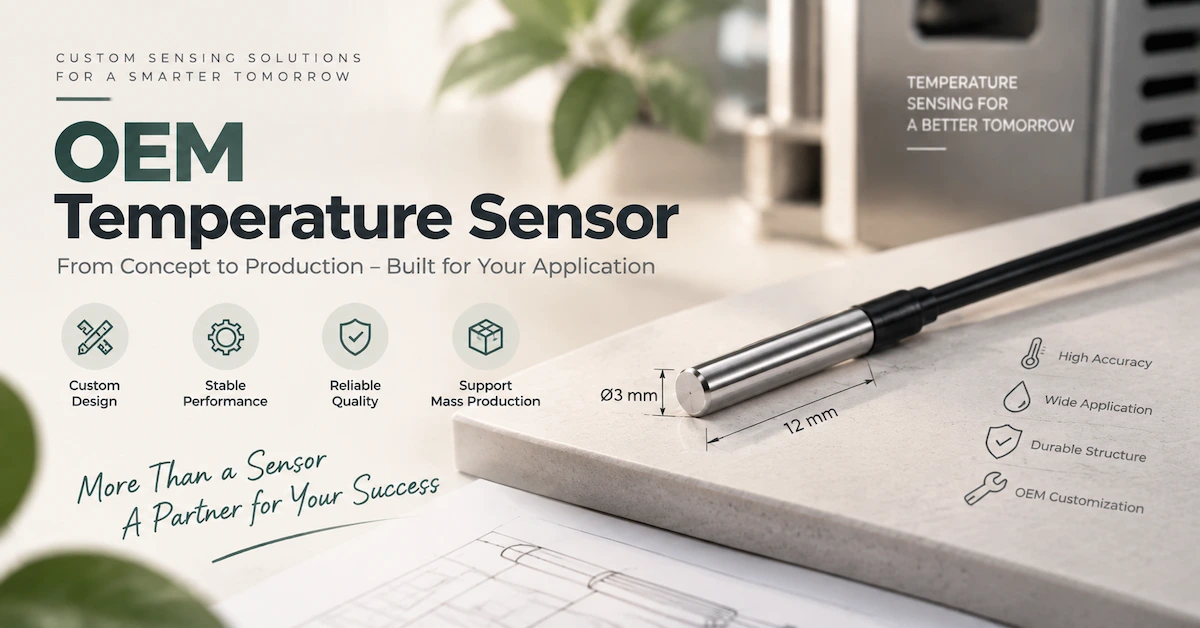
A Custom Temperature Sensor Manufacturer should do more than change the cable length or put an existing thermistor inside a different metal tube. For an OEM project, the supplier should help translate an application into a controlled specification: what temperature is being measured, which resistance-temperature characteristic the controller expects, where the sensing element will be installed, what the probe will be exposed to, and how the approved design will be reproduced in later orders. For Tianrui, many custom temperature-sensing projects begin with NTC thermistors and are developed into complete NTC temperature sensor assemblies using different housings, cables and connection structures. The practical buying question is therefore not “Can you make a custom sensor?” but “Can you define, sample, verify and reproduce the exact sensor my equipment needs?”
Which Buyers Actually Need a Custom Temperature Sensor?
Custom development makes sense when a standard sensor cannot satisfy the electrical curve, installation geometry, connector, cable, environmental exposure or assembly process of the finished equipment. Appliance manufacturers may need a probe that fits a refrigerator liner, coffee machine heater or water tank; HVAC companies may need surface, pipe or air-temperature sensing; industrial equipment builders may require a probe that works in a defined mounting position or cable-routing space. You can review Tianrui’s application directions for home appliances, automotive electronics, industrial equipment and electronics and electrical systems. Customization is less useful when an existing standard part already matches the controller, mechanical interface and operating conditions; redesigning a sensor simply to make it “unique” can create unnecessary tooling, qualification and inventory work.
Start with the Application, Not the Sensor Drawing
A common sourcing mistake is sending a manufacturer an old probe photograph and asking, “Can you make the same one?” Appearance is useful, but it does not define the sensing requirement. A stainless-steel tube can contain different thermistor characteristics; two identical black cables can have different conductor, insulation or temperature requirements; two similar connectors may have different terminal arrangements. Before discussing a drawing, describe the measurement task: air temperature, pipe surface, liquid, heater surface, evaporator, motor housing or another location. Then describe normal operating temperature, abnormal exposure, moisture, vibration, mounting pressure and the controller interface. Tianrui’s thermistor solution page is a useful starting point for understanding how the sensing element and application requirement are connected.
Define the Electrical Specification Before Requesting Samples
For an NTC-based custom sensor, R25 is only the starting point. Buyers should also define the required B value and its reference interval, resistance tolerance, relevant resistance-temperature data and the temperature range where the controller must make reliable decisions. A hypothetical example shows why this matters: an OEM engineer has an existing “10K” probe and requests another 10K sensor from a second supplier. Both samples read close to 10kΩ at 25°C, yet their readings diverge when the equipment reaches its normal operating range because the resistance-temperature curves are different. The replacement can therefore pass a room-temperature incoming check and still create a system-level temperature error. A qualified Custom Temperature Sensor Manufacturer should ask for the controller requirement, existing R-T table or reference sample rather than assuming that one nominal resistance makes two sensors interchangeable.
| Specification | What the buyer should define | Why it matters |
|---|---|---|
| Sensing technology | NTC or another required sensing principle | Determines the electrical behavior and interface |
| R25 | Nominal resistance at 25°C | Establishes the reference resistance |
| B value | Value plus defined temperature interval | Helps define the resistance-temperature relationship |
| Resistance tolerance | Required tolerance at stated conditions | Affects interchangeability and calibration |
| R-T requirement | Important resistance points across the working range | Confirms controller compatibility |
| Operating temperature | Normal and temporary exposure | Influences element, housing, cable and sealing choices |
| Response requirement | Response target and test method | Prevents comparison of unrelated test conditions |
| Measurement position | Air, surface, pipe, liquid or equipment component | Determines probe construction and installation method |
Choose the Probe Construction Around the Installation
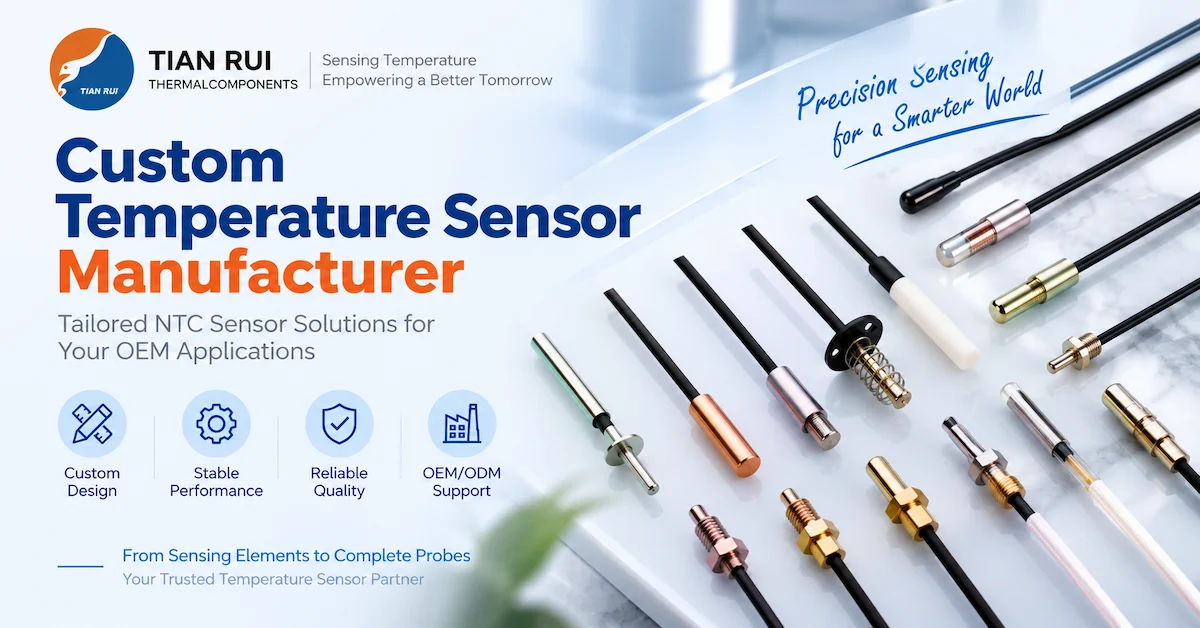
Once the electrical requirement is clear, the housing should be selected around mechanical fit and environmental exposure. Tianrui offers metal shell NTC temperature sensors as well as plastic shell NTC temperature sensors, but neither material is universally “better.” A metal probe may suit compact mechanical mounting or contact measurement; a plastic housing may be useful when the equipment geometry, insulation approach or installation method calls for it. The complete assembly matters more than the shell name. Sensor performance in an OEM product also depends on how the thermistor is positioned inside the probe, the thermal path between the measured object and sensing element, sealing around the cable exit, and the way the sensor is fixed during production.
Cable, Connector and Termination Are Part of the Sensor Design
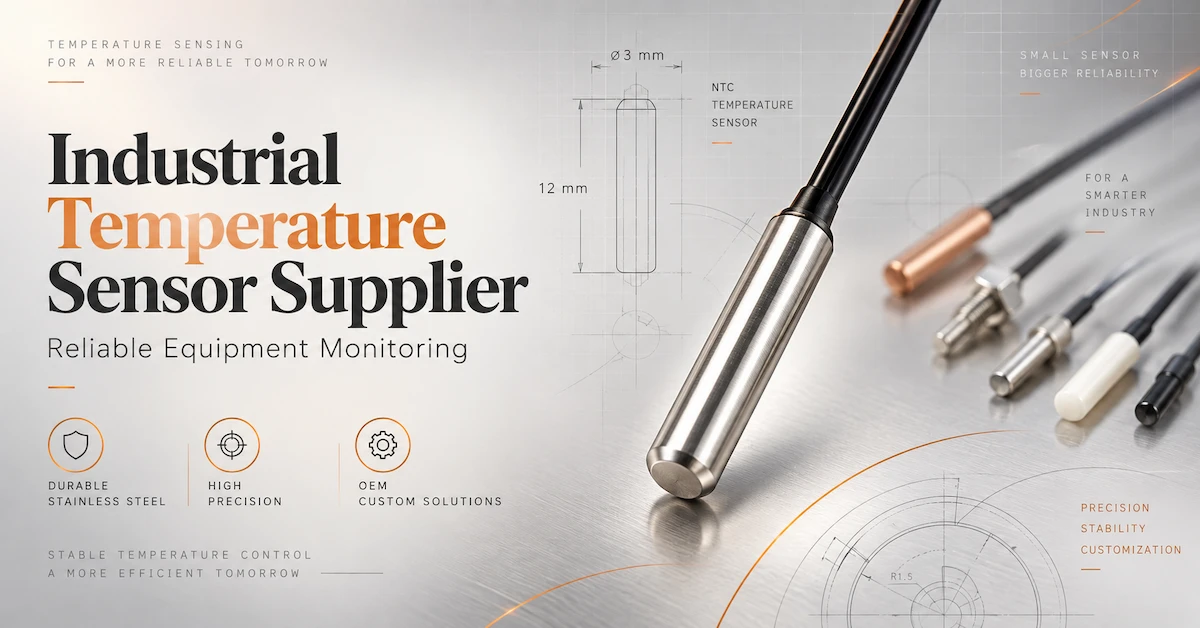
Cable requirements are often treated as purchasing details and discussed late in the project, yet they can determine whether the sensor can actually be installed. A custom RFQ should state the finished cable length, conductor requirement, insulation type if known, connector identity, pin arrangement, terminal style and any routing constraints. If the cable passes close to a heater, moving part, sharp edge or wet zone, tell the manufacturer at the beginning. A Custom Temperature Sensor Manufacturer should evaluate the complete assembly rather than treating the thermistor, cable and connector as unrelated items. Tianrui’s 3×12 mm stainless steel NTC probe, button type NTC temperature sensor and T type NTC temperature sensor show how different probe forms can serve different mechanical requirements.
Compare Sensor Structures by Function, Not Appearance
The table below is a selection framework rather than a claim that every structure suits every environment. Final suitability should be confirmed against the actual sensor specification and equipment conditions.
| Sensor structure | Main selection advantage | Typical design question | Best considered when |
|---|---|---|---|
| Cylindrical metal probe | Compact protective housing | What diameter and insertion depth fit the equipment? | Probe or pocket installation |
| Button/contact sensor | Broad contact surface | How will contact pressure and thermal transfer be controlled? | Surface temperature measurement |
| T-type compact sensor | Compact mounting geometry | Does the sensor fit the available cavity or fixture? | Small appliances and constrained spaces |
| Plastic-shell probe | Application-specific insulation and geometry | Is the housing shape compatible with the equipment? | Appliance and HVAC assemblies |
| Bare/encapsulated NTC element | Maximum freedom for customer-side integration | Who is responsible for housing, sealing and wiring? | Customers designing their own sensor assembly |
Materials Should Be Chosen as a System
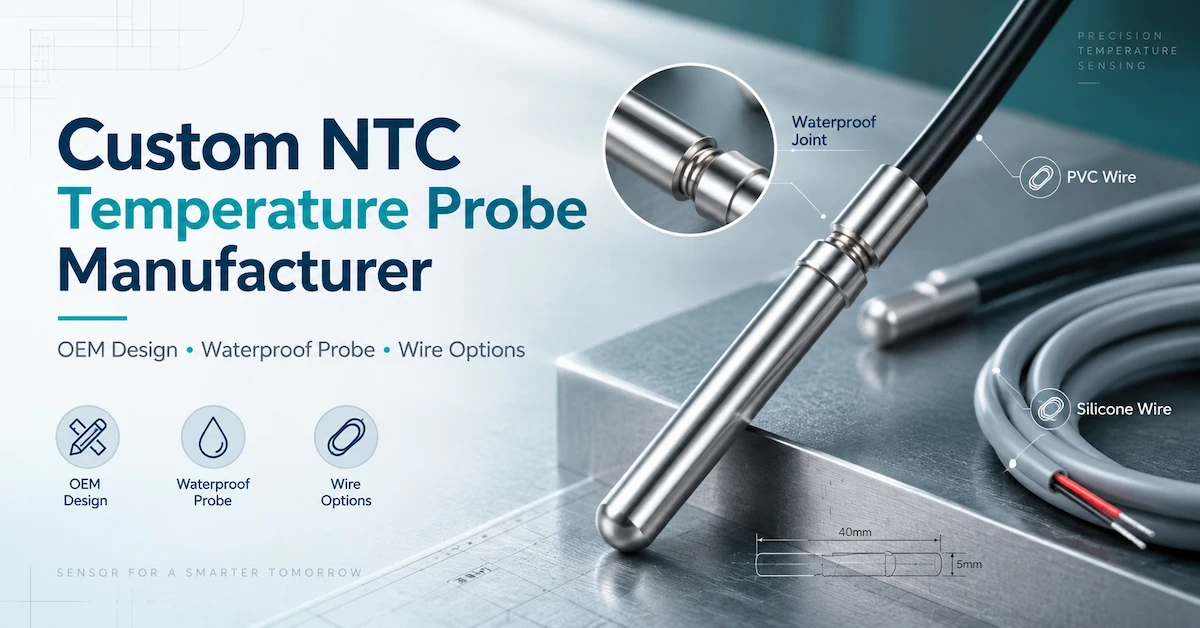
A custom temperature probe is a system made from several materials that experience the application together. The sensing element may tolerate a certain temperature, but the cable insulation, encapsulant, adhesive, terminal and connector may have different limits. The metal housing may resist one environment while the cable exit becomes the weak point. For this reason, avoid specifying a “high-temperature sensor” or “waterproof probe” only from the material name. Ask the manufacturer to confirm the complete configuration and the conditions under which it is evaluated. A stainless-steel housing does not by itself establish an ingress rating, chemical-resistance level or pressure capability, and an electrical thermistor specification does not automatically describe the mechanical durability of the finished probe.
How Should Manufacturing Workmanship Be Reviewed?
For OEM sourcing, workmanship should be translated into observable control points. Ask how the thermistor is connected to the lead wires, how the sensitive element is positioned inside the housing, how insulation is maintained, how filling or sealing materials are controlled, how cable exits are protected and how finished dimensions are checked. The exact process depends on the sensor construction, so a useful review does not begin with a list of fashionable process terms; it begins with the drawing and the possible failure modes of that design. If a supplier changes the thermistor source, cable, sealing material or connector after sample approval, that change may affect performance even when the outside dimensions remain identical. This is why sample revision control and production specifications are important parts of custom sensor manufacturing.
Quality Control Should Match the Failure Risk
A Custom Temperature Sensor Manufacturer should be able to discuss how the approved requirements will be checked, but buyers also need to distinguish development qualification from routine production inspection. Electrical resistance checks at defined temperatures may be relevant to every project; dimensional inspection, cable retention, insulation, response testing, moisture exposure or temperature cycling may be added according to the application. The important point is not to demand every possible test. It is to define which failures would matter in the actual equipment and agree on a sensible test method and acceptance limit. If certificates or test reports are required for a market or customer program, request the document title, covered product, applicable model or material, date and scope rather than assuming that a company-level certificate automatically applies to every customized probe.
Do Not Treat Sample Approval as a Single “Pass”
A useful sample program separates electrical verification, mechanical fit and installed-system performance. First check that the sensor matches the agreed electrical requirements. Then confirm dimensions, cable and connector fit. Finally, test the probe in the actual equipment or a representative fixture. Imagine a coffee-machine project where two sensors have the same resistance curve, but one probe sits slightly farther from the heating surface because its housing length is different. Electrically the samples may be equivalent; thermally they may respond differently in the finished product. Record the sample revision, drawing, electrical specification and test conditions together. That record becomes the reference for later production, reducing the risk of approving one configuration and ordering another.
Ask About Capacity and Lead Time for the Exact Custom Assembly
Overall factory output is not the same as capacity for one custom sensor design. A simple probe may use readily available materials, while another project may depend on a special connector, cable, stamped part or molded housing. When comparing suppliers, ask separately about engineering review, prototype preparation, customer validation and normal production. Clarify what event starts each lead-time calculation: receipt of the RFQ, drawing confirmation, sample approval, material arrival or purchase order. Do the same for quantity. Sample MOQ, pilot quantity and recurring production MOQ can be different. Tianrui’s About Us page provides company background, but commercial capacity and lead time for a new custom configuration should still be confirmed for that particular project.
What Determines the Cost of a Custom Temperature Sensor?
The sensor element is only one cost driver. Probe material, housing dimensions, cable type and length, connector, terminals, sealing process, custom tooling, testing, inspection requirements, packaging and order quantity can all influence the quotation. The cheapest sample price is therefore not always the cheapest production solution. A lower quote may exclude a connector, use a different cable, omit a validation requirement or assume a different annual quantity. Give every shortlisted manufacturer the same RFQ package and ask them to state exceptions clearly. That makes quotations comparable. It also exposes a major sourcing risk early: if suppliers are pricing different interpretations of the specification, selecting the lowest number does not mean you selected the lowest-cost design.
Common Risks When Choosing a Custom Temperature Sensor Manufacturer
The first risk is specifying only R25 and ignoring the rest of the electrical curve. The second is approving the probe by appearance without confirming the internal construction. The third is assuming housing material proves environmental protection. The fourth is requesting “the same as our old sensor” without an approved drawing or resistance-temperature data. The fifth is allowing cable, connector or encapsulation changes without revision control. Another common problem appears after sourcing changes: purchasing compares a new supplier’s unit price with an incumbent product, but the two quotations use different testing, packaging or connector requirements. A good sourcing process makes assumptions visible before samples are ordered, because correcting an unclear specification after tooling or production is usually slower and more expensive than resolving it during engineering review.
A Practical OEM/ODM Development Process
For a custom temperature sensor project, the workflow can be kept straightforward: define the application, confirm the electrical requirement, select the probe structure, issue a drawing, prepare samples, verify the samples in the intended equipment, freeze the approved revision and release production. If the design changes, issue a new revision rather than modifying an old drawing informally. Tianrui’s temperature-sensing portfolio can be reviewed through the NTC temperature sensor category, while project-specific requirements can be submitted through the contact page. When contacting the manufacturer, send the application, sensing position, operating temperature, R25, B value or R-T data, housing dimensions, cable and connector requirement, sample quantity and expected purchasing volume. If some values are unknown, mark them as open items instead of guessing.
What Should You Send Tianrui for a Custom Sensor Review?
A useful inquiry does not need to be a perfect engineering package, but it should contain enough information to start a technical discussion. Send an existing sensor sample, drawing or clear dimensions if you have them; describe the equipment and sensing position; provide the controller’s required resistance characteristic; state the temperature and environmental conditions; identify cable length and connector requirements; and explain what you need to verify during sampling. Buyers can first review Tianrui’s temperature sensor products and then contact Tianrui with the project information. This gives both sides a better starting point than a short request such as “10K sensor, please quote.”
Frequently Asked Questions
What can a Custom Temperature Sensor Manufacturer customize?
Customization may involve the sensing element specification, resistance characteristic, probe housing, dimensions, cable, connector, terminal arrangement and assembly structure. The exact combination must be evaluated for feasibility; “custom” should not be interpreted as an unlimited guarantee that every electrical and mechanical requirement can be combined.
Can I customize an existing NTC temperature sensor instead of developing a new one?
Yes, when the electrical characteristics and basic probe architecture already suit the project, modifying a cable, connector or housing dimension may be more practical than starting from zero. The changed assembly should still be documented and validated before production.
Is a 10K NTC sensor enough information for a quotation?
Usually not for an OEM approval. Provide the reference resistance, B value and interval or R-T data, tolerance, temperature range, probe dimensions, cable, connector, operating environment and estimated quantities where available.
Can two 10K temperature sensors replace each other directly?
Not automatically. They can share the same nominal resistance at 25°C while having different resistance-temperature characteristics, construction, tolerances or response behavior. Compare the full specification and verify the replacement in the equipment.
Should I choose a metal or plastic temperature sensor probe?
Choose according to installation, thermal transfer, mechanical requirements and environmental exposure. Metal and plastic housings serve different design needs; neither is inherently the right choice for every application.
Can a custom sensor use my specified connector and cable length?
Connector and cable customization can be discussed as part of the sensor assembly. Provide the connector identification, pin arrangement, cable length and any cable-routing or environmental requirements so feasibility can be reviewed.
How should custom sensor samples be tested?
Test the agreed electrical characteristics first, then mechanical fit, followed by performance in the intended equipment or a representative setup. Environmental and durability tests should be selected according to the risks of the specific application.
Does a stainless-steel probe mean the sensor is waterproof?
No. Housing material alone does not prove the sealing performance of the complete assembly. The sensor’s cable exit, joints, encapsulation and test conditions also matter. Request evidence for the exact configuration and exposure requirement.
How should buyers compare quotations from different sensor manufacturers?
Use the same drawing, electrical specification, cable, connector, testing requirement, packaging and quantity for every quotation. Ask suppliers to identify deviations or assumptions instead of comparing prices based on different configurations.
What information speeds up a custom temperature sensor quotation?
Provide the application, sensing position, resistance specification, operating temperature, probe dimensions, cable and connector requirements, environmental conditions, sample quantity and forecast purchasing volume. A reference sample or drawing can also help clarify the project.
Conclusion
Selecting a Custom Temperature Sensor Manufacturer is ultimately a specification-management decision, not a search for the most attractive probe photo or lowest unit price. OEM buyers should first define the sensing function and electrical curve, then confirm the housing, cable, connector, operating environment and validation method before approving samples. A controlled drawing and clear test plan make supplier comparison easier and reduce the risk of discovering incompatibility after production begins. If you are developing a custom NTC probe for an appliance, HVAC, automotive or industrial application, review Tianrui’s NTC temperature sensor portfolio and submit your project requirements for specification and sample discussion.