



Custom PTC solutions from prototype to mass production.

PTC EV Heater

‌
‌
‌
‌
‌

Product Details

Description
Privacy Policy
Reviews

Specification

Product Name: PTC Electric Vehicle Heater

Rated voltage: 350V

Power: 1500-2000W

Certification: ROHS

Application: Suitable for constant temperature heating of electric vehicle air conditioners and other similar equipment.

Model Rated Voltage Rated Power Max Surge Current Electrical Sterngth Dimension
MZ21-15A 350V DC 1500W±5% 8.5A 2500V/1min 255x100x20mm
MZ21-18A 350V DC 1800W±5% 10.3A 2500V/1min 255x100x20mm
MZ21-20A 350V DC 2000W±5% 11.5 A 2500V/1min 255x100x20mm

PTC heater - efficient heating, reducing battery life attenuation

describe

From a safety and reliability perspective, PTC heaters are generally safer than traditional heating wires, offering higher isolation and withstand voltage, smaller footprint, and more stable performance. In some applications, traditional heating wires cannot pass safety certification, while PTC heaters can. Therefore, PTCs can be used in applications requiring high safety standards. However, not all PTC heating element manufacturers and components meet safety requirements, making it crucial to select a high-quality PTC heating element supplier. The main safety and reliability issues with PTCs used for solid-state heating include: first, the PTC ceramic body can break down and burn, causing a short circuit and burning the insulation layer; second, insulation breakdown and leakage can cause the outer casing to become electrically charged.

feature

PTC heaters are used to heat solids at a constant temperature. Their applicable heating temperature range is 0 to 300°C, with an ambient heating temperature range of 50 to 300°C and an ambient temperature range of -40 to 250°C. PTCs with surface temperatures that are too high or too low are difficult to manufacture and may not even function properly.
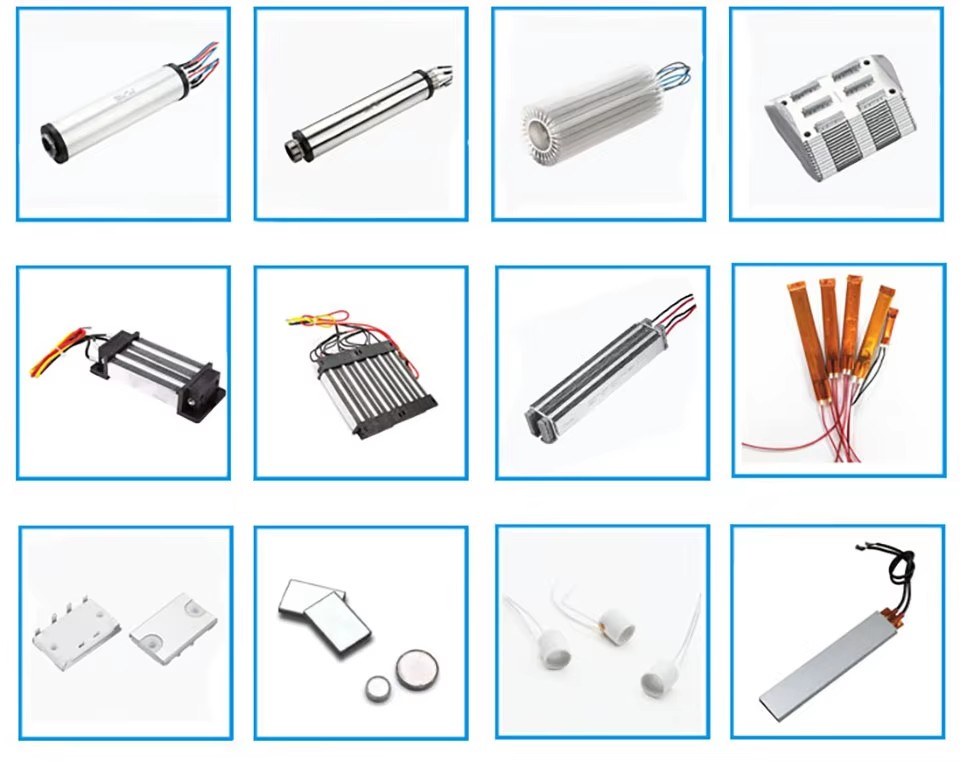
PTC EV Heater

People who viewed this also viewed

PTC Heater for Electric Vehicle

PTC (Positive Temperature Coefficient) heaters are a core component of the thermal management system for new energy electric vehicles, primarily responsible for cabin heating and battery pack thermal management.

Unlike traditional fuel-powered vehicles that utilize engine waste heat for heating, electric vehicles lack a stable source of engine waste heat and therefore require independent heating devices. PTC heaters, due to their superior safety, high heating efficiency, and compact size, have become the most widely used heating technology in electric vehicles. Essentially a semiconductor ceramic heating element, their core characteristic is that their resistance increases with increasing temperature, thereby achieving automatic temperature control and preventing overheating.

What to include in your inquiry

Clear requirements help our engineering team answer faster and recommend the right component the first time.

  • Product type and application, such as an NTC sensor for a battery pack or a PTC heater for an air-handling unit.
  • Key electrical values: resistance at 25 °C, B-value or switching temperature, rated voltage and power.
  • Operating temperature range, response time and any insulation, sealing or waterproof requirements.
  • Mechanical details including probe or housing size, lead length, cable, terminal and connector type.
  • Expected annual quantity, sample needs and target delivery schedule.
  • Drawings, photos or a current part number if you are replacing an existing component.

What happens after you contact us

  1. An engineer reviews your requirements and asks about any missing parameters.
  2. We recommend a standard model or propose a custom design together with a quotation.
  3. Samples are prepared for your testing and approval before volume production starts.