What Is a PTC Thermistor?
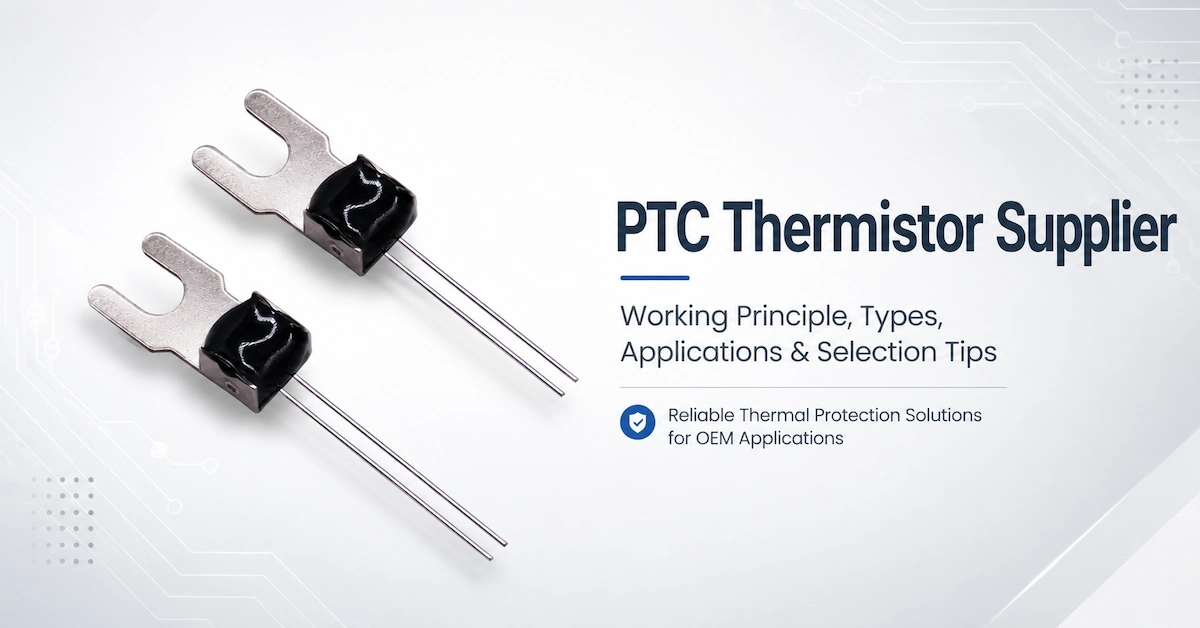
A PTC thermistor is a temperature-sensitive electronic component that uses positive temperature coefficient characteristics to change its resistance according to temperature variations.
Unlike conventional resistors, a PTC thermistor increases its resistance significantly when temperature rises near its designed transition point. This unique behavior allows it to provide automatic protection and temperature-control functions in many electronic and industrial applications.
For engineers and purchasing teams, selecting a reliable PTC Thermistor Supplier is not only about obtaining a component with a specific resistance value. A qualified supplier should also understand:
- ceramic material characteristics;
- resistance-temperature behavior;
- Curie temperature control;
- application requirements;
- production consistency;
- customization needs.
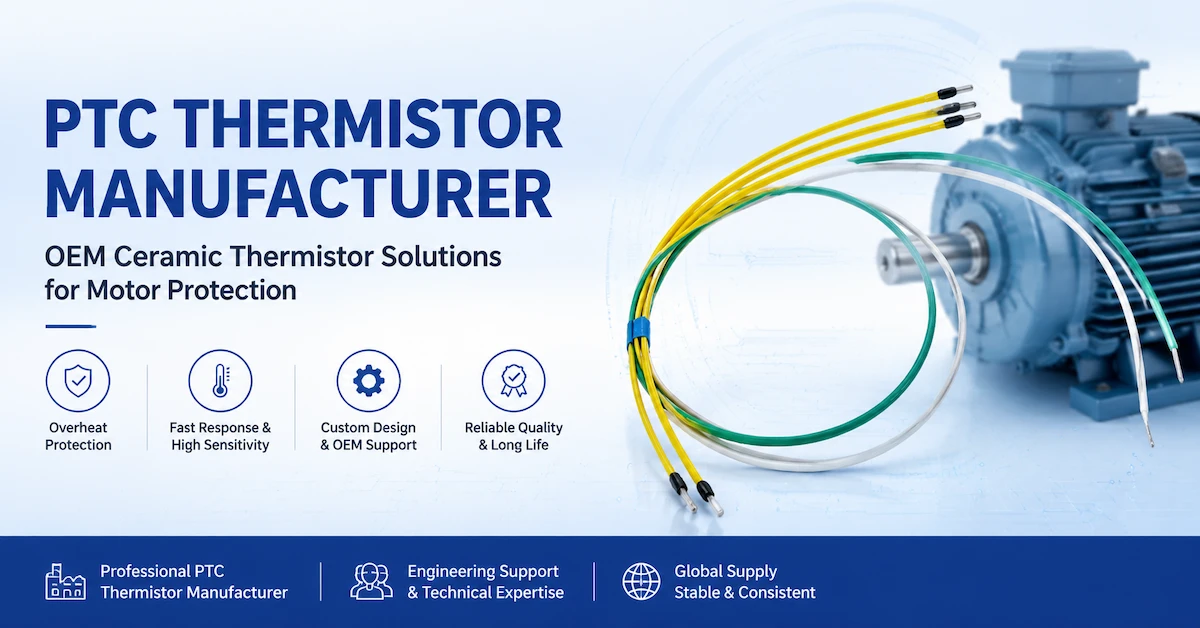
Tianrui provides PTC thermistor solutions for applications including motor protection, temperature protection, electronic circuits and customized OEM projects.
A suitable PTC thermistor supplier should help customers transform application requirements into a reliable component specification.
How Does a PTC Thermistor Work?
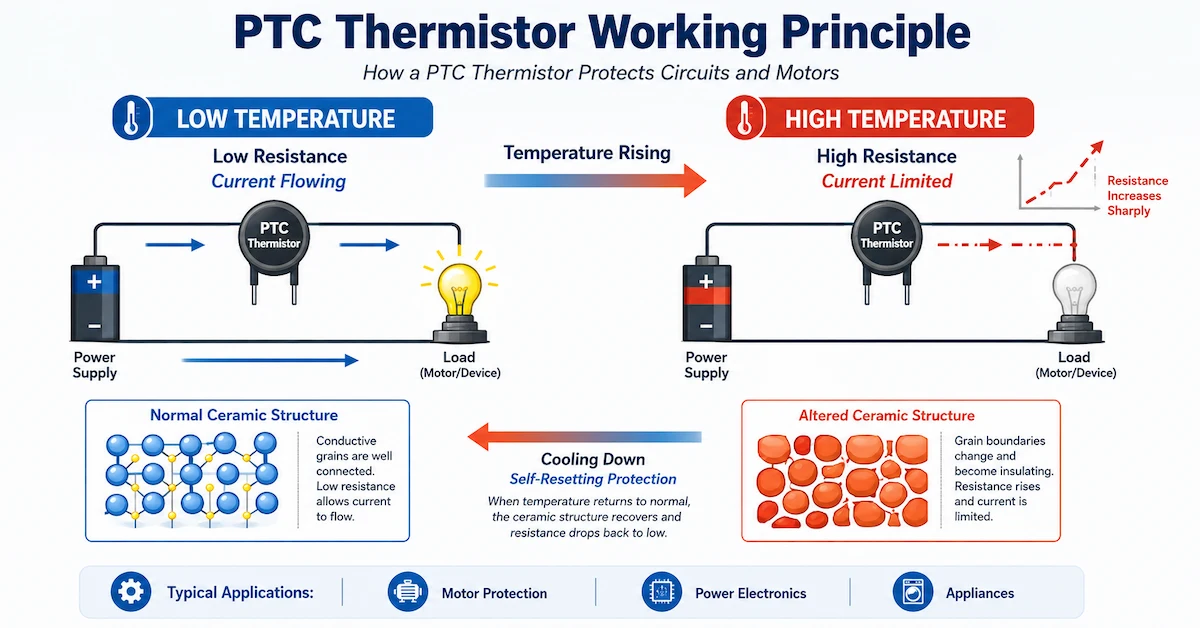
The working principle of a PTC thermistor is based on the positive temperature coefficient effect.
The resistance of the component changes according to temperature.
When operating under normal temperature conditions:
- resistance remains relatively low;
- current can pass normally;
- the protected circuit operates as designed.
When temperature increases:
- the ceramic material approaches its transition temperature;
- resistance increases rapidly;
- current flow is reduced;
- the component provides a protective effect.
This self-regulating characteristic makes PTC thermistors useful in applications where automatic protection against abnormal temperature or current conditions is required.
However, the final performance depends on many factors:
- ceramic formulation;
- material composition;
- electrode structure;
- component size;
- operating environment;
- heat dissipation conditions.
Therefore, when selecting a PTC Thermistor Supplier, buyers should evaluate the supplier's technical understanding rather than only comparing catalog specifications.
Understanding the Structure of a PTC Thermistor
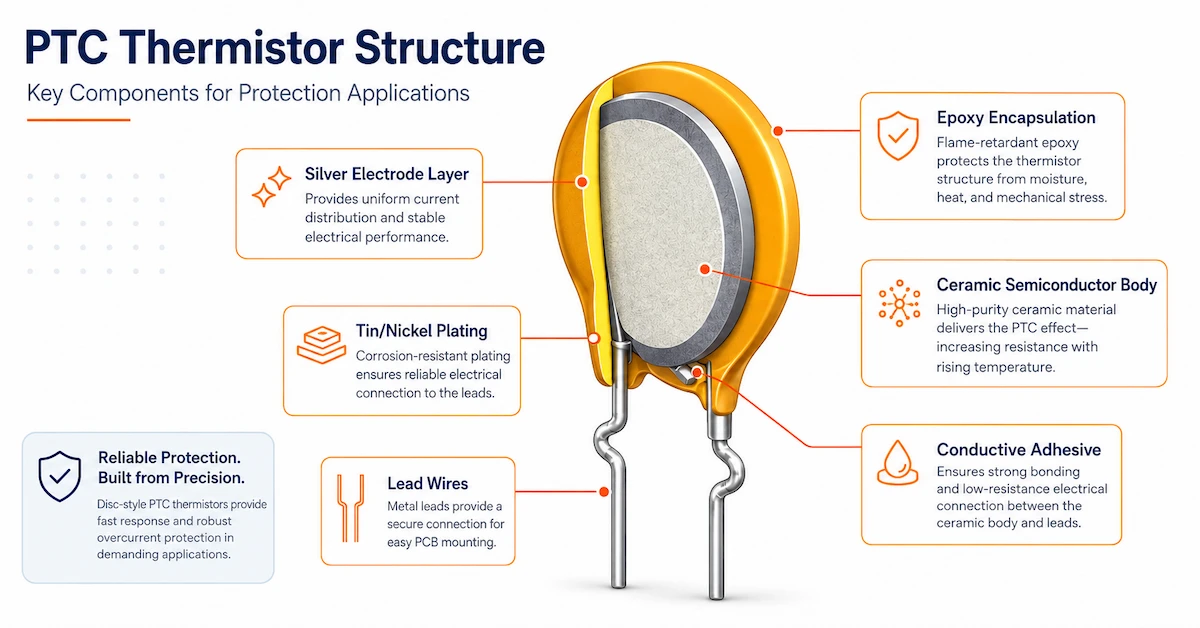
A typical PTC thermistor consists of several important elements:
PTC Ceramic Material
The ceramic element is the core functional part. Understanding PTC ceramic technology helps buyers evaluate material capability and product consistency.
Most PTC thermistors use barium titanate (BaTiO₃)-based ceramic materials because they provide suitable temperature-dependent resistance characteristics.
The ceramic formulation affects:
- resistance value;
- switching temperature;
- response behavior;
- stability.
Electrodes
Electrodes provide electrical connection between the ceramic element and the external circuit.
Their design influences:
- electrical conductivity;
- reliability;
- connection stability.
Terminals or Leads
Depending on the application, PTC thermistors may use:
- wire leads;
- terminal structures;
- customized connections.
The mechanical design should match the customer's assembly requirements.
Protective Packaging
Different applications may require different protection structures to improve:
- mechanical strength;
- environmental resistance;
- installation compatibility.
A professional supplier should be able to evaluate the complete component design rather than only supplying the ceramic element.
What Are the Main Types of PTC Thermistors?
Different applications require different PTC thermistor structures and characteristics.
A reliable supplier should provide suitable solutions according to the customer's protection requirements.
Motor Protection PTC Thermistor
Motor protection is one of the most common applications for PTC thermistors.
Motor temperatures may increase due to:
- overload;
- blocked rotation;
- excessive current;
- insufficient cooling;
- abnormal operating conditions.
PTC thermistors installed near motor windings can detect temperature increases and provide protection signals.
Typical applications include:
- industrial motors;
- pumps;
- compressors;
- fans;
- automation equipment.
Tianrui provides Motor Protection PTC Thermistor solutions designed for temperature protection applications.
Important selection factors include:
- switching temperature;
- sensor size;
- resistance characteristics;
- installation requirements;
- operating environment.
Temperature Protection PTC Thermistor
Temperature protection PTC thermistors are used where equipment needs reliable overheating detection.
Applications include:
- electronic devices;
- appliances;
- power systems;
- industrial equipment.
The supplier should help customers select:
- suitable resistance characteristics;
- temperature response;
- component size;
- installation method.
Tianrui's PTC Thermistor products cover different temperature protection and electronic protection requirements.
Composite PTC Thermistor
Composite PTC thermistors are designed for applications requiring specific protection characteristics.
They can be used for:
- overcurrent protection;
- circuit protection;
- electronic protection systems.
Compared with simple temperature sensing components, composite structures may provide different electrical response characteristics depending on the application.
Ceramic PTC Thermistor
Ceramic PTC thermistors are based on semiconductor ceramic materials.
Their performance depends heavily on:
- ceramic formulation;
- sintering process;
- material consistency;
- electrical characteristics.
For OEM buyers, working with a supplier that understands ceramic processing can improve product consistency and long-term reliability.
What Are the Main Applications of PTC Thermistors?
A reliable PTC Thermistor Supplier should understand not only component specifications but also the customer's final application.
Different industries have different requirements for temperature response, reliability and installation.
Motor Protection Applications
Motors often operate under changing loads.
PTC thermistors help detect abnormal temperature increases caused by:
- overload;
- mechanical failure;
- excessive current.
Industries include:
- industrial automation;
- HVAC equipment;
- pumps;
- compressors;
- machinery.
Automotive and New Energy Applications
Modern vehicles require reliable thermal protection components.
PTC thermistors may be used in:
- electric motors;
- battery systems;
- charging equipment;
- automotive electronic modules.
Important requirements include:
- vibration resistance;
- temperature cycling capability;
- compact size;
- long-term stability.
Power Electronics Applications
Electronic systems need protection against abnormal operating conditions.
Applications include:
- adapters;
- transformers;
- power supplies;
- control boards.
PTC thermistors can provide protection by increasing resistance when temperature rises.
Household Appliance Applications
Many appliances use temperature protection components.
Examples include:
- refrigerators;
- air conditioners;
- washing machines;
- dryers;
- kitchen appliances.
For appliance manufacturers, consistency between production batches is especially important because components are often used in large quantities.
Industrial Equipment Applications
Industrial equipment requires reliable operation under continuous working conditions.
PTC thermistors are used in:
- control cabinets;
- automation systems;
- industrial motors;
- electrical equipment.
The supplier should understand the operating environment and recommend suitable component specifications.
What Does a PTC Thermistor Symbol Represent?
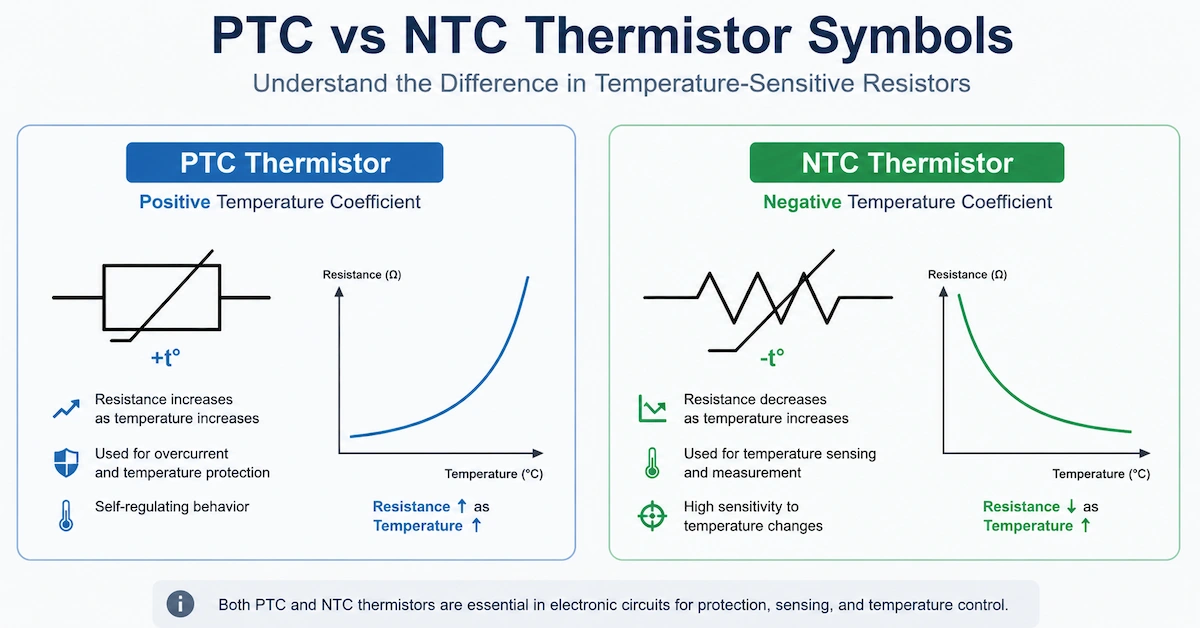
In circuit diagrams, the PTC thermistor symbol is used to identify a temperature-dependent resistor with a positive temperature coefficient characteristic.
The symbol helps engineers understand that the component:
- changes resistance according to temperature;
- can be used for thermal protection;
- provides temperature-related circuit control.
For engineers selecting components, understanding the symbol is only the first step.
The actual component selection should also consider:
- resistance value;
- switching temperature;
- voltage requirements;
- current characteristics;
- operating environment;
- mechanical dimensions.
A professional PTC Thermistor Supplier should provide complete technical specifications rather than only a product name or symbol.
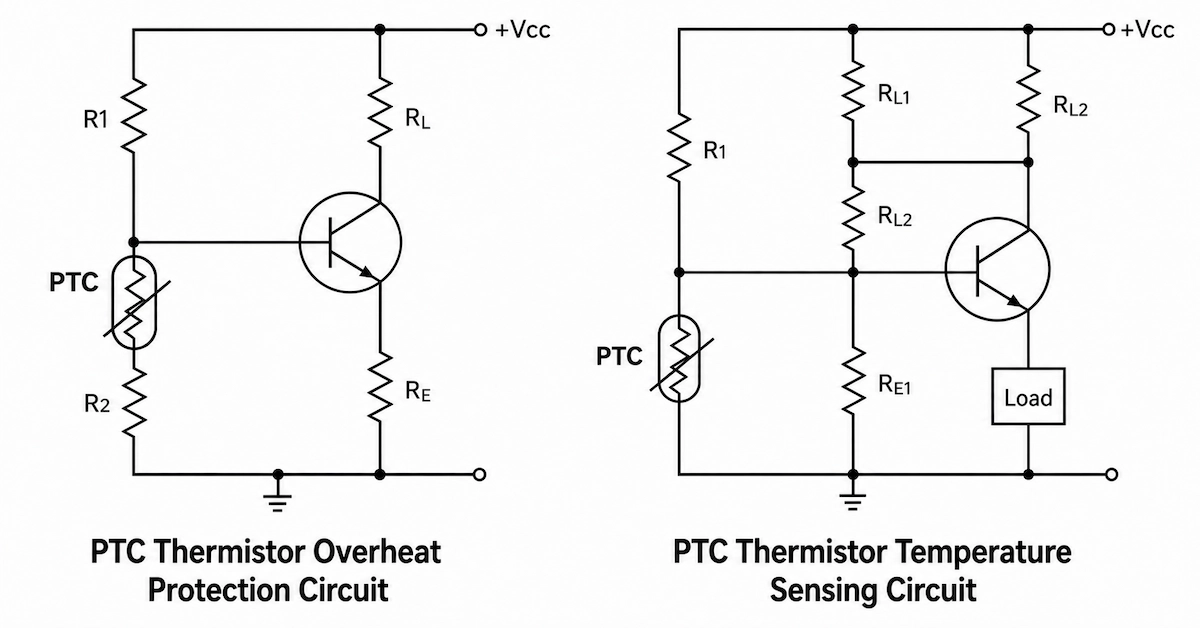
What Technical Parameters Should You Check Before Purchasing?
Selecting the correct PTC thermistor requires understanding the key electrical and thermal parameters.
Resistance Value
Resistance at a defined temperature is one of the most important specifications.
It affects:
- circuit compatibility;
- protection response;
- electrical performance.
Buyers should confirm:
- resistance value;
- tolerance;
- measurement conditions.
Curie Temperature
Curie temperature is the temperature range where the PTC effect becomes significant and resistance starts increasing rapidly.
It influences:
- switching behavior;
- protection temperature;
- application suitability.
However, Curie temperature should not be considered the same as the final operating temperature of the entire system.
Actual performance depends on:
- heat dissipation;
- installation conditions;
- surrounding materials;
- operating environment.
Resistance-Temperature Characteristics
The resistance-temperature curve shows how resistance changes as temperature increases.
This information helps engineers evaluate:
- response behavior;
- protection performance;
- operating stability.
Maximum Voltage
The maximum operating voltage determines whether the component can safely operate in the intended circuit.
Applications with higher voltage requirements need careful evaluation of:
- electrical stress;
- insulation;
- component structure.
Operating Current
Current characteristics are important for protection applications.
Engineers should evaluate:
- normal operating current;
- overload conditions;
- protection response.
Dimensions and Packaging
Physical size affects:
- PCB integration;
- installation space;
- assembly process.
A customized supplier may support:
- different sizes;
- wire configurations;
- terminal designs;
- packaging requirements.
How Do You Choose the Right PTC Thermistor Supplier?
Choosing a PTC Thermistor Supplier requires evaluating more than product availability.
A reliable supplier should demonstrate technical capability, manufacturing consistency and application support.
Evaluate Material and Manufacturing Capability
PTC thermistors depend heavily on ceramic material performance.
A capable supplier should understand:
- ceramic formulation;
- BaTiO₃-based materials;
- sintering processes;
- electrode technology;
- resistance consistency.
Material control directly affects:
- switching temperature;
- resistance stability;
- product reliability.
Check Customization Capability
OEM customers often require more than standard components.
Customization may include:
- resistance value;
- switching temperature;
- component size;
- lead wire length;
- terminal type;
- packaging structure.
A supplier with engineering support can help optimize the component according to the final application.
Tianrui supports custom PTC thermistor development based on customer requirements, drawings and application conditions.
Evaluate Testing Capability
Before mass production, suppliers should validate component performance.
Typical testing includes:
| Test Item | Purpose |
|---|---|
| Resistance testing | Confirm electrical consistency |
| Temperature response testing | Verify switching behavior |
| Voltage testing | Check electrical suitability |
| Current testing | Evaluate protection performance |
| Dimension inspection | Confirm mechanical compatibility |
| Reliability testing | Verify long-term stability |
A good supplier should be able to explain:
- what is tested;
- how it is tested;
- what acceptance criteria are used.
Compare Manufacturer Capability, Not Only Price
When comparing different suppliers, buyers should evaluate:
| Evaluation Factor | Why It Matters |
|---|---|
| Technical support | Helps solve application problems |
| Material knowledge | Improves product consistency |
| Customization | Supports OEM requirements |
| Testing capability | Reduces qualification risk |
| Production control | Ensures repeatability |
| Communication efficiency | Speeds development |
The lowest quotation does not always provide the lowest total project cost.
A supplier with stronger technical support may reduce:
- repeated sampling;
- design changes;
- production problems;
- qualification delays.
What Is the PTC Thermistor Manufacturing Process?
A professional manufacturer controls the complete production process.
Material Preparation
The process begins with ceramic material preparation.
Important factors include:
- raw material selection;
- formulation control;
- mixing consistency.
Material variation can influence final electrical characteristics.
Ceramic Forming
The ceramic material is formed into the required component structure.
The forming process affects:
- dimensions;
- density;
- mechanical strength.
High-Temperature Sintering
Sintering creates the ceramic structure required for PTC characteristics.
Process control affects:
- resistance behavior;
- temperature response;
- stability.
Electrode Processing
Electrodes provide electrical connection.
Quality factors include:
- adhesion;
- conductivity;
- durability.
Assembly and Inspection
After ceramic processing, components are assembled and tested.
Inspection may include:
- resistance measurement;
- appearance inspection;
- dimensional verification;
- electrical performance testing.
How Does Quality Control Affect PTC Thermistor Reliability?
Quality control is essential because small variations can influence electrical performance.
A reliable PTC Thermistor Manufacturer should control quality throughout the production cycle.
Incoming Material Control
Raw materials should be inspected before production.
Potential checks include:
- ceramic material characteristics;
- electrode materials;
- accessory materials.
Process Control
During manufacturing, suppliers should monitor:
- forming accuracy;
- sintering conditions;
- electrode processing;
- assembly consistency.
Finished Product Testing
Final inspection may include:
- resistance;
- switching temperature;
- electrical characteristics;
- dimensions;
- reliability performance.
For OEM customers, quality control should connect:
approved specification → production process → inspection result → delivery consistency.
How Can OEM Buyers Develop Custom PTC Thermistors?
A structured development process reduces communication problems.
Step 1: Requirement Analysis
The supplier reviews:
- application;
- electrical conditions;
- temperature requirements;
- installation limitations.
Step 2: Technical Proposal
The supplier evaluates:
- suitable PTC characteristics;
- component structure;
- material direction.
Step 3: Prototype Development
Samples are produced according to:
- drawings;
- specifications;
- testing requirements.
Step 4: Customer Validation
The customer verifies:
- electrical performance;
- temperature response;
- installation compatibility;
- reliability.
Step 5: Mass Production
After approval, production follows the confirmed specifications.
This process helps maintain consistency between prototypes and production batches.
Why Choose Tianrui as Your PTC Thermistor Supplier?
Dongguan Tianrui Electronics Co., Ltd. focuses on PTC and NTC temperature-sensitive components and provides solutions for electronic protection and temperature-control applications.
Tianrui's company manufacturing capability includes:
- Founded in 2010;
- approximately 5,000㎡ production facility;
- automated production equipment;
- dedicated testing equipment;
- large-scale PTC component production capability.
The company provides:
- PTC thermistors;
- temperature protection components;
- PTC heating elements;
- customized thermal solutions.
For OEM customers, Tianrui supports projects from requirement communication and product selection through customization, inspection and technical support.
Buyers can review Tianrui's PTC Thermistor solutions and submit application requirements through the contact page.
What Information Should You Provide When Requesting a PTC Thermistor Quote?
A complete RFQ helps suppliers provide more accurate recommendations.
Recommended information includes:
| Information | Details |
|---|---|
| Application | Motor, appliance, electronics, industrial equipment |
| Resistance requirement | Target resistance value |
| Switching temperature | Required protection temperature |
| Voltage | Operating voltage |
| Current | Normal and maximum current |
| Size | Installation limitation |
| Wiring | Lead and terminal requirements |
| Environment | Temperature, humidity, vibration |
| Quantity | Sample and production volume |
| Testing | Required validation |
If some parameters are unknown, provide the final application requirements.
An experienced supplier should help determine suitable specifications.
FAQ About PTC Thermistor Suppliers
What is a PTC Thermistor Supplier?
A PTC thermistor supplier provides temperature-sensitive ceramic components used for protection and temperature-control applications. A reliable supplier should support product selection, customization, testing and stable production.
How does a PTC thermistor work?
A PTC thermistor increases resistance as temperature rises near its transition point. This characteristic allows it to limit current or provide overheating protection.
What is the difference between PTC and NTC thermistors?
PTC thermistors increase resistance as temperature rises, while NTC thermistors decrease resistance. They are used for different sensing and protection requirements.
What applications use PTC thermistors?
PTC thermistors are used in motor protection, battery systems, power electronics, appliances, industrial equipment and temperature-control applications.
Can a PTC thermistor supplier customize products?
Yes. Customization may include resistance value, switching temperature, dimensions, wires, terminals and packaging according to application requirements.
How do I select the right PTC thermistor?
Consider resistance, switching temperature, voltage, current, dimensions, operating environment and application requirements.
Why is ceramic material important for PTC thermistors?
Ceramic formulation affects resistance characteristics, temperature response and long-term stability. Material control is important for consistent performance.
How does a supplier test PTC thermistors?
Testing may include resistance measurement, temperature response testing, electrical testing, dimensional inspection and reliability evaluation.
Should I choose a manufacturer or distributor?
For standard products, distributors may be suitable. For OEM projects requiring customization and technical support, direct cooperation with a manufacturer often provides better control.
What information should I provide for a quotation?
Provide application details, electrical requirements, temperature conditions, dimensions, quantity and any required testing standards.
Conclusion
Choosing the right PTC Thermistor Supplier requires evaluating technology, manufacturing capability, quality control and long-term cooperation potential.
A reliable supplier should provide:
- stable ceramic material control;
- consistent electrical performance;
- customization capability;
- professional testing;
- production reliability;
- technical support.
For OEM projects, the ideal supplier is not simply the one offering the lowest price. It is the supplier that can understand application requirements, provide suitable component solutions and maintain consistent quality during mass production.
Tianrui provides PTC thermistor solutions for customers requiring temperature protection and electronic protection components. Buyers can contact Tianrui with application details, drawings or technical requirements to discuss suitable solutions.