What Is a PTC Thermistor for Motor Protection?
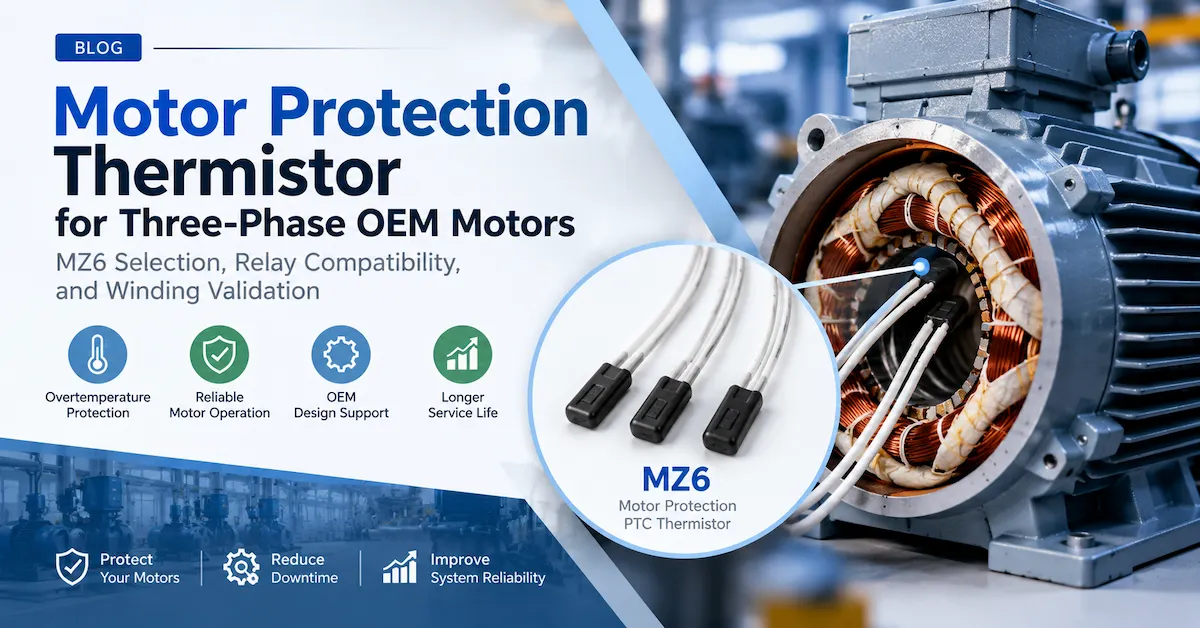
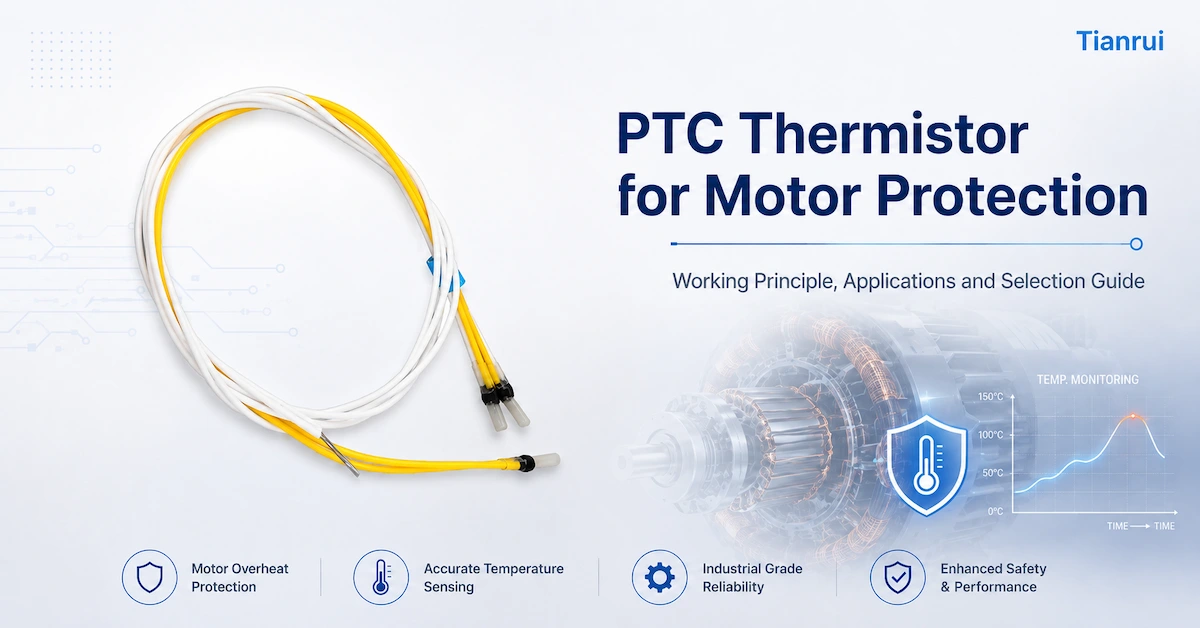
A PTC Thermistor for Motor Protection is a temperature-sensitive electronic component designed to monitor motor temperature and provide overheating protection.
PTC stands for Positive Temperature Coefficient. Unlike ordinary resistors, PTC thermistors increase their electrical resistance significantly when temperature rises to a specific threshold.
This unique characteristic allows the component to act as a temperature monitoring device inside motor windings or other heat-sensitive areas.
When a motor operates under normal conditions, the PTC thermistor maintains a relatively low resistance value. As the motor temperature increases due to overload, blocked rotation, excessive current or poor cooling conditions, the resistance of the PTC thermistor rises sharply.
The protection circuit detects this resistance change and activates protective actions, such as:
- stopping the motor;
- triggering an alarm;
- reducing operating load;
- preventing permanent damage.
Compared with traditional temperature protection methods, PTC thermistors provide a compact and reliable solution for modern motor protection systems.
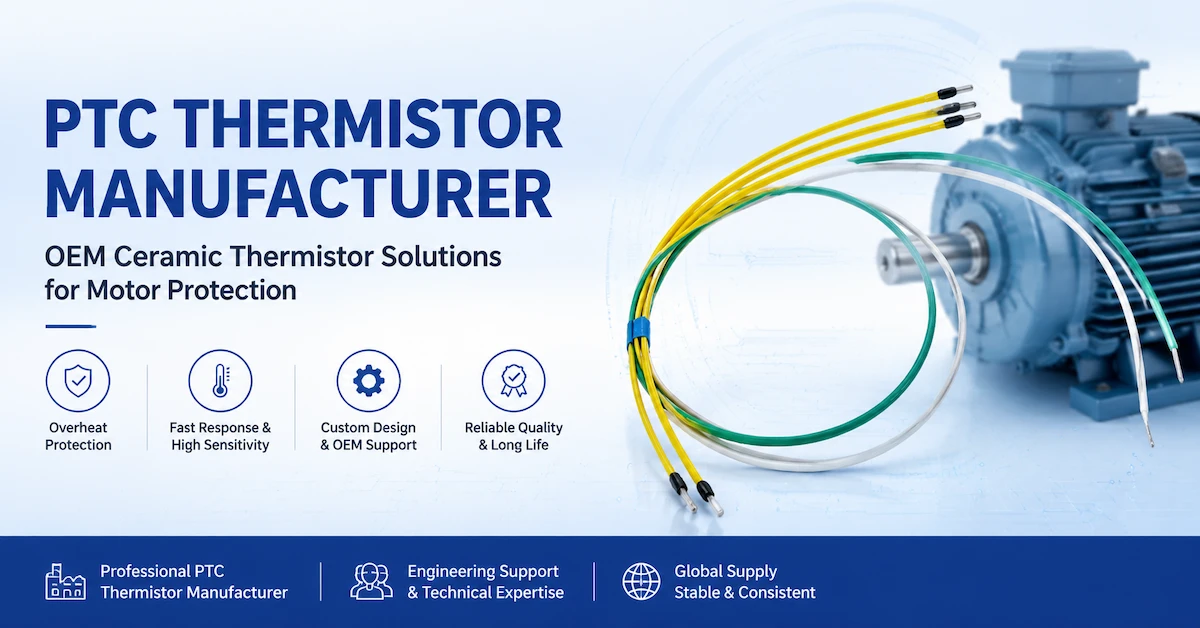
Tianrui provides customized motor protection PTC thermistor solutions for electric motors, industrial equipment and temperature monitoring applications.
How Does a PTC Thermistor Protect a Motor?
The working principle of a motor protection PTC thermistor is based on the relationship between temperature and electrical resistance.
The protection process includes several stages:
| Operating Condition | PTC Thermistor Behavior |
|---|---|
| Normal motor operation | Low resistance state |
| Temperature increase | Resistance gradually rises |
| Overheat condition | Resistance increases sharply |
| Protection triggered | Control system detects abnormal temperature |
During normal operation:
The motor winding temperature remains within the designed range. The PTC thermistor maintains a stable resistance value, allowing the motor to operate normally.
During overheating:
When the motor temperature reaches the PTC response temperature, the thermistor resistance increases rapidly.
The connected protection relay or controller detects the resistance change and activates protection.
The process can be summarized as:
Motor overload
↓
Temperature rises
↓
PTC resistance increases
↓
Control circuit detects signal
↓
Motor protection activates
This simple detection method makes PTC thermistors widely used in motors where reliability and compact design are required.
Why Are PTC Thermistors Used for Motor Protection?
Electric motors are often exposed to changing operating conditions.
Common causes of motor overheating include:
- overload operation;
- frequent starting;
- insufficient ventilation;
- mechanical blockage;
- abnormal voltage;
- excessive ambient temperature.
Without effective temperature protection, overheating may cause:
- insulation aging;
- winding damage;
- reduced efficiency;
- shorter service life;
- unexpected equipment downtime.
PTC thermistors help manufacturers improve motor reliability through direct temperature monitoring.
Fast Temperature Response
PTC thermistors are installed close to the heat source, often inside motor windings.
This allows them to detect temperature changes quickly.
Advantages include:
- early overheating detection;
- faster protection response;
- reduced damage risk.
Compact Installation
Motor space is often limited.
PTC thermistors feature:
- small size;
- flexible installation;
- lightweight structure;
- easy integration into winding systems.
They can be used in motors where larger temperature sensors are difficult to install.
Reliable Overheat Protection
Unlike protection methods based only on current measurement, PTC thermistors respond directly to temperature changes.
This helps detect conditions where:
- current may still appear normal;
- local hot spots occur;
- cooling performance decreases.
Long-Term Stability
For industrial equipment, temperature protection components need consistent performance over long operating periods.
High-quality PTC thermistors provide:
- stable resistance characteristics;
- repeatable response temperature;
- reliable thermal protection.
Cost-Effective Protection Solution
PTC thermistors offer a simple protection method without requiring complex sensor systems.
For many motor applications, they provide an effective balance between:
- protection performance;
- installation cost;
- system complexity.
What Applications Use PTC Thermistor for Motor Protection?
PTC thermistors are widely used wherever electric motors require reliable temperature monitoring.
Industrial Motors
Industrial motors often operate continuously under demanding conditions.
Applications include:
- pumps;
- fans;
- compressors;
- conveyors;
- production machinery.
Motor protection PTC thermistors help prevent failures caused by:
- overload;
- overheating;
- abnormal operating conditions.
Electric Motors
Modern electric systems require compact thermal protection components.
Applications include:
- electric vehicle motors;
- servo motors;
- automation motors;
- power equipment.
Temperature monitoring helps improve:
- system reliability;
- operational safety;
- equipment lifespan.
HVAC Equipment
HVAC systems rely on motors for:
- compressors;
- blowers;
- fans.
PTC thermistors can protect these motor components from overheating during continuous operation.
Household Appliances
Many appliances use compact electric motors.
Examples include:
- washing machines;
- refrigerators;
- air conditioners;
- ventilation equipment.
PTC temperature protection helps maintain safe operation.
PTC Thermistor vs Traditional Motor Protection Methods
Different protection technologies have different characteristics.
| Feature | PTC Thermistor | Thermal Switch | Temperature Sensor |
|---|---|---|---|
| Temperature response | Direct thermal response | Fixed switching point | Continuous measurement |
| Installation size | Compact | Compact | Depends on sensor type |
| Motor winding installation | Suitable | Limited | Depends on design |
| Protection signal | Resistance change | ON/OFF switching | Analog/digital output |
| System integration | Simple | Simple | Requires controller |
PTC thermistors are especially suitable for applications where direct winding temperature monitoring is required.
How to Select the Right PTC Thermistor for Motor Protection?
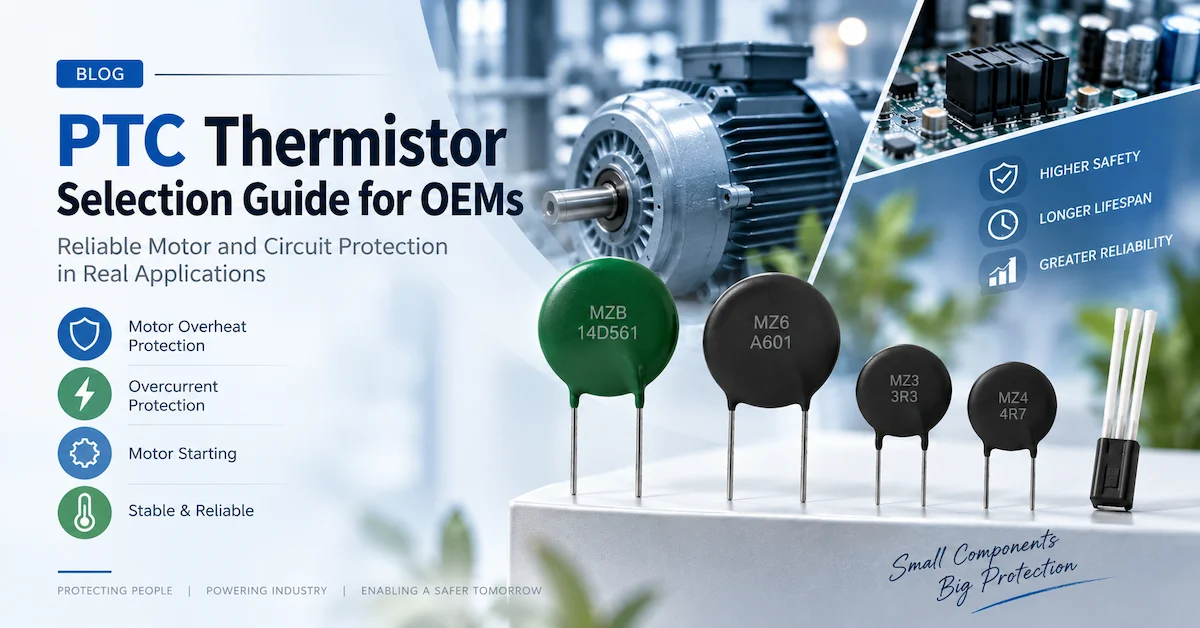
Selecting a suitable PTC thermistor requires understanding both the motor requirements and protection system design.
Important factors include:
Response Temperature
The response temperature determines when the protection system activates.
Selection depends on:
- motor insulation class;
- operating temperature;
- safety requirements.
Resistance Characteristics
Engineers should evaluate:
- normal resistance;
- response resistance;
- resistance change curve.
The protection circuit must be compatible with these characteristics.
Installation Method
Common considerations include:
- winding space;
- fixing method;
- wire routing;
- insulation requirements.
Operating Environment
Motor applications may involve:
- vibration;
- humidity;
- dust;
- temperature cycling.
The selected PTC thermistor should match the actual environment.
Electrical Compatibility
Important parameters include:
- rated voltage;
- measuring circuit design;
- relay/controller compatibility.
A suitable PTC thermistor should work reliably with the complete protection system.
What Technical Parameters Should You Check for a Motor Protection PTC Thermistor?
Selecting a PTC Thermistor for Motor Protection requires evaluating electrical, thermal and mechanical parameters together.
A suitable thermistor should match the motor design, protection circuit and operating environment.
Key parameters include:
| Parameter | Importance |
|---|---|
| Rated Response Temperature | Determines protection activation point |
| Resistance Value | Ensures compatibility with control circuit |
| Resistance Tolerance | Affects consistency between components |
| Number of Sensors | Determines monitoring accuracy |
| Size and Shape | Influences installation feasibility |
| Wire Length | Supports motor assembly requirements |
| Insulation Performance | Ensures electrical safety |
| Operating Temperature Range | Matches application conditions |
Rated Response Temperature
The response temperature is one of the most important specifications for motor protection.
It defines the temperature range where the PTC thermistor begins a significant resistance increase.
The correct selection depends on:
- motor insulation class;
- maximum allowable winding temperature;
- operating environment;
- protection requirements.
For example, a motor designed for continuous industrial operation may require a different response temperature compared with a small appliance motor.
Resistance Characteristics
PTC thermistors are selected according to their resistance behavior.
Important values include:
- resistance at normal temperature;
- resistance at switching temperature;
- resistance after temperature rise.
The protection circuit must correctly recognize the resistance change.
Poor matching between the thermistor and control system may cause:
- false alarms;
- delayed protection;
- incorrect motor shutdown.
Sensor Quantity and Installation Position
Different motor designs may require different numbers of PTC thermistors.
Factors include:
- motor size;
- winding structure;
- heat distribution;
- expected hot spots.
For larger motors, multiple sensors may be installed to improve temperature monitoring reliability.
Size and Mechanical Compatibility
Motor internal space is limited.
Engineers should consider:
- thermistor dimensions;
- wire routing;
- insulation distance;
- installation position.
A compact design allows easier integration into:
- motor windings;
- coils;
- compact assemblies.
How Does a PTC Thermistor Improve Motor Reliability?
Motor failures are often related to excessive temperature.
Even when electrical current remains within normal limits, motors may overheat because of:
- poor ventilation;
- mechanical overload;
- frequent starts;
- environmental temperature changes.
A PTC thermistor detects the actual temperature condition near the motor heat source.
This provides several benefits:
Prevents Insulation Damage
Motor winding insulation can degrade when exposed to excessive heat.
Continuous overheating may cause:
- insulation aging;
- reduced dielectric strength;
- winding failure.
PTC temperature protection helps identify abnormal temperature conditions before serious damage occurs.
Reduces Unexpected Downtime
Industrial equipment downtime can create significant production losses.
Motor protection systems using PTC thermistors help:
- detect abnormal conditions early;
- reduce unexpected failures;
- improve maintenance planning.
Supports Equipment Life Extension
Maintaining motors within a suitable temperature range helps improve:
- operating stability;
- component lifespan;
- maintenance intervals.
What Industries Use Motor Protection PTC Thermistors?
PTC thermistors are used across many industries where motor reliability is critical.
Industrial Automation
Applications include:
- servo motors;
- robotic systems;
- CNC equipment;
- production machinery.
Automation systems require reliable protection because unexpected motor failure may affect the entire production process.
HVAC Systems
HVAC equipment uses motors for:
- compressors;
- fans;
- pumps;
- blowers.
PTC thermistors help protect these components during continuous operation.
Pumps and Compressors
Pumps and compressors often operate under changing loads.
Potential risks include:
- blocked flow;
- excessive load;
- insufficient cooling.
Motor winding temperature monitoring helps improve reliability.
New Energy Equipment
Modern energy systems increasingly use electric motors.
Applications include:
- EV-related equipment;
- charging systems;
- energy storage equipment;
- industrial electrical systems.
How Is a Motor Protection PTC Thermistor Manufactured?
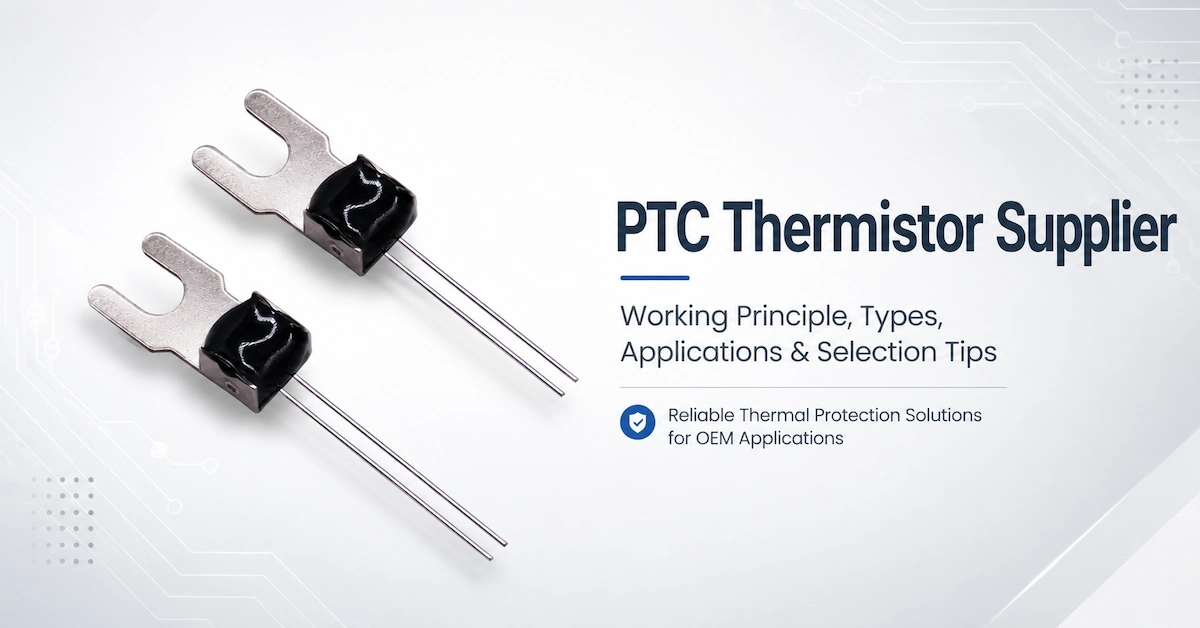
A reliable PTC Thermistor Supplier should control the complete manufacturing process.
Typical production steps include:
Ceramic Material Preparation
The process starts with controlled ceramic material preparation.
Material characteristics influence:
- resistance behavior;
- temperature response;
- long-term stability.
Ceramic Forming
The ceramic material is formed into the required shape.
Process control affects:
- dimensions;
- density;
- electrical characteristics.
Sintering Process
High-temperature sintering creates the final ceramic structure.
This step influences:
- PTC characteristics;
- mechanical strength;
- product consistency.
Electrode Processing
Electrodes provide electrical connection.
Quality factors include:
- conductivity;
- adhesion;
- durability.
Assembly and Testing
Final assembly includes:
- wire connection;
- insulation protection;
- electrical testing;
- appearance inspection.
How Does Quality Control Affect PTC Thermistor Performance?
For motor protection applications, consistency is critical.
A professional supplier should perform quality checks throughout production.
Typical testing includes:
| Test Item | Purpose |
|---|---|
| Resistance Testing | Verify electrical characteristics |
| Response Temperature Test | Confirm protection point |
| Thermal Cycling Test | Evaluate stability |
| Insulation Test | Ensure safety |
| Dimension Inspection | Confirm assembly compatibility |
| Reliability Test | Validate long-term performance |
Quality control helps ensure that each production batch performs consistently.
How Can OEM Customers Customize PTC Thermistors for Motor Protection?
Different motor manufacturers may require different thermal protection solutions.
Customization options may include:
- response temperature;
- resistance characteristics;
- sensor quantity;
- wire length;
- insulation material;
- packaging structure.
A typical OEM development process includes:
Step 1: Application Analysis
The supplier evaluates:
- motor type;
- operating conditions;
- temperature requirements;
- installation space.
Step 2: Product Recommendation
The supplier selects suitable:
- PTC characteristics;
- structure;
- electrical parameters.
Step 3: Sample Development
Prototype samples are produced for:
- electrical testing;
- motor integration;
- customer validation.
Step 4: Mass Production
After approval:
- specifications are confirmed;
- production standards are established;
- quality inspection continues.
Why Choose Tianrui as Your PTC Thermistor Supplier?
Tianrui Electronics focuses on PTC and NTC temperature-sensitive components, providing thermal protection solutions for industrial and electronic applications.
For motor protection projects, Tianrui supports customers with:
- PTC thermistor development;
- customized specifications;
- application evaluation;
- production support;
- technical consultation.
Tianrui's Motor Protection PTC Thermistor products are designed for applications requiring reliable motor temperature monitoring and overheating protection.
Customers can also learn more about Tianrui's company capability, including manufacturing experience and customized thermal component development.
What Information Should You Provide When Requesting a PTC Thermistor Quote?
To select the correct motor protection thermistor, customers should provide:
| Information | Details |
|---|---|
| Motor Type | AC motor, DC motor, servo motor, etc. |
| Application | Pump, compressor, fan, machine, vehicle |
| Response Temperature | Required protection temperature |
| Resistance Requirement | Electrical characteristics |
| Installation Space | Sensor size limitation |
| Wire Requirement | Length and insulation |
| Working Environment | Temperature, humidity, vibration |
| Quantity | Sample and production volume |
Providing detailed application information helps suppliers recommend a more suitable solution.
FAQ About PTC Thermistor for Motor Protection
What is a PTC thermistor used for in motor protection?
A PTC thermistor monitors motor temperature and provides overheating protection by changing resistance when temperature increases.
How does a PTC thermistor detect motor overheating?
When motor temperature reaches the designed response point, the PTC thermistor resistance increases sharply. The control system detects this change and activates protection.
Where is a motor protection PTC thermistor installed?
PTC thermistors are commonly installed inside motor windings or near heat-sensitive areas where they can detect temperature changes directly.
Can PTC thermistors protect against motor overload?
Yes. When overload conditions cause excessive temperature rise, PTC thermistors can detect overheating and trigger protection.
What motors use PTC thermistors?
Applications include industrial motors, compressors, pumps, fans, servo motors, HVAC motors and automation equipment.
What is the difference between PTC thermistor and thermal switch?
A PTC thermistor provides a resistance-based temperature signal, while a thermal switch typically provides a direct ON/OFF switching action.
Can PTC thermistors be customized?
Yes. Suppliers can customize response temperature, resistance characteristics, dimensions, wires and installation structures.
How do I choose a PTC Thermistor Supplier?
Evaluate material capability, customization support, testing methods, production consistency and technical experience.
Why is temperature protection important for motors?
Excessive heat can damage insulation, reduce efficiency and shorten motor lifespan. Temperature protection helps improve reliability.
Conclusion
A PTC Thermistor for Motor Protection provides a reliable and compact method for monitoring motor temperature and preventing overheating failures.
By using the positive temperature coefficient characteristics of ceramic materials, PTC thermistors can detect abnormal temperature increases and help protect motors in demanding applications.
For motor manufacturers and industrial equipment suppliers, selecting the right solution requires evaluating:
- response temperature;
- resistance characteristics;
- installation requirements;
- operating environment;
- supplier manufacturing capability.
Tianrui provides customized PTC thermistor solutions for motor protection applications, supporting customers from technical evaluation and sample development to stable production.
For motor protection requirements, customers can explore:
to discuss temperature protection requirements and customized solutions.