What Should You Expect From an NTC Thermistor Manufacturer?
An NTC Thermistor Manufacturer should do more than supply a component with a specified resistance value.
For OEM buyers, the important part is whether the manufacturer can keep the thermistor's electrical characteristics consistent while adapting the component to the actual application.
An NTC thermistor has a negative temperature coefficient, which means its resistance decreases as temperature increases. This characteristic makes NTC thermistors useful for temperature measurement, compensation, monitoring and control.
The difference between a suitable manufacturer and a simple reseller usually becomes clear when a project requires something specific:
- a particular R25 resistance;
- a defined B value;
- tight resistance tolerance;
- a controlled operating temperature range;
- a special package;
- customized leads;
- a particular mounting method;
- stable performance across repeated production batches.
For this reason, an OEM sourcing decision should look at material capability, process control, testing, engineering support and production consistency, not just the quotation.
Who Buys NTC Thermistors Directly From a Manufacturer?
Different buyers have different reasons for sourcing directly.
Electronics Manufacturers
Electronics companies may use NTC thermistors for temperature sensing, compensation or circuit protection.
Their priorities often include:
- stable resistance;
- compact dimensions;
- fast response;
- consistent batches;
- automated assembly compatibility.
Home Appliance Manufacturers
Refrigerators, air conditioners, washing machines, ovens and other appliances commonly need temperature-sensing components.
Here, the thermistor may be assembled into a complete temperature sensor with a wire, probe or connector.
HVAC Manufacturers
HVAC equipment can use NTC sensing elements to monitor air, coil or equipment temperature.
The required resistance curve and temperature range depend on the controller and sensing location.
Automotive and Energy Equipment Manufacturers
Automotive electronics, battery systems and energy equipment can impose tighter requirements on:
- operating temperature;
- vibration resistance;
- long-term stability;
- mechanical protection.
Distributors and Component Buyers
A distributor may prioritize:
- stable availability;
- standard models;
- packaging;
- MOQ;
- lead time;
- price consistency.
For standard products, a supplier may be enough. For customized or repeat OEM projects, direct manufacturer involvement becomes much more valuable.
When Should You Choose an NTC Thermistor Factory Instead of a Trading Supplier?
A standard thermistor can often be purchased through a distributor.
The situation changes when the component has to match a specific product design.
| Requirement | Distributor | Direct Manufacturer |
|---|---|---|
| Standard NTC thermistor | Suitable | Suitable |
| Custom resistance | Depends on sourcing | Better suited |
| Custom B value | May be limited | Better suited |
| Custom dimensions | Depends on supplier | Better suited |
| Custom lead configuration | Possible | More flexible |
| New product development | Limited | More practical |
| Sample modification | Depends on factory | Direct communication |
| Production consistency | Depends on source | Process-level control |
| Long-term OEM program | Less control | Better coordination |
The point is not that every buyer needs a factory.
If you are buying an established standard component, a distributor may be perfectly practical.
If you are developing a product and expect repeat orders, direct communication with an NTC Thermistor Factory can remove several layers between your engineering team and the production line.
How Does an NTC Thermistor Work?
The basic operating principle is straightforward.
As temperature rises, the resistance of an NTC thermistor decreases.
The controller measures the resistance and uses the known resistance-temperature relationship to estimate the temperature.
In simplified form:
Temperature ↑ → NTC Resistance ↓
The actual resistance curve is not linear. This is why two thermistors that are both described as “10K NTC” should not automatically be treated as interchangeable.
Their:
- B values;
- tolerance;
- resistance-temperature curves;
- temperature ranges;
- physical construction
may be different.
For an OEM design, the complete electrical specification matters more than the “10K” label alone.
Which NTC Thermistor Specifications Matter Most?
Before contacting an NTC Thermistor Supplier, define the parameters that directly affect your circuit.
| Parameter | What It Tells the Buyer |
|---|---|
| R25 | Nominal resistance at 25°C |
| B Value | Resistance-temperature relationship |
| Resistance Tolerance | Allowed resistance variation |
| B Value Tolerance | Allowed variation in the B characteristic |
| Operating Temperature | Usable temperature range |
| Rated Power | Permitted operating condition |
| Thermal Time Constant | Response speed |
| Dissipation Factor | Heat dissipation behavior |
| Size | Mechanical compatibility |
| Lead Configuration | Assembly compatibility |
| Encapsulation | Environmental and electrical protection |
R25 Resistance
R25 is the nominal resistance measured at 25°C.
Common values vary depending on the circuit and application.
The correct value should be determined by the control system rather than selected simply because it is commonly available.
B Value
The B value describes how the resistance changes with temperature over a defined range.
This is especially important when the thermistor operates across a relatively broad temperature range.
A mismatch in B value can cause the controller to interpret the actual temperature incorrectly.
Tolerance
A tighter tolerance can improve consistency, but it also tends to increase manufacturing requirements and potentially cost.
The right tolerance is the one required by the finished product.
There is little benefit in paying for a tighter tolerance than the application can use.
What NTC Thermistor Materials Are Used?
The sensing element is only one part of the finished component.
Depending on the design, an NTC thermistor can include:
- semiconductor ceramic material;
- electrodes;
- lead wires;
- glass;
- epoxy resin;
- plastic;
- metal housings;
- insulation materials.
Material selection affects more than appearance.
It can influence:
- operating temperature;
- environmental resistance;
- mechanical strength;
- electrical insulation;
- response characteristics;
- service life.
Ceramic NTC Material
Ceramic semiconductor materials provide the fundamental resistance-temperature characteristics.
Manufacturing consistency at this stage is important because variations in the material can affect the electrical behavior of the finished thermistor.
Epoxy Encapsulation
Epoxy can protect the sensing element and electrical connections.
Tianrui's MF52 NTC thermistor, for example, uses epoxy resin encapsulation and is designed as a compact temperature-measurement component. Its published specifications include B values from 3380K to 4150K, resistance values from 1.5kΩ to 220kΩ and an operating range of -55°C to +125°C.
Glass Encapsulation
Glass encapsulation is useful when the application places greater demands on sealing and temperature resistance.
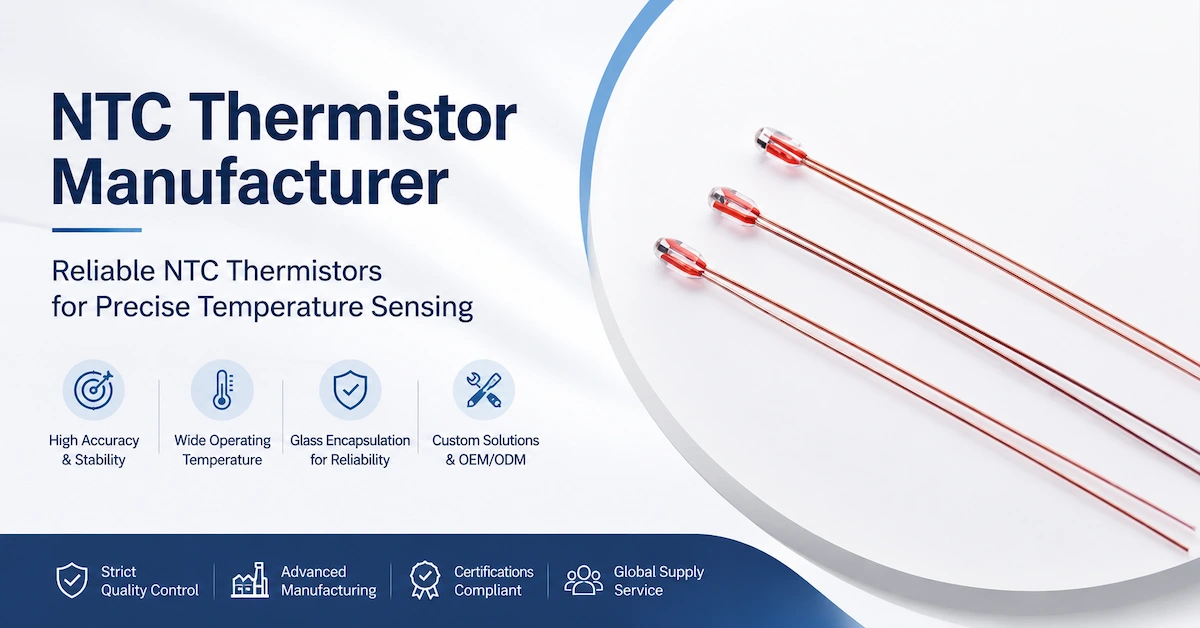
Tianrui's glass-encapsulated NTC range includes high-temperature versions and published configurations using a 3950K B value with different resistance and tolerance options.
Metal Housing
A metal shell can protect an assembled NTC temperature sensor against mechanical and environmental conditions.
Stainless-steel probe configurations are used for applications involving appliances, HVAC, automotive systems and industrial equipment.
What Manufacturing Process Should an NTC Thermistor Manufacturer Control?
A reliable production process should control the component from material preparation through final testing.
A simplified flow is:
Material preparation → Ceramic processing → Electrode formation → Electrical testing → Encapsulation → Lead assembly → Final testing → Inspection
The exact sequence depends on the thermistor type.
Material Processing
The raw material formulation and processing conditions influence the resistance-temperature characteristics.
This is one reason manufacturing experience matters when sourcing an NTC thermistor.
Electrode and Lead Assembly
Electrical connections need to remain stable during production and use.
Poor connection quality can result in resistance instability or intermittent performance.
Encapsulation
The encapsulation process protects the sensing element.
The appropriate material depends on the operating environment.
Final Assembly
For an assembled sensor, the manufacturer may also need to control:
- probe dimensions;
- cable length;
- connector;
- terminal;
- sealing;
- mounting structure.
A bare thermistor and a finished temperature sensor are therefore different procurement products, even though they use the same sensing principle.
How Does Quality Control Affect NTC Thermistor Consistency?
This is one of the most important questions for OEM buyers.
A sample can meet the specification while a large production batch performs differently if process control is weak.
Quality control should therefore cover both electrical characteristics and physical construction.
Resistance Testing
The manufacturer should verify resistance according to the agreed test temperature and method.
B Value Testing
B-value consistency helps ensure that the resistance-temperature curve remains within specification.
Temperature Response
Where required, the finished component should be evaluated across the intended temperature range.
Dimensional Inspection
For custom parts, inspect:
- diameter;
- length;
- lead spacing;
- lead length;
- housing dimensions.
Electrical Safety Testing
Depending on the finished design, relevant testing can include:
- insulation;
- withstand voltage;
- electrical continuity.
Reliability Testing
Application-specific validation may include:
- thermal cycling;
- humidity;
- vibration;
- long-term operation.
Tianrui's current website describes a production approach covering automated manufacturing, precision testing, process quality control and final inspection/reliability verification.
What Is the Difference Between an NTC Thermistor and an NTC Temperature Sensor?
These terms are related but should not always be treated as the same product.
An NTC thermistor is the sensing element.
An NTC temperature sensor may contain that thermistor together with:
- wires;
- probe housing;
- epoxy;
- connector;
- terminals;
- mounting hardware.
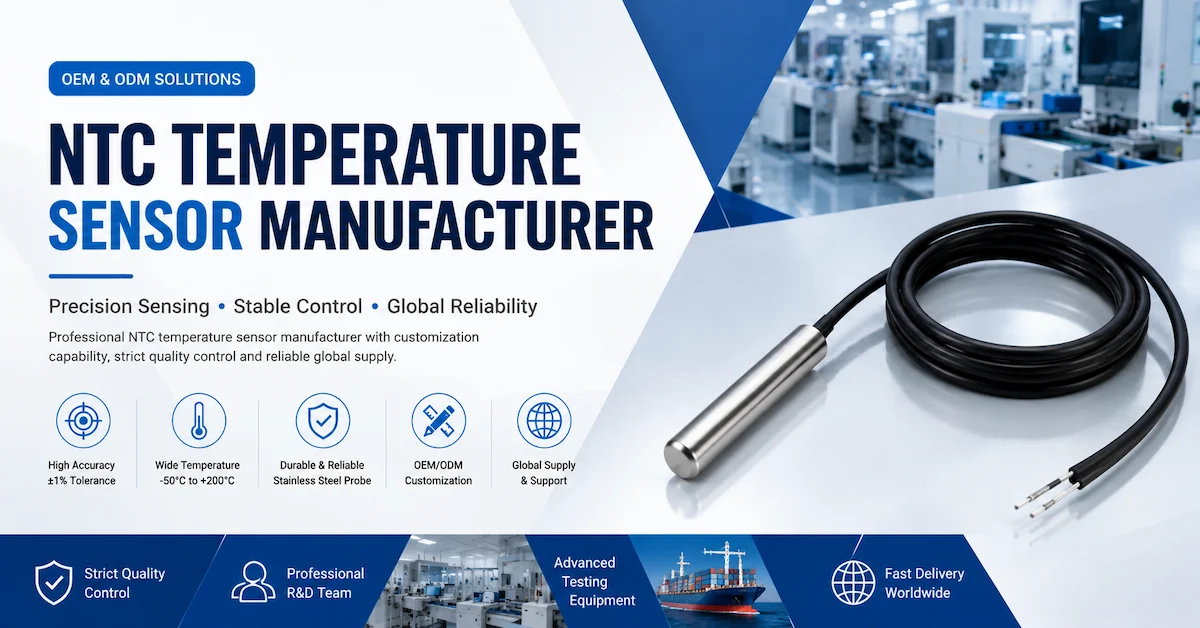
For example, Tianrui's stainless-steel NTC temperature sensor combines an NTC thermistor with a stainless-steel probe and cable assembly. A published 3×12 mm configuration uses a 10KΩ, 3435 NTC characteristic with ±1% tolerance and UL1332 28AWG wire.
This distinction is important when requesting an RFQ.
If your production line needs a complete sensor assembly, asking for only an “NTC thermistor” may produce an incomplete quotation.
How Do You Select a Custom NTC Thermistor?
For a Custom NTC Thermistor, start with the application instead of starting with a catalog model.
1. Define the Temperature Range
State the minimum and maximum temperatures the component will actually experience.
2. Define the Electrical Curve
Provide:
- R25;
- B value;
- tolerance;
- required resistance-temperature curve.
3. Define the Physical Space
Give the manufacturer:
- maximum diameter;
- maximum length;
- lead spacing;
- mounting limitations.
4. Define the Environment
Mention whether the sensor will encounter:
- moisture;
- condensation;
- vibration;
- chemicals;
- pressure;
- repeated thermal cycling.
5. Define the Connection
Specify:
- wire type;
- wire length;
- insulation;
- connector;
- terminal.
This information allows the manufacturer to propose a configuration based on the finished application instead of simply recommending the closest catalog item.
What Can an NTC Thermistor OEM Manufacturer Customize?
OEM customization can happen at several levels.
| Customization Area | Typical Options |
|---|---|
| Resistance | Different R25 values |
| B Value | Application-specific curve |
| Tolerance | Standard or tighter tolerance |
| Temperature Range | Application-specific |
| Package | Bead, disc, glass,epoxy |
| Probe | Metal, plastic or custom structure |
| Wire | Length, gauge, insulation |
| Connector | Customer-specified type |
| Terminal | Ring, fork, custom terminal |
| Mounting | Threaded, clip, embedded |
| Encapsulation | Epoxy,glass or other protection |
| Packaging | Bulk or customer packaging |
A capable NTC Thermistor OEM partner should also be able to discuss whether the requested combination is technically practical.
That matters because not every combination of resistance, B value, size and temperature range can be achieved with the same construction.
What Should You Ask an NTC Thermistor Supplier Before Ordering?
Do not limit the RFQ to:
“Please send your best price for 10K NTC.”
That leaves too much room for different interpretations.
A better RFQ includes:
- Application
- R25 resistance
- B value
- Resistance tolerance
- B-value tolerance
- Operating temperature
- Probe or package size
- Wire specification
- Connector or terminal
- Expected quantity
- Annual demand
- Required testing
- Drawing or reference sample
If you have an existing sensor, send the sample or drawing whenever possible.
This can reduce back-and-forth communication during sample development.
How Should You Compare NTC Thermistor Manufacturer China Options?
For buyers sourcing from China, unit price is only one part of the comparison.
Consider the following:
| Evaluation Point | What to Check |
|---|---|
| Product Range | Can the factory produce the required type? |
| Engineering | Can they understand your electrical and mechanical requirements? |
| Materials | Are materials and encapsulation options clear? |
| Testing | What is checked during production? |
| Customization | Can dimensions and connections be modified? |
| Samples | Can they provide samples before bulk production? |
| Capacity | Can they support repeat orders? |
| Lead Time | Are sample and production schedules realistic? |
| Communication | Can engineering questions be resolved quickly? |
| Quality Records | Is production consistency measurable? |
| Packaging | Can the supplier follow your packing requirements? |
| After-Sales | Is there a clear process for handling quality issues? |
A China-based manufacturer is worth considering when its technical and production capabilities fit the project—not simply because its quotation is lower.
What Affects NTC Thermistor Cost?
There is no single “standard price” for an NTC thermistor.
Cost can change with:
- resistance value;
- B value;
- tolerance;
- material;
- package;
- size;
- lead configuration;
- encapsulation;
- testing;
- connector;
- custom tooling;
- order quantity.
For example, a simple bead thermistor and a finished stainless-steel temperature probe may both use an NTC sensing element, but they are not equivalent products from a manufacturing-cost perspective.
For OEM buyers, the better calculation is:
Component price + assembly + testing + logistics + quality risk
A slightly higher unit price can make commercial sense if it reduces rework, field failures or inconsistent batches.
What Production Capacity Should an NTC Thermistor Manufacturer Have?
Capacity should be evaluated against your actual purchasing plan.
Ask two separate questions:
Can the supplier make the sample?
and
Can the supplier maintain the same specification during mass production?
A manufacturer may be able to produce several hundred samples but struggle with a large recurring order.
For a long-term OEM project, ask about:
- production equipment;
- current capacity;
- production scheduling;
- raw-material availability;
- testing capacity;
- normal lead time;
- peak-season planning.
Tianrui states that it operates a 5,000 m² production facility in Dongguan and provides NTC/PTC sensor support from prototype development through volume production.
How Does an OEM NTC Thermistor Project Move From Sample to Mass Production?
A practical process is:
Requirement Review
The buyer provides the electrical, mechanical and application requirements.
Engineering Evaluation
The manufacturer determines whether the requested combination is technically feasible.
Sample Development
Samples are produced for evaluation.
Application Testing
The customer installs the sample in the actual equipment.
Specification Approval
The approved resistance, B value, dimensions, materials and connection become the production specification.
Pilot Production
A controlled batch verifies production consistency.
Mass Production
The approved configuration moves into regular production.
This sequence is especially useful when the thermistor is part of a new appliance, HVAC system, automotive component or industrial device.
Why Choose Tianrui as Your NTC Thermistor Manufacturer?
Tianrui focuses on PTC and NTC thermistors, temperature sensors and related thermal products.
Its current product portfolio includes several NTC structures, including glass-encapsulated thermistors, bead-type thermistors, disc-type thermistors and assembled NTC temperature sensors.
For OEM customers, the company presents its capability around more than standard catalog supply. Its current website describes customization of resistance, B value and temperature range, together with cable, connector and housing engineering and OEM/ODM support from prototype to volume production.
That approach is useful when your requirement is not simply:
“I need an NTC.”
but rather:
“I need this resistance curve, in this package, at this temperature range, with this cable, connector and mounting method, and I need the same specification delivered repeatedly.”
For buyers comparing manufacturers, this is the level at which engineering communication and process control become part of the product.
What Information Should You Send for an NTC Thermistor RFQ?
For a faster and more useful quotation, send:
| RFQ Information | Example |
|---|---|
| Application | HVAC, appliance, automotive,industrial |
| R25 | 10KΩ |
| B Value | 3950K |
| Tolerance | ±1% |
| Temperature Range | Application-specific |
| Package | Bead, glass, epoxy, disc |
| Dimensions | Drawing or defined dimensions |
| Wire | Length, gauge,insulation |
| Connector | Part number or drawing |
| Quantity | Sample + annual demand |
| Testing | Required inspection/testing |
| Drawing | Recommended |
| Existing Sample | Highly useful for replacement |
If some specifications are unknown, provide the application, existing component and controller requirements. A manufacturer can then determine which parameters need to be confirmed before sampling.
FAQ About NTC Thermistor Manufacturer
What is an NTC Thermistor Manufacturer?
An NTC Thermistor Manufacturer develops and produces negative temperature coefficient thermistors and, depending on its capabilities, complete NTC temperature sensor assemblies.
What is the difference between an NTC Thermistor Supplier and Manufacturer?
A supplier may source products from a factory, while a manufacturer directly controls production. For customized OEM projects, direct manufacturer communication can simplify engineering, sampling and production control.
What does an NTC Thermistor Factory produce?
Depending on its equipment and process capabilities, a factory may produce bead, disc, glass-encapsulated and other NTC thermistors, as well as assembled temperature sensors.
What is the most important NTC thermistor specification?
R25 and B value are two of the most important electrical specifications, but tolerance, temperature range and physical construction also need to match the application.
Can I order a Custom NTC Thermistor?
Yes.Customization may include resistance, B value, tolerance, package, dimensions, wires, connectors, terminals and mounting structures, depending on technical feasibility.
Can an NTC thermistor be used in a refrigerator?
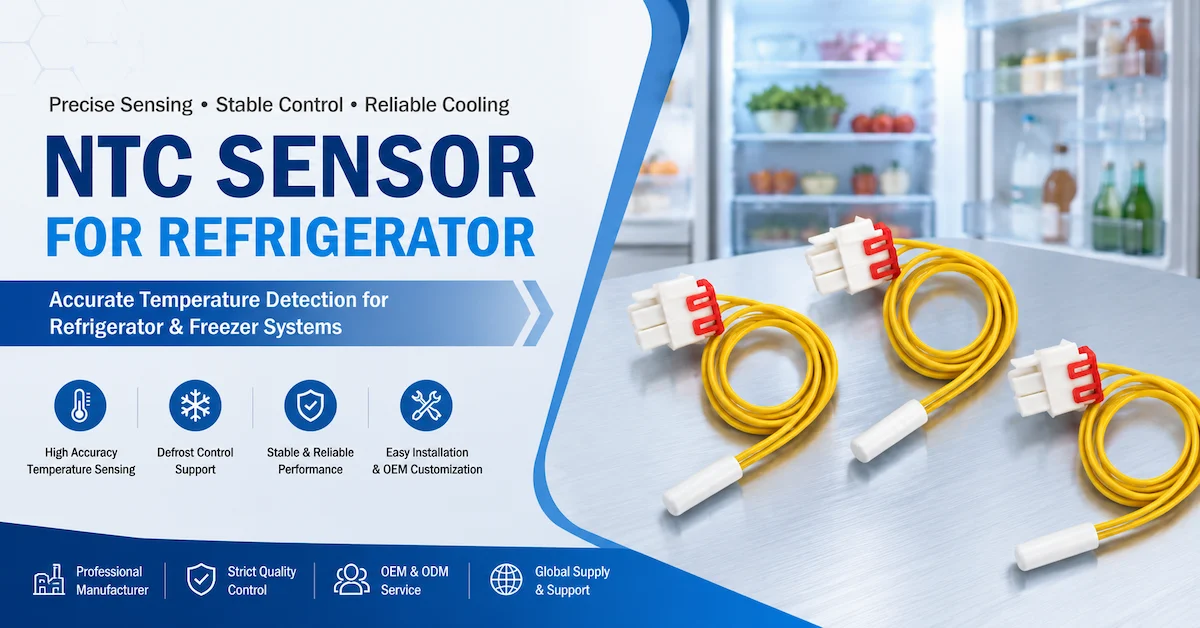
Yes. NTC thermistors and assembled NTC temperature sensors are widely used for refrigerator and freezer temperature monitoring and related control functions. Tianrui currently lists refrigerator-specific NTC temperature sensor products.
Can NTC thermistors be used in HVAC equipment?
Yes. NTC sensors can be used for temperature measurement and control in HVAC and refrigeration equipment. The required resistance curve and mechanical configuration should be matched to the HVAC controller and sensing location.
How do I choose an NTC Thermistor Manufacturer China?
Compare electrical capability, materials, testing, customization, engineering communication, sample support, production capacity and long-term consistency instead of comparing unit price alone.
What should I provide for an NTC Thermistor OEM project?
Provide R25, B value, tolerance, temperature range, dimensions, package, wire, connector, application, quantity and drawings or reference samples whenever available.
How can I reduce risk when ordering NTC thermistors?
Approve samples in the actual application before mass production, define the complete specification, confirm the testing method and make sure the manufacturer can reproduce the approved configuration consistently.
Conclusion
Selecting an NTC Thermistor Manufacturer is ultimately a product-development and supply-chain decision.
The right partner should be able to connect the dots between:
Material → Resistance → B Value → Package → Application → Testing → Mass Production
For standard components, a distributor may be sufficient.
For a customized OEM project, however, the manufacturer's ability to control materials, electrical characteristics, assembly and testing becomes much more important.
Before requesting a quotation, define the electrical requirements first. Then confirm the physical structure, operating environment, cable or terminal configuration and expected production volume.
Tianrui's current NTC portfolio covers multiple thermistor and temperature-sensor structures, while its stated manufacturing capability includes automated production, precision testing, process quality control and support from prototype development to volume production.
For a custom project, you can start with your R25, B value, temperature range, drawing or existing sample. This gives the manufacturer enough information to determine whether an existing configuration is suitable or whether a custom NTC thermistor should be developed.
Recommended next step: review the available NTC Thermistor products and submit your requirements for an OEM quotation.