How to Choose an NTC Temperature Sensor Supplier for Repeat OEM Orders
Choose an NTC Temperature Sensor Supplier by checking three things together: whether the sensor matches your controller’s resistance–temperature curve, whether the complete probe suits its installed environment, and whether the approved construction can be reproduced in later orders. A quote for “10K, waterproof, one-meter cable” leaves important decisions unresolved. Before approving a supplier, request a defined electrical specification, an assembly drawing and a sample-validation plan. Tianrui’s NTC temperature sensor range includes assembled probes for different applications; the purchasing task is to identify the right configuration, not simply the closest-looking product.

Which Buyers Need Application-Specific Supplier Support?
This approach is intended for appliance manufacturers, HVAC equipment builders and sourcing teams placing repeat production orders. Engineering needs a sensor that works with the controller; purchasing needs a comparable quotation; quality teams need an agreed acceptance method. Put those requirements into one specification rather than three separate email conversations. For a small order of an already approved standard part, a stocking distributor may be a practical choice. For a new housing, connector or sensing position, evaluate access to engineering and assembly support. An NTC Temperature Sensor Supplier should also clarify whether the offer covers a bare thermistor, a wired element or a finished probe. These are different purchasing items, as explained in Tianrui’s NTC thermistor sourcing guide.
Why a 10K Label Is Not Enough for Supplier Approval
Match the Resistance–Temperature Curve, Not One Resistance Reading
An NTC thermistor’s resistance decreases as temperature increases. R25 identifies its nominal resistance at 25°C, while the B value describes its resistance–temperature characteristic over a defined interval. Two sensors can therefore both be labeled 10K without being interchangeable. Consider a hypothetical incoming inspection: two samples meet the resistance requirement at 25°C, but their curves differ elsewhere. Both pass that single-point check, yet the controller may interpret only one correctly across the operating range. Request the resistance–temperature table, relevant tolerances and the temperature points used to define B. Tianrui’s NTC sensor selection guide explains why the electrical curve and controller must be considered together.
Keep Resistance Tolerance Separate from Temperature Accuracy
A resistance tolerance is not a temperature-error specification. For example, 10,000Ω at 25°C with ±1% resistance tolerance gives a resistance interval of 9,900–10,100Ω at that reference temperature. It does not mean ±1°C accuracy. Temperature error depends on the sensor’s curve and the measurement system. The circuit also matters: reference-resistor tolerance, conversion settings and sensor self-heating deserve attention during evaluation. Rather than asking only for a “high-accuracy sensor,” state the allowed temperature error at the application’s important measurement points. The NTC circuit-design guide discusses these system-level sources of reading error.
Specifications to Include in Your NTC Sensor RFQ
Give each shortlisted NTC Temperature Sensor Supplier the same request for quotation. The following table is a purchasing checklist, not a set of universal Tianrui product ratings. Attach the controller requirement or existing sensor documentation wherever possible, and mark unknown fields for review instead of allowing each bidder to make a different assumption.
| Specification | What to provide or confirm | Acceptance question |
|---|---|---|
| Sensing task | Air, pipe surface, liquid or equipment surface | What temperature must the controller actually track? |
| R25 | Nominal resistance at 25°C and tolerance | Does the reference resistance match the controller? |
| B value and R–T data | B value, its temperature interval and the resistance–temperature table | Does the curve match beyond room temperature? |
| Measurement requirement | Allowed temperature error at relevant operating points | How will the finished system be checked? |
| Temperature exposure | Normal operation, storage and temporary excursions | Are all assembly materials suitable? |
| Response requirement | Required response and agreed test conditions | Are supplier results directly comparable? |
| Probe construction | Housing, diameter, length and mounting drawing | Does it fit and contact the intended sensing location? |
| Cable and connector | Cable specification, finished length, connector identity and termination | Can production assemble it without modification? |
| Environmental exposure | Condensation, immersion, cleaning agents, vibration or pressure, where applicable | What evidence is needed for this particular environment? |
| Procurement scope | Sample quantity, order quantity, forecast demand and documentation | What exactly is included in the quotation? |
Select the Construction for the Installed Environment
Refrigerators and Freezers: Define the Sensing Position
Compartment sensing and evaporator or defrost sensing serve different functions. Do not transfer a probe specification from one position to another without checking the conditions at that location. For a refrigeration project, identify the mounting point, expected moisture exposure, temperature cycle and cable route before discussing the housing. Ask the supplier to assess the installed assembly rather than only the sensing element. Tianrui’s refrigerator NTC sensor guide provides a more detailed starting point for this application.
HVAC and Water-Heating Equipment: Distinguish Surface Measurement from Immersion
A pipe-clamp sensor measures at the pipe surface; it is not the same installation as a probe placed in a liquid or a sensor pocket. Tianrui lists pipe-clamp NTC temperature sensors for external mounting. For that arrangement, specify the pipe diameter, attachment and thermal-contact conditions. For a liquid-related application, identify whether the probe is directly exposed to the medium or installed inside a protective pocket. Confirm pressure, sealing and material requirements for the actual arrangement rather than assuming that every metal probe is suitable for immersion.
Compare Published Probe Configurations Before Requesting Samples
Tianrui’s catalog provides several starting points. The entries below are published configurations, not interchangeable model approvals. Electrical details, dimensions, environmental ratings and commercial terms still need to be confirmed for the exact item being quoted.
| Published product reference | Listed configuration or application | What the buyer should resolve |
|---|---|---|
| Cylindrical stainless-steel NTC probe | NTC element enclosed in a stainless-steel probe | Required electrical curve, confirmed drawing and sealing arrangement |
| Underfloor-heating NTC probe | Listing identifies 10K, 3950K, 1% and a 3 m PVC cable | B-value interval, tolerance definition, thermostat compatibility and final cable specification |
| G12/G18 pipe-clamp NTC sensor | External pipe-surface temperature sensing | Pipe fit, attachment, contact conditions and controller requirements |
| Air-energy-tank NTC probe | Listing identifies B3950 and resistance options including 5K, 10K, 15K, 20K, 50K and 100K | One selected resistance option, installation method and application-specific sealing evidence |
Look Beyond the Housing: Materials and Assembly Workmanship
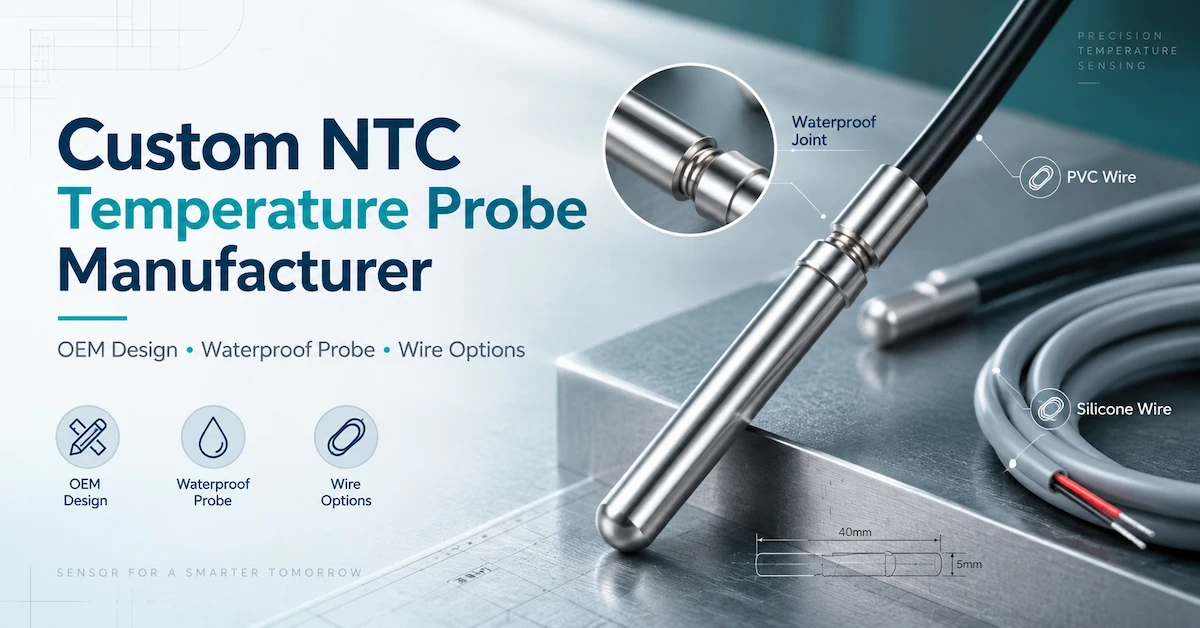
A finished probe includes the sensing element, electrical connections, insulation, housing, cable and termination. Ask your NTC Temperature Sensor Supplier for an assembly drawing and confirmation of which processes it performs or controls. The review should address how the element is positioned, how joints are protected, how the cable exit is supported and how finished dimensions are checked. Do not prescribe a joining or sealing method before the design has been reviewed. Tianrui offers metal-shell NTC sensors and plastic-shell NTC sensors; the useful comparison is between complete assemblies, not an assumption that one housing material is always better.
Approve Samples Against a Written Test Plan
Separate Electrical Matching from Installed Performance
Ask the NTC Temperature Sensor Supplier to agree on how sample resistance will be checked at the reference temperature and additional application-relevant points. Record the equipment, stabilization conditions and acceptance limits. Then test the probe with the intended controller and mounting arrangement. An electrical match does not, by itself, prove that the installed sensor follows the temperature your appliance needs to control. Treat circuit behavior and probe placement as part of the evaluation, not as problems to investigate only after production starts.
Define Environmental and Mechanical Tests for the Project
Choose tests according to the failure risks at the sensing location. A development plan might include moisture exposure, temperature cycling, cable retention, connector fit and response testing, but the conditions and limits should be agreed for the particular assembly. Record resistance before and after relevant exposures, and document any physical change. Distinguish sample qualification from routine production inspection: a development test does not automatically describe what is checked on every shipped piece. These are recommended approval steps, not a claim that every catalog item has already passed the same test program.
Ask for Product-Specific Quality and Certification Evidence
Treat each certificate, declaration or test report as a document to review, not a substitute for the specification. Request the issuing organization, document date, covered product identity and applicable scope. Check whether the evidence concerns the company’s management system, an individual component or the finished sensor assembly. Do not extend a document from one model to a different housing or cable configuration without confirmation. For repeat orders, agree on batch identification, inspection records, nonconformance handling and notification of material or process changes. A useful supplier response connects the evidence to the part number and revision you are purchasing.
Connect OEM Development to Repeat Production
For a custom NTC temperature sensor, use a controlled sequence: application review, drawing and electrical-specification agreement, sample development, customer validation, revision approval and production release. Keep a dated record of what changed between sample versions. Before the first production order, approve the cable, connector, housing, electrical curve and agreed inspection requirements together. Where production risk justifies it, use a pilot batch to check assembly and incoming-inspection arrangements. Tianrui describes OEM/ODM sensor development covering configurable resistance, B value, housing, cable and connector requirements. Feasibility and the exact development scope should be confirmed for the requested combination; customization is not a promise that any specification can be achieved in any package.
Compare Total Cost and Confirm Capacity for Your Assembly
An NTC Temperature Sensor Supplier quotation should distinguish the unit price from sample charges, tooling, special testing and other agreed costs. Compare offers using the same drawing, quantity, packaging and inspection scope. A lower price is not a saving if it excludes a connector or assembly operation that another quotation includes. Ask for separate sample and production schedules, including the approval event from which each lead time starts. Capacity should be discussed for the selected probe construction and testing requirements, not inferred from a supplier’s overall component output. Confirm the first order, expected repeat demand and any components that could limit replenishment. Record the response in the quotation so purchasing can compare commitments rather than impressions.
Discuss Your NTC Sensor Project with Tianrui
Dongguan Tianrui Electronics Co., Ltd. was founded in 2010 and is based in Dongguan, China. Its published offering includes NTC thermistors and assembled temperature sensors, alongside PTC-related thermal products. For buyers evaluating Tianrui as an NTC Temperature Sensor Supplier, the next step is a specification discussion around the actual appliance or HVAC assembly. Send the sensing location, working temperature range, controller requirements, drawing or reference sample, connector details and purchasing forecast. Identify missing information rather than replacing it with an assumed value. Use the contact page to request a sensor review and quotation, including sample requirements and the documents needed before approval.
Frequently Asked Questions
What should I ask an NTC Temperature Sensor Supplier first?
Ask whether the proposed part matches your controller’s electrical curve and installed sensing conditions. Request an assembly drawing and identify which specifications remain open before comparing price. A catalog description is a starting point, not the complete purchasing specification.
Are all 10K NTC temperature sensors interchangeable?
No. A 10K designation alone does not establish the full resistance–temperature curve, tolerance, usable range or mechanical compatibility. Compare the electrical data and finished assembly before approving a replacement or alternate source.
Does ±1% resistance tolerance mean ±1°C accuracy?
No. The two specifications use different quantities. Resistance tolerance describes variation at stated conditions; temperature accuracy must be evaluated over the required temperature range and with the measurement system taken into account.
Is a stainless-steel NTC probe automatically waterproof?
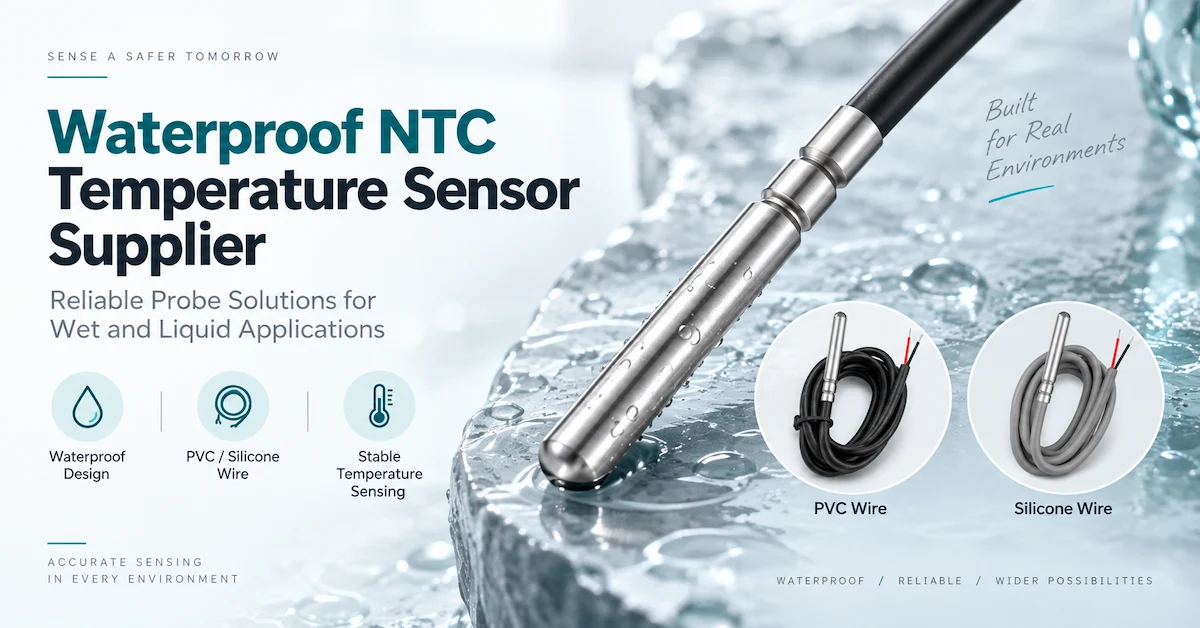
Do not infer an ingress rating from the housing material. Request evidence for the complete probe, including the cable exit and termination, under the exposure conditions relevant to your application. Confirm any rating for the exact configuration.
Can the cable length and connector be customized?
Tianrui lists cable, connector and housing engineering among its customization options. Provide the required connector identity, finished cable length and installation constraints. Availability, feasibility and any effect on samples or delivery need project-specific confirmation.
Should I buy a bare NTC thermistor or a finished sensor assembly?
Buy the form your production process needs. A bare thermistor leaves housing, wiring, mounting and related verification within your assembly scope. A finished probe should be quoted against an approved drawing that defines those items.
Which sample tests should be agreed before an OEM order?
Agree on electrical checks, dimensional verification and installed performance first. Add environmental or mechanical evaluations according to the actual exposure risks. Specify acceptance limits and keep the approved sample identity linked to the production drawing.
What is the minimum order quantity?
Request the MOQ for the exact configuration rather than relying on a general supplier statement. Ask whether different conditions apply to samples, initial production and repeat orders, and have those conditions included in the quotation.
How long do samples and production orders take?
Obtain separate schedules after the specification is reviewed. Clarify whether the stated period begins after drawing approval, sample approval or another agreed event. Treat development, material preparation and regular production as distinct planning steps.
What should an RFQ include when some parameters are unknown?
Provide the application, existing sensor or drawing, controller information, mounting arrangement and expected quantity. Mark unknown values explicitly. This gives the supplier a defined set of questions to resolve instead of leaving assumptions hidden in the quotation.
Conclusion
The right NTC Temperature Sensor Supplier should help turn an application requirement into an approved, repeatable sensor specification. For appliance and HVAC projects, that means checking the electrical curve, installed construction, validation evidence and delivery scope together. Do not approve a production part solely because its room-temperature resistance and appearance look correct. Define what must match, confirm how it will be tested and keep the approved revision attached to future orders. To discuss an existing probe or a new OEM design, send Tianrui your sensor requirements for specification review and quotation.