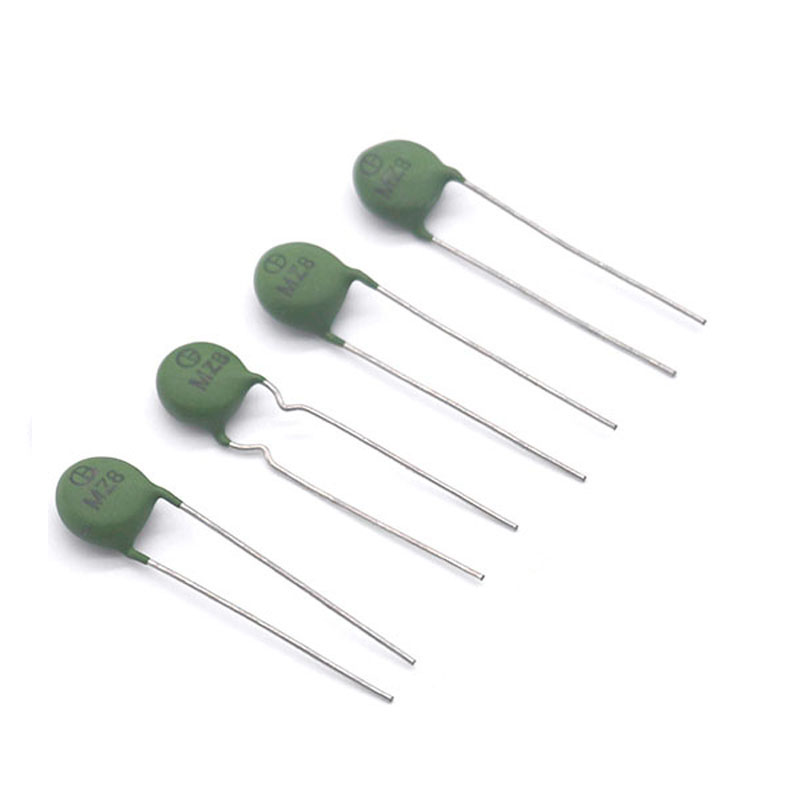
One of the most practical and rewarding applications of a PTC thermistor is creating a resettable overcurrent protection circuit. Whether you're a hobbyist protecting a new project or an engineer adding safety to a design, using a PTC as a "polyfuse" is straightforward and highly effective. This guide will walk you through the design and implementation of a simple circuit to safeguard your electronics.
The Goal: Protect a Load from Overcurrent
Our objective is to protect a valuable load (e.g., a motor, a sensor, or a microcontroller board) from damage if too much current tries to flow through it, either from a fault or a short circuit.
Why a PTC? Unlike a one-time-use fuse, a PTC thermistor will automatically reset after the fault is removed and it cools down, saving you from constant replacements.
Step 1: Selecting the Right PTC Thermistor
Choosing the correct component is 90% of the design work. You'll need to consult a manufacturer's datasheet (from vendors like TDK, Murata, or Bourns) and look for these key parameters:
-
Hold Current (I<sub>hold</sub>): The maximum current the circuit will operate at normally. The PTC must allow this current to flow indefinitely without tripping. Select a PTC with a hold current rating slightly higher than your circuit's normal operating current.
-
Example: If your load draws 500mA normally, choose a PTC with an I<sub>hold</sub> of 550mA or 600mA.
-
-
Trip Current (I<sub>trip</strong>): The minimum current at which the PTC will trip into a high-resistance state. This typically occurs at a specific temperature and is often specified at 20°C or 25°C.
-
Note: The trip current is always significantly higher than the hold current (often 2x).
-
-
Maximum Voltage (V<sub>max</sub>): The maximum voltage the PTC can withstand in its tripped state without arcing or breaking down. Ensure this is higher than your power supply voltage.
-
Maximum Current (I<sub>max</sub>): The absolute maximum fault current the PTC can withstand without being destroyed.
-
Resistance (R<sub>min</sub>/R<sub>max</sub>): The initial resistance at 20°C. A lower resistance means less power loss and voltage drop during normal operation.
Step 2: The Circuit Design
The circuit itself is remarkably simple. The PTC thermistor is placed in series with the load on the positive power rail.
How it works:
-
Normal Operation: Current flows from V<sub>CC</sub>, through the PTC (low resistance), to the load, and back to GND. The voltage drop across the PTC is minimal (V<sub>drop</sub> = I * R<sub>PTC</sub>).
-
Fault Condition (Overcurrent/Short): Excessive current flows, heating the PTC. It quickly reaches its Curie point and "trips," increasing its resistance by a factor of 1000 or more. This high resistance drastically limits the current in the circuit to a tiny, safe trickle (I<sub>leakage</sub>), protecting the load.
-
Reset: Once the fault is removed (e.g., the short circuit is fixed) and power is cycled, the PTC cools down. Its resistance drops back to its low value, and the circuit resumes normal operation automatically.
Step 3: Practical Considerations and Layout
-
Placement: Place the PTC as close as possible to the power input connector. This protects everything downstream.
-
Environment: Remember that the trip time is affected by ambient temperature. A hot environment can cause the PTC to trip at a lower current.
-
Power Dissipation: In its tripped state, the PTC will have a significant voltage drop across it (close to the power supply voltage). This means it will dissipate heat (P = V * I). Ensure your design has adequate space around the PTC to allow for this heating and subsequent cooling.
-
Not for Precision: This is a robust, fault-tolerant protection system, not a precision current-limiting circuit. The load will be without power until the PTC resets.
Example Scenario
Let's protect a 12V DC fan motor that normally draws 0.5A.
-
Selection: We choose a Bourns MF-R600 PTC.
-
Hold Current (I<sub>hold</sub>): 600mA (perfect for our 500mA load)
-
Trip Current (I<sub>trip</sub>): 1.2A
-
Max Voltage: 30V (well above our 12V supply)
-
Max Current: 40A
-
Initial Resistance: ~0.1Ω
-
-
Circuit: We place the PTC in series on the 12V line going to the motor.
-
Operation:
-
Normal: Voltage drop = 0.5A * 0.1Ω = 0.05V. Negligible!
-
Fault: If the motor seizes and draws 2A, the PTC will heat up and trip within seconds, cutting current to ~10mA.
-
Reset: Once the obstruction is cleared and power is cycled, the fan will work again.
-
Conclusion
Incorporating a PTC thermistor for overcurrent protection is a simple, cost-effective, and highly reliable strategy. By carefully selecting a component based on your circuit's normal operating current and voltage, you can add a self-healing layer of safety that prevents costly damage and frustrating downtime. It’s one of the easiest ways to make your electronic designs more robust and professional.