What Is a PTC Heating Element, and How Should an OEM Choose One?
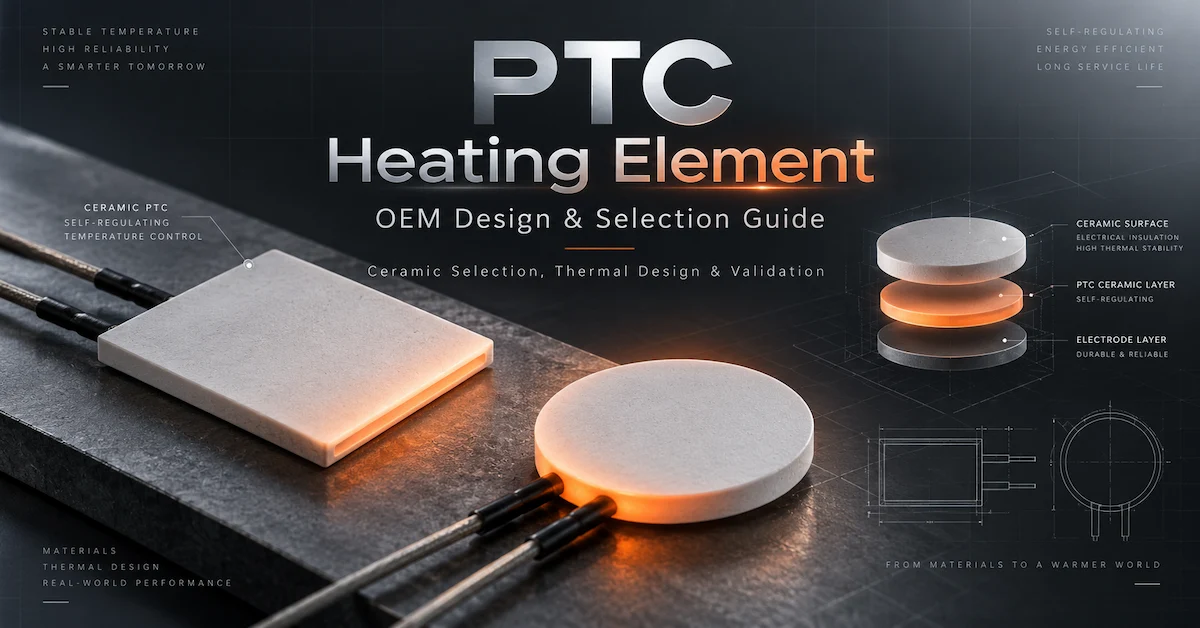
A PTC Heating Element is an electrically powered heat source made from a positive temperature coefficient ceramic. As its temperature approaches a designed transition region, its electrical resistance rises sharply and limits additional electrical heating. The best element for an OEM device is not necessarily the one with the highest nominal temperature or the smallest footprint. It is the one whose resistance-temperature curve, electrical rating, ceramic geometry, contact design, and heat-transfer path meet the equipment's actual requirements.
For engineers designing hair-care appliances, warm-air equipment, industrial cabinets, and heat-pump auxiliary heaters, selection should follow a repeatable sequence: define the heating load, choose an appropriate element architecture, evaluate its cold and hot electrical behavior, engineer the thermal interface, and test the complete assembly under normal and abnormal operating conditions.
Tianrui Electronics offers PTC thermostatic heating elements, including ceramic component configurations intended for integration into larger heating assemblies. This guide focuses on those components rather than repeating a general heater-manufacturer or supplier comparison.
PTC Heating Element vs PTC Heater vs Protection Thermistor
These names are related but describe different levels of a heating system. Distinguishing them early prevents specification errors and misleading purchase inquiries.
| Term | What It Usually Means | What the OEM Must Specify |
|---|---|---|
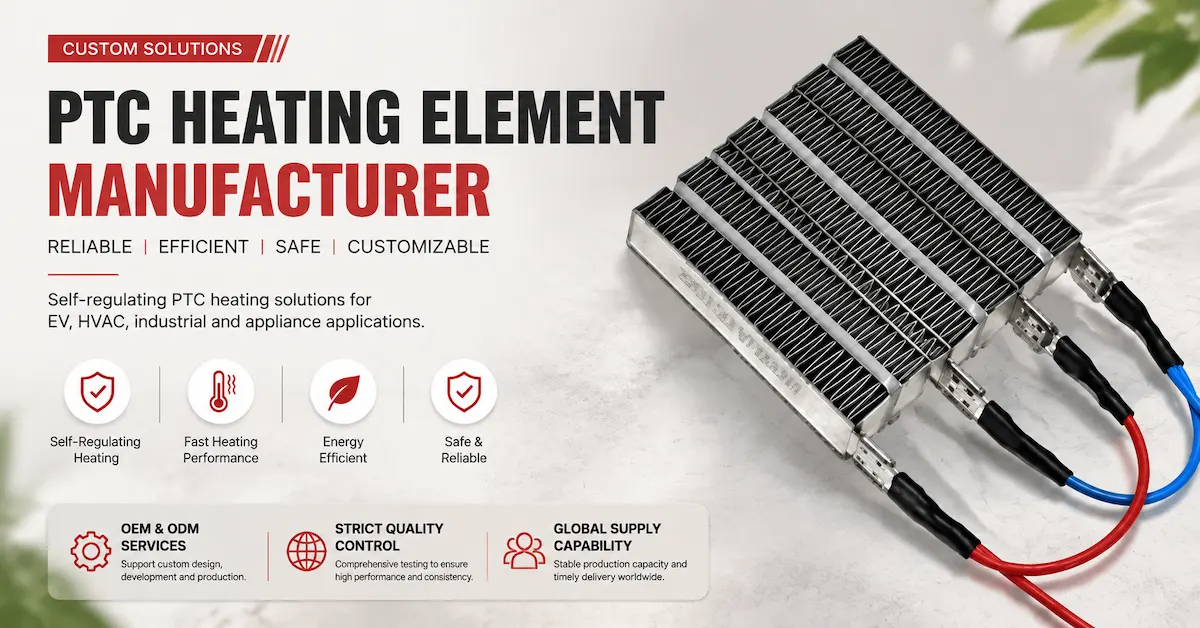
| PTC heating element | The electrically active ceramic component, often a plate, disc, or other formed shape | R-T behavior, ceramic size, voltage, electrodes, thermal interface |
| PTC heater assembly | Ceramic elements plus housing, fins, insulation, terminals, or other integration parts | Complete thermal output, mounting, electrical isolation, dimensions |
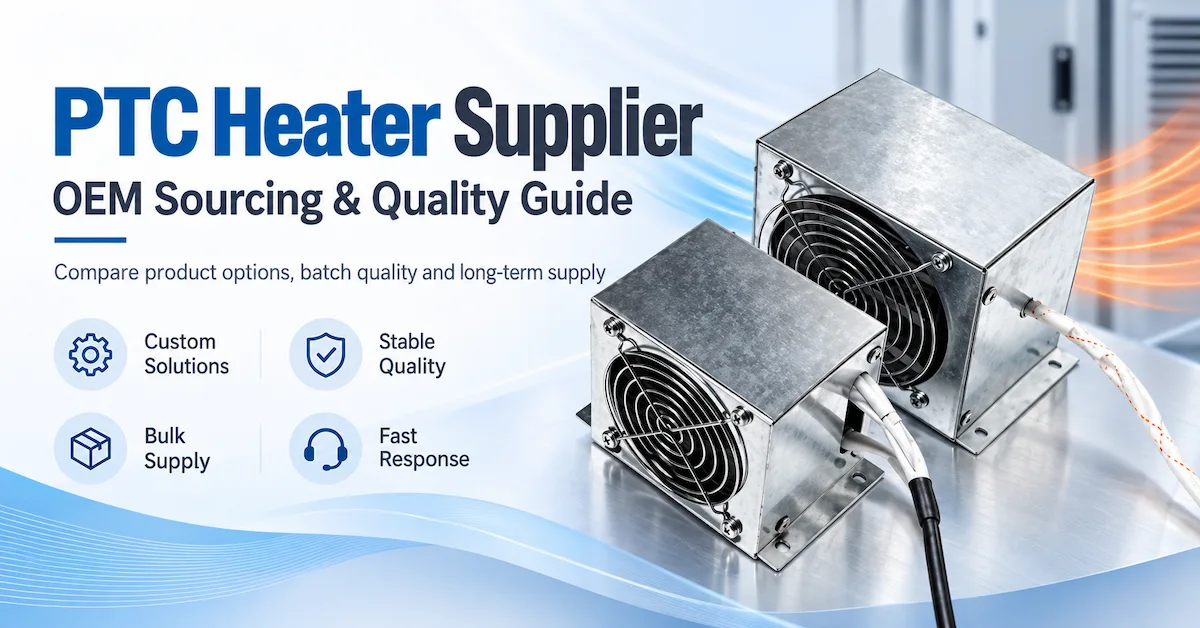
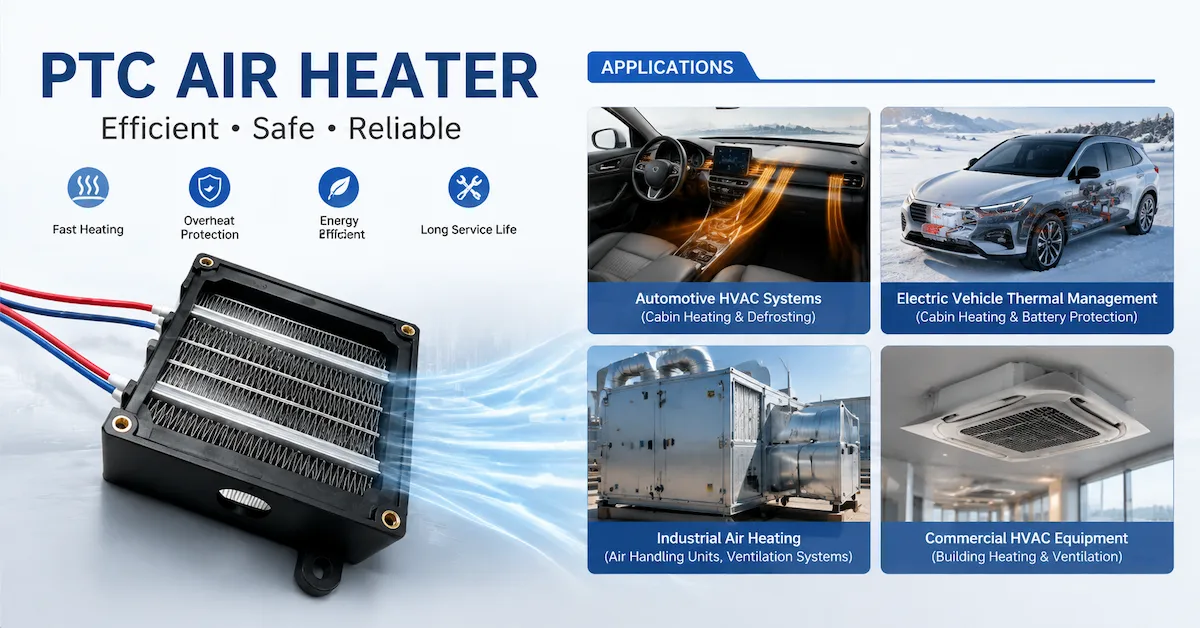
| PTC air heater module | Heater assembly designed to transfer heat into moving air, sometimes with a fan | Flow rate, pressure drop, air temperature rise, fan interaction |
| PTC protection thermistor | A PTC component selected primarily for overcurrent or overtemperature response | Trip/hold behavior, fault voltage and current, protective coordination |
| NTC thermistor | A negative-temperature-coefficient component often used for sensing or inrush limiting | Application-specific resistance characteristics, not ceramic heater output |
A bare ceramic PTC element is not automatically a safe, finished heater. Its electrodes, insulation, enclosure, wiring, and thermal path must be engineered for the intended product. Likewise, a circuit-protection PTC thermistor should not be selected as a heating component just because it also exhibits a positive temperature coefficient.
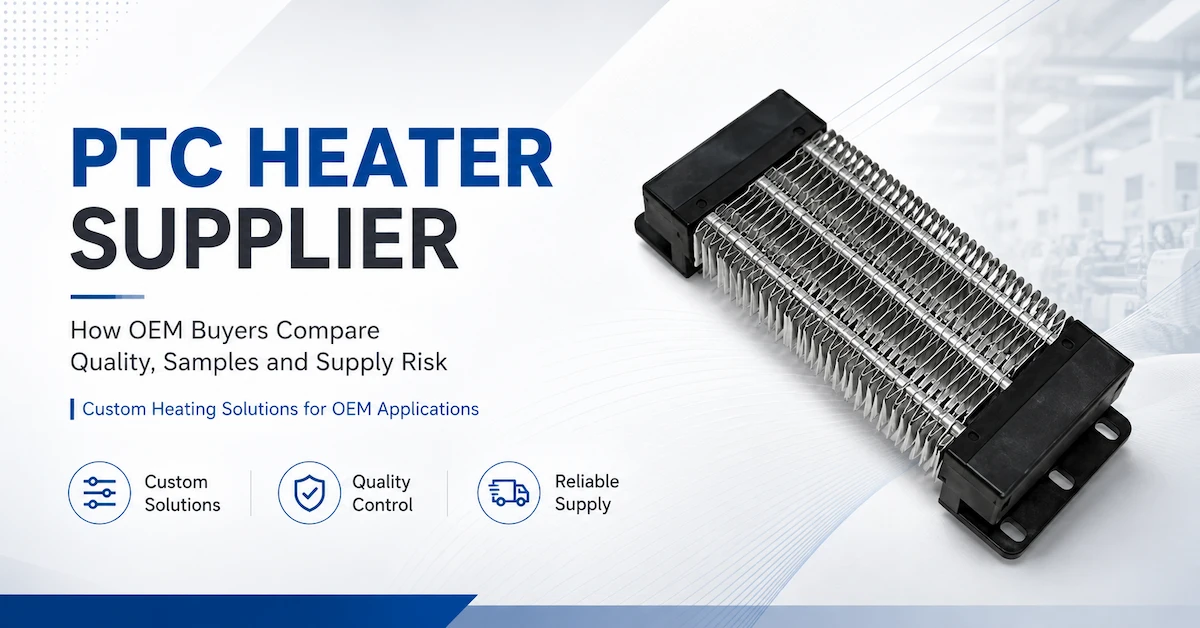
When a design requires a complete air-heating assembly instead of a ceramic component, the broader PTC heater category is a more relevant starting point.
How Does a Ceramic PTC Heating Element Self-Regulate?
Many commercial ceramic PTC heaters use doped barium titanate-based semiconductor ceramics. Their electrical behavior arises from ceramic composition, grain-boundary effects, processing, and electrode construction. The result is a nonlinear resistance-versus-temperature curve rather than a fixed resistance across the entire operating range.
At a relatively low element temperature, resistance may be low enough for substantial electrical heating. As the element warms toward its specified transition region, resistance increases strongly. With a nearly constant supply voltage, current and electrical power then decrease.
The basic electrical relationships are I = V/R and P = V × I = V²/R for a resistive component under the relevant instantaneous or steady electrical conditions. Because resistance is temperature-dependent, these equations cannot be used with one room-temperature resistance value to predict power throughout warm-up.
Curie temperature is not the finished product's target temperature
A quoted Curie or switching temperature describes a material-related transition, not a guarantee of the temperature measured on a metal plate, plastic enclosure, outlet air stream, or water tank. The ceramic temperature, contact-surface temperature, and heated object's temperature can differ substantially.
For a contact-heating application, poor thermal contact may leave the ceramic relatively hot while the object warms slowly. In a forced-air application, increasing airflow may remove heat faster and change the element's operating current. Ambient conditions and installation geometry matter as much as a label value.
Does self-regulation mean the element needs no thermostat or fuse?
No universal conclusion follows. PTC self-regulation can be a valuable design characteristic, but equipment-level safety still requires evaluation of abnormal voltage, blocked airflow, electrical insulation, accessible surface temperature, nearby materials, control faults, and foreseeable misuse. A thermostat, thermal cutoff, fuse, or independent control system may remain necessary according to the product and applicable requirements.
Research from Fraunhofer IKTS on PTC ceramic heating structures highlights the importance of the heat-transfer interface, while an early study in IEEE Transactions on Industry Applications (1972) discusses the thermal-design considerations behind self-regulating appliance heaters. Both reinforce an essential engineering principle: the ceramic's electrical behavior and the final assembly's thermal behavior must be evaluated together.
Which Ceramic PTC Heating Element Shape Should You Select?
Element geometry influences mounting, heat-transfer area, thermal mass, electrode arrangements, and the practical manufacturing solution. It is rarely useful to choose a shape without considering how heat will leave the ceramic.
Rectangular ceramic plates
A rectangular PTC heating plate can be suited to compact assemblies that have a relatively flat thermal interface. Dimensions and thickness can be selected to fit the intended component stack, subject to manufacturing and electrical limitations. Long or narrow geometries may require particular attention to thermal expansion and contact uniformity.
Tianrui lists a rectangular ceramic PTC heating element in its product range. Buyers should ask for the specific mechanical drawing and electrical curve because the shape name alone does not identify a unique rated power or Curie temperature.
Round ceramic discs or stones
Round elements may fit circular pockets, compact cartridge arrangements, or designs with symmetrical contact structures. Selection still depends on electrode placement, mounting force, power density, and the actual heat sink. A disc of the right diameter may be thermally unsuitable if contact pressure is inconsistent.
Custom ceramic forms and element stacks
OEM assemblies sometimes need multiple ceramic pieces arranged within a metal carrier, finned structure, or heater housing. More elements do not necessarily produce a simple multiple of single-element heating power, because they influence each other's temperatures and may share electrical or thermal pathways.
A practical shape selection table is shown below.
| Geometry | Potential Integration Advantage | Main Design Risk | Common Engineering Question |
|---|---|---|---|
| Rectangular plate | Flat contact and compact packaging | Uneven pressure or thermal contact | Is the heated surface flat across the full footprint? |
| Round disc | Fits circular cavities or holders | Contact alignment and edge loading | How are electrodes contacted without stressing the ceramic? |
| Thin rigid ceramic piece | Low profile in space-limited equipment | Fragility and insulation stack thickness | Can the element withstand assembly load and thermal cycling? |
| Multiple-element arrangement | Scalable assembly layout | Current sharing and thermal interaction | How will elements be electrically connected and cooled? |
| Fully integrated heater module | Simplifies installation into final equipment | Less freedom to alter heat transfer | Does the module meet the actual system duty point? |
Important distinction: A thin rigid ceramic element should not be described as bendable. Flexible PTC films and rigid ceramic heaters are different constructions; any bending allowance requires a verified specification for the exact product.
Which Electrical and Thermal Specifications Actually Matter?
A generic request for “24V PTC ceramic heater, 200°C” omits most of the engineering details required to select a suitable component. A well-defined specification should connect measured properties to the finished equipment's performance needs.
| Parameter | Why It Matters | Information to Request |
|---|---|---|
| Rated voltage and waveform | Electrical compatibility | DC or AC, nominal and permitted range |
| Zero-power resistance | Initial material reference under a defined low-self-heating test | Measurement temperature, method, limits |
| Resistance-temperature curve | Predicts response as the element heats | Graph or tabulated R-T points with tolerances |
| Curie/transition characteristic | Indicates the region of strong resistance increase | Definition and acceptance range |
| Cold-start current | Affects supply, wiring, switching, and protection | Measurement at lowest expected ambient and maximum voltage |
| Steady operating power | Influences real heat output | Measured under stated installation and cooling conditions |
| Dimensions and flatness | Determines assembly fit and contact | Drawing, tolerances, thickness, edge condition |
| Electrode system | Affects electrical contact and durability | Contact method, material, recommended assembly method |
| Surface or medium temperature | Defines useful thermal outcome | Sensor position, test condition, allowable range |
| Thermal-cycle behavior | Supports durability evaluation | Agreed cycle profile and change limits |
| Insulation requirements | Controls accessible or grounded part exposure | Construction, withstand test, creepage/clearance where applicable |
Zero-power resistance is not operating resistance
“Zero-power” means a resistance measurement made at sufficiently low excitation that self-heating does not materially affect the result, under a defined reference condition. A published zero-power range should never be substituted directly for a hot resistance measurement.
Cold-start current deserves its own limit
Consider a hypothetical 24V DC system and a ceramic element with an initial resistance of 12Ω at the specified start temperature. The simple initial estimate is 24/12 = 2A, with an apparent initial electrical power of 48W. This is only an illustrative point estimate, not a Tianrui specification. Actual inrush and power evolution depend on the ceramic's temperature, the supply behavior, circuit impedances, and time-dependent heating.
If the equipment starts in a cold warehouse or outdoors, its worst-case initial current may differ from a room-temperature bench test. Your supply, switch, wiring, connector, and overcurrent protection should be selected using measured or reliably specified worst-case conditions.
Thermal response time is a system property
An element may warm quickly on an unloaded bench but heat a large metal object much more slowly. Time-to-temperature must specify the thermal load, contact method, measured location, voltage, and ambient temperature. Avoid purchasing decisions based on a headline “heats in seconds” claim without comparable test conditions.
Tianrui PTC Heating Element Models: How Should Published Data Be Used?
Tianrui publishes a thermostatic PTC ceramic series with individual MZ9 identifiers. These entries are useful for early discussions, but broad model ranges should not be mistaken for an approved design specification.
| Published Model Example | Listed Supply | Listed Zero-Power Resistance | Listed Curie Information | Listed Size |
|---|---|---|---|---|
| MZ9-FJA-1 | 220V AC | 1,000–4,000Ω | 120–260°C range | 24 × 15 × 2.5 mm |
| MZ9-FIA-2 | 220V AC | 1,000–4,000Ω | 120–260°C range | 30 × 15 × 2.5 mm |
| MZ9-FUD-1 | 350V DC | 4,000–8,000Ω | 220°C | 24 × 15 × 3.5 mm |
| MZ9-FID-3 | 110V DC | 100–450Ω | 220°C | 24 × 15 × 2.5 mm |
These values are transcribed from Tianrui's PTC thermostatic heating element listing. They describe published examples, not verified production tolerances, independently tested specifications, or recommendations for direct substitution. The broad 120–260°C entry must be clarified for the actual variant rather than treated as one precise transition temperature.
Before releasing a purchase order, ask for a model-specific datasheet covering the reference temperature for zero-power resistance, R-T behavior, electrical limits, dimensions and tolerances, test conditions, and whether the offered variant matches the published listing. A conflicting voltage entry elsewhere on the same page should also be clarified directly with the manufacturer rather than silently assumed correct.
How Do You Calculate the Heating Load Before Selecting the Ceramic Element?
Electrical ratings are useful only when connected to the energy and heat flow required by the product. A preliminary thermal calculation can establish a sensible starting point before requesting samples.
Worked example: heating a small aluminum plate
Assume an OEM device must heat an illustrative 90g aluminum plate from 25°C to 100°C in 90 seconds. Take an approximate specific heat capacity of aluminum of 900 J/(kg·K). Ignoring losses, the sensible heat is:
Q = m × c × ΔT = 0.09 × 900 × 75 = 6,075J.
The ideal average useful power over 90 seconds is 6,075/90 = 67.5W.
That does not imply that a 67.5W nameplate element will meet the product requirement. In practice, the heater also warms its own carrier, transfers heat across contact layers, and loses energy to surrounding air and structures. The startup current, power decline near the PTC transition, and thermal resistance of the mounting stack all affect warm-up time.
An engineering prototype should therefore assess the full transient temperature curve. If the plate does not reach its target in time, investigate interface losses, heater contact, thermal mass, and power behavior before simply increasing the ceramic's nominal temperature.
Contact heating versus air heating
For contact heating, the dominant questions concern interface conductance, contact area, pressure, thermal mass, and surface temperature uniformity. For forced-air heating, key inputs include air mass flow, required temperature rise, pressure drop, and the heat exchanger.
A bare ceramic plate placed in an airstream is not automatically equivalent to a finned air-heater module. Fraunhofer IKTS specifically discusses the need for improved heat transfer from typical ceramic geometries into the heated medium. In many systems, the metal exchanger and airflow design determine whether useful heat reaches the target.
Liquid heating requires a designed assembly
An exposed ceramic PTC piece should not be assumed safe for direct immersion. Heating water or coolant may require a sealed, electrically isolated heat-transfer assembly, compatible materials, defined pressure and flow limits, and system-level abnormal-condition protection. Use the actual application design and testing evidence rather than generalized claims that every PTC element tolerates dry-boil conditions.
How Should You Design the Thermal Interface and Mounting Structure?
The heat path from ceramic to the target is a major determinant of OEM performance. Even a well-matched resistance-temperature characteristic cannot compensate for poor contact design in a demanding application.
Contact pressure and surface flatness
Ceramics are brittle compared with metals. Excessive point load, uneven clamps, or differential thermal expansion can damage the element or produce inconsistent interfaces. A mounting design should distribute load appropriately and account for thermal cycling.
A metal heat spreader may help distribute heat, but it can also increase thermal mass and warm-up time. The right interface balances response, temperature uniformity, electrical isolation, and assembly durability.
Thermal interface materials
An engineer may consider a dry clamped interface, a suitable insulating pad, a thermally conductive compound, or another qualified assembly method. Each option changes the thermal resistance and reliability picture.
| Interface Choice | Potential Benefit | Qualification Question |
|---|---|---|
| Controlled dry contact | Simple bill of materials | Is contact repeatable across tolerance extremes? |
| Thermally conductive insulating layer | Electrical isolation and heat transfer | Does it survive voltage, temperature, compression, and aging? |
| Qualified thermal compound | Can reduce small air gaps | Can it migrate, dry out, or contaminate contacts? |
| Metal carrier or heat spreader | Distributes heat and aids mounting | Does it add excessive thermal mass or thermal stress? |
Do not solder, braze, bond, or clamp a ceramic element using a generic method without checking the electrode construction and assembly limits specified for that part.
Keep user-accessible surfaces in mind
A ceramic element can be in its self-regulated region while another accessible surface is still hot enough to cause injury. Define temperature measurement points around the finished product and consider insulation, guards, thermal cutoffs, and enclosure material ratings as appropriate.
How Do Electrodes, Materials, and Ceramic Processing Affect Performance?
Barium titanate-based PTC ceramics depend on material formulation and processing. Dopants, microstructure, grain boundaries, sintering, and electrode interfaces influence the resulting electrical behavior. A buyer normally does not need to dictate every ceramic production parameter, but should identify the functional characteristics that must remain consistent.
Tianrui's PTC heating element engineering solution discusses barium-titanate ceramic materials and electrode options including silver, silver-palladium, and nickel. These are examples described in the company's technology materials; they are not confirmation that every listed electrode can be used on every SKU.
For custom designs, useful questions include whether the manufacturer can provide the specified voltage behavior, transition characteristic, geometry, electrode arrangement, and repeated thermal-cycle stability. Ask which properties are routine catalog options and which require a revised ceramic formulation or new tooling.
What changes with electrode selection?
Electrodes provide the electrical interface to the ceramic. Contact resistance, adhesion, operating temperature, thermal expansion, and attachment method can influence reliability. A supplier should specify how the electrodes are contacted within the finished assembly and whether the connection method has been qualified for the duty cycle.
Can every desired specification be customized independently?
No. Voltage, room-temperature resistance, ceramic dimensions, transition behavior, and thermal output are physically linked. Changing thickness or electrode geometry can affect resistance; changing formulation can alter the transition characteristic; changing the mounting assembly affects actual operating temperature. An effective OEM design review makes these interactions explicit before tooling is approved.
PTC Heating Element Applications: Which Designs Benefit Most?
A ceramic PTC heating element can support multiple industries, but practical selection depends on what is being heated and how the component is integrated.
| OEM Application | Main Heating Objective | Key Design Concerns |
|---|---|---|
| Hair straightener or styling tool | Heat a contact plate with controlled warm-up | Insulation, plate temperature uniformity, repeated cycling |
| Compact household appliance | Heat a small object or surface | Installation space, accessible temperatures, wiring |
| Humidity-control cabinet | Provide modest heat to reduce condensation risk | Temperature distribution, enclosure airflow, continuous duty |
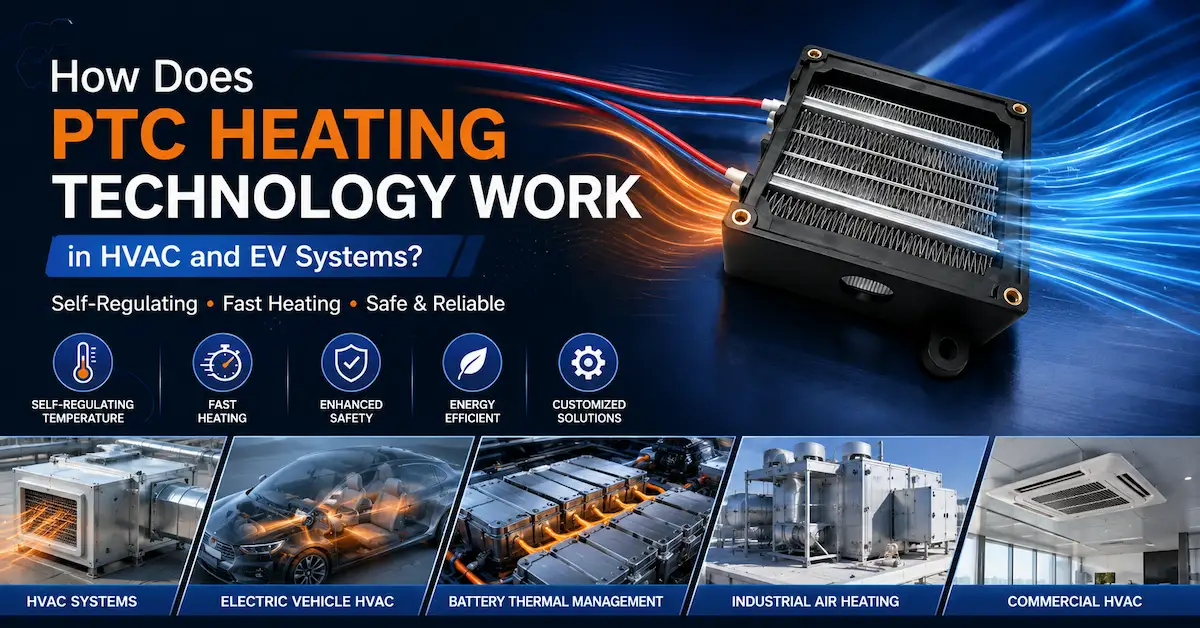
| HVAC auxiliary heater | Add heat to an air or heat-transfer system | Heat exchanger, airflow, temperature limits |
| Heat-pump water heater auxiliary system | Provide supplementary thermal energy | Electrical isolation, sealed assembly, medium compatibility |
| Industrial instrument or fixture | Stabilize a defined thermal region | Control stability, mounting, vibration |
| Vehicle-related thermal module | Meet a defined vehicle heating function | Voltage environment, vibration, qualification and packaging |
Household and hair-care appliances
Small appliances often have tight dimensions and user-accessible housings. Engineers should consider heating time and contact-surface temperature alongside electrical insulation and emergency operating conditions. Tianrui's PTC heater with insulation-film solution is relevant when a project needs a structure combining heating components with electrical insulation; the exact construction requires validation.
HVAC and heat-pump auxiliary heating
Tianrui's thermostatic-element page identifies heat-pump water heaters and central air-conditioning-related heating equipment among its application areas. In these systems, the complete heating assembly matters: medium contact, airflow or fluid flow, heat exchanger design, insulation, and control integration should be established before choosing the ceramic piece.
Industrial equipment and cabinets
A compact self-regulating element may fit a purpose-designed enclosure heater. The goal is often to limit condensation or maintain a component above a specified temperature, not to maximize ceramic temperature. Evaluate low ambient startup, humidity exposure, mounting surface temperature, and safe operation during normal ventilation changes.
Where a bare ceramic element may be the wrong answer
If an OEM needs a finished module with certified electrical interfaces, a fan, a protective enclosure, or high heat transfer into moving air, a simple bare element may create more engineering work than a suitable pre-assembled heater. In this situation, compare total integration cost rather than element price alone.
What Prototype Tests Should an OEM Require Before Approval?
Sample qualification should use measurable acceptance criteria agreed before testing. “It heats up” is not a meaningful approval standard.
| Test | Recorded Condition | Decision Value |
|---|---|---|
| Zero-power resistance | Reference temperature, low measurement excitation | Checks baseline ceramic behavior |
| R-T curve or selected resistance points | Controlled temperature points | Verifies transition behavior |
| Cold-start current | Minimum expected start temperature, maximum voltage | Sizes supply and switching components |
| Warm-up response | Defined thermal load and mounting | Confirms useful heating time |
| Stabilized operation | Defined voltage, ambient, cooling | Measures power and temperature balance |
| High/low supply evaluation | Permitted operating voltage extremes | Checks electrical tolerance |
| Thermal interface test | Specified clamp force and heat spreader | Checks contact sensitivity |
| Thermal cycling | Defined cycle temperatures and duration | Screens for interface and ceramic degradation |
| Insulation/dielectric test | Approved construction and test conditions | Supports electrical safety validation |
| Relevant abnormal operation | Foreseeable airflow, control, or contact failures | Evaluates system-level risk |
A test report should show sample identification, the exact revision, instruments, conditions, measured points, acceptance limits, and observed results. Testing requirements depend on the equipment, so this matrix is a planning tool rather than a claim that all listed tests have been performed by Tianrui on every product.
What does “approved sample” mean?
It should mean the sample and its associated drawing, electrical characteristics, mounting configuration, and test plan are controlled. When volume production begins, acceptance should refer to the same configuration. A photo or a successful one-off demonstration is not sufficient for a demanding OEM program.
Which standards should be considered?
For household and similar appliances, the relevant parts of IEC 60335 may inform equipment-level safety work. The IEC 60068 series provides environmental test methods that may be useful in qualification planning. The actual standards depend on the end product, region, and applicable edition. Mentioning a standard does not establish that a particular Tianrui element or the finished appliance is certified to it.
How Do OEM Buyers Compare PTC Elements and Suppliers Without Guesswork?
An effective commercial comparison begins with engineering equivalence. Two ceramic plates may have similar dimensions but different R-T curves, ceramic materials, electrical contact methods, and behavior under cooling. Treat them as alternatives to be qualified, not automatic replacements.
Technical comparison first
Request the proposed part number, electrical test conditions, dimensional drawing, transition behavior, terminal construction, and known operating limits. If the supplier quotes a ceramic element while another quotes a complete insulated heater assembly, normalize the scope before comparing prices.
Cost drivers and tooling
Costs may depend on ceramic formulation, size, electrode design, production volume, custom fixturing, electrical insulation, testing, and required documentation. A modified standard part may be more economical than developing an entirely new element, but that depends on feasibility and purchasing volume.
MOQ and lead time
Tianrui's website discusses customization and production services, but a public product category does not establish the MOQ or delivery date of a particular custom component. Ask separately for engineering samples, pilot production, and recurring volume orders. Confirm whether any tooling, material procurement, or engineering qualification is needed before the stated lead time begins.
Quality and change control
OEM teams should specify incoming material controls, critical dimensions, electrical test points, accepted deviations, lot traceability, and product change notification. A replacement ceramic formulation or electrode arrangement may require customer approval even if nominal dimensions remain unchanged.
A sensible scorecard may weight application fit (30%), qualification evidence (25%), production controls (20%), commercial terms (15%), and engineering communication (10%). These percentages are an illustrative buyer framework, not an independently verified manufacturer ranking.
How Does Tianrui Support Custom PTC Heating Element Projects?
According to its publicly available company information, Dongguan Tianrui Electronics Co., Ltd. was founded in 2010 and reports a manufacturing area of approximately 5,000 square meters, automated equipment, and specialized testing instruments for its wider PTC component business. These company-level figures should not be interpreted as a guaranteed output or lead time for a specific custom heating element.
The company's heating-element solution describes discussions about customer drawings and product ideas, structural and material selection, engineering design, mold development, inspection, and technical consultation. These capabilities are relevant when an OEM requires a non-standard element shape, electrode arrangement, or heating assembly.
An efficient inquiry can begin with a published ceramic part, move to a drawing review, then proceed to sample evaluation and any agreed production qualification. A more complex project may require several iterations because the ceramic electrical behavior and final assembly's heat transfer are linked.
For company background, see the Tianrui Electronics manufacturing profile. Before approving a custom order, request model-specific specifications, test scope, tooling responsibilities, and a confirmed production plan rather than relying on general corporate claims.
What Should Be Included in a Custom PTC Heating Element RFQ?
An actionable request for quotation allows the manufacturer to identify whether a catalog part fits or whether design work is necessary. The technical result is more useful when the OEM shares the intended heating task rather than guessing a ceramic specification.
Application and thermal load
-
Equipment and industry; medium or object to be heated.
-
Starting temperature, target temperature, and permitted heat-up time.
-
Thermal mass or airflow; relevant ambient temperature range.
-
Required duty cycle and expected operating life conditions.
Electrical requirements
-
AC or DC supply; nominal, minimum, and maximum voltage.
-
Available current and inrush limits; switching method.
-
Required insulation or protective components.
-
Preferred resistance or Curie characteristic, if already established.
Mechanical and integration requirements
-
Available length, width, thickness, and tolerance limits.
-
Flatness, ceramic shape, electrode and contact preferences.
-
Mounting, contact pressure, heat sink or spreader arrangement.
-
Housing, interface material, wires, and connector details if an assembly is needed.
Commercial and qualification requirements
-
Target market and applicable product standards.
-
Drawing revision or reference sample, prototype quantity, and acceptance tests.
-
Pilot order, expected annual volume, target schedule, and packaging.
-
Required technical documents, traceability and change-control expectations.
If voltage, resistance, or Curie temperature is not yet fixed, state the required thermal result and physical constraints. This makes an engineering discussion possible without inventing specifications.
A practical next step is to send drawings or application data through Tianrui's PTC heating element inquiry channel and request an element recommendation, sample proposal, and model-specific data sheet.
Frequently Asked Questions About PTC Heating Elements
1. What is the main advantage of a PTC heating element?
Its ceramic resistance increases sharply within a designed temperature region, which can reduce current and power as the element heats. This self-regulating characteristic is useful in many compact electric-heating designs, provided the final assembly's heat transfer and protection measures are properly engineered.
2. Is Curie temperature the same as heater surface temperature?
No. Curie temperature describes the ceramic's transition behavior, while a measured surface temperature depends on thermal contact, load, airflow, electrical supply, and sensor placement. Verify the temperature of the actual heated part rather than relying on a ceramic transition value alone.
3. Can I use the same PTC heating element on AC and DC supplies?
Do not assume so from voltage magnitude alone. Verify the exact component rating, connection design, switching conditions, supply variations, and application qualification. The manufacturer should confirm which AC or DC configuration a particular SKU supports.
4. Are all ceramic PTC heating sheets flexible?
No. A thin rigid ceramic piece can still fracture under bending. A flexible film heater is a different construction. Only treat a product as bendable if the specific datasheet defines permissible bending and installation conditions.
5. Is a PTC element safe without an external thermal cutoff?
Self-regulation alone is not a universal safety guarantee. Consider accessible temperatures, nearby materials, abnormal airflow, electrical faults, insulation, and applicable equipment standards. Independent protective measures may be needed depending on the design.
6. How do I estimate the required element power?
Begin with the heated object's mass, heat capacity, temperature rise, and required warm-up time, then account for thermal losses, mounting resistance, and the PTC's changing electrical power. Use the estimate for candidate screening, not as a replacement for prototype testing.
7. Can a bare PTC ceramic element heat water directly?
Do not assume an exposed ceramic element is suitable for immersion. Liquid heating generally requires a properly designed insulated, sealed heat-transfer assembly and qualification for the medium, electrical environment, and foreseeable fault conditions.
8. What should I check when replacing an existing element?
Match more than size and nominal voltage. Compare the R-T curve, ceramic transition, cold-start current, electrode layout, mounting, insulation, and actual heating performance. Treat a different manufacturer's part as a substitute requiring validation.
9. Can Tianrui provide custom PTC heating elements?
Tianrui publishes heating-element customization support involving drawings, product design, material and structure selection, mold development, inspection, and technical consultation. Feasibility, MOQ, sample timing, and final specifications require project-specific confirmation.
10. What is the fastest way to obtain an accurate OEM quote?
Provide the application, target thermal result, voltage range, installation drawing, operating environment, and estimated sample and production quantities. A clear RFQ gives the supplier enough information to recommend a viable ceramic component or complete assembly without unnecessary quotation revisions.
Conclusion
The right PTC Heating Element is selected by matching ceramic electrical behavior to the real thermal load and mechanical interface of the finished OEM equipment. Confirm the R-T characteristics, dimensions, electrodes, insulation, operating conditions, and prototype acceptance criteria before approving volume production; self-regulation cannot replace application-specific safety validation.
For a standard ceramic option or a custom PTC component project, explore Tianrui's PTC heating element engineering solutions and submit your drawings and operating requirements for an OEM quotation.